David Kusnet

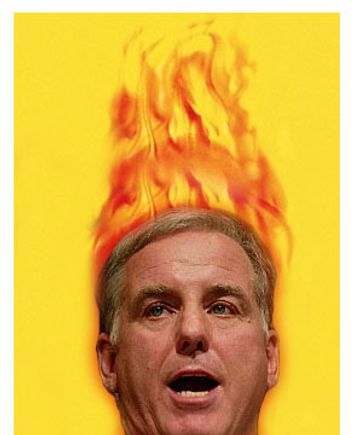
Is Dean too hot?

The Democratic front-runner has ignited a blaze of Bush hatred. But will it burn up the party's chances in 2004?

Buoyed by the endorsements of the two largest unions in the AFL-CIO, Howard Dean seems likely to ride the wave of rank-and-file Democrats’ anger at George W. Bush all the way to the party’s presidential nomination.

Meanwhile Bush’s handlers have devised a strategy designed to defeat Dean or any other hard-hitting opponent: benefit from a backlash against what they claim are extreme attacks against a sitting president.

Like a prizefighter hitching his trunks high above his waistline so that he can claim his opponent keeps hitting him below the belt, Bush’s cornermen are already trying to get the Democrats disqualified as hateful partisans, even before he and his as-yet-unchosen challenger start squaring off.

The message that the Democrats are crazed with anger at Bush is reverberating through the Republican echo chamber. In a recent memo to party leaders, Republican national chairman Ed Gillespie attacked the Democrats as the party of “protests, pessimism and political hate speech.”

Sounding a similar note in a fundraising appeal this month, Vice President Dick Cheney warned Republican donors to expect “fiery rhetoric” from the Democratic presidential contenders, including attacks on Bush’s “character, his veracity, even the president’s leadership of the war on terrorism.”

Last month, in response to a razzing by a heckler, Florida Gov. Jeb Bush called Dean the candidate for “hot, angry people that aren’t rational and are screaming and hollering.” Over the summer, the Weekly Standard did a cover story about Bush hatred, titled “The Democrats Go Off the Cliff,” while conservative columnists from the New York Times’ David Brooks to the Washington Times’ David Limbaugh warned that the Democrats are too nasty when it comes to Bush.

All this suggests that Bush’s backers are reading the same talking points: The president is a man of moderation beset by hateful partisans.

This strategy serves four goals: portraying Bush as the unifying leader that he could have become after the terrorist attacks of Sept. 11, 2001. Diverting attention from his own high-risk policies. Painting his eventual opponent — especially if it’s Dean — as the real extremist and a hothead as well. And blaming Bush’s lack of legislative accomplishments on the Democrats’ refusal to work with a president they despise.

It’s a shrewd strategy, worthy of White House political mastermind Karl Rove. And don’t say Dick Cheney, Jeb Bush and Ed Gillespie haven’t warned you.

But if the Republicans are tipping their hands, are the Democrats playing into their hands? Is Bush counting on driving the Democrats crazy, making them so angry that they’re following his game plan?

Dean won Democrats’ hearts, their dollars and, most likely, their votes, by becoming the first contender to take the gloves off against Bush. He kept saying: “The only way to beat this president is to go right after him.” Impressed by the former Vermont governor’s progress from footnote to favorite, the other contenders have been upping the rhetorical ante with red-hot rhetoric of their own.

The usually mild-mannered Midwesterner Dick Gephardt keeps calling Bush “a miserable failure.” The sweet-talking Southerner John Edwards brands Bush “a phony.” Combat veteran John Kerry calls for “regime change” here in the United States. Nice guy Joe Lieberman maintains a Web site about Bush’s lack of integrity. The Rev. Al Sharpton compares Bush to a “gang leader,” and U.S. Rep. Dennis Kucinich and former Sen. Carol Moseley Braun have offered epithets of their own. Only retired Gen. Wesley Clark has held his rhetorical fire against the commander in chief.

If any of the contenders worries about a backlash from all this Bush bashing, only one has said so publicly. In an interview this week with editors and reporters of the Washington Post, Edwards said: “It’s true that you can get Democratic activists on their feet cheering much more quickly bashing Bush than any other way. But, remember, we’re going through a process here that people are looking for a president. They’re not looking for someone who can just beat up George Bush.”

As long as the nomination remains undecided, all the contenders, including Edwards, will keep trying to “get Democrats on their feet cheering.” Party activists have been applauding attacks on Bush and screaming for more. “Bush gets Democratic base voters very angry — more even than Reagan,” declares Democratic pollster Geoff Garin. That’s because Bush ran as a moderate “compassionate conservative,” won a disputed election, and proceeded to govern as a confrontational conservative, with three consecutive top-bracket tax cuts and a new doctrine of preemptive war. Also, if the Democrats are an uneasy coalition of the underpaid working class and the overpaid meritocracy, Bush seems genetically engineered to offend them all: a president’s son who, by his own admission, stumbled through life until age 40, after which he acquired a baseball team, a governorship, the presidency, and an aura of unearned entitlement.

With nine contenders competing for the favor of any angry party membership in a primary season that’s starting sooner and probably ending earlier than ever before, Bush bashing is smart politics. But is it the ticket to beating a sitting president who is most comfortable casting himself as an ordinary guy beset by overly aggressive adversaries, from Texas Gov. Ann Richards, who called him “Shrub” in 1994, to Vice President Al Gore, who hovered over him during their debates in 2000?

Sensing that the Bush campaign wants to benefit from a backlash against the angriest attacks on him, Democratic strategists are discussing how harshly and how personally to criticize him. It’s a question of style, not substance, but, as defeated Democrats from Walter Mondale and Michael Dukakis to Al Gore and Gray Davis can testify, style matters, too.

Considering what Americans want in their president, many strategists are concluding the Democratic nominee needs to walk a tightrope on bashing Bush: Stress policies, not personalities. Don’t be a passive fall guy, but don’t be a pugnacious bad guy, either. Offer a positive vision for America’s future. And leave the really rough stuff — charges that Bush isn’t up to the job, or that the administration lied the nation into war in Iraq — to others.

While the centrist Democratic Leadership Conference counsels against attacking Bush personally, so do some on the party’s left. “I don’t think Democrats should engage in personal attacks on the president,” explains Bob Borosage, co-director of the liberal Campaign for America’s Future. “His personal failings are not nearly as striking as his policy debacles. People can like him and still know he’s incompetent.”

On the balancing act between being seen as pugs or patsies, Donna Brazile, who managed Gore’s presidential campaign, explains: “We should not back down and not blink. But we should also learn how to disagree with people and still respect them. That is the only way to defeat your enemy.”

Instead of focusing entirely on the thrust and parry of charges and countercharges, several strategists caution that, as pollster Geoff Garin observes, “the first challenge in an election against an incumbent is to make the case for change.” Borosage adds: “The Democrats have to lay out what they’re for. There’s a real danger of just being a critic rather than a leader.”

As for attacking Bush’s competence or integrity, these strategists suggest that the Democrats try what Bush himself has done masterfully since he began his first presidential campaign in 1999: Let others make the harshest attacks. “It’s a very different question whether the ultimate nominee ought to be making the most damning case or whether others in the party ought to,” Garin says.

This strategy of going after Bush’s policies, not his personality, flows from the fact that, unlike partisan Democrats, most Americans still like him. As with former Presidents Dwight Eisenhower, Gerald Ford and Ronald Reagan — and unlike Lyndon Johnson, Richard Nixon and Bill Clinton — more people like Bush personally than approve of the job he’s doing. Even now that the polls show Americans are evenly divided about Bush’s performance as president, his personal approval ratings are almost 10 points higher than his job approval, according to recent surveys by CNN/USA Today and the Wall Street Journal.

His good ol’ boy manner made friends during the 2000 campaign and the first eight months of his presidency, but Bush truly bonded with Americans after the Sept. 11 attacks. “Bush is really well liked by people because he’s been through a real crisis with folks, and they feel a real connection with him,” explains Democratic strategist Will Robinson. “Just like attacking someone’s friend, you have to be careful about attacking him. People are willing to give a friend who’s in trouble a lot of latitude.”

Going after a sitting president with a stiletto, not a sledgehammer, is also in keeping with the lessons of the past century of presidential politics, which Rove, a close student of history, has doubtless pored over. When it comes to defeating presidents for reelection, treating them contemptuously may be emotionally satisfying for their opponents. But it isn’t a winning political strategy.

In fact, as Georgetown University historian Michael Kazin explains, presidents “gather strength from the other side’s hatred” because it intensifies their own support and antagonizes Americans who respect the presidency even if they question an incumbent’s policies.

In modern times, the presidents whose opponents despised them most vocally and viciously — Franklin D. Roosevelt, Richard Nixon and Bill Clinton — were reelected by landslides. They turned their adversaries’ antagonism into an asset by turning the electorate against their most intense opponents — the “economic royalists” who jeered FDR, the student protesters who marched against Nixon, and the “vast right-wing conspiracy” that tried to impeach Clinton.

As for the presidents who were defeated for reelection — Gerald Ford, Jimmy Carter, and George H.W. Bush — they weren’t despised by the voters or demeaned by their opponents. And the challengers who beat sitting presidents — candidates Carter in 1976, Ronald Reagan in 1980, and Clinton in 1992 — avoided attacking the incumbents intensely or personally.

In 1976, Carter beat Ford by killing him with kindness. Promising “a government as good and decent as the American people,” Carter never attacked Ford for pardoning Nixon, his disgraced predecessor. Four years later, in the midst of recession, inflation and the Iranian hostage crisis, Reagan beat Carter without ever attacking him personally. Reagan’s pollster, Ronald Wirthlin, cautioned in a memo: “Care must be taken so that the Governor’s [Reagan's] criticism of Carter does not come off as too shrill or too personal. We can hammer the President [Carter] too hard, which will spawn a backlash … The Governor must never attack Jimmy Carter’s personal integrity.” In 1992, Clinton won the nomination against several rivals who attacked the first President Bush much more harshly than he did, including Iowa Sen. Tom Harkin, who said, in his stump speeches: “George Bush has feet of clay, and I’m going to take a blow-torch to them.”

In his speech announcing his candidacy, Clinton declared: “We’re not going to get positive change just by Bush bashing. We have to do a better job of the old-fashioned work of confronting the real problems of real people and pointing the way to a better future.” In the primaries and in the general election, Clinton did something none of this year’s Democratic contenders are doing: He expressed empathy with the plight of people “working longer and harder for less” and explained how government could help them improve their lives.

“Very little of what Clinton said was attacking Bush,” recalls former White House press secretary Dee Dee Myers, who traveled with Clinton during the 1992 campaign. “The tone was, ‘We all know President Bush is a decent man. But he is just misguided on the economy, healthcare, and what life is like for most Americans.’”

But can the second President Bush be beaten the same way the first one was? Or is the only way to defeat this Bush to demolish the personal credibility that has been at the core of his appeal but could be his greatest vulnerability? The case has been made — implicitly by Dean and explicitly by Gore — that Bush is different from previous presidents, particularly his father, and must, therefore, be challenged differently.

Few Americans believed that Bush I was personally to blame for the recession or other problems during his presidency, much less that he was lying about them. They just thought he didn’t have a clue about how to solve those problems.

But Bush II is very different — or so this analysis argues. While his father seemed clueless about how to solve the nation’s new problems, the younger Bush always has an answer. The trouble is, it’s an answer that he — and his conservative base — favored long before the problem emerged.

Bush has always wanted to cut the taxes of wealthy people, so he justified the tax cuts first because the nation could afford them when the federal budget was in surplus and then because the nation needed it when the economy was in recession. He always wanted to remove Saddam Hussein, so, after Sept. 11, his administration kept suggesting that Iraq had weapons of mass destruction and was working with al-Qaida, however shaky the case for both claims.

Just as his solutions fit any crisis that comes down the pike, so does Bush always seem able to find facts to make his case. Summing up this analysis of why Bush is deceptively dangerous, Gore told the Internet-based liberal activist group MoveOn.org: “The president seems to have been pursuing policies chosen in advance of the facts” and is making “a systematic effort to manipulate the facts in service to a totalistic ideology that is felt to be more important than the mandates of basic honesty.”

If Gore is right, then maybe, just maybe, the best way to challenge Bush is to “go right after him,” as Dean promises to do. Challenge his premises as well as his policies. Make the voters look behind Bush’s friendly smile to see his extreme agenda and his habit of making up the facts as he goes along.

But this battle plan is problematic against any president — especially a personally popular one. It’s one thing to convince the voters that Bush’s policies are a failure — even “a miserable failure,” as Gephardt keeps saying. It’s a little tougher, but still possible, to make the case that Bush’s policies are based on faulty facts. But, as the trial lawyer Edwards could remind his rivals, it’s much more difficult to prove that Bush’s policies are based on deliberately falsified information. And, as today’s Democrats can learn from studying the fates of Ford, Carter, and Bush I, who remained respected but weren’t reelected, they don’t have to destroy Bush II personally in order to defeat him politically.

Dean himself may well understand this. Careful planner that he is, he could well be sketching out his general election campaign already. He previewed his appeal to the entire electorate with his formal announcement speech in his hometown of Burlington, Vt., in June, emphasizing positive themes of empowering Americans to defend their democracy against wealthy special interests and secretive preemptive warriors. He refined this rhetoric in a rare formal, prepared address in Boston last month, suggesting that the survival of American democracy is at stake next year and the grassroots movement supporting him is in the tradition of patriots who have preserved democracy in the past.

So Dean has both the message and the policy agenda to make the case to the undecided electorate that he can solve problems Bush can’t. The challenge for the feisty front-runner is to present those policies with optimism more than anger, and to strike the right note when it comes to the president. As long as he’s fighting for the Democratic nomination, that could be difficult, since the Bush-hating base may prefer Angry Howard to Dignified, Optimistic Howard. But if he wraps up the nomination early, he’ll have time to modulate his appeal.

While bashing Bush is emotionally satisfying for some, beating Bush requires making a more reasoned and positive case. For angry Democrats, next year’s strategy could be summed up this way: “If it feels good, think twice before doing it.”

Can John Kerry turn it around?

His campaign's in disarray, his message is muddled, and the media has narrowed its focus to Wesley Clark vs. Howard Dean. But backers insist the combat veteran is ready for a long battle.

When John Kerry lost his voice at two crucial moments early in the Democratic presidential primary race — during the first Democratic debate in South Carolina in May and again at the AFL-CIO candidates forum in August — it was hard not to see his hoarseness as a metaphor for his troubled campaign. Howard Dean had seized the lead in Iowa and New Hampshire and was making headlines as the grass-roots favorite who could harness the outrage of the party’s base and ride it to the nomination. Kerry was having a hard time projecting his complex message above the pro-Dean din.

Now, a month after his last bout with voicelessness, Kerry supporters are insisting their candidate has found himself and is coming on strong with a new amped-up appeal. A new TV spot declares that the man who fought in Vietnam and then led antiwar protests can bring the same “courage” to providing “affordable healthcare, rolling back tax cuts for the wealthy, really investing in our kids.” With Kerry accused of being programmed and passionless, the spot begins with film footage of arguably his most memorable political moment, as a recently returned veteran asking the Senate Foreign Relations Committee: “How do you ask a man to be the last man to die in Vietnam?”

But Kerry’s new message is in danger of being drowned out by the excitement surrounding retired Gen. Wesley Clark, who announced his candidacy Wednesday, as well as static from his own troubled campaign, whose talented but top-heavy staff is squabbling over whether to bash Dean or take a more statesmanlike approach.

Clark’s candidacy is bad news for all the Democratic contenders, but especially for Kerry, who can no longer say he is the only candidate with the credibility on national security that comes from military service. The interest in Clark, which ranges from New York Rep. Charles Rangel to influential labor leader Gerald McEntee (who had earlier hinted that he supported Kerry) to members of former President Bill Clinton’s inner circle (and perhaps the former president himself), suggests that Democrats want to run a more compelling version of the war hero Kerry for president — or balance a nominee other than Kerry with a vice presidential candidate who has experience defending the nation. Maybe most important, Clark’s dramatic entry into the race increasingly has the media treating the nomination battle as a two-man contest between Clark and Dean, with other candidates, including Kerry, mere also-rans.

Meanwhile, Kerry communications director Chris Lehane resigned Monday, and his departure attracted attention to disarray within Kerry’s campaign. Current and former Kerry associates describe different fault lines — Senate staffers vs. campaign staffers; newer Washington-based staffers and consultants vs. older Boston friends; liberal populists vs. “New Democrat” centrists; and even, sometimes, the candidate and his wife, the outspoken Teresa Heinz Kerry (both Kerrys, for instance, have publicly lamented not running TV ads sooner, in order to head off Dean), against Kerry’s staff.

More staff changes are expected soon, but time is running out on efforts to reorganize the campaign. Kerry has few remaining chances to get his message across and attract the undivided attention of the Democratic activists who dominate early party caucuses and primaries. He didn’t stand out in recent Democratic debates in Baltimore and Albuquerque, N.M., where the news was Connecticut Sen. Joe Lieberman’s attacks on Dean. And he was less well-received than Dean, former House Democratic leader Dick Gephardt, and North Carolina Sen. John Edwards in a joint appearance at a conference of the largest AFL-CIO union, the 1.5 million-member Service Employees International Union.

Kerry got a small bounce after he relaunched his campaign early this month with a formal announcement of his candidacy and a four-state tour, taking the lead in two separate national polls conducted by Time/CNN and Fox News. He continues to attract endorsements from leading Democrats, including California Sen. Diane Feinstein, who announced her support Tuesday.

But the Massachusetts senator still trails the former Vermont governor 38 percent to 26 percent in a Boston Globe poll of New Hampshire Democrats, whose early primary is likely to leave the losing New Englander injured or eliminated from the race for the presidential nomination. And lately Kerry has been attracting new and not always positive attention for his campaign’s recent barrage of e-mail to journalists attacking Dean for his statements about the Israeli-Palestinian conflict, his reversal of his support for free trade agreements, and his unsurprising rejection of an invitation from Kerry to debate one-on-one.

“We’ve noticed for months, but the media is only catching up recently, that Howard Dean has taken different positions about different issues at different times,” said the Kerry campaign’s press secretary, Robert Gibbs. “It’s fair game.”

Kerry’s campaign wasn’t expected to go like this, especially after the terrorist attacks of Sept. 11, 2001, when he seemed to be the strongest candidate the Democrats could field against President Bush. A Vietnam veteran who had earned a Bronze Star and three Silver Stars, a former county prosecutor, and a four-term senator with a liberal voting record and expertise on foreign policy, national defense, and combating terrorism and drug trafficking, Kerry seemed the sort of tough-minded progressive who could rally Democrats in the primaries and reach out to swing voters in the general election.

Moreover, Kerry had the reputation as a skilled infighter who came from behind to win Democratic primaries for lieutenant governor in 1982 and U.S. senator in 1984. He kept his Senate seat against the popular Republican Gov. William Weld in 1996, with the two former prosecutors debating eight times. Many Democratic activists eagerly awaited the devastating counterpunch that the war hero Kerry would deliver against Republicans with no combat experience, including Bush and Vice President Cheney, if they ever dared to question his patriotism.

So why hasn’t Kerry caught fire? He has suffered from his muted, muddled message, confused by a campaign that airs its disagreements in public, and his own patrician reserve. Many observers think his manner has only become more subdued after his recovery from prostate cancer earlier this year, although he insists he feels fine and made a full recovery.

At a time of war and recession, core Democrats’ twin passions are peace and populism. But Kerry is no longer seen as a peace activist, and he never was a populist.

Even before the Iraq war began, Kerry became one of its first political casualties. Together with Lieberman, Gephardt, and another presidential contender, North Carolina Sen. John Edwards (who formally announced his presidential candidacy Tuesday), Kerry voted for the congressional resolution authorizing military action in Iraq.

But Kerry, whom many still remember as a leader of Vietnam Veterans Against the War, paid the highest price among Democratic activists. “If Kerry had opposed the war, he would have had the entire Democratic left behind him,” said Jeff Faux, who recently retired as president of the liberal Economic Policy Institute. “With his war record and moderate style to appeal to the centrists, and a desire by the money people to unite early against Bush, he could have been closing in on the nomination by now.”

Instead, Dean became the only leading contender to oppose the war. He soared, and Kerry sagged. But more than antiwar sentiment was at work. “The essence of the Dean message wasn’t antiwar, it was anti-Bush,” explained Robert Borosage, co-director of the liberal Campaign for America’s Future. “It was that Dean was willing to speak out against Bush, and the others weren’t. The Washington-based candidates, including Kerry, didn’t understand how furious Democrats were with Bush and how much they wanted someone who would express fury at his policies, how he had stolen the election, and what he was doing to the country.”

While Kerry was expected to be a peace candidate, populism has always been alien to him. From a patrician background and now a multimillionaire-by-marriage, Kerry doesn’t bash big business, as Edwards does, or boast of devoting his career to the cause of working families, as Gephardt does.

Former advisors recall that he rejected populist appeals in his reelection campaign in 1996, even though polling showed that it would have been popular to berate profitable corporations for laying off employees. This year, too, his domestic policy positions are complex and nuanced. He calls for repealing Bush’s tax cuts for the wealthy but not those, such as the children’s tax credit and the elimination of the marriage penalty, that benefit the middle class. And he proposed expanding health insurance through a less costly and comprehensive program than those proposed by Gephardt and Dean.

While these positions have popular appeal, especially in the general election, they don’t lend themselves to sound bites and bumper stickers. Kerry’s campaign has had a hard time framing and focusing his message. In interviews with advisors, staffers and supporters, no two offered the same answer to the question: “Tell me Kerry’s message in one or two sentences.”

A leading advisor explains Kerry’s appeal this way: “Bush has taken the country radically in the wrong direction. This is not just a series of policy mistakes but is driven by a vision that is fundamentally wrong — a radical vision that is at odds with America’s principles and 200 years of our history.

“This is a more fundamental and more basic critique of Bush than Dean has offered,” the advisor continued. “Dean focuses on the Iraq war. Kerry’s critique applies across the board to an economic policy that puts wealth in the hands of a few and a foreign policy that abandons alliances we have worked decades to build.”

Meanwhile, Kerry’s chief speechwriter, Andrei Cherny, rattles off a riff on Kerry’s patriotic populism: “We now have a government that hasn’t measured up to the American people’s courage and sense of optimism about the future. John Kerry will bring that sense of courage and forward-looking optimism to the White House.”

The complexity of Kerry’s message, and the lack of agreement among his advisors and staff about what it is, reflect the feuding and factionalism within his campaign.

In the latest headline-making family quarrel, communications director Chris Lehane resigned, amid reports that his draft for a Dean-bashing announcement speech had been rejected by the candidate and his media advisor, Bob Shrum.

In fact, the quotable, combative Lehane, who issued a statement wishing Kerry well, may have been looking for a way out of the campaign, so that he could devote all his time to a lucrative consulting business whose clients include the effort against recalling California Gov. Gray Davis. Based in California, Lehane had worked without pay for Kerry and decided not to move to Washington, D.C, to take a full-time salaried job with the campaign. While Kerry and Shrum were the principle authors of Kerry’s announcement speech, a longtime Boston political observer maintains that several of Lehane’s lines did find their way into the text. Meanwhile, Lehane’s business partner, Mark Fabiani, has been helping Clark launch his candidacy.

With Lehane’s departure, Shrum is clearly calling the shots on Kerry’s message. A former wordsmith for Massachusetts senior Sen. Edward Kennedy, Shrum has orchestrated hard-hitting campaigns for clients ranging from Kennedy and Kerry to former Maryland Gov. Parris Glendening, the late California Sen. Alan Cranston, and the late Pennsylvania Gov. Robert Casey. Shrum helped craft populist appeals for two of Kerry’s current rivals — Edwards in his 1998 campaign for senator and Gephardt in his 1988 run for the presidential nomination — and counseled Al Gore to adopt a similar theme (“the people against the powerful”) in the last lap of his presidential campaign in 2000.

Now Shrum seems to have synthesized a message that melds populism with Kerry’s patriotism and the New Democrats’ emphasis on the middle class. In the weeks ahead, the campaign will criticize Bush for failing to ask the wealthiest Americans to contribute to their country in a time of crisis, while differentiating Kerry from Dean and Gephardt, who want to eliminate recent tax cuts for the middle class as well as wipe out those for the wealthy.

This message began to emerge as Kerry’s announcement address, delivered the day after Labor Day, retooled the stump speech he’d delivered for the past year. Unusually lengthy and substantive for an announcement address — “denser and more intricate than it had to be,” in the judgment of Boston political consultant Dan Payne — Kerry’s speech still had many memorable lines that he could use with great effect in TV spots, candidate debates and campaign appearances.

Attacking Bush’s premature photo-op finale to the Iraq war, Kerry offered this surefire applause line: “Being flown to an aircraft carrier and saying, ‘Mission accomplished,’ doesn’t end a war.” Recalling that he served in and marched against an earlier war, he declared: “Protest is patriotic.” Segueing to “patriotic patriotism,” Kerry criticized Bush for glorifying “a creed of greed” that “comforts the comfortable at the expense of ordinary Americans” and “lets corporations do as they please.”

Why did it take Kerry so long to craft a message, take to the airwaves, and spread the word in cyberspace? Different cliques in the candidate’s circle of friends, advisors and staff offer strikingly similar critiques of the campaign.

For most of the past two years, Kerry’s campaign was “troubled by an inside-the-Beltway view of the world” that was “preoccupied by his biography” and “did not understand the depth” of rank-and-file Democrats’ “resentments of Bush,” declared one political activist who has known Kerry for more than 30 years. “His own instinct was to oppose the war, but they [Kerry's Senate staff] talked him out of it,” this Kerry confidant continued.

Other longtime Kerry associates blame the campaign staff for not being tough enough on Bush and Dean, for failing to tell Kerry to his face to be more plain-spoken and less policy-wonkish, and for shutting them out of strategy sessions.

Significantly, of all the Democratic presidential campaigns, only Kerry’s is publicly mired in internal quarrels, although Gephardt, Edwards and Graham are also running behind earlier expectations. With the exception of Dean’s campaign manager, Joe Trippi, only Kerry’s campaign has what one Massachusetts political operative calls “celebrity consultants,” who may be eager to preserve their reputations, whatever the outcome. And Kerry also suffers from Massachusetts’ distinctive political culture, with its long memories, deep pessimism and biting wit. Just as Boston baseball fans are used to watching the Red Sox lose pennant races, Massachusetts political hands are accustomed to seeing local heroes, from Edward Kennedy to Michael Dukakis and Paul Tsongas, stumble when they reach for the presidency. So, while other candidates have hometown cheering sections, Kerry faces a chorus of kibbitzers, eager to explain to the national press why their state’s latest standard-bearer is no John F. Kennedy.

Before Labor Day, rumors were rife that Kerry would shake up his campaign staff, perhaps replacing or demoting campaign manager Jim Jordan, a former executive director of the Democratic Senate Campaign Committee. Over the past two weeks, Kerry has alternately encouraged and denied these rumors while two opportunities passed by to shake up his staff without risking reports that his campaign was in disarray. His relaunch would have been an appropriate moment to announce new staff, and the commemorations of Sept. 11 might have overshadowed campaign news.

Now, Kerry campaign press secretary Gibbs says that the campaign will not have “unplanned changes,” such as replacing current staffers with new ones, but instead will “continue to add staff and grow, as campaigns do.” Lehane’s departure creates an opening for a new communications director, likely to be congenial to Shrum. And, since the campaign still does not have a chair — usually a part-time position filled by a political veteran — Kerry could place a senior strategist above Jordan. The most-mentioned possibility is John Sasso, who managed Dukakis’ successful campaigns for governor, planned his presidential run, and returned during the final weeks of the 1988 campaign when Dukakis gained ground. Sasso turned down Kerry’s offer to manage his presidential campaign but might accept a call for help similar to Dukakis’ pleas in October 1988. Another prospect is Boston political consultant John Marttila, whose clients have included Delaware Sen. Joseph Biden and former New York City Mayor David Dinkins.

But layering in new staff might further confuse a campaign that already double-teams key roles, with two media firms (Shrum, Devine and Donilon, and Greer, Margolis, and Mitchell) and two pollsters (Boston’s Tom Kiley and Washington’s Mark Mellman).

Still, the pre-mortems on Kerry may be premature. He continues to have enormous potential — as a candidate, and as a president.

Former Kerry speechwriter Bill Woodward remembers the senator as “intellectually curious,” interested in talking through complex positions on issues such as affirmative action and education reform. Former Clinton White House aide Minyon Moore recalls: “When the president invited senators to talk policy in his residence, Kerry always stood out. His depth, his knowledge of policy issues, his thoughtful line of questioning was always thorough and impressive. I said, at that time, This guy can be president.”

But, to become president, Kerry will have to be more persuasive, and that means finding the voice he had years ago.

Long before Clark or Dean were well known, Kerry was seen as an eloquent orator, with a commanding presence. “When he was younger, he was a speaker of style and grace,” recalls University of Massachusetts journalism professor Ralph Whitehead. “He modeled himself after President Kennedy. Since then, the country has changed, the culture has changed, public discussion has become coarser, and Kerry seems frozen in time.”

Recently, while Kerry’s message has been shaping up, he has been loosening up. In a New Hampshire diner, he choked up with tears after a jobless mother told him about the hard times she’s suffered. Several days later, he jammed on the guitar with the rock musician Moby.

But what he needs, most of all, is to communicate outrage and answers not only about an increasingly unpopular involvement in Iraq but also about unemployment, stagnant wages, shrinking health coverage, plundered pension plans, and other crises confronting working Americans.

A Kerry friend since the early 1970s, Marco Trbovich says, almost wistfully: “Kerry has a powerful sense of injustice.” But that moral passion is something Kerry has yet to communicate in this campaign.

As his TV spot recalls, Kerry has spoken powerfully in the past. As a 27-year-old former Navy swift boat commander, recently returned from Vietnam, and without advisors and staff, Kerry eloquently and memorably told a Senate committee: “How do you ask a man to be the last man to die for a mistake?”

If Kerry finds the voice he had as a younger man, the former front-runner could be a contender again.

Continue Reading Close
www.salon.com/writer/david_kusnet/index.html