David Menconi

Can music learn from the slow-food movement?

Great-sounding records can be made on home computers, but one man's convinced a fantastic studio is music's future

  • more
    • All Share Services

Can music learn from the slow-food movement? (Credit: manifoldrecording.com)

This past summer, Zenph Sound Innovations had a problem. Zenph is a North Carolina-based company specializing in computer-generated “re-performances” of classic recordings with astounding results. But Zenph’s latest project — “The Spanish Masters,” featuring renowned cellist Zuill Bailey and soprano Isabel Bayrakdarian accompanying recreations of century-old piano-playing — was coming in over budget.

That’s when Zenph’s management took a cue from the project’s setting, Manifold Recording Studio, which was designed with both old-school live performance and new-school open-source philosophy in mind. Manifold co-owner Michael Tiemann suggested that Zenph go the crowd-funding route to raise the money needed.

“I proposed that we offset the costs by holding a recording salon,” Tiemann says. “So we invited a select group of people to come in and experience the music live in the studio as it was being created.”

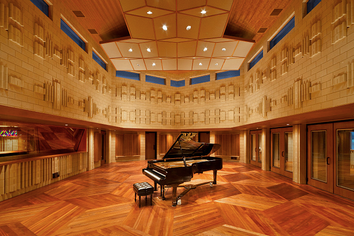
Six people came in to watch, and each paid $250 for the privilege. Presto, budget gap closed. If Tiemann has his way, that will be a regular happening at Manifold, a wildly ambitious high-end studio that opened over the summer in the rural splendor of Chatham County, North Carolina (near Raleigh).

Thanks to his deep pockets from his position at the software company Red Hat, Tiemann had the means to turn his “passionate obsession” of a dream into reality. He spared no expense on Manifold, which is a remarkable facility with lavish attention to detail. Most of the building’s dimensions are based on the Fibonacci sequence and/or the golden ratio, with all the grids of the floors, walls and ceilings lined up to interlock and intersect with perfect symmetry. The wooden floor of the main studio is composed of a diamond pattern, and each diamond has 12 slats in honor of the 12-note scale of Western music.

The studio’s technical gear is all state-of-the art, of course. Manifold is the sort of destination studio where you could imagine U2, Adele or some other chart-topping act setting up shop for a month or three to wax their latest opus. But if anything seems less practical than starting a record company right now, it’s building a high-end recording studio that rents for $2,000 a day. Having built it, Tiemann is convinced they will come — although the “they” he has in mind is less top-of-the-pops and more grassroots.

Even though Manifold is very much a high-tech facility, Tiemann’s vision of it is steeped in the vibes of past glory days from the era before Pro Tools rendered studios obsolete. Speaking of models for Manifold, Tiemann cites the Beatles’ old stomping grounds of Abbey Road, where they pioneered the technique of using the studio as another instrument; Peter Gabriel’s Real World, a studio he says was “built to support creativity”; and most of all the old CBS 30th Street Studio, favored back-in-the-day recording venue of everyone from Miles Davis to Leonard Bernstein.

“When Miles Davis would record at 30th Street, he’d bring three or four dozen people into the studio and they’d do a live recording session,” Tiemann says. “This was a lot like a musical version of the salon model, people gathering in a room small enough to support conversation and large enough to hold a diverse group of people. Glenn Gould, who recorded ‘The Goldberg Variations’ there, said that recording would completely replace live performance within 50 years. That was in 1966 and it has not quite come true, not yet. What we’ve got in mind is to bring together those two experiences, recording and performance.”

To that end, Manifold is set up to do broadcasting or webcasting, just in case anyone is of a mind to make a recording/performance available to a wider real-time audience. Even without that, it’s a very comfortable space for a live audience of several-score fans. And with the right act and setup — an unplugged rock band, say; or James Taylor, who grew up right down the road in Chapel Hill and still has ties to the area — you could imagine Manifold being the perfect setting for the right kind of live-recording project.

“Everybody still wants to make great-sounding records in great studios,” says Souvik Dutta, a producer scheduled for two Manifold projects in 2012 including one with Widespread Panic guitarist Jimmy Herring. “It’s like taking your kid to a baseball game to see his favorite player.”

Still, are there enough projects like that out there to support a studio that cost millions to build? Tiemann is convinced there is, citing parallels with the slow-food movement.

“Just as the slow-food movement encourages eaters to think more holistically about how food is grown, prepared and brought to the table, this co-producer model gives people much more access to the creative process of music,” Tiemann says. “They’re not just financially involved, but also participants in a stronger way than the traditional music industry has really encouraged. There is a new economy waiting to be discovered, new markets waiting to be engaged. We’re very early in addressing this brave new market, and doing so at a time when the record industry’s rhetoric is so wildly against anything new that it makes us look like the crazy ones.”

Trying to sell an idea like Manifold is actually familiar territory for Tiemann, a guru of the open-source-software movement whose career began just as the Internet was coming together in the 1980s. Early in the game, Tiemann was doing a lot of work with open-source software, which is free and set up so that users can easily modify it.

But open-source software seemed like a commercial dead end until Tiemann figured out how to monetize software that you give away: Sell support services, the software equivalent of giving away cell phones and charging monthly user fees. Red Hat, a company specializing in Linux software, acquired Tiemann’s company in the late 1990s, and he moved from Silicon Valley to Red Hat’s home base of North Carolina.

Tiemann started out as Red Hat’s chief technical officer, eventually settling into his current role as the company’s vice president of open-source affairs. That involves a fair amount of punditry and acting the gadfly. Couple that open-source mindset with his lifelong love of music (he first recorded as a 10-year-old member of the Saint Thomas Choir while growing up in New York City), and Tiemann might be just the guy to drag the record and studio industries kicking and screaming into the 21st century.

“People said the idea of giving away software and selling services to new markets would never work,” Tiemann says. “That worked out fine and this can, too. What would it be worth to provide a path to sustainable success in the music industry? I think that’s worth a lot. Strip-mining the low end, selling less and less quality to more and more people — there are limits to that model, and the music industry has done about as much of that as can be done. It’s time to try something new.”

Can an indie label with great taste save the music industry?

Major labels are collapsing. What if the answer's just great taste? Ask Merge, the indie with the best album Grammy

  • more
    • All Share Services

Can an indie label with great taste save the music industry?Spoon's Britt Daniel, Superchunk and Merge co-founder Laura Ballance, Grammy winners the Arcade Fire (Credit: Merge Records)

Editor’s note: The arts face monumental challenges on every front. The double-shot of a recession and the growth of the Internet have helped push Borders into bankruptcy, regional arts groups to the brink, cost tens of thousands of “creative class” jobs and have the media, publishing and entertainment industries searching for a new way forward. In this new series, Art in Crisis, we will explore both what these changes mean for the culture, as well as profile the new innovators building the models of the future.

Onstage, Superchunk is in full cry as the four players churn through “Throwing Things,” a song that dates back to 1991. Guitarist Mac McCaughan is at the center-stage mike with bassist Laura Ballance to his right, and they bounce straight up and down as they crank away on the song’s riff (even though, as McCaughan notes later in the set, the stage is really too slippery for proper punk-rock pogoing). Ballance’s graying hair flies as McCaughan hollers the vocal.

I’m making a promise, and that’s a start…

Afterward, McCaughan gazes out over the crowd in front of the stage, gathered to hear headliners Flaming Lips at the Hopscotch Music Festival in Raleigh, N.C. And he cracks a bit of a smile.

“I, uh, just had a disturbing realization,” McCaughan says. “That song is older than a lot of the people here.”

There is laughter all around, and Superchunk goes right into “My Gap Feels Weird,” a song of much more recent vintage. “Gap” came out on Superchunk’s “Majesty Shredding,” an album that actually cracked the top half of the Billboard 200 when it was released last year. Even given the withered state of the music industry, that’s a pretty solid commercial achievement for a punk record on an independent label — or it would be for most labels.

By now, however, it’s pretty old hat for Merge Records, McCaughan and Ballance’s labor-of-love-turned-powerhouse-franchise. These are grim times in the music industry, which has been steadily dwindling away for the past decade. Against that backdrop, Merge is a shining beacon — and one of the music industry’s last, best models for survival. And all they’ve ever done is stick to their guns — great taste, rigorous curation, the right balance of up-and-comers and veteran acts. Talk to Merge co-founders McCaughan and Ballance about that, and they find it both amusing and bemusing.

“Well, we’re not getting smaller in spite of the rest of the music business shrinking,” Ballance says, over lunch at a bistro around the corner from Merge’s office in downtown Durham. “But for a Superchunk record to make it to No. 85 on Billboard is mostly a reflection of the pathetic nature of the music industry right now. Back in the industry’s heyday, it wouldn’t have even been a blip on the charts.”

Merge got started during that heyday, in 1989, when MTV still played music and major-label albums routinely did multi-platinum business. As the top end of the industry has eroded, Merge’s star has risen with a series of milestones. The label drew its first ink on the Billboard 200 in 2004 (with Arcade Fire’s “Funeral”), cracked the top half a year later (Spoon’s “Gimme Fiction”), hit the top-10 in 2007 (Spoon’s “Ga Ga Ga Ga Ga”) and made it all the way to No. 1 in 2010 (Arcade Fire again).

That set the stage for Merge’s most improbable coup this past February, taking the album-of-the-year Grammy Award. Arcade Fire’s chart-topping album “The Suburbs” turned the trick, besting a field that included Lady Gaga and Eminem. And Merge is in the midst of clearing yet another hurdle, its first-ever gold-record certifications (for all three Arcade Fire albums).

That’s quite a trip from Merge’s humble origins 22 years ago, when the label’s “office” was a corner of Ballance’s bedroom.

“At least it wasn’t overnight,” McCaughan says. “It was slow-growth, which is good and healthy, I think. That makes it easier to get your mind around, since we’ve been in the middle of it the whole time and it’s been a gradual process. Still, yeah, it’s strange to think about how far we’ve gone. In some ways, the first Arcade Fire album selling 100,000 copies was more shocking than the last one doing 600,000. And ‘The Suburbs’ debuting at No. 1 was a surprise, too. We knew it would do well, probably top-5. But making it to No. 1 was pretty crazy.”

                                                                            *   *   *

Early on, Merge was not much more than a name stamped onto cassette tapes and seven-inch vinyl singles by Bricks, Angels of Epistemology, Chunk and other acts in the Raleigh-Durham-Chapel Hill triangle. By the spring of 1990, McCaughan and Ballance had added the “Super” prefix to their band Chunk (to avoid confusion with the similarly named New York band). The first Merge release to bear the Superchunk name was a single, “Slack Motherfucker,” a punk-rock call to arms about the downside of dayjobs.

The alternative-rock revolution was brewing by then and Superchunk signed with Matador Records, the hip New York label that was also home to Liz Phair, Yo La Tengo, Guided By Voices and other key indie-rock acts. But they kept Merge going, too, as an outlet for their own one-off singles and side projects, plus releases by friends’ bands including Polvo, Finger and Erectus Monotone.

Superchunk made three albums for Matador, a run that concluded with 1993’s “On the Mouth.” By then, Nirvana’s “Nevermind” had triggered the industry’s alternative-rock goldrush, and Superchunk had its pick of major labels. But instead of signing with a major, McCaughan and Ballance chose to remain independent and take Superchunk back to Merge. Almost by accident, it turned out to be a fortuitous choice.

“None of us got into bands or this label because we thought it would turn into a career,” McCaughan. “But we just kept doing it, and somehow it did.”

One immediate dividend of going the do-it-yourself route was that Superchunk released far more music than any major label would have been willing to put out: five albums in seven years. Superchunk remained Merge’s flagship act for most of the 1990s, doing enough business to grow the label and allow it to become more ambitious in its signings.

Eventually, Merge outgrew Superchunk and became a stand-alone business, just as the band was starting to wind down and enter a long period of inactivity (“Majesty Shredding” was Superchunk’s first album in nine years). Neutral Milk Hotel, Jeff Mangum’s then Georgia-based psychedelic band, was Merge’s first act to surpass Superchunk commercially, cracking the 100,000-copy mark with 1998’s “In the Aeroplane Over the Sea.” New York art-pop band Magnetic Fields also raised Merge’s profile with “69 Love Songs,” a 1999 three-CD box set.

In the early 2000s, Merge also signed Spoon, a Texas rock band licking its wounds after a hideous experience on the major label Elektra. Spoon thrived on Merge, cracking the top-10 with its last two albums. Merge has since signed a number of other veteran acts coming off major labels, including Richard Buckner, Teenage Fanclub and Imperial Teen.

But new discoveries are still Merge’s calling card. Along with Arcade Fire, key Merge finds include the space-country ensemble Lambchop; hip hometown pop bands The Love Language and Rosebuds; the lushly melodic U.K. band The Clientele, and singer/songwriter M. Ward, better-known nowadays as half of the duo She & Him, opposite singer/actress Zooey Deschanel.

“We’ve never really done much bush-beating,” McCaughan says. “I mean, I’d buy a lot of records and see a lot of bands, then and now. I guess more bands come to us now because we’re bigger. But the way we listen to and think about putting out music has not changed. It’s about what we like, and sensing from the band that we’re on the same page – and that they don’t have misconceptions about what kind of label we are, how much we spend.”

                                                                              *   *   *

Even though Merge routinely puts albums into the top-10, its staff is small and only numbers around 15 full-time employees (a number that is hard to quantify precisely due to the presence of part-timers and interns). This fall’s release-schedule highlights include “A Very She & Him Christmas” and new albums from indie-rock supergroup Wild Flag and Archers of Loaf frontman Eric Bachmann’s Crooked Fingers.

Despite the sales and acclaim of recent years, Merge is operating at pretty much the same pace as always. This year will see 23 full-length releases, about the same number as last year. McCaughan and Ballance seem just as cautious as ever, and still committed to the long haul.

“It would have been very easy for Merge to get big, fat and stupid,” says Eric Garland, founder/CEO of BigChampagne Media Measurement, which Rolling Stone calls the mostly widely accepted charts for online and digital music. “They never did. They’ve always bet on the long run — the art, the artist and the relationship with the fan. They’ve built a terrific brand, and they’ve always been right-sized. In the early 21st century, they’re everybody’s dream. It’s like the three little pigs; build that house of brick because it will provide for you in stormy weather. Merge is a brick house.”

Merge has always made it clear to its bands that they have to be willing to get out and play live, which is something McCaughan and Ballance know about first-hand. Even in this age of downloads, viral videos and social networking, there’s still no substitute for face time with audiences.

“Looking at the records we put out this year, the ones that could’ve done better all had a common denominator,” McCaughan says. “The bands didn’t tour. It’s not a silver bullet, but there’s only so far you can go without playing for people and connecting. So many records come out every week, it’s a crazy deluge. Even when you’re hearing a great song on the radio or online, it’s probably in the middle of a hundred other things. But hearing a great song played live sticks with you.”

At the same time, there are exceptions. East River Pipe, the artistic moniker of Fred Cornog, has never played a live show. But he is a bonafide Merge act, even though he’ll probably never be a huge seller.

“We try not to overspend and always hope we’ll break even,” Ballance says. “There are bands we still release that we just know are not gonna sell much. But that’s not why we put them out. We put them out because we like them and believe in them. Not necessarily that they’ll sell a lot, but we believe in them as artists.”

As for the bands that do sell, the Spoons and Arcade Fires, Merge is grateful to have them. But that doesn’t mean you’ll see much in the way of vanity hardware around the Merge offices. If you think they have an album-of-the-year Grammy Award on display somewhere, think again.

“Nah, we don’t have one,” Ballance says. “We’d have to order that, and pay for it. I don’t even know what we’d do with that.”

She pauses to laugh and ask McCaughan, “Where would we put a Grammy?” He just shrugs.

“It would go in the bathroom, I think,” Ballance concludes. “That’s where things like that always go. Everybody I know who has a gold record keeps it in the bathroom.”

Continue Reading Close