David Moberg
Divorce, labor style
The breakup of the AFL-CIO may turn out to be a good thing, especially for workers.
With the Service Employees and Teamsters unions leaving the AFL-CIO at its convention in Chicago on Monday, taking away nearly a quarter of the federation’s members and dues, the months-long debate over strategy for the labor movement finally turned into a full-fledged fracture. Two other unions are boycotting the 50th anniversary of the labor federation’s founding merger, and there’s a good chance for at least two more defections from the federation in the coming months.
As one of their major constituencies unravels, Democratic politicians are worried — and with good reason. But even if it’s obviously not good news for Democrats, the split might turn out to be a manageable problem, maybe even delivering some benefits in the long run.
The initial anxiety is well founded, however. Unions lopsidedly support Democratic candidates with money, troops for the political ground war and votes. Although only 13 percent of America’s workforce are union members, exit polls showed that 24 percent of voters in the last election came from union households. And polls taken for the AFL-CIO, still the umbrella federation of most unions, showed union members to be far more Democratic than comparable voters with a similar profile — even those members who were white males, gun owners and regular churchgoers.
Although unions split all over the map in the Democratic presidential primary last year, variously supporting Howard Dean, John Kerry, Dick Gephardt and John Edwards, they were remarkably unified in support of Kerry in the general election. Such unity magnifies the labor movement’s influence, and AFL-CIO president John Sweeney mourned its loss. “At a time when our corporate and conservative adversaries have created the most powerful anti-worker political machine in the history of our country, a divided movement hurts the hopes of working families for a better life,” he told convention delegates Monday. About an hour later Teamsters president Jimmy Hoffa and Service Employees International Union president Andy Stern broke away.
The main issues in the fight between Sweeney supporters and the SEIU-led Change to Win Coalition centered on organizational changes that the dissidents argued would increase organizing of new members. But the coalition’s moves were also seen as “nothing but a disguised power grab,” in the words of Steelworkers president Leo Gerard, who supported Sweeney. Both sides insisted that unions need both to organize and to do political work. But the Change to Win unions criticized the Sweeney camp for increasing the AFL-CIO budget to create a year-round political education and mobilization program but not providing the massive dues rebates for organizing that it proposed.
The Change to Win Coalition, now on its way to becoming a rival labor federation, also attacked the AFL-CIO for being too close to the Democratic Party and simply “throwing money at politicians” in hopes of solving labor’s problems, especially its continually declining share of the workforce. “I think workers want an AFL-CIO program that’s not an appendage of any political party,” argued John Wilhelm, the hospitality division president of UNITE HERE, which represents textile, laundry and hotel workers. “We should support Democrats when it makes sense. We should challenge Democrats in the primary.” His colleagues and some of Sweeney’s supporters argue that unions should reach out more to Republicans, despite the rightward and anti-union trend of the Republican Party.
The AFL-CIO’s leaders argue, however, that they’ve always been willing to back moderate Republicans who support some key worker issues, like Pennsylvania Sen. Arlen Specter, who addressed the convention by video. There are just fewer of them these days. And labor’s political operation does not give money to politicians, as many individual unions do with their voluntary contributions, but rather educates, registers and mobilizes union family voters.
Unions in general are also clearly frustrated that many Democrats rely on their backing but then neglect their key economic populist issues. Yet despite their internal conflicts, leaders from both the AFL-CIO and Change to Win insist that any Democrat who votes for the U.S.-Central America Free Trade Agreement should not get labor backing.
So the differences in political strategy and policies may not be as great as the rhetoric suggests. AFL-CIO political director Karen Ackerman argues that “unity in the labor movement is always critical, and anything that serves to undermine that unity hurts the program.” What’s more, there have always been divisions in organization and policy in the labor movement: The biggest union, the National Education Association, is among the unions outside the AFL-CIO. And even within Change to Win there’s a gulf on environmental politics between the SEIU and UNITE HERE, which oppose drilling in the Arctic National Wildlife Refuge, and the Teamsters and Laborers, which support drilling.
One of the biggest challenges to unity concerns the state and local federations of unions that are, in the best cases, important political powerhouses. The most aggressive central labor councils have worked hard to pull together local unions in active coalitions. Stern and Hoffa pledge to continue supporting these groups, which in some cases rely heavily on SEIU dues in particular, but official AFL-CIO policy prohibits such participation by unions not in the AFL-CIO. Lamenting that central labor councils are like the children hurt by a divorce between parents they love equally, John Ryan, leader of the Cleveland Federation of Labor, is not alone in hoping to maintain as many ties as possible, even with defectors, while still following the rules.
Like other Change to Win leaders, Stern says, “We intend to cooperate with the AFL-CIO politically. We hope they will cooperate with us.” And Harold Schaitberger, the Fire Fighters union president who is critically loyal to Sweeney, says, “Politics will remain similar, if not identical … It doesn’t bode disaster if these unions choose to disaffiliate.”
In the end, the split has the potential to make union politics only a bit more fractious than usual, with the Change to Win unions simply outside the well-honed political apparatus of the AFL-CIO.
Is there an upside? Although there’s a chance that Republicans will attempt to leverage the divisions within labor, cutting narrow deals for endorsements while maintaining conservative policies, there’s also a chance that a fractured labor movement will force candidates to work harder for endorsements. “I think it’s good for Democrats and good for Republicans, if they’re promoting worker rights,” UNITE HERE’s Wilhelm said. “But if union membership declines, it’s bad for worker [friendly] candidates.”
The main potential benefit is if the competition between the two rival federations and strategies ends up generating union growth — instead of expensive, destructive fights over who represents whom. And the growth of the labor movement would be one of the best possible developments for Democrats, especially in swing states like Ohio and Florida. As Ackerman told delegates at the convention, “If we had just 100,000 more union members in Ohio last fall, this country, this world, would be a different place.” Ultimately, if there is much greater growth, the current disunity may be worth the very real political risks.
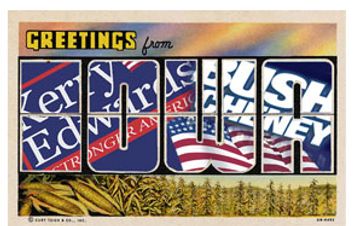
Battleground: Iowa
They sparked Kerry's comeback in the primary season. Will Hawkeye State voters now put him in the White House?
Lloyd Pratt, owner of a fledgling Web design business, feels no affinity to either political party. At age 38, he has never voted before. But this year? “Most definitely, oh yes,” he said, pausing from repair work on his home in a modest neighborhood of this Mississippi River town. “I totally disagree with the way Bush has managed our country.”
Pratt, wearing a black Harley-Davidson T-shirt, ticked off a litany of reasons for his decision to plunge into electoral politics. First, he objects to the war in Iraq, undertaken simply to avenge President Bush’s father, he believes. “Bush lied to the country and killed thousands, and nobody is talking of impeachment?” he said incredulously. “In my opinion, it’s murder. He should have gone after the person who attacked our country.” And by spending money on the war, Pratt said, the government has neglected needs at home, like healthcare. His wife, who runs her own small business, has had cancer, and neither can afford health insurance. Now they also worry about paying rising heating bills as winter approaches. The Bush tax cuts “didn’t do me a lick of good,” Pratt said, and Bush’s “trickle-down” economic policies have meant that “it’s impossible for us to operate our businesses. Nobody wants to spend money on new products.”
Continue Reading CloseOn, Wisconsin!
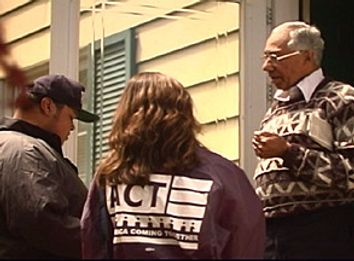
The election ground game in the Badger State is a grinding door-to-door battle for every vote.
In the presidential battleground state of Wisconsin, West Allis is a political free-fire zone where a guerrilla campaign is being waged house to house. In this old, inner-ring suburb of Milwaukee, George W. Bush beat Al Gore in 2000 by just 184 votes out of 29,050 cast — and some precincts were split precisely in half. West Allis is still starkly divided, and no issue is more divisive than the war in Iraq.
The suburb’s residents are largely aging, white, working- and middle-class families, many of whom have bumped through long layoffs and wrenching job changes as global economic forces and unsupportive public policies have roiled the highly skilled manufacturing industries of southeast Wisconsin. While their economic interests and worries may tilt them toward the Democrats, concern about taxes, social conservatism (especially opposition to abortion) and now anxieties about war or terrorism tilt many to the Republicans.
Continue Reading CloseIn Ohio, the war has already begun
Super Tuesday might not bring much drama in the Buckeye state, but labor and other groups are mobilized for a fierce fight to defeat President Bush in November.
One clue to the outcome of the November presidential election could be found last Thursday afternoon on the east side of downtown Cleveland, in the windowless cubicle of a modest blue and gray storefront just across from the Board of Elections building. There were eight union members sitting in front of computers and telephone auto-dialers, talking into their headsets as they urged fellow unionists to vote for John Kerry in Tuesday’s primary election. But the significance of this operation was not so much its boost for Kerry as what it reveals about a much broader campaign — extending beyond the labor movement — to block President George W. Bush from winning a second term no matter who the Democratic candidate might be.
Continue Reading CloseBig wins, hidden dangers
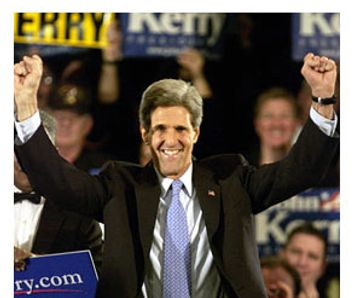
John Kerry dominated Michigan and Washington on Saturday. But will it be possible to please both big industrial unions and environmentalists?
A steady stream of Democrats flowed into the caucus sites in Greenville, Mich., on Saturday, and when the polls had closed, the voters in this economically anxious small town of north central Michigan shared the strong consensus of voters from all parts of the state: Massachusetts Sen. John Kerry would be the best candidate to take on President George W. Bush in the fall.
“There were lots of anti-Bush comments and anger all day,” said the Rev. Vince Lavieri, chairman of the party in Montcalm County, where Greenville is located. “But everybody seemed upbeat. They seemed to be thinking, now we’re getting this process going. We’re beginning to do something.” Defeating Bush was clearly that something.
Continue Reading CloseMichigan: Bad news for Bush
The economy of Greenville, Mich., will be devastated when a big refrigerator factory moves to Mexico. Now residents here are getting ready to express their fear and anger at the polls.
The big election-year question for voters in this charming little town of 8,000 in north central Michigan was posed last year — on Oct. 21, to be exact. That’s when Electrolux announced that it would close the refrigerator factory that had been the mainstay of the local economy since 1877 and move its operations to Mexico. As a result, most of the plant’s 2,700 workers would lose their jobs.
Until then, many local Democrats had been focused on the war in Iraq and the failure to find weapons of mass destruction, explains the Rev. Vince Lavieri, chair of the Montcalm County Democratic Party. But after the announcement, that changed, Lavieri says. “Everyone began thinking: Where am I going to find work?”
Continue Reading ClosePage 1 of 4 in David Moberg