David Skinner

Leaving little to the imagination

When Clarence Thomas gave a fire-breathing speech at the "conservative prom," it made my head spin. And not in a good way.

  • more
    • All Share Services

Leaving little to the imagination

Sometimes called the conservative prom, the American Enterprise Institute’s Francis Boyer lecture and dinner is an annual black-tie event that brings together many classes of right-side Washington: ideologues, intellectuals, bureaucrats, research assistants, foundation heads, journalists — and a fair sprinkling of people who actually pay for the privilege of dining with them. An award is given; the recipient delivers a lecture. Things kick off with free drinks, include a solid meal and feature first-rate live music. It’s a terrific evening, a grand departure from your average suffocating D.C. cocktail party. I probably should be too embarrassed to admit it, but the conservative prom is the reason I own a tuxedo.

And this year was even more special than usual. Our guy is in the White House, and that has a most direct effect on everyone there. To take an obvious example, Lynne Cheney, an AEI fellow, is married to the vice president — you know, Dick (the 1993 Boyer award winner). Both were there, along with a retinue of Secret Service agents. But there were also many young politicos whom I knew from dollar-Bud happy hours, now doing things like setting up departments of the executive branch. Instead of a gathering of dissidents, this year’s dinner and lecture was, suddenly, a party for the in-crowd

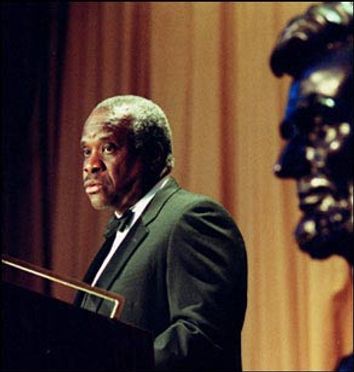
As such, it was the most exuberant expression of Washington right-wingery I have seen. The centerpiece of the evening was a lecture by this year’s Boyer winner, Supreme Court Justice Clarence Thomas — a wild, high-speed pitch aimed at the heart of American political debate. It was truly something to behold. In a roomful of conservatives, Thomas proved more conservative than the vast majority. In a roomful of outspoken people, he seemed the boldest. Watching him, I felt my spine tingle and my head spin. This was not necessarily a good thing.

In his speech, Justice Thomas ran the bases of conservative thought. He described coming to Washington in 1979 and being on the incorrect side of debates over affirmative action, welfare and school busing. “When whites questioned the conventional wisdom on these issues, it was considered bad form,” Thomas said. “When blacks did so, it was treason.” Fighting words followed fighting words. “It takes no education and no great intellect to know that it is best for children to be raised in two-parent families.” We Americans, he said, are embroiled in a culture war.

Even his words of praise carried the distinct echo of a man so firmly on the right side of the ideological scale that it would take an editor for the New York Review of Books (or two) to balance him out. He praised conservative intellectuals with the fervor of a conservative college student discovering them for the first time: “It is awe-inspiring to read the works of Gertrude Himmelfarb, Michael Novak, Michael Ledeen, Judge Bork and others in this audience.” Thomas wasn’t just playing the room. In September 1975, when the Wall Street Journal published a review of a book by Thomas Sowell (1990 Boyer recipient) by AEI scholar and Catholic intellectual Novak (1999 Boyer recipient), Thomas said, “The opening paragraph changed my life.”

The beleaguered justice alluded to his own ugly confirmation hearings as a way of talking about the price one pays for showing political courage. He even seemed to take a shot at President Bush and his notion of “compassionate conservatism.” He denigrated the importance of civility in politics, making use of Himmelfarb’s distinction between caring and vigorous virtues. Compassion is among the former, he said, and serves only to “make daily life pleasant.” Courage, however, is among the latter. Vigorous virtues, Thomas quoted Himmelfarb, “characterize great leaders, although not necessarily good friends.”

Surely it was a kind of courage that gave Thomas the strength to praise Pope John Paul II, repeating the pope’s advice to people with strongly held convictions: “Be not afraid.” But it could only have been a kind of mania for revealing one’s thoughts that led Thomas to use the pope’s words to describe our “culture of death.” This phrase, of course, is papal shorthand for capital punishment, abortion and euthanasia — the opposite of John Paul II’s “gospel of life.” Summarizing, Thomas said, “Listen to the truths that lie within your heart, and be not afraid to follow them wherever they may lead you.”

But if you ask me, many of the truths, especially the really conservative ones, that lie within Justice Thomas’ heart should stay there. It seems the opposite of wisdom for a sitting Supreme Court justice to trumpet his privately held views on controversial questions of domestic policy. It may be courageous for a man so openly scorned by so many Americans to invite yet more scorn. I do admire that. There is a kind of balls-out, happy-warrior outrageousness to it that makes me want to stand up and shout “Bravo!” And were Thomas simply an officeholder whose enemies were free to take their revenge at the polls, I’d be calling him the bravest man in American politics.

But Thomas is a member of the Supreme Court, and that institution is likely to share in what scorn he inspires. His views on the culture of death are easy fodder for critics should Roe vs. Wade be revisited (or, for that matter, cases involving the death penalty or euthanasia). His public musings on preferential treatment in college admissions could be used by his enemies to denigrate the high court’s decisions on affirmative action.

Watching him speak the other night, I found it easy to see the qualities that have made him a conservative hero, only I now find myself wishing he didn’t show them to the whole world. I had always rejected the liberal smear that called him stupid for not taking part, with the other justices, in the interrogation of lawyers who bring cases before the court. But now, here he was, the famously silent jurist, opening his mouth to articulate an indiscriminate passion for the conservative movement. He denounced political orthodoxy, but he personified conformity to the fire and brimstone branch of conservatism. My impression wasn’t of a great mind speaking to a room of movement types; here was a movement type speaking to his own.

Before the evening closed, I made the rounds, saying hello to friends, congratulating many on their well-deserved fortunes. Being at a party like this is a bit like walking through a group portrait of the vast right-wing conspiracy. I get a real jolt of pleasure from that, hanging around some of the major characters and great bit players of history. I mean, how’s this for a great Washington moment? I saw Kenneth Starr with his arm around Clarence Thomas, the two of them yukking it up like a pair of old college buddies. Actually, one can hardly imagine a better picture of moral courage — or a better pinup for liberal outrage.

Matters of the heart

George W. Bush gets the Oprah gig right, all the way down to the tears.

  • more
    • All Share Services

Oprah Winfrey fans like stories from the heart — which is fortunate, since both presidential candidates have many. In fact, back when George W. Bush’s life story of sin and redemption was new to voters, he was destroying Al Gore in the polls. And lately, as Gore’s pre-White House biography, especially his marital romance, has received a lot of attention he has pulled ahead of Bush. Oprah fans are also, by and large, female and middle-class, representing a hotly contested group of voters, which may explain why both presidential candidates have now appeared on the Oprah Winfrey show. Today was Bush’s turn.

He was once a drinker, voters were reminded, but now he was sober. He was lost, but now he was found, having accepted Jesus Christ as his savior. Prodding him to describe a time when he may have needed forgiveness, Oprah said, “I am looking for specifics.”

“I know you are,” Bush responded, “but I’m running for president.” He dutifully answered that his favorite sandwich was peanut butter and jelly on white bread. His favorite dream was of himself being sworn in as president of the United States. And he showed a resistance to being interrupted similar to Oprah’s.

Words failed him now and then. He repeatedly used the phrase “A leader is” to little rhetorical effect. Another word score shows him abusing “fabulous.” Asked if he is smarter than most people, he said yes and then circled back to make it clear he didn’t want to sound condescending, so no, he didn’t think he was smarter than other people. Explaining that he was not running in order to return the Bush tradition to the White House, he went too far in reverse: “There are better ways to uphold the honor of my family and that is to be a decent loving citizen.” (Yeah, but being president can’t be that bad either.)

Luckily Bush has the bearing of someone who’s “the comedian in the family.” Asked to tell a joke, he told a cute one your average pastor would consider appropriate. He also gets a lot of what might be called anticipatory chuckles — laughs in response to the vague sense that something funny is going on. His first response when Oprah asked about a time when he needed forgiveness was “Right now.” This ambiguous line was received with much laughter, only to be followed by a second round of the nervous and confused kind. Bush also has an air of goodwill that makes the people around him jolly. This allowed him to talk politics constantly without seeming to. Did he worry about what other people think of him, Oprah asked. “I care what 51 percent of the people think of me,” he answered, in perhaps his best quip. Was he the black sheep of his family? Maybe, maybe not, but “not now that I’m running for president.” Whereas Al Gore described himself as a family man who also did politics, Bush never strayed very far from the message that he wants to be president.

Still, Bush found time to mention his wife and children. His daughters are “sensitive girls” he’d like to protect from “the meat grinder of public opinion.” Were there things he knew for sure? Oprah asked. “That I love my wife” was second only to “That there is a God.” Like many, many memorable guests before him, Bush cried on the Oprah Winfrey show. Talking about when his wife Laura became toxemic while carrying their twins, his eyes became wet and continued to glisten even after the following commercial break. And so, if Al Gore went on Oprah last week to prove he was a real person, George W. Bush proved he was a real Oprah guest, which is even better.

Continue Reading Close

Gore’s soft sell on “Oprah”

Shunning the politician mantle, he pitches himself as a successful, sensitive, middle-aged professional who really, really loves his wife.

  • more
    • All Share Services

The Gore campaign team has been saying for a while now that it would emphasize its candidate’s credentials as a real person. Monday, the campaign had the vice president take the next logical step: Al Gore went on “The Oprah Winfrey Show.”

Gore talked, endlessly it seemed, about Tipper Gore. Oprah asked how he had reacted to the news of Tipper’s depression. He did what he had to, he said, which was to “feel the love and start the healing.” He touted his wife’s work in protecting American kids from those “albums that are inappropriate,” something the Gores played down in 1992. He once gave Tipper a bracelet, he told everyone, inscribed, “To the bravest person I know.”

He said he couldn’t explain what she had to be so brave about. Of course, it didn’t matter, since the point was not about Tipper, his “soul mate,” but about Gore: a man who loves his wife silly, irrationally, so much he can’t even say.

Such is the kind of dumbstruck male preferred by Oprah’s audience. “Men mature more slowly than women,” Gore said when asked to say something about being a man.

“Yes, they do,” Oprah replied.

“What’s the most important problem facing America?” an audience member asked.

Though the subject came up later during the show, Gore’s first answer did not mention the people “who have to choose between food and medicine” — one of the few political comments made during the hour. Instead, his answer was: “We need more meaning in our national life.” In general, Gore behaved as if talking about his job was a bit gauche. Holding office, he made clear, is what he does when he is done taking care of “all the family and personal time.” Asked about his faith, Gore went for a full Oprah pander. “Somebody told me,” the vice president of the United States said, “we are not human beings who occasionally have a spiritual experience; we are spiritual beings having a human experience.” Oprah didn’t fall for it — which is strange, since a day doesn’t go by when she isn’t hawking the same flaky brand of New Age slogans.

Presidential candidates are on television all the time, but only on occasions like this do they appear with television stars. Unfortunately, they pale next to the real, real thing. On Arsenio Hall’s show in 1992, Bill Clinton seemed to have barely enough air in his lungs to fill his saxophone. Similarly, Gore looked very, very pasty Monday. Still, as Oprah guests go, he did a pretty good job, holding up his part of the conversation, letting her talk about what he thought.

For example, Oprah, who is single and childless, gave a brief editorial on the importance of training expectant parents. Did the vice president agree? “I think parenting education is an idea whose time has come,” said the willing guest. The studio audience seemed to like that.

The exposure a candidate gains from such appearances can be quite valuable. Oprah has tens of millions of very devoted, very involved fans. This isn’t the professional-minded, three-newspapers-a-day Washington crowd. Oprah’s largely female audience is made up of enthusiasts who send her approximately 25,000 letters a week and enough money to fund the weekly $50,000 donations her show makes to do-gooders. They make millionaires of the novelists and self-help authors whose work she promotes. Furthermore, female voters have been key to the gains Gore has recently made against George W. Bush in polls. If Oprah can make Gary Zukav a bestselling author, why couldn’t she put a presidential candidate over the top? Soon after the Gore appearance was announced, a Bush appearance a week from now was also announced. And Oprah’s invitations rarely go unaccepted.

Who knows what to call it when candidates avoid politics, as Gore did on “Oprah,” and talk only about their personal lives? It’s not technically politics. It’s more like the personals: Gore was a successful middle-aged professional, the sensitive type, looking for someone to understand him — and for women to support him in droves.

Continue Reading Close