David Wroe

What the latest antimatter breakthrough means

CERN scientists isolated a few of these particles for about 1000 seconds. Here's why that matters

  • more
    • All Share Services

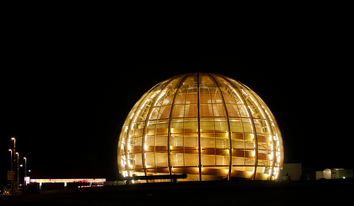
What the latest antimatter breakthrough meansThe globe of the European Organization for Nuclear Research, CERN, is illuminated outside Geneva, Switzerland, early morning Tuesday, March 30, 2010.

GENEVA, Switzerland — In the antimatter department at CERN, the world’s biggest science facility, a picture hangs on the wall showing the filmmaker Ron Howard surrounded by beaming scientists.

Howard’s adaptation of the Dan Brown novel Angels & Demons centers around a secret society that steals a small quantity of antimatter from CERN and hides it in the Vatican.

The book and the film’s scientific accuracy was limited to the convenient plot point that, when brought together, antimatter and matter annihilate one another in a terrific burst of energy, just enough, in this case, to wipe out Vatican City.

Now to reality: scientists at CERN announced recently that they had managed to create, isolate and hold a small quantity of antimatter for over 16 minutes — the longest by far that had been achieved.

So far so frightening? Not exactly. The Vatican can rest easy, explains Joel Fajans, a physicist from the ALPHA project, which made the breakthrough. There are fundamental reasons why an antimatter bomb will never be made.

The purpose of creating and holding antimatter, rather, is to study this strange twin of matter in the hope of solving one of the great riddles surrounding the creation of the universe — and thereby explain why we are here at all.

Basic laws of physics postulate that matter and antimatter should have been created in equal quantities in the Big Bang and gone on to cancelled each other out, leaving behind only energy. That means no stars, no planets, no people.

Instead, for reasons physicists can only guess at, matter gained a slight advantage over antimatter in the fiery moments after the Big Bang. A fraction of a percent of matter survived the mutual destruction and went on to form the galaxies, stars and planets.

But why should nature be so arbitrary as to choose one over the other? Why are we here at all? And, given that we are, why are we not made of antimatter instead?

“People are confounded by this. The question of what happened to antimatter is one of the grand challenges of physics,” Fajans told a GlobalPost reporter on a visit to CERN, located just outside Geneva near Switzerland’s border with France. “It is astounding, and it’s also embarrassing, that no one knows why this is the case.

“Matter and antimatter annihilate one another … We shouldn’t be here. But we are here. There is clearly an excess of matter … which means something is likely wrong with the theory of the Big Bang.”

The laws of physics say that matter and antimatter are exactly the same, only with reversed charges. Matter, which makes up everything around us, contains positively charged protons and negatively charged electrons. Antimatter contains the opposite, negatively charged protons (called anti-protons) and positive electrons (called positrons.)

Other than that, they should be the same, at least theoretically. If the ALPHA team’s investigations prove that they are actually different, antimatter will be in violation of one of physics’ most cherished laws, the charge, parity and time, or CPT, theorem.

CPT basically says that processes in physics should turn out the same even when you flip the charges, turn everything inside out and run it backwards. Put another way, CPT gives the universe a nice, harmonious symmetry. If antimatter contradicts it, other theories may unravel.

“As soon as you open a little crack, your imagination and ability to discover can run wild. Any difference will open up possibilities.

“It would show that there is some bigger, as yet unknown, set of laws. It would truly be the proverbial Big Deal.”

Fajans, an animated 53-year-old MIT graduate and tenured professor at the University of California, Berkeley, spends about half of his time at CERN, the European Organization for Nuclear Research. His workplace is a massive warehouse in the middle of which sits a bewildering array of machinery. It is here that Fajans and the ALPHA team managed to trap 309 anti-hydrogen atoms for up to 1,000 seconds, or just over 16 minutes, an achievement they announced in June’s edition of Nature Physics.

People have been creating antimatter for decades. Indeed it occurs naturally, albeit rarely. If you eat a banana, for instance, some of the potassium will emit positrons as it decays in your body. Sodium also emits positrons and, by combining these with antiprotons created in a CERN particle accelerator (and then slowed down in a proton decelerator), they can make anti-hydrogen atoms.

Last year, the ALPHA team became the first scientists to trap anti-hydrogen, though only for a split second. Even this was a remarkable feat given antimatter is instantly annihilated when it touches anything, even air.

“Basically we had to make a bottle with no sides,” Fajans explained, referring to the web of magnetic and electric beams that held the atoms in suspension in a perfect vacuum.

By trapping anti-hydrogen for 16 minutes, the scientists are getting closer to being able to hold it in a state of calm and actually study it closely.

One method is to look at the effects of gravity. There is a theory, albeit an unlikely one, that antimatter will “fall upwards.” But first the ALPHA collaboration will look at the spectral qualities of antimatter — that is, does it glow the same color as ordinary matter when blasted by microwaves or light? This might reveal differences in the basic structure of antimatter.

Sadly none of this will provide an unlimited energy source of the kind that drives the Enterprise in Star Trek nor, happily, the kind that makes the bomb in Angels & Demons. The energy economics are unfeasible, Fajans explains. It takes far more energy to create antimatter than we can ever get out of it — a fact of physics that won’t change.

On the bright side, positrons are already used in medical diagnostics, in positron emission tomography, known as PET scans. Antimatter might also prove useful in the treatment of cancer by annihilating tumors without damaging surrounding tissue.

But most of the work is being done in the name of pure discovery. Fajans expects it will take another five to ten years before scientists have solid answers about antimatter, though he and his team plan to start experimenting on it this year.

As it happens, he is cautious about the prospects of finding anything unusual. The current laws of physics are built on a very solid foundation and revolutions don’t come that often.

But physics is by nature iconoclastic. Take the neighbouring Large Hadron Collider, the world’s biggest and most famous scientific experiment, which is hunting for the Higgs Boson, the so-called God Particle (a term physicists, not surprisingly, loathe.) Physicists need the Higgs Boson to exist in order to confirm their overarching theories. But it would be more interesting if it turned out not to exist, Fajans said.

“The fun starts when theories are broken,” he said, somewhat mischievously. “The LHC is on a campaign to find the Higgs Boson. They’ll probably find it, but it would be much more interesting if they didn’t.”

The Norway shooter’s creepy Internet world

A look at the violent online games and virulently anti-Muslim websites that influenced Anders Breivik

  • more
    • All Share Services

The Norway shooter's creepy Internet worldAnders Behring Breivik

BERLIN, Germany — Norwegian police said Tuesday they believe Anders Behring Breivik acted alone when he killed 76 people last week. That has turned attention to his influences, specifically violent online video games and anti-Islam websites that encourage the notion of a clash of civilizations. And the killer’s online fantasy world is a scary place indeed.

“It”s clear from his manifesto that he was slowly withdrawing from wider civil society,” said Matthew Goodwin, an expert on right-wing extremism at Britain”s University of Nottingham. “Online, he was certainly active in terms of far-right blogs such as Brussels Journal and Gates of Vienna. He had a extensive Facebook network and had built up substantial online links.”

The network Breivik claims to belong to is a modern day Knights Templar, the order of Christian crusaders who in modern times are popular with conspiracy theorists and feature in the novels of Dan Brown, the author of “The Da Vinci Code.” He claims to have met in secret with a like-minded group to reconstitute a modern Knights Templar.

Whether Breivik is insane, as his lawyer has suggested, is being debated. Despite his claims of belonging to a network, experts say his profile is that of a loner increasingly living life in the virtual world.

“We don’t know whether this network even exists, nor how extensive it is, or whether this is just his preoccupation with online gaming,” Goodwin said.

The political blogs Breivik read included Jihad Watch, The Brussels Journal, TheReligionofPeace and Atlas Shrugs, each of which advocates a harsh, polemicist view of Muslims. An example from TheReligionofPeace, “we see no use in pretending that Islam is just another religion … In fact, Islam is dreadfully unique.”

Each of the blogs in one form or another has condemned and distanced itself from Breivik. But Goodwin said that the anti-Islam blogs and websites fed into Breivik”s world view, detailed in a 1,500-page manifesto attributed to him, of a great conflict between Europe and the Islamic world.

Breivik’s massacre has prompted calls in Europe for much greater scrutiny of extremism on the web. Germany”s Greens party leader, Cem Ozdemir, blasted the lack of accountability on the Internet, saying, “We need to do more to ensure security.” A police union leader in Germany, Klaus Jansen, told the Neue Osnabruecker Zeitung newspaper that an “alarm button” should be introduced for the Internet that would enable people who came across dangerous content to report it quickly.

“Not everybody who goes on a far-right blog is going to go on a shooting rampage but certainly they are contributing to a wider culture of violence in the far right,” Goodwin said. “Some of the ideas that are exchanged on these sites contributed to the ideas that Breivik was using — the notion of a clash between cultures, the notion of an Islamic takeover of Europe, the need to take violent action.

“Even though they’re not necessarily creating terrorists, they are certainly contributing to a culture within the far right that holds a potential for violence and that’s an important reason to look at them more closely,” he added. “We’ve spent 10 years looking at Al Qaeda and unfortunately we’ve got to look at other forms of extremism, including on the Internet.”

Frank Waldschmidt, a German trauma and crisis psychologist, said there are many indications that Breivik was an isolated person who fuelled his own fantasies.

“The violent fantasies, the drawn-out planning, the intense preparation, the meticulous work on a long-cherished plan — all of that says to me that he’s classified as a lone perpetrator,” Waldschmidt said.

The danger, he added, is that the mass distribution of Breivik’s 1,500-page manifesto — which can be downloaded on the Internet — posed the risk of elevating the killer in the minds of others.

He said the manifesto could “infect people who find themselves in a similar life situation to him.”

Extreme loners could regard Breivik’s massive tract as the possibility “to be something and to achieve something, and in their weak self-worth, build up a figure of action.”

Jeroen Rink, a Dutchman who befriended Breivik playing the online war games Call of Duty and the World of Warcraft, was one of the people who received Breivik’s manifesto just hours before he embarked on his attacks, according to Dutch daily De Telegraaf.

In his manifesto, Breivik writes about using a violent video game as a training tool.

“I just bought Modern Warfare 2, the game,” he wrote in the document. “It is probably the best military simulator out there and it’s one of the hottest. I see MW2 more as part of my training-simulation than anything else.”

Continue Reading Close