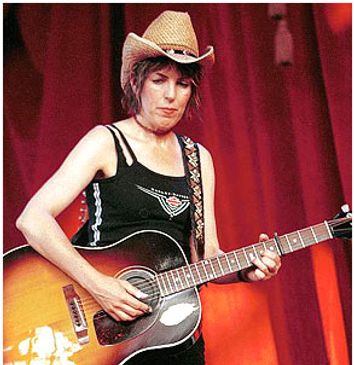
God love the 48-year-old artist who continues to push herself to extremes. Whatever descriptions apply to Lucinda Williams’ previous albums, the aptly titled “Essence” (due June 5 on Universal’s new Lost Highway imprint) is even more so — darker, leaner, rawer, sexier, sadder, more twisted through its depths of desire and obsession. It’s a nervy progression, almost necessarily uneven because of the risks it takes, balancing a grace that soars toward aching perfection with an intimacy that elicits a squirmy discomfort.
With 1998′s “Car Wheels on a Gravel Road,” the uncompromising artist earned some commercial acceptance, scoring a gold record and winning a Grammy, while eliciting the sort of critical rapture once reserved for Williams’ pantheon of inspirations (Bob Dylan, Neil Young, Hank Williams and Muddy Waters). The more radical “Essence” is likely to prove a tougher sell. It could well be her masterpiece, but it’s an emotional mess of a masterpiece, one that finds her poking around in a psychosexual murk where other artists might be scared to get their hands dirty, singing to the world what most folks would be scared to whisper to themselves.
Take the title cut (also the album’s first single and centerpiece), the boldest anthem she’s ever recorded. Not merely because she sounds more like PJ Harvey than Emmylou Harris, over the rhythmic insistence of a sensual throb. And not merely because of lyrical explicitness such as “You’re my drug, come on and let me taste your stuff,” and “Please come find me and help me get fucked up.”
No, the shock of “Essence” is that an artist so widely heralded as strong-willed, a fiercely feminist icon, should allow herself to sound so abjectly needy, so desperate in the throes of knee-knocking heat, so incomplete without a man. (I am woman, hear me pant.) The emotional investment she gives lines like “Kiss me hard/Let me wonder who’s in charge” takes the sentiment so far beyond the pale of political correctness that she makes Pat Benatar’s “Hit Me With Your Best Shot” sound like a love tap, while the bridge’s bare-boned directness incongruously echoes Dr. Seuss. (“I am waiting here for more/I am waiting by your door … /I am waiting in my car/I am waiting at this bar.”)
Yet Williams is nobody’s video love doll. “Essence” is less a song about seducing an object of desire than a song about lust’s voracious hunger, an arousal so strong it all but obliterates that object. The aftermath of such ravaged urgency inevitably elicits one of those bittersweet songs so characteristic of Lucinda Williams, songs of leaving or being left, as the magnetism of mad abandon simply can’t sustain itself. It’s a song that strips away every last layer of protective bark from an impulse that will not be denied.
What “Tonight’s the Night” was for Neil Young, “Broken English” for Marianne Faithfull — maybe even “In Utero” for Nirvana — “Essence” is for Williams. It isn’t a pretty picture, but the power of her artistry has never proceeded from pretty. Throughout her career, she’s been told that she could reap considerable dividends if she would tone down this and tidy up that. If she’d apply some eyeliner to the chorus and a little more polish to the arrangement, she could enjoy the sort of success with her songs that others have.
From Patty Loveless with “The Night’s Too Long” and Mary Chapin Carpenter with “Passionate Kisses,” through subsequent covers by Tom Petty (“Changed the Locks”) and Emmylou Harris (“Crescent City”), other more mainstream artists have embraced her songs and smoothed them out. Even among some listeners who respond to her songwriting, there are those who resist her rough-hewn delivery — the barbed wire with which she laces her hooks — just as there were those who could appreciate early Bob Dylan only when sung by the likes of Joan Baez or Peter, Paul and Mary.
Few artists put such a tough core around such emotional fragility. Through each of her previously troubled recording projects, Williams has been as protective of her output as a lioness with her cubs, battling with record labels, producers, musicians, boyfriends (and bassists, so often a twofer slot in Williams’ bands) in her single-minded devotion to the sanctity of her work. Yet the work itself reflects a vulnerability that few artists risk; the skin of her songs is so transparent that you can see right through to the singer’s troubled heart. You start to question whether the greatest song is with the hurt that inspired it.
Even by Williams’ uncompromising standards, “Essence” is a very different album from “Car Wheels” or her earlier efforts. Where her instinctive synthesis has consistently defied categorization — finding a common denominator among blues, country, folk and rock, while falling through the cracks between them — her sound here is off the roots-rock map. With the basic tracks providing subliminal support — the atmospheric interplay less concerned with the notes than with the breathing spaces between — co-producer Charlie Sexton fills the fringes of these arrangements with the sort of otherworldly loops and effects that so often distinguishes a Daniel Lanois soundscape.
As for the songs, where “Car Wheels” provided a musical travelogue of Williams’ South, an evocation of how time and place shaped the singer’s soul, “Essence” is more of an interior psychodrama. Only one of its songs, “Bus to Baton Rouge,” supplies the sort of narrative detail that so often informs her writing; it sounds as if it could have been held from the previous album. The other cut that strikes the most familiar chord is “Reason to Cry,” on the surface a roadhouse ready-made, a “ladies’ choice” slow dance, which Williams invests with a lyric that cuts to the core: “When nothing makes any sense/You’ve got a reason to cry.”
Fiction writers have long embraced Williams, the daughter of a poet, as a kindred spirit, partly because her writing is so devoid of writerly affectation. It’s tough to write so simply, to render the complications of love and life in the plainest language possible. Distilling her art to its purest expression, the album-opening “Lonely Girls” could pass as a lullaby, though it’s unlikely to elicit sweet dreams, as the singsong incantation seems to deepen the indelible melancholy.
“Steal Your Love” and “I Envy the Wind” spike the same vein of obsession as “Essence,” with Williams’ vocals somehow combining a childlike innocence with a feral hunger on the first, while her quavery tremble on the second leaves her voice as naked as an exposed nerve. The sort of raw immediacy that would make more polished singers cringe is plainly Williams’ goal. On “Blue” the chamber strings of David Mansfield provide plaintive contrast to the singer’s ravaged tremble, as Williams turns her bittersweet meditation into tone-poem testament.
“So go to confession/Whatever gets you through,” she sings, her words without adornment, her voice shorn of refinement. “You can count your blessings/I just count on blue.”
“Out of Touch” carries the album’s only hint of pop buoyancy, though here again the prevailing mood is blue rather than bright. It’s a song that sustains a perfect emotional pitch, as regret meets resignation over passage of time, the way of the world and the inevitability through which connections that once seemed crucial have somehow been squandered. Like so much of Williams’ writing, it’s a song so specific it could have come straight from her diary, yet so universal it encompasses everyone.
The first five songs are so tightly focused — such a fully realized song cycle of longing and loss — that the album’s more eclectic second half can’t help seeming scattershot by comparison. With its lazy rhymes and slang, the half-baked “Are You Down” barely bothers to pull itself together as a song, relying instead on the sinuous groove of keyboardist Reese Wynans and guitarist Bo Ramsey to insinuate itself beneath the listener’s skin.
By contrast, “Get Right With God” burns as hot as “Essence,” though the hellfire here is spiritual rather than sexual. Even Williams attempts to distance herself as she instructs the musicians to “Get da-own!” (in a caricature of a cracker accent), yet the intensity of the plain-spoken, guitar-driven prayer transcends parody. Sin and salvation aren’t conceptual abstracts but palpably physical, and one is as likely to burn from the former as yearn for the latter.
Redemption arrives with the final cut, as “Broken Butterflies” takes poetic flight from all the earthbound verse preceding. This is Williams at her most ambitiously Dylanesque, finding divine inspiration in a hymn of bitterness in which the New Testament meets “Positively 4th Street.” It offers a spellbinding close to an album that takes risks that few contemporary artists chance, from a songwriter who continually challenges her audience because she never stops challenging herself. Even if the rest of “Essence” weren’t so powerfully unsettling, she could stake her claim to greatness on this song alone.
Imagine a parallel universe of rock revisionism, one in which the Beach Boys never progressed beyond the sandbox of surfboards and hot rods, while Buffalo Springfield evolved into the sonic conceptualists of “Pet Sounds.” Now blow away the lint of nostalgia from such a conjured unlikelihood, and you’ll have a sense of what an ear-opening surprise is the Jayhawks’ “Smile.”
Yeah, the Jayhawks — Midwestern journeymen, bearers of the tattered alt-country standard, the band whose promise in the early ’90s dimmed from Next Big Thing to Thing That Never Was. By all rights, this is a band that should have quit five years ago, when frontman and founder Mark Olson renounced corporate rock for family values, prefering to make homespun music with his bride Victoria Williams (as the Original Harmony Ridge Creek Dippers) instead of continuing to grasp for the brass ring that seemed perpetually beyond the Jayhawks’ reach.
Into the breach stepped guitarist Gary Louris, perennially the Minneapolis band’s most valuable player, yet one whose virtuosity seemed best suited to furthering the creative impulses of others (in support of Joe Henry and, later, Kelly Willis, in addition to his crucial collaborations with Olson) rather than asserting his own. The release of “Sound of Lies” (1997) earned Louris credit for holding the band together, yet the results were mixed at best, with the new Jayhawks so determined to avoid comparisons with the old that they sounded more like the cornfield ELO. It seemed that Golden Smog (Louris’ side project with Wilco’s Jeff Tweedy and other kindred spirits) had a brighter future than the Jayhawks.
By contrast, “Smile” has the urgency of a band risking everything on one final roll of the dice, recognizing that if such a radical attempt at renewal doesn’t work, the game is finished. There’s no holding back here, nothing saved for next time out. Whether one hears the album as late-blooming brilliance or last-gasp desperation, it shows no signs of the flannel-shirt complacency that finds so much of the music currently branded as “Americana” recycling the same cowflop.
Instead, soundscapes such as “Somewhere in Ohio” and “(In My) Wildest Dreams” find the band pushing its creative interplay to extremes, as waves of harmonies, washes of fuzztone psychedelia, tinges of chamber orchestration and loops of rhythm programming reinforce the album’s shimmering spirit of musical uplift. From the title song’s album-opening “Wake Up” call through the tune’s all-but-subliminal warning that “the sky is falling down,” the music opens its heart and lays bare its ambition, paying the sort of attention to detail that gives each song an aural imprint.
Serving as unlikely co-conspirator is Bob Ezrin, the veteran producer for whom too much is never enough. Though his work on Lou Reed’s “Berlin,” Alice Cooper’s “Welcome to My Nightmare” and Pink Floyd’s “The Wall” showed a heavy hand, here his arrangements enhance rather than overwhelm the ‘Hawks’ lighter melodic touch.
With “Smile” (the title that Brian Wilson initially intended for the Beach Boys’ follow-up to “Pet Sounds”), the band risks alienating its core constituency in the hopes of attracting a broader audience. Yet instead of a commercial compromise, the album sounds more like a creative liberation, a lifeline renewed by a band that resists playing out the string.
Continue Reading
Close
Kelly Hogan, bless her heart, describes herself as “a big juicy goober.” She’s the post-punk version of a Southern good ol’ gal, devoid of the pretenses of divahood, the stylistic adornments of the sophisticated chanteuse. Yet the release of Hogan’s “Beneath the Country Underdog” blows her unassuming cover. Beyond the self-deprecating persona — always the buddy, never the vamp — lies a voice of such soulful depth and interpretive command that it all but demands to be measured for the tiara and elevated to the throne.
In short, “Underdog” is star time — a triumphant return to the spotlight for a singer who enjoyed indie-rock acclaim a decade ago with Atlanta’s Jody Grind, but who has more recently been working behind the scenes, as a publicist for Chicago’s scrappy Bloodshot label. Though the album arrives from Bloodshot in the guise of an alternative-country release — produced by Jon Langford (Mekons, Waco Brothers), backed by his Pine Valley Cosmonauts — it shares more in spirit with Dusty Springfield’s classic “Dusty in Memphis,” the country-pop crossovers of Patsy Cline or even the languid bluesiness of Billie Holiday than it does with the honky-tonk punk of Hogan’s labelmates. Such comparisons suggest just how far Hogan’s brand of artistry has fallen from fashion. These days, it’s startling to hear a singer who can crawl inside a song rather than climbing on top of it, who treats the material with interpretive respect instead of reducing it to a platform for self-conscious displays of vocal gymnastics. The dynamics of contemporary divahood tend to exhaust artist and listener alike; ears attuned to the screech make it all the harder to hear a whisper.
Yet anyone who happens to hear Hogan caress a lyric will find the seduction difficult to resist. From the shellshocked tenderness she brings to Willie Nelson’s “I Still Can’t Believe You’re Gone” to the luminous surrealism that shimmers through Stephin Merritt’s “Papa Was a Rodeo” and the lubricious romp of Loretta Lynn/Conway Twitty’s “Wild Mountain Berries,” Hogan displays the emotional equivalent of perfect pitch. Where so much singing is larger than life, and thus less than true, Hogan’s art betrays no artifice: She enhances the material rather than distracts from it, never overselling herself at the expense of the song.
Her defiance of conventional categorization is both an artistic blessing and a commercial curse. Though the Jody Grind attracted a rapturous and growing legion of fans, the band had the misfortune to be a few years ahead of the curve on the swing revival, which could have belatedly provided a context for its cabaret-style homages to the sophistication of George Gershwin and Burt Bacharach. Unfortunately, before that could happen, the band suffered a far greater misfortune: a fatal car crash after a 1992 gig. Hogan stayed behind in a hotel; the bassist and drummer were killed.
After disbanding the Jody Grind in the wake of the tragedy, Hogan retreated from the spotlight into the shadows of indie obscurity, playing guitar instead of singing leads in the Rock-A-Teens and releasing a lo-fi buzz of a 1996 solo album with the typically self-deprecating title, “The Whistle Only Dogs Can Hear.” When she moved to Chicago the following year and took the job at Bloodshot, she was more concerned with paying her credit-card debts (amassed over years of touring) than with advancing her musical career. Yet it wasn’t long before label’s roster began coaxing her into their sessions. Her contributions to Langford’s Pine Valley Cosmonauts’ celebration of Bob Wills, a Knitters tribute and Alejandro Escovedo’s Bloodshot studio debut showed that her smoky alto could waltz effortlessly between the uptown cabaret and the country roadhouse.
Characteristically eclectic, “Beneath the Country Underdog” adapts its title from the autobiography of jazz great Charles Mingus and its style from an intimate synthesis of jukebox country, Southern soul and tuneful pop — finding common ground for sources as diverse as Johnny Paycheck and Percy Sledge. Even the original material evokes a timeless past that transcends categories, as “Gone” (one of three on the album written by Hogan and guitarist Andy Hopkins) offers brief tribute to Sam Cooke’s “You Send Me,” while the gospel chorus on Langford’s “Mystery” suggests a musical cousin of the Band’s “The Weight.”
The Band’s own songbook provides the album’s benediction, as Hogan transforms the closing “Whispering Pines” into prayer set to melody, channeling the ethereal strains of the late Richard Manuel and Rick Danko into a refrain of eternal wistfulness. There’s a ghostly evanescence in the way the call of Hogan’s vocal coaxes response from Langford, whose roles then reverse so that she supplies the echo. When Hogan sings, “The lost are found,” she brings fulfillment to the loveliest piece of music we’re likely to hear this year.
Continue Reading
Close
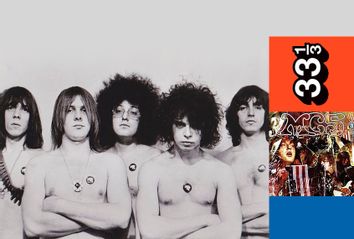
Wouldn’t this be a more interesting world if Melissa Etheridge had picked Iggy Pop rather than David Crosby to sire her love child? Were popular culture subject to Darwinian principles, natural selection alone would seem to favor a lean, mean rockin’ machine over an overstuffed walrus with a liver transplant. Yet Etheridge’s choice is the same one that rock itself made in 1970 — the year that the music went so terribly wrong. Climbing the utopian tower of sweetness and light was “Deja Vu,” an album which elevated the whiny warbles of Messrs. Crosby, Stills, Nash and Young into the harmonies of post-hippie solipsism. Down a darker alley was the Stooges’ “Fun House,” a switchblade howl from the trailer-trash abyss. The first album topped the charts; the second went straight to the toxic dump of oblivion.
Or so it seemed at the time. Thirty years later, “Fun House” still has the rabid bite of a junkyard dog, as Rhino’s unleashing of “1970: The Complete Fun House Sessions” attests. Reviled by critics and ignored at the cash register, the album initially dismissed as a demented novelty has resurfaced as an expensive collectible, limited to a numbered edition of 3,000 (available only through the Rhino Web site).
Just the heft of the box suggests the glorious absurdity of the enterprise: a seven-disc, eight-hour expansion of an album that originally clocked in at a mere 36 minutes. One hundred thirty-three “bonus” tracks, previously unreleased, where the original album included only seven cuts. Thirty different takes of “Loose,” Iggy Pop’s ode to his oversized phallus, where one verse was previously enough to send most listeners begging for relief. And then there’s the supreme marketplace irony: the $119 price tag, where the original “Fun House” had been all but impossible to give away at less than $4.
It’s a joke, right? Only in the sense that the Stooges themselves were a joke, the Nietzschean Neanderthals as rock ‘n’ roll super men. As front man, Pop was less singer than satyr, spewing his primal urges as an ejaculatory stream of rant and grunt. The songs were mainly riffs — often the same riff — pulverized by musicians who were barely familiar with their instruments, but who understood that slash-and-burn intensity was more crucial to rock ‘n’ roll than virtuosic dexterity. Their concert rampages made it hard to tell when one song ended and another began, or if the band were bothering with songs at all.
Instead of lingering in the detumescence of rock’s peace-and-love afterglow, the Stooges met the complacency of popular culture with a raging hard-on. While rock was self-consciously trying to grow up — aspiring toward the poetry of the printed page, the complexity of jazz or classical music, the respectability of polite society — the Stooges were defiantly dumbing down. Stoogeland reduced the entirety of experience to being bored and getting laid (peace and love as reflected in the funhouse mirror), while recognizing that the latter wasn’t necessarily an antidote to the former.
Outside the soul-numbing, blue-collar Rust Belt of the band’s native Midwest, there was simply no cultural context for the Stooges, a band for whom musical celebrity was as ludicrous as rock was crucial. The music was too primitively raw for mass consumption, though high-energy pretenders such as Alice Cooper and Grand Funk Railroad would soon enjoy commercial success with a pasteurized approximation of the Stooges’ sonic assault.
It wasn’t until the mid-’70s that punk rock heralded the influence of the ignoble Stooges, showing just how far ahead of its era the band had been. By the time the Sex Pistols’ Johnny Rotten snarled “No future,” Iggy Pop had been living that future for almost a decade. Not that respect necessarily benefited the Stooges (by then disbanded), as Pop’s ascension into a punk icon, along with his adoption as David Bowie’s pet poodle, left him a caricature of his former Stooge self, while the rest of the band was all but anonymous.
Another decade down the road, the Stooges’ synthesis of punk attitude and metal dynamics could be heard as the progenitor of grunge. Yet “Fun House,” an album originally derided as behind the times, a reversion to both pimply-faced adolescence and Stone Age primitivism, has subsequently shown more staying power than either the punk or the grunge it spawned. (It’s hard to imagine anyone wading through seven hours of Alice in Chains outtakes.)
The revelatory dimension of “1970: The Complete Fun House Sessions” is how tidy it makes the 1970 LP sound in comparison. The album was recorded as the follow-up to the previous year’s “The Stooges,” produced by former Velvet Undergrounder John Cale. That debut had earned the band considerable notoriety, and even some FM airplay for “I Wanna Be Your Dog” on the emerging “underground” format, while sacrificing much of the nuclear energy and the anything-goes recklessness of their live performances.
In order to channel as much of that surge as possible, the band and producer Don Gallucci (fresh from Crabby Appleton’s with “Go Back”) decided to record the band live in the studio, rather than layering overdubs in the conventional manner as Cale had. On the first run, the band pretty much bashed its way through its concert set, with guest saxophonist Steve Mackay punctuating the wah-wah and fuzztone menace of guitarist Ron Asheton to push Pop to the extremes.
Whatever those early versions lack in polish — a flubbed note here, a blown rhythm there, a lyric (or even a coughing jag) holding space for something more inspired — the crazed intensity of the formative outtakes grinds the official LP to dust. As the fourth take of “1970″ makes plain, no one could possibly scream, “I feel all right” with more psychotic desperation than Pop. Or howl, “Let me in!” with more insistence, as he does through the early stabs at the title track. With every roll of tape unspooled in chronological order, memorializing every false start and in-joke, “The Complete Fun House Sessions” lets it all hang out.
Rock was never product for the Stooges, a band that equated show business with pro wrestling and art with museums. Thus the attempt to commodify the music’s assault into a commercially palatable package was doomed from the outset, though producer Gallucci did his best to focus the energy into a recognizably song-oriented format. He even provided keyboard overdubs for a rarely heard 45 version of “Down on the Street,” to make the band sound more like the Doors. Concluding this boxed set, the bid for a hit single shows just how out of sync were the Stooges with the tenor of the times.
For Pop, the obvious single was “Loose” — “Hitsville!” he exclaimed between takes — which lost its lyric about his “red hot weenie” as the sessions progressed, but retained the triumphant chorus: “I’ll stick it deep inside, stick it deep inside, ‘CAUSE I’M LOOSE!” Though such an orgasmic explosion never stood a chance of equaling even the marginal airplay previously given “I Wanna Be Your Dog,” let alone conquering the charts, it spurts triumphant through 30 takes as the climactic achievement of Stoogedom. As “The Complete Fun House Sessions” makes plain, the only way to sustain the pulverizing energy of “Loose” was with another, even more pulverizing version of “Loose.”
“Let’s just put out a single and not an album,” says Iggy. “How about an album with 22 takes of ‘Loose?’” responds engineer Brian Ross-Myring.
In retrospect, it was a brilliant idea, a Zen-like distillation of the band for whom too much was never enough. Such is the essence of the Stooges, the sonic obliteration of that line between a dumb joke and a visionary achievement.
Continue Reading
Close