Douglas Cruickshank
Pomegranate porn
Photographer Flor Gardu
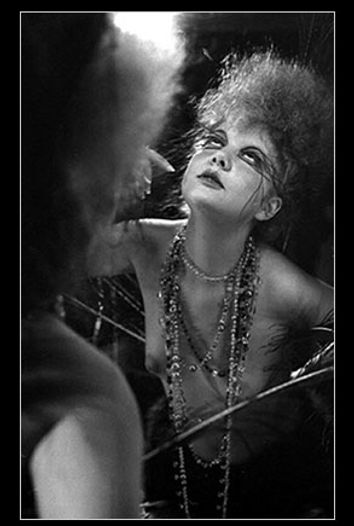
Photographer Flor Garduño says that seven out of 10 of the models she worked with on her new book, “Inner Light,” a collection of nudes and still lifes, have gotten pregnant.
“Among my friends,” Garduño tells poet Verónica Volkow, who wrote the introduction, “word started getting around — it was a joke — that if someone wanted to get pregnant, she had to pose for one of Flor Garduño’s photographs … one of the models got pregnant, even though she was using birth control.” Still another woman saw Garduño’s lush black-and-white images and “a short time later she also got pregnant,” the photographer says.
It’s hardly surprising. There is an unmistakable air of fecundity about Garduño’s work and it goes beyond matters of reproduction. Here are pictures with ideas attached — thinking, breathing, feeling photographs. Garduño’s strong, evocative symbolism and her poetic sensibility coupled with a flawless sense of composition make these sensuous, often ethereal images the sort of pictures you can look at over and over; these are photographs worthy of staring at, then closing your eyes and remembering. The funny thing is — given that many of the photos are nudes — when you do stare, you find that you’re not looking where you might expect to.
Making a nude photograph that possesses intellectual weight is a challenging proposition. A photograph — any photo — of a naked person is charged; nine out of 10 of us will have to look at it whether it’s any good or not. Men, who are ostensibly stimulated by visual images more than women are, find nude photos of females all but irresistible. Most photographers who shoot nudes know this, but fail to transcend it even when they try. Yet some, and Garduño is preeminent among them, make pictures that have so much going on that every element of the image integrates with every other and our eyes go wild, looking everywhere. These aren’t merely nudes, they’re novels or perhaps epic poems rendered by a magical realist.
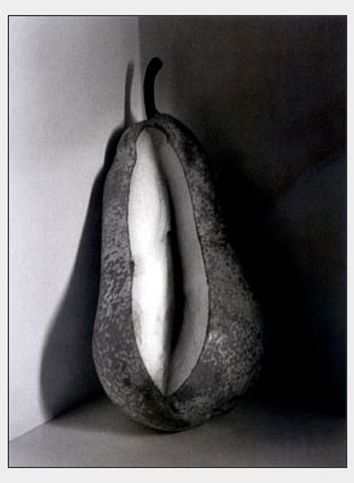
“Holistic” is a dreadfully overused word, but I can’t think of a better one to describe Garduño’s ability to capture not just the sensuality of a woman’s body, but also the sensuality inherent in an entire scene. Who knew that leaves could be sexy? For that matter, since when are pears erotic? Well, since Garduño sliced a wedge from one and propped it against a wall. And don’t get me started on the pomegranate, the one with the seeds wantonly spilling out.
But most of her images — nudes or not — aren’t even specifically about sex. They’re about life and nature and procreation and form and death and funniness and beauty and dreams and whimsy and I take it back — they are about sex. Life, when it’s really full like that — fertile with ideas and emotions, electric with thought and fantasy — is the very quintessence of sex. Good sex, the real thing, cannot be separated from every other aspect of life. That’s why photography that is only about sex is often sexless and boring.
Garduño’s work is in major collections around the world, including the Museum of Modern Art in New York and the Bibliothèque Nationale in Paris. Her earlier book, the critically acclaimed “Witnesses of Time,” is a visual meditation on the sacred and symbolic as reflected in the everyday lives of native Indians in Mexico, Guatemala, Peru, Bolivia and Ecuador who still practice ancient rituals. And, though “Inner Light” is utterly different thematically, you see the ripple effect “Witnesses of Time” has had on some of the images in this book; Garduño is well attuned to the intersection of spirit and matter; the power of the iconic object and how objects become iconic when presented as the keystone in a spiritual story, a narrative we seem to be witnessing as we view her photographs.
Garduño lives in Switzerland and Mexico (her Swiss husband, Adriano Heitman, is also a photographer) and has two children, one of whom, Azul, appears in some of the pictures in “Inner Light.” The photographer seems to have a philosophical kinship with the legendary Manuel Alvarez Bravo, which isn’t surprising: Like Bravo, a native of Mexico, Garduño began her career as his assistant. Some of her photographs even appear to make playful tribute to his, such as “La Nopala,” a seated nude woman looking at the viewer through eye holes cut out below an array of buds on a piece of cactus. “La Nopala” humorously echoes Bravo’s famous “La Buena Fama Durmiendo” (“Good Reputation Sleeping”), a solemn image of a nearly nude woman lying next to four prickly cactus buds. And one of Garduño’s most sensuous images (and most exquisite compositions), “Vestido Elegante” (“Elegant Dress”), a nude female partly visible behind large, swordlike leaves, is vaguely reminiscent of Bravo’s “Fruta Prohibida” (“Forbidden Fruit”), a view of a woman, her shirt open, her breast visible behind long blades of grass.
Garduño, however, though she is clearly influenced by Bravo, possesses her own very distinctive vision and is a gifted picture maker in her own right. For one thing, she’s more prone to frolic than Bravo. Her 1998 photograph “Pez Espada” (“Swordfish”), a nude holding a massive swordfish head on top of her own, is certainly surreal, but it’s also a hoot and something of a challenge. The fish’s giant eye stares out at the camera lens, looks right back at the viewer, and the head dwarfs the woman holding it. It takes a few moments before you even notice that she’s nude. Then you realize that the pose is similar to Rodin’s thinker and it becomes clear that Garduño’s sense of humor sets her work far apart from Bravo’s often (though not always) somber imagery.
But Garduño can be contemplative, too. One of the most exalted nudes in the book is her “Vestido Eterno” (“Eternal Dress”), a madonna-like picture of a young woman, her eyes closed, her head turned slightly upward and a garland of white roses draped across the top of her breasts. It’s a picture you could hang on a wall and never tire of, it is so rich with references to religion, mythology and eroticism. The woman’s subtle expression, suffused with emotion, is simply compelling and seems to change as you gaze at it. If art is the transmission of feeling then Garduño has made a masterwork with “Vestido Eterno.”
What comes through vividly in her photographs is that this is the work of a happy person, which is unfortunately rare in art today. That Garduño has managed to imbue the work with that feeling is testament to her inner resourcefulness, her toughness and vulnerability. There is plenty to be sorrowful about these days, but she’s managed to capture those eternal qualities of nature and humanity that conquer that sorrow. In the introduction, Volkow writes, “Garduño looks at the world with the eyes of a treasure’s caretaker, which are the same as those of a pregnant woman. Every figure glows as if it were fervently embracing a promise, beaming with an overwhelming fullness. Each fruit, each body is like a star: It radiates a beauty that emerges from an overflowing richness. Every form seems to express an innate force; it dawns with the power of its strength. Garduño shares with us a woman’s complicity with the vital force of objects and bodies. Everything here lives from within the miracle of fecundity.”
To which one can only respond: Yes! And thank god for poets — both the ones who use words and those who use cameras.
Sexy monkeys and mutant bunnies
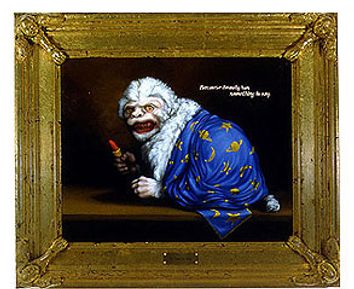
Painter Laurie Hogin uses the style of Old Masters and a frightening menagerie of beasts to illustrate the nightmares to be found in the American dream.
When artist Laurie Hogin, 39, was a child, she lived in a suburb of New York adjacent to a 600-acre woodland. “It belonged to some old guy who just wasn’t going to sell it,” Hogin says, “so we had these woods to play in — me and my two friends. It was a wonderful, safe place for us. We were all interested in what was then called ecology; we’d see foxes, deer, wild turkey, pheasant, we’d find mushrooms. But it was a ravine with a road above it and occasionally people would dump tires, garbage and 55-gallon drums. This outraged us.”
Continue Reading Close“The Partly Cloudy Patriot” by Sarah Vowell
A "This American Life" commentator celebrates nerds and explains how to love your country without turning into a boorish, jingoistic, kitsch-crazed lout.
Wouldn’t it be nice if you could be a patriot without having to fly the flag from your porch and the antenna of your car every day, if you could skip applauding crappy, gung-ho songs about how great America is, cheering saccharine, saber-rattling speeches about how great America is, and otherwise wallowing in all the lamebrained, jingoistic posturing that now seems required behavior for U.S citizens who wish to demonstrate a commitment to their country? Yes, it would be very nice.
Good news: At least one of us has managed to pull it off. In her third book, “The Partly Cloudy Patriot,” Sarah Vowell does a bang-up job of being a good American without being a terrible bore. A solid thinker with a warm heart and a smart mouth, she loves the U.S. in much the same way that one loves one’s family (or perhaps a favorite flea-bitten old dog) — acutely aware of its many shortcomings, but true-blue to the end. “My ideal picture of citizenship,” Vowell writes, “will always be an argument, not a sing-along.”
Continue Reading Close“Normal will never happen again”
The author of two books about coping with sudden death talks about the emotional fallout of losing someone without having had a chance to say goodbye.
In October 1997, a bee stung Brook Noel’s 27-year-old brother, Caleb, a professional athlete. Neither he nor anyone else in his family was aware that he was severely allergic to bee stings. He went into anaphylactic shock and died the same day. In the days that followed, trying to grapple with the trauma of losing her brother, Noel went looking for a book that would help her cope. “There was nothing on sudden death,” she says. “It was all on terminal illness.”
So she wrote a book herself. The publication of “I Wasn’t Ready to Say Goodbye: Surviving, Coping and Healing After the Sudden Death of a Loved One,” coauthored with Pamela D. Blair, led to media attention. Later, five months prior to the 9/11 attacks, Noel was asked to join the 48-member Family Support Team of the National Air Disaster Alliance.
Continue Reading CloseThe life of the Dead
Band insider Dennis McNally talks about his new 600-page biography of the Grateful Dead, and answers questions about their long, strange trip.
Even the many who have fond recollections (or any recollections at all) of the ’60s have heard just about as much as they can bear about the 20th-century decade that can’t get over itself.
And yet, there is always more — flashbacks, confessions, photos — for those whose appetite for the past might never be satisfied.
Most recently, the era is plumbed in “A Long Strange Trip: The Inside History of the Grateful Dead,” a 600-page memoir by the band’s publicist, Dennis McNally. In truth, it’s not just about the ’60s — the book hits 1970 about midway and continues on through half of the ’90s. And McNally does not throw avid fans of the band, or the ’60s, a mere bone. His history of the quintessential psychedelic band, and the strangely intoxicating waves it made, is an entertaining, picaresque, and exhaustive contribution to pop culture anthropology.
Continue Reading CloseDeal breakers
You may not push that hottie out of bed for eating crackers. But what about for wearing Tevas?
A stated willingness to tolerate a prospective lover’s propensity for dining on saltines while in bed is the generally accepted test of one’s depth of attraction, the indicator of just how much you would be willing to put up with in order to indulge with said object of desire in a bit of horizontal hijinks.
I first learned of the cracker test when I was 13. A sophisticated, and platonic, friend of mine — a worldly woman of 16 — had carnal cravings for a skinny, scraggly-haired drummer with bad teeth. I questioned her taste in men. She admitted that to some he might not be the most appealing of characters, but he did have that certain something, she insisted, that had nothing to do with looks. “I sure wouldn’t push him out of bed for eating crackers” she said from the bottom of her heart, or maybe lower.
Continue Reading ClosePage 1 of 16 in Douglas Cruickshank