Edward Behr

Consider the prune

The world's most famous prune is French, but California grows its clones. Is there a difference between them?

The most famous prune in the world, the pruneau d’Agen, has been a celebrated product of southwest France since at least the 1500s, outliving — and even thriving because of — several nearly existential threats.

The variety of plum grown to be dried into these prunes is the Prune d’Ente, chosen after the winter of 1709 killed many trees, requiring widespread replanting. Its taste was superior to that of previous varieties, its fruit was larger and higher yielding, and it was well-adapted to the region. Agen prunes were a huge success, heavily exported, until the two world wars of the 20th century devastated production, creating another chance for selecting and propagating especially fine specimens. From 1943 to 1949, French government researchers on bicycles, knowing that the variety embraces many clones, selected 60 outstanding trees and reduced those to the six best. One of them, assigned the number 707, now makes up roughly three-quarters of all the Prune d’Ente planted in France, which under the Indication Géographique Protégée, awarded by the EU in 2002, is the only variety permitted.

The Central Valley of California is the world’s largest producer of prunes, and their quality, too, can be high. Genetically, there may not be a great difference between Agen prunes and those raised in California. The U.S. variety is French Improved, descended from examples of Prune d’Ente imported in the mid-19th century. (The 707 didn’t do well in California.) Differences in taste may come from differences in climate and in pruning. The latitude of the Agen orchards, followed around the globe to North America, runs a little north of Toronto, and the French trees, which receive significant rain during the growing season, are pruned to be open, so the fruit is exposed to the sun. The Central Valley trees, in contrast, grow in much greater heat and receive little or no rain; they require irrigation and are pruned so the foliage will protect the fruit.

Besides effects of clones and location, any edge of flavor in the Agen prunes might be due to slightly greater ripeness at harvest. Not that there is a difference in goal, but the Agen growers may achieve it more often. In California, the time to harvest is determined by measuring the softness of the fruit, which is linked to sweetness; growers aim to pick when resistance to pressure, applied to the fruit with a penetrometer, falls to between three and four pounds. But in France, explains Jean-Michel Delmas, a grower, farm-union activist, and historian of the pruneau d’Agen, the growers measure the sweetness directly with a refractometer, looking for 21 degrees Brix — each degree equaling approximately 1 percent sugar — and sometimes achieving much more. (Ripeness often used to be determined by the plums themselves, which fall from the tree as they become ripe. Growers would spread straw on the ground as a cushion to prevent bruising.) The harvest in nearly all the Agen plum orchards is now mechanized, and the machines, which shake the trees and catch the fruit, pass four to seven times, as the fruit ripens. In California, similar machines harvest much more aggressively, passing just once to gather all the fruit from the tree.

Long ago, the Agen plums were dried in the sun or on farms in warm bread ovens. Today mechanical driers reduce the moisture to 21 to 23 percent for keeping, and then in a recent innovation that quickly became universal in the region, before packaging they are rehydrated to 35 percent. That gives a more luscious consistency, and there’s no longer a need to soak before use.

Most California prunes are now pitted, but only about half the French ones are. Although French technical experts say that last-minute pitting before packaging has no effect on flavor, Delmas thinks differently. “In fact,” he says, “a large part of the flavor comes from the presence of the pit. Without it, the plum loses the heart of its aroma.” He associates the pit with a violet perfume. Among the local dishes he eats frequently are prunes with rabbit or with pork as well as with beef, in a daube, a red-wine braise.

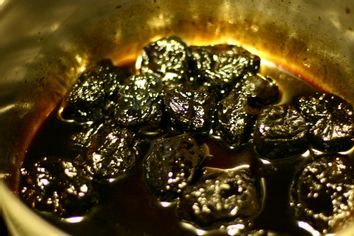
To ensure safekeeping, producers of pruneaux d’Agen now add the preservative sorbic acid or its relatives or they pasteurize at 70 degrees C, giving a slightly darker color and a more concentrated, caramel flavor. When I made a side-by-side comparison of some Agen prunes (pitted, no preservatives) with two California brands (pitted, with preservatives), the Agen were softer and moister, thinner-skinned, sweeter, with slightly fruitier, somewhat stronger flavor and a longer aftertaste. But, alas, the Agen prunes cost nearly double.

Click here to read more from the Art of Eating on Salon, and visit artofeating.com

The pleasures of truly wild wild rice

If you've never loved this dark grain, it's probably because you haven't yet had the real thing

19th century Native American women harvesting wild rice in the traditional manner.

In the 1960s — and in an odd contradiction — cultivated wild rice began to be grown in California in paddies, like regular rice, and harvested by machine. But northern, truly wild wild rice, or “manoomin” in Ojibway, grows in the shallow waters of ponds, lakes and rivers in the north-central United States and adjacent Canada. It isn’t rice at all, of course, but the seed of a tall, annual aquatic grass, Zizania palustris (sometimes still called by the earlier name Zizania aquatica). The wild grain continues to be gathered by hand, often by Indians, as a commercial crop. Gathered from nature and processed in the traditional way — heated and stirred in an iron pot or washtub over a fire — wild rice is olive green to brown mixed with tan. It tastes nutty, toasted, slightly grassy and, as one writer puts it, like tea.

There’s now much more of the cultivated Zizania than there is of the wild. The cultivated strain was selected for holding its ripe seed longer, so more grain is on the plant when the combine passes through. In nature, wild rice shatters quickly — releases its seed to settle to the bottom and in spring form next year’s plants. Cultivated wild rice is also different in other ways. The color, as a rule, is nearly black. That’s because the grain darkens more while it remains longer on the plant, because it darkens further if it’s not processed quickly, and because the hulling machines are adjusted to leave more bran. The companies that are the main customers for cultivated Zizania want it dark, so it stands out in blends with white rice.

Most of the genuinely wild wild rice sold in the United States comes from Minnesota. Since 1937, the state has limited the season, required a license to harvest the rice, and required that the harvesting be done by hand from canoes. Each year the dates are declared according to the maturity of the crop. Most individual harvesters sell their rice to small or large processors who dry and hull it mechanically. Traditionally, the seeds are dried first in the sun and then “parched” over a wood fire with constant stirring, so the rice doesn’t scorch. Parching gives the characteristic toasted flavor to wild rice. But its main purpose is to dry the rice fully to preserve it while shrinking the kernel and making the hull crisp, so afterward the kernel can be freed. The grain often used to be trod with moccasin-covered feet, lightly, so as not to break the kernels, then winnowed to separate the chaff from the rice.

Normally with grain, more bran gives more flavor, as in the case of brown regular rice or whole-wheat flour (though their flavor isn’t necessarily better). With wild wild rice, batches that are a little darker from having been processed with a little more bran are more flavorful and, to some tastes, better.

What’s odd about the black cultivated Zizania from paddies is that despite having all that bran, it doesn’t taste like much. That might be because it’s a somewhat different plant, because growing conditions in the paddy are too easy, or because the grain isn’t toasted in processing. In cooking, the thick bran coating of the paddy rice is slow to soften, and the grain is often served with an unpleasant firm texture. Altogether, cultivated Zizania seems pointless. Wild rice from lakes and rivers, however, is excellent. The flavor of each batch reflects the particular lake or river where it grew, its ripeness when harvested, and the method and care with which it was processed.

To cook wild rice
Rinse 1 cup (150 grams) of the grain in three changes of water and drain. Bring 2 cups (475 ml) water to a boil, and add the rice and ½ teaspoon salt. Simmer gently until roughly a quarter of the kernels have split open and curled back, the point at which the rice is somewhat tender but not too soft — from ½ to ¾ of an hour. It usually takes experience to match the precise simmer to the precise amount of water (which also depends on the batch of rice), so that the rice is done at the same time the water runs out.

Click here to read more from the Art of Eating on Salon, and visit artofeating.com.

Continue Reading Close

How to buy, hold, and sharpen a good knife

Balance, weight, bolster and tang: Here's what they mean for you and your cutlery

Before you buy a knife, hold it. Think about its weight and balance and how comfortable it feels. A good knife is balanced, which makes it a little easier and less tiring to use. If you suspend the knife between thumb and forefinger, holding the top of the blade at its widest point next to the handle, the blade won’t tip much up or down. For ease and control, the best way to hold a chef’s knife is to grip the widest part of the blade itself between your thumb and curled forefinger, with three fingers firmly around the handle. You have the most leverage and again the most ease and control, if you cut with the wide part of the blade close to your hand.

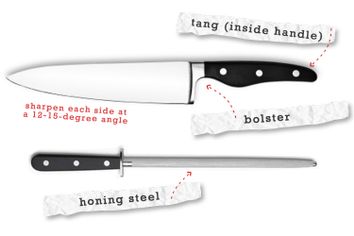
When you hold a good stamped knife this way, the handle should curve down to prevent your middle finger from uncomfortably pressing against the thin butt of the blade. On a forged knife, the side of your middle finger rests against the flat back of the bolster, an extra thickness of metal that reinforces the blade at the widest point and provides more to grasp. But a small bolster or none at all is better if you sharpen your own knives. As the blade is worn down slightly with each sharpening, the bolster, too, must be ground down now and then. Otherwise, it comes in contact with the cutting board, so the blade touches only at the bolster and the tip, not the middle, and you can’t cut all the way through food. Perhaps the biggest advantage to softer, old-fashioned staining steel blades (see part one of this article) is that the bolster is easier to reduce by hand. With stainless, which is so much harder, you almost have to use a grinding wheel.

The part of the blade that enters the handle is called the tang. A full tang is visible all around the edges of the handle, sandwiched between its two halves, the three pieces being held together by rivets. A rattail tang is hidden inside a handle, which is fine if the handle material is good and the bond is permanent. The material might be plastic, epoxy-impregnated wood, or metal. The handle should be smooth and large enough that there is plenty to grip. As for the shape, if you hold a chef’s knife like a lot of professionals, then you grasp only the forward part of the handle and its particular contour doesn’t so much matter.

When I cook, I prefer somewhat thinner, lighter blades, whether traditionally forged or stamped out of a steel sheet. Some people mistake extra metal for a sign of quality, but a heavy knife is more tiring to use, its swollen shape more often binds in the cut, and the thicker blade takes longer to sharpen. And for the very reason that there is less metal to remove from a thinner blade, it is easier to sharpen to a steep angle: it cuts better, though it grows dull more quickly. Good French knives are generally a little lighter and thinner than their German competitors. (It’s somewhat more complicated than that. The French firm Thiers-Issard, for one, makes thinner knives for the American market than for the French one.) Global brand knives from Japan are exceptionally thin, and thus very light and sharp, but the thin butt of the blade presses uncomfortably against your middle finger, if you grip the knife partly holding onto the blade itself. Flexibility, including the extreme flexibility of a filet knife, also comes from a thin blade. The more flexible forged blades are not usually made from different steel; they’re just ground thinner.

Knives, regardless of their toughness, will eventually want care — honing on a steel, which straightens out tiny defects in the edge, and sharpening, which actually removes metal from the worn blade and re-establishes the original angle.

Everyone wants to know the name of a good electric knife-sharpener. I don’t know of one. Most remove too much metal, shortening the life of the knife, and they leave a coarse edge that for real sharpness requires a lot of honing, preferably starting with a stone and finishing with a steel — and then what’s so great about the machine? Worse, none of the machines I’ve tried allow you to sharpen the whole blade. The bolster, and even the handle of a small or narrow knife, get in the way. You can’t quite insert the entire blade, so in time the middle of the blade arcs up away from the cutting board. Plus, the machine isn’t set up to grind the bolster. Sooner or later you have to have your knives rescued by a professional.

Delay the whole problem of sharpening by protecting your knives’ sharp edges. Keep them from touching other metal, especially loose knives and utensils in a drawer or a dishwasher or dish drainer. Wash sharp knives by hand. Don’t ever leave the knives in the sink, where they may be dulled as well as cut someone. A hard plastic board is easy to clean but hard on a sharp edge; wooden is better for most things (if it picks up aromas, place it for a few hours in the sun). Before each use, hone your knives on a steel, four or five times per side; you’ll notice more improvement with staining steel than stainless. If you take care of the edges and don’t use them too often, stainless-steel knives may stay sharp for several years.

I’ve always sharpened my own knives. (All this concerns Western knives; Japanese are another world.) Least expensive is a small carborundum stone, about three-quarters of an inch by three inches, which costs a few dollars at a hardware store, but sharpening with a small stone takes time. Wet the small stone with water and, taking care not to cut your fingers, rub it in a circular motion against the blade. As you rub, the water and grit will form an abrasive paste. Usually, you rub at a 12- to 15-degree angle to the blade. (If you look closely at the edge of the blade, you may be able to determine the original angle. If you like it, copy it with the stone.) Since you sharpen both sides, that makes a “V” of 25 to 30 degrees. A steeper angle is sharper — cuts better — but it’s more vulnerable and dulls more quickly, and it takes more time to create it. A wider angle is stronger, easier to create, and dulls more slowly, but it never cuts as well. Sharpen the whole blade evenly, but concentrate on the tip if that’s the dullest part.

A two-by-eight-inch two-grit carborundum stone is much faster than the little one. Again, keep the stone wet, but move the knife rather than the stone. With larger stones like these, push the blade into the stone at 12 to 15 degrees, holding the handle in one hand and resting the fingertips of the other just short of the tip on the dull side, and making a sweep across the stone so as to grind the whole blade. (Pulling instead of pushing leaves a minute curl of metal attached to the blade, a slight disadvantage, though the steel later removes it.) Make the same number of swipes on each side, alternating every pass or two. I might make a dozen passes per side for each of the three stones, though a really dull knife requires extra time with the coarse stone (and the number of passes depends on the force you use). Check that you haven’t taken too much metal from the center of the blade by holding it at a right angle to a counter or another flat surface. If you see a sliver of light in the middle, then work more on the two ends. Reduce the bolster each time, or have a skilled professional grind it occasionally. Wipe away grit before flipping the stone to the finer side, which will remove the marks of the coarser one. To test the sharpness, draw your thumb lightly across the blade at a right angle, in one direction and then the opposite. A sharp blade will catch at your skin slightly. If both sides feel more or less alike, you’ve sharpened them equally.

Finish the edge with strokes of the steel; try to do so at the same angle you used with the stone. A steel merely completes, or later refreshes, the edge when it curls over from use; it doesn’t sharpen a dull knife. Some steels are diamond-coated to ensure they are harder than the edge they are refreshing. Most steels are magnetic. They gather any tiny bits of metal from the knife edge, so as to leave it perfectly clean and sharp.

Click here to read more from the Art of Eating on Salon, and visit artofeating.com

Continue Reading Close

What you really need in a knife: A sharp blade

Feel and design are matters of preference; sharpness isn't, and this is what you need to know when choosing one

If you were going to have any kitchen tool beyond a hot plate, a pot, and a spoon, it would be a really sharp knife. A dull knife crushes and tears rather than slices. It requires more strength, and if it takes real force it may slip dangerously. A blunt edge doesn’t cut crisp vegetables so much as wedge them apart; it mashes tomatoes; it presses out juices from meat. You can test the sharpness of a knife by pulling your thumb across the blade at a right angle to it and without pressure. A dull edge feels smooth; a sharp edge catches at your skin.

Almost all the knives I use, above all the ten-inch chef’s knife I use most often, are forged — hammered — from a single piece of hot steel. Forged knives are typically more three-dimensional than the other, dominant kind, which is stamped out of a thin rolled sheet. But a forged knife doesn’t cut automatically better than a good stamped knife. (An excellent one is the Forschner Victorinox ten-inch chef’s knife, sold online for as little as $21, one of the great knife bargains.) And even the cheapest knife can be made extremely sharp. The knives at a low-price chain store are all stainless-steel, like nearly every knife today, but the metal is nearly always thin, most of the cutting edges are coarsely ground and slightly uneven, and the handles may be small and uncomfortable. Yet they may cut well enough at first, and the price is under $10. A staining ten-inch chef’s knife forged by the French maker Thiers-Issard, among those that can call its knives Sabatier, was recently $120. Some stainless versions from other producers run much higher. A made-to-order ten-inch chef’s knife from the Master Bladesmith Bob Kramer, by reputation as high as quality gets, now costs $1500, if you’re lucky enough to get on the waiting list. And you can spend a few thousand dollars or more for a great Japanese knife


The extraordinary range in price reflects differences in design, materials, and craftsmanship. A good knife can last years longer than a cheap one. A well-designed knife is faster, more precise, and more comfortable. It’s less tiring for professionals who work with a knife for long periods. But for most people the high price of a top knife is out of proportion to the practical advantages. If practicality were the only question, there would be hardly any forged knives. The reason there are so many, apart from the credulousness of consumers, must be that a well-made object is a pleasure for its own sake.

Hardly any knives are still made of the old-fashioned high-carbon steel that tarnishes and rusts. The brand-new blade may come coated with oil and look as bright as stainless. The two metals, newly ground and polished, are impossible to tell apart without a test. But after a couple of weeks of use, the old-fashioned steel turns dull gray and spotted, easy to tell apart from stainless. To me, a high-carbon knife has a feeling that I can only describe as more real — a combination of the darkened metal, the brass rivets, the weight of the knife, and the thin, tapering grind of the blade.

The tarnishing steel is known as “high-carbon,” but the stainless is known as “high-carbon stainless steel.” All steel is harder than plain iron because it contains a tiny amount of carbon. Seemingly insignificant amounts transform the metal, from less than 0.25 percent in low-carbon steel to about 0.75 percent in the high-carbon steel used for knives. The carbon makes plain high-carbon steel, the tarnishing kind, very hard — and yet brittle. (Because of the brittleness, if you pry with or twist a knife blade, the metal may snap, ruining the knife.) Paradoxically, plain high-carbon steel behaves as if it were soft when it comes to sharpening, and unlike stainless steel, it doesn’t tend to clog the surface of the sharpening stone.

Stainless steel is tougher. It resists corrosion (“stainless” is in fact a misnomer) because it contains a large amount of chromium, often 18 percent in knives, generally with a few more percent of elements such as manganese, nickel, silicon, vanadium, and molybdenum, each contributing particular qualities of hardness, brittleness, or toughness. The more carbon there is, the more chromium is required to maintain stainlessness, and the added chromium makes the blade tougher. Stainless steel is harder to sharpen, but once sharp it stays sharp longer.

Knife hardness is measured on the Rockwell C scale. That involves forcing a diamond-tipped cone into the blade and calculating the resistance it meets. Plain high-carbon knives are usually Rockwell C51 to C53; high-carbon stainless-steel knives are often C56 to C58 and sometimes higher. But the Rockwell numbers tell only hardness, not brittleness, toughness (the opposite of brittleness), or resiliency (the steel returns to shape). The numbers for a particular brand of forged knife are always a range because the hardening of a forged blade is not easy to control.

The difference in hardness between staining and stainless knives has shrunk somewhat in recent years as many knife manufacturers have switched to slightly softer, more expensive stainless-steel alloys, a few numbers lower on the Rockwell scale. Nonetheless, plain high-carbon steel knives remain easier to sharpen, and for that reason they tend to be sharpened more often than stainless-steel.

One kind of steel isn’t better than the other. I love the easy sharpening of a staining blade, but unless you wipe it after each slice, the knife can discolor acidic fruits and onions and impart a metallic taste. To prevent rust, the blade should be cleaned and dried immediately after each use. Unless you’re an antiquarian purist cook, you also need stainless steel. I use both almost every day.


Click here to read more from the Art of Eating on Salon, and visit artofeating.com.

Continue Reading Close

A call for a new term beyond organic: “Authentic”

It's time to define quality in a way corporations can't co-opt

Elena Green, 3, helps her mother buy berries at the Westmoreland Berry Farm stand at the Arlington Farmers' Market in Arlington, Virginia in this picture taken June 28, 2008. While price hikes are rippling through farmers' markets across the United States, they are doing little to deter shoppers looking for local produce. Picture taken June 28. REUTERS/Jonathan Ernst (UNITED STATES) To match feature FOOD-USA/FARMERSMARKET(Credit: © Jonathan Ernst / Reuters)

Some things — asparagus, summer turnips, green beans, peas, lettuce, plums, certain apples — taste obviously different when they are taken directly from the tree or soil rather than purchased in a supermarket. Yet very few of us know that from harvesting our own plants and trees. The closest we come is buying such produce at a farm stand or farmer’s market. The supporters of small-scale growers and farmers’ markets, which were once few and cheap and are now so much more plentiful and expensive, are sometimes accused of impracticality and elitism. But there’s no reason to deprive anyone of a choice between higher and lower quality. And small-scale producers sometimes show the way for mass-producers, as they did and continue do in the case of organic production.

Idealistic market gardeners came first, but of course large corporations have dominated the U.S. supply of organic food for years. The federal government’s much-negotiated definition of “organic,” when it came into force in 2002, was strong evidence of the big money to be made. At first, the small-scale growers were worried that it would be hard to compete.

Eliot Coleman, the fine market gardener who lives on the coast of Maine, has no doubt that well-raised organic food is superior to conventional, but after the government defined “organic,” he concluded it was “dead as a meaningful synonym for the highest quality food.” He cares equally about benign agricultural methods, the healthfulness of food, and the way it tastes, and part of what he found missing from the definition was a concern for freshness and ripeness. Coleman thinks a good grower not only makes such obvious choices as avoiding the use of poisonous chemicals but does a host of small things that are impossible to capture in a set of rules. Those things include choosing the exact kinds and amounts of fertilizer, the amount and timing of water (if any), the particular cultivar of fruit or vegetable, and the timing of harvest. The kind of individual grower Coleman believes in is motivated by the satisfactions of producing high quality and doing good as well as by the desire for profit.

Such market gardeners are sometimes criticized for being expensive boutique growers, for sounding morally superior, and for being unrealistic about how much money, time, and energy most people can afford to devote to shopping for food. (Of course, what it really costs to produce reasonably good food is a lot more than we typically pay for food, if you factor in agricultural subsidies, soil erosion, air and water pollution, the environmental cost of using so much petroleum-based fertilizer, the health problems of those who work in certain farm environments, and more.) Most American farmers, whatever they might prefer to do, now compete to produce as cheaply as possible in order simply to stay in business. How good can food be if the main goal is to reduce the cost of production?

To promote better food, in an article that appeared some years ago in Mother Earth News, Coleman proposed an attractive, romantic new post-”organic” term based on the Greek word authentes — “one who does things for him or herself.” To have an “authentic” label, food would have to be sold directly by the person or family who grew it — no middleman. (Of course, many farmers don’t have the time or desire to do their own retail selling. But if they did, customers could give useful feedback on varieties, ripeness, and taste.) “Fresh fruits and vegetables, milk, eggs, and meat [would be] produced within a 50-mile radius of their place of final sale,” Coleman wrote, suggesting possible standards. “The seed and storage crops (grains, beans, nuts, potatoes, etc.) [would be] produced within a 300-mile radius.” Only “traditional processed foods” — cheese, bread, wine — could claim to be “made with authentic ingredients.” Growers wouldn’t cease to be organic. But rather than focus on ways to combat pests and diseases, they would focus on creating healthy plants as well as animals, which would be raised on pasture as much as possible. Coleman especially likes the definition of “authentic” as “local, seller-grown, and fresh” because that meaning couldn’t be taken over by national and international producers. “Authentic” food would be a worthwhile point of reference. The idea is as timely now as when he first proposed it.

Click here to read more from the Art of Eating on Salon, and visit artofeating.com. 

Continue Reading Close

The new chocolate, made in ancient style

Most chocolatiers work in the European mold, but some look closer to cacao's home for maximum flavor

Working in rented space in an industrial building near chop shops in Somerville, Massachusetts, Taza Chocolate is not a remelter of purchased chocolate — a high craft of its own as practiced by certain celebrated chocolatiers. Rather, it is one of a handful of superior new U.S. producers of chocolate who work in small batches, starting with cocoa beans. Taza, which sold its first bar in 2007, processes minimally; it aims at maximum aroma. Above all, what sets it apart is that it doesn’t conch.

Conching gives most chocolate its characteristic smooth texture, and it has an important influence on taste. Low-end chocolate is conched for a day or less; a high-end European bar might be conched for as long as five days. The conching machine — the original, designed by Rudolphe Lindt in 1874, was shell-shaped, hence “conch” — repeatedly works the soft mass of ground cocoa transforming it through heat, movement, and exposure to air. The chocolate gains a creamy smoothness, while some of its inherent acidity evaporates. Yet the exposure to air also takes away some desirable aromas. Taza works outside the European tradition. Instead Alex Whitmore, one of the two Taza partners, was inspired by the chocolate he encountered in southern Mexico. Taza’s texture remains slightly coarse, because of the cocoa itself and because spread throughout is a fine sand of sugar. (Similar chocolate is made in Modica in Sicily.) In your mouth, the sugar is the last part of the chocolate to melt, leaving an unusually sweet aftertaste. Even Taza’s strongest bar, at 80 percent chocolate, tastes sweeter than most other dark chocolate. The large compensation is an unusually intense, especially fruity flavor. 

The cacao trees that produce the beans are nearly all Trinitario: hybrids of the robust Forastero variety and the rare, superior but disease- and insect-susceptible Criollo. Taza’s cocoa beans are organically and sustainably grown and purchased directly, mostly from one small farmer co-op in the Dominican Republic.

At harvest, the beans together with the sweet mucilaginous pulp surrounding them are taken from their curious football-like pods and fermented with naturally occurring yeast, a key step that creates much of the basic flavor of any chocolate. An alcoholic fermentation is followed by an acetic (distinctly vinegary) one, the times, temperatures, and equipment all affecting the complex changes and final quality. Rather than the three- or four-day fermentation usual in Mexico, Taza prefers six-to-seven days for more fruit flavor. And rather than the common fast drying for one to two days, often in the sun, Taza requires slow drying in the shade over about eight days to preserve aroma and give a less acetic result, all the more important when there is no conching. “It takes a lot of time and trips to the farm and effort, study, to learn about flavor,” Whitmore said. “Most of what I know about the post-harvest I learned from people with years of experience. I’m still learning.” As with the craft of producing other foods, the best flavor results not from a single step but from a superior raw material and care all along the way.

In Somerville, the beans are roasted more lightly than they would be in Mexico, again to preserve fruit flavor, just as a lighter roast of coffee beans does. The Barth Scirocco roaster, bought used like the rest of Taza equipment, employs hot air. A winnower breaks the roasted beans and blows off the outer shell, and it separates out the hard, bitter germ within each bean. The broken bits, called nibs, are ground fine between the granite stones of two refurbished molinos. Like the stones of a grist mill, only on a much smaller scale, these wear down in use and must be periodically dressed: the radiating pattern reincised in the grinding surface. Whitmore himself does that.

Vanilla is the flavor most complementary to chocolate, sometimes added in artificial form. Here, whole organic vanilla beans are ground with the nibs. Then organic sugar goes in and grinding continues. The sugar, bought from a Brazilian mill that is part of a green cane project, is pale tan in color and contributes a light cane flavor. Cocoa beans naturally contain about 50 to 55 percent cocoa butter, and the last step before molding any chocolate is tempering, which determines the texture of that cocoa butter and gives a chocolate bar its characteristic crispness. At Taza a small machine precisely raises, lowers, and again raises the temperature so the cocoa butter sets with a firm, even crystalline structure. The molded chocolate breaks with a snap.

Taza means cup. In Mexico, as in pre-Columbian America, most chocolate is consumed as a liquid, hot chocolate being drunk in southern Mexico the way coffee is in other places, and Taza produces disks for making hot chocolate. For the bars meant for eating, the chocolate paste is ground in the molinos and is further milled between the granite rollers of small machines meant to be marzipan refiners. The stones’ imperfections, as opposed to the perfect smoothness of steel rollers, somewhat reduce the size of the sugar particles while preserving the rustic texture Taza wants. Whitmore says that more milling to make the particles smaller would take away flavor.

The four Taza eating bars come in 60, 70, and 80 percent chocolate from the Dominican beans and 75 percent from some particular beans from Chiapas. (The number refers to the percentage of actual cocoa mass in the chocolate, as opposed to sugar, perhaps milk, or other ingredients.) That last bar, from old, rare strains of cacao, has a distinct flavor of walnut skins, including their astringency. Usually I prefer 70 percent chocolate, but Taza’s grains of sugar make the chocolate seem sweeter than it is, and I prefer the 80. I’ve tasted this side by side with chocolate from other new, small-batch makers, who all work in the conventional conched style and with two international points of reference. Taza was more vivid and intense than any of them, full of the flavors of small red fruits, though a little wildly fruity and perhaps not as clean and focused. The fruit is underlined by a strong current of vanilla and the sweetness from late-dissolving sugar. And when I made hot chocolate with the 70 and 80 percent bars (because they’re less sweet than the disks), a floral side came out, to me jasmine. It’s not that conching is a mistake. Specific results reflect variables of time, temperature, and different machines, and for most people probably the conched texture is unbeatable. But you can’t fully understand chocolate flavor until you’ve tasted the unconched kind.

For more on the Art of Eating, visit artofeating.com.


Continue Reading Close

Page 1 of 2 in Edward Behr

www.salon.com/writer/edward_behr/index.html