Burying the lead
By Edward W. LempinenBetween now and November’s election, we’ll hear a fierce but familiar debate between critics who believe the press has a liberal bias and those sure the slant is conservative. Consider another possibility, though: Two pieces Thursday in a couple of influential publications show that bias can result not from ideology but from myopia. You know — the vision thing.
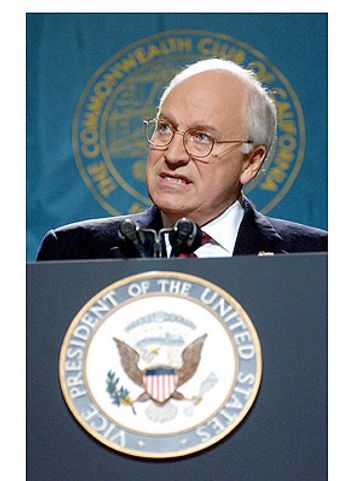
The context: With the anniversary of the Iraq War approaching, terrorists bomb a Baghdad hotel, levelling the building. Seven are killed; dozens are wounded. The bombing came on a day in which Vice President Dick Cheney and John Kerry both made some of their most ambitious comments to date about Iraq and terrorism. The New York Times, in a front-page, top-of-the-fold story by Nick Madigan and Katharine Q. Seelye, gave the lead strictly to Cheney. The headline: “Cheney Attacks Kerry’s Record on the Military.” The lead: “In a blistering critique of Senator John Kerry’s record on military issues, Vice President Dick Cheney on Wednesday portrayed the Democratic presidential candidate as weak, inconsistent and a threat to the security of the nation.”
The souped-up lead is followed by two withering quotes from Cheney, by which time some strong impressions have been created in a reader’s mind. Only in the fourth graf does Kerry get to respond that Bush policy had left the nation “bogged down in Iraq” and its troops “with the target squarely on their backs.” Structured as it is, the story gives Cheney a nice little propaganda win. But why use that structure? If there’s a good reason, it’s not evident in the story. In the parlance of newsrooms, why not use a double-barreled lead that features both men attacking each other, even as terrorists strike in Baghdad? That would be fair, accurate, efficient — and much more dramatic.
At ABC News, meanwhile, political director Mark Halperin and his crew at The Note showed a different sort of impaired vision. They might’ve questioned how Cheney could credibly attack Kerry as soft on security on the same day that Baghdad, under Bush’s watch, was in flames. But no — here’s The Note’s lead: “As John Kerry begins his own (semi-)private Idaho vacation, here are the mistakes his campaign has made of late, allowing an aggressive Bush-Cheney operation to win a series of news cycles, during this (ALL TOGETHER NOW!!!) critical period in defining John Kerry for America.”
The Note’s piece is a good read; the analysis is strong. Yes, Kerry bumbled through a bad week. But hey — on a day when Bush’s Iraq and terrorism campaigns seems to be approaching meltdown, are news-cycle victories or Kerry’s vacation really more significant?
And then there were two
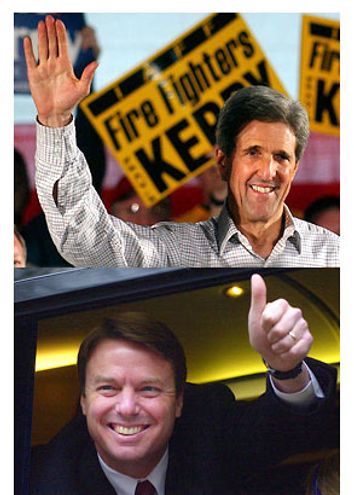
Kerry breaks into the open field, with Edwards still in pursuit -- while the Dean meteor continues to burn out.
By Edward W. Lempinen
After a month of surprise, confusion and tumult, the race for the Democratic presidential nomination is, suddenly, much more clear: The nomination is John Kerry’s to lose.
John Edwards won in South Carolina Tuesday, and he made a strong showing in an Oklahoma race that was too close to call even after all the votes were in. But Kerry, the liberal senator from Massachusetts, took the bellwether state of Missouri by a commanding margin over Edwards. In addition, he won in Delaware, North Dakota, New Mexico, Arizona, placed a strong second in South Carolina and was running strong in Oklahoma.
Howard Dean, considered a sure winner by some pundits just a month ago, was scarcely a factor in the seven primary elections Tuesday. He predicted that his “turning point” would come Saturday in the Washington state caucuses, but even with a win there, it is difficult to imagine a run of future victories that could give him the nomination. Sen. Joe Lieberman and retired Gen. Wesley Clark posted disappointing numbers in the seven-state primary. Lieberman quit the race Tuesday night, and even if Clark holds on to his narrow lead in Oklahoma, he may not be long for the game.
Edwards staffers tried to make the best of their one victory, casting the race from here on out as a two-man contest. But Kerry, already in Seattle, delivered a front-runner’s speech aimed at the Republican incumbent.
“George Bush, who speaks of strength, has made America weaker,” he told cheering supporters. “Weaker economically, weaker in education, weaker in health care. And the truth is that George Bush has made America weaker by overextending the armed forces of the United states, overstraining our reserves, driving away our allies, and running the most arrogant, reckless, inept and ideological foreign policy in the modern history of our country.
“Our opponents say that they want to run on national security. Well, we will not run from that debate — I welcome it. I will remind them happily that some of us know something about aircraft carriers for real.”
But in a different forum, Kerry saved a shot for Edwards. In an interview with the Associated Press, he said he was “stunned” by his large wins in Delaware, Missouri and Arizona; he called the night a big success despite finishing second to John Edwards in South Carolina. “I compliment John Edwards but I think you have to run a national campaign, and I think that’s the strength we have shown tonight,” Kerry said. “You don’t cherry-pick the presidency.”
Pundits agreed he was by far the day’s big winner.
Democratic strategist Doug Schoen was typical. If Kerry “wins in five states,” Schoen told the New York Times, “it’s almost over; six, almost certainly over; seven, it’s over.”
By Schoen’s count, it’s almost over.
For months, campaign strategists had looked forward to Feb. 3 as the first make-or-break date of the primary season. Because Iowa and New Hampshire are the first races in the campaign, they get a lot of attention, but they’re small and not especially representative of the nation as a whole; the premium in those races is on door-to-door, face-to-face politics.
Clark all but said that the race didn’t even start until Feb. 3; Lieberman, too, skipped Iowa. Clearly, they were wrong. Dean’s strategy, as the underdog who became front-runner, was to dominate those first two contests so completely that he overwhelmed the opposition, leaving Feb. 3 voters no practical choice but himself. But he fared poorly in Iowa and New Hampshire, and his campaign imploded.
On Tuesday, there were races in the East, the South, the Midwest and the Southwest, a sample much closer to a cross section of the nation. Unable to be seven places at once, the candidates were forced to rely much more heavily on advertising and ground organizations — a race similar to a national, general election campaign. And there was only one way to interpret the results: After an intense affair with Dean and an intriguing flirtation with Clark, Democrats are getting ready to tie the knot with Kerry.
It’s a pragmatic choice, not one resulting from a drunken, poetic infatuation. His initials are JFK, but few have the illusion that he’s a Kennedy-esque candidate. He’s not especially telegenic. His can be less than inspiring on the stump. He’s a millionaire in populist’s clothing. He undoubtedly cast some votes as a veteran senator that will come back to haunt him. And yet, the marketplace of Democratic voters seems to be settling on him as the candidate who has the best package of attributes — and who is, therefore, most able to defeat Bush in November.
In simplest terms, he’s a conventional baby-boom liberal. Among all the Democratic candidates who have served in Congress, his ratings with the liberal Americans for Democratic Action are the highest — 92 out of a possible 100. Even so, he has cast votes with President Bush on key issues, such as the authorization to invade Iraq — votes that could inoculate him with some centrists and disenchanted Republicans. He has an appealing personal story line. He served with distinction in Vietnam, and has the backing of many veterans; and yet as one of the leaders of Vietnam Veterans Against the War, he earned credentials as an antiwar, counterculture hero.
He is, arguably, the candidate who can credibly reach to the left and the right for votes and credibly challenge Bush on national security issues — assuming he’s the Democrats’ nominee.
A new CNN/USA Today/Gallup Poll this week seems to bear that out. In a head-to-head match-up, Kerry defeats Bush 53 percent to 46 percent. Edwards edged Bush, too, but only by 1 percentage point — a statistical dead heat.
That’s how the dynamic seemed to play out Tuesday in Missouri, too. With attention so focused on South Carolina, the Show Me state has been almost an afterthought. But with an economy ravaged by recession and job losses, it is of critical importance to Democrats, and most analysts say it will be one of about 15 states where the presidential race will be won or lost in November. (The others include such delegate-rich states as Florida, Pennsylvania, Ohio and Michigan, along with smaller prizes like Minnesota, Oregon, Nevada, New Hampshire and Arizona.) Kerry dominated the contest Tuesday, with over 50 percent of the vote in early returns, compared to roughly 20 percent for Edwards.
Make no mistake — the race is not over. The weeks ahead may demonstrate again the deep cultural and political disagreements that define the nation, and the Democratic Party. It appears, for now, that Edwards and perhaps Dean will be able to exploit that. Edwards’ best hope is to peel off the South; Dean, fighting a guerrilla action, might hope to lock up the Left Coast with wins in Washington on Saturday and in California on March 2. (Oregon doesn’t vote until May 18.)
Edwards, the boyish, first-term North Carolina senator, was in Columbia, S.C., last night, but with the Tennesee primary scheduled for next Tuesday, he was set to visit Memphis Wednesday morning and in Norfolk, Va., that afternoon.
The scheduling suggests that Edwards may not make a full-scale push in Michigan, the culturally diverse, industrial powerhouse where polls give Kerry a commanding lead heading into Saturday’s caucuses. But Edwards could poll well in Tennessee and Virginia next Tuesday; if he continues to build momentum in the South, he could enter Super Tuesday on March 2 with hopes of scoring well in Texas and Georgia and, a week later, in Florida, Louisiana and Mississippi.
Dean’s campaign, once so hip and so hot, is now in disarray — and, apparently, flaming out. He all but skipped the Feb. 3 contests, and though his supporters had low expectations, Dean’s numbers may have been even worse than they expected. Preliminary results showed that he won less than 5 percent in South Carolina and Oklahoma, about 8 percent in Missouri, and roughly 10 percent in Delaware.
Now he is turning to Washington, where he has a large, energetic base of support, in hopes of breaking his fall. After mocking Kerry as “Bush-lite” earlier this week, he has continued to attack the new front-runner as a cog in the Beltway status quo. At a rally Tuesday in Spokane, he told supporters bluntly what is at stake: “If you want change in America, at 10 a.m. on Saturday you can have it because Washington state is going to be the turning point — if we win — of this campaign.”
For the four other Democrats still in the race, Tuesday’s vote was a test of viability — and all four seemed to fail the test. Clark, the war hero and former NATO commander who was seen by some as the most capable of challenging Bush on national security grounds, may have stayed alive with an apparent victory in the close Oklahoma race. While he attracted a core of committed volunteers and high-profile endorsements, his candidacy never gelled. He had been expected to win Oklahoma, but he lost ground late to Edwards and Kerry.
His only son, 34-year-old screenwriter Wesley Clark Jr., suggested a loss in Oklahoma should compel his father to drop out of the race. But he blasted the news media yesterday for coverage of his father’s campaign.
“You go out and see the way politics really works,” he complained to reporters. “It is a dirty business filled with a lot of people pretending to be a lot of things that they are not … There was a lot of sneering and whispering going on by columnists and talking heads … It is all a horse race. No one is talking about the issues.”
Lieberman, who supports the Iraq war and is the unofficial candidate of the centrist Democratic Leadership Council, never found traction in a race that has been shaped in early months by Dean’s fierce antiwar critique, and by a general assault on Bush that has found its courage in recent weeks. He sought hope where he could find it, touting an endorsement by the Arizona Republic as evidence of his “Joe-mentum.” He was hoping for another boost in Delaware, but the “Joe-mentum” turned to “slo-mentum” there. Kerry won the state, and soon after the polls closed there, Lieberman quit the race.
Dennis Kucinich, the leftist congressman from Ohio, did nothing Tuesday night to improve on his weak showing in earlier races.
The Rev. Al Sharpton finished far off the lead in South Carolina yesterday, with 10 percent of the vote, but early reports suggested that even African-American voters there preferred Kerry and Dean. The New York civil rights leader was hit this week by reports in Salon and elsewhere that he has made a de facto alliance with a Republican campaign team, which apparently helped raise the money to keep him in the race.
Now, and perhaps for the next month, it’s a two-man race, with Kerry clearly the dominant force and Edwards a long shot: Dean could theoretically still be a factor, but that’s looking less and less likely. Even if Kerry is able to hold his momentum, fascinating political questions will be playing out just below the surface of the campaign.
Is Edwards running for vice president, and when will he make that decision? Last night, he insisted that’s not the case. “I think this is the continuation of the surge we’ve seen in the other caucuses and primaries,” he said. “We’re in as good of financial shape as any campaign in the race.” If Kerry creams him in the big March 2 primaries, packed with states like California and New York that are likely to swing to the Massachusetts senator, will Edwards remain in the race, tantalized by the March 9 primaries in Florida, Mississippi and Louisiana? If he does well there and thinks he has a shot, he could conceivably remain in the race all the way through June 1, trying to pick up states like North Carolina, Kentucky and Alabama.
Such a move, however, would likely hurt Democratic Party unity. An earlier Edwards departure would make it easier for Kerry to select him as a running mate, a development many are predicting.
Dean insisted again last night that he’s in the race for the long haul. “We’re going to keep going and going and going and going,” he told supporters in Tacoma, “just like the Energizer Bunny.” But on MSNBC’s “Hardball,” Dean qualified that slightly. “Is the long haul February 17 in Wisconsin?” asked host Chris Matthews. “No,” Dean replied, “the long haul is March 2nd.”
If he stays in, what’s his objective? Though he insists he can win the nomination, he’s lost in nine states and won in none — voters aren’t drinking the Kool-Aid. He might pin his hopes on March 2, but unlike with Edwards, the primary schedule offers him no hope after that. If he doesn’t win on Super Tuesday, he’s finished. At what point does he hurt the party’s effort to defeat Bush?
Perhaps his goal is to keep Kerry honest, and to maintain the influence of the Deaniacs on the party agenda as long as possible. If that effort keeps his supporters engaged and energized, and if it doesn’t become destructive, Dean can take satisfaction that, even in a losing effort, his effort has helped the party. And in the end, that would be good for Kerry, too.
Laura McClure and Mark Follman contributed to this report.
The curse of the orange hats
By Edward W. LempinenFor the next 48 hours or so, while the journalistic ground troops are on their way from Iowa to New Hampshire, the BSDs of the pundit class will be vivisecting the Howard Dean campaign to determine what went wrong Monday night. So far, everybody’s overlooked the blip of trouble that began to flash on Iowa radar about a week ago: the bright orange watch caps worn by Dean’s volunteers.
An estimated 3,500 or more earnest Dean ground troops were in the corn-belt state last week, during the cold heart of winter, for a precinct-by-precinct effort to turn on and turn out Dean voters. They were known as “The Perfect Storm,” or, among journalists on the trail, as “the orange hats.” Bright with the light of common faith, that volunteer corps was supposed to provide Dean with the margin of his success. No other campaign could match those numbers or that degree of commitment, the pundits said.
But it didn’t work.
Maybe it’s unfair to blame the hats, but put yourself in the boots of an average Iowa Democrat a few days before the caucus. The campaign is so intense that it has become a form of political harassment. Your phone rings every 10 minutes with an automated robo-call on behalf of one candidate or another. Your mailbox is jammed with political junk mail. Then comes a knock on your door and there you find a couple of committed campaigners from Park Slope or Noe Valley or Wicker Park telling you that Howard Dean is your man. And they’re wearing these really loud orange caps.
How would you react if a bunch of Iowans invaded your neighborhood like that? Now you’re beginning to understand what might’ve happened to Dean on Monday.
Sure, many factors are to blame for Dean’s bad night, but the orange hats are more than a footnote in the history of haberdashery. Though issues are important in a political race, a candidate is just as likely to rise and fall on the semaphore of style and symbols that define a campaign.
In the aftermath, I can’t help but think the Dean-ites came off as a little precious, maybe even a little bit cultish, in those caps. What was the point? Were they trying to impress Iowans with the size of their army? Were they a subtle, ironic comment on the presumed nerdiness of the locals? Were they an expression of uncritical devotion to the higher political cause? Inevitably, the choice of headwear set the volunteers apart, and not in a good way. It made them stand out, much as saffron robes make a Hare Krishna devotee stand out at an airport. And “The Perfect Storm” imagery? Someone should have told Dean: In the Midwest, when the weather turns violent, sensible people get away from windows and doors and head for the basement to wait it out.
Iraq is not Vietnam
The antiwar left shows a troubling indifference to the plight of Iraqis -- and flirts with irrelevance -- by demanding that President Bush bring the troops home now.
By Edward W. Lempinen
It is a terrible thing to watch a war in progress, even from a distance. If there’s a pulse in your imagination, you have some sense of the violence of it, the fear and the grief of it; men and women, children and animals, are killed and injured, losing homes, farms and possessions. Even when the worst of the fighting is over, there can be months, even years, of dislocation and suffering. It is impossible to watch without a solemn wish that it hadn’t been necessary, and that it should come to an immediate end.
It is no surprise, then, that as we near the six-month mark in the difficult Iraq War, “bring the troops home” is emerging as a defining sentiment of the antiwar left and making its way into some parts of the mainstream political dialogue. A group of antiwar military personnel and their families has adopted the name “Bring Them Home Now.” The sentiment is seeping into the Democratic campaign for president. Dennis Kucinich, the antiwar Democratic presidential candidate, issued a statement on Aug. 25: “It was wrong to go into Iraq. It is wrong to stay in Iraq. Let’s support our troops by bringing them home.” The language even crept into remarks from South Dakota Democrat Tom Daschle, the hyper-cautious minority leader of the U.S. Senate, when he insisted earlier this month that Bush must offer to Congress a war spending plan “that clearly lays out how we’re going to succeed in Iraq and how we’re going to bring our troops home safely.”
Daschle’s demand is not only justified, but responsible — and yet his choice of words is disconcerting. It is the nature of mass politics that the most complex issues are distilled to bumper sticker slogans; the unfortunate effect is that these slogans can become the driving political imperative. And so the emergence of “bring the troops home” as a slogan this early in the Iraq War is an ominous development. The slogan is catchy, yes, but it is laced with contradictions and questions that resist simplification.
At what point, exactly, should we bring them home? What happens then to Iraq? Is it realistic to expect France and Germany or the 21 neighboring governments of the Arab League — none of them democracies — to take over? Who prevents Saddam followers or hard-line Islamists from seizing control at the barrel of a gun? And in that event, what happens to the Iraqis who were thrilled by Saddam’s fall or to those who oppose rule by conservative Muslim clerics?
In the months and weeks leading up to the invasion of Iraq, it was possible for reasonable people to disagree about whether the war was in the interests of national security or morally justified. Such disagreements were inevitable, because the prospect of war presented Americans their counterparts in the U.K. with one of the most complex dilemmas of our era. In the aftermath, as it has become clear that the administration of President George W. Bush misled the American people about the nature of the threat, many liberals and leftists have rightly pressed to hold him accountable. But in a climate of frustration and rage, the use of slogans like “bring the troops home” or “he lied, they died,” is luring partisans into a realm of moral simplicity. And for everyone on the left — whether antiwar, pro-war or morally conflicted — this should be a cause for concern.
In adopting a seemingly single-minded campaign against Bush, Vice President Dick Cheney and their allies, those in the antiwar left run the risk of alienating moderates and losing perspective on the war. Their perspective distorted by righteous indignation, they run the risk of forgetting the tyranny of Saddam Hussein and the profound suffering endured by the Iraqi people for the past quarter-century. They run the risk of forgetting that, no matter how dubious and confused and corrupt the White House motives, the invasion might in fact work toward the liberation of the Iraqi people. That is a worthy goal, and one that the left might invest in. But that point increasingly seems lost in the hyperbole and hysteria of some attacks against Bush.
Consider the evidence: New York Times columnist Maureen Dowd describes Iraq as a “country full of people that revile us.” Left-wing journalist Greg Palast writes a frivolous fantasy about Bush resigning at the second anniversary of the Sept. 11 terror attacks. A Salon reader writes a letter to the editor: “It’s a travesty that our soldiers and the Iraqi citizenry are made to endure the mess the administration created.” A woman at a political forum in Iowa tells the Des Moines Register: “George W. Bush is ready to blow up this world in our name … The vast majority of people watching this are never going to vote for you or anyone else because the disbelief and the disenchantment is that great.”
No doubt there is great disenchantment. That’s the inevitable product of Bush’s arrogance, deception and incompetence, compounded by the unprecedented budget deficits created by his tax cuts. Bush didn’t ask the American people to go to war to liberate Iraq; he sold it as essential to American security, and in fact it seems now that the outcome could tip decisively toward greater insecurity. And yet, these and other commentators lack a sense of history, and of moral proportion. Bush is guilty of profound failures, but nothing as immediately urgent and irreversible as the crimes against humanity committed by Saddam. He provoked war with his neighbors. He starved and repressed his own people, systematically murdered and tortured intellectuals, artists, clerics and others who opposed his regime. He is responsible for the deaths of a million people. And all the while, he fanned anti-Semitism and anti-Americanism throughout the region.
There were good arguments against the war. The United Nations should have signed off on the invasion (though it must be said that the U.N. showed no particular concern for the plight of the Iraqi people). The administration manipulated intelligence to justify the attack. Bush and Blair did not have a postwar plan adequate to win the peace. In the days after Bush submitted his low-ball request for $87 billion to support military and rebuilding campaigns in Iraq and Afghanistan, we are reminded of the best argument against the war: That it would be so expensive in human lives and taxpayer dollars, and so destabilize the region that it could not be justified, even if that meant cost-savings and geopolitical stability must be achieved on the backs on the Iraqi people and on Iraqi generations unborn.
Today, though, all of those arguments are moot, even the best of them. The invasion is done, the moment is past. Now we see how the plan was flawed, and we see there are life-and-death problems. The time has come for the antiwar left to determine what role, if any, it will play in solving those problems.
For some, especially in the antiwar camp, this is not an easy transition.
Every generation, as it comes of age, feels a yearning for a great cause that inflames righteous political passion, a cause that directs its best energy to the achievement of something great and memorable. For the generations that fought World War I and World War II, history imposed that cause and exacted a great toll. From this yearning, and this action, has come much of the most memorable literature, poetry and music in Western cultural history.
The late 1960s were the defining moment for the generation of baby-boomers who are the dominant force in our culture, and in many ways, for the entire post-WWII era; succeeding generations have aspired to the same significance. The protests in favor of civil rights and against the Vietnam War — and, more generally, in favor of peace and love — created an iron template that shapes our values today.
Perhaps that explains an impulse that was evident for months before the invasion: the Vietnamization of Iraq. Many of the mass demonstrations before the war were described as festive. There was a feeling of recreating the ’60s, and the hip, intoxicating power and influence of the counterculture in that decade.
By the second week of the war, when it became clear that the invasion was meeting resistance, antiwar leaders and other commentators were already warning that Iraq would become a quagmire. When Iraqis began to pull down Saddam statues a couple of weeks later, that premature concern was silenced, though only for a time. With the administration’s failure to restore services and security since the fall of Baghdad, with the emergence of an elusive anti-U.S. guerrilla force and the slow but steady rise in the number of U.S. casualties, antiwar activists and others are questioning the war effort more aggressively than ever, and more effectively. The slogan “Bring the Troops Home” is an echo of those days, imposing the vernacular of the Vietnam era onto the war in Iraq.
But we must be clear on one crucial point: Iraq is not Vietnam.
Yes, there is a risk that Iraq will exact a huge cost in lives and money, as Vietnam did, and we may again find it difficult to achieve our aims and find a constructive exit. But if we see the two conflicts as morally similar, our perspective will be dangerously distorted. That diminishes the tragedy of the earlier conflict and fails to appreciate that the political character of the current conflict is altogether different. And where our perspective is distorted, so is our political response.
Vietnam was a theater of the Cold War. As part of a broad effort to check the spread of communism, the U.S. sought to suppress a popular uprising of the Vietnamese people and to impose a non-democratic government in its place. Though the Iraq war has been initiated by an administration of radical conservatives, it has had the effect of toppling a Stalinist tyrant and has, though haltingly, moved to give the Iraqis freedom and to put power in their hands. Vietnam was a war that suppressed freedom and self-determination, though fought in the name of preventing Communist tyranny; the Iraq war, whatever its motive, has had the effect of freeing the Iraqi people from tyranny.
Vietnam was backed energetically by Russia and China; Saddam’s cause today is backed by virtually no one, though perhaps the hard-line ayatollahs of Iran and Islamist fascists of al-Qaida are trying to exploit the war for their own gain. The first U.S. soldier died in Vietnam in 1959, and by the time the war ended in 1975, 58,000 Americans were dead, along with 400,000 South Vietnamese and 900,000 Viet Cong and North Vietnamese. In Iraq, as of Friday, 347 U.S. and British soldiers had died in combat and non-combat situations over the past six months; roughly 7,000 Iraqi civilians have died, along with unknown thousands of Iraqi troops.
I don’t mean to diminish these casualties by saying they are fewer than those in Vietnam. No, we should regret every one of them, and grieve every one. But they should remind us that freedom often imposes a cost, and that the battle for freedom is sometimes a life-and-death struggle, a struggle that demands patience.
We forget that the birth of the United States took 13 years, from the start of the Revolutionary War in 1775, through the British surrender in 1781, to the ratification of the U.S. Constitution in 1788. Without the help of the French government and the Marquis de Lafayette, the American rebels might have lost the war. And when the revolution was finally won, Lafayette penned his famous line: “Humanity has won its battle; Liberty now has a country.”
Which brings us to the core of the present contradiction: A vocal bloc of the antiwar left does not see the invasion of Iraq as a liberation. It cannot. Its rage against Bush, while justified, is so powerful that it overwhelms subtlety and nuance. In such a polarized political climate, one cannot embrace the possibility of liberation without seeming to embrace Bush and Cheney. Because that latter embrace is impossible, it becomes impossible for some to strike a firm, constructive alliance with the Iraqi people.
That reflex was evident in the run-up to the war. Millions of people turned out for demonstrations in the U.S. and Europe, and though many Iraqi exiles — including religious leaders and intellectuals — had favored the invasion, the marchers rarely confronted the issue of human rights under Saddam. Sometimes, they were openly hostile to Iraqis on the march route who dared to question the antiwar movement. Such are the ugly dynamics of political denial: The human rights dossier conflicts with the imperative to oppose Bush, and so the dossier is, in effect, ignored.
A similar trend has unfolded since the fall of Baghdad: Though there have been many positive developments, there has been a disproportionate focus on the struggles, the failures, the breakdowns. Thus the attention paid to the now-infamous 16 words in Bush’s State of the Union speech that claimed hard proof of Saddam’s quest for nuclear weapons, or to the claim by the government of U.K. Prime Minister Tony Blair that Saddam needed only 45 minutes to launch a WMD strike, or to the enrichment of Cheney’s old posse at Halliburton.
The press, too, bears some blame for creating the distorted perspective. By focusing on the points of highest drama, the news creates an impression that Iraq is engulfed in chaos. But the impression is misleading. Iraq is the size of California; most of the attacks have occurred in the so-called Sunni Triangle, the land between Baghdad in the south, Fallujah about 35 miles to the west, and Tikrit, about 100 miles to the north. That’s roughly the size of the triangle between San Francisco, Santa Cruz and Modesto, or between Manhattan, Philadelphia and Allentown, Pa. The bombing of the U.N. and other symbolic targets in Baghdad and elsewhere in the Sunni triangle have been terrible, but the rest of Iraq is relatively stable, with only scattered attacks. There have been periodic mass demonstrations against the occupying forces, but they are not daily and not widespread. Though Iraqis appear bitterly frustrated with U.S. incompetence, they have thus far given the U.S. and U.K. time to get things in order.
The left sees through many of the distortions of the mainstream press, and it would see through this one, too, if it wanted to. But that does not serve the political purpose of some blocs in the anti-Bush movement: To defeat Bush, the war must be a failure. And so the sense emanates from some quarters that the war should’ve been over and done in a matter of days, or weeks, and that, with sporadic fighting continuing now six months into the Iraq conflict, and with new casualties every other day, or every day, it is time to bring the troops home and to hang the shame on Bush.
This is precisely the point at which the antiwar left runs the greatest risk of losing sight of the Iraqi people. Implicit in some of the current antiwar slogans is the conclusion that Iraq would’ve been better off without the war. If the ultimate objective is Bush’s failure, then the gains of the Iraqi people might be inconvenient and therefore discounted, consciously or subconsciously. But there have been considerable gains, and long-term liberation does remain a possibility.
The torture chambers are closed. Uday and Qusay Hussein, Saddam’s sociopathic sons and his likely successors, are dead. An Iraqi governing council has been established, and though it has yet to find traction, it can at least be said that Ahmed Chalabi, the unpopular Iraqi exile, is not the dominant force that Bush’s neo-con hawks hoped he would be. A new Cabinet of 25 Iraqi officials was named this month to oversee day-to-day government services in the country. There is freedom of speech and religious freedom (both of which are being used to criticize the U.S.) There is freedom of the press. Take a look at the smart new publication Iraq Today, and you see evidence of a nation that is frustrated, fearful, angry — and still, in spite of it all, hopeful.
“The new Iraq will be different from that of Saddam Hussein,” Iraqi Foreign Minister Hoshyar Zebari told the Arab League this month, at his first meeting since joining the group. “The new Iraq will be based on diversity, democracy, constitution, law and respect for human rights.” The other ministers must have listened with misgiving, because none of them share those values.
The antiwar left has seized on Bush’s accuracy problem, and that’s a good thing. Using misinformation and propaganda to manipulate public opinion might be the coin of the corporate realm and political campaigns, but the behavior is profoundly undemocratic. So too with patronage, corruption, dishonesty and the deadly failures of postwar planning. It is essential to hold Bush and his allies accountable for their attacks on U.S. democracy and their failure to provide, as much as possible, for the security and well-being of the Iraqi people.
Even Bush allies have come to acknowledge that his postwar plan has been deeply flawed. Much of the public now accepts that Bush’s case for war was based on exaggeration, distortion and deception. He provided no concrete evidence that Saddam was stockpiling weapons of mass destruction. The administration claimed an alliance between Saddam and al-Qaida, but never came close to proving it. And yet, in his brief speech to the nation on Sept. 7, Bush insisted again that Iraq “is now the central front” in the global war on terrorism. With increasing frequency, even mainstream analysts are responding to such arguments with disbelief that verges on derision.
But among those who are liberals or leftists, rage is an insufficient response to the current state of affairs. Apart from all the incompetence and corruption evident in Bush’s handling of the invasion, in spite of his dubious motives, something hugely important and inspiring is happening in Iraq: The 25 million people who live there today have a degree of freedom and opportunity that most of them have never known. And while there’s much potential for the effort at liberation to collapse, there is also the potential that it may succeed.
Am I being naive? Possibly. Maybe the governing council and the Cabinet and the noble words of Hoshyar Zebari are symbols orchestrated by Washington to make the sale back home, even though they’re unrelated to political reality as perceived by the average Iraqi. I continue to wonder why many Iraqis seem more angry at the U.S. than at Saddam or the saboteurs who target their power stations and oil pipelines. Certainly I know how tenuous conditions are in Iraq; perhaps a few more car bombs, timed and targeted with care, could plunge the whole country into chaos.
The difficulty, for many on the left, is that the war and Bush seem inseparable, so that if you cheer the liberation, you seem to be cheering Bush and Cheney. But that perspective, too, is a form of shortsightedness: If the war is not over in a matter of weeks, one thinks, then it is lost, or not worth fighting. When the car bombs blow, you say: “I told you so.” The Iraqis are responsible for their own freedom, or maybe you think that the Arab world is not ready for freedom. These are the thoughts that can sometimes be implicit in a slogan like “bring the troops home.”
There is another way of looking at things: Bush and Saddam, each in his own way, poses a profound threat to democracy, and so it’s incumbent on us, even those who vehemently opposed the war, to oppose both of them while pressing to provide sufficient aid and support to make the liberation of Iraq a reality. One can oppose the enrichment of Halliburton, and yet still help to rebuild Iraq.
But there are no easy answers; it will take patience and commitment, and the costs will be significant. The history of places like Germany, Russia and Cambodia tells us that the damage done to the soul of Iraq in the years under Saddam will take a long time to heal. Many on the antiwar left are urgently calling on Bush to hand off the conflict to a multi-national United Nations force, but that may be a dangerous shortcut, or an outright illusion. On a recent edition of CNN’s “NewsNight with Aaron Brown,” former CIA analyst and Middle East specialist Reuel Marc Gerecht spelled out how troops from France and Russia, even Turkey and other largely Islamic nations, might reawaken old antagonisms among the Iraqis. Katrina vanden Heuvel, editor of the Nation, appeared on the same show to argue the antiwar point, but she had no answer for that. And even if other countries were to provide troops through the U.N., they could summon only a fraction of the 140,000 U.S. soldiers now stationed in the country.
Many of those troops are weary and uncertain, I know. Even as I lament the losses among them, I’m also thinking these days of the tens of thousands of Iraqis who rose up against Saddam in 1991, with the encouragement of the first President Bush, and how they were abandoned by the U.S.; today their bodies fill the mass graves that are being discovered throughout the country. And I think, too, of Iraqi poet and novelist Hamid al Mokhtar, who was profiled in a May 1 story by my colleague Phillip Robertson. Mokhtar was held for eight years and repeatedly tortured in Saddam’s notorious Abu Ghraib prison; with Robertson, he returned to the prison for a grim tour of the cells and the death chambers where thousands were hanged. “We don’t want revenge,” the poet said, “we want the judgment of the law and not of the person.”
At this moment, Hamid al Mokhtar confronts the left with a choice — and not just the antiwar left, but pro-war progressives and those who remain morally conflicted: Either press to get the U.S. out of the region ASAP, or fully commit to the rebuilding of Iraq. Do the job quickly, or do the job right. We might’ve preferred a different choice, or different terms, but this is what history has given us.
The choice will play out starkly in the presidential campaign now underway. A majority of the American public realizes that Bush misrepresented the evidence for war and had no credible postwar plan, and that incompetence can be turned against him. To back a candidate simply because he opposed the war is a gesture, and gestures alone will not save the lives of American troops or restore our place in the world or preserve the Iraqis’ freedom.
Liberals and leftists must argue that a Democratic president is needed to clean up the Republican mess. They should make the case that the country must elect someone who will reverse the Bush tax cuts, at least in partly if not entirely, and use some of the proceeds to fully secure Iraq and our troops there. Elect someone with the diplomatic connections and skill to restore constructive ties with Europe, Latin America and the United Nations. Elect someone who can both level with the American people and build trust with the people of Iraq.
Leaving Iraq prematurely is the worst message that the U.S. can send to the world; that would only confirm the cynicism and lack of commitment that others perceive in us, and it’s not a message the left should endorse. Instead, we should suspend use of the slogan “Bring the Troops Home” before it catches fire. Better to rally behind a new line: “Do the Job Right.”
And bring the troops home when the job is done.
See no evil
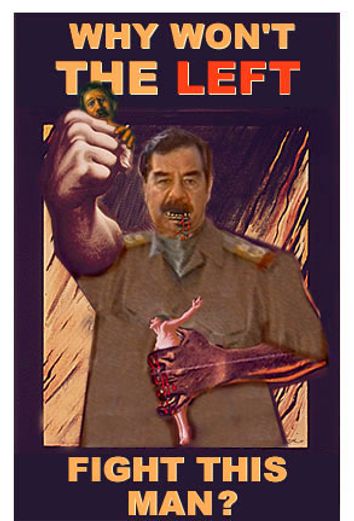
Progressives have lots of arguments against the war on Iraq -- some of them compelling. But why aren't they burning to free Saddam's oppressed masses?
By Edward W. Lempinen
Amina Lawal is a Nigerian divorcee, illiterate and unemployed, and when she gave birth to a baby girl out of wedlock in 2001, neighbors in the Muslim village where she lives reported her to local authorities. She was arrested, charged with adultery and, after a trial in one of the new Islamic courts, sentenced to death. Her case has attracted international attention, and there is hope that the sentence will be blocked. But human rights monitors say her life remains at risk: If the sentence is carried out, she will be buried up to her waist in the ground and then stoned until she is dead.
Amina Lawal’s case is undoubtedly complicated. Yet the more I consider it, the more I feel the urge for a simple, primitive response. I know there is intensifying conflict between Christians and Muslims in Nigeria; I know that in the interests of bringing calm to a volatile situation, the United Nations or the government of the United States, joined by allied countries and interest groups, should exercise every possible diplomatic channel to prevent her execution. But if that were to fail, the urge says, let’s send in a small, skilled military squad to rescue her and her loved ones. Even at the risk of casualties, let’s use military force to achieve humanitarian ends, and in saving the life of a 31-year-old Muslim peasant, let’s send a message to the poor and dispossessed of the world, and to the religious zealots and tyrants who repress them. Let’s just do it.
I can imagine many leftists would share the same urge, and yet, the more deeply I consider it, the more complicated the problem becomes. First of all, why Amina? Why not any of a million other victims of tyranny, including many in our own country who are threatened with cruel and unusual punishment? If you start with Amina, where does it stop? We can’t solve all the problems of the world. And perhaps intervening to save Amina will only incite the furies of the Nigerian Muslims who rose so violently in the days before the Miss Universe pageant. We have to let the Nigerians solve their own problems. Violence, in the long term, will only beget more violence.
The problem is so difficult that I’m nearly paralyzed by the awareness of things that could go fatally wrong. Until, inevitably, this complex set of calculations leads back to the root equation: In the worst-case scenario, if we do not seek a military solution, then we must let Amina Lawal die. To some degree, then, I would be responsible for her death.
I find myself thinking a lot about Amina Lawal these days because the moral dilemma she poses so closely parallels the dilemma that has confronted the left as the United States and a few allies move toward an unpopular war to overthrow Saddam Hussein in Iraq. Though there is indisputable evidence that Saddam Hussein has sought to become a nuclear power, though it seems clear that he is hiding chemical and biological weapons, and though he is guilty of human rights abuses on a harrowing scale, many on the left are deeply conflicted because it is so difficult — in fact, it is impossible — to know whether the human costs of taking him out would be greater than the costs of attempting to undermine him through more gradual means.
On balance, though, the left in America and Europe has come down strongly against the war. And in protest marches, antiwar advertising and local arts events, the evidence leaves one to wonder whether this highly visible bloc of the left has weighed these issues — weighed life by life the repression of the 24 million Iraqis who live in a ruthless police state, not to mention the thousands or tens of thousands who have been imprisoned without trial, tortured, exiled or killed. Instead, it sometimes seems that the left is so averse to war, especially war waged by America, that it is prepared to turn a blind eye to even the most ghastly realities. Perhaps it is because the left no longer sees these realities that its antiwar arguments tend to justify continuation of the status quo.
That, too, is a form of paralysis. But it is emblematic of an evolution in leftist values that has occurred so gradually over a period of decades that the profound nature of the shift is often not noticed. Today, the political counterculture and the antiwar movement in the West often seem to be one and the same. Instead of fighting fascists or other genocidal tyrants as it might have during the Spanish Civil War or World War II or even during the Central American conflicts of the 1980s, the modern left fights war; because the United States is the world’s most significant military agent, and because it has so often used military power to support anti-democratic governments, the left understandably fights the United States. Such opposition to war is reflexive, and too often outweighs its outrage on behalf of the oppressed. Its capacity for the kind of muscular empathy that leads to action has atrophied, leaving only the possibility of reaction, of opposition. The antiwar left does not mount massive protests against China, Pakistan or Egypt. Millions do not pour into the streets on behalf of the student-led democracy movement in Iran. And Saddam Hussein and Osama bin Laden are not angrily compared to Hitler — that treatment is more often reserved for George W. Bush.
Make no mistake: I consider Bush and his closest advisors dangerous. In policy and in manner, their anti-democratic tendencies are clear. In the overlapping wars on terrorism and Iraq, their hubris, their dishonesty and their incompetence have alienated potential allies at home and around the globe. Bush’s claims that Iraq is an immediate threat to the security of the United States, and that Saddam is allied with al-Qaida, have been unpersuasive. Even if the White House hawks had the highest and most idealistic motives, they have created such deep mistrust that nobody believes them. Where Saddam’s depredation should be the issue, in the eyes of the world, they themselves are the issue. In this way, Bush has discredited the very cause he claims to support.
And yet, I wonder: Is it possible that some of the most vocal and visible elements of the left are vulnerable to a similar charge? Whether George Bush or his father or Al Gore or Bill Clinton is president — in one basic sense, that is immaterial. Conditions in Iraq are what they are. With war now upon us, the deeper issue is about the relationship of American and European leftists to the people of Iraq, about our obligations to aid them in enormously difficult circumstances, and about the best means for doing so.
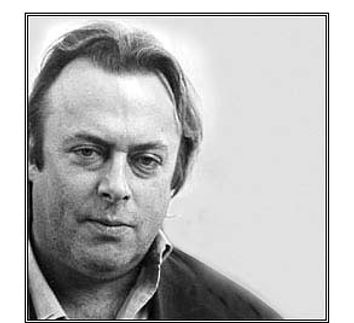
In the months leading up to war, the old paradigms of alliance and opposition have shifted strangely, or fallen apart. Though it is rarely visible in news accounts, the left is deeply divided. A huge and outspoken block of antiwar leftists finds itself allied with old soldiers of the Gulf War era, like retired Gen. Brent Scowcroft. Others once identified with the radical left, like the writer Christopher Hitchens, find themselves allied with George W. Bush, one of the most conservative presidents in the post WWII era. But the pro-war leftists, perhaps because they lack the numbers and a dramatic venue, are almost completely overshadowed by the antiwar leftists who can turn out millions for demonstrations around the globe.
In most every argument against the war, whether it is posed between friends over drinks or by the presence of 100,000 people at a wintry demonstration, there comes a crucial moment: “I’m not defending Saddam,” the argument goes. “I know Saddam is a ruthless tyrant. I know he has committed terrible human rights abuses. But …” What follows “but” is often a withering critique of Bush or the United States, Tony Blair, Jose Maria Aznar, or Silvio Berlusconi. Hidden in this argument is a curious dynamic: The words “ruthless dictator” and “human rights abuses” have been uttered so many times that they are like a dead key on a piano. They have lost their emotion and their power to convey anything close to the reality of ruthless dictatorship and human rights abuses.
Amnesty International has documented and cataloged Saddam’s abuses for 20 years. Reading this dossier brings to life the methodical daily acts of repression in Iraq; the means by which Saddam’s regime secures its hold over 24 million people is not at all abstract.
Consider this passage from a press statement last October:
“Amnesty International has over the years documented gross human rights violations committed on a massive scale in Iraq affecting all sectors of society. These violations, which have been committed by Iraqi military, intelligence and security personnel, have included ‘disappearances’ of thousands of people, the extensive use of the death penalty, extra-judicial executions, arbitrary arrests, long-term detention without charge or trial, grossly unfair and secret trials, systematic torture of suspected political opponents, judicial punishments constituting torture or cruel, inhuman punishments, prisoners of conscience, and forcible expulsions.”
Here is a passage from an August 2001 report:
“Torture victims in Iraq have been blindfolded, stripped of their clothes and suspended from their wrists for long hours. Electric shocks have been used on various parts of their bodies, including the genitals, ears, the tongue and fingers. Victims have described to Amnesty International how they have been beaten with canes, whips, hosepipe or metal rods and how they have been suspended for hours from either a rotating fan in the ceiling or from a horizontal pole often in contorted positions as electric shocks were applied repeatedly on their bodies. Some victims had been forced to watch others, including their own relatives or family members, being tortured in front of them.
“The scale and severity of torture in Iraq can only result from the acceptance of its use at the highest level.”
Even such descriptions as these seem too clinical, somehow, too bureaucratic. But in the Amnesty International files are many more personal stories, and some have haunted me since I first read them.
In October 2000, dozens of Iraqi women suspected of prostitution were arrested and beheaded, without trial. One of them was a Baghdad doctor who reportedly had been critical of the Iraqi health services. Another was a mother of three, whose Islamist husband had fled into exile while suspected of working against the state.
Then there is the case of a former army general who fled Iraq in 1995 and who, in exile, joined an opposition group. In June 2000, he received a videotape in the mail. He watched: Iraqi agents were raping a woman from his family. Soon after, the general got a phone call from Iraq, apparently from an intelligence agent. The caller asked whether he had enjoyed the “gift.” And by the way, the caller said, we still have her in custody.
Or consider the story of a former intelligence officer who was arrested in the mid-1990s. He apparently was suspected of having contacts with opposition groups. For two years he was held in solitary confinement at the General Intelligence headquarters in Baghdad. The cell was painted entirely red; even the light was red. The intelligence officer was subjected to regular and varied torture: He was hogtied and suspended from a metal bar. He was beaten and shocked. He was raped with a wooden stick. He was released at the end of 1997, but then, in 1999 he was arrested once more. The nightmare started all over again.
Strangely, it is not the physical torture that lingers with me. Rather, the red room haunts my imagination — and not just the color of it, but the intention of it. It is not enough to take him out of political circulation. It is not enough to wreck his body and humiliate him. They wanted to destroy his sanity. And then they sent him back to his family and friends so that his broken body and broken mind would convey an unmistakable warning.
I read these stories of intimidation, humiliation, murder and systematic subjugation, and I come away puzzled. Many of us on the left are preoccupied with cataloging the mendacity of the White House, or lamenting the ineffectuality of the Democrats; we spend hours researching how Republican officials or their cronies did deals with Saddam or how the impending war is a cynical ploy for taking Iraq’s rich oil fields. Of course it is essential to document these failures and misdeeds and to work relentlessly to hold these people accountable. Still, none of that addresses the issues raised by the red cell. None of these address the fact that Saddam, by some counts, is blamed for a million deaths.
What are we doing to make sure that not another woman is raped or beheaded as a form of political terror? What are we doing to make sure that not another man is humiliated and rendered mute and powerless as the ex-general was? What are we doing to shut down the headquarters of General Intelligence? In the community of human rights monitors, work toward these goals is heroic and often dangerous. These would seem also to be urgent goals for all who consider themselves progressive. But for the most part, in all the angry debate over the war, the left rarely discusses these issues. We acknowledge Saddam as a ruthless dictator and lament his human rights abuses, but we focus our rage on Bush.
When Secretary of State Colin Powell was preparing to go before the United Nations Security Council last month, there was a minor controversy over the decision to cover the U.N.’s tapestry of Picasso’s painting “Guernica,” a masterpiece depicting the suffering brought by war. But a crucial nuance was overlooked both by U.N. staffers who wanted the picture covered and antiwar critics who saw hypocrisy in the move.
The bombing of the Basque town of Guernica was carried out by Hitler’s Luftwaffe in 1936, as part of his effort to help fascist General Francisco Franco to overthrow the democratically elected leftist government of Spain. In a few hours of relentless bombing, 1,600 people were killed or wounded. Picasso was a Spanish pacifist and a leftist; he was a partisan of the elected government and an anti-fascist. His painting was perhaps a testament to the horrors of war, but in the context of the time, it would inevitably be seen as a testament to the specific horrors of fascism. Indeed, in the aftermath of Franco’s victory, Picasso would not let his painting be shown in his home country until “public liberties and democratic institutions” had been established.
The Spanish Civil War was the last war in modern times that galvanized the American and European left to take up arms. Famous poets and writers went to war against Franco — anarchists, socialists and communists — and when they died in the trenches, they became leftist heroes. George Orwell had not yet written his masterpiece “1984,” and he was among the wave of leftist artists and intellectuals who took up arms to aid the Spanish Republicans. In “Homage to Catalonia,” an account of his months on the front lines in northeastern Spain, we see just how the mind-set of a Western leftist in 1937 differs from the mind-set that prevails today.
Before Orwell was almost killed by a bullet in the neck, there were long weeks of waiting. “I was sick of the inaction on the Aragon front and chiefly conscious that I had not done my fair share of the fighting,” he wrote of those days. “I used to think of the recruiting poster in Barcelona which demanded accusingly of passers-by: ‘What have you done for democracy?’ and feel that I could only answer: ‘I have drawn my rations.’ When I joined the militia I had promised myself to kill one Fascist — after all, if each of us killed one they would soon be extinct — and I had killed nobody yet.”
You see the fundamental leftist impulse of that era: Anti-fascist, even if it means taking up arms.
An American variant could be found in James Jones’ still-stunning novel “From Here to Eternity.” Jones’ hero is Pvt. Robert E. Lee Prewitt, a rock-hard soldier’s soldier, a boxer and ultracool bugle player who is anti-authority to the core of his brooding, blues-playing soul. He rebels against the Army, goes AWOL from his base in Hawaii, and then, in the days after Pearl Harbor, he tries to steal back into the base to rejoin his unit — only to be shot and killed by a U.S. patrol. But the book is suffused with the sense that, at the onset of World War II, Prewitt was America’s greatest weapon against fascism, if only America could harness his nature instead of trying to suppress it.
Today, the explicit anti-totalitarian impulse has been narrowed and diminished in leftist culture. Instead, the fundamental leftist reflex has evolved into something related, and yet quite different: antiwar, anti-America, and anti-American authority. That helps to explain the strange behavior of an alienated idealist like John Walker Lindh, who, in disillusionment with his native country, ends up fighting with the ferociously anti-democratic forces of the Taliban. It explains how some lost souls would go to Iraq to serve as human shields, unaware or unconcerned that they would provide support and aid to a tyrant.
What accounts for the difference between 1937 and 2003? Though the left had a tortured and complex evolution in the aftermath of WWII, from the disillusionment of the Stalin years through the blacklists of the McCarthy era, one thing changed everything: Vietnam. Superficially, the arguments for intervention in Vietnam and Iraq appear the same: that the small country far from home poses a direct threat to our interests, our freedom and our lives. Forty years ago, it was fear of communism — and the geopolitical illusions spawned by that fear — that drove the U.S. to intervene. It was so horrible and so unnecessary, mass cruelty and tens of thousands of deaths justified by a systematic lie. And in the crucible of that time, the antiwar movement and the political counterculture and popular culture fused. To oppose war became righteous. It appropriated the moral high ground. It was hip.
By the late 1970s and 1980s, the transformation was evident in leftist reaction to the liberation struggles in Central America. In El Salvador and Guatemala, the U.S. provided arms and money to military regimes that relied on death squads and torture chambers to suppress popular uprisings; in Nicaragua, the U.S.-backed remnants of the Somoza dictatorship and others who were trying to overthrow the deeply flawed but popular Sandinista government. American and European leftists played a significant role in illuminating the U.S. complicity, and they combated it by domestic political action, by spiriting torture victims to safety in the United States and, in some cases, by risking their lives to provide support to communities in those embattled countries.
But the Lincoln Brigade of the Spanish Civil War had no counterpart in those years. Much of the resistance to U.S. policy was organized or supported by churches and pacifist groups. And though some were murdered as they worked for justice in those countries, there was no leftist call to enlist and fight in defense of freedom and democracy, no valor in killing or risking death alongside armed opponents of the death squad governments.
A decade later, many leftists opposed military intervention to take down Slobodan Milosevic, who is now on trial for war crimes at The Hague. I remember talking with a friend at the height of that conflict, a committed and connected human rights advocate, who had left his job with a high-profile rights group out of frustration with its political caution. The left at the time was riven by such uncertainties and disagreements. I asked my friend: What do you think we should do about Bosnia?
I was surprised when he uttered words that seemed forbidden: “We should’ve bombed the shit out of Milosevic a long time ago.”
Perhaps the roots of today’s divisions go back to Bosnia. A few years later, during the debate over the Kosovo intervention, the left was suffering from a profound internal conflict. Many found that intervention justified, just as my friend would justify the need for military action against Milosevic. But for many others on the left — including stalwarts like Noam Chomsky and Ramsey Clark — even horrific accounts of a ruthless despot engaged in ethnic cleansing could not move them to accept the use of U.S. military force.
The expected U.S. intervention in Iraq today is more difficult and more ambiguous, and the potential for casualties greater by far. In this climate, the antiwar left has galvanized and thrived and, with considerable success, has reached out to others who are apprehensive about the possible costs of war. But when leftists drift from their most essential values — to stand for the liberation of repressed people, and to oppose those who repress them — their righteous passion only partly offsets the strains in their reasoning. In extreme cases, they seem to have lost their compass. There is a good argument against an invasion of Iraq, but arguments commonly employed by many on the left seem to contradict bedrock leftist values.
1. Conflict can be solved without war.
This is a noble faith, and I wish it were true. But history is rich in examples of people who were able to throw off repression only with force, and sometimes only with the help of foreign allies. More than 50 million people dead in World War II prove the point. Moreover, the argument suggests that the Salvadoran rebels weren’t right to take up arms against the death-squad government there, that Nicaraguans weren’t right to take up arms against the Somoza dictatorship, that the African National Congress wasn’t justified in employing arms against apartheid when apartheid would not yield to reason alone. Even the American revolution, perhaps the most durable democratic revolution in world history, was powered by the barrel of a gun.
2. We can’t solve all of the world’s problems. The popular variant: Why Iraq? Why now? Why not North Korea?
I am tempted to answer: Yes, let’s liberate North Korea too. There are 22 million people there living under a despotic, almost cultlike mind-control government that starves its population and pours its meager resources into soldiers and guns. But that is not the real intention of those who make this argument. They cite North Korea to block a move against Iraq, apparently untroubled that such a calculus leaves two despots in power rather than one. Such demands for moral consistency ignore the fact that there is no consistency in the nature of the conflicts and that each, therefore, requires a different approach. Because North Korea has a much bigger and more lethal military, it would be more difficult to unseat, and so the human cost of a military action against North Korea could be far higher. Further, it has seemed clear that Kim Jong Il wants negotiation, and because the U.S. has resisted, he is escalating the threat of violence. Saddam’s game is much different, and by most accounts, he is much less likely to change through negotiation.
3. We have to let the Iraqis solve their own problems.
This argument, very similar to arguments made on behalf of the Viet Cong in the 1960s, seems an homage to democratic self-determination. In fact, it is almost cruelly naive. Saddam’s effectiveness over 20 years has been in crushing dissent before it has a chance to form. He arrests, imprisons, tortures and kills based on suspicion alone, and sometimes even in absence of suspicion. If you have a dissident thought, you not only risk your own life, but the lives of your family and friends. Coup attempts have repeatedly been cruelly crushed in advance. Saddam’s willingness to back up the threat with violence, systematically, every day, millions of times, has assured that the Iraqis cannot solve this on their own.
4. Invading Iraq will give rise to a new legion of terrorists.
The U.S. invasion of Kosovo helped protect a Muslim minority; the invasion of Afghanistan helped to free a Muslim population, though the follow-through has been insufficient. This argument assumes that other Muslims in the region are not smart enough to get that message. In fact, though, Saddam’s support in the Muslim world is, at best, limited; despite the prevailing propaganda, Iraqi exiles in the region have had some influence in tempering the inclination to make Saddam an Arabic martyr. Yes, it’s true that an invasion might drive some into the terrorist camp. But if we are paralyzed by that fear, or if we fail to act because we fear a terrorist counterattack, then the intolerance of the terrorists and the repression of the dictators win out over liberation.
5. We have to let the U.N. weapons inspectors finish their job.
This is a credible argument, but it raises worrisome questions. According to a detailed written report prepared and delivered last week by chief U.N. weapons inspector Hans Blix, the inspections teams has been unable to account for 550 shells and 450 bombs filled with mustard gas; 6,526 bombs containing about 1,000 tons of chemical warfare compounds; 10,000 liters of anthrax; and up to 19,000 liters of botulinum toxin. British foreign secretary Jack Straw — once described by the Sunday Times of London as “the decent man of politics” — last week further expanded the list of missing items: 1.5 tons of VX nerve agent; 6,500 chemical bombs and 30,000 weapons for delivering biological and chemical weapons. The question is: What if Saddam doesn’t account for them, and the inspectors can’t find them? Is an invasion justified then? Confronted with this contradiction, some antiwar activists have recently argued there is no evidence to prove that Saddam has weapons of mass destruction. That argument is nearly untenable, except on a basis of wishful thinking.
6. This is a war for oil. The general variant: Bush does not have the right motive for war.
The evidence suggests this is not a war for oil, or not purely so. Though Bush’s motives have been as changeable as the political weather, and therefore largely unconvincing, the record suggests that some of his closest advisors believe that by moving the Taliban out of Afghanistan, turning Saddam out of Iraq and, perhaps, fomenting democratic revolution in Iran, the U.S. will have partially neutralized the cancerous anti-American sentiment that thrives in the region. Is that plausible? Perhaps it is, and perhaps it isn’t. Clearly, the women of Afghanistan are better off today than they were under the Taliban. Clearly, Saudi Arabia has signaled that it will move toward some modest democratic reforms. Many in the Iranian democracy movement believe that a U.S. intervention against Saddam will help their cause. But still, let’s suppose the war-for-oil charge is true. Suppose further that, in the process of seizing control of the oil fields, Saddam’s system of repression is broken and the political prisoners are freed. The result is unintended, but it is positive nonetheless. Or would it be better, as some seem to suggest, that Saddam and his system of terror be left in place if only so that Chevron didn’t get control of the oil?
7. The U.S. is guilty of gross hypocrisy because it backed Saddam in the war against Iran and helped him rebuild after the Gulf War.
Yes, the U.S. and other Western powers are guilty as charged. At what point, then, does the time come to correct the error and to make reparations for this moral failure?
The arguments of the Bush hawks are no more persuasive. Even when they have argued that invading Iraq is a human rights issue, it’s almost impossible to take them seriously because none of their arguments in favor of war have been steady or consistent. And yet, here is the paradox: Bush is insincere and untrustworthy, but at least he’s talking about stopping torture and repression.
On the left, none of these arguments frames the war issue as an issue of freedom (or even relative freedom) vs. totalitarianism. With the exception of the argument in favor of weapons inspections, each is designed to block forceful action against a dictator who has the DNA of Hitler and Stalin. None of the arguments above offers a plan for ending torture, ending suppression, and protecting human rights and civil liberties.
In a moment of moral urgency, the arguments against war instead urge preservation of the status quo. They are, in a word, conservative.
The implicit assumption of the post-Vietnam culture is that pacifism always holds the moral high ground. But in the Iraq conundrum, there is no high ground, no moral purity. If you argue for war, on humanitarian grounds, you are saying: We must risk thousands of casualties not only among soldiers, but among children and civilians, so that Saddam’s weapons can be destroyed and his murderous system of repression can be dismantled. If you argue that war is to be avoided because of those potential casualties, then you are arguing that Saddam’s system of repression — the political murders, the torture chambers, the slow death of the soul that comes from living under such tyranny — must be endured.
It is an impossible calculation, especially for those who are leftists precisely because they wish to relieve human suffering. But in the current context, every choice entails suffering and death. And so we are left to weigh the potential casualties, which we can never really know; we weigh the likely reactions to a military intervention in the wider Arab world. We weigh the moral elements, as well, whether the costs we incur balance out in favor of liberation.
Which leads to the best argument against the war: That the costs are likely to be so high — in civilian casualties, in terrorist counterattacks, in tax dollars, in environmental damage — that they justify leaving Saddam and his system of repression in place. But while opponents of the war frequently make the first half of that argument, they are understandably uneasy to articulate the second. By definition, leftists oppose tyranny, and it goes profoundly against character to accept it.
The esteemed writer and human rights campaigner Ariel Dorfman is among the few to take on this contradiction directly. Dorfman comes to the debate with a powerful moral pedigree: He served as an advisor to Chilean President Salvador Allende and then, after the 1973 military coup, he managed (unlike many of his friends and colleagues) to escape Chile. He spoke out eloquently against Israel’s war in Lebanon. His letter to an unknown Iraqi in the Washington Post last month was chilling in its honesty.
In the letter, Dorfman acknowledges that he has done next to nothing over the years to counter Saddam’s tyranny and nothing to help those who suffer from it daily; and he acknowledges that many Iraqis would likely welcome a U.S. invasion. “What right does anyone have to deny you and your fellow Iraqis that liberation from tyranny? ” he asks. “What right do we have to oppose the war the United States is preparing to wage on your country, if it could indeed result in the ouster of Saddam Hussein?”
But Dorfman doubts the Saddam has substantial quantities of weapons of mass destruction, doubts that the U.S. is interested in democracy, and fears that the human costs of war would be greater than the benefits of liberation. To the unknown Iraqi he says: You must fight your own battle; no one else can liberate you. And he concludes with a lament: “Heaven help me, I am saying that I care more about the future of this sad world than about the future of your unprotected children.”
Dorfman is anguished by the choice, plainly. There has not been a more difficult moral challenge confronted by the left since Stalin. And so I can understand when people who have weighed these issues honestly conclude, with evident agony, that the costs of invading Iraq are likely to be higher than the costs of preserving the status quo. But just as I’m haunted by the videotape of the Iraqi woman being raped, or by the red torture chamber at the General Intelligence headquarters in Baghdad, the words of exiled Iraqi opposition leader Kanan Makiya have resonated for weeks in my imagination. Salon reporter Michelle Goldberg interviewed the Iraqi leftist in December, and she asked him: What would you say to liberals who oppose the war?
“Think this question through from the point of view of what people in Iraq have been through,” Makiya replied, “not from the point of view of your agendas at home. You do not want to be where you’re putting yourself today. In your deepest heart of hearts, you don’t want to be there. If you are there, it’s because you’re ignorant of what’s going on inside Iraq. But the very people who stand to suffer the most are asking you to do this, and you of all people should be behind it.”
Makiya’s calculation is implicit: The costs of war will be justified by the benefits of liberation — the people of Iraq believe so themselves.
I agree with Makiya. Perhaps it is a leap of faith on my part, perhaps a fatal form of optimism, but I believe that leftists must stand for the liberation of Iraq. It is a debt owed to the Iraqis, and to every democratic movement in the Middle East, whether in Iran, in the occupied territories, in Turkey or Egypt, and all the more because the U.S. has so often been the co-author of their repression. As a leftist, I cannot rule out the value of force in achieving the ends of freedom and tolerance — the threat of force and, if there is no other alternative, the use of force.
We are now days away from invasion, perhaps only hours. It is too late to wish that it could’ve happened at another time, in another climate, too late to argue that Bush should have waited — too late to argue that, even at a cost of billions of dollars, Bush should’ve waited even into the fall so that he could build trust with other nations and with the people of the Arab world. Perhaps keeping a gun at Saddam’s head would have worked, though after so many years of his stubborn deception, I doubt it.
For those leftists who have supported the war, and for those who have loudly opposed it, now is the time for a shift in strategy. Bush and his inner circle have repeatedly gone on the record describing the war on Iraq as a war of liberation. Even if we do not believe them, we must work relentlessly to hold them accountable. We must insist that the U.S. and its allies implement, as quickly as possible, a constructive post-war plan. They must protect the Kurds from Saddam and from Turkey. Aided by the U.N., they must provide for the humanitarian needs of the Iraqi people, no matter the cost. If they truly want to detoxify the Middle East, Bush and his inner circle must commit to seeking a practical solution to the conflict between Israel and the Palestinians. They must be reminded constantly, and forcefully, that it is urgent to repair trust, and to stop the corrosion that comes with chronic hypocrisy. By insisting on these values, by returning to the street in a tide of millions, the left might hijack the meaning of this tragedy and salvage from it something constructive. In doing so, we would stand for something that would resonate well into the political center; in doing so, we might create energy that could be channeled into the 2004 presidential campaign.
In the chaos of the moment, we must remember that we are living in the crucible of our era. The Cold War is over. The Vietnam paradigm no longer holds. History is tipping on a fulcrum. For fear of military intervention, the world failed to stop the Rwandan genocide of 1994, but since then, the U.S. and the U.N. have engaged in three invasions with significant humanitarian impact: Bosnia, Kosovo and Afghanistan. Whatever the intentions of the Bush administration, Iraq is a similar test, and though it is far more extreme in its requirements, and far more uncertain in its justification, it is part of a growing momentum in which world leaders can join to use military force to resolve humanitarian emergencies.
Pacifism is the highest ideal, but it has practical limits. The use of force is the gravest undertaking, and yet, sometimes it is necessary. It is a sad fact that a credible threat of military force, or the earlier use of it, could have prevented well over a million deaths in Rwanda, in Bosnia and Iraq. And it is a sad fact of human nature that we will be confronted with this question again. There will be another rogue state that kills its own people, and that radiates menace and instability beyond its borders. We would do well to remember that by accepting military force as option, we do not undermine leftist ideals, but instead we simply prepare to apply them, soberly, in a world of hard choices and moral ambiguity.
There is no way to avoid this responsibility without paying high costs. Let us hope that if an uneducated Nigerian divorcee named Amina Lawal is standing alone in her remote village, facing execution by stoning for making love with a man, that we on the left are ready to do whatever is needed to save her life, or to accept the consequences of our compromise.
How convincing was Powell?
Sandra Mackey, Peter Bergen, Khidir Hamza, Todd Gitlin and other experts on Iraq, al-Qaida and weapons inspections evaluate the secretary of state's U.N. presentation.
By Michelle Goldberg, Edward W. Lempinen and Suzy HansenOn Wednesday morning, Secretary of State Colin Powell made the most detailed case yet that Saddam Hussein was flouting the will of the United Nations, hiding his chemical and biological weapons and cooperating with al-Qaida.
“Clearly, Saddam will stop at nothing until something stops him,” Powell told a skeptical U.N. Security Council, calling the evidence the U.S. has assembled “irrefutable and undeniable.”
But is it? Salon asked a panel of experts on Iraq, disarmament and Middle Eastern policy to evaluate Powell’s case to the U.N.
Sandra Mackey, author of “The Reckoning: Iraq and the Legacy of Saddam Hussein”
I wasn’t quite sure who his audience was — whether it was the international community or whether it was aimed at American domestic opinion. I felt like it was more a recitation of facts rather than a fire in the belly kind of speech. Definitely, when he finished up with the part on links to international terrorism, he was targeting the American public.
It’s been a real stretch all along to tie Saddam Hussein and Osama bin Laden together and that speech made the most deliberate reach to bring together rumor, innuendo, facts and so forth to really make that argument. It wasn’t terribly effective because, as he said, Osama bin Laden and Saddam Hussein do not have similar goals. One’s a secularist and one’s an Islamist and they’re rivals for the same constituencies. Then, when he said that hatred could overcome those things — that was again trying to make that argument that the link was there. But I didn’t think it was terribly effective.
Saddam is a very devious character and I’m certainly not one to say that he wouldn’t do anything like [al Qaida-like terrorist activities]. But Saddam is the personality type that he can’t get himself involved in anything that he cannot control. He knows as well as anybody else that he cannot control a network of terrorist cells that work on their own. I have a very hard time accepting the argument that Saddam Hussein is going to give weapons to al-Qaida simply because he can’t guarantee that he can control it. And the terrorism that Saddam has been involved in has been against his domestic enemies, different from al-Qaida.
I also thought that Powell’s attempt to link up the connection between Hussein and Hamas was very detrimental to U.S. interests in the Middle East, because what we have got to do if we’re going to go to war with Iraq is deal with the Palestinian issue. That was definitely aimed at American public opinion. You cannot separate the issue of Iraq from the issue of the Palestinian question. It’s like that issue doesn’t exist. That’s what this administration should have done first: say that we’re going to deal with the Palestinian issue and then deal with Saddam Hussein. But they’re not.
Powell did a credible job in really laying out the fact that Saddam Hussein does have ambitions in that area that would certainly be enormously enhanced by possessing of weapons of mass destruction. It was bolstering the contention of the administration that the longer you wait the harder he will be to deal with. My argument with the administration is not so much about what they’re saying about Saddam being a menace to the region. My argument is that the way they have handled this whole approach to Iraq has really turned into an ideological battle in which the U.S. follows unilateralism in what really is a multilateral world. We’ve been running a multilateral foreign policy since the Second World War. It’s even more necessary now to run a multilateral foreign policy but yet the administration is going off course.
It may not happen immediately –[that a war on Iraq will inflame the region] — but to the region it looks like were launching a war against Iraq in order to control oil and protect Israel. Once we get bogged down in Iraq the more that perception will be strengthened.
I think the inspectors have been effective. As long as they’re in there then you can at least be on the ground. The chemical and biological weapons are a concern but a nuclear potential changes the strategic balance. That’s really the important thing. That’s the one thing they really could pick up regardless of what Hussein’s doing because it’s much more difficult to hide nuclear weapons.
Richard Murphy, assistant secretary of state for Near East and South Asian Affairs under President Reagan and a former U.S. Ambassador to Syria, Saudi Arabia, Mauritania and the Philippines. He’s currently a senior fellow in Middle East Studies at the Council on Foreign Relations.
He made the case to the converted, he may have made it to the wavering, but he didn’t budge those who have been critical from the beginning — France, China and Russia.
Clearly, though, there’s still room for agreement. While they all insist they want more time for inspections and are waiting to hear from Blix on the 14th, I think that Powell has given them something to stand on that they didn’t have before, to the extent that they care about their own population’s [anti-war sentiment] and the position their own respective leaders have talked themselves into. Chirac has put himself into a rather tight corner. For him to regain any maneuverability he needs some time to think about the evidence presented. Perhaps Powell’s speech and Blix’s next appearance taken altogether will start to move the French position. Powell did use the word “irrelevant” in speaking about the need for the council to shoulder responsibilities. That’s a fairly powerful incentive for both France and Russia.
The specifics he gave certainly were new — the mobile vans for chemical and biological weapons, the communications intercepts and satellite photography. I thought it was a very effective presentation. There was nothing new about al-Qaida, but he was very careful to stay on grounds he could defend against any challenge. He didn’t link the Saddam regime with 9/11 and he didn’t bring up the story of Mohammed Atta meeting in Prague with a representative of Baghdad. His comment about the understanding reached between Baghdad and al-Qaida not to attack each other was the least convincing, because there was no audio intercept, nothing you could photograph. That evidence is what made it such a strong presentation on chemical and biological weapons paraphernalia. I don’t think the specifics he had left much room for spinning, frankly.
Khidir Hamza, Iraq’s former director of nuclear weaponization and coauthor with Jeff Stein of “Saddam’s Bombmaker: The Terrifying Inside Story of the Iraqi Nuclear and Biological Weapons Agenda”
He made a tremendous case. Powell was at his best today. He is becoming the real warrior of the administration. Today his speech and his presentation is really a powerful argument for not even continuing with inspections. What he’s saying today is it is useless to go on with inspections, Saddam will defeat any inspections you can devise. That was the whole gist of his speech.
Many people are very convinced by his speech, but there are some who are unconvincible. I doubt if he’ll convince the French no matter what he does. What I think he did today is make the American public much more aware of the problem. He put so much detail and threw in so much classified information. He jeopardized sources and methods, but it was worth it. We are going to war and we want as many people with us as possible. The American government has decided it’s worth the risk, even if no one in Iraq will talk on cellphones now. The guy who talked on the phone is dead by now.
Most of the arguments Powell made today have been around in the Iraqi opposition for a long time. The defectors he’s talking about came through the Iraqi opposition. I myself came in through the Iraqi National Congress. So the Iraqi opposition has a first-hand view. For them, it’s a happy day. It’s liberation. This proves what they’ve been saying all these years, with nobody hearing them.
Jonathan B. Tucker, a former United Nations biological weapons inspector in Iraq (1995), is currently on leave from Monterey Institute of International Studies as a visiting senior fellow at the U.S. Institute of Peace. His last book was “Scourge: The Once and Future Threat of Smallpox.”
He laid out a lot of evidence that cumulatively made a strong case that Iraq is not cooperating fully with the inspection process but I don’t think he made the case that Iraq poses an imminent threat that would warrant a preemptive war and regime change.
Another troubling subtext of the presentation was that the U.S. government possessed intelligence — for example, the satellite images of decontamination trucks carting away prohibited materials from weapons sites — that would have been of great value to the inspectors had it been made available. I noticed that Hans Blix often appeared extremely angry and I think that might have been the reason — not only that Iraq was pulling the wool over his eyes, but that the U.S. had actionable intelligence while the inspectors were in the country and did not make it available. I think this was because there was resistance from the intelligence community to declassify information and strong elements of the administration that did not want inspections to succeed — the hawks who saw the inspections as a sideshow.
Saddam appears to have limited numbers of Scud missiles and perhaps some unmanned aerial vehicles that could disseminate agents but they are short range systems that do not pose a direct threat to the U.S. They pose threats to his neighbors. If Saddam were to attack Israel then he would probably face nuclear retaliation. He knows his fate would be sealed.
The irony is that the CIA did an assessment last October in which it assessed that the most likely circumstances under which Saddam would provide weapons to terrorists is if we invade. The main threat to the U.S. is through terrorist proxies but it doesn’t seem likely he would do that. I see all this more as a challenge to the authority of the Security Council than to U.S. security. If the U.S. were to go it alone, we would make the Security Council irrelevant and eliminate its effectiveness with dealing with international conflict. If we set the example that we can go to war preemptively, it’s a prescription for chaos and anarchy.
Peter Bergen, author of “Holy War, Inc.: Inside the Secret World of Osama bin Laden”
I was more or less convinced [by what Powell said about an al-Qaida presence in Iraq], but there wasn’t a vast amount of new material. We knew [al-Qaida leader Abu Musab] Zarqawi had been implicated in the killing of [U.S. diplomat] Lawrence Foley. It doesn’t change my general feeling that Zarqawi was not in division A of al-Qaida. He’s still in division B. He’s not on the FBI’s most wanted list. To make him out to be a major figure is sort of misleading.
There were two new things. One was the suggestion that Zarqawi has a network of lieutenants implicated in these rashes of attempted chemical weapons attacks from England to Spain. And certainly it would be new if there were two dozen al-Qaida affiliates in Baghdad, but affiliates is a kind of weasel word. It can mean lots of different things.
Another substantive thing about the presentation is how this intelligence is gathered. The whole presentation was obviously supported by telephone intercepts and satellite pictures. That was not the case in the al-Qaida section. You had to trust what he said about intelligence sources. But he’s a fairly credible figure. Do the thought experiment where Dick Cheney was presenting it; obviously Powell was the right person to do this presentation.
As for the information that Iraqi agents made a nonaggression pact with Osama bin Laden, I’m not entirely sure what that means. It seems to undercut one of their arguments. Why would they be signing a nonaggression agreement if they were close friends? You don’t sign nonaggression pacts with people you’re doing business with. It cuts both ways.
One of the things that did leap out at me was what Powell said about how Iraqis were linked to terrorism throughout the ’90s. The State Department’s own reports sabotage the view that Iraq is involved in anti-Western terrorism. Every year the U.S. State Department releases an authoritative survey of global terrorism. According to its 2000 report: Iraq “has not attempted an anti-western attack since its failed attempt to assassinate former President Bush in 1993 in Kuwait”. Even after Sept. 11 the heaviest charge made in the state department’s subsequent report was pretty mild: “Iraq was the only Arab-Muslim country that did not condemn the Sept. 11 attacks against the United States.” So this stuff is of very recent vintage.
Judith Kipper, Middle East specialist affiliated with the Council on Foreign Relations and the Center for Strategic and International Studies.
I think the presentation of Powell was to be admired. He was eloquent and elegant and he was very, very respectful of the Security Council and the inspections process. As far as the evidence that he presented, I think it’s of course interesting, but I don’t believe it’s compelling. Everyone knows that the Iraqi regime does have weapons of mass destruction. The intercepts and the photographs are somewhat tantalizing, but they’re not really new. I don’t think anyone — including the Security Council members — assumed that Iraq would do provide anything more than minimal cooperation, or that they would simply hand these things over in the way that the presentation seemed to imply.
On the terrorist part of it, I think that he raises more questions than are answered. If there is a camp in northeast Iraq that’s training al-Qaida, that’s a Kurdish area. The U.S. has good relations with the Kurds. The U.S. is bombing almost every day in the no-fly zone, so why hasn’t that camp been eliminated? I don’t know the answer to that. If there is a camp of Islamic radicals, how come for even 24 hours after we knew it existed it was allowed to remain there? There’s no reason they couldn’t go to that area for a special operation or why wouldn’t we get cooperation with the Kurds to eliminate that installation. I think the White House has been determined from the beginning to link what has been circumstantial evidence of contacts between Iraqis and al-Qaida and other groups — the administration is determined to make it more than what it really is.
Have people come to Iraq for medical or education reasons, to get medical care or to learn to do certain things? Well, yes. But have they come to learn to do chemical warfare? Or biological weapons? I have seen no evidence of that … though I have no access to secret information. Is there operational cooperation, or did Iraq have knowledge of al-Qaida operations, especially Sept. 11? I don’t think that case has been made.
Powell’s presentation was effective in that it raised very specific questions that have to be addressed by the international community. But that doesn’t mean that it’s effective in achieving the intentions the administration had for this speech. For example, France or someone else might come and say that we need to provide more intelligence data to the weapons inspectors and not provide it to the public so that they can catch the Iraqis red-handed — and that to do that, the inspectors need more time.
Mansour Farhang was revolutionary Iran’s first ambassador to the United Nations and worked as a mediator during the early months of the Iran-Iraq war. He is a professor of international relations and Middle Eastern politics at Bennington College.
He made a very compelling case, but it was a political speech. As a political speech I think it was as effective as it could be, but I really never had any doubt about the truth of what he had to say. I don’t think anybody in the Security Council including the Iraqi delegate could question the truth of what he was saying. The Iraqi delegate had to deny it, but rest of the people didn’t really question the substance of what he said.
But at the end he said we want disarmament or we want regime change, and there’s no doubt that the word disarmament as it applies to U.S. policy towards Iraq is a euphemism for regime change. That’s the issue. People are fearful of the consequences. Many of the people who oppose the war believe Saddam could be kept in a box and continually squeezed if the inspectors will remain stationed in Iraq. It’s much more than containment. They will continue to diminish his capacity and at some point he will die or be overthrown.
If there was one thing I was thinking of, it’s that there’s a lot of skepticism about American motives, particularly in the Middle East, and maybe this is just idealistic thinking, but I think Powell could have made his presentation dramatically more credible if he made at least a veiled reference to past U.S. support for Saddam Hussein, and expressed regret. After all, when he tried to explain the nature of the regime and spoke about Saddam using chemical weapons, he went back to a period in Saddam’s rule when he was a de facto American ally. People in the region know this, and when they know this and Powell makes absolutely no reference to it, it makes them question his integrity.
The al-Qaida connection was largely circumstantial. In my own opinion, they definitely have a community of interest and definitely the Muslims fighting the Kurds in Northern Iraq are connected to Saddam and in some way connected to al-Qaida. I believe what he said. I don’t think there is any question about all of these connections.
But the real issue is whether war is the only way to get rid of Saddam. In the case of war, people in the region are concerned that once again hundreds of thousands of Iraqis are going to be decimated. The concern is whether it is necessary to punish the desperate people of Iraq one more time.
It’s virtually certain that an overwhelming majority of the Iraqi people support regime change. They want him gone, they want him destroyed, they want him dead. But they don’t want to be refugees and they don’t want to be bombed. I read in an Iranian newspaper that the Iraqi regime, over the last three or four weeks, has removed a lot of people close to the border with Iran and perhaps has planted a lot of mines. If this is the case, it means the many Iraqis who are going to cross the border to go to Iran will have to go over mines.
The Iranian government has already established 20 refugee camps less than 20 yards over the border. Last time, altogether a million Iraqis crossed the border and 200,000 remained in Iran. Iran wants to avoid all that.
Nothing Powell said could have changed my view and the view of the Middle East. The only country he could sway is France, because France is using a legalistic argument, at least in public. Every time they make a statement they refer to evidence. If the United States has the right kind of evidence, that could at least put an end to the public position of France. It’s the only country where a legalistic argument and evidence could make a difference. With respect to China and Russia, evidence has nothing to do with it.
Todd Gitlin, professor of journalism, Columbia University
Powell produced a lot of evidence before the United Nations today. The first question is, What does it demonstrate? The second is, What is to be done about it?
Without my own fleet of satellites, my own spy inspectorate, my own telephone intercepts, how can I — how can any of us? — confirm the evidence of Iraqi evasion and lying that Powell brought forth? Leave that built-in problem aside, and let’s assess Powell’s argument as we would try to assess any fact-based statement any official anywhere makes in public. On its face, much of what Powell offered seems plausible. It would come as no surprise that Saddam Hussein cheats, and that his command hierarchy carries out his orders to cheat.
Powell’s evidence of cheating involves principally chemical and biological weapons, and longer-range missiles. So let’s stipulate that in these respects Saddam Hussein is — continues to be — in material breach of Security Council Resolution 1441.
About nuclear weapons, the evidence is more blurry. Powell brought up the now-famous aluminum tubes, about which he made two strong and (to me) new points: 1) They’re machined to a very high standard, higher than if they were simply intended for rocket use. 2) They’ve improved over their predecessors. He claimed further 3) that Iraq is trying to acquire other equipment useful for a uranium enrichment gas centrifuge process. And 4) that Saddam Hussein regularly exhorts his nuclear sciences “and praises their progress.” All this suggests that Saddam Hussein is in breach of 1441 in the nuclear area as well.
One wonders, however, on the subject of nuclear weapons, why Powell didn’t bring up Bush’s claim (in his State of the Union address) that British intelligence demonstrates that Saddam Hussein has been trying to buy uranium in Africa. Could it be that that evidence isn’t so hot? And if so, would closer scrutiny also undermine some of items 1-4 above?
In any event, Saddam has committed material breaches, yes, without doubt. But the terrifically real, consequential, unavoidable question is: Do they make war wise?
If Saddam Hussein could be deterred from the use of chemical and biological weapons in 1991, why can’t he be deterred now?
Doesn’t it remain the case that the greatest danger of Saddam using chemical or biological weapons comes in reaction to a U.S. attack, whether against attacking soldiers or against Israel?
As for nuclear — the serious threat to the United States itself — if U.S. intelligence knows which firms Iraq was negotiating with in 1999-2000 (items 3-4), why can’t the U.S. stop such deals without paying the awful price of war? And if the tubes can’t smoke without uranium, isn’t this an argument for continuing the inspections and finding them?
Finally, as for the Saddam-Qaida links, even if Powell is correct — and there is room for multiple interpretation — they concern biological and chemical weapons that, while certainly ugly, do not rise (or fall) to the level of mass destruction.
So the evidence Powell brought forward is considerable, but it is evidence that Saddam Hussein has violated 1441, not evidence that the costs of war are worth paying.
Samer Shehata, acting director of Arab studies programs, Center for Contemporary Arab Studies, School of Foreign Service, Georgetown University
There is no doubt that Colin Powell’s speech today at the Security Council was quite impressive … in its presentation. But no nation will be influenced by Powell’s remarks. There was no “smoking gun.” Not one permanent member of the Security Council [the U.K., France, Russia, China and of course the U.S.] will change its position on the question of using force against Iraq to comply with Security Council Resolution 1441. The question for Americans is different, however. The question should not be “is Iraq complying fully with Resolution 1441″ or “how many ‘material breaches’ of that resolution have occurred in the last two months.” This is about war, the most serious decision a nation can face. The question must be: is there an imminent threat to the citizens of the United States? Does Iraq pose an immediate danger to us? The answer to this question is clearly NO.
No one doubts Saddam Hussein’s record on human rights. No one doubts the brutality of the Iraqi regime — a regime, incidentally, that received massive support from the United States in the 1980s — including billions of dollars in agricultural aid, intelligence support in Iraq’s eight-year war against Iran (and, more specifically, satellite photos of Iranian troop positions with the full knowledge that Iraq would use chemical weapons against those troops — chemical weapons which were obtained through U.S. companies with the tacit approval of several U.S. administrations.) Let’s also not forget that the present secretary of defense, Donald Rumsfeld, after all, traveled to Baghdad and shook Saddam’s hand on Dec. 20, 1983!
But getting back to Colin Powell’s speech: One could go through Powell’s allegations one by one and find serious fault with many of them. For example, the high-strength aluminum tubes which Powell claimed Iraq imported for use in their nuclear weapons program (incidentally, Vice President Cheney, National Security Advisor Condoleezza Rice and President Bush made the same claim earlier) were in fact “not suitable” for uranium enrichment according to the International Atomic Energy Agency [IAEA]. In fact, the IAEA reported that the tubes were most likely for ordinary artillery rockets, consistent with Iraq’s claim. This was widely reported including in an article entitled “U.S. Claim on Iraqi Nuclear Program Is Called Into Question” which appeared in the Washington Post on Jan. 23.
Second, satellite photos of building construction — and the claim that the photos depict a “liquid engine test facility” — do not prove anything. Recently the United States shared information with weapons inspectors about a building that the U.S. claimed could be a hiding place for one of Iraq’s unaccounted for Scud missiles and it turned out to be a chicken farm outside of Baghdad!
This is pretty weak evidence and it makes one wonder — this is the best the Bush administration and the CIA have in their case that Iraq has a working nuclear weapons development program? This is the best evidence this administration has that we should send young American men and women thousands of miles away and put them in harm’s way? I for one am not convinced.
Finally, I agree with some of the remarks made by France’s Foreign Minister Dominque de Villepin. The U.N. inspections program (UNMOVIC) is working well on the ground and should be strengthened. If more inspectors are needed, then send them. If more resources need to be allocated, then allocate them. And whatever action is taken, it should come under the auspices of the United Nations. The U.S. should not act unilaterally (or even with a small coalition) or outside the direction of the U.N.
Page 1 of 3 in Edward W. Lempinen