Elizabeth Bukowski

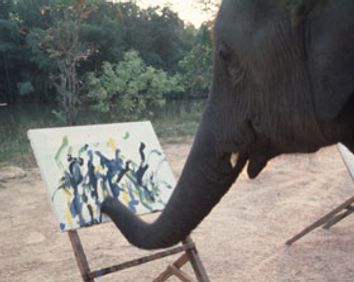
Why do elephants paint?

Well, because there's a shortage of jobs in the logging industry these days. And, no, as a matter of fact, they don't sell their canvases for peanuts.

  • more
    • All Share Services

Why do elephants paint?

If you are an artist, thank Vitaly Komar and Alex Melamid for their relentless efforts to show that art is a hoax. If you’re an Asian elephant, thank them for getting you a job.

href="http://www.diacenter.org/km/artists.html ">Komar & Melamid are a team of artists in New York who emigrated from Russia in 1965. Their work has ranged from paintings satirizing Soviet iconography to “The People’s Choice,” which used polls and market research to create the “Most Wanted” and “Least Wanted” paintings for various countries and cities. (Landscapes with lots of blue are the universal favorite.) In other words, they have repeatedly used art to make art look silly and pompous.

Now they are teaching elephants how to paint. It all started when they read reports of the plight of domesticated elephants in Asia, whose numbers have dwindled in recent years from 11,000 to only 3,000. The elephants used to make a good living hauling trees in the logging industry, but deforestation of the countryside has led to bans on teak logging. There aren’t many opportunities for 6,000-pound mammals in the Asian job market. The elephants and their keepers, or mahouts, were forced to scrape by on performing tricks for tourists or doing illegal logging work at night.

Komar & Melamid had heard about elephants that painted in American zoos, including Ruby, whose works raised more than $100,000 a year for the Phoenix Zoo before her death in 1998. They took the idea to Asia, opening the world’s first elephant art academy in Lampang, Thailand, in November 1998. In 1999 their Asian Elephant Art and Conservation Project started two more academies, near Ubud in Bali, Indonesia, and in Kerala, India.

In the art classes, elephants work with trainers to learn to hold a paintbrush in their trunks and to make basic strokes across a canvas. “We try to stay out of artistic decisions,” says Melamid, the spokesman for the duo. The elephants’ abstract creations are beginning to sell to tourists who visit elephant camps. Last year the works raised about $5,000 in Lampang, “which is big money for Thailand,” Melamid says. And this week, on March 21, paintings by elephants were auctioned at Christie’s in New York. (One painting by Ganesh, a 6-year-old Indian elephant, went for $2,100.)

Of course, the project has implications beyond keeping elephants off the dole. Are these paintings just a kind of circus trick, or are the elephants really creating art? In an interview in the New York studio he shares with Komar, Melamid took a puckish delight in the puzzles and paradoxes the art of elephants presents.

How does an elephant get into art school?

The schools are started at elephant camps, so they don’t have to travel far. Not every elephant can paint, though — maybe only 10 percent.

Are they good students?

Juthanam [a 7-year-old who lives in Lampang] and Ramona [a 5-year-old who lives in Bali] are the sweetest ones. They are smiling all of the time. They are kids. We work mostly with younger elephants; supposedly they are easier to teach. They’re also smaller. When they get to my age they are gigantic, and the boys have these huge tusks. It’s kind of scary. Some seem to enjoy it, but they can’t paint for very long because they get bored and start looking around. Some do it quickly. Juthanam is a very careful painter; it takes her so much time to paint. She’ll hold the brush in front of the canvas without touching the surface. You are waiting and thinking, “Juthanam, please get on with it.” Then — blip — she’ll make a tiny mark.

Do you think my dog could paint?

The thing about elephants is they have this unique organ, the trunk. It has 50,000 muscles, much more than the hand. It has a sense of smell; it breathes. Imagine if your hand had a sense of smell. It’s amazing, really. And art is born out of necessity. There are 3,000 elephants with no jobs. We can’t set them free because there is no wilderness. Animal art, social concerns, environmental concerns — all these important subjects of the end of millennium got connected in this project.

What does this project mean for the art world?

If this goes as planned it will change art forever. No kidding. We will have 1,000 painting elephants by the end of the year. They will make maybe 100,000 pictures a year. At some point the size of the enterprise will be so big it can compete with human art, whether you want it or not — not compete, but influence each other.

An example is photography. I remember as a young artist, the worst accusation you could make of an artist was: “Are you a photographer or what?” People were ashamed to use photography. They always did, but they kind of concealed it. Now it’s fashionable to be like a photographer. These relationships are always changing. Now people say, “Are you an elephant? Come on, what are you painting?” A couple of generations will really reject elephant art. But then new artists will come and say, “Yes, we are elephants!” Maybe art students will try to find their inner beast, their inner elephant. I don’t know.

So someday all art will look a little more like elephant paintings?

The highest art for us is still self-expression, something inner — if you don’t think, maybe that’s the best art. That’s why the late art of [Willem] de Kooning is so good. He became senile. And in a way to be senile is to be like an elephant, or any other animal, totally mindless. And in a way maybe it’s the best way to produce art. At that point the elephants can compete with us; it’s a level playing field. With mathematics, I don’t know if we’ll ever achieve a level playing field. Actually, I am almost an elephant in mathematics.

Some people say what the elephants do is not art.

Well, what is art? With modern art it’s always a question. Since the time of [Marcel] Duchamp, whatever is in the gallery or museum becomes art. That’s the way it is now. And the question became irrelevant because if everything is art, nothing is, in a way. We are trying to take art from the museums and see if it works or not. If an object is taken out of the museum, will it still work as a piece of art or will it lose its value? It’s a field war. We’re not in a classroom.

Why was “The People’s Choice” so controversial?

We learned from that project that art has become a new religion; it’s a full-blown religion. People really go to museums to have something to believe, to have a mystical experience and stuff like that. And anything you say that is different seems blasphemous to them. You touch on something that is holy. Religion is like art — it’s not clear what is involved. A rational explanation of either of them never works. Does God exist? Does art exist? It lives on this irrational faith, and that is part of its power.

Has there been as much controversy about the elephant art?

Well, humor saves it. But if you talk about religious subjects as if they’re not religious with a religious person, you can offend someone.

Do you have faith?

I’m an artist, but an old artist. I’ve had different stages in my artistic career. I have been passionately in love with art, maybe in a religious way. Now I’m in my atheistic phase.

Do you believe the elephants are making a kind of automatistic art?

The whole idea of automatism was reductionism, to go down, go simpler, in our feelings. That’s kind of the 20th century. Maybe this is going even simpler, going to a “lower” species. I don’t know. When Jackson Pollock was painting, was he thinking about anything? If he had been blindfolded, would his art be better or not as good? These are very profound questions which unfortunately I’m not intellectually prepared to solve. But it touches on a nerve. When I was younger I was sure that I could resolve some of these things with my brainpower, but now I understand I can’t understand anything anyway. The point of the artist is that we can show. I’m not sure that we can make any decisions. We can just show people and let them decide for themselves.

Lucinda Williams

With her gorgeously "flawed" voice, the genre-bending singer has exquisitely mapped out the South -- as well as her own heart.

  • more
    • All Share Services

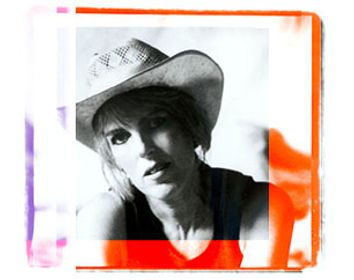
Lucinda Williams

Lucinda Williams’ music is something of a Baedeker’s guide to the South. It’s not just that the singer-songwriter, born in Lake Charles, La., shows her roots by bending the region’s musical styles into a magnetic sound all her own. She’s also a master of evoking the character of a place with the telling, everyday detail: “Cotton fields stretching miles and miles/Hank’s voice on the radio.” When she adds in the names of the cities she has known, as she does in song after song, even those who have never traveled below the Mason-Dixon line end up feeling they know Lafayette, Memphis and New Orleans.

Her fifth and most recent album, “Car Wheels on a Gravel Road,” winner of a Grammy for best contemporary folk album in 1998, is as geographic as anything she’s done. Enough cities are listed here to rival a road atlas of the South, yet the emotional journeys Williams describes resonate with people everywhere. The songs range in mood from regretful to defiant to nostalgic. But they share a conviction, or at least a flickering hope, that relief — whether from a broken heart in “Joy” or from stifling domesticity in the title track — is just an address change away. In “Jackson,” recovery from a breakup is measured in miles: “Once I get to Baton Rouge, I won’t cry a tear for you.” The mournful “Greenville” urges a washed-up drunk to leave town. And a man finds heaven on earth in “Lake Charles.”

For all the implied locomotion, “Car Wheels” sure moved slowly from recording studio to CD store: Six years passed between this album and her previous one, “Sweet Old World.” As impatient fans wondered when they’d hear from her again, Williams grappled with a series of challenges. First, Chameleon, her label for “Sweet Old World,” went under. She was then on the American label until it, too, dissolved and she moved to Mercury. There were also delays in the studio. Williams recorded “Car Wheels” from scratch twice and worked with producers in Nashville, New Orleans and Los Angeles before achieving the sound she wanted. (Ironically, she was searching for a “less produced” feel.)

Perhaps unsurprisingly, the painstaking process alienated some of her collaborators, including her longtime guitarist, Gurf Morlix, who had co-produced “Sweet Old World.” Alt-country icon Steve Earle, who plays guitar on a few tracks and whose company, twangtrust, is listed as a co-producer on the final product, described the experience as “the least amount of fun I’ve had working on a record.”

Earle is neither the first nor the last to question Williams’ unwillingness to settle for “good enough.” The songwriter fought her way out of a contract with RCA in 1990 when the company wanted to release what she considered a substandard recording. Refusing to compromise, she moved to the much smaller Chameleon label, where she had more artistic control. And during the long wait for “Car Wheels, ” the press often portrayed her as a nutty perfectionist. Today, Williams has a pat response for those who second-guess her methods: “You can’t praise the work and criticize the process,” she has said in more than one interview.

Certainly the ends justify the means in the case of “Car Wheels,” her breakout album. Williams’ earlier work consistently won raves from critics and fellow musicians but was just as consistently overlooked by disc jockeys and the public. “Lucinda Williams should be at the very center of country music. She is an example of the best of what country at least says it is,” Emmylou Harris said in 1995. “But, for some reason, she’s completely out of the loop. And I feel strongly that that’s country music’s loss.” Williams won a Grammy in 1992 for Mary Chapin Carpenter’s version of her song “Passionate Kisses.” And Patty Loveless took “The Night’s Too Long” into the top 20 in 1990. But Williams didn’t really get her due until “Car Wheels,” which made best-of-the-year lists around the country (and won the prestigious Village Voice critics poll) in 1998 and went gold last summer (meaning 500,000 copies had been shipped) and had sold more than 420,000 copies by the end of December.

The album’s success might owe something to the current music scene, which is more hospitable to genre-bending than it was when Williams first started out over two decades ago. For years, her brilliant blend of blues, country, folk and rock slipped through the cracks in the music industry. Record execs just didn’t know how to categorize her. In the late ’80s, she made a demo tape for CBS Records in Los Angeles. They said it was “too country” for them and sent it to CBS Nashville, where — guess what? — it was judged “too rock ‘n’ roll.”

Or it could simply be that America was finally ready for a literary songwriter of Williams’ caliber. She lingers on traditional country motifs — heartbreak, honky-tonking, homesickness — but gives them a modern twist that transcends geographic and genre borders. And despite the distilled pain and longing that darken her lyrics, there is never a sense of defeat. Whether addressing the suicide of a friend in “Sweet Old World” or a long-gone lover in “Still I Long For Your Kiss,” Williams makes clear that she retains a spark of hope and will battle on.

Even when singing the blues, she is an optimist. She described the songs on her first album, “Ramblin’ on My Mind,” a 1979 collection of covers of blues and Cajun classics, as “blues as metaphor” or “blues as a sort of two-way mirror which, regardless of the hardships reflected, also reveals something better on the other side,” according to John Morthland’s liner notes.

Williams’ father, poet and literature professor Miller Williams, clearly influenced her craft. “He’s been my mentor,” she told the Journal of Country Music in 1996. “Instead of going to college and taking creative writing, I learned by writing, by trial and error, and by showing [my father] what I was working on and listening to his criticism.” Like the best poetry, her songs waste no words and vividly describe a specific scene that reveals a universal feeling or theme. In “The Night’s Too Long,” for example, an idealistic waitress named Sylvia bets that moving to the city will bring her closer to what she wants: “So she saved her tips
and overtime/And bought an old rusty car/She sold most everything she had/To make a brand new start.”

And her father influenced her music in other ways. As the Williams family followed Miller’s career and restlessness to various Southern university towns, “Cindy” got to know the places that would later figure prominently in her songs. And the music she heard as she was growing up — Miller was a devoted Hank Williams fan (the family is not related), while her mother leaned more toward Joan Baez — had a lasting impact on her sensibility.

When Williams was 12, she picked up a guitar a friend had left at her house and tried to play. “The first songs I did were from John and Alan Lomax’s books of folk songs,” she told the Washington Post in 1989. “I literally sat down with those books and my folk records. I can’t read music, so I would listen, figure out the melody from the records and find the words in the books. That’s all I did; I had no other interests.” She eventually took guitar lessons, but only learned specific songs to build a repertoire; she never has learned to read music.

Bukka White, Robert Johnson, Neil Young and Peter, Paul and Mary were some of her early favorites. But it was Bob Dylan who really grabbed her. “Highway 61 Revisited” came out in 1965, the year she started playing guitar, and, as she told the Journal of Country Music, “That was it for me. I had somehow found the combination, the link of heavy, intense, brave lyrics — he’d obviously listened to a lot of blues — great melodies, and a voice that wasn’t perfect.”

She could have been describing her own music. Williams’ voice is unforgettably, gorgeously “flawed.” It twangs, purrs, quavers and cracks, conveying strength and vulnerability, release and dammed-up emotion at the same time. It has a raw casualness that, given Williams’ attention to detail, can only be the result of study and practice. “I’ve always had an awareness of my voice being distinct,” she said in the JCM. “A lot of the time I feel kind of limited vocally. I can hear it in my head, but I can’t pull it off. I’m restricted because of my range. I just don’t have that kind of voice, that kind of range — you know, like even Emmy has, or like Joni Mitchell. When I first started out those were the voices I wanted to sound like. Eventually, though, you have to come to terms with your limitations, which, in turn, become your trademark.”

Williams had just started playing in bars in New Orleans — doing covers of Dylan, Baez and Joni Mitchell as well as her own songs — when her father got a teaching job in Mexico City and the family moved south of the border. Some of her father’s friends at the State Department suggested that Williams and Clark Jones, a family friend, perform concerts at Mexican schools as a goodwill gesture. “We went to high schools, colleges. It was a little scary,” she told the JCM. “We were famous American folk singers as far as they were concerned. They made these big posters and would always misspell his name: ‘Clarck Jones and Cindy Williams!’ Like it was Peter, Paul and Mary to them.” She wasn’t a famous American folk singer — yet.

Back in the U.S., she displayed her father’s rambling tendencies and split
her time between the music scenes in Austin and Houston for about 10 years. She later drifted through Los
Angeles and New York before settling in Nashville, where she lives today
with her boyfriend of about four years, bassist Richard Price. Until meeting
Price, Williams had a rocky love life (as reflected in her many songs of
breakups and loneliness), including a short-lived marriage in the mid-1980s
to drummer Greg Sowders. “Richard’s the only man I’ve ever been involved
with who wasn’t threatened by my success,” Williams told Us magazine last
year.

In 1980 she cut her first album of original work, “Happy Woman Blues,” which seamlessly mixes musical traditions. With an economy of words, she conjures images and moods that take the listener to Dixie. The raucous “Lafayette” is an anthem for a town where “we danced all night long to a sweet Cajun song/Drinkin’ and jivin’ till dawn.” “Maria” is a profile of a woman who was “born to roam.” And there’s a foot-tapping, carefree version of “I Lost It,” which appears in a slower form on “Car Wheels.”

It was her next album, however, that put Williams on the map. After CBS turned her down, she took her demo tape to the British indie punk label Rough Trade, which immediately signed her. “Lucinda Williams” came out in 1988. Dobros and mandolins mix with electric and acoustic guitars. Romance gets a variety of treatments in these songs, from the irrepressible “I Just Wanted to See You So Bad” to the slightly paranoid “Changed the Locks” to the self-preserving “The Side of the Road.” Now available as a reissue from Koch, the album was highly acclaimed and sold close to 100,000 copies — a small coup for an independent label.

“Sweet Old World,” released on Chameleon in 1992, was not the breakout album fans were expecting after the eponymous album. It can seem too traditionally folky for the eclectic Williams. As always, though, the songs are meticulously written. “Pineola” is a picture of stunned grief inspired by the suicide of her friend poet Frank Stanford. The title track is also about suicide: “See what you lost when you left this world,” Williams croons. And she covers “Which Will” by Nick Drake, the British folk singer who killed himself in 1974.

Fans got what they wanted with “Car Wheels,” though. And the six long years they had to wait only sweetened the reward. Williams has always focused on the art, not commercial success — how many musicians fight to get out of their major-label contracts? Still, she must be pleased with her new popularity. For one thing, it amounts to a big “I told you so” — she has been doing things her way all along and now it has paid off. And it’s unlikely anyone will try to force her to compromise again.

That’s good news for Williams fans. Few musicians today produce songs that are so closely linked — in form and content — to the South. Certainly none do so with as much originality, eclecticism and literary artistry as Williams. “I like to pay homage, it’s like a respect thing almost, like being proud of where you’re from and proud of your roots,” she said in an interview this year with Addicted to Noise. “I think everybody should be proud of where they’re from.”

Continue Reading Close

Merle Haggard

For 35 years the country music legend's been kickin' ass and making God laugh -- he don't need no stinkin' sound check.

  • more
    • All Share Services

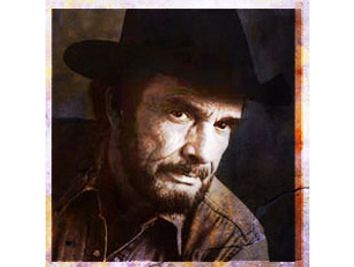
Merle Haggard

Merle Haggard has given up on the idea of a sound check. We’re in his tour bus on West 43rd Street in Manhattan, in front of the Town Hall theater, where he will perform in a few hours. President Clinton is in town, and the Merlemobile is being shooed away by New York’s finest to make room for the motorcade. Traffic is moving in slow motion; finding another place to park this hulking vehicle could take all night.

Not that Haggard is concerned. He’s been in this business for 35 years and has 41 No. 1 country songs on his risumi, including the classics “Mama Tried,” “Think I’ll Just Stay Here and Drink” and the notorious “Okie From Muskogee.” He specializes in writing deceptively upbeat songs of longing — for a woman, for the bottle, for the past, for the road — that are inspired by his rough-and-tumble life and the struggles of the rural working class. His singular mahogany voice and synthesis of elements of the work of artists from Bing Crosby to Lefty Frizell continue to thrill listeners and influence musicians of every persuasion. He’s a living legend of country music; he don’t need no stinkin’ sound check.

Dressed in jeans, sweat shirt and pork-pie hat, Haggard sinks back into the bus’s beige leather banquette as he talks about his many projects this fall: HarperCollins published his memoir “My House of Memories” last month; he has a new two-CD set, “For the Record: 43 Legendary Hits” out from BNA; and he’s winding up a cross-country tour. At 62, Haggard shows no signs of slowing down. Of course, his bankruptcy in 1992, due to a combination of reckless living and careless money management, gives him little choice. “It’s not really what I had in mind for this point in my life. But we seem to be getting hotter,” he says over the goofy banter of the members of his entourage who are along for the ride. (“Maybe we should ask Clinton to play with us tonight. He could play the whore-Monica.”)

Recording the CD, a collection of new versions of many of his greatest songs, was a humbling experience. “An analogy might be if Babe Ruth had lived as long as I have and then tried to repeat a great moment at the plate,” he explains. “It’s hard to recapture.” It’s a mixed bag, Haggard admits: “Some of the songs are better, some not as good, some just different.” Tracks such as “Misery and Gin” seem richer coming from an older, wiser man; others, including “Sing a Sad Song,” don’t seem to suit the depths of his mature voice.

There are also duets with Willie Nelson and Brooks & Dunn, and, despite his vocal aversion to most contemporary singers, he teams up with Jewel for “That’s the Way Love Goes.” “I was on tour when she recorded at my studio, so I didn’t even meet her until we performed together at the Country Music Awards” in September, Haggard recalls. “It was a pleasant surprise. She’s a real nice girl. I think we’ll be doing more together.”

Suddenly, Haggard is craning his neck, scanning the lanes of stationary cars. “Is that Kris’ limo up there?” he asks. (Kris Kristofferson is the opening act tonight.) “Let’s go see if he wants to come back here.”

“I already asked the driver,” one of the gang pipes up. “He said he didn’t want to.”

“Not the driver, Kris!” exclaims Abe Manuel, an all-around musician and longtime member of Haggard’s band, the Strangers.

“He didn’t seem to speak English.”

“Who, Kris? He writes in English,” Manuel says of the songwriter, with mock bewilderment.

Haggard is much amused by the exchange. He rocks back slightly as his creased face stretches into a huge grin. Then he turns to me: “You see what it’s like around here?” he deadpans, his eyes a heart-stopping cobalt blue. “The only way we can keep from going crazy is to try to totally confuse one another.”

His wrinkles are not all of the “laugh line” sort, to be sure. A mix of “The Grapes of Wrath” and “Rebel Without a Cause,” with some
Elvis Presley-style brilliance and excess mixed in, Haggard’s life has been a series of dramatic highs and lows. “My House of Memories” more or less picks up in the 1970s, where “Sing Me Back Home,” his first memoir, left off. “I’ve had a monstrous 20 years since that first book, just career-wise,” he marvels.

Haggard grew up in a converted boxcar outside Bakersfield, Calif. His parents were transplants from Oklahoma, like many who moved West during the Depression, but Merle was born in California. (He has lived there almost all of his life, shunning the Nashville scene.) After his father died when he was 9 years old, Haggard was constantly in trouble: running away, hopping trains, skipping school, joyriding and committing other minor crimes. The stories of his many escapes from the authorities might be the best parts of “My House of Memories.” He finally landed in San Quentin for a botched restaurant robbery when he was 20.

Prison shocked him into living on the straight and narrow. “Going to prison has one of a few effects,” he explains. “It can make you worse, or it can make you understand and appreciate freedom. I learned to appreciate freedom when I didn’t have any.”

When he was paroled in 1960, he became a regular on the stages of Bakersfield, where the local oil- and cotton-field workers were enthusiastic country-music listeners. “Sing a Sad Song” hit the charts in 1963, and he signed with Capitol soon after. He had five No. 1 country songs by the end of 1968, including “The Fugitive,” “Sing Me Back Home” and “Branded Man.” Then in 1969 came the controversial song that secured his stardom: “Okie From Muskogee,” an anthem defending traditional values in the age of hippies and free love. “The song confused everybody,” Haggard remembers. People assumed the song reflected his views, but “that was just the way the song went together. It wasn’t necessarily me in that song.”

“Okie” struck a powerful chord with many Americans. The first time Haggard played it was at an Army base. “People came up on the stage, grabbed the mike and said, ‘We don’t want to hear anything else until we hear that song again.’ We thought an Army base wasn’t a fair trial, so the next night we played it in a concert hall. People came over the orchestra pit and onto the stage. It was kind of scary — Beatlemania was going on at the time and we didn’t know how to handle that kind of response.” “Okie” went double platinum in 120 days, and Haggard went on to record more hit songs than any other country performer except Conway Twitty.

The smooth success of his career always contrasted with his rocky personal life. There have been four divorces (including one from Bonnie Owens, once Mrs. Buck Owens, who still performs with Haggard), drug addictions, high-stakes gambling and ill-fated investments. “My House of Memories” describes in detail the hedonistic years Haggard spent living on a houseboat on Lake Shasta during the 1980s. By the early-’90s, he had burned through $100 million. He received his bankruptcy papers at the hospital the day his son Ben, now 6, was born.

Today he is on his way to financial health and says he is finally living at peace. The habits of his wild years are nowhere to be seen on the ranch outside Redding where he lives with his fifth wife, Theresa, and their children, Ben and 9-year-old Jenessa. Instead of chasing women and throwing parties, Haggard spends his free time with his family at one of the nearby creeks, fishing for bass. “After we take care of all our chores, and we have about 200 acres so there’s a lot to do, at about 4 we turn off the phone and go fish until dark. We usually have our supper down there by the creek. It’s our tradition.”

Looking back on the old days wasn’t easy for him. “Writing a memoir is like going to a psychiatrist,” he says. “The emotions are still sensitive. You uncover these memories and the emotions are just lying there, naked.” Indeed, his guilt and regret are clear in the memoir’s passages about his children from previous marriages, who he doesn’t think got enough of his affection; his mother’s memories and fears that were only revealed to him in a handwritten autobiography discovered after her death; and his loss of control over his life due to drugs and drink, which allowed others to take financial advantage of him.

Sound like the screenplay for a movie? Robert Duvall thinks so. He owned the film rights to Haggard’s life story, but they expired recently. Now he’s trying to buy them back. However, “the deal he’s offering isn’t that good, and I’m just not in the market for deals that aren’t that good,” Haggard says. “It’s my life and I don’t particularly care if the story is told.”

Haggard stares out the window for a moment, seeming not to hear my questions about his opinion of contemporary country music. The bus inches forward. Did I say something wrong? I think about his recent encounter with two pushy reporters from the Star tabloid at his ranch — Haggard got fed up with their prying and escorted them off his property, mid photo session — and hope I am not about to be ejected from the bus.

Finally he turns and quips: “Someone said to me today they really like the commercials on the radio –they let you know when one song stopped and another started.” (Phew, I’m safe.) “I hear a lot of blandness, a lot of songs about things with no point. In Redding, I’d rather listen to the rock ‘n’ roll station than the country station. At least on the rock station you get good rock.” The last “spectacular” thing he heard on the radio, he says, is “Unforgettable” by Natalie Cole, one of his favorite singers.

Particularly rankling for Haggard, who is passionate about the history of music, is contemporary country’s lack of roots. “I’m not sure today’s country comes from the same place mine does. It comes from technology, not from the labor camps or cotton fields that I identify with,” he says. “When I got started in this business, you started with the art form. Then they’d say they want you to record. Now they pick you because you look like Hank [Williams], and they add the music. But you can’t take a guy and make him into a Hank.”

Haggard thinks pop-country music — which has produced megastars like Shania Twain and Garth Brooks — is on its way out. “People are being force-fed new country. They haven’t had a choice. Only one type of music is getting played. But I think a change is about to occur. Music fans are bored to death,” he argues. “It’s like Harry Potter. No one expected that to be so successful. But people grabbed on to something different.” Haggard, too, seems ready for something different. “The music and the crowd’s response are what make this fun,” he says as the bus rounds the corner of Sixth Avenue and 44th Street.

Yet of all his songs, he says the one that best describes his current position in life is “Footlights,” a 1978 number about a burned-out musician. He wrote it after he had to play a concert five minutes after hearing that Lefty Frizell, one of his idols, had died.

I’ll try to hide the mood I’m really in
And put on my old Instamatic grin
Tonight I’ll kick the footlights out again.

“I’m getting to the point where it’s time to start thinking about not being able to make a living the way I have for 35 years,” he says as the bus parks in a once-in-a-lifetime empty stretch of curb not far from Virgil’s, the barbecue restaurant where he will have a quick dinner before taking the stage. “I wasn’t investing until recently. Now I have a new family I wasn’t planning on. You know they say if you want to make God laugh, tell him your plans. Well, my plan was to live on a houseboat and drink and party my way out. I quit drinking and smoking not because of pressure from outside but because of the kids and new responsibilities. I’m glad I did it. I think I’m more in charge now.”

He’d like to get into business — the “other side of the camera,” as he calls it. But that’s later. Right now he’s looking forward to getting back to his ranch and his family. “I like to listen to the creek run.”

Continue Reading Close