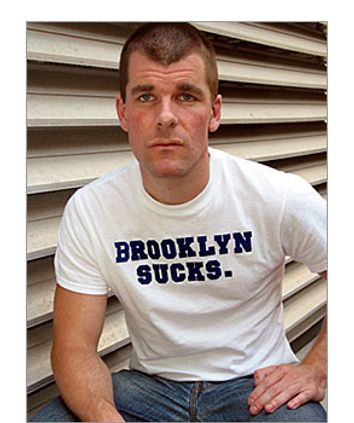
Elizabeth Spiers

A spiritual three-ring circus

Billy Graham's last crusade, at Shea Stadium, was a lot tamer than the fire-breathing revivals of my youth -- but the crowd was a lot more interesting.

  • more
    • All Share Services

Brothers and sisters: This weekend, the good and holy reverend who is called Billy Graham came to Queens, N.Y., and yea, I was there. The reverend descended upon Flushing Meadows Corona Park and I beared witness whilst a few miles away my roommate Mario threweth a Gay Pride party in our West Village apartment. And, lo, the incongruity of the two events didst not surprise me out as much as I thought it wouldth. But everything else did.

— Book of Me, Chapter 2, Verse 23

When I hopped on the No. 7 train to Shea Stadium to join several thousand people to hear what was ostensibly the 86-year-old Billy Graham’s last series of sermons, I was expecting an old-time Christian revival, but that wasn’t what I got. I was also expecting the fiery orator I grew up with as a Southern Baptist evangelical in small-town Alabama, but I didn’t exactly get that, either.

To be fair, Graham had warned me. On June 24, on the first night of what the Billy Graham Evangelical Organization was calling the “Greater New York Crusade,” Graham began his first sermon by saying that “after all we’d heard and seen” — the newspaper accounts, the TV appearances, the enormous building-size banners with large, steely-eyed Graham heads staring off into what one presumes can only be eternity — “I’m probably an anticlimax.” And he was. That’s not to say that parts of him were not impressive. Graham is, after all, the “respectable” evangelical. He’s not the guy who declared a SpongeBob Squarepants video “pro-homosexual.” (That was James Dobson, who, full disclosure, employs one of my cousins.) He’s not the guy who said “abortionists” were responsible for 9/11. (That was Jerry Falwell.) And he’s certainly not the guy who routinely whacks people on the head with his palm, “slaying them in the spirit” and “curing” them of terminal diseases, broken bones and, it would seem, the capacity for rational thought. (That would be Benny Hinn.)

Graham has been preaching for over 60 years to audiences large and small, is comparatively moderate and has earned the respect of people on both sides of the conservative-liberal divide, some of the more prominent names of which appeared in between the three short sermons he delivered during the weekend revival. Bill Clinton introduced Graham’s Saturday sermon with a story about hearing Graham in Little Rock, Ark., as a boy. “All the powerful white people wanted him to speak to a segregated audience,” Clinton said to the mostly nonwhite crowd. “And he said, ‘Jesus doesn’t want me to speak to a segregated audience.’” (The crowd cheered.)

And Graham himself, with his wild flames of titanium hair and bass voice that can only be characterized as “booming,” provided constant reminders of his respectability, liberally interspersing references to his recent media appearances in his sermons and even preceding the name of the A-list journalist who conducted an interview with the phrase “my good friend.” If I weren’t conditioned to believe the man behind the podium was above such things, I’d almost swear he was name-dropping.

Graham’s sermons, for the most part, followed a narrative style in which he recounted a joke or anecdote and used the punch line to segue into an important lesson — which, in my experience as a sermon consumer (forced and voluntary), is the standard formula. But there was something strange about them, in that they offered little of substance. The revivals of my childhood and adolescence, in contrast, were raucous affairs, with blistering 45-minute sermons designed to break you down and convince you that the only way you’d ever put yourself back together again was with the aid of your lord Jesus Christ — and probably not even then.

The visiting pastors were the most effective because they were on the revival circuit most of the year and had the technique perfected. They might have only one story to tell, but it was always a heart-rending tale of a spiraling descent into the pits of hell involving illegal narcotics, near-death experiences and torrid affairs with wayward women whose temptations made Odysseus’ sirens seem quite manageable. And if those sins were not likely to be on your list of confessions anytime soon — if, say, your biggest problem was not turning off the TV when “Dynasty” got a little too risquié and the kids were still up — it didn’t matter because it was just a matter of time before one thing would lead to another. Sin was a slippery slope and you’d be snorting cocaine off the linoleum at a swingers party in no time.

There was none of that at this weekend’s revival. The mission was love, tolerance and pandering to New Yorkers — none of which is inconsistent with my value system. The pandering fell along predictable, if a bit surreal, lines. First there was the obligatory Yankees reference. (“Did you watch the Yankees vs. Tampa Bay? … They and the Mets both need your prayers.”) Then there was his expressed happiness to be in the melting-est of melting pots, with his acknowledgment that he had seen “some Koreans” praying only minutes before. And perhaps remembering some regrettable anti-Semitic comments he made during the Nixon era that were later be mentioned in the New York Times (a paper he reads “every day”), he gave a special shout-out to New York Jews. “It is here [in Queens] that the U.N. met for the first five years,” said Graham in his first sermon. “It was also here that the U.N. voted to establish the state of Israel. Now more Jewish people live in New York than all of Jerusalem.” If the cheering was any indication, the pandering went over well.

And when the Graham crusade wasn’t pandering to New Yorkers, it was pandering to the kids of today. There was a “Star Wars” reference (“in the new ‘Star Wars’ movie, you see a young man who made a wrong decision … The young man was searching, and he was looking for something that was missing”) and a discussion about what young people want (“to be loved and recognized as individuals”). And at one point, Graham explored the profundity of Rolling Stones lyrics. “I can’t get no satisfaction,” he said in a monotone voice with no discernible rhythmic cadence, “though I try … I try … I try … And I try.” (Christ is capable of providing the satisfaction the spiritually bereft Mick Jagger couldn’t get, he later pointed out.) For the 10-and-under set, there was a superhero named “Bibleman,” who, I imagine, will inevitably be deemed gayer than the Teletubbies, SpongeBob and Bert and Ernie put together by one of Graham’s contemporaries.

And for the teenagers, there was an assortment of Christian contemporary bands and singers. Mercy Me, fronted by a fresh-faced and slightly pudgy young guy named Bart Miller, kicked off their first set with a fist in the air and a rallying cry: “How many came to worship?” The band members had hip but tasteful and unobjectionably short haircuts and dressed mostly in black, one with an upturned polo shirt collar. “We’re dark, brooding … Christian … uh … preppies,” the band’s look seemed to say. Hesitantly. The music, however, was very popular — engendering more raised hands and singing along than any of the traditional choir-led hymns that split up the program segments. Other crowd pleasers included Jars of Clay and Michael W. Smith, a composer who resembles a more wholesome version of George Michael (and whose music, full disclosure, I used to listen to religiously — in both senses of the word).

For the older crowd, there was the Bill Gaither Trio — a country-cum-gospel-cum-folk group responsible for what I find to be some of the worst Christian contemporary music in existence. The Gaithers wore three-piece suits in breezeless 80-degree weather, so you had give them credit, if only for showing up and not passing out in the heat.

The satellite acts were no doubt part of the reason Billy Graham himself was less impressive. It’s hard to have an extended spiritual experience when the people in charge of programming are shifting gears every 20 minutes. And then the slick production values were kind of distracting. The sessions, which were projected onto several large screens, were split by flashy cutaway graphics that helpfully identified the people onstage, but not too helpfully made you feel as if you were watching some bizarre Protestant version of the Grammys.

The whole thing cost $6.8 million to produce, Bishop Roderick Caesar (“from right here in Queens”) informed the audience on Day 2, and the Billy Graham Crusade recovered 45 percent of the budget via donations. If attendees wanted to contribute, they could render unto Caesar and the crusade the other 55 percent via cash, check or credit card, which many people happily did. “A complete audit of every penny received will be published in the New York Times,” said Caesar, “because we have nothing to hide.”

As with most affairs where money changes hands, there appeared to be a fringe market around the Graham enterprise. In between sessions, attendees were encouraged to buy books from the Crusade bookstore including a coffee-table volume that offered a photographic history of Graham’s various crusades throughout the years. Signage for Snapple was everywhere and the concession stands served only Pepsi, lending unwitting credence to any conspiracy theories about the inherent evil of Coca-Cola. There was also the occasional middle-aged woman with a cooler offering black-market bottles of Poland Spring water at the cut-rate price of “One dollar, one dollar!” But for a gathering of this size with absolutely no drunks and the world’s only immaculate portable toilets, the program officials and cops on hand appeared to consider the sales a tolerable infraction.

But the odd hodgepodge of elements that made up the revival, as produced by the reverend and his associates, was not nearly as odd as the audience that showed up to witness its execution. For every variation of Christianity that exists, there were representative members in attendance trying to convert every other element to their own special brand, either passively, aggressively or passive-aggressively. Their pamphlets ranged from lists of New Age-y feel-good aphorisms to dark apocalyptic tracts (“It has been shown that the United States is the power represented by the beast with the lamblike horns”) to pseudo-patriotic brochures, including one titled “Remember,” the cover of which was a shot of the New York skyline with two large tablets bearing the Ten Commandments superimposed over the area where the Twin Towers once stood.

The most friendly group was a community of men and women with long hair (sometimes held back with headbands made of natural-looking fibers) and sporty clothing in neutral beige, brown or olive colors who call themselves the Twelve Tribe Communities. They said they do not ascribe to any specific denomination, are not too keen on organized religion and live according to the principles of Christianity. One young woman I spoke with, an ex-Green Party activist who had done some work for FAIR, insisted, however, that they were not a “hippie commune” (although she later conceded a few were “ex-hippies”), their outposts in Vermont, drum circles and spontaneous Frisbee games notwithstanding.

At the other end of the spectrum were two men and a woman from “A True Church” in Lake Hughes, Calif., who were standing behind police barriers with signs that said “God Caused 9/11″ and “Billy Graham Is Going to HELL.” The apparent ringleader, a skinny, middle-aged guy with a scruffy strawberry blond beard and wraparound sunglasses (and ironically named Darwin), spent a few minutes angrily explaining to me that Graham was representative of a false Christianity, one that was too inclusive for his tastes and accommodated too many people who did not belong. Roman Catholics, for example, were going to hell. “The Bible says they follow demons.” Darwin had gotten into a screaming match with a slightly larger man just before I walked over to chat, so I wasn’t particularly inclined to ask what he thought about liberal, agnostic New Yorkers. Other key tenets of Darwinian thought, according to the “A True Church” brochure: Christmas is a lie. Women are to be silent in church. And true believers hate. The police barriers were suddenly reassuring.

Somewhere in the middle of the friendly-angry continuum but not exactly evangelical was the Revolutionary Communist Youth Brigade, two of whose members, ages 24 and 22, were walking in front of me into the park on Saturday carrying their own signage (“The Bible taken literally is a HORROR!”). Joey, the curly-haired 24-year-old and the more vocal of the two, wore glasses and a “Communist Revolutionary” T-shirt. Alya, the 22-year-old, had pink streaks in her half-blonde, half-dark hair and a patch on the back of her black hoodie that said, “Fuck Sexism.” That provoked a few disapproving stares from mothers with kids and junior-size Bibles in tow.

Incredibly, Joey picked an argument with some of the Twelve Tribe members — his primary object of protest being the Bush administration. As his voice got increasingly louder and more adamant, an irritated, nonhippie passerby sputtered, “Yeah, he’s the anti-Christ!” When I asked Joey why he so strongly identified Christians as de facto Bush supporters, he was more thoughtful and conceded that some of them weren’t. “Even Billy Graham has his differences with Bush,” he said. “But Billy Graham’s not in charge.”

Graham had not made any political statements one way or the other, though he disconcertingly kept repeating the mantra “War does not increase death” in his sermons, presumably to highlight the inevitability of death, but effectively making war sound not so bad as previously thought. While not the most hostile or confrontational of the aggressive evangelicals by a long shot, Joey and Alya stood out with their punk aesthetic. “How are people here reacting to you?” I asked. “We’re getting literature stuffed in our pockets as we hold our signs up,” said Alya with a wry smile.

With so many diverse constituencies claiming Graham and, by extension, Graham’s God, as uniquely their own and Graham trying to cater to all of them, the New York Crusade was a sort of spiritual three-ring circus. But it was also a powerful antidote to the naive, monolithic portrayals of Christian evangelicals in America that would have them all looking and acting like the ones I knew growing up — such as my Bob Jones University-educated teacher in fifth grade who spent the first hour or so of every day reading Bible stories to me and the other 29 students in my class, despite the fact that the school was not parochial, and made us memorize woefully out-of-date street terms for obscure drugs that were probably not even available in the state, lest any “pushers” offer us “angel dust” after Sunday school. Or the music minister for whom I sang — badly — in an a cappella group that favored black spirituals despite the fact that my church openly ostracized African-Americans.

In reality, the future of evangelical America probably looks less like the evangelical America that voted for Bush, wants to see the Ten Commandments affixed to the courthouse steps and would overturn Roe vs. Wade at the first opportunity, and more like the Billy Graham Greater New York Crusade: diverse, a bit chaotic and increasingly more aware of pop culture, technology and commercial and cultural realities. The result may be anticlimactic, but it’s a lot more interesting than those old-timey revivals.

Back in Manhattan, the city was clearing out after the Gay Pride Parade and as I walked back to my apartment, I thought of the last person I saw before heading into the subway to Queens: a guy with short, bleached-blond hair, a couple of body piercings and a baggy black kilt with zippers. Three friends were with him, two wearing matching T-shirts with little rainbow crosses on the breast. His was different. It said “Gay Pastor.”

Bold no more

A fond farewell to the gossip who exposed the choreographed-hype machine behind every boldface name.

  • more
    • All Share Services

I seem to remember being introduced to her at parties, and we’ve exchanged e-mails once or twice, but I probably wouldn’t recognize Joyce Wadler if she mugged me in the street and I had to spot her in a police lineup an hour later. It’s strange that I don’t remember much about her personally because her New York Times gossip column, Boldface Names, is one of my favorites, and if I had pursued her the way I’ve pursued other writers I’ve liked, we’d have at least had an awkward, stilted conversation by now. In the past two years, I’ve edited and contributed to New York’s Intelligencer column, freelanced for the New York Post’s Page Six and been the founding editor of Gawker, but in all my gossip column-hopping I never found anything quite like Boldface Names under Wadler’s tenure, which began in January 2003 and ended on Friday (she will now write for the paper’s Home section).

Loyal readers of the column may argue that it was never a gossip report as much as a party report, but let’s get one thing out of the way: The classic gossip column — a column that actually, as the phrase implies, reports gossip — is as dead as Walter Winchell and Hedda Hopper. It was tortured to death by lawyers, publicists and J-school moralists who painfully litigated, negotiated and preached it out of existence. Even Star magazine has fact-checkers nowadays. Things have changed.

And the parties, inasmuch as they’re worth covering and are likely to generate gossip, have changed, too. No longer are the respectable A-list celebrities free to roam unescorted around impromptu New York soirees, expressing their unvarnished and possibly offensive opinions, touching each other inappropriately but enjoyably, and occasionally retiring to the men’s room for a discreet line of cocaine. Now, the parties are choreographed, spontaneity-free events. Little bits of the Studio 54 era certainly remain (just this week, the questionable art of Damien Hirst merited front-page coverage in the Times Arts & Leisure section, and Henry Kravis engineered a record-setting leveraged buyout — also questionable), but don’t expect to read about truly decadent parties among the rich and famous anymore.

When the celebrities Wadler did encounter were obnoxious or stupid or just plain boring, she dispensed with any social niceties and let the reader know it — interrupting, for instance, a tedious Christian Slater interview with a Tom Wolfe-ish interjection, replete with capital letters and exclamation marks (“SPLAT!!!!!! SCHPLOTTT!!!!!! KERPLUNK!!!!!!!”) and the following regret: “Our deepest apologies. We have permitted an actor to go on for too long about his Craft, and a reader in Denver has just slumped forward into her latte grande.”

Wadler also skewered the ridiculous stylistic conventions that are particularly indigenous to gossip columns — notable among them the non sequitur that invariably results when short, unrelated items are crammed together. A fictional character of Wadler’s own creation, Mr. Segue Man, would conveniently appear to provide the column with an absurd transition sentence that technically melded two utterly unrelated items together. And there was the Columbia J-School Young’un, Wadler’s hypothetical protégé to whom she routinely dispensed advice and (somewhat ingeniously) used to make light of the fact that standard operating procedure in entertainment coverage would be roundly condemned (or, at the very least, frowned upon) in other arenas of journalism. One such warning to the J-School Young ‘un concerned a common, devious tactic among certain publicity-hungry celebrities: “A gorgeous movie star attempts to charm reporters by claiming to remember them. It is particularly disarming when the meeting between star and reporter was brief, which, believe us, the meeting between our correspondent and Ms. [Penelope] Cruz had been. It took place almost two years ago and lasted five minutes, tops.” (Fittingly, Mr. Segue Man ran off with Columbia J-School Young ‘un in Wadler’s last column.)

But the key feature of the Boldface Names column was Wadler’s attention to the intermediaries who turn the celebrities into the slickly packaged blockbuster-budget products — particularly the celebrity publicist who, by virtue of having to protect his or her client, is forced to orchestrate public deceptions by quashing any real questions. The journalist is asked to not do what journalists do in return for access. And many comply. Wadler did not. Even when it looked as if she did, she didn’t: “Ms. Cruz had been flogging a perfume,” she continued in the above missive to Columbia J-School Young’un, “and her publicist had warned us that if we asked about TOM CRUISE, whom she was then dating, he would stop the interview. To our shame (yes, even Boldface has off days) we shirked our obligations, depriving readers of such critical information as the seriousness of the affair and whose last name the couple used when making restaurant reservations.”

“This is The Times’ excuse for a gossip column” the New York Post’s Liz Smith complained recently to the New York Observer. “They don’t let what’s happening be the story.” What she meant is that they don’t let what’s supposed to be happening be the story. If they did, Tom Cruise would charmingly glide in and out of a Joyce Wadler column unscathed by double-entendres and notes about his publicist. He doesn’t, because that isn’t what happens, and Wadler wasn’t for a moment going to pretend that it was.

To be fair, it would be more difficult to do what Wadler was doing in a normal publication that prints entertainment journalism, given that other publications face far heavier damage should they insinuate that the whole thing is a ruse. Unlike, say, Us Weekly or Vanity Fair, the New York Times doesn’t need celebrities as much as celebrities need the New York Times.

The Times is, after all, the last place you’d expect to find a gossip column (which will now be authored by Campbell Robertson, a witty 28-year-old from Alabama who will continue, one hopes, in the Wadlerian vein), much less a slightly facetious one laced with postmodern devices. This is the same newspaper that has an ombudsman column devoted almost mostly, if not entirely, to public self-flagellation; “tongue-in-cheek” isn’t an institutional forte. But perhaps the Times has done its readership a service by providing real transparency in journalism — in the unlikeliest of places.

Continue Reading Close

Flagrante T-shirt-o

A Brooklyn entrepreneur prints shirts proclaiming that the wearer had sex with everyone from the Strokes to Anna Wintour -- and New York is eating them up.

  • more
    • All Share Services

Flagrante T-shirt-o

Lists cover the walls of 31-year-old artist and entrepreneur Ken Courtney’s Brooklyn apartment. “Reproduce, Consume, Jerk off, Eat, Reproduce, Fuck, Shop, Reproduce, Consume,” reads one. Another catalogs trendy celebrities: Chloë Sevigny, the Strokes, Matthew Barney, J.T. Leroy. Luxury brands fill another: Tod, Gucci, Prada, Lexus, Burberry, Range Rover, Marc Jacobs, Rolls-Royce.

Against one wall leans a rack of 50 or so vintage shirts, almost all of which have been screen-printed with statements like “I Fucked Paul Sevigny” (the brother of actress Chloë Sevigny and a member of the Brooklyn band A.R.E. Weapons) or “I Fucked Anna Wintour” (the editor of Vogue) or I Fucked — fill in the blank with any celebrity, media personality or downtown New York scenester whose name Courtney can fit onto a shirt. Most of the shirts bear their original logos and slogans with the occasional rugby or polo thrown in for variety. Courtney sells them through his company, Just Another Rich Kid for approximately $80 each, and they’ve become a hot item in New York, where the revival of ’80s synthesizer music, Flock of Seagulls haircuts, leg warmers, and heavy black eyeliner have heralded the age of ironic fashion.

The combination of Courtney’s text and the original logos is often intentional and the results can be amusing — and at times, disconcerting. A black D.A.R.E. T-shirt — a vestige of Nancy Reagan’s drug wars — sits beneath the text: “I Fucked Kurt Cobain,” a heroin addict who killed himself. After hearing about the T-shirts from a friend, I ordered one that reads “I Fucked David Remnick” (the New Yorker editor), with the letters centered around a Champion logo.

To a casual observer, the lists and the T-shirts could easily be mistaken for the obsession of someone who has spent too much time watching MTV and reading US magazine. But as Courtney explains, it’s all part of an art project he calls “The Commodification of Celebrity.”

“Everyone’s trying to be cool by name-dropping, associating themselves with celebrity,” he says, rolling his eyes. “Instead of doing this slimy name-dropping thing, I was like, well, why don’t you just put it on a shirt? Take it to, like, the nth degree. Not ‘I sat next to Paris Hilton at a concert’ or ‘I saw Danny DeVito at a restaurant,’ but ‘I fucked Paris Hilton.’ The literal interpretation isn’t there. It’s more just name-fucking, using this commodity of the celebrity name to buy coolness, or insider status, or whatever.”

As Courtney explains his various “theories,” he becomes more animated. Every time his athletic frame relaxes into his computer desk chair, his body tenses a few seconds later as he leaps up to find another vestige of a previous exhibit, a printed-out e-mail, or an article that demonstrates his point. His eyes widen and his tenor voice reaches a crescendo at the end of sentences, which he often punctuates with a “You know?” and a furrowed brow that indicate he’s not entirely sure he buys his own explanations — or that you do. Occasionally, he pauses in the middle of his discourse de la célébrité, letting his eyes wander to some invisible spot on the wall or ceiling, running his hand through his close-cropped brown hair, and wrinkling his nose as if searching for one last piece to tie all of his ideas together.

The walls of Courtney’s apartment are decorated with large, Rothko-esque abstract paintings that he created over a year ago. Bright blocks of orange, yellow and black are arranged with precision on rectangular canvases interspersed throughout the living area and bedroom. The paintings, the lists and the shirts were recently part of a small exhibition at Duke University titled the “New American Dream.” A friend of Courtney’s at the university contacted him about exhibiting the paintings as a stand-alone project in a student center gallery, but Courtney took the opportunity to add the lists and shirts to the mix, to use all of his “art” to elucidate his philosophies about celebrity.

“I think our past heroes — the people we used to be into — were Nelson Rockefeller and Oprah, Bill Gates, Madonna,” says Courtney. “People who had actually done something.” (Lumping Nelson Rockefeller and Madonna in the same category? That’s a new one.) His work, Courtney explains, is about instant, overnight celebrity — celebrity for no reason and fame for simply existing. Reality TV stars, naughty White House interns, and party-girl hotel heiresses.

“Now I think everybody wants to be famous,” he says. “Everybody wants to be paid for being themselves, and no one wants to work hard anymore. I kind of got into this idea of the ‘New American Dream’ being fame and celebrity and effortless wealth. The hard-work thing is gone. People just want to be like, ‘I’m here! Pay me!’ Every American wants to be famous!”

Every American? “I don’t know that they want to deal with the reality of it,” he says, “But even my mom. She’d want to be a Hollywood star. I feel like it’s almost un-American to not want to be famous.”

OK, I say. His shirts seem to illustrate this point. But where do the paintings come in?

“I had these three paintings,” he says, gesturing to the abstract canvases on the wall. “One of them was called ‘Eminem,’ one of them was called ‘Andy Warhol,’ and one of them was called ‘Lil’ Kim.’” What do big blocks of color have to do with Eminem? Nothing, Courtney says. “Because people are so trained to recognize [Eminem's] name, it engages them in a dialogue, and they don’t know why they’re in it. They’re trying to figure out why it’s named Eminem.” In other words, they’re tricked into interpreting the painting through the lens of a celebrity ideal.

Warhol did something similar, says Courtney. “When Warhol did Marilyn Monroe, he used the commodity of her face to get attention for his paintings. If he’d just used me or you or his mom, no one would care. Not to devalue the fact that he did it in twelves or nines or silk-screened. Presentation was important. But it’s still Marilyn Monroe.”

As Courtney waxes poetic about Andy Warhol, my gaze drifts back to the lists on the wall. “What about the lists?” I ask.

“I went to a Web site and found out what the top eight plastic surgery procedures are,” says Courtney. “What the top eight abused prescription drugs are. A list of high luxury brands — Lear and Cartier and Rolls-Royce — those unattainable things that only really rich people can get. And then a list of eight things that I think people want from fame — sex, beauty, agency, wealth, access, control, happiness, validation…” The lists, Courtney says “show another side of being famous — having to perfect oneself for the public.” The media, he says, fabricates unrealistically pristine images of celebrities that make normal people feel inadequate, and as a result, normal people try to pursue the accoutrements of fame.

What are the implications if Courtney’s right? What happens to American society if everyone wants to be famous and no one wants to work for it? If everyone wants status, but not accountability?

“I think people are getting really complacent,” says Courtney. “We’re getting really lazy and gluttonous, and everybody wants to make $2 million and have a Hummer and drink Cristall. I don’t want to be a nihilist, but I feel like we’re just pushing toward that point where the seams are popping.”

The youngest of four children, Courtney grew up in what he describes as a “straight-up small-town middle-class family” in upstate New York, where his father worked as a salesman for R.J. Reynolds. He majored in psychology at Cornell before heading to New York in 1997 to try to make it as an artist. For all of his disdain for celebrity, Ken Courtney is currently enjoying a degree of it himself. Just Another Rich Kid shirts (Courtney says the name of his business was inspired by all the “kids in the city who portray themselves as struggling indie artists but when you delve a bit more you find out their godmother is Mary Boone or something”) have appeared in several European fashion and art publications, and Courtney’s name has appeared in bold on Page Six, the New York Post’s notorious gossip sheet. “For some reason I was just flipping through the Post,” he says. “And I looked at the highlighted names, and I saw ‘Ken Courtney’ and a reference to the shirts and I thought, That’s so weird.”

His own minor celebrity doesn’t heavily affect Courtney’s lifestyle, because as he points out, a press mention here and there doesn’t necessarily mean he’s minting money from the project. He runs the entire operation out of his tiny apartment and says he gets two or three requests a day for shirts, which he screen-prints in his apartment, often late at night. He has “two and a half” unpaid interns: art, design and fashion students who responded to an ad Courtney posted on Craig’s List for help with an “indie men’s shirt line.” They help out with the business paperwork, button sewing, and assorted other shoestring-shop activities. “I spend a lot of time standing in line at the post office,” he says.

Courtney isn’t sure how many shirts he has sold or how much money he has earned, and it’s not always apparent to onlookers that Courtney’s operation is fundamentally an art project. “I like to think that everyone thinks like this. Then I remember that I’m living in New York,” he says, laughing. “I’m making fun of all of us for being celebrity obsessed. But I don’t like explaining it to people if they don’t already get it.”

And not everyone gets it. The Strokes’ merchandising company, Blue Grape, recently issued Courtney a cease-and-desist letter for manufacturing “I Fucked the Strokes” T-shirts after spotting one in a fashion layout in Time Out New York and another in Vice Magazine. “They thought I was making a ton of cash from it,” says Courtney. “I made two shirts! Neither of which sold!” Blue Grape is demanding that he recall the “I Fucked the Strokes” shirts and send all of them to the company’s law firm, where they will be destroyed. Ah, the torments of being an artist!

Ironically, some of Courtney’s other detractors think the T-shirts are a literal incarnation of the status-grubbing attitude they skewer. Courtney shows me his favorite piece of hate mail. It reads, “I saw your site and have this to say: I hate you and everything you represent. Your ‘clothes’ are a fuckin’ scam. Whatever it is that you consider ‘cool’ fucking sucks. Anyone stupid enough to buy your bullshit deserves to wear it so that when they are seen in the street, everyone will know that they are retarded. You iron on ugly letters, inane artfag phrases, and wack images onto thrift store refuse, then sell it for a lot of money to assholes who think they are so fucking stylish. YOU HAVE NO SOUL. You and your ilk are a bunch of T. Rex lookin, Fraggle Rock rejects who need to bathe. You are wack enough to get off on this hate-letter. DIE.”

Apparently, Courtney is wack enough to get off on the hate letter. Laughing, he pulls out an ad he created from the text of the e-mail. The phrase “T. Rex lookin, Fraggle Rock rejects” is circled in red.

Courtney acknowledges that he, and his popular “star fucker” shirts, will soon face the end of their 15 minutes of fame, but says that even as that moment approaches, he has other projects lined up. The shirts are only one part of the Just Another Rich Kid line, and Courtney says he has new designs in the works. He’d also like to install the “New American Dream” exhibit in New York “if I can find a gallery to show it.”

As I cross back into the living area, I notice yet another list, carefully spelled out at eye level on the wall in black stick-on letters: “Mirror, Sell Shirts, Job, Steamer, Video Camera, Studio, Foam Core, Spoons, Tissue Paper.” A statement about the accoutrements and pressures of life as an artist? “Oh, that’s just stuff I need,” says Courtney with a laugh.

Continue Reading Close

Don’t hate David Amsden because he’s brilliant, celebrated and 23

Yes, the New York Times gushed over his hipster lifestyle. But the author of "Important Things That Don't Matter" is entering the literary fast lane with more than style going for him.

  • more
    • All Share Services

“I was so fucking fed up,” says 23-year-old David Amsden, a former New Yorker intern and current contributing writer to New York magazine. “Enough with this uber-neurotic fiction where nothing really happens! I can’t relate to any of the stuff! I just wanted something that felt really raw and honest.”

Amsden’s first novel, “Important Things That Don’t Matter,” is the story of a 20-year-old recounting his tumultuous relationship with his cokehead father in Maryland suburbia. “I was reading stories from the ’70s and ’80s about couples [that are having problems],” Amsden says. “There are children in the stories, but the child is just a wooden literary device.” “Important Things That Don’t Matter,” he explains, reverses the traditional model and tells the story from the child’s point of view.

If his age and journalistic résumé aren’t enough to generate interest in his debut novel, Amsden’s celebrity friends (photographer Ryan McGinley, “Ken Park” starlet Tiffany Limos, among others) and hipster credentials lend glitter to what was already a marketable literary effort. As a result, fascination with Amsden’s casually messy haircut, mellow drawl and affinity for clothing that would best be described as “thrift-store chic,” can sometimes eclipse interest in the actual book. A recent New York Times article called (“A Night Out With David Amsden: Oh, to Be a Boldface Name”) in particular, filled several column inches with such details.

I read the New York Times article and mentioned the book on Gawker.com — a pop culture Web site I edit — as being part of a hipster literary movement that had “kicked into disaffected, ironic overdrive.” Skeptical but curious, I picked up the book and to my surprise, devoured it in a couple of hours. It was hypnotically engaging and almost painfully genuine.

Amsden happened to e-mail me a few days later. He had read Gawker and wanted to assure me that the book was “neither ironic nor disaffected.” I sat down with Amsden fully expecting him to sound like the 20-year-old protagonist in “Important Things That Don’t Matter.” The character’s verbal tics, attitudes and speech patterns were so consistent throughout the book that I had assumed that Amsden was writing in his own voice. A few minutes into the conversation, I realized that wasn’t the case. Amsden is quite simply an extremely talented writer. (So, he’s 23. Get over it.)

In the following interview, Amsden discusses the repercussions of literary celebrity, publishing industry politics and the art of self-promotion.

Tell me a little about what prompted you to write the book.

I always really wanted to write a book. Part of what compelled me to do it so fast, at this age maybe, was that I was getting a little tired of writing for magazines and I didn’t know what the hell else I was going to do. Go back to grad school? I think a lot of people take deeper breaths than I do, and they’re like, “well, I could always go back to grad school, get a law degree.” And I’d get fucking kicked out of law school, or I’d get in trouble, or I wouldn’t keep my grades up.

Who do you feel your audience is, and who would you like them to be?

One of the coolest parts of publishing a book is that it gets in the hands of someone who you would never expect to like it. One editor who wanted to buy it at a different publisher was my parents’ age, and she really dug it from that point of view — really savvy, smart woman — it gave her this window into her kids. I think the real key people are sort of 15 to 30 — which is sort of a difficult thing, because, well, two reasons: One, none of those people buy hardcover books; two, some of them don’t even look at books yet, they’re so young.

I went to my high school and I did a reading there and a speech. A bunch of kids bought the book and I got an e-mail from this girl — sophomore, 15-years old, really smart girl — and she got it. That’s really young, but I think when you’re young like that, you can read in a more pure state.

What were you reading at 15?

Me? I wasn’t reading much at 15. I only read, maybe two books that year. I got into reading books when I was 15 because I wanted to impress this really smart girl. She said — and I’ll always remember this — she said the man she marries will know who Helmut Newton is. Helmut Newton?! Is he a photographer? Like, who the fuck is Helmut Newton? And at the time? When you’re 15?

So, I read a couple of books then. I read “Story of My Life,” by Jay McInerney — because she loved it. It’s the only book of his I’ve ever read. I don’t even know if it’s any good, but I totally enjoyed it when I was 15. It has this scene, where this woman really wants to fuck this guy, but she thinks it’s too early, so she goes home and masturbates with the faucet. And it sort of drags it out, and it’s this really funny scene. And I remember that it taught me so much about women! (Laughing) I’ve seen McInerney at a couple of book parties. And I’ve never met him. I’ve wanted to. I’ve wanted to be like, “Dude, you have no idea how …”

I used it as a line when I was 16. I’d say, “I know this seems crazy, but read this book and do what it says,” and they’d be like, “Noooo! that’s gross!” Then two weeks later they’d be like, (grinning) “Aaaawesome.”

I didn’t like reading very much at 15. Books didn’t do it for me. I was much more into smoking pot.

What about now?

I really like Denis Johnson. “Jesus’s Son” was one of the first books that got me as an adult. It’s that thin line — it’s like being 17 and really loving “The Sun Also Rises,” and then not being able to touch it after 19. I like some of Martin Amis. “The Rachel Papers,” I liked a lot; I think that was probably pretty influential for this book. Who else? I like William Faulkner a whole lot. I like Jonathan Franzen’s first book, “The Twenty-Seventh City” and “Strong Motion.” I read those recently and they fucking blew me away. I mean, I was floored — totally floored. I like Rick Moody quite a bit. That’s how I found my agent, because I loved him, and she represented him. Who else? Junot Diaz, I think is phenomenal. I look forward to another book because I’ve read “Drown” maybe 10 times now, and I need to read something else. Lorrie Moore … she’s brilliant. There are others I read that I don’t like so much. I can’t remember them. I read like three books a week so …

Do you think living in New York enhances your writing or distracts you?

I think it really is … if you can handle being so close to the bullshit but not being affected by it, it enhances it. Actually, Jonathan Franzen — I interviewed him — he told me this. And I agree more now that I’ve experienced it to a tiny degree. The best thing about being in New York is that it really demystifies the publishing industry. Like, if you get a real bitchy review somewhere, or a bitchy piece about you, or a rejection — all of that — you understand that it’s sort of par for the course. You sort of understand the mechanics of it and know the personalities involved and it doesn’t hurt you very much.

Some people get really distracted in New York and want to pursue being famous more than writing. That could really happen. But really, the thing with writing is that you never get, you know, really famous. I mean, even if you are, you’re still like …

No one’s walking up to you on the street and asking for your autograph.

Yeah. I mean, I’ve always liked that about it. These things like getting into the New Yorker, publishing a book, seem as palpable as one day going to the moon. And once you’re here, you’re like, “Oh, I know — that idiot used to work at X publishing house; now he works at Y. He hates me because I wrote this one thing two years ago,” and you understand that it’s like 85 people who have all, to one degree or another, fucked each other over and made love to each other. So shit’s gonna come up.

So you’re not, as a first-time novelist, sensitive to criticism, bad reviews?

I don’t have that problem because a lot of the books I love, I haven’t heard about through reviews. Maybe I’m fortunate because I just haven’t been reading the New York Times Book Review for that many years.

If I got a really bad review by someone who seemed to understand the book and didn’t like it, I’d be more hurt. The Onion did this review; they just attacked it. I know how this works because I’ve seen it happen: This woman read the press release and read certain things about me — probably read that New York Times piece — decided she hated me, decided I was just the enemy. She spent the whole review talking about all of that. “He’s done this and that when he’s young, so of course he’s getting compared to all these people.” But seriously, I don’t even know who compared me to them. Nick Hornby? I haven’t seen that anywhere. Dave Eggers? I haven’t seen that anywhere. And at the end of the piece it was like, “It was well-written and queasily compelling.” Isn’t that what a book’s supposed to be? Compelling? Aren’t you supposed to want to keep reading it? So you read a review like that and it’s just that kind of funny.

Would you prefer that a lot of people read it even if they don’t entirely understand it or have a small number of people get it and fewer reading it?

Well, I always loved books that … the books I’ve really loved, many of them, if they were really big books, I never knew about them. I just sort of stumbled upon them like I was part of some small little group that maybe liked this book. That’s sort of ideally what you want, but at the same time, you want to make a living doing it. I want to be able to keep doing it and not have to go to law school.

On one level you want the only people who like your book to be the people you’d want to hang out with in some fictitious house party. I’ve been fortunate so far, where the reviewers haven’t really missed it too much. And I don’t think there’s some false idea of the book being propagated out there. I think that does happen. I think that’s happening, maybe, with James Frey’s book — which I haven’t read — but it’s really getting these weird diatribes.

Yeah, I think he’s got this Norman Mailer thing going on …

His whole shtick is out of hand. But I believe it’s genuine; it’s just annoying. He just sounds annoying. [But] I don’t think that’s manipulated. I don’t think he’s like, “I’m going to get so much damn press.” He’s probably just this dipshit, this asshole. It’s probably like, not a lot of people like him when they meet him. I’ve known plenty of people like that.

How do you think that working in the media industry affected your life as a writer and and your writing?

I think it’s been great in that I learned that the artistry of writing is sort of intertwined with grinding it out. Learning to work and do it everyday, even when you don’t like it and to think of it as a job. I think there’s some sort of intangible thing that I can’t really place. Like, I was hanging out with a photographer recently who shoots for big magazines, like the New York Times Magazine and also does artistic stuff. We were just talking, and he was like, “I think that, somehow, doing this has helped my other work. I don’t know quite know how.” And that’s kind of how I feel.

But also — that New York Times article — I wanted to talk about that. [In the Times story, reporter Linda Lee followed Amsden for a night out, writing at one point, "you've got to hate this guy. He's already been called the voice of his generation," describing him as "darkly handsome in a studied, downtown way," and recounting his party-hopping with his fashionable friends.]

OK.

Well, I just wanted that clarified — that (laughing) I do not keep a blog of my life. But that was a very odd article. I think it’s tough. It was really funny, in a sense, but I certainly don’t think it was a full representation of me as an individual.

What else do you think they got wrong?

Some of my friends were like, “What a fucking great article! You look like a badass,” and they understand that you take it with … not a grain of salt, but with a fucking salt lick. Because it’s the Style section of the New York Times. And I don’t know anyone who looks at that as the be-all, end-all of truth. At the same time, it’s everyone’s favorite section, and everyone reads it. And it is the New York Times.

There’s that one quote “you have to have some faith in people — or your ability to manipulate them.” That was said with such sarcasm — I mean, such obvious sarcasm — after a long rambling monologue of mine on things I’ve been doing to try to promote the book.

If an article like that makes me look like some kid — like a self-promoting type — you gotta remember: I’m not getting the treatment of Z.Z. Packer, whose book first book is getting brought in with all the flags waving from the publishing house. They must be spending millions of dollars to promote this book; you see ads for it everywhere. It’s everywhere. Every single thing costs money. I don’t have all that going for me, and I do want people to read my book.

And I don’t think there’s anything wrong with handing someone a flyer for it. In a sense, what’s so amazing about that to me, is how earnest that is, and how grass-roots it has been. I’ve really been breaking my back to try to get this book out to the right people. And what is more callous? Taking out a $75,000 ad in the New York Times Book Review? It makes you look more literary, but come on, it’s $75,000 — that’s why the ad is in there. It’s not in there because you’re a genius. It’s not in there because you’re anyone. It’s in there because your publisher bought your book for a shitload, and they’re nervous, and they’re taking these ads out.

Compare that to seeing someone reading Kundera, and saying, “Hey, here’s a bookmark. Can you come to a reading?” And I think it’s funny that we live in a time period where that can get really callous coverage and being someone like Z.Z. Packer … and I’ve read two of her short stories, and they’re really great. They’re the real deal. But that huge publicity blitz! Profiled everywhere. Everyone in the media who’s covering it understands that that’s because an enormous amount of money is being spent. And my whole thing was the process of very little money being spent.

What do you want people to ask you that they don’t?

Well, it’s tough. To get press on books is so difficult. I don’t mind this, because I like personalities, too, but what they really go after is the author’s personality. And the problem with personalities is when they’re digested into a small form. I’ve never met Jonathan Safran Foer, but everything I know of him is that he’s “little Princeton intellectual guy.” I’m sure he’s a lot more than that, but that’s because become his, you know … And Franzen is über-serious literary guy with the perpetually furrowed brow. And there’s something sort of fun about that. I think of Raymond Carver and I just think of this drunk dude. And I’m sure he was more than a drunk dude; same way I think of Foer as more than a Princeton intellectual arty kid. So, in that sense, what people have asked me a lot about is me, and my age, and that’s fine because I think that’s kind of interesting. I mean, I don’t think it’s that interesting about me, but as a reader.

I mean, I don’t expect the New York Times to do a “night out with” column and have me deconstructing, at length, modern literature. I think that’d be about the most boring thing ever. That was the one thing I was really fed up with — reading a lot of really self-conscious things and wanting to get back to raw Raymond Carver-y, not embarrassed of really true straightforward emotion and that’s something I haven’t really gotten to talk about because I spent time being quizzed on my clothes and my haircut by the New York Times (laughing) … It’s all good. It’s all fun. That’s what it comes down to, I guess.

Continue Reading Close

When personal assistants attack!

Lauren Weisberger talks about life as an underling at Vogue, how her editor shields her from negative press, and her new roman a clef, "The Devil Wears Prada."

  • more
    • All Share Services

When personal assistants attack!

Lauren Weisberger wedges her lanky frame into a corner seat in the back of an Upper East Side cafe. “Is this OK?” she asks, tucking a strand of her long blond hair behind her ear and poising herself to move if necessary. “Sure,” I shrug, “it’s fine.” She seems a little nervous, and understandably so.

Weisberger’s “The Devil Wears Prada” — a breezily written, thinly veiled roman à clef about the year she spent at Vogue as power editor Anna Wintour’s assistant — chronicles the experiences of Andrea, a recent college grad who works at Runway magazine for an abusive editor. The book was hotly anticipated by media insiders and publishers as both a tell-all about the inner workings of the fashion magazine world and the summer ’03 version of last year’s bestselling “The Nanny Diaries.” The buzz surrounding the book has been amplified by talk of a six-figure advance and a comparable sum for the movie rights, which were sold before the manuscript was even finished.

Several of the book’s reviews have been harsh, and many of them deeply personal. Of particular note was a piece in the April 13 New York Times Book Review by the former editor in chief of Harper’s Bazaar, Kate Betts — once an employee of Wintour herself. Betts denounced the book as “bite-the-boss fiction” and treated the lead characters, Andrea and Miranda, as direct proxies for their respective counterparts, Weisberger and Wintour. “Andrea has an unbecoming superiority complex and is just as much a snob as the snobs she is thrown in with,” Betts wrote. “[She] makes no bones about the fashion business being beneath her, or that her true calling is not to be fetching tall lattes for Anna/Miranda but to be supplying high-minded prose for The New Yorker.”

Weisberger, in a preppy rugby shirt, jeans and no makeup, hardly looks like the bitter fashionista one would imagine grinding a metaphorical Manolo into the neck of one of the most feared editors in the fashion industry, as Andrea eventually does in a climactic blowup with Miranda, and as some say Weisberger did with Wintour by writing the book. Betts’ sentiments have been echoed by others who have charged Weisberger with ingratitude, snobbery and, perhaps most damning of all, bad writing. Salon talked to Weisberger about the chilly reception the book has received, the charges leveled against her by Betts and others, and her experiences as a writer.

Why did you choose to write a book that so closely mirrored your own experiences?

I mean, it doesn’t so closely resemble my own experiences, only in that, yes, one of my jobs out of college was working at a magazine. To a certain extent, you do write what you know. Everyone does. I’m only 26 so I don’t have that much experience doing anything anywhere so I’m not equipped to write about 99 percent of the topics out there. But I thought, you know, it’s a fun setting. At least, I think it’s a fun setting. The fashion world naturally lends itself to being glamorous and exciting with all the models and the clothes and everything.

How do you feel about the reception the book has gotten so far?

It’s completely overwhelming. I don’t think I ever expected the book to get this kind of attention — negative or positive. My publisher calls every day and gives me sales figures — which mean nothing to me. People tell me that it’s doing so well and that’s amazing. The anticipation was sort of stressful, but now that it’s out there, and I know people are buying it … For the most part, I’ve gotten nothing but a ton of support and a ton of enthusiasm. There is, for sure, negative stuff out there and that’s not easy to read. I don’t think it’s easy for anyone. But I really am focusing on the good stuff. Just the idea that people are reading it is awesome to me.

What did you think of Kate Betts’ review in the New York Times?

It’s not easy to get bad reviews, so what more can I say? I can’t speak to anyone’s agenda. I don’t know her. I can’t presume to know …

Why do you think the Times had her do the first review?

If you find the answer to that question, I would love to know. I’m the first in line for that answer. [Laughing] I have no idea. I’m kind of curious.

Have you tried to find out?

No, I can’t — it’s just been so busy and so crazy and there are a lot of good things to focus on. I would be lying if I said I didn’t wonder, but I certainly haven’t done anything to figure out why they asked her to review it.

I know a lot of authors who have this “I’m not reading any reviews” rule. Do you not read certain reviews? Or do you have someone filter them?

My editor filters them. She’s the first one who introduced me to the concept of “you don’t have to read everything that’s written about you.” She sends me good things, fun things. And, you know, I have read some of the negative ones, but it’s usually when I stumble on them myself. People are like, “Oh, come on. You must be reading it secretly,” but I’m really not. It’s easier to just pretend it doesn’t exist.

There was a lot of publicity before your book came out, and people were throwing around these very high advance figures — probably because the magazine world is very interested in the publishing world and vice versa.

Here in New York we’re media obsessed. Writers write about writers who write about writers and reporters and freelancers, and it’s just a festival of information. We’re all analyzing and examining and predicting and I can’t imagine that it’s like that everywhere else. I’m really, really looking forward to my book tour for that reason. I want to leave New York for a little while, hear from people who are actually reading the book — not book critics, not reviewers, not New York media, but, you know, the people I intended it for. I think it’s getting different reception elsewhere.

Why do you think your book has a broader appeal in other parts of the country?

Because it’s about that universal first job experience. Everyone has worked for a tough boss before. No matter what industry you’re in, everyone can relate to that feeling of never being prepared, and of being asked to do stuff that you find humiliating.

Do you think you would have gotten published if you hadn’t spent a year as Anna Wintour’s assistant?

I don’t know. I’d like to think so. I’d like to think that it’s a fun story, a light story. It’s a book you pick up to read on vacation, or on a plane. It’s a guilty pleasure. I read a lot of “real books,” but I also read a lot of books in this genre and I read Cosmo, and you know, it’s another way to relax. It’s a diversion; it’s entertainment.

How do you think it affects your writing career if, let’s say, later on you want to write a serious work of literature? Are you afraid of getting pigeonholed because you did this first?

I have no regrets about writing this book, or this type of book. As long as I’m able to actually maintain a career where I can write full-time, I’ll be thrilled.

When you left college, why did you choose to work at Vogue?

I got an offer at Vogue. And I desperately wanted to work in magazines. My interest wasn’t in fashion, but when you get an offer right out of college for a magazine that big — I decided that it was probably better to start at a big name magazine, even if I wasn’t necessarily fascinated with the subject.

Did you end up doing any editorial work?

No, I didn’t do any editorial work, but I knew that going in.

How would you say Elias-Clark, the large fictional publishing company that owns Runway, is different from Condé Nast, the large publishing company that owns Vogue?

It’s not so much a matter of differences and similarities; it’s that as an assistant, I had to do a number of things that assistants everywhere do. I had to get coffee. I had to order food. I had to make copies. I had to fax. I had to take phone messages. It just doesn’t make for interesting reading. In writing the book I had to take those very basic things that assistants at Condé Nast — and everywhere else — are asked to do and try to figure out how to make them more outrageous.

When I was reading the book, I noticed several references to the main character’s ambitions to write for the New Yorker. Is that what you’d eventually like to do?

No. I mean, I love the New Yorker. And I think that anyone who likes writing views the New Yorker as the, you know, pinnacle of the publishing world. If you get 50 words published in the New Yorker, it’s more important than 50 articles in other places. So, would I love to one day write for them? I guess. But that’s not my sole ambition.

Some critics have pointed out that it is sometimes difficult to distinguish between the main character, Andrea, and her boss, Miranda, because they exhibit some of the same traits. Andrea was a little snobby. Was that your intention?

I wanted her to be sarcastic and irreverent in a way that I think a lot of recent college graduates moving to the city are. She’s someone who rolls her eyes at everything. I did set out to make her that way and I did intend for her to change over the course of the book, to become more like Miranda. But she recognizes that in herself. And at the end when Miranda says, “You remind me of me when I was your age,” all of a sudden, she’s like, “Oh my god! I remind this dreadful woman — this woman I loathe — of me!” If people are recognizing that, well, that was my intention.

I don’t think of [Andrea] as snobby; I just think of [her] as a character who laughs at herself and everything around her whenever the opportunity arises. I won’t go so far as to say I’m like that, but a lot of my friends and a lot of the people I meet just kind of make fun of everything around them and it’s not meant to be mean-spirited.

But there’s that scene in the book where Andrea makes fun of her brother-in-law for being from Houston. Isn’t that snobby?

Say you’re sitting in a mall and you’re people-watching and when everyone walks by you make comments. It’s not meant to be hostile; it’s just a way to pass the time.

Are you concerned that people buying the book will misinterpret it?

Hopefully, the vast majority of people who pick it up will read it and enjoy it for what it is. It’s a beach read; this is not great literature. We all know that.

Continue Reading Close