Ellen Shapiro

New York’s hot new designer

A young German graphic artist talks about the point of view in his work and starting anew in the Big Apple

  • more
    • All Share Services

New York's hot new designer
This article originally appeared on Imprint.

Photo of Tristan Schmitz by Maksim Shdan

He arrived in New York last September with his wife, their kitten and two suitcases. The next morning, he reported for work as the new senior designer at Chermayeff & Geismar. That doesn’t happen every day. I recently had the opportunity to chat with Tristan Schmitz, 28, about leaving his home country, Germany, and starting anew here.

Your portfolio is very consistent and shows a strong point of view. How do you like to characterize your work?

Two things, I think. One is the use of the grid to reorganize content. The second is reduction in typography. By that I mean having a limited palette of typefaces and using them with discretion: the minimum number of sizes, styles and weights to achieve effective communication.

“We were totally convinced by Tristan’s past work in Germany,” says Ivan Chermayeff. Leading off Tristan’s portfolio: this symbol for Key Investors financial services, Dusseldorf. Creative Director: Ulrich Leschak.

Do you have a special affinity with Chermayeff & Geismar, or did you interview at several design offices?

The work of Chermayeff & Geismar had always resonated with me. I did not interview anywhere else. They are the ones who design the stuff I really like. Whenever I needed inspiration, I’d take their red, green, yellow and blue “TM” book off the shelf and flip through the pages. That book is a masterpiece because it reveals the intelligence of every symbol without any written description.

 Your job might be the dream of hundreds of young designers. How did you land it?

Hannah and I had been taking our vacations in New York for several years. When we were here last April I called Ivan Chermayeff to ask him if I could come in, see the studio, meet him, and if he could take a look at my work. Ivan was very gracious, and he and I ended up talking for two hours. Then he said, “You must meet Tom [Geismar].” After Tom was in the conference room for a while, he said, “You must meet Sagi [Haviv]. We had a great talk, but all three of them kept telling me that they were not looking to hire any designers.

After the interview, Hannah and I enjoyed the last days of our vacation. Just as we were packing to go to the airport I got a call from Sagi asking whether I could come in again, that they’d like to work something out. They told me they were offering me a position as a senior designer and asked if I could start in September.

Two posters, first-prize winners in Project Sunshine, a juried international poster exhibition in Japan that supports relief efforts after the 2011 tsunami. Design assistant: Martin Major.

Faculty tour poster 2008, University of Applied Sciences, Düsseldorf, Department of Design; project team: Tristan Schmitz, Prof. Andreas Uebele. Winner of competitions including Graphis Posters; 100 Best Posters 2008 Germany, Austria, Switzerland; and Golden Bee 8, Moscow International Biennial of Graphic Design

Did you say “yes” right away?

It is never easy to leave your home country, your family, your friends. It was a hard decision whether to continue to run my own studio in Düsseldorf, which was getting to be successful and recognized, or to take this once-in-a-lifetime opportunity. Düsseldorf has a big community of creative people, and Hannah and I had recently moved to a new place with a big studio and a huge kitchen. Hannah studies graphic design like me, but also won “top chef” on TV cooking shows in Germany and combines food and design. It’s difficult to leave all that. But we woke up one night and asked ourselves, What if this kind of chance never came up again? I saw it as my opportunity to bring to the world-famous studio of Chermayeff & Geismar everything I had learned from my studies in Düsseldorf and Arnhem and the work I did at Büro Uebele in Stuttgart. And then to learn from the masters.

Brochure showcasing views of Berlin from the visitors’ dome atop the Deutscher Bundestag, the German Congress. Tristan was the project manager for corporate design for the German Bundestag while at Büero Uebele, Stuttgart. Photography: Deutscher Bundestag/Studio Kohlmeier; Deutscher Bundestag/Stephan Erfurt.

Capabilities book for SMM Management Consulting, Düsseldorf. TDC Tokyo 21 nominee in the Corporate Design category. “Tristan’s portfolio was very good, and he is a phenomenally skilled designer,” says Sagi Haviv. ”But for me what closed the deal was his sense of urgency and strong convictions about good design.”

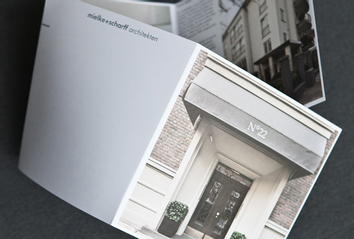
Brochure showcasing work of Mielke+Scharff, architects. Photography by Mareen Fischinger.

Did things go as expected? Any surprises?

First of all, Hannah and I had to move up our wedding, which had been scheduled for September. We had two weeks to plan everything. Nevertheless, it was an amazing day. And then we came here with two suitcases and our kitten, Kiyoko, who injured her tail on the airplane. I will not bore you with all my comical stories about getting our visas and the trip itself.

And life at the office?

Previously I was a project manager or my own boss. Here, everything goes through three partners. This can be challenging and requires compromises on all sides. We all have a personality. I claim that I have taste―but so does everybody else. We all offer opinions and arguments about what works best for the design, and if there is a good reason to choose this instead of that. In some cases we all agree. In all cases the work gets better because of this process. And it is interesting to work in English because so much can be said with so few words.

How do you like living in New York?

New York City is unique. Although in certain ways life is much tougher here ― paying twice as much rent every month for a Williamsburg, Brooklyn, apartment a quarter of the size of what we had in Düsseldorf can be frustrating ― it is a better life. There is so much energy here. Things get done more quickly. And it’s a culture of diversity that I think is unmatched anywhere else, especially the restaurants, the museums.

Your English is nearly perfect. I have noticed that particularly about people from Germany, the Netherlands and Switzerland. They may have a slight accent but rarely make grammatical mistakes. Why is that?

We have to do better. We have to prove ourselves to be the smartest, especially taking into consideration Germany’s history. And we have an excellent school system, free and supported by the government.

Design of Kwartier, a new typeface for signage systems, currently being refined for commercial release. “We see a lot of portfolios, but Tristan’s really stood out. We saw a kindred soul, and didn’t want to miss the opportunity,” says Tom Geismar .

What are you working on right now?

I’m working on the design of an iced tea brand that will fulfill the hearts of New Yorkers with a great icon and good taste. I’m also working on the corporate design for an international zoo, which will be announced in March, and one other icon that is not public yet.

What do you recommend to other young designers who might have similar career aspirations?

Wait until you are really sure your portfolio represents your signature, that the work is consistent, not squishy or all over the place. Concentrate on a powerful visual language, not a “style” of the moment. Learn from the best designers, but mix in your own tasty cocktail. When you interview, be polite but confident. A good portfolio is nothing without a good presentation.

Copyright F+W Media Inc. 2012.

Salon is proud to feature content from Imprint, the fastest-growing design community on the web. Brought to you by Print magazine, America’s oldest and most trusted design voice, Imprint features some of the biggest names in the industry covering visual culture from every angle. Imprint advances and expands the design conversation, providing fresh daily content to the community (and now to salon.com!), sparking conversation, competition, criticism, and passion among its members.

Revisiting the power of Nazi propaganda

A new Holocaust Museum exhibit provides unique insight into one of the world's most devastating ad campaigns

  • more
    • All Share Services

Revisiting the power of Nazi propaganda (Credit: Kunstbibliothek Berlin/BPK, Berlin/Art Resource, New York)
This article originally appeared on Imprint.

The People Vote Slate 1, National Socialists -- 1932 -- Willi Engelhardt, artist. Credit: Library of Congress, Prints and Photographs Division, Washington, D.C.

What is the role of the printed word and image in collectively inciting societies to brand certain members and groups as evil, and to convince the citizenry to condone — if not incite — murder?

During a recent visit to the United States Holocaust Memorial Museum in Washington, D.C., I was reeducated in the power of branding — especially as applied to poster design — at the special exhibition, State of Deception: The Power of Nazi Propaganda, which demonstrates how the Nazi party used carefully crafted messages, advertising and design techniques, and then-new technologies (radio, television, film) to sway millions with its vision for a new Germany. As described in its press release, “The exhibition presents posters, photographs, artifacts, and film documenting the propaganda in the Nazi effort to achieve and consolidate power and drive the world into a war that cost some 55 million lives, including 6 million Jews, in the Holocaust. The legacy of this era continues today, influencing debates about hate speech and the dangers of propaganda in democratic societies, as well as efforts to prevent and punish the crime of genocide.”

I came away with one overriding question: Has any other organization of any kind, before or after, done a better job of using all the elements of branding and mass communication — symbol, headlines and slogans, color scheme, typography, imagery — to transmit its messages and mold public opinion?

Cover of "State of Deception: The Power of Nazi Propaganda," book by Steven Luckert and Susan Bachrach of the United States Holocaust Memorial Museum. The cover image is from a poster for the film “S.A. Mann Brand,” 1933. Credit: Kunstbibliothek Berlin/BPK, Berlin/Art Resource, New York. Book designed by Laura Lindgren.

To look into all of this more deeply, away from the crowds that clogged the passages of the maze-like exhibit, I bought the book. Like the exhibit, the book opens by defining propaganda as “the dissemination of information, whether truthful, partially truthful, or blatantly false, that aims to shape public opinion and behavior,” and is laid out in four main sections:

1919-1933: Propaganda for Votes and Power: A vision of national unity and promise of future prosperity for Germany glorified Hitler, recruited adherents, and helped transform the Nazi Party from an obscure extremist organization into Germany’s largest political party.

Workers, Awaken -- 1932. This election poster shows the German worker, enlightened through National Socialism, towering over his opponents. A Jew is portrayed whispering in the ear of a Marxist, symbolized by the red cap. Behind them, a communist youth with a bloody knife carries a banner that states “Beat the Fascists, Civil War, Class Struggle.” Credit: U.S. Holocaust Memorial Museum

Hitler über Deutschland (Hitler over Germany) -- 1932. Cover image from Nazi Party political pamphlet that detailed Hitler’s election campaign for president. Josef Berchtold, artist. Credit: U.S. Holocaust Memorial Museum/Randall Bytwerk

1933-1939: Propaganda and Persecution in the Racial State: Propaganda fueled the flames of hate by blaming the Jews and others for Germany’s economic woes and depicting them as a threat to racial purity and national health, making legislative measures against Jews (seizure of property and businesses, banishment from many professions, closure of schools, etc.) appear to be in the best interest of the public.

Poster for the film “Der ewige Jude” (The Eternal or Wandering Jew) -- 1940. As part of its wartime attack on Jews, the Ministry of Propaganda used motion pictures as a medium for antisemitic messages. This film was billed as a documentary on world Jewry aimed at unmasking the alleged pernicious influence of the “parasitic Jewish

1939-1945: Propaganda for War and Mass Murder: Posters, pamphlets, newspapers, radio broadcasts, films, school curricula, even toys and board games justified war by creating a potent image of the enemy and fostering a climate of acquiescence to the mass murder of Jews and others (including gypsies, homosexuals and people with disabilities) viewed as undesirable by the Nazi state.

“Behind the enemy powers: the Jew” -- 1942. Nazi propagandists frequently depicted the Jew as a conspirator plotting world domination by acting behind the scenes in nations at war with Germany. This caricature represents the Jewish financier manipulating the Allies: Great Britain, the United States, and the Soviet Union. Hanisch, artist. Credit: U.S. Holocaust Memorial Museum/Gift of Helmut Eschwege

“]

“He is to blame for the war!” -- 1943. The Nazis sought to provoke hatred of Jews by transforming the perception of them from ordinary neighbor into enemy guilty of warmongering and betraying Germany from within. Mjölnir [Hans Schweitzer, artist. Credit: Library of Congress Prints and Photographs Division, Washington, D.C.

In all these materials, the integrity of the logo, the swastika, is never compromised, though it is depicted in a number of versions, including 3-D, as architecture and sculpture, in a pattern, as a symbol for a location on a map. The illustrations are powerful and compelling. The typography is nationalistic and bold, when related to Germany, with Fraktur and Kabel, often in hand-lettered versions, predominating. When related to Jews, scripts and fake Hebrew are used. The color scheme is strong and consistent: red, black, gold, tan.

Thankfully, after 1945, it was all dismantled*. As explained in part 4, “1945-Present: Propaganda on Trial,” after the Allied victory came the de-Nazification of Germany. Not only were war criminals brought to trial, statues of Hitler were removed, street names changed, information about the concentration camps documented and publicized, broadsides and films reinforced the concept of collective guilt on the part of the German public. And in the wake of the Holocaust international laws were passed criminalizing incitement to genocide, most notably in a 2003 verdict of the International Criminal Tribunal for Rwanda in which three Hutu Rwandans, a publisher and two talk-radio hosts, were convicted of “direct and public incitement for genocide” — the murder of half a million members of the Tutsi minority.

The exhibit and the book ask as many questions as they answer. For example, “What is the best way to expose and counter deceptive messages?” and “What limits should there be on speech and what are the costs of exposing them?”

According to the exhibit’s curator and author of the book, Steven Luckert, Ph.D., the public is seeking answers. “From the time of its opening on January 30, 2009 through the end of 2011 nearly 1.3 million people visited the State of Deception exhibition, making it our most popular special exhibition since the museum opened in 1993,” he stated via e-mail. “We are planning to launch a traveling version in 2013. The online version of the exhibition will continue to remain on the museum website, and we will probably increase the number of articles on Nazi propaganda currently available.”

Like other museums on the National Mall (Air and Space Museum, African Art Museum and Smithsonian Institution), the United States Holocaust Memorial Museum is free and open to the public almost every day of the year. The State of Deception exhibition will be on display through September 2012. See the Plan a Visit page for details.

* Note: The Nazi propaganda machine may have been dismantled after 1945, but the imagery keeps rearing its ugly head. In the last few months, swastikas were painted on libraries and synagogues in Brooklyn, Queens, New Jersey, Connecticut, California and Washington state.

Copyright F+W Media Inc. 2011.

Salon is proud to feature content from Imprint, the fastest-growing design community on the web. Brought to you by Print magazine, America’s oldest and most trusted design voice, Imprint features some of the biggest names in the industry covering visual culture from every angle. Imprint advances and expands the design conversation, providing fresh daily content to the community (and now to salon.com!), sparking conversation, competition, criticism, and passion among its members.

Continue Reading Close

Picasso’s fascinating early works

A new exhibit traces the seminal painter's development as an artist from childhood through young adulthood

  • more
    • All Share Services

Picasso's fascinating early worksStudy of a Torso, 1895. Charcoal and black pencil on paper. (Credit: ©2011 Estate of Pablo Picasso / Artists Rights Society (ARS). New York)
This article originally appeared on Imprint.

Head of a Woman, 1921, pastel on paper. ©2011 Estate of Pablo Picasso / Artists Rights Society (ARS). New York

I’ll never forget an object I saw in the Picasso Museum in Barcelona 25 years ago: Picasso’s first-grade reader. He’d filled the margins with pencil drawings: animals, birds, people. Next to the book in the glass case was a teacher’s note to his mama: “Pablo should stop drawing in class and pay attention to his lessons” (my rough translation). Last year, I went back to the museum, which had been much enlarged and fancied up, and wanted to see that little book again. “Not possible. It’s in the basement now,” I was told. Too bad, because it could be an object lesson to all artists and designers (and their early teachers).

With much anticipation, I visited the current  “Picasso’s Drawings 1890 – 1921 – Reinventing Tradition” exhibition at the Frick Collection. Which early works, I wondered — Picasso was 9 years old in 1890 — would be there, and what would they reveal about how his budding talent was viewed and nurtured (or not)?

The earliest drawing in the exhibit — which presents 60 works in pencil, ink, watercolor, gouache, pastel and chalk — is an 1890 pencil drawing of Hercules, based on a statuette in the hallway of the family’s apartment house in Málaga. Picasso’s father, Don José Ruiz y Blasco, I’ve learned, was a museum curator who painted naturalistic depictions of animals and birds and taught drawing at the local art school. Young Pablo, then, was surrounded from birth by works of art and by the teaching and practice of making art. I think we can safely assume that his parents were not too troubled by the teacher’s note.

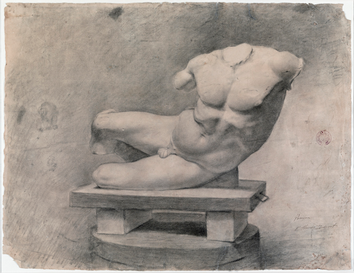
Study of a Torso, 1895. Charcoal and black pencil on paper. ©2011 Estate of Pablo Picasso / Artists Rights Society (ARS). New York

Picasso’s formal academic art education began in 1892, when as an 11-year-old he drew “Bullfight and Six Studies of Doves,” a pencil drawing that foreshadows iconic themes that reappear throughout his career. “Study of a Torso,” above, demonstrates how well he was able to master Renaissance draftsmanship and principles of style and form by age 14.

Most Picasso exhibitions these days are blockbusters, with advance ticket sales, long lines, huge crowds. The Frick is an opulent and perhaps underappreciated Fifth Avenue mansion that houses a renowned collection of old master paintings. This exhibit makes it possible to see — in an uncrowded setting — works on paper that give an intimate glimpse into the artist’s influences, techniques, themes and experiments. “Mother and Child on the Shore,” below, anticipates the 22-year-old artist’s mature themes and colorations.

Mother and Child on the Shore, 1902, pastel on paper. ©2011 Estate of Pablo Picasso / Artists Rights Society (ARS). New York

Still Life with Chocolate Pot, 1909, watercolor on paper. © 2011 Estate of Pablo Picasso / Artists Rights Society (ARS), New York

In 1904 Picasso moved to Paris, where, as the exhibition catalog notes, “he was uniquely situated in time and place to create his combustive mix of traditional means and new formulations.” By the time he painted “Still Life with Chocolate Pot,” above, he‘d broken away from traditional means of representation. The forms of ordinary objects have been made angular and faceted, and are seen from different points of view: cubism is born.

The Cup of Coffee, 1913, papier collé with charcoal and white chalk. © 2011 Estate of Pablo Picasso / Artists Rights Society (ARS), New York

I was most drawn to the collage, or papier collé, above, ”The Cup of Coffee.” “It is if Picasso had literally cut up the past,” reads the catalog. “The methods, techniques and supports of the rich history of drawings and reassembled them into a new order.” This charcoal and chalk drawing on fine art paper incorporates patterned wallpaper that was cut and pasted together in a dimensional manner, casting shadows that made me want to reach through the glass and touch it. And maybe it incorporates typography, too; I see a big blue letter ‘E.’

Two Women with Hats, pastel on paper, 1921. © 2011 Estate of Pablo Picasso / Artists Rights Society (ARS), New York

In the 1920s, when “everybody” was doing cubism, Picasso returned to classicism, his own brand, which married monumental sculptural elements with influences ranging from Italian mannerism to Ingres to African sculpture. “Head of a Woman,” the theme image of the exhibit, at top left of this post, and “Two Women with Hats,” above, demonstrate the power of and intimacy of works on paper. They’re both in a tiny room on the 142,600-sq-ft museum’s first floor; the exhibition continues down a spiral staircase to a lower-level area. (Is the museum saying that they wouldn’t give up any wall space in the 18 grand rooms that display the Van Eycks and Rembrandts for this stuff?)

The Frick Collection West Gallery, 1 East 70th Street @ Fifth Avenue, NYC. The 3-story mansion was designed for industrialist Henry Clay Frick by Thomas Hastings of Carrere and Hastings and completed in 1914. It became a museum after a 1935 conversion by John Russell Pope.

The Frick Collection Garden Court. Benches all around invite contemplation.

“Picasso’s Drawings” closes at the Frick on Jan. 8, after which the exhibit will travel to the National Gallery in Washington, D.C.

Continue Reading Close

The silver age of photojournalism

A New York gallery displays iconic prints of Elvis, Marilyn and the Kennedys from the black-and-white film era

  • more
    • All Share Services

The silver age of photojournalism Elvis Presley in 1958 (Credit: Bill Ray)
This article originally appeared on Imprint.

“There was a time, before photography got discovered and revered as art, that everybody knew who the good photographers were. The people who cared about photography and knew all the photographers knew who the good ones were. And you could rank them in order, and move the order around according to what they had shot most recently. There was unanimity—a consensus of their colleagues about who was really taking telling pictures. I’m not sure that there’s the same consensus today, or the same knowledge of what’s out there and who is good.”

—from an interview with John Loengard by David Schoenauer

ImprintI went to the Leica Gallery on a recent Saturday afternoon for the “75 Years of Life” show, to see original prints of iconic photographs by Alfred Eisenstaedt, Margaret Bourke-White, John Dominis and many others whose work defined the silver age of black-and-white photojournalism.

Just as anticipated, I escaped from the hordes of holiday shoppers on lower Broadway into a tranquil atelier that’s dedicated to celebrating the almost-lost art of the image as captured on black-and-white film and printed in the darkroom on photographic paper.

All the pictures were there, ready to be studied up-close and personal, with no lines, crowds or admission fees. Just me and one other visitor with the Kennedys and Marilyn and Elvis, heads of state and Hollywood royalty, Babe Ruth and Billie Holiday, Depression-era families, concentration camp survivors and military heroes, and Eisenstadt’s VE-Day Times Square kiss.

Bill Ray: Elvis Presley, 1958, from "75 Years of Life"

John Loengard: Brassai's Eye, 1981

What was not expected was to get really energized by a complementary exhibit of images by famed Life photographer and photo editor John Loengard, and then to meet Loengard himself. Celebrating his new book, “The Age of Silver,” the Loengard show presents 24 thought-provoking pictures of photographers working on location and in their studios. Over his 55-year career, Loengard interviewed and photographed Eisenstaedt, Henri Cartier-Bresson, Richard Avedon, Berenice Abbott, Harry Benson, and many others. There is the astonishing picture of Annie Leibovitz out on a Chrysler Building gargoyle as an assistant hands her a camera back freshly loaded with film, and there is Jay Maisel hanging from a water tower, solo, getting the shot.

Those pictures made me nostalgic for the days when graphic designers pored over contact sheets and sent out negatives to be printed at labs. Do other designers mourn the qualities of film photography that may never be captured again, while acknowledging that our survival would be impossible today without the access and speed of digital?

John Loengard: Annie Leibovitz on the Chrysler Building, 1991

John Loengard: Jay Maisel 190 Broadway, 1981

I’d just finished jotting down facts about the Leica Gallery (3,000 square feet, 130 shows over 18 years, 40,000 visitors a year) provided by Rose Deutsch, who with her husband, Jay, has co-directed the gallery since it opened in 1993, and started talking with her about the inimitable qualities of film when Loengard walked in. Without putting down the box of photo paper he was carrying, he joined the conversation.

“What is it that’s missing from digital?” I asked. “Is it the grain, or the full tonal range from whitest whites to blackest blacks?” “Think of Jell-O,” was his answer. “Silver suspended in gelatin, emulsion on paper.”

Yes, but a more complete answer can be found in David Schoenauer’s extensive interview on La Lettre de la Photographie: “You had a century of black-and-white photographs, and its emphasis was on expression and gesture. If you wanted to photograph someone, say, typically in the act of living, you got a sense of who they were and what they were by how you depicted their body and the expression on their face. I think that’s one of the qualities of black-and-white photography that we became sensitive to. And this was something that color would not add to.”

Leica Gallery is more than a walk down photography’s memory lane. It is keeping alive those rare moments when the perfect expression and gesture were captured on film. Thinking a bit more about the quote with which I opened this post: Maybe only a few people know “who the good ones are” anymore, but in a world where almost everyone is a photographer and a publisher (a good thing, no?), we can still celebrate the work of the good ones from the past.

Located at 670 Broadway between Bond and Bleecker in Manhattan’s NoHo district, Leica Gallery is open Tuesday through Saturday from noon to 6 p.m. Most prints are for sale, priced between $800 and $2,000, framed. The “75 Years of Life” and John Loengard exhibits will close on Jan. 7.

Copyright F+W Media Inc. 2011.


Salon is proud to feature content from Imprint, the fastest-growing design community on the web. Brought to you by Print magazine, America’s oldest and most trusted design voice, Imprint features some of the biggest names in the industry covering visual culture from every angle. Imprint advances and expands the design conversation, providing fresh daily content to the community (and now to salon.com!), sparking conversation, competition, criticism, and passion among its members.

Continue Reading Close

How to spot a (graphic) knockoff

No, those aren't real Pepsi briefs. But the counterfeiters' logo reproduction and typography are nearly perfect

  • more
    • All Share Services

How to spot a (graphic) knockoff
This article originally appeared on Imprint.

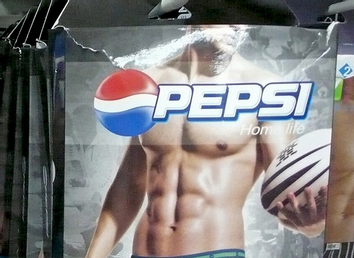
Product packaging spotted at the Wumart (I kid you not) in Beijing.

ImprintAre these REAL Pepsi briefs, or is this the ultimate in knockoffs? I asked Lisa Francella, senior director of Visual Identity and Branding Extension at Pepsico Inc. in Purchase, N.Y. “I know this is not a package that I approved!” was her answer.

Pepsi briefs

Like many knockoffs in China—sold in wholesale markets, shops, and on the street—the packaging, hang tags, and merchandise itself fool the eye. The logo reproduction and typography are so realistically done that an experienced graphic designer can’t tell the difference. On most counterfeit packaging, for, say, North Face or Nike apparel, the English is perfect. Which is amazing in a country where it’s typical to ponder over such menu items as “Mossiness and Fried Dried Peas” and “Adding Up Fried Shrimp’s Balls.” Counterfeiters avail themselves of excellent scanning and printing technology; they put the care into it because for them it’s like printing money.

The People’s Republic of China, with a population of 1.4 billion, is the second-largest market for Pepsico after the United States. The company, which operates in 148 counties, has since the 1980s made a $1 billion investment in China, licensing its trademarks for beverage and food products and opening plants in most major cities.

Pepsi briefs

What does the small text say? One guess: “Pepsi gives you six-pack abs, and a package she will appreciate.”

You might find the idea of Pepsi men’s underwear in a Wumart comical. But to a soft-drink and snack-food company trying to maintain a clean-cut, all-American image, the suggestion of erections might not be the most welcome type of brand extension. How can Pepsi and other companies protect their overseas investments? According to Julius Rabinowitz, a trademark and copyright attorney who has won cases fighting knockoffs of many big international brands, “You monitor it. You scour the marketplace. You send people over and you hire people locally. You make reporting infringements worth their while by paying them more than the bribes they’d get to look the other way.”

And if you see something, say something, right? “Yes,” says Julius, who, in the interest of full disclosure, is my husband and was in the Wumart when I spotted the underwear. “If you work for a company and see something that looks suspiciously like trademark infringement or counterfeit merchandise, report it to headquarters. They have to make the decision whether it’s worth it to try to try to stop the infringers in court. They’d need to hire a local law firm. It could take up to two years and cost $100,000 or more. And they still might not be able to stop it. In the U.S., we have a culture, courts, and enforcement procedures that are pro-trademark, that honor trademark interests. In China, they do not.”

One tip-off for the underwear: It’s 2011 and these packages still sport the 1971 logo, not the Arnell Group update unveiled in 2008. An update that was not universally appreciated.

Closer to home, U.S. designers are getting increasingly upset over the proliferation of name-your-price websites that make such offers as: “Host your very own design contest where thousands of talented designers compete to create a logo design you love, or your money back.” To add injury to insult, many elements in the “winning” designs are stolen from legitimate logos. Design a logo with a lotus icon for a yoga studio today, and next week your icon is on Lotus Brand Rice in Singapore or Frank Lotus Ford Dealership in Pittsburgh. Your icon may have traveled globally via the circular route: Elements of U.S. logos become part of vast libraries of pictorial elements used by teams of graphic artists, many of them in Asia, who crank out stuff for the guys who run online contests patronized by U.S. business owners lured by the promise of a cheap logo.

Short of not posting your work, what to do? Some designers suggest protesting loudly: Contact the website doing the selling. Contact the gullible clients doing the buying; maybe they will ask for their money back. Julius disagrees. “They won’t care,” he says. “And there’s always more value in posting your work, even if there’s a risk that it will be knocked off.”

Oh, well. Let’s just order some “Added Hot Taste Saliva Chicken,” dig in, and enjoy.

Copyright F+W Media Inc. 2011.

Salon is proud to feature content from Imprint, the fastest-growing design community on the web. Brought to you by Print magazine, America’s oldest and most trusted design voice, Imprint features some of the biggest names in the industry covering visual culture from every angle. Imprint advances and expands the design conversation, providing fresh daily content to the community (and now to salon.com!), sparking conversation, competition, criticism, and passion among its members.

Continue Reading Close

What makes people happy?

An acclaimed graphic designer turns the lens on his own life as he works on a film exploring this eternal question

  • more
    • All Share Services

What makes people happy?


What makes you happy? Is it how much money you make, who your partner is, your clothes or car? What makes you unhappy? Is it the weather, your too-small apartment, things your partner does (or the fact that you don’t have one)? Graphic designer Stefan Sagmeister has been busy seeking the (often surprising) answers. And he’s making a movie about it with Hillman Curtis, Web designer and director of TV commercials and short films.

Stefan is the guinea pig, the subject of “The Happy Film,” “Making a movie about happiness is like making a movie about life,” Stefan told a full house of fans at the SVA Theater last Thursday, most of whom had paid $50 to be there — it was a fundraiser to help finish the movie. “I’ve learned that 50 percent of happiness comes from your genes,” he said, telling a story about the ‘giggle twins’ who were separated at birth to explain one of his charts. “Only 10 percent comes from life conditions like income, race and physical attractiveness; and 40 percent from your activities and relationships.” Yes, the movie is mostly about his life, but he’s doing it in a well-researched way he hopes will compel viewers to try out one or more of the happiness-quotient-increasing strategies he’s been experimenting with.

The Happiness Chart, as explained by Stefan Sagmeister: “Happiness is not determined by where you live or how much money you make, but by factors like whether you have good friends and enjoy being with them.”

I’ve been following Stefan’s career with equal degrees of awe and skepticism since 1999, when I profiled him for Communication Arts magazine. Skepticism, especially, about his “years without clients,” during which he went to exotic locales and came back to New York with huge splashes of publicity. Yet when I interviewed him for C.A. and again in 2008 for Etapes, the French design magazine, which asked me to report on his “Things I Have Learned in My Life So Far” book and exhibition at Deitch Projects, he was gracious, warm and open. After attending last Thursday’s event, I will delete any remaining skepticism. Every generation has its Leonardo da Vinci. I’m becoming more convinced that Sagmeister is it, and we graphic designers are lucky to have him in our midst. Yes, a few people out there are grousing about how much money they think he makes and how much better his clients are than theirs. Face it: He is brilliant. He is a meticulous craftsman, original and brave. (You didn’t cut typography into your body and bleed to make a poster, did you? And you didn’t write books half as good as “Things I Have Learned” and “Made You Look,” and Hillman’s “Creating Short Films”.)


“What if you took ‘retiring,’ the last active part of your life, and interspersed five years of it into ‘working’?”


“I was very close to my mother and fell into a depression after she died.”

He is honest. He told the audience things like: “I had to do something like make this movie. A friend accused me of coming home from a year in Bali with only a few skimpy furniture ideas.” “I ignore 50 positive comments and focus on the one negative one.” “I have an addictive personality and used to have an alcohol problem.”

Criticisms and unhappy states of mind propelled him into researching the answers to such questions as, “What are the factors that make people happy?” He consulted experts and read psychology books from the pop to the academic, ultimately finding the right balance for himself in “The Happiness Hypothesis: Finding Modern Truth in Ancient Wisdom” by Jonathan Haidt, professor of psychology at the University of Virginia, who was in the audience and is an advisor to the film. Haight’s keys to happiness, which Stefan will continue to experiment with and Hillman will film, are meditation, pharmaceuticals, and cognitive behavior therapy. “It’s gonna be awful,” Stefan predicted of his forthcoming, and first, foray into therapy (with camera crew in the room).


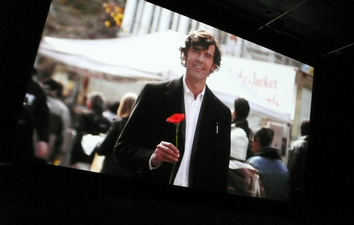
“Could I make myself happy and prove that HAVING GUTS ALWAYS PAYS OFF FOR ME by standing in the greenmarket with a flower and trying to say nice things and pick up a girl?”

After showing a 15-minute preview of the film, which is about 30 percent completed, Stefan and Hillman took questions from the audience:

Q: How was it for the two of you to work together?

Hillman: Pretty good, pretty smooth.

Stefan: I didn’t realize how difficult it would be to make a documentary.

Q: Did the process of making the film make you happier?

H: Yes.

S: Very much unhappier.

Q: What is your hope for the film?

H: Theatrical release.

S: If audience members say to themselves, “I will try that out. It just might work for me.”

Q: What are your major obstacles to getting it finished?

H: Making the time between other projects.

Q: How different are you at 49 than 29?

S: Not as good looking. [He introduced the good-looking actor in the audience who played him at 29.]

Q: Why did you choose cognitive behavior therapy over other therapies?

S: Research has proven its effectiveness and you can learn it on your own. I like efficient, cheap tricks.

Q: How much money did you raise tonight, and how much more is needed to finish the film?

S: The event raised about $5,000, and $500,000 is needed to complete the film.

H: At this rate we’d need to organize 100 more evenings like this. We will not.

Copyright F+W Media Inc. 2011.

Salon is proud to feature content from Imprint, the fastest-growing design community on the web. Brought to you by Print magazine, America’s oldest and most trusted design voice, Imprint features some of the biggest names in the industry covering visual culture from every angle. Imprint advances and expands the design conversation, providing fresh daily content to the community (and now to salon.com!), sparking conversation, competition, criticism, and passion among its members.

Continue Reading Close

Page 1 of 2 in Ellen Shapiro