Ellen Willis

“Terror and Liberalism” by Paul Berman

An important liberal thinker argues that Islamic fundamentalism is the new face of fascism. But his faith in the Bush administration as a force for freedom is naive.

  • more
    • All Share Services

Of the many strange moments since Sept. 11, 2001, perhaps the most surreal was Dan Rather’s recent interview with Saddam Hussein. Here we have the dictator challenging George W. Bush to a debate and bragging about receiving 100 percent of the vote in the last election. And here we have America’s quintessential establishment journalist, unfailingly polite and even deferential, reminiscing about his last interview with the dictator a decade ago, asking him about the logistics of his debate proposal, and inviting him to say a few words in English.

“Where is Oriana Fallaci when we need her?” I muttered, recalling the classic interview in which the redoubtable Fallaci got Henry Kissinger to describe himself as a cowboy. Afterward, Rather was duly criticized by his peers for not challenging Saddam more aggressively. But the issue was not just Rather’s passivity. It was his obliviousness to the nuttiness of the encounter, based as it was on two absurd premises: that it is possible to have a reasonable conversation with a mass murderer and that something of value could be accomplished in an interview that Saddam had decreed would be taped and reviewed by his people and only then handed over to CBS. The pervasive subtext of the conversation was Rather’s awe in the presence of power, his self-congratulation at being allowed in this rarefied company, and his determination to say nothing that would jeopardize such access in the future. Clearly it had escaped him that the only reason for interviewing a perpetrator of crimes against humanity is to provoke him, through confrontation or manipulation, into revealing something of who he really is.

“There are no gas chambers. This is a lie.” “So, Mr. Hitler, do you speak any English?” Jeez!

This incident does not appear in Paul Berman’s new book, but it’s a study in Berman’s theme: the denial built into liberal rationalism and materialism. “Terror and Liberalism” contends that Islamic fundamentalism and Saddam Hussein’s Baath socialism are morally, ideologically and historically continuous with the totalitarian movements of the 20th century; that fascism and communism both fed on liberals’ resistance to comprehending the irrational nature of those movements; and that the same blindness is rampant today. The subject of Berman’s critique is liberalism in the broadly philosophical rather than specifically political sense, a worldview that underlies a range of political positions from the French socialists’ opposition to World War II and ultimate collaboration with the Nazis to the anti-interventionism that currently dominates the European and American left to the foreign policy “realism” embraced by European governments and our own diplomatic establishment.

Basic to this worldview, Berman notes, is the belief that people act rationally in their self-interest. It assumes that political conflict is about a clash of interests — about military power, or class struggle, or territory, or oil. When apocalyptic mass movements commit violence, it must be in response to grievances: exploitation by the rich, domination and humiliation by the powerful. Violence that makes no sense in those terms — if it’s aimed at random civilians, or Jews, or women who show their faces in the street; if it’s suicidal as well as murderous — only shows that its perpetrators are unhinged by oppression. In those circumstances, the irrational is rational. But totalitarian movements, Berman argues, do not fit this liberal calculus; they are wholly pathological, a nihilistic romance with death.

In tracing the origins of this pathology, Albert Camus’ “The Rebel,” published in 1951, is Berman’s touchstone. For Camus, the human impulse to rebel takes a sinister turn, beginning with the French Revolution and flowering with 19th century romanticism: “The love of freedom and progress” becomes “weirdly inseparable from a morbid obsession with murder and suicide.” This obsession finds its way into anarchist and socialist revolutionary movements in Russia, Europe, America. A variant of it crops up in European colonialists in Africa, with such insane events as the Belgian massacre of the Congolese. Ultimately it converges with mass movements of the right and the left. Somewhere along the way, the impulse to rebel has been harnessed to its seeming opposite, the ideal of submission to an all-embracing authority: “the total state, the total doctrine, the total movement.” (The word “totalitarianism” is Mussolini’s.) And this frenzy of absolutism is directed, above all, against liberal tolerance and pluralism. In this anti-liberal crusade Berman discerns a modern acting-out of the Armageddon myth: The people of God are under siege — from within by the corrupt city dwellers of Babylon, from without by the minions of Satan. After a war of extermination against the evil forces, the people of God, in their purity, will reign.

“Terror and Liberalism” challenges the notion that these are only Western stories, and that Islamic radicalism and Baathism have wholly indigenous roots. Berman documents the interpenetration of Western and Muslim identities and influences, the development of Islamic fundamentalism in response to liberalism, the incorporation of both fascist and Stalinist elements into the Baath movement. In the chapters that for me are the high point of the book, he analyzes the work of the late Islamist philosopher Sayyid Qutb, who wrote, among other things, an exhaustive commentary on the Quran. To Qutb, the world was a sinkhole of alienation, afflicted with a “hideous schizophrenia” that went back to the early Christians, with their separation of the sacred and secular realms, and that culminated in modern liberalism. The schizophrenia threatened to infiltrate and destroy Islam, not through conquest but through the spread of liberal ideas. This was the crisis that made jihad imperative: a theological, ideological crisis, not a geopolitical one.

In its broad outlines, Berman’s argument is compelling. I agree that totalitarian movements and regimes have certain fundamental characteristics in common despite their different positions on a right-left or religious-secular or East-West spectrum. I agree that both the left and the advocates of realpolitik seem incapable of recognizing and confronting such movements until their catastrophic consequences are obvious — and often not even then. Berman lays out the evidence for these propositions with eloquence and rigor. But when it comes to explaining the roots of totalitarianism and the depth of liberal denial, “Terror and Liberalism” is less successful. Berman’s framework for discussing the totalitarian impulse is moral and literary, an approach that leaves gaps in the narrative: Why does rebellion turn nihilistic? How does the quest for freedom become a craving for submission, and attraction to the forbidden act of murder merge with a lust for self-destruction?

Berman sees that these dynamics are profoundly erotic. He cites Camus’ observation that “the sinister excites. The transgressions of suicide or murder arouse a thrill that sometimes takes an overtly sexual form.” Yet because he does not pursue the logic of that thought, he ends up, as so many moralists do, suggesting that totalitarian terror is an unfathomable mystery, that it’s foolish not only to try to explain it in rational terms but to try to explain it at all: “At Auschwitz the SS said, ‘Here there is no why.’ The anti-war Socialists in France believed no such thing. In their eyes there was always a why.”

The implication is that irrational equals unintelligible — a notion long ago thrown into question by the liberal Enlightenment’s own self-critique, psychoanalysis. The problem with liberal-rationalist explanations is that they ignore the unconscious, the “why” that refers not to mundane conditions of life in the present but to fantasies shaped by hidden desire, rage and anxiety grounded in the past. The perversion of sexuality into sadistic aggression has always been the underside of repressive patriarchal cultures, East and West; suicide — aggression turned against the self — is its close companion. The will to power is the will to ecstasy is the will to surrender is the will to submit and, in extremis, to die. Or to put it another way, the rage to attain a freedom and happiness one’s psyche cannot accept creates enormous anxiety and ends in self-punishing despair: murder-suicide, the ultimate expression of rage and despair, stills the anxiety for good.

Since patriarchal culture in its various versions is our universal legacy — weakened yet far from surpassed even in “enlightened” liberal societies — it is by no means hyperbolic to suggest that in our hearts we are all potential terrorists. What then is the why that transmutes the urge toward murder-suicide from a private, unconscious nightmare to a symptom of mass-hysterical barbarism cheered on by whole populations? Berman may go too far in discounting the political and economic whys of the liberal rationalists. They do play a part, whether in creating unstable situations that loosen social controls against violent acting out or in exacerbating people’s anger while providing it with legitimate rationales and plausible targets. But such conditions only enable terror; they do not cause it. In his discussion of the “hideous schizophrenia” and the fear that it will subvert and destroy Islam, Berman supplies the key to the puzzle: Totalitarian terror is above all the reaction of people who have internalized a rigid patriarchal morality against the desires aroused by contact with liberalism — against, in a word, temptation. The very violence of the reaction attests to the strength of the temptation — to the lure of freedom.

So much for the terrorist; but what of the liberal? It seems to me, and I believe Paul Berman would agree, that understanding the motives of totalitarians may in the end be less important than understanding the reluctance to oppose them. Ironically, it is Berman who, in contemplating this part of the story, is lulled by the reasonable surface of things. He attributes the “rationalist naiveté that is shared by almost every part of modern liberal society” — including the FBI and CIA, who failed to foresee 9/11 despite myriad warning signs — to ideology: “a belief that, around the world, people are bound to behave in more or less reasonable ways in pursuit of normal and identifiable interests … that the world is, by and large, a rational place.” Irrationalist movements simply don’t jibe with the liberal worldview. But this answer begs the question. When people persist in their naiveté in the face of repeated experience, which is to say of history, it’s a good guess that something else is going on: namely that they are denying not just the terrorists’ dark impulses but also their own.

Rationalism, I would argue, is built on the scaffold of denial — not vice versa. And in this sense, there is an uneasy link between liberalism and the totalitarian left: Unlike fascism and radical fundamentalism, which anathematize liberalism and glorify the will to power, communism claims to be the true avatar of liberal values — reason, science, progress, equality, freedom — and denies the will to power that in fact is embodied in the totalitarian state. If the liberal uses rationalism to ward off murderous thoughts, the communist uses it to deny actual murder — hence the well-known gap between the ideals of communist revolutionary movements and the character of the resulting regimes.

In his conclusion, Berman picks up Arthur Schlesinger Jr.’s 1949 call for “a new radicalism” — by which he means, as Schlesinger meant, a dynamic liberalism ready to fight for its ideals: for human rights and women’s rights, ethnic and religious tolerance, the rule of law against racism, anti-Semitism, obscurantism, poverty. I agree, absolutely, that we should defend democratic values, abroad as well as at home. But where Berman sees a battle to rescue liberalism from its failures, I see a problem with liberalism itself. For liberals the antidote to totalitarian absolutism is pluralism — as Berman puts it, “the tolerant idea that every sphere of human activity — science, technology, politics, religion and private life — should operate independently of the others.” The problem with this idea is that it does not correspond with reality, for in fact the various spheres — Berman might have included economics — are interrelated.

The relationships are not always obvious: It took feminists and other cultural radicals to point out, for example, that “private life” — sex, marriage, the family — has a political dimension, that it involves relations of power, often enforced by the state. What a real new radicalism might look like — a radicalism at once democratic and cognizant of the deep structures of our social and psychic life — is a subject for another essay. But it’s precisely the mindset that takes separate spheres for granted, and refuses to look at hidden connections, that invites the willed self-delusion Berman rightly scorns. To weave such connections into a seamless web of Truth is indeed totalitarian; but to deny them is also to simplify the world.

That simplification has its own dangers. If myopic liberalism bears a trace of resemblance to the illiberal left, militant liberalism easily drifts toward the illiberal right. While I’m generally leery of making comparisons between the Vietnam era and today’s very different landscape, it’s worth pondering that the liberal architects of that war saw it as a fight for democracy against totalitarianism. In Berman’s formulation, the United States represents the party of liberalism even under the present far-right administration; whatever the failings of George W. Bush, he is a mere annoyance next to the totalitarian threat. But is he really?

Bush’s couplike ascent to power, his singleminded commitment to the care and feeding of plutocrats, his view of America’s mission as cleansing the world of evil, his use of 9/11 as an excuse to launch a far-reaching assault on civil liberties, can fairly be said to represent a crisis of democracy. Central to Bush’s outlook (and that of his attorney general) is a Christian fundamentalism as hostile to liberalism as Sayyid Qutb. The recent conviction of abortion-doctor assassin James Kopp should remind us that Christianity has its own terrorist fringe; the violence committed by the fanatics of Operation Rescue and the Army of God may be puny compared to Osama bin Laden’s, but it’s similar in spirit.

Berman, who was characterized in the New York Times as one of the liberal left’s “reluctant hawks” on Iraq, does criticize Bush in his book. He notes that the president’s credibility has been damaged by his regressive domestic policies, contempt for the treaties, organizations, and vocabulary of international cooperation, minimalist support for the new Afghan government, and maximalist national security doctrine. But the problem, as Berman poses it, is that Bush has failed to effectively communicate his democratic intentions — not that the intentions themselves are in doubt.

For Berman, it is evidence of Bush’s good faith that we overthrew the Taliban — a policy I did and do support. But is it just a minor matter that with an indifference that looks awfully like cynicism we have basically abandoned Afghanistan to the warlords? Does American messianism, embodied in an expansive doctrine of preventive war (and combined with American corporations’ avidity to get their hands on those lucrative rebuilding contracts), bode well for democracy in Iraq? And when the war is won, and consolidating the United States’ control requires making deals with various pressure groups, which will have more influence — the “realist” State Department and the Europeans, or the Iraqi National Congress? (Take your time.) It’s troublesome questions like these that make me a reluctant dove.

All that said, “Terror and Liberalism” is an important entry in the debate over the meaning of 9/11 and after, not least because it is clearly written from a left-of-center perspective and aimed at a left-of-center audience. I hope that audience will engage the book, rather than dismissing its author as an apologist for war or American imperialism. For the left’s ability to address the issue Berman raises is nothing less than a test of its ability to make sense of the contemporary world. “Freedom for others means safety for ourselves,” he concludes. “Let us be for the freedom of others.” Let us, indeed.

The new talking World War III blues

On Bob Dylan's new "Love and Theft," the topical and the timeless merge with maniacal intensity.

  • more
    • All Share Services

The new talking World War III blues

Somewhere around the fourth or fifth time I listened to Bob Dylan’s new album, “Love and Theft” — after I’d finished being distracted by all the musical influences and had begun paying attention to the voice and hearing some of the words — a 30-year-old memory surfaced: In the middle of an LSD trip I had begun to worry that my identity was dissolving or flying apart, and as a test I decided to sign my name. I was relieved to see that my signature was exactly the same as usual. And then it occurred to me how silly my worry had been. The truth was, I realized, that my “signature” was so tenacious it would be quite difficult, perhaps impossible, to get rid of even if I wanted to. After all, how many people (I would become one of them not long afterward) spent years in psychotherapy trying to change their signatures just a little bit?

From the earliest years of his career Bob Dylan has had a passionate impulse to obliterate his personal identity. That passion has, at various times, been reflected in his biographical mythmaking, his allergic reaction to his celebrity, his flirtations with religion, his compulsion to confound the expectations of his audience by constantly transforming his persona. (In the process he has often denied that the previous incarnation ever existed: Who, me? Political? A folksinger? A poet? An outlaw?) And ever since “John Wesley Harding” — his dramatic 1967 switch to acoustic “folk songs” that sound more like comments on “the folk song” — much of his work has been defined by an apparent desire to unload the baggage of his own experience and become a vessel, channeling American Music.

Of course, the counterimpulses have also been strong: Dylan has an indelible signature, not to mention an indelible ego. The essential tensions in his music have never been about electric versus acoustic but about personal and idiosyncratic versus collective and generic; topical and profane versus primordial and sacred; transcendence as excess versus transcendence as purgation; “Blonde on Blonde” versus “John Wesley Harding”; “Blood on the Tracks” versus “Time Out of Mind.”

I’ve always had reservations about Dylan’s post-”JWH” attempts to get out of his skin, from the homage to country and western of “Nashville Skyline” to the cult of impersonality in the perversely named “Self Portrait” and his hermetic ’90s renditions of old folk songs better left to ethnographers. In “Time Out of Mind” — an album I found virtually unlistenable at the time it came out to near-universal acclaim four years ago and have only now, and grudgingly, come to admire — it struck me that the self-abnegating impulse had doubled back on itself and become a particularly unpalatable form of megalomania, wherein the listener is buttonholed and forced to become a surrogate for the singer’s elusive lover or muse.

“Love and Theft” takes up the quest for anonymity in a quite different way, or so it seems at first. It is mostly pleasant to listen to, yet its self-conscious, let’s-give-them-a-tour-of-the-genres schtick is annoying: The first time Dylan did this, in 1970 on “New Morning,” there was arguably a real need to nudge parochial rock and folk fans to stretch themselves and listen to other Americas; here it merely feels like an invitation to critics to parade their musical erudition. Sifting through this album’s combinations and permutations of blues, country, honky-tonk, swing, r&b, Tin Pan Alley pop, soul, was that a Chuck Berry riff?, etc., etc. — is certainly a fun game, but the best kind of eclecticism (of which Dylan’s corpus is replete with examples) is still the kind that doesn’t call attention to itself, that instead creates a whole greater than its parts.

Still, as I said, the game is only temporarily distracting. Soon individual songs begin to break from their generic moorings like Avalon rising out of the mist: the plangent “Mississippi”; the ominous “High Water,” punctuated by background rumbles and crashes; “Sugar Baby,” with its funereal echoes of “Old Man River” and the traditional “Look Down, Look Down that Lonesome Road.” Then Dylan’s voice hits me, not pleasant at all. It’s beyond raspy, it’s laryngitic, maybe consumptive, it sounds some of the time like it’s coming from a great distance, through a wind tunnel or something, it’s fuzzy. Stuck in the vinyl era, I keep wanting to brush away the lint from an imaginary phonograph needle. It’s as impersonal as static or the coughing in a hospital ward, except that every now and then there’s an echt-Dylan phrase or inflection to remind us of that signature, scrawled like graffiti into musical concrete.

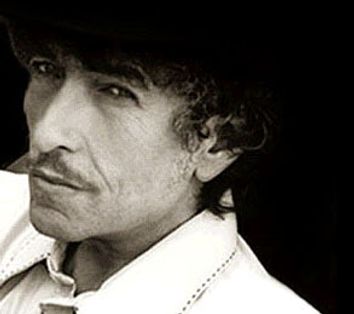
I take another look at the CD cover: the front has Dylan unadorned, vulnerable, looking hardly different — faint mustache, lined face, bags under the eyes notwithstanding — from his pictures in the ’60s; flip the album over and you get some kind of Mexican bandito, whose mustache, along with white hat and quarter-smile, serves as a disguise. Dylan is hardly there at all.

But it’s the lyrics, finally, that make “Love and Theft” what it is — an album in which the individual and the generic, the topical and the timeless, merge with maniacal intensity: “New Morning” crossed with “Time Out of Mind,” juiced by turns with opium and speed. Talk about prophetic: “Every moment of existence seems like some dirty trick/ Happiness comes suddenly and leaves just as quick/ Any minute of the day the bubble could burst ….” And: “I’m stranded in the city that never sleeps … / Some things are too terrible to be true … / The sun in the city leavin’ at 9:45/ I’m having a hard time believing some people were ever alive.” And: “Oh who knows who the bell tolls for, love/ It tolls for you and me” (that one rolling with the jaunty beat of the New Morning-ish “Moonlight”). And: “High water rising, shacks are slidin’ down/ Folks lose their possessions, folks are leaving town …. / Things are breakin’ up out there/ High water everywhere.” And: “George Lewes told the Englishman, the Italian and the Jew/ You can’t open up your mind, boys, to any conceivable point of view/ They got Charles Darwin trapped out there on Highway 5/ Judge says to the high sheriff, I want him dead or alive.”

If Dylan manages to predict the next day’s news by once again tapping into the language of millennial apocalypse, he also captures contemporary anomie (his own, ours) by inventing a narrator — or narrators, it’s hard to tell — who descends into the hell, or purgatory, or limbo, of America’s mysterious rural past, which seems to be located mainly in the south. Contemplating the “earth and sky that melts with flesh and bone,” “goin’ where the wild roses grow,” following the southern star, crossing rivers, staying in Mississippi a day too long, staying with his not-real Aunt Sally, dreaming of Rose’s bed, proposing to marry his second cousin, our hero (or is it heroes?) (or anti-hero/heroes?) walks the line between love and battle, not that there’s much of a difference. Between “Don’t reach out for me, she said/ Can’t you see I’m drowning too?” and “Sugar baby get on down the road, you ain’t got no brains nohow/ You went years without me, might as well keep goin’ now” falls a manifesto of sorts: “I’m not sorry for nothing I’ve done/ I’m glad I fight, I only wish we’d won.” By the end, the topical is slowly submerged as the timeless closes over our heads.

It’s seductive stuff, at moments as compelling as anything Dylan has ever done. And yet I find myself resisting. Something is missing, as it was in “Time Out of Mind”: the irony Dylan once used to undercut his romanticism and his I-am-America self-importance — and not least to befuddle the audience that had taken his latest posture too literally. Since you can’t get away from yourself, not really, at some point you have to come to terms with that or become delusional.

In post-Sept. 11 America, the inescapably topical is also enveloped in history and myth. In the gap where the towers used to be rise many ghosts: of our Cold War alliance with the Afghan mujahedin, the Gulf War, the fatwa against Salman Rushdie, the Iranian hostage crisis, Vietnam, the Israeli-Arab War of ’67, World War II, Pearl Harbor, Hiroshima, World War I, the Civil War, the American Revolution, and beyond, back before the New World, the New Eden, was envisioned. The American imagination will be taxed with demands for unquestioning unity and generic patriotism, will be burdened or inspired by our sense of loss and defiance, identification and separateness, new tensions between individual and collective. And irony (which in some quarters has been prematurely pronounced dead) will be very, very important. The Dylan line that suits does not appear on this album. Better to go back to the beginning, to “Talking World War III Blues” with its teasing ode to mutual paranoia: “I’ll let you be in my dream, if I can be in yours.” Like the Woody Guthrie songs that were its inspiration, it shamelessly appropriates traditional form for contemporary purpose, and its coda is “I said that!” with the accent on the “I.” You can’t get any more mythically American than that.

Continue Reading Close

Vote for Ralph Nader!

Building a left-wing alternative to the Democrats is more important than the small chance that Roe vs. Wade will be overturned.

  • more
    • All Share Services

I’m voting for Ralph Nader — even though I think he’s an asshole on abortion and issues of sexual politics generally — in the hope that the Green Party will get 5 percent of the vote.

Of course, I have the moral luxury of voting in New York, so I don’t have to worry that I will throw the election to George W. Bush. But I’m not sure I’d do otherwise even if I lived in a swing state. I think the left has been paralyzed by its hostage relationship to the Democrats. And while I believe that ultimately it’s mass social movements, not electoral politics, that accomplish real change, I also think it’s important to challenge the aura of invulnerability that now surrounds the relentlessly center right-to-far right two-party system, which has convinced millions of people that believing in meaningful change is pointless, akin to believing in the tooth fairy.

Not only is Al Gore committed to the New Democrats’ corporate agenda, but on social issues other than abortion he is to the right of President Clinton. Counting on fear to whip the left wing of the party into line, he basically ignores it and has not made any gestures to co-opt the Nader vote. Instead he merely demonizes the Naderites as spoilers. The last straw for me was Joe Lieberman. For years I’ve been voting for Democrats on the grounds that at least the party is not run by right-wing lunatics, but if you listen to Lieberman’s rhetoric, he’s a Christian rightist in Jewish drag.

Both Gore and Lieberman are pandering to religious and moral conservatives, again ignoring the secularists and social liberals who are the backbone of the party. Neither of them ever met a civil liberty he liked. I am chilled by their demagogic attacks on popular culture. Gore’s talk of “cultural pollution” reminds me of Nazi rhetoric.

Gore is also pandering to the nonexistent Clinton moral backlash vote. (Does anyone believe that if Clinton were running he wouldn’t be way ahead right now?) By refusing to campaign with the still-popular president, or even to let Clinton campaign in closely contested states, Gore is not only endangering his own candidacy but sabotaging the Democrats’ efforts to take back Congress — which to me is much more important, in terms of staving off the lunatics’ agenda, than whoever gets to the White House. (I’m voting for Hillary Rodham Clinton, despite reservations, for just that reason.)

Meanwhile, Lieberman refuses to give up his Senate candidacy, which means if he wins the vice presidency and his Senate race, the Republicans get to appoint his replacement. In short, both candidates are far less interested in running against a conservative, do-nothing Republican Congress than in than in keeping their distance from Democratic liberals.

On Supreme Court appointments, I doubt that Bush would be willing to expend the political capital necessary to get a reliably hard-right idealogue through what promises to be a closely divided Senate. (And for the same reason, as well as his own proclivities, Gore would almost certainly appoint centrist rather than liberal justices.) Still, there is a risk that a Bush victory might lead to Roe vs. Wade’s being overturned — more so, certainly, than with Gore. Should avoiding this risk be the bottom line for feminists?

It’s a hard question, and one I certainly can’t dismiss. Yet more and more I am coming to the conviction that Roe vs. Wade, in the guise of a great victory, has been in some respects a disaster for feminism. We might be better off today if it had never happened, and we had had to continue a state-by-state political fight. Roe vs. Wade resulted in a lot of women declaring victory and going home. In the meantime we have been losing abortion rights on the ground, both in terms of access and funding and on the ideological and psychological levels. With their pro-family, pro-religion rhetoric, Gore and Lieberman reinforce this anti-woman, anti-sexual atmosphere even as they support “choice.”

Today abortion is legal (within limits) but fraught with stigma and danger, and in many parts of the country might as well be illegal. Only a revived feminist movement will change that. And though I’m not a fan of “the worse the better for reviving the movement” scenarios — it ain’t necessarily so — I do think, again, that the feeling of being blackmailed to support the Democrats, whatever they may dole out, to avoid the possibility of losing Roe vs. Wade has a paralyzing effect.

I also think that while feminists have to organize independently and militantly to challenge sexism on the left, unless the left as a whole revives, the chance of organizing a real feminist movement (one willing to say “abortion” instead of “choice,” and attack family values and conservative religious and moral values, for starters) is nil. We have to break through the current end-of-history, “no real change can ever happen” mentality on every front, and the best way to do that on Tuesday is to vote for Ralph Nader.

Continue Reading Close