Emily Gordon
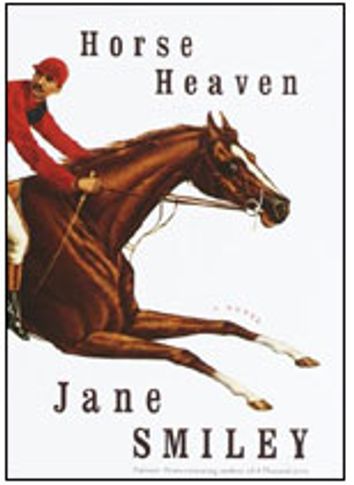
“Horse Heaven” by Jane Smiley
A great big novel, jampacked with characters, that brings poetry to the dust and the lust of the racetrack.
Horses are whores, works of art, incubators, bargaining chips, slaves, money pits, athletes, status symbols, workers, toys, pets, beauty queens, food, machines. Jane Smiley, whose considerable range has thus far stretched from Shakespearean tragedy to campus satire, has produced a remarkable literary achievement: a resolutely unsentimental horse novel. With “Horse Heaven,” she makes us care about horses the way E.B. White made us care about pigs in “Charlotte’s Web,” and makes us understand them the way Walter Tevis made us understand chess in “The Queen’s Gambit.” And as with everything Smiley writes, she rides this uneven turf with the calm of a jockey who knows she won’t be thrown.
One of her characters sums it up: “A day at the races is thousands of stories.” Smiley sets the novel at and around the track, jumping from New York to Florida to Maryland to Chicago to New Orleans to Southern California to Texas to France. Along the way, she stages numerous races, from casual contests to the Belmont Stakes, and dips in and out of the lives of her human characters, which sometimes intersect, and the lives of her horses, too, most prominently Froney’s Sis (a self-esteem-challenged orphan), Residual (thoughtful), Epic Steam (a pain in the ass) and a promising bay colt later named Limitless.
There are so many characters that you’re bound to end up identifying with somebody. Will it be Farley Jones, the middle-aged Zen trainer and enlightened man? Or Elizabeth Zada, the “animal communicator” who has enviable (and profitable) powers of intuition? Or Rosalind Maybrick, the unhappy wife of a difficult owner? Or Eileen, Rosalind’s peevish Jack Russell terrier, who occasionally gets an internal narrative of her own from about a foot off the ground? (Everything smells, literally and figuratively.) Or Krista Magnelli, the struggling breeder and beleaguered young mother? Or Roberto Acevedo, the young rider from a dynasty of jockeys, whose thrill in his first real race we get to experience directly? Or — my own pick — will you put your sympathetic dollar on Justa Bob, the biggest sweetheart of them all and a genuine romantic hero? He’s a horse, too.
At every turn, there’s plenty of that “old, old story,” as Groucho Marx says in “A Day at the Races” — “Boy meets girl. Romeo and Juliet. Minneapolis and St. Paul.” We witness the love of a trainer for his boss’s wife, of a billionaire for the tantrically adept psychic, of a trainer for a broken-down stallion, of a corrupt owner for money, fame and (sporadically) Jesus. There’s also a full complement of track villainy; among the lowest of the lowlifes is scurrilous vet Curtis Doheny, who without blinking will do anything to a horse to keep it bringing in the cash.
Throughout, Smiley’s pellucid style brings poetry to the dust and greed of the track while establishing firm analogies between the mania of the racing world and the runaway reveries of her human protagonists. Her plot turns can be startlingly efficient, and tragic or wonderful events can take place over the course of a single sentence: “Here was where Rosalind fell in love.” All of the scenes involving Sam, a hardworking and kind veterinarian, are riveting, reminiscent of the supple, homely tone of “A Thousand Acres.” And Smiley’s pacing is impeccable. The Breeders’ Cup sequence especially — a montage involving most of the principal characters — demonstrates her gift for sustained buildup, for the juxtaposition of small and large events.
Even in her seemingly offhand descriptions, Smiley achieves a similar effect with carefully distilled metaphor: Epic Steam “was big and shining and all but black and, well, mysterious. He looked like a Cadillac with a Mafia don inside.” While horses are easy screens for the projection of human fantasies, Smiley spares us the cutesy anthropomorphizing that would obscure their essential natures. And though the novel isn’t a rollicking satire like “Moo,” there’s a considerable amount of sly humor here. Eileen, the terrier, gets a lot of good lines, but so do many others. A typical dig: The wife of a wealthy horse agent “went to a lot of parties. Although she was a princess, she never minded talking to anyone with scads and scads of discretionary income.”
The novel does have surprising gaps. For one thing, there are swaths of the horse-racing world that Smiley only glances at. I wanted to see more of the grooms (mainly immigrants whom we glimpse but don’t meet), jockeys (after his debut race young Roberto disappears for almost the entire length of the novel), stableboys and -girls. (We look in on a likable girl who has lost her father, but what do horses do for her in particular?) A few characters are too broadly typed, especially an Italian-Irish horse masseur named Luciano, whose rhapsodies about the healing power of gnocchi and wine become increasingly silly. More unsettling is the character of Tiffany Morse, a black ex-Wal-Mart checker who glides from obscurity and boredom to the dazzle of high-end racing without a hitch. Why don’t we get her inner monologue? Finally, Smiley’s attempt to root the novel in a specific political climate — the Clinton impeachment circus — seems an unnecessary distraction.
These are cavils, though. Horses’ truths are our truths; as Deirdre says, “They have great hearts. But it’s their downfall, that they don’t feel the cost until they’ve paid it.” Jane Smiley allows us to feel the cost as it’s being paid, and that’s what makes this novel a reader’s heaven.
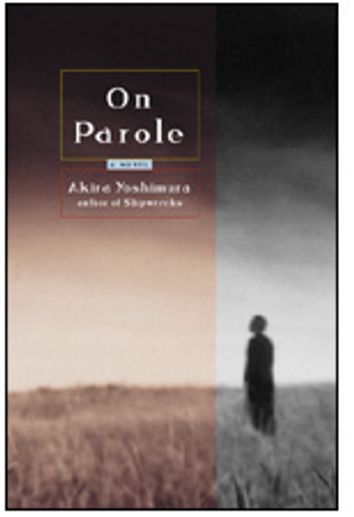
“On Parole” by Akira Yoshimura
A bestselling Japanese novelist depicts the grim aftermath of a grisly crime.
We don’t know yet what Shiro Kikutani did, but it must have been grisly for him to merit life in prison. Nonetheless, his good behavior — at least while the guards are watching — gets him paroled after 15 years. And so this reticent middle-aged man is plunked back into society, though gradually, like a goldfish in a baggie still adjusting to the tank’s temperature.
This is the premise, and much of the plot, of Akira Yoshimura’s “On Parole.” Yoshimura’s 20 novels have all been bestsellers in Japan, but he was nearly unknown in America until the 1996 translation and publication of “Shipwrecks,” a fast-paced, swashbuckling story set in a fishing village in medieval Japan. The two books have a dramatically different feel. “Shipwrecks” is gruesome, all right — its hero is a 9-year-old boy whose fellow villagers live by tempting sailors onto shore and killing them for the food on board. It’s also constructed of lively conversations, nuanced relationships between family members and rich, sharply observed details — the smell of squid innards, the mythology in funeral rites — of the doomed villagers’ everyday lives.
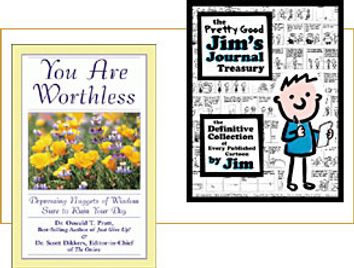
Continue Reading Close“You Are Worthless” and “The Pretty Good Jim's Journal Treasury” by Scott Dikkers
The editor of the Onion unleashes two collections of anti-humor laced with cyanide.
As editor in chief of the Onion, Scott Dikkers turns media smugness inside out and leaves it there to bleat. The weekly anti-newspaper — whose online edition, theonion.com, has garnered the operation its deserved cult status — began humbly as a Madison, Wis., humor rag and now provides the world with its special brand of absurd government statements, nonsensical graphs, sly headlines and pathetic profiles. This year, the Onion’s bestselling collection of made-up front pages, “Our Dumb Century,” further elevated Dikkers’ satirist-
Well, for one thing, he’d like us to quit being so goddamned cheerful. His newest creations, “You Are Worthless” and “The Pretty Good Jim’s Journal Treasury,” are not for those on the slippery end of the mood-swing seesaw. Undiluted by the Onion collective, Dikkers’ humor is strong stuff: pastel Sweet Tarts with a cyanide kick.
“You Are Worthless” is a dark little book in the vein of Jack Handey’s “Deep Thoughts,” Matt Groening’s “Life in Hell” and, within the Dikkers landscape, raw Onion lectures on stain removal and marital health. Writing as Dr. Oswald T. Pratt (“best-selling author of ‘Just Give Up!’”), a sad-sack psychiatrist who sends every patient he sees into fits of further despair, Dikkers takes everything that Hallmark holds dear — love, family, work, friendship, self-esteem, spirituality, pets — and efficiently uglifies it.
But the advice (presented in boilerplate self-help format with large type, italics and curlicues) comes in several flavors. Some of the dictums are pure elementary-
Many of Dr. Pratt’s nuggets are sick in the best way — but you need to start off in a pretty good mood to chew the harsher ones without wincing. If you rush, you’ll miss out on the bizarre, the paranoid and the wonderful: “When they try to give you pills, fight them with all your strength.” “If your cat were just a little bit bigger, it would kill and eat you.” And my favorite: “Are you in love? Sucker.”
Fortunately, there is no need for such a book among the denizens of “Jim’s Journal,” the comic strip that Dikkers drew for 10 years before his editorial tenure began. This collection will introduce legions of Onion guzzlers to a delightful cartoon, which even at its peak ran in only a few dozen college newspapers. Here’s the concept: We’re reading the daily diary of a young man named Jim, whose life is pretty much unbroken by significant events. Dikkers’ bold-lined drawings are exactly as detailed as they need to be — which is to say, not very.
So what’s there? A little fuzz-haired guy with stick legs and no mouth who goes to college; works at McDonald’s, a copy shop, a grocery and a bookstore; and has a roommate (the hyper Tony), a pal (Steve, whose jokes in a deliberately jokeless strip are necessarily lame), a girlfriend or something (Ruth, twice Jim’s size, perpetual smiley face) and a cat (Mr. Peterson, who comes closest to being Jim’s soul mate). All the while, he narrates with remarks so dry they float off afterward like tumbleweeds: “When it was over we turned off the TV, sat around and didn’t say much of anything.”
Dikkers slips in a few straight essays between his protagonist’s (nominal) phases, explaining how he used anti-humor to parody a genre he’d never really liked and noting that Jim is a Taoist slacker whose observations resemble Camus’. But you need neither a higher consciousness nor irony specs to find pleasure in “Jim’s Journal.” Except for a jarring plot development near the end of the strip’s run, Jim’s serene unchangingness is hypnotic, clever, poignant, sublime and, oddly enough, funny. If there are enough Jims in the world to balance out the Dr. Pratts, I’d say we’re doing pretty well.
Seasons Of Her Life: A Biography Of Madeleine Korbel Albright
Emily Gordon reviews "Seasons of Her Life" by Ann Blackman.
| “Seasons of Her Life,” Ann Blackman’s biography of Secretary of State Madeleine Albright, can’t quite decide if it’s for the seminar room or the airport. Peppered with gossip about Albright’s love life, references to her weight and superfluous quotes from Deborah Tannen, it’s nonetheless the compelling story of a shape-shifter who has lived multiple lives. Though Blackman never adequately answers some big questions — what, for instance, are the politics of a woman who almost had an abortion, pals around with Jesse Helms and found the 1968 Columbia University demonstrations an irksome distraction from her studies? — her portrait of the secretary is affecting and well researched.
Continue Reading CloseGod of The Rodeo: The Search For Hope, Faith, And a Six-Second Ride iIn Louisiana's Angola Prison
Emily Gordon reviews 'God of the Rodeo' by Daniel Bergner
“God of the Rodeo,” Daniel Bergner’s expansion of his eloquent Harper’s magazine story about the annual rodeo at Angola, La., state penitentiary, presses down hard on America’s open sores: race, class, masculinity, religion, family, violence. It’s a book that’s hard to accept and hard to take, but difficult to shake from your mind.
Almost all of the 5,000 residents of Angola — a former slave plantation once termed “the bloodiest prison in America” — are African-Americans, supervised by whites on horseback as they pick crops on the prison farm. The average inmate will die in jail, and most receive no visits after their first three years. A man in Jonathan Stack’s and Liz Garbus’ powerful documentary “The Farm: Angola, USA” put it this way: “Serving time is just like a puzzle. A 2,000-piece puzzle … Your life is scattered. You the one got to put it back together.”
Continue Reading Close