Emily Loftis

Port of Oakland shut down

Day of action results in at least 27 arrests in three cities

  • more
    • All Share Services

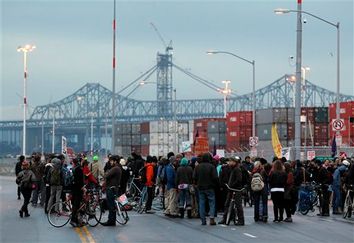
Port of Oakland shut downProtesters block one of the entrances to the Port of Oakland on Monday Dec. 12. (Credit: AP)

OAKLAND, Calif. — Monday’s 5:30 a.m. march to shut down the Port of Oakland was cold, wet and dark, but adrenaline was high for the day of action coordinated over the past few weeks with hours of debate, outreach and planning. More than Occupy Wall Street camps — mostly between Anchorage and San Diego, but also in Denver, Houston, New York City and others — demonstrated in solidarity with the Longview, Wash., longshoremen’s six-month battle with multinational grain transporter EGT and L.A. port truck workers who suffer low wages and union-busting practices.

The crowd was mostly, but not limited to, the young core organizers who have been involved since the beginning. There were also a mother strapped with a child, a clergyman, workers and teachers. While union leaders had voiced opposition to the action, there were plenty of union members in the crowd. At around 10 a.m., protesters got word that the port was officially closed after the arbiter had deemed it an unsafe workplace. Marchers left the port, many holing up for afternoon naps and meals. Those who still had energy, along with day workers who couldn’t make the “morning shift,” rallied at Occupy Oakland’s original site, Frank Ogawa Plaza, to hear organizers, union leaders and veteran activist Angela Davis speak.

By the time of the afternoon rally, word had come of port actions in other cities. In Portland, Ore., demonstrators blocked two terminals. In Houston protesters trying to shutdown the port were met with an unprecedented arrest tactic: A big red inflatable tent was placed over protesters lying on the ground, before 20 were arrested. In Seattle protesters were hit with tear gas and flash-bang grenades. In Denver, 13 occupiers trying to shutdown a Walmart distribution center were arrested. In San Diego four people were arrested. Occupiers in San Diego and Portland both requested that Oakland continue the blockade in response to police action — a promise Oakland had made long before the evening’s general assembly voted on the proposal.

The second march to the port in the afternoon was, as expected, much bigger than the morning shutdown with the crowd numbering in the thousands.

Terry Fletcher, an elementary schoolteacher, said she isn’t sold on shutting down the ports, but she considers the need for working-class solidarity more important than the tactics. She thinks such a big action should have had more focused demands, but she came out anyway.

“I’m used to organizing with goals, but maybe they’re organizing in a different way and it could work,” she said. “But it’s more important to be in solidarity.”

Mark Herbert, a company port trucker who was waiting to deliver shipments of meat from the Midwest, watched from his truck. When word got out that he was losing between $200 and $400 a day because of the port shutdown, reporters swarmed him.  Herbert is an independent contractor from Utah and not represented by a union. When pressed on his own working conditions, it became evident he had some sympathy for the protesters. “Some of the stuff I agree with. I’d like better benefits.” He laughed: “Maybe that’s why I have diabetes and high stress.” Herbert admitted that when he has work-related grievances, he basically just keeps them to himself and really has few options in the way of addressing those complaints.

The shutdown continued through early morning hours of Tuesday without police response. A port spokesperson told KCBS news that the “ripple effect” of the Oakland shutdown would cost $8.5 million. (For more on the economics of the port, see Andrew Leonard on “The Costs of a Port Shutdown.”)

The Oakland police chief told the Bay Citizen that police would continue to monitor the protesters’ activity and decide how to respond based on “the crowd’s demeanor and the resources we have available.”

Occupy vs. Big Labor

In the Dec. 12 port shutdown campaign, the rank and file are leading organized labor, not the other way around

  • more
    • All Share Services

Occupy vs. Big LaborOccupy Oakland protesters (Credit: AP/Noah Berger)

As Occupy Wall Street groups stretching from San Diego to Anchorage mobilize for a multi-port shutdown of the North American West Coast, union members are finding the mobilization offers more than just support against union busting and unfair contracts. Activists and rank-and-file workers say the movement is teaching them what the bureaucratic infrastructure of organized labor has made them forget: collective power.

On Dec. 12, general assemblies (the decentralized governing bodies of OWS) in Los Angeles, Oakland, Calif., Tacoma, Wash., Santa Barbara, Calif., Portland, Ore., Seattle, Longview, Wash., San Diego, Anchorage, California’s Port Hueneme region, and dozens of smaller camps plan to blockade ports and halt commerce for a day. There is a combined Dallas-Houston effort to demonstrate at the port in Houston. Japanese rail workers, who are sympathetic to longshoremen, who work a partner company of Bunge — the company Occupy is protesting — will be demonstrating in Japan.

Farther inland, Denver will try to shut down a Walmart distribution center. Occupy Bellingham may block coal trains; and landlocked California occupiers will bus to the coast. According to the Journal of Commerce, the “West Coast ports handle more than 50 percent of the U.S. containerized trade, including 70 percent of U.S. imports from Asia.” The demonstration is in solidarity with Longview longshoremen who say their jurisdiction is being threatened by multinational grain exporter EGT, as well as port truckers who have been prevented from unionizing in Los Angeles. (Their little-known plight was exposed by Salon in October.)

The campaign to shut down what some call “the Wall Street of the Waterfront” is consistent with the general Occupy Wall Street message on the distribution of power and wealth. Yet, the effort faces opposition from the union bureaucracy’s upper echelons, precisely because of the conflict with EGT. Last week officials of the International Longshore and Warehouse Union (ILWU ) sent out a memo reminding its members:

“To be clear, the ILWU, the Coast Longshore Division, and Local 21 are not coordinating independently or in conjunction with any self-proclaimed organization or group to shut down any port or terminal, particularly as it relates to our dispute with EGT in Longview.” (emphasis added).

So, paradoxically , where labor conflict is starkest, the union leaders reject outside support, and when Occupy Oakland acts to support the union’s members, the union itself resists. That’s why Dec. 12 looms not just as a test of strength for the Occupy movement. The port shutdown is also shaking up Big Labor.

Mobilizing without unions

The idea of a port shutdown was born out of an Occupy L.A. plan to demonstrate in solidarity with local port truckers. L.A.’s intentions exploded into a large-scale mobilization to shut down the ports along the entire coast.

Shrugging off tent removal, tear gas and rubber bullets, Occupy Oakland has become the nucleus of coordination, holding inter-Occupy conference calls; brainstorming budgets to provide camps with everything from porta-potties to bullhorns; and using union networks to connect rank-and-file members with general assemblies on the West Coast.

Hundreds of Oakland citizens are leafletting commuter trains, staging rush-hour banner drops, reaching out to non-unionized workers, and sending out bilingual teams to ethnic boroughs to help populate the blockade. Other local organizations are independently working for the event. For example, the International Socialist Organization immediately began contacting branches in relevant cities while the East Bay Interfaith Committee for Worker Justice will be hosting a pre-march teach-in about the plight of longshoremen and port truckers.

As for the possibility of future police action, the occupiers do not have to speculate. The City of Oakland and the Oakland Police Department will be working together to keep port operations running on Dec. 12. Though Oakland is no stranger to police violence at port shutdowns the police presence may actually help the protesters.

A police blockade, says one union member and shutdown organizer, is enough reason to prevent longshoremen from unloading ships. Though the longshoremen could technically ask the police to escort them across the picket line, historically, they have not done so. Such a standoff would protect the ILWU from litigation and enable it to respect– as it usually does — a community picket.

The labor battle in Longview highlights Big Labor’s awkward position of resisting a popular movement against corporate power. Longshoremen have been protesting EGT’s decision to contract with another union whose members are paid lower wages than the ILWU’s.

EGT is an export grain facility owned, in part, by agribusiness holding company Bunge Ltd., and has employed ILWU workers on the ports for years. Bunge extracts billions of dollars a year in profits, but has a tarnished international reputation. It was expelled from Argentina this year for accusations of evading taxes. Environmentalists charge Bunge with undermining ecological recovery through intensive sugar cane and soybean-growing in Brazil. It has also resisted South American union demands for workers’ rights.) But in the United States, the company’s name doesn’t make much news outside of stock reports and longshoremen activist sites.

The ILWU’s problem is that no-strike clauses in contracts require union leaders to foreswear labor action and distance themselves from independent action. Throughout the protests, including those at the Nov. 2 general strike and shutdown of the Oakland port, most unions did not officially sanction the strike, though they all supported it materially and in marching feet. The president of Local 21 of ILWU, for example, was a keynote speaker of the Nov. 19 march.

But resistance endures at the top of the unions. In a recent meeting, the Alameda County labor council not only refused to endorse the port shutdown, but actually considered a public rejection of the action. The proposal was eventually tabled, but the whole debate was arguably a consequence of the entanglement of big business and labor: specifically, of the labor council’s executive treasurer-secretary and a port commissioner.

“The fear of getting sued that haunts the union leadership is unfortunate,” said Barucha, a young anarchist with Occupy Oakland.

“It’s not our job to rail against union leadership,” she said. “We don’t have to come out and criticize union leadership, because we’re leading by example. The occupation movement being able to provide a better framework of getting the rank-and-file working class’s needs met. [It] exposes the recuperation of the union institution by political parties.”

For years, members of certain — not all — unions say their bosses have compromised their collective power in back-door agreements and concessions. Some resent the “team concept,” a labor term for the working relationship between union bosses and CEOs, which places efficiency and profits over workers’ needs, according to disgruntled members. There is similar sentiment regarding the unions’ long-standing relationship with the Democratic Party — an institution also married to big business.

“The Occupy movement struck a chord,” explained Stan Woods, a member of the Transport Workers Solidarity Committee, a multi-union rank-and-file organization made up of ILWU members, teamsters, city train drivers and other similar blue-collars workers. “The union leadership doesn’t want to be left out, but they are hamstrung by their relationship with the Democrats, mayors and other politicians. They’re caught in a quandary.”

Barucha says the democratization paradigm of the leaderless occupation movement is proving to be a model for workers unhappy with the status quo.

“This is the first time there has been an exemplary movement that is encouraging and teaching people to self-organize.” The occupation, she said, allows union members to act as individual community participants and create community pickets, alongside the unemployed, the non-unionized working class, the homeless and any other supportive neighbors that share the same material needs.

One Bay Area couple who belong to another big local union, the United Food and Commercial Workers, said they and some other grocers chose to organize after watching their contracts being written up behind closed doors. The couple, who asked not to be identified, said the UFCW leaders negotiated a pension concession that they could opt out of by accepting other concessions.

“The union and the company decided all of this without employees being aware of it,” said one grocer. “They kept sending out sugarcoated letters but never once said, ‘Prepare yourself because there’s going to be drastic changes.’”

After attending Occupy Oakland’s general strike, they heard socialist and union activist John Reimann speak to the crowd. They approached him and asked for help. Out of their concerns, and those of others who had joined the strike, they formed the Grocery Workers’ 99% Club, a group of UFCW members who “have created a sort of rank and file caucus of members who want to fight to make their union do what it is supposed to do: fight for the members,” said Reimann.

“We’re not trying to break the union,” said the anonymous grocer. “We just want our voice back so we can make decisions about our contracts. That’s what we thought the unions were supposed to be about.”

And that desire is an oft-missed message of the West Coast occupation movement, often overshadowed in media coverage focused on sanitation issues and simplistic debates on violence. The occupation movement is proactive as well as reactive, offering new paradigms that transcend binary choices such as unions vs. corporations, Democrat vs. Republican, and leaders vs. followers. Just as the 1 percent now has to listen to the 99 percent. Big Labor has to listen to the rank and file. Dec. 12 marks a step in the evolution of the movement from a collection of improvised tent-villages to a national network of empowered, community-conscious problem-solvers.

Continue Reading Close

Pancho’s Message to the 100%

After protesters rally to his defense, ICE releases undocumented Oakland occupier who was arrested while meditating

  • more
    • All Share Services

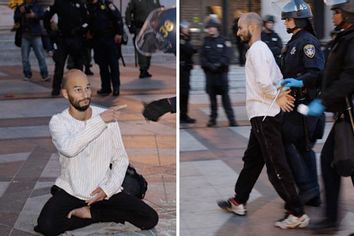
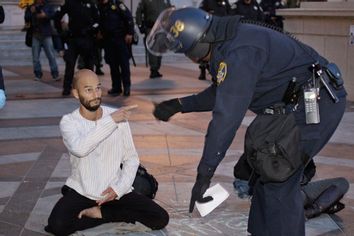
Pancho's Message to the 100%Police arrested Pancho Ramos Stierle as he was meditating at the Occupy Oakland encampment on Monday, Nov. 14, 2011. (Credit: Ap/Paul Sakuma)

An undocumented Oakland occupier arrested earlier this week was released from Immigration and Customs Enforcement custody on Thursday after  his supporters bombarded ICE, local officials and Rep. Barbara Lee with demands for his release. Francisco “Pancho” Ramos-Stierle, a Mexican-born former graduate student in astrophysics turned community activist, became a cause celebre among his fellow demonstrators after he was arrested Monday while meditating during the police dismantling of the Occupy Oakland Camp in Oscar Grant/Frank Ogawa Plaza.

“This is totally the revolution of the human spirit,” he told friends in a conference call after his release, “and this is such a pleasure to be surrounded with all of you.”

ICE can still recall Ramos-Stierle for a deportation hearing at any time but supporters are claiming victory for the man they call Pancho and vindication for the message of “restorative justice.” While critics may wonder what the immigration issue has to do with Occupy Wall Street’s over-arching message of political and economic inequality, Pancho’s friends have no trouble connecting the dots.

Melissa Dickman, who played a major role in “Team Pancho,” the group of friends and lawyers who mobilized petitions and phone calls on his behalf, said  immigration has become a troubling issue in America “because of the corporations and the capitalist model we have. Folks move to the U.S. because of NAFTA because we’ve made it impossible for folks to live where they are. It’s a byproduct of capitalism.”

But Dickman insists Pancho’s saga is also a spiritual one. She quoted Pancho’s version of the 99 percent meme: “We are the 99 percent facilitating the healing of the 100 percent.” Pancho and his friends emphasize fostering connections: “There is something spiritual about this, even in our relationship to one another,” she said.

In jail, Pancho wooed police officers with his earnest philosophy.

“We were in shackles and we were in handcuffs,” he told reporters in a conference call after his release, “but those people [deputy officers] they were in handcuffs and shackles in their soul. So we were just providing keys to them. So we said, ‘You know, you don’t need to be doing this.’”

Pancho’s own vision for the movement’s future is tied up in what he calls the “constructive program” of the occupation. He argues that the Occupy Wall Street movement should not to get too caught up in demonstrations, saying 90 percent of the occupation community’s energy should be spent on construction and only 10 percent on protests.

“It’s beautiful that its emerging in a horizontal way, organically,” he said of the movement. “The more we concentrate on the constructive, the more we’re going to have food serenity and water serenity and then we will be ready to make a bonfire of [genetically modified] Monsanto seeds. And we will be ready to make a bonfire of passports and visas. And we will be ready to disband the BART police and ban all the police from the city. But first we have to have our own justice system, our own restorative system.”

Vow of silence

The morning of Pancho’s arrest, nearly everyone in Occupy Oakland had agreed they would march to a nearby intersection, to strategically avoid arrest by a police force intent on dismantling the encampment. A few people, including religious leaders in the interfaith tent, chose to stay, saying they wanted to use their community positions to send a political message. Pancho’s immigration status made him much more vulnerable, but he also chose to stay.

An officer approached him while he was meditating, Pancho recalled.  ”Hey man, if you don’t move you’re going to be arrested,” he said. Because Pancho takes a vow of silence every Monday, he handed the officer a scribbled note that read, ”I practice silence, but I’d like you to hear that I love you.” After the officer read it, he smiled, and thanked Pancho. Then he asked, “Are you going to move, or are we going to arrest you?” Pancho wrote back, “I’m meditating.”

So he was were arrested. After Alameda County authorities dismissed charges against him and about 20 other protesters, Pancho remained in detention because of his undocumented status. Thanks to the hotly debated Justice Department program known as Secure Communities, Pancho was handed over to ICE detention Thursday and his friends feared he might be immediately deported as many people are. County officials told Inside Bay Area that they had no authority to keep ICE agents from deporting Pancho.

Yolanda Huang, one of Pancho’s lawyers, disputed that, saying that enforcement of ICE’s detention requests is voluntary.

“What they’re hiding behind is ‘We don’t have a choice.’  But it’s not true,” she said, asserting that Alameda County Sheriff Gregory J. Ahern did have the authority to release Ramos-Stierle.

For whatever reason, Pancho was released on Thursday afternoon.

Ramos-Stierle’s  story is unique yet typical of the occupation movement. He was a doctoral student of astrophysics at U.C. Berkeley, until he discovered his work would be used to create “safer nuclear weapons.” He resigned from the program and has been active in community organizing ever since. He seeks to bring restorative justice to youth and supports the attempted “democratization” of the University of California. He was previously arrested while supporting families persecuted by Arizona’s infamous SB1070 law and is now involved in Free Farm, an urban garden that gives vegetables away to San Francisco city-dwellers.

Randall Amster is a longtime friend of Pancho’s and the director of the Peace and Justice Studies Association at Arizona’s Prescott College. He said that Pancho’s arrest symbolized how he acts to make community change.

“He was meditating in a space that had been filled with violence and force and conflict,” Amster said. “It seems he wanted to dramatize another story, to hold space peacefully. Those are the things that motivate him.”

On Thursday, a thread of emails bore witness to the respect Pancho has among organizers and friends. They quickly collected 8,000 petition signatures requesting his release. An onslaught of supporters contact Rep. Lee and the ICE offices. At one point, in Alameda County detention, Pancho was placed in a red jacket — the color reserved for dangerous criminals — and bound with metal shackles. That didn’t last long. Nor did his incarceration. Pancho Ramos-Stierle is, in every sense of the phrase, a free man.

(Josh Wolf, an observer of the Bay Area Occupy movement featured Pancho in a video originally posted on Color Lines.)


Continue Reading Close

Spiritual leaders arrested at Occupy Oakland

A dozen faith leaders among 32 arrested by riot police

  • more
    • All Share Services

Spiritual leaders arrested at Occupy OaklandA policeman talks to a demonstrator as police break up an Occupy Wall Street encampment in Oakland on Monday. (Credit: AP/Paul Sancya)

At least a dozen spiritual leaders were arrested in the evacuation of Occupy Oakland on Monday morning as they sat in a candlelit circle in front of the camp’s interfaith tent. They were among 32 people arrested by riot police, according to news reports.

“They wanted to hold the sacred space and be a peaceful presence,” said Jon Jackson, deacon at  the First Congregational Church of Oakland, a camp participant who chose not to be arrested. According to witnesses, the arrested included Kurt Khuwald, a professor at the Starr King seminary in Berkeley, Father Joseph Vitale, who has been arrested many times before, and Marcus Leifert, a seminary student at Starr King.

“The Occupy movement wants to make people aware of the gross disparity, which is what Jesus and many other religious leaders want,” Jackson said. Jesus, he noted, “was opposed to government hierarchy” and was always talking about the oppression of the poor.

The  arrests are “signals of moral integrity,” said bystander Emily Webb, a graduate student at Starr King who is training to be a Unitarian Universalist minister. “The people were arrested from a diverse group of traditions representing the fact that we all have something that we hold dear. The system creates hell on Earth for people. The clergy are standing for a world where all can peacefully assemble.”

The interfaith tent had been used in recent weeks by Muslims, Christians, Hindus, pagans and other spiritual groups for religious services, rituals, Bible studies and yoga.

The police action clearing the Frank Ogawa Plaza differed dramatically from the last evacuations two and three weeks ago, which resulted in violent clashes between police and protesters and a severe head injury to Iraq war vet Scott Olsen (who was released from the hospital last week). There were no injuries reported Monday.

The largely peaceful evacuation was the result of the occupiers’ decision to march out of the Plaza after the “cop watch” spotted geared-up officers on their way to the encampment. Occupiers rallied in downtown Oakland’s 14th and Broadway intersection, chanting, marching in a circle, and drumming. The cops marched in between the protesters and the encampment, forming lines and setting up barricades to block marchers from returning. Some cops had their names visible on their shirts, while others had only small white labels with badge numbers and names on the back of their helmets — not easily noticed if a protester is being attacked by an officer.

When I left the scene at around 7 a.m. Zachary Running Wolf, an occupier who had climbed up a tree when news of a raid solidified, was still occupying the tree with an upside-down flag hung beside him.

Continue Reading Close

Oakland militants talk back

At the most confrontational occupation, debate turns to violence and resistance

  • more
    • All Share Services

Oakland militants talk back Occupy Oakland

OAKLAND, Calif. — This working-class city has a history of aggressive civil and labor rights action. From the 1946 General Strike to the emergence of the Black Panthers in the 1960s, to Occupy Oakland today, this is a city that has not shied from confrontation with the powers that be. There is a strain of  civic pride that is infused with memories of resistance in the face of oppressive circumstances.

Last week’s intensive media coverage of clashes between police and demonstrators by Salon and others was certainly not the first time that the aggressive actions of Oakland protesters have overshadowed their message. But reporters who have done more than sit on the edge of the camp in news vans, sipping lattes, and waiting to be cued by flash-bang grenades, know that the  ideology behind the “violence” — a term that makes most Occupy Oaklanders bristle — is more nuanced than is usually presented in mainstream news coverage.

In a wide-ranging discussion with Salon, several occupiers, most of whom identified themselves as anarchists, talked about tactics of resistance. They say police brutality has been undercovered. The whole country knows the story of Scott Olsen, the Iraq war veteran whose skull was fractured by a riot cop on the first night of gassing and bullet sprays; but Olsen is not the only one who experienced police brutality.

On the second night of police-protester clashing, Kayvan Sabehgi, another veteran, was beaten until his spleen was lacerated. He spent 18 hours on the jail cell floor, reported the Guardian, before he was finally taken to the hospital.

The occupiers tell stories of people whose hands were broken by police batons, and others who were struck by rubber bullets. I was thrown to the ground because I was trying to photograph police activities. To add to the culture of mistrust, some cops concealed their names and badge numbers after being accused of infractions.

“Interpretations of violence come from people’s experiences,” said a young black-clad anarchist with mohawkish dreads and gentle eyes. “People who didn’t grow up with a lot of violence are going to have a different definition than people who grew up defending themselves.”

The man — who prefers to go unnamed — is friendly and reflective. He takes late-night shifts on “cop watch,” a cadre of patrols who alert the camp when cops are spotted in riot gear or in large numbers.

Like occupiers who won’t willingly allow cops on the Plaza, many in Oakland — inside and outside the camp — say they feel more fear than safety when cops are around.  That may be hard for some people to understand, but in Oakland the memory of Oscar Grant is strong. In January 2009,  Grant, a young man from Oakland, was arrested at a BART station. While being forcibly restrained by police, the unarmed Grant was shot to death. Police said Grant was resisting arrest, a claim disputed by witnesses. Grant’s  wrongful death brought enraged locals swarming into the streets, marching and breaking windows.

“We should be proud of people that stood in the face of the violence of the state,” said one Black Panther at Occupy Oakland who speaks in a fatherly way about foolhardy youthful romanticism. “At the same time, we mustn’t be fooled that we should be prepared to face the state head on.”

“The whole theory of nonviolence is that the state has the monopoly on the potential use of violence,” said John Reimann, who describes himself as a labor activist. And that threat, says another anarchist/occupier, Michael Spencer, is all based in fear.

Spencer is an organizer of Occupy Oakland who teaches other campers about the facilitation and consensus process of the General Assembly, the governing structure of the Occupy movement.  He says the very existence of the police force is a threat of violence.

“That threat is the backdrop of what the law is,” he explained.  ”You don’t steal something because you know the cops will come whack you. They have assault weapons in their trunks. People in Oakland know that better than anyone else.”

While most considered last week’s window-breaking and barricade-burning “out of line,” they also described the protesters’ actions as vandalism, not violence.

“Property damage is not violence,” said Spencer with a frown. “The reality was, no cops got hurt. It looks like more than it was. They were just burning shit in the street.”

The experienced occupiers attributed the incident to frustrated youth who don’t know how to deal with their anger at injustice and have never lived through a time of class struggle.

“You’ve not had a big movement of the working class for the last 30 or 40 years,” explained Reimann, “and there are people who want to see the whole system shaken up. It’s difficult to see where the force can come to shake up the system. But it is that layer of youth that are so angry at the capitalist system that are needed in the workers’ movement.”

All of those I spoke with, except one, believe there may be a time for aggressive tactics in the occupation movement, but the time is not yet.

“I think we should look at it as what helps to inspire workers and make them more inclined to get involved,” counseled Reimann in good socialist style. “That should be the basis on which we determine our tactics.”

One protester resisted  the idea of using violence.

“The movement is an indictment of violence and coercive means by which society is controlled,” explained Kevin Skipper, who has been camping and participating since the beginning of the occupation. “So if we use those same means to protest, it doesn’t make [the message of] what we’re protesting any less true. It’s just a missed opportunity to demonstrate an alternative.”

Such is the debate at Occupy Oakland.

Continue Reading Close

Occupy Oakland shuts down port

Massive peaceful protests end with a late-night clash and arrests

  • more
    • All Share Services

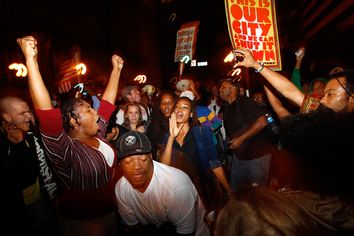
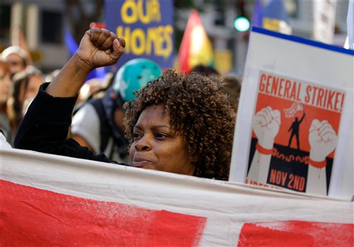
Occupy Oakland shuts down portA woman marches with Occupy Oakland protesters on Wednesday. (Credit: AP Photo/Ben Margot)

What began as a relatively peaceful day of demonstrations in Oakland on Wednesday ended in tear gas, rubber bullets and sound grenades being fired on occupiers. The Oakland Police Department arrested dozens of protesters who had taken over an abandoned building near the Oscar Grant plaza where the occupiers have an encampment.

The confrontation came at the end of a long day of festivities around a General Strike and a mass march on the Oakland Port. The Critical Mass bike activists led the march to the Bay, cycling in swirling formations in intersections along the way as they waited for the crowd to catch up. A bus took people who couldn’t walk the distance to the port, and teachers marched in solidarity with neon green T-shirts. By 9 o’clock Wednesday evening, the port, one of the largest in the country, was effectively shut down.

“Whose ports? Our ports?” the crowd chanted in the catch-all occupation meme.

Many protesters I spoke with had never been involved with direct action before Wednesday. Some had been edgy about coming to the march after last week’s raid and subsequent attacks on the Occupy Oakland camp that ended with several people injured and one cracked skull. Andrea, who has not been camping at the Plaza, said she was nervous, but that, “It’s important to make them know we’re not afraid. That mentality keeps people bound up in the lives they’re living.”

Oakland’s fear of armed authorities is entrenched in a culture of police brutality that receives what many locals consider easy punishment. In 2003, there was an effort to shut down the port that ended with the police using sting balls, concussion grenades and other non-lethal weapons.

Earlier on Wednesday, several marchers picketed banks, efforts that resulted in a few broken bank windows and furious tweeting: “Guy breaks window w beer bottle. Another guy yells ‘that isn’t what this is about.” There was a big mess at Whole Foods, where workers were told they would face discipline if they joined the strike. Throughout the day, and even during the port shutdown, the police presence was small. After the reaction to last week’s attacks on nonviolent demonstrators, the cops seemed to favor  a minimal and subdued presence.

Late-night confrontation

But after clogging up downtown Oakland all day, and stopping commerce in one of the U.S.’s largest ports, a core group of occupiers set their sights on the former headquarters of the Travelers Aid Society, a government-funded nonprofit that provided aid to houseless people in Oakland. The nonprofit, located a block away from Oscar Grant plaza, has been shuttered due to funding cuts.

The protesters reclaimed the property in accordance with the Occupy Oakland General Assembly’s vote to support such occupations. “We welcome the Travelers Aid Society to resume providing services in this building,” stated a flier handed out on the plaza. “Otherwise, we will make it into a library and open workshop space for the people of Oakland.”

Soon the occupiers were celebrating with loud funk music, break-dancing and cookies at the newly occupied building.  It wasn’t long before the police showed up in riot gear and gas masks. As many protesters fled, others built up barricades and set them on fire. The cops set off tear gas, and loaded dozens of protesters up in paddy wagons.

Boots Riley, a prominent activist-rapper, said the organizers had no communication with police when planning the strike or the port shutdown, saying that police reaction is never truly predictable.

“I think this is leading toward direct action that challenges the system and defines what it is, which is exploitation,” Riley said. “This is leading toward a more effective era of organizing that cuts through ambiguities.”

At stake is the direction of Occupy Oakland. Since last week’s raid, the size of the movement has more than doubled as its ranks swelled with union members, families and teachers, groups previously hesitant to join in. But many of these new protesters are also much more moderate than the anarchist core that first got the camp up and running. Occupy Oakland has heard a lot of debate around the use of violence and nonviolence, with peaceniks assuming the movement will be pacifist while other urbanites feel government-sanctioned violence against citizens should be resisted, even if it means engaging in self-defense.

After the use of non-lethal weaponry, the friction between the police department and protesters is unlikely to change. What remains to be seen: How will the newer, more moderate occupation community respond to last night’s events?

Continue Reading Close