Emma Pearse

An adoptee, exposed

Years after reuniting with my own birth mother, reading A.M. Homes' new memoir of adoption was like finding the journal I never kept.

  • more
    • All Share Services

An adoptee, exposed

For the past three weeks I’ve been carrying around A.M. Homes’ new memoir of adoption, “The Mistress’s Daughter,” like it’s a purse that holds all of my essential items: driver’s license, cash, lip gloss. The book is Homes’ first autobiographical work after seven volumes of barbed, love-drenched fiction. It’s also a story that almost eerily mirrors my own, a story I move through life simultaneously avoiding (for fear of never escaping) and blurting out (because without it, nothing makes sense). I am an adoptee who reunited with my birth parents at the age of 17. “I remember not knowing,” Homes writes on the first page of “The Mistress’s Daughter.” “First thinking something was very wrong, assuming it was death — someone had died. And then I remember knowing.”

I too have two beginnings: The day I arrived at my adoptive parents’ home, age 6 weeks, and the day I met my birth mother. I too remember not knowing and then knowing.

Homes’ tale is a traumatic one, inhabited by the sorts of disturbed, perverse characters that will already be familiar to fans of her fiction, and set within the same mundane sphere of existence in which Homes routinely stages her stories. But this time the characters are real — as is their confusion, their perversion, their mediocrity. And at the center of it all is Homes herself. She narrates the story of her reunion with her birth parents at age 31 and her subsequent search for her “life story,” all while recounting childhood memories that seem suddenly significant, and journeying through vaguely illicit meetings with her newly discovered parents. Finally, Homes takes to obsessive Web and library genealogy searches, desperate to locate anyone who might be related to her: an investigation into biological lineage that is ultimately more traumatic than it is uplifting — and that confirms her conviction: “I am an amalgam. I will always be something glued together.”

“The Mistress’s Daughter” joins a well-stocked shelf. There’s plenty of literature about adoption; I know because psychiatrists and family members, including my birth mother, have nudged me to read it, supposing it will help me deal with the intense emotions and surreal urges that only I seem to experience. And hidden among the self-help schlock there have been a few gems. ” Family Wanted: Stories of Adoption,” is an unfortunately titled — but mostly beautifully written — collection of stories about adopting or being adopted, told by literary luminaries like Paula Fox, Robert Dessaix, Tama Janowitz and Homes herself. (The essay Homes wrote for the collection “Witness Protection” spurred her to write the memoir.) Until now, though, I’ve begrudgingly avoided the adoption genre. This has been partly in the name of self-protection: Must I really absorb all these gloomy versions of my own story? But also I’ve simply been turned off by the lovey, woe-ridden language: treacly pinks and frosted greens, photos of sad-eyed, chubby babies and titles like “Can You Wave Bye Bye, Baby?” It all seemed to reek of victimhood and to equate the adoptee experience with other unfortunate afflictions like depression an alcoholism.

On the flip side of all those reassuring, boring books are the idolized adoptees who littered the popular culture of my youth. I grew up reading and watching Annie, Punky Brewster, Pippi Longstocking; even Popeye had that babbling bundle of joy, Swee’Pea. Some of those characters were technically orphans, yes — the difference being that orphans have lost their parents before any alternative arrangements could be made — but their appeal was based on the vigorous individuality that is presumed to emerge in the absence of birth parents. I consumed their stories hungrily because they were entertaining and because their prettily peculiar lives were closer to my true fantasies than was Barbie or those golden twins of the “Sweet Valley High” novels. But none of them made me reconsider my own story in any meaningful way.

Homes’ memoir does. “The Mistress’s Daughter” is the first tale I’ve read that details and deconstructs the experience in a way that isn’t so sappy that it makes me want to, well, not be adopted. There’s vulnerability in Homes’ nonfiction storytelling that’s too often lacking in her fiction. Even the book jacket, papered by a seductive photo of Homes as a child — baring the same deep catty eyes that have stared from countless author photos — says, for the first time: This is me. What’s more, her story is almost mine, from the initial family meeting in the living room, revealing that “someone is looking for you,” to the moment in her adoptive mother’s kitchen when it all became too much. Reading in “The Mistress’s Daughter” about Homes’ fear of attachment and “equally constant fear of loss,” about her persistent childhood suspicions that “every family was better than mine,” was like stumbling upon the diary I never kept.

This is Homes’ tale: Her mother, Ellen, and birth father, Norman, had an adulterous affair and conceived Homes when Ellen was 22. When it became clear that Norman did not intend to leave his wife and wed Ellen, as he had promised, she gave up Homes to a liberal, artsy, middle-class family who had recently lost a son to kidney failure. As birth mother and child get closer, Ellen turns out to be rather loopy — a needy, self-centered woman who calls Homes on Valentine’s Day and, upset that her daughter has not sent her a valentine, tells her, “You can just go to the roof of your building and jump off.” Ellen’s behavior is consistently obnoxious; still Homes paints an empathetic picture of her birth mother, a petite woman who chain-sucks on cigarettes and seems to want only to love and be loved. She is intelligent but dysfunctional, portrayed as a victim both of her gender and time, and of her own mental instability. Norman, on the other hand, comes off as a brash, insensitive man, still married to the woman to whom he was unfaithful with Ellen, with his four other children safely hidden in a large house in Washington, D.C. Homes and he meet in clandestine spurts over the course of a few years, in hotels and restaurants, like lovers. Norman seems to struggle with feelings of responsibility to Homes, but ultimately abandons their relationship, leaving her alone to grapple with the unwieldy pieces of her biological heritage.

I arrived at my adoptive mother and father’s three-bedroom home in a suburb of Canberra, Australia, on the day of my father’s 30th birthday. I gained an older brother, a dog named Chappy who later ran away, and two teachers for parents, who divorced two years later. It wasn’t a breezy childhood but it wasn’t terrible — if anything, it was shockingly normal. But like Homes, one of the bullet points on my lifeline is the day I remember, in an instant, knowing. Where Homes was standing “in the kitchen doorway holding a jelly doughnut” (something she never ate) when her adoptive parents broke the news that there was news, I was leaning against the kitchen doorway scooping Nutella from the jar with my index finger (something I was never allowed to do). I was 16, just home from another day at school, when my father and stepmother appeared at the door. “What are you doing here?” I asked. “We thought we’d visit,” they said cheerily, so that my instant anxiety — “who died?” — was briefly allayed. “We have some news,” Mum said when we were all seated in the living room. “Someone has written you a letter.” I started to cry. “What does she say?” I remember asking, even before thinking to ask her name.

Months later, just before summer hit the city — sleeves and sunglasses weather — I met her. I’d spent months avoiding photos of her and letters from her, and insisting that our first contact be not over the phone. When we finally met on the top of a hill overlooking Canberra’s manmade lake, I remember the feeling: like that gut-dropping, cheek-quivering moment of falling in love (which, at 17, I figured I’d done plenty of). And then I remember feeling giddy for about a year. The months following that day — accompanying her on tour (she is a concert pianist), sharing beds in hotel rooms, my spontaneous winter visit to New York, where she lived, during which time the city experienced the biggest blizzard in 50 years — were the highest and most vulnerable of my life. It’s the only time I’ve known when nothing else has mattered, where there was nothing else I wanted to do, nothing else I could imagine had any point.

The occasion on which Homes meets her mother barely resembles mine. The two greet each other, after months of Ellen’s bullying Homes to do so, at the setting of Eloise’s dreamy childhood, the Plaza Hotel. Homes is a prolific, celebrated novelist with a cottage in East Hampton and a national fan base. Her mother is a fragile, single woman wearing a coat made out of rabbit and lugging a vaguely criminal past. Her mother orders lobster that she dips into butter and Harveys Bristol Cream, a libation Homes has never witnessed anyone drink. Homes orders a Coke. She can’t eat. “Nothing, I will have nothing,” she tells the waiter. She finally flees the scene, and her mother calls: “Will I see you again?”

“I pretend not to hear,” Homes writes.

“The Mistress’s Daughter” is full of such matter-of-fact vulnerability, moments when Homes, the woman who a reviewer once said “has the ability to scare you half to death,” faces her real, new life without armor, and then tells us about it. We are not used to this from Homes — a writer whose characters, as in “Music for Torching,” think nothing of burning down their house and then taking their children for a steak dinner. Homes’ characters are always emotionally charged but, at the hands of their meticulous creator, often unapproachably so. In the end, “Music for Torching” (as well as “The End of Alice” and “In a Country of Mothers”) teases readers with the possibility of redemption, but ultimately concludes that there is more to life than enlightenment.

In her memoir, though, it’s another story: The restraint is still there, but it has morphed into a bracing honesty, allowing the author to explore her frailty without having to embellish it. “In the morning we leave,” she writes of a road trip her adopted mother takes her on when she is nearing breaking point. “The motion of the car is soothing — it makes up for my inability to move myself, it fulfills my need for someone else to move me, to carry me. The road unfolds.” Here Homes has taken her personal life and offered it as collective, achieving what all the cloying self-help books on my shrink’s shelf fail to do, by assuring with characteristic bite that while the circumstances of adoptees’ stories may differ, the feelings are so often the same. “To be adopted is to be adapted,” she writes. “To be amputated and sewn back together again. Whether or not you regain function, there will always be scar tissue.” Homes told an interviewer recently that she is “completely opposed” to the memoir form. For myself, I can only say, I’m glad she’s so fiercely in favor of the truth.

Destination: Australia

Forget Paul Hogan and Foster's-drinking loudmouths. Bill Bryson and Peter Carey introduce you to real, fiercely proud Australians.

  • more
    • All Share Services

Destination: Australia

“Australians can’t bear it that the outside world pays so little attention to them,” writes British-American author Bill Bryson in “In a Sunburned Country,” his 2001 travel memoir on Australia. This is true. While we’re not often surprised that nobody knows that Canberra (not Sydney) is our nation’s capital, Australians are interminably dealing with terrible, old jokes involving Paul Hogan, Foster’s, kangaroos as transportation, and shrimp on the barbie — not to mention constant incredulity that humans survive in a country teeming with poisonous snakes, spiders and sharp-toothed beasts.

In preparing a non-Australian for down under, it’s also true that the best accompanying literature is that which risks reinforcing the cliché of Australia as the land of the wild, the dangerous and the empty. Our literary history is packed full of the stereotypes that Americans, at least, hold so dear. But, at its best, Australian literature manages to cut through the cliché and reveal some of what is at the core of our collective rough-as-guts personality.

Bryson’s book does just that. His sweeping, wry reportage provides a cringingly accurate analysis of the fierce pride Australians have in our rugged, Neanderthal image. In Sydney, Bryson’s guides — a local reporter and photographer — insist that Bryson must experience two great Australian pastimes: boogie boarding and playing the pokies. (Pokies is Australian for poker or slot machines, mate.) Boogie boarding, they explain, is when “you take a miniature surfboard and paddle out into the sea, where you catch a big wave and ride it back to shore. It’s easy. You’ll love it.” Amid the silly account of Bryson’s complete inability to do this, his guides’ dismissive attitude toward the dangers involved prepares Bryson’s readers for a culture as diligent in its frivolity as its geographical elements are extreme.

“What about the sharks?” Bryson asks. Noting that it has been “at least a couple of months” since a shark attack, the photographer concludes, “Sharks are way overrated as a danger. Way overrated. It’s the rips that’ll get yer,” nonchalantly referring to the underwater currents that “often carry people out to sea.”

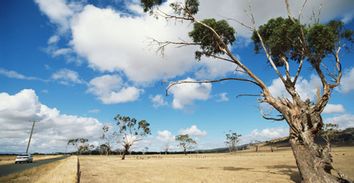
Such curious stoicism is more seriously addressed in Jill Ker Conway’s 1989 memoir, “The Road From Coorain,” an earnest account of growing up in a rural part of New South Wales. The country’s most populous state, it boasts Sydney as its capital, and spans a vast chunk of our famed, lush central-east coast (Bondi just one of its many legendary beaches) and then deep into the barren mainland, much of which is bush or desert. Conway writes intricate, intimate descriptions of the flat, crackling landscape: From the purple desert peas and “nut-flavored” grasses that thrive around the vital Murray River, she sweeps readers into “the dead heart of the country,” where her family lives off the land, cultivating grain, breeding sheep and cattle, and silently hoping for rain.

Hard work governs Conway’s childhood, broken up in “a good season” by rowdy dances in the closest town. In the prevailing low times, however, depression seeps in. Conway writes of an unspoken divide between her extraordinarily beautiful mother and proud, hardworking father, a schism that plays over and over in Australian literature: “It seemed flatter and more barren than any land [my mother] had ever seen. She saw no landmarks to identify directions, only emptiness. My father saw a strong fertile soil, indications of grazed-out saltbush, dips and changes in the contours of the land and its soils, landmarks of all kinds.”

Conway makes the perfect travel companion: She is unsparing and sincere as she writes of her experience traveling from the country’s desert through country towns and outer urban areas until she arrives with her mother in Sydney. The majority of Australians have never lived on this land, but many of us learn about it through Conway. She writes of a time that has passed, but the contrast she conveys between urban and rural, bush and city, is as stark now as then and as essential to the contemporary Australian experience.

The death of her father when Conway is 11 is the impetus for her move from the country — he dies while fixing a pump that might water the family’s withering flock of sheep. It’s as wrenching a story as Peter Carey’s epic and audacious novel “True History of the Kelly Gang” (2000), which begins: “I lost my own father at 12 yr. of age and know what it is to be raised on lies and silences my dear daughter.” The book, which was an international bestseller, imagines the life of infamous bushranger Ned Kelly, perhaps the most celebrated (real) figure in all of Australian history — picture Jesse James, Paul Bunyan and Paul Revere rolled into one. Carey, one of our most celebrated authors, infuses Kelly with such wit and empathy that his book reads as much as a tempestuous coming-of-age tale as an opinionated retelling of a fraught and crucial time in Australian history.

In an unpunctuated, uneducated Australian Irish, Kelly narrates his feral upbringing at the hands of his poor, foul-tempered Irish parents as well as his first childhood crimes. “Within the year I would of learned to kill a beast very smart and clean and have its hide off and drying in the sun before you could say Jack Robertson but on this 1st occasion I failed to find the artery,” narrates young Ned of his first killing of a neighbor’s fat heifer. Later, as an adult, Kelly’s beautifully wrought vernacular whirls readers through dusty locations like Benalla, Euroa and Stringy Bark Creek, all of which lie in the eucalyptus-thick bushland between Canberra and Melbourne. Kelly was hunted through this terrain by mounted (English) police until the final, fiery showdown at Glenrowan, about 150 miles north of Melbourne. Here, in 1880, Kelly’s outlaw status came to an end and his legend as an icon of rebellion began.

Many days’ drive west along vast stretches of highway and rough, rugged coast sits Perth, a sparse, flat, tree-studded city that lies between the long, buttery beaches along the Indian Ocean and the low, sprawling hills of the Darling Ranges. Said to be the most isolated city in the world, Perth and its surrounding coastal and country towns provide the backdrop for most of Tim Winton’s novels, the best of which is “Dirt Music” (2001), a slow, seething domestic drama set in a small, well-to-do fishing village. Georgie is a privileged, edgy ex-nurse and city girl, married to the town’s star fisherman. She reads literature and binge-drinks and — when she decides to end her monotony and hitchhike out of town — meets Lu, a hunky musician with a sad past. The book conveys an insidious hopelessness even in the midst of remarkable natural beauty — “sun-torched surfaces,” quaint and quiet dirt roads and steady, open water. People with nicknames like Fox and Bird and Darkie drink themselves to unnecessary deaths or float for days across the thick blue of the ocean. Winton’s choppy, rhythmic language captures the flowing and convoluted pace of western Australian life: “The grey sand was hot underfoot and the afternoon sun roasted the back of her neck until they came to a grove of tuarts whose shade and pad of fallen litter offered some relief.”

But all this despair is not limited to the wild open spaces. Andrew McGahan’s “Praise” (1998) plays out in the suburban living rooms and skanky beds of winterless Brisbane, the capital of Queensland on the northeast coast, home to surfers and indie rockers alike. Here, lanky Gordon Buchanan drinks beer (Tooheys, not Foster’s), and smokes, and fucks his nymphomaniac girl, Cynthia, who has a rotten case of excema. The pair work in the bottle shop (liquor store), when they can make it there. Gordon drives a 1970s Holden Kingswood — a beast of a car so legendary in status that Andy Warhol, had he been Australian, would have used it instead of a Brillo box. Cynthia is ever threatening to leave Gordon and follow her parents hundreds of miles north to the tropical city of Darwin. McGahan is our Denis Johnson; Gordon Buchanan our dulled-down, overdeveloped narrator of urban substance-fueled woes, and the book moves with the raw, dry tone American audiences might recognize from Australian films like “Lantana” and “Little Fish” (or indeed, the film version of “Praise” itself).

It’s hardly a surprise, then, that Bryson found us “an extraordinarily self-critical people” with a bizarrely pessimistic outlook. “You encounter it constantly … a nagging conviction that no matter how good things are in Australia, they are bound to be better elsewhere,” he writes. None of which matches up with our extraordinary contribution of talent to Hollywood or our reckless romance with nature. Or does it? Either way, both sides of Australia are there for you, our dear cousins — the dusty old men, the barbecued prawns and the occasional crocodile fight. Leave it to the non-Australian to bring it home: “Maidens’ long bar was lined from end to end with sun-leathered men in shorts and sweat-stained muscle shirts and wide-brimmed hats,” Bryson writes of visiting one country town pub. “It was like stepping in to a Paul Hogan movie. This was more like it.”

Continue Reading Close