Erich Follath

Leaked intel: Iran’s secret bomb plans

According to classified documents, nuclear research in Iran isn't just for civilians

It was probably the last attempt to defuse the nuclear dispute with Tehran without having to turn to dramatic new sanctions or military action. The plan, devised at the White House in October, had Russian and Chinese support and came with the seal of approval of the US president. It was clearly a Barack Obama operation.

Under the plan, Iran would send a large share of its low enriched uranium abroad, all at once, for a period of one year, receiving internationally monitored quantities of nuclear fuel elements in return. It was a deal that provided benefits for all sides. The Iranians would have enough material for what they claim is their civilian nuclear program, as well as for scientific experiments, and the world could be assured that Tehran would not be left with enough fissile material for its secret domestic uranium enrichment program — and for what the West assumes is the building of a nuclear bomb.

Tehran’s leaders initially agreed to the proposal “in principle.” But for weeks they put off the international community with vague allusions to a “final response,” and when that response finally materialized, it came in the form of a “counter-proposal.” Under this proposal, Tehran insisted that the exchange could not take place all at once, but only in stages, and that the material would not be sent abroad. Instead, Tehran wanted the exchange to take place in Iran.

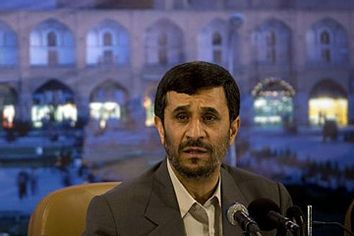
Once again, the Iranian leadership has rebuffed the West with phony promises of its willingness to compromise. The government in Tehran officially rejected the nuclear exchange plan last Tuesday. To make matters worse, after the West’s discovery of a secret uranium enrichment plant near Qom, President Mahmoud Ahmadinejad defiantly announced that he would never give in, and in fact would build 10 more enrichment plants instead.

Highly volatile material

But officials in Washington and European capitals are currently not as concerned about these cocky, unrealistic announcements as they are about intelligence reports based on sources within Iran and information from high-ranking defectors. The new information, say American experts, will likely prompt the US government to reassess the risks coming from the mullah-controlled country in the coming days and raise the alarm level from yellow to red. Skeptics who in the past, sometimes justifiably so, treated alarmist reports as Israeli propaganda, are also extremely worried. They include the experts from the United Nations International Atomic Energy Agency (IAEA), whose goal is prevent the spread of nuclear weapons.

After an extensive internal investigation, IAEA officials concluded that a computer obtained from Iran years ago contains highly volatile material. The laptop reached the Americans through Germany’s foreign intelligence agency, the Bundesnachrichtendienst (BND), and was then passed on to the IAEA in Vienna.

Reports by Ali Reza Asgari, Iran’s former deputy defense minister who managed to defect to the United States, where he was given a new identity, proved to be just as informative. Nuclear scientist Shahram Amiri, who “disappeared” during a pilgrimage to Mecca in June 2009, is also believed to have particularly valuable information. The Iranian authorities accused Saudi Arabia and the United States of kidnapping the expert, but it is more likely that he defected.

Iran’s government has come under pressure as a result of the new charges. They center on the question of who exactly is responsible for the country’s nuclear program — and what this says about its true nature. The government has consistently told the IAEA that the only agency involved in uranium enrichment is the National Energy Council, and that its work was exclusively dedicated to the peaceful use of the technology.

But if the claims are true that have been made in an intelligence dossier currently under review in diplomatic circles in Washington, Vienna, Tel Aviv and Berlin, portions of which SPIEGEL has obtained, this is a half-truth at best.

According to the classified document, there is a secret military branch of Iran’s nuclear research program that answers to the Defense Ministry and has clandestine structures. The officials who have read the dossier conclude that the government in Tehran is serious about developing a bomb, and that its plans are well advanced. There are two names that appear again and again in the documents, particularly in connection with the secret weapons program: Kamran Daneshjoo and Mohsen Fakhrizadeh.

Secret heart of Iran’s nuclear weapons program

Daneshjoo, 52, Iran’s new minister of science, research and technology, is also responsible for the country’s nuclear energy agency, and he is seen as a close ally of Ahmadinejad. Opposition leaders say he is a hardliner who was partly responsible for the apparently rigged presidential election in June. Daneshjoo’s biography includes only marginal references to his possible nuclear expertise. In describing himself, the man with the steely-gray beard writes that he studied engineering in the British city of Manchester, and then spent several years working at a Tehran “Center for Aviation Technology.” Western experts believe that this center developed into a sub-organization of the Defense Ministry known as the FEDAT, an acronym for the “Department for Expanded High-Technology Applications” — the secret heart of Iran’s nuclear weapons program. The head of that organization is Mohsen Fakhrizadeh, 48, an officer in the Revolutionary Guard and a professor at Tehran’s Imam Hossein University.

Western intelligence agencies believe that although the nuclear energy agency and the FEDAT compete in some areas, they have agreed to a division of labor on the central issue of nuclear weapons research, with the nuclear agency primarily supervising uranium enrichment while the FEDAT is involved in the construction of a nuclear warhead to be used in Iran’s Shahab missiles. Experts believe that Iran’s scientists could produce a primitive, truck-sized version of the bomb this year, but that it would have to be compressed to a size that would fit into a nuclear warhead to yield the strategic threat potential that has Israel and the West so alarmed — and that they could reach that stage by sometime between 2012 and 2014.

The Iranians are believed to have conducted non-nuclear tests of a detonating mechanism for a nuclear bomb more than six years ago. The challenge in the technology is to uniformly ignite the conventional explosives surrounding the uranium core — which is needed to produce the desired chain reaction. It is believed that the test series was conducted with a warhead encased in aluminum. In other words, everything but the core was “real.” According to the reports, the Tehran engineers used thin fibers and a measuring circuit board in place of the fissile material. This enabled them to measure the shock waves and photograph flashes that simulate the detonation of a nuclear bomb with some degree of accuracy. The results were apparently so encouraging that the Iranian government has since classified the technology as “feasible.”

SPIEGEL obtained access to a FEDAT organizational chart and a list of the names of scientists working for the agency. The Vienna-based IAEA also has these documents, but the Iranian president claims that they are forged and are being used to discredit his country. After reporting two years ago that the Iranians had frozen their nuclear weapons research in 2003, the CIA and other intelligence agencies will probably paint a significantly more sobering scenario just as the UN Security Council is considering tougher sanctions against Iran.

Mulling sanctions

When France assumes the Council’s rotating chairmanship in February, Washington could push for a showdown. While Moscow is not ruling out additional punitive measures, China, which has negotiated billions in energy deals with Iran, is more likely to block such measures.

China could, however, approve “smart” sanctions, such as travel restrictions for senior members of the Revolutionary Guard and nuclear scientists. Fakhrizadeh is already on a list of officials subject to such restrictions, and Daneshjoo could well be added in the future.

But the West would presumably be on its own when enforcing sanctions that would be truly harmful to Iran — and to its own, profitable trade relations with Tehran. The most effective trade weapon would be a fuel embargo. Because of a lack of refinery capacity Iran, which has the world’s second-largest oil reserves, imports almost half of the gasoline it uses. Sanctions would trigger a sharp rise in the price of gasoline, inevitably leading to social unrest. Experts are divided over whether it would be directed against the unpopular regime or if the country’s leaders could once again inflame the Iranian people against the “evil West.”

This leaves the military option. Apart from the political consequences and the possibility of counter-attacks, bombing Iran’s nuclear facilities would be extremely difficult. The nuclear experts have literally buried themselves and their facilities underground, in locations that would be virtually impossible to reach with conventional weapons.

While even Israeli experts are skeptical over how much damage bombing the facilities could do to the nuclear program, the normally levelheaded US General David Petraeus sounded downright belligerent when asked whether the Iranian nuclear facilities could be attacked militarily. “Well, they certainly can be bombed,” he said just two weeks ago in Washington.

Translated from the German by Christopher Sultan

How Israel destroyed Syria’s Al Kibar nuclear reactor

In a hushed-up mission in September 2007, Israeli jets blew up a mysterious complex in the Syrian desert

A satellite image of the suspected reactor before the Sept. 6, 2007 air strike: Israeli intelligence obtained information about the secret project after stealing data from a laptop belonging to a senior Syrian official.

The mighty Euphrates river is the subject of the prophecies in the Bible’s Book of Revelation, where it is written that the river will be the scene of the battle of Armageddon: “The sixth angel poured out his bowl on the great river Euphrates, and its water was dried up to prepare the way for the kings from the East.”

Today, time seems to stand still along the river. The turquoise waters of the Euphrates flow slowly through the northern Syrian provincial city Deir el-Zor, whose name translates as “monastery in the forest.” Farmers till the fields, and vendors sell camel’s hair blankets, cardamom and coriander in the city’s bazaars. Occasionally archaeologists visit the region to excavate the remains of ancient cities in the surrounding area, a place where many peoples have left their mark — the Parthians and the Sassanids, the Romans and the Jews, the Ottomans and the French, who were assigned the mandate for Syria by the League of Nations and who only withdrew their troops in 1946. Deir el-Zor is the last outpost before the vast, empty desert, a lifeless place of jagged mountains and inaccessible valleys that begins not far from the town center.

But on a night two years ago, something dramatic happened in this sleepy place. It’s an event that local residents discuss in whispers in teahouses along the river, when the water pipes glow and they are confident that no officials are listening — the subject is taboo in the state-controlled media, and they know that drawing too much attention to themselves in this authoritarian state could be hazardous to their health.

Some in Deir el-Zor talk of a bright flash which lit up the night in the distant desert. Others report seeing a gigantic column of smoke over the Euphrates, like a threatening finger. Some talk of omens, while others relate conspiracy theories. The pious older guests at Jisr al-Kabir, a popular restaurant near the city’s landmark suspension bridge, believe it was a sign from heaven.

All the rumors have long since muddied the waters as to what people may or may not have seen. But even the supposedly advanced Western world, with its state-of-the-art surveillance technology and interconnectedness through the mass media, has little more solid information than the people in this Syrian desert town. What happened in the night of Sept. 6, 2007 in the desert, 130 kilometers (81 miles) from the Iraqi border, 30 kilometers from Deir el-Zor, is one of the great mysteries of our times.

‘This incident never occurred”

At 2:55 p.m. on that day, the Damascus-based Syrian Arab News Agency (SANA) reported that Israeli fighter jets coming from the Mediterranean had violated Syrian airspace at “about one o’clock” in the morning. “Air defense units confronted them and forced them to leave after they dropped some ammunition in deserted areas without causing any human or material damage,” a Syrian military spokesman said, according to the news agency. There was no explanation whatsoever for why such a dramatic event was concealed for half a day.

At 6:46 p.m., Israeli government radio quoted a military spokesman as saying: “This incident never occurred.” At 8:46 p.m., a spokesperson for the US State Department said during a daily press briefing that he had only heard “second-hand reports” which “contradict” each other.

To this day, Syria and Israel, two countries that have technically been at war since the founding of the Jewish state in 1948, have largely adhered to a bizarre policy of downplaying what was clearly an act of war. Gradually it became clear that the fighter pilots did not drop some random ammunition over empty no-man’s land on that night in 2007, but had in fact deliberately targeted and destroyed a secret Syrian complex.

Was it a nuclear plant, in which scientists were on the verge of completing the bomb? Were North Korean, perhaps even Iranian experts, also working in this secret Syrian facility? When and how did the Israelis learn about the project, and why did they take such a great risk to conduct their clandestine operation? Was the destruction of the Al Kibar complex meant as a final warning to the Iranians, a trial run of sorts intended to show them what the Israelis plan to do if Tehran continues with its suspected nuclear weapons program?

In recent months, we have spoken with key politicians and experts about the mysterious incident in the Syrian desert, including Syrian President Bashar Assad, leading Israeli intelligence expert Ronen Bergman, International Atomic Energy Agency head Mohammed ElBaradei and influential American nuclear expert David Albright. We have also talked with individuals involved in the operation, who have only now agreed to reveal, under conditions of anonymity, what they know.

These efforts have led to an account that, while not solving the mystery in its entirety, at least delivers many pieces of the puzzle. It also offers an assessment of an operation that changed the Middle East and generated shock waves that are still being felt today.

Syria’s unpredictable president

Tel Aviv, late 2001. An inconspicuous block of houses located among eucalyptus trees is home to the headquarters of the legendary Israeli foreign intelligence agency, the Mossad. A memorial to agents who died in commando operations behind enemy lines stands in the small garden. There are already more than 400 names engraved on the gray marble, with room for many more. In the main building, intelligence analysts are trying to assemble a picture of the new Syrian president.

In July 2000, Bashar Assad succeeded his deceased father, former President Hafez Assad. The Israelis believed that the younger Assad, a politically inexperienced ophthalmologist who had lived in London for many years and who was only 34 when he took office, would be a weak leader. Unlike his father, an unscrupulous political realist nicknamed “The Lion” who had almost struck a deal with the Israelis over the Golan Heights in the last few months of his life, Bashar Assad was considered relatively unpredictable.

According to Israeli agents in Damascus, the younger Assad was trying to consolidate his power by espousing radical and controversial positions. He supplied massive amounts of weapons to the Iranian-backed Hezbollah in Lebanon, for their “struggle for independence” from the “Zionist regime.” He received high-ranking delegations from North Korea. The Mossad was convinced that the subject of these secret talks was a further upgrading of Syria’s military capabilities. Pyongyang had already helped Damascus in the past in the development of medium-range ballistic missiles and chemical weapons like sarin and mustard gas. But when Israeli military intelligence informed their Mossad counterparts that a Syrian nuclear program was apparently under discussion, the intelligence professionals were dismissive.

Nuclear weapons for Damascus, a nuclear plant literally on Israel’s doorstep? For the experts, it seemed much too implausible.

Besides, the senior Assad had rebuffed Abdul Qadeer Khan, the Pakistani “father of the atom bomb,” when Khan tried to sell him centrifuges for uranium enrichment on the black market in the early 1990s. The Israelis also knew all too well how complex the road to the bomb is, after having spent a lengthy period of time in the 1960s to covertly procure uranium and then develop nuclear weapons at their secret laboratories in the town of Dimona in the Negev desert. They took extreme measures to prevent then-Iraqi dictator Saddam Hussein from following their example: On a June night in 1981, Israeli F-16s, in violation of international law, entered Iraqi airspace and destroyed the Osirak nuclear reactor near Baghdad.

Key phase

The Israelis took a pinprick approach to dealing with the “little” Assad. In 2003, the air force conducted multiple air strikes against positions on the Syrian border, and in October Israeli fighter jets flew a low-altitude mission over Assad’s residence in Damascus. It was an arrogant show of power that even had many at the Mossad shaking their heads, wondering how Assad would respond to such humiliating treatment.

At that time, the nuclear plant on Euphrates had likely entered its first key phase. In the spring of 2004, the American National Security Agency (NSA) detected a suspiciously high number of telephone calls between Syria and North Korea, with a noticeably busy line of communication between the North Korean capital Pyongyang and a place in the northern Syrian desert called Al Kibar. The NSA dossier was sent to the Israeli military’s “8200″ unit, which is responsible for radio reconnaissance and has its antennas set up in the hills near Tel Aviv. Al-Kibar was “flagged,” as they say in intelligence jargon.

In late 2006, Israeli military intelligence decided to ask the British for their opinion. But almost at the same time as the delegation from Tel Aviv was arriving in London, a senior Syrian government official checked into a hotel in the exclusive London neighborhood of Kensington. He was under Mossad surveillance and turned out to be incredibly careless, leaving his computer in his hotel room when he went out. Israeli agents took the opportunity to install a so-called “Trojan horse” program, which can be used to secretly steal data, onto the Syrian’s laptop.

The hard drive contained construction plans, letters and hundreds of photos. The photos, which were particularly revealing, showed the Al Kibar complex at various stages in its development. At the beginning — probably in 2002, although the material was undated — the construction site looked like a treehouse on stilts, complete with suspicious-looking pipes leading to a pumping station at the Euphrates. Later photos show concrete piers and roofs, which apparently had only one function: to modify the building so that it would look unsuspicious from above. In the end, the whole thing looked as if a shoebox had been placed over something in an attempt to conceal it. But photos from the interior revealed that what was going on at the site was in fact probably work on fissile material.

One of the photos showed an Asian in blue tracksuit trousers, standing next to an Arab. The Mossad quickly identified the two men as Chon Chibu and Ibrahim Othman. Chon is one of the leading members of the North Korean nuclear program, and experts believe that he is the chief engineer behind the Yongbyon plutonium reactor. Othman is the director of the Syrian Atomic Energy Commission.

By now, both Israeli military intelligence and the Mossad were on high alert. After being briefed, then-Prime Minister Ehud Olmert asked: “Will the reactor be up and running soon, and is there is a need to take action?” Hard to say, the experts said. The prime minister asked for more detailed information, preferably from first hand.

The CIA catches a big fish

Istanbul, a CIA safe house for high-profile defectors, February 2007. An Iranian general had decided to switch sides. He was a big fish, of the sort rarely caught in the nets of the CIA and the Mossad.

Ali-Reza Asgari, 63, a handsome man with a moustache, was the head of Iran’s Revolutionary Guard in Lebanon in the 1980s and became Iran’s deputy defense minister in the mid-1990s. Though well-liked under the relatively liberal then-President Mohammad Khatami, Asgari fell out of favor after the election victory of hardliner Mahmoud Ahmadinejad in 2005. Because he had branded several men close to Ahmadinejad as corrupt, there was suddenly more at stake for Asgari than his career: His life was in danger.

Sources in the intelligence community claim that Asgari’s defection to the West was meticulously planned over a period of months. However Amir Farshad Ebrahimi, a former Iranian media attaché in Beirut who fled to Berlin in 2003 and who had known Asgari personally for many years, told us that the general contacted him twice to ask for help in his escape — first from Iran in the second half of 2006 and later from Damascus. In Ebrahimi’s version of events, Asgari succeeded in crossing the border into Turkey at night with the help of a smuggler. Ebrahimi says he only notified the CIA and turned his friend over to the Americans after Asgari had reached Istanbul.

But from that point on, the versions of the story coincide again. The Americans and Israelis soon discovered that the Tehran insider was an intelligence goldmine. For the Israelis, the most alarming part of Asgari’s story was what he had to say about Iran’s nuclear program. According to Asgari, Tehran was building a second, secret plant in addition to the uranium enrichment plant in Natanz, which was already known to the West. Besides, he said, Iran was apparently funding a top-secret nuclear project in Syria, launched in cooperation with the North Koreans. But Asgari claimed he did not know any further details about the plan.

After a few days, the general’s handlers flew him from Istanbul, considered relatively unsafe, to the highly secure Rhein-Main Air Base near Frankfurt. “I brought my computer along. My entire life is in there,” Asgari told his friend Ebrahimi, who identified him for the Americans. Asgari contacted Ebrahimi another two times, once from Washington and then from “somewhere in Texas.” The defector wanted his friend to let his wife know that he was safe and in good hands. The Iranian authorities had announced that Asgari had been “kidnapped by the Mossad and probably killed.” But then nothing further was heard from Asgari. The American authorities had apparently created a new identity for their high-level Iranian source. Ali-Reza Asgari had ceased to exist.

The need for US support

Olmert was kept apprised of the latest developments. In March 2007, three senior experts from the political, military and intelligence communities were summoned to his residence on Gaza Street in Jerusalem, where Olmert swore them to absolute secrecy. The trio was to advise him on matters relating to the Syrian nuclear program. Olmert wanted results, knowing that he would have to gain the support of the Americans before launching an attack. At the very least, he needed the Americans’ tacit consent if he planned to send aircraft into regions that were only a few dozen kilometers from military bases in Turkey, a NATO member.

In August, Major General Yaakov Amidror, the trio’s spokesman, delivered a devastating report to the prime minister. While the Mossad had tended to be reserved in its assessment of Al Kibar, the three men were now more than convinced that the site posed an existential threat to Israel and that there was evidence of intense cooperation between Syria and North Korea. There also appeared to be proof of connections to Iran. Mohsen Fakhrizadeh-Mahabadi, who experts believed was the head of Iran’s secret “Project 111″ for outfitting Iranian missiles with nuclear warheads, had visited Damascus in 2005. Iranian President Mahmoud Ahmadinejad traveled to Syria in 2006, where he is believed to have promised the Syrians more than $1 billion in assistance and urged them to accelerate their efforts.

According to this version of the story, Al Kibar was to be a backup plant for the heavy-water reactor under construction near the Iranian city of Arak, designed to provide plutonium to build a bomb if Iran did not succeed in constructing a weapon using enriched uranium. “Assad apparently thought that, with his weapon, he could have a nuclear option for an Armageddon,” says Aharon Zeevi-Farkash, the former director of Israeli military intelligence.

Suspicious ships

Olmert approved a highly risky undertaking: a fact-finding mission by Israeli agents on foreign soil. On an overcast night in August 2007, says intelligence expert Ronen Bergman, Israeli elite units traveling in helicopters at low altitude crossed the border into Syria, where they unloaded their testing equipment in the desert near Deir el-Zor and took soil samples in the general vicinity of the Al Kibar plant. The group had to abort its daring mission prematurely when it was discovered by a patrol. The Israelis still lacked the definitive proof they needed. However those in Tel Aviv who favored quick action argued that the results of the samples “provided evidence of the existence of a nuclear program.”

One of them was the head of the trio of experts, Yaakov Amidror. Amidror, a deeply religious man strongly influenced by his fear of a new Holocaust, also found evidence suggesting that construction on the Syrian plant was to be accelerated. He told Olmert about a ship called the Gregorio, which was coming from North Korea and which was seized in Cyprus in September 2006. It was found to have suspicious-looking pipes bound for Syria on board. And in early September 2007, the freighter Al-Ahmad, also coming from Pyongyang, arrived at the Syrian port of Tartous — with a cargo of uranium materials, according to the Mossad’s information.

At the time, no one was claiming that Al Kibar represented an immediate threat to Israel’s security. Nevertheless, Olmert wanted to attack, despite the tense conditions in the region, the Iraq crisis and the conflict in the Gaza Strip. Olmert notified then-US National Security Advisor Stephen Hadley and gave his own military staff the authority to bomb the Syrian plant. The countdown for Operation Orchard had begun.

“Target destroyed”

Ramat David Air Base, Sept. 5, 2007. Israel’s Ramat David air base is located south of the port city of Haifa. It is also near Megiddo, which according to the Bible will be the site of Armageddon, the final battle between good and evil.

The order that the pilots in the squadron received shortly before 11 p.m. on Sept. 5, 2007 seemed purely routine: They were to be prepared for an emergency exercise. All 10 available aircraft, known affectionately by their pilots as “Raam” (“Thunder”), took off into the night sky and headed westward, out into the Mediterranean. It was a maneuver designed to deflect attention from the extraordinary mobilization that had been taking place behind the scenes.

Three of the 10 F-15′s were ordered to return home, while the remaining seven continued flying east-northeast, at low altitude, toward the nearby Syrian border, where they used their precision-guided weapons to eliminate a radar station. Within an additional 18 flight minutes, they had reached the area around Deir el-Zor. By then, the Israeli pilots had the coordinates of the Al Kibar complex programmed into their on-board computers. The attack was filmed from the air, and as is always the case with these strikes, the bombs were far more destructive than necessary. For the Israelis, it made little difference whether a few guards were killed or a larger number of people.

Immediately following the brief report from the military (“target destroyed”), Prime Minister Ehud Olmert called Turkish Prime Minister Recep Tayyip Erdogan, explained the situation, and asked him to inform President Assad in Damascus that Israel would not tolerate another nuclear plant — but that no further hostile action was planned. Israel, Olmert said, did not want to play up the incident and was still interested in making peace with Damascus. He added that if Assad chose not to draw attention to the Israeli strike, he would do the same.

In this way, a deafening silence about the mysterious event in the desert began. Nevertheless, the story did not end there, because there were many who chose to shed light on the incident — and others who were intent on exacting revenge.

Washington , DC , late October 2007. The independent Institute for Science and International Security (ISIS) is located less than a mile from the White House. It is more important than some US federal departments.

The office of its founder and president, David Albright, who holds a degree in physics and was a member of the United Nation’s International Atomic Energy Agency (IAEA) group of experts in Iraq, is in suite 500 of the brick building that houses the ISIS. As relaxed as he seems to his staff, in his pleated khaki trousers and rolled up shirtsleeves, they know that it is no accident that Albright has managed to turn the ISIS into one of the leading think tanks in Washington. Albright’s words carry significant weight in the world of nuclear scientists.

The ISIS spent four weeks analyzing the initial reports about the mysterious air strike in Syria, combing over satellite images covering an area of 25,000 square kilometers (9,650 square miles) before they discovered the destroyed complex of buildings in the desert.

In April 2008, Albright received an unexpected invitation from the CIA to attend a meeting. There, then-CIA Director Michael Hayden showed him images that the Israelis had obtained from the Syrian computer in London (much to the outrage of officials in Tel Aviv, incidentally, as it provided insights into Mossad sources). The photos enabled Albright, who was familiar with the dimensions and characteristics of North Korea’s Yongbyon reactor, to compare the various stages at Al Kibar. “There are no longer any serious doubts that we were dealing with a nuclear reactor in Syria,” the scientist concluded.

Albright believes that the CIA’s strange behavior had to be understood in the context of the Iraq disaster. At the time, the administration of then-President George W. Bush, citing CIA information, constantly repeated the false claim that Saddam Hussein possessed weapons of mass destruction. This time around, American intelligence wanted to prove that the threat was real.

But where did the Syrians get the uranium they needed for their heavy-water reactor, and in which secret plants was it enriched? In addition to the North Koreans, were the Iranians also involved? And what did the latest images of this “Manhattan project” in the Syrian desert actually depict — the conversion of an existing plant or a completely new facility?

The Sisyphus of non-proliferation

Vienna, the UN complex on Wagramer Straße, headquarters of the IAEA’s nuclear detectives. An impressive collection of national flags hangs in the lobby, like sails waiting for a tailwind. Of the 192 UN member states, 150 are also members of the IAEA, and almost all UN members have signed the Nuclear Non-Proliferation Treaty (NPT). The problem children of the nuclear world, Israel, Pakistan and India, have not signed the treaty. All three of them possess — or in the case of Israel, are believed to possess — nuclear weapons.

Signatory states like Syria and Iran are entitled to support in pursuing the peaceful use of nuclear energy. They are also required to either phase out nuclear weapons and prevent their proliferation (in the case of the nuclear “haves”) or refrain from developing them in the first place (in the case of the “have-nots”).

The IAEA, whose job is to verify compliance with the provisions of the NPT, has 2,200 employees and an annual budget of roughly $300 million. That may sound impressive, but it is really just peanuts if the claim repeatedly made by politicians around the world is true, namely that the possibility of nuclear weapons falling into the hands of blackmailing dictators or terrorists poses the greatest danger to humanity.

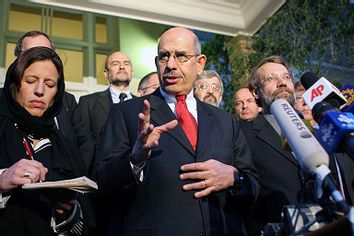
During an interview in his Vienna office in May 2009, IAEA Director General Mohamed ElBaradei, 67, sighed as he took stock of his life. At times, the IAEA boss says, he has felt like Sisyphus, the tragic figure in Greek mythology who is constantly pushing a boulder up a mountain, only to lose hold of it shortly before the summit. ElBaradei, the winner of the 2005 Nobel Peace Prize, has repeatedly pointed out that his organization is subject to the whims of the member states. The nuclear detectives can admittedly be deployed to use their highly sensitive testing equipment to obtain a “nuclear fingerprint” in any particular place, but they also need access to reactors. Libya has caused problems in the past, while today’s recalcitrants are North Korea and Iran — in other words, the usual suspects. And now Syria. The news about the desert nuclear plant came as a great shock to the IAEA.

“What the Israelis did was a violation of international law. If the Israelis and the Americans had information about an illegal nuclear facility, they should have notified us immediately,” says ElBaradei, who only learned of the dramatic incident from media reports. “When everything was over, we were supposed to head out and search for evidence in the rubble — a virtually impossible task.”

Alarming findings

But he had underestimated his inspectors. In June 2008, a team of IAEA experts visited the destroyed Al Kibar plant. The Syrians had given in to pressure from the weapons inspectors, but they had also done everything possible to dispose of the evidence first. They removed all the debris from the bombed facility and paved over the entire site with concrete. They told the inspectors that it had been a conventional weapons factory, and not a nuclear reactor, which they would have been required to report to the IAEA. They also insisted that foreigners had not been involved.

The IAEA experts painstakingly collected soil samples, and used special wipes to remove minute traces of material from furnishings or pipes still on the site. The samples were sent to the IAEA special laboratories in Seibersdorf, a town near Vienna, where they were subjected to ultrasensitive isotope analyses capable of determining whether samples had come into contact with suspicious uranium. And indeed, the analysis produced some very alarming findings.

In its report, the IAEA describes “a significant number of anthropogenic natural uranium particles (i.e. produced as a result of chemical processing)” which were “of a type not included in Syria’s declared inventory of nuclear material.” The Syrian authorities claimed that the uranium was introduced by the Israeli bombing, something that the IAEA said was of “low probability.”

In its latest report, released in June 2009, the IAEA demanded, in no uncertain terms, that Damascus grant it permission for another series of inspections, this time with access to “three other locations” that may have been related to Al Kibar. “The characteristics of the complex, including the cooling water capacities, bear a strong similarity to those of a nuclear reactor, something which urgently requires clarification,” says one IAEA expert. In the cautious language of UN officials, this is practically a guilty verdict.

In the crosshairs

“Syria is not giving us the transparency we require,” ElBaradei says angrily. A picture hanging in his office seems to reflect his mood. It is a print of “The Scream,” by the Norwegian painter Edvard Munch, which depicts a deeply distraught person. ElBaradei does not believe that he is too lenient with those suspected of illegally pursuing nuclear weapons programs, as the Bush administration repeatedly claimed, particularly in relation to Iran. The IAEA, he says, will probably receive permission for a new inspection trip to Syria soon. Or at least he hopes it will.

If and when that happens, a different host will greet the UN team. The affable Brigadier General Mohammed Suleiman, an Assad confidant in charge of all manner of “sensitive security issues,” was formerly in charge of presiding over the inspections. However he was assassinated in 2008. He landed in the crosshairs of his pursuers, just like Hezbollah commander Imad Mughniyah.

For the Israelis, Mughniyah was the epitome of terror, the most notorious terrorist mastermind in the Middle East. He was responsible for the bloody attack on American military headquarters in Beirut in the 1980s and on Jewish institutions in Argentina in the 1990s, attacks in which hundreds of innocent people died. He is regarded by some as the inventor of the suicide attack and was deeply rooted in Iranian power structures.

The Mossad had information that Mughniyah was planning to avenge the air strike on Al Kibar with an attack on an Israeli embassy — either in the Azerbaijani capital Baku, Cairo or the Jordanian capital Amman.

Assassinated in an SUV

Damascus, the building complex of the Atomic Energy Commission of Syria in the city’s Kafar Soussa diplomatic quarter, February 2008. Visitors are not welcome. “Please contact post office box 6091,” says the guard at the entrance. There is also an email address (atomic@aec.org.sy). But inquiries sent to both addresses remain unanswered. No wonder, say experts, who speculate that the threads of a secret nuclear weapons program come together in the inconspicuous AECS complex.

It was precisely on the street where the AECS complex is located that Imad Mughniyah, a.k.a. “The Fox,” parked his Mitsubishi Pajero on Feb. 12, 2008 while he attended a reception at the nearby Iranian embassy. It was a rare appearance by a man who normally avoided being seen in public. But on that evening Mughniyah knew that he would be among friends, including Hamas leader Khaled Mashal and Syrian General Mohammed Suleiman, whom he had met many times in Tehran and at Hezbollah centers in Lebanon.

Shortly after 10:30 p.m., Mughniyah drank his last glass of freshly squeezed orange juice. Then he kissed the host, the newly installed Iranian diplomat Ahmed Mousavi, on both cheeks, as local custom dictates, and left the party. Mughniyah was “probably the most intelligent, most capable operative we’ve ever run across,” said former CIA agent Robert Baer, who had been tracking him for a long time. The terrorist knew that he was at the very top of the Mossad’s hit list, and he also knew that the FBI was offering a $5 million reward for information leading to his arrest. But he felt relatively safe in Syria, as he did in Beirut and Tehran, which he visited on a regular basis.

The explosion completely destroyed the SUV and ripped apart Mughniyah’s body. He was killed instantly. But the explosive charge was apparently calculated so carefully that nearby buildings were barely harmed. The terrorist leader remained the only victim on that night in Damascus.

Whoever committed the act, “the world is a better place without this man,” the American government announced the next day through State Department spokesman Sean McCormack. Hezbollah, which had no doubts as to who was responsible for the killing, called Mughniyah a “martyr” and vowed to retaliate against the “Zionists.”

The Israeli government neither confirmed nor denied any involvement in the assassination. But agents at the Mossad could hardly contain their delight. According to information leaked to intelligence expert Uzi Mahnaimi, Israeli agents had removed the driver’s seat headrest and filled it with a compound that would detonate on contact. Intelligence expert Ronen Bergman can even describe the reaction of Israelis who were involved. “It was a shame about that nice new Pajero,” one of them reportedly said.

Tartous, a medieval stronghold of the Knights Templar on the Syrian Mediterranean coast, five months later. It was at this port city, 160 kilometers northwest of Damascus, that the mysterious freighter Hamed had once berthed with its supposed cargo of cement from North Korea. Here, on a beach eight miles north of the medieval city walls, General Suleiman had a weekend house, not far from the Rimal al-Zahabiya luxury beach resort. In the summer, Suleiman traveled to his weekend house almost every Friday to review files, relax and swim. On this first August weekend in 2008, President Assad’s eminence grise must have taken along a particularly large number of documents. A few days later, he had planned to accompany Assad on a secret visit to Tehran.

As always, Suleiman drove from Damascus to Tartous in an armored vehicle. Additional bodyguards were waiting for him at his chalet. They never let him out of their sight, even escorting him into the water when he went swimming. After Mughniyah’s murder on a busy Damascus street, security was at the highest possible level. The general, who interacted with the global community as the regime’s senior representative on nuclear issues, was considered particularly at risk.

The sea was calm that morning. Yachts were cruising off the coast, and there was nothing to raise suspicions in Tartous, a popular sailing destination for Syria’s moneyed aristocracy where boats can be chartered for visits to nearby Arwad Island and its fish restaurants. An unusually sleek yacht came within 50 meters of the coast, but it was not close enough to raise any red flags with the bodyguards when their boss decided to jump into the sea.

No one even heard the gunshots, which were probably fired from precision rifles equipped with silencers. But they clearly came from offshore, striking Sulaiman in the head, chest and neck. The general died before his bodyguards could do anything for him. The yacht carrying the snipers turned away and disappeared into international waters.

Hushed up

The Syrian authorities kept the news of the murder from the public for days. After that, it issued terse statements about the “vicious crime.” According to the official account, the general was “found shot dead near Tartous.” There was no mention of a yacht or of the angle from which the shots were fired.

Speculation was rife in Damascus. Diplomats assumed that Suleiman had become too powerful for his fellow cabinet members, and that his killing was evidence of an internal Syrian power struggle. According to Western critics of the president, Suleiman had become a burden for Assad after the debacle involving the bombed nuclear plant and the Mughniyah murder, and he was eliminated on orders from Assad. For experts, however, the most likely scenario is that the Israelis were behind the highly professional assassination.

Suleiman, who was nicknamed “the imported general” because of his European appearance, was buried in a private ceremony in his native village of Draykish two days after his murder. President Assad sent his younger brother Maher to attend the secret funeral, while he himself embarked on his scheduled trip to Tehran. It was important for him to put on a show of self-control, no matter how distressed he may have felt.

Can bomb attacks and hit squads against real or presumed terrorists bring about progress in the Middle East? Is it true that Arabs and Israelis only understand the language of violence, as many in Tel Aviv are now saying? Did the operation against the Al Kibar complex, which violated international law, bring the Syrian president to his senses, or did it merely encourage him to harden his position?

And what does all this mean for a possible Iranian nuclear bomb?

The consequences of Operation Orchard

“The facility that was bombed was not a nuclear plant, but rather a conventional military installation,” Syrian President Bashar Assad insisted during an interview at his palace near Damascus in mid-January 2009. “We could have struck back. But should we really allow ourselves to be provoked into a war? Then we would have walked into an Israeli trap.” What about the traces of uranium? “Perhaps the Israelis dropped it from the air to make us the target of precisely these suspicions.”

Damascus, he said, is not interested in becoming a nuclear power, nor does it believe that Tehran is developing the bomb. “Syria is fundamentally opposed to the proliferation of nuclear weapons. We want a nuclear-free Middle East, Israel included.”

Assad, outraged over Israeli belligerence in the Gaza Strip, has suspended secret peace talks with the enemy, which had been brokered by Turkey. But it is also abundantly clear that Assad is eager to remove himself from the list of global political pariahs and enter into dialogue with the United States and Europe.

In the autumn of 2009, relations between Damascus and the West seem to be on the mend, probably as the result of American concessions rather than Israeli bombs. French President Nicolas Sarkozy received Assad at the Elysée Palace and told him that the normalization of relations would depend on the Syrians meeting a provocatively worded condition: “End nuclear weapons cooperation with Iran.” In the first week of October, Syrian Deputy Foreign Minister Faisal Mekdad traveled to Washington to meet with his counterparts there. And Saudi Arabia’s King Abdullah, with Washington’s explicit blessing, went to Damascus in an attempt to make a shift to the moderate camp more palatable for Assad.

President Barack Obama will probably send a US military attaché to Damascus soon, followed by an ambassador. Syria could be removed from the US’s list of state sponsors of terrorism, a list which also includes Iran, Cuba and Sudan. The prospect of billions in aid, as well as transfers of high technology, is being held out to Assad. The Syrian president knows that this is probably his only hope to revive his ailing economy in the long term.

Relations between Damascus and Tehran have worsened considerably in recent weeks. Western intelligence agencies report that the Iranian leadership is demanding that Syria return — in full and without compensation — substantial shipments of uranium, which it no longer needs now that its nuclear program has been destroyed.

The latest news from Damascus, the ancient city where Saulus turned into Paulus according to the old scripts: According to information obtained from sources in Damascus, Assad has been considering taking a sensational political step. He is believed to have suggested to contacts in Pyongyang that he is considering the disclosure of his “national” nuclear program, but without divulging any details of cooperation with his North Korean and Iranian partners. Libyan revolutionary leader Moammar Gadhafi reaped considerable benefits from the international community after a similar “confession” about his country’s nuclear program.

The reaction from North Korea was swift and extremely harsh: Pyongyang sent a senior government representative to Damascus to inform Syrian authorities that the North Koreans would terminate all cooperation on chemical weapons if Assad proceeded with his plan. And this regardless whether he mentioned Pyongyang in this context or not.

Tehran’s reaction is believed to have been even more severe. Saeed Jalili, the country’s leading nuclear negotiator and a close associate of Iran’s supreme religious leader, apparently brought along an urgent message from the Ayatollah Ali Khamenei, in which Khamenei called Assad’s plan “unacceptable” and threatened that it would spell the end of the two countries’ strategic alliance and a sharp decline in relations.

According to intelligence sources, Assad has backed down — for the time being. However he is also looking for ways to do business with his enemies, even Israel’s hard-line prime minister, Benjamin Netanyahu. Nevertheless, Assad is loath to give up his contacts to Hezbollah and Tehran completely, and he will demand a very high price for the possible recognition of Israel and for playing the role of mediator with Tehran, namely the return of the entire Golan Heights.

Time on its side

Did Operation Orchard make an impression on the Iranians, and did they understand it the way it was probably intended by the Israelis: as a final warning to Tehran?

The Iranians have — literally — entrenched themselves, and not only since the Israeli attack on Syria. Many of the centrifuges they use for uranium enrichment are now operating in underground tunnels. Not even the bunker-busting super-bombs the Pentagon has requested be made available soon, citing “urgent operational requirements,” are capable of fully destroying facilities like the one in Natanz.

The Americans — or the Israelis — would have to conduct air strikes for several weeks and destroy more than a dozen known nuclear facilities to set back the Iranian nuclear program by more than a few weeks. It would be a far more complex undertaking than the Israelis’ past attacks on the Osirak reactor in Iraq and Syria’s Al Kibar nuclear plant. And even after such a comprehensive operation, which would expose them to counterattacks, they could not be entirely sure of having wiped out all key elements of the Iranian nuclear program. Just in September, Tehran surprised the world with the confession that it had built a previously unreported uranium enrichment plant near Qom.

Operation Orchard achieved only one thing: If the Iranians had planned to build a “spare” nuclear plant in Syria, that is, a backup plutonium factory, their plans were thwarted. But Tehran has time on its side. The Iranians are already believed to have reached breakout capacity — in other words, the ability to begin building a nuclear weapon if they so desire. Iran is on the verge of becoming a nuclear power.

And Syria? There is nothing to suggest that Damascus will or is even able to play with fire once again. A conventional factory has in fact been built over the ruins of the Al Kibar plant. There is no access to the plant — for “security reasons,” as residents of Deir el-Zor say tersely — at the roadblock near the great river and the desert village of Tibnah.

The turquoise-colored river flows slowly, the river that Moses, according to the Bible, promised to the Israelites as part of their holy land. To this day, many radical Israelis take the relevant passage in the Bible as seriously as an entry in the land register: “Every place that your foot shall tread upon shall be yours. From the desert, and from Libanus, from the great river Euphrates unto the western sea.”

Referring to the same river, the Prophet Muhammad is supposed to have said: “The Euphrates reveals the treasures within itself. Whoever sees it should not take anything from it.”

Translated from the German by Christopher Sultan

Continue Reading Close

Iran has no interest in compromise

There is little hope that negotiations between Tehran and the U.S. will lead to progress on Iran's nuclear plans

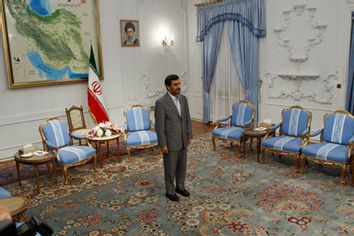
Iranian President Mahmoud Ahmadinejad waits to meet the Iraqi parliament speaker, Ayad al-Samarraie, unseen, at the presidency in Tehran, Iran, Monday, Sept. 7, 2009.

Three months after the disputed presidential election, Iran’s leadership is more confident than ever. President Mahmoud Ahmadinejad has provoked the West at the U.N. General Assembly, while at home the opposition continues to be brutally repressed. There is little hope of progress at the negotiations that begin in Switzerland on Thursday.

Parvin Fahimi will be out there on the front line again, risking life and limb. She’ll continue to take up her protest signs and shout “Down with the dictatorship!” as she did most recently on Iran’s “Jerusalem Day” last Friday. Fahimi, 53, is a strong personality, a leader of street protests and an icon of the Iranian opposition against President Mahmoud Ahmadinejad’s regime.

“I’m also just a normal housewife,” she says, readjusting her black chador inside her apartment in the middle-class Tehran neighborhood of Apadana. “But in my homeland, if you want justice and freedom, you have to put everything else on hold.”

Fahimi’s apartment is a shrine, a memorial to her murdered son, Sohrab Aarabi. Dozens of photos of Sohrab line the walls, as if to make sure the memory of her beloved youngest son will never fade. There’s Sohrab serious over his schoolbooks, Sohrab energetic on the soccer field, Sohrab looking pensive during a break at school. Sohrab, who had so many plans, who wanted to discover the world and experience first love. Sohrab, who became a martyr — against his will.

Deep lines of sorrow have formed around his mother’s eyes, and her voice breaks as she tells her story. But then she composes herself again, holding tightly to her notebook, a last anchor documenting everything. She still finds it all so difficult to believe.

Women and children beaten

The third day after the “stolen election” on June 12, massive demonstrations took place on the streets of Tehran. Parvin Fahimi was there with her four sons, but they became separated in the chaos. The Basij militia, Ahmadinejad’s thugs, arrived. People fled into doorways and found detours home. By late morning, Siavash, 23, Siamak, 27, and Sohail, 25, had made their way back to the family apartment. Only Sohrab, 19, was missing.

The odyssey that followed was a dreadful emotional roller coaster ride for Fahimi. She took her son’s photograph to all of Tehran’s authorities. She visited police headquarters, spent the night in front of Tehran’s notorious Evin prison, and screamed at officials in the public prosecutor’s office, after having been told her son’s name was “marked” and he was being investigated as a potential ringleader. She was offered hope — Sohrab was under arrest but in good health, and would contact her soon.

During her desperate search, Fahimi viewed dozens of police photographs of unidentified bodies. Again and again, she saw women and children being beaten in prison cells. Then, after more than three weeks, came the awful truth — Sohrab was dead. The death certificate issued by a medical officer tersely stated that he had been hit in the chest with a bullet.

His mother still doesn’t know if her son really died the night of the demonstration, or if he was tortured and then killed in prison. Opposition leaders Mir Hossein Mousavi and Mahdi Karroubi visited to offer their condolences, and thousands showed their solidarity at the funeral march held 40 days after Sohrab was buried.

Fahimi also lost her husband two years ago to a brain tumor. That was fate, she says. But now, to lose her youngest child — that, Fahimi says, was a crime. “What keeps me alive,” she explains, “is the certainty that Sohrab didn’t die in vain.” As she shows her guests to the door on a Tuesday evening shortly before midnight, the call to prayer begins to sound from the rooftops — “Allahu akbar,” God is great. It’s also the code word for Iran’s resistance, whose symbolic color is green.

Last-ditch attempt

It’s now four months on from the election and tensely awaited talks between Iran and the permanent members of the U.N. Security Council, plus Germany, are about to begin. It’s the first time in decades that a high-level American government representative will be present. William Burns, under secretary of state under President Barack Obama, will travel to Switzerland on Oct. 1 to participate in the discussions — without preconditions. The Republican opposition in Washington has ranted that it’s an unacceptable concession to a “rogue” state. It’s more of a last-ditch attempt to get Tehran to see reason on the matter of nuclear weapons, counter Obama’s confidants. Together with the other participating countries, Burns will offer Tehran a packet of economic and diplomatic incentives if it will abandon or at least suspend its program of uranium enrichment, which many in the international community suspect is a possible first step toward building a nuclear bomb.

If Iran’s leaders persist in their stubbornness, however, America and its allies will push for significantly harsher sanctions. The mullah state doesn’t seem concerned, however. “Do you really believe there are sanctions that can hit us that hard?” asks Iran’s top nuclear negotiator, Saeed Jalili, in a recent interview.

What will happen if the negotiating parties walk away from Geneva empty-handed? What if it comes to a gasoline embargo against Tehran, a move that — despite Iran’s assertions to the contrary — could hit the country hard, since Iran imports more than a third of its fuel? What will happen if Israel’s hard-liner Prime Minister Benjamin Netanyahu decides on a military strike against Iran’s nuclear facilities, sites Israel has come to view as a threat to its own existence in the wake of the Iranian president’s many provocative statements?

Ahmadinejad secures his power base

Ahmadinejad’s speech to the U.N. General Assembly on Wednesday evening last week did little to allay fears. It was the fifth time Ahmadinejad had attended the assembly in New York and the fifth time he had taken to the podium. During his speech he addressed such diverse topics as “monotheism and justice,” which can apparently save the world, and “moral values and spirituality.”

Again and again, he returned to his obsession with the “small minority” that controls the world with the help of its “private networks,” namely the Jews — although he never mentioned the objects of his hate by name. Accusations that Israel is committing “genocide” in the Gaza Strip and trying to establish “a new form of slavery” provoked an uproar, with many Western delegates walking out. But on the main question at hand — Iran’s nuclear program — he offered not a word, only vague hints of a willingness to engage in dialogue, and bitter derision toward Barack Obama, saying the American president’s promised changes have failed to materialize.

Ahmadinejad believes he has already weathered the worst of the reaction to his blatantly manipulated reelection. And indeed, there is little indication that either his government or the entire political system of the Islamic Republic is on the verge of collapse. After a period of tension, Supreme Leader Ayatollah Ali Khamenei seems to have reconciled with Ahmadinejad, giving the president’s political power a boost. The parliament has not gone further than verbal criticism and has now approved all but three of the president’s 21 chosen candidates for the new cabinet. The country’s defense minister is now Ahmad Vahidi, whose alleged involvement in terrorist attacks in Argentina in the 1990s led to an international warrant for his arrest.

And yet, however well Ahmadinejad may seem to have succeeded in securing or even expanding his power base in the short term, he’s far from winning the battle over Iran’s future. There is something else bubbling under the surface, and it can be felt at large-scale demonstrations like “Jerusalem Day,” an annual event in support of Palestinians and against Israel. The government mobilized hundreds of thousands of supporters for a planned demonstration, but then watched as tens of thousands of them split off and began to shout opposition slogans. Mousavi and Karroubi as well as reformist ex-president Mohammad Khatami were there, publicly joining the protest. So far, the regime hasn’t dared to arrest these opposition leaders, instead persecuting less well-known dissidents in show trials reminiscent of the Stalinist era.

“Deep concern”

In the meantime, several prominent clerics could also prove dangerous for Ahmadinejad. Highly respected Grand Ayatollah Hossein Ali Montazeri, 86, tells his followers in the city of Qom that this is a “criminal leadership,” describing revolt against it as a “religious duty.” Few of the country’s high-ranking clerics support Ahmadinejad. Hassan Khomeini, 37, who is a symbolic figure due to being the grandson of Islamic Revolution leader Ayatollah Ruhollah Khomeini, has made his dissatisfaction with the current government clear.

Even influential Ayatollah Mohammad Mousavi Bojnurdi, 66, a man generally seen as apolitical, speaks in his unadorned office of his “deep concern” over developments in Iran. Bojnurdi, who heads the Imam Khomeini Research Institute in Tehran, spent more than a decade in exile in Iraq and France together with the revered father of the Islamic Revolution. He attests to the fact that Islam forbids “ruling with a stick.” And he prays daily for the people who have been injured in the demonstrations.

On the other side there is Mohammad Ali Ramin, 55, professor of morality and religion at Tehran’s Payame Noor University, who says, “Anyone you know my thoughts, knows what moves the president. And I think he’s doing everything right.” The university’s name means “message of light.” Ramin is the man who influences Ahmadinejad’s view on Israel — and the Holocaust. Whether the latter took place at all, says the professor, who has red hair and a gentle, disarming voice, needs “to be more thoroughly researched first.”

He himself has absolutely nothing against Jews, Ramin insists, only against the “Zionist regime,” which he describes as “criminal.” When Ahmadinejad says that Israel is doomed to destruction, he’s only articulating the conclusion reached in his many conversations with Ramin.

How, exactly, will Israel disappear from the face of the Earth? “It will be obliterated, as every unjust power in history has eventually been destroyed,” claims Ramin. He is Ahmadinejad’s adviser, although he doesn’t like being described as such, preferring to be called his “close friend and companion.” At the end of our conversation in the university library, he adds that he receives a great deal of support for his views over the Internet as well, especially from Germany.

A tough negotiator

Meanwhile, the man who will be taking center stage at the international talks in Switzerland is one who has previously served many presidents. From his finely manicured hands to his soft, slightly high-pitched voice and his smart appearance in pinstripes, Saeed Jalili is a consummate career diplomat. Critics call him an expert in the art of survival, always on the side of the powerful. Supporters praise his political intuition and strategic skill. He was discovered 20 years ago by then-President Ali Akbar Hashemi Rafsanjani, who first sent Jalili abroad as an attaché, then soon afterward appointed him deputy head of the Iranian Foreign Ministry’s American division.

But Jalili, who holds a Ph.D. in political science, is most closely affiliated with one man — Ayatollah Khamenei himself. The smooth politician won the revolutionary leader’s favor, becoming director general of his office. Anyone who wanted access to the heirs of the Islamic Republic’s founder had to go through Jalili.

Jalili is not afraid of confrontation. Friends and enemies alike agree that Jalili, who comes from the holy city of Mashhad, is a tough negotiator who has few qualms about defending his position by any means necessary. The opposition movement accuses Jalili of having been one of the masterminds behind the brazen manipulation of the June 12 presidential election — an allegation he indignantly rejects.

Close links

No one doubts that Jalili, as head of Iran’s Supreme National Security Council, would have at least had the power and capabilities to do so. The location of the Council’s massive headquarters with its black marble facade in the center of Tehran’s government district — Khamenei’s office to the left, the presidential palace to the right — testifies to its central importance in the Iranian power structure.

Jalili sees no reason to deny his close links with Ahmadinejad. He proudly tells visitors that he and the president “have known each other for such a long time.” Both served in the paramilitary Revolutionary Guards, both taught at Tehran University. “That is probably one of the reasons why we both share the same visions,” says Jalili. He probably means the same vision of Iran as a nuclear power. When Ahmadinejad’s obstructionism drove out the former chief nuclear negotiator, Ali Larijani, two years ago, Jalili got the job.

Jalili isn’t impressed by the U.S. decision to take part in direct negotiations for the first time. He politely but firmly dismisses Western hopes that a Tehran government weakened by inner turbulence might be ready to make concessions. Compromises just aren’t Jalili’s thing. 


This article has been provided by Der Spiegel through a special arrangement with Salon. For more from Europe’s most-read newsmagazine, visit Spiegel Online or subscribe to the daily newsletter.

Continue Reading Close

A forced breakthrough in the Middle East

If Obama can get Israel to agree to stop building new settlements, there may be a new opportunity for peace

Battling against the occupier: Young Palestinian protesters hurl stones towards Israeli soldiers during a protest against Israel's controversial separation barrier in the West Bank village of Bilin near Ramallah.

Cell 28, block 3, Hadarim Prison, 30 kilometers (19 miles) northeast of Tel Aviv: This is where one of the two men who could play an important role in the Middle East in the coming months is currently incarcerated. The other man sits in the Oval Office at the White House in Washington.

In 2004, an Israeli court sentenced Marwan Barghouti, 50, to life in prison for his role in the planning of several murders. At the time, Barghouti called it a “show trial” and insisted that it would not deter him from sticking to his position. Even behind bars, the charismatic Palestinian leader stressed the need to “fight the occupying power.” At the same time, however, he argued the case for peaceful coexistence with the Israelis and advocated a two-state solution. Three weeks ago, at the convention in Bethlehem of Fatah, which governs the West Bank, the prisoner received the third-largest number of votes for a spot on the group’s central committee.

There had been persistent rumors that the Israelis wanted to release Barghouti from prison, hoping to pave the way for him to become a potential “Palestinian Nelson Mandela.” But when Prime Minister Benjamin Netanyahu’s nationalist right-wing government came into power five months ago, the chances of that experiment coming to fruition seemed reduced to almost nothing. But now Israel’s hawkish premier has the opportunity to release the man from cell 28 without losing face among his supporters. In exchange for turning over Gilad Shalit, an Israeli soldier abducted three years ago, radical Islamist Hamas is demanding the release of 450 Palestinians it has listed by name.

Somewhat surprisingly, Barghouti is on the list. The Fatah leader has been a vocal critic of what he calls Hamas radicals’ “coup” in the Gaza Strip, and he has also called for reconciliation between Fatah and Hamas, which have clashed violently in the past. If Palestinian unification is even conceivable, it will require Barghouti’s participation. With German mediation, the Shalit deal, long in the making and hampered several times by various details, could be completed successfully in the coming weeks.

Watching from Washington

Officials in Washington are also keeping a close eye on — and apparently taking a favorable view of — the potential prisoner exchange deal and the prospect of changing the face of the Middle East. U.S. President Barack Obama is pursuing ambitious goals in the Middle East, and the comprehensive peace plan he has been developing is now taking shape. Obama is tying together the region’s two main problems, which are widely viewed as intractable: the conflict between Israelis and Palestinians and the threat of Iran becoming a nuclear power. At the same time, he is applying tremendous pressure to all sides to achieve simultaneous progress on both fronts, progress that could lead to an overall solution.

But isn’t it naïve for the U.S. president to hold out the prospect of a peace treaty in two years, in a region where radical Islamists remain determined to destroy Israel and radical Zionists create new provocations every day by expanding the Jewish settlements in the occupied territories? Can the Iranian leadership still be dissuaded from pursuing its nuclear ambitions? “The explicit linkage is, in any case, a dangerous gambit,” concludes the British daily the Guardian.

The way Obama’s new approach works was in evidence during the Israeli premier’s trip to Europe last week. Although Obama was not physically present, his presence was nonetheless felt, as were his demands. On the one hand, he wants the Israelis to halt settlement construction in the occupied territories and negotiate with the Fatah leadership. On the other hand, Obama’s plans call for tougher sanctions on the Iranians, beginning this autumn, if they do not accept Washington’s offer of comprehensive nuclear talks by the end of September. Netanyahu was intent on preventing the parallel treatment of these two sets of demands — and, above all, the establishment of a link between the two subjects — but failed to do so during his European trip.

When the Israeli prime minister stood next to his British counterpart, Gordon Brown, at No. 10 Downing Street on Tuesday, there was a palpable distance between the two men. The construction of Jewish settlements, Brown said, is an ” obstacle” and must be stopped. At the same time, Brown threatened Tehran with tougher sanctions. In Paris, French President Nicolas Sarkozy seconded Brown’s demands and, in addition to agreeing with his call for a tougher approach, fundamentally questioned Tehran’s reliability and willingness to compromise. “These are the same leaders, in Iran, who tell us that the nuclear program is peaceful and that the elections were honest. Frankly, who believes them?”

On Wednesday, also in London, Netanyahu met with Obama’s special envoy to the Middle East. For weeks, George Mitchell has been repeating Washington’s call for a “complete halt to settlements” like a mantra. Behind the scenes, there was apparently even talk of Washington suspending its deliveries of military equipment and its billions in aid if Israel refused to cooperate.

Western action bears fruit

Probably the biggest disappointment for Netanyahu came on Wednesday. German Chancellor Angela Merkel, whom Netanyahu’s predecessor Ehud Olmert had called Israel’s “best friend in Europe,” and who has taken an extremely mild stance toward Israel’s occupation policy in the past, joined the chorus of critics when she said unambiguously that a halt to settlement construction was a “key condition” of comprehensive peace, and that “substantial changes” on the part of the Israelis were needed on this issue. “Time is the essence,” the chancellor cautioned her guest, while at the same time stressing the need to increase pressure on Tehran. But Netanyahu did not address Merkel’s demands in Berlin, and instead limited himself to emphasizing Israel’s good relations with Germany.

The West’s concerted action seems to be bearing fruit. The stalemate, which is the status quo in the Middle East, is beginning to change. Apparently all it takes is a lot of pressure for politicians on all sides to react.

In May Khaled Mashaal, Hamas’ Damascus-based political leader who is known for his uncompromising demands, surprisingly declared that his “goal” was the establishment of a Palestinian nation in the West Bank and the Gaza Strip. This cautious overture is unlikely to be enough to convince the West to enter into talks with Hamas. However, if Mashaal meant what he said, it would amount to a de facto recognition of the existence of Israel. Even Fatah, with which both the West and Israel are negotiating, has not gone much further.

Could ultra-conservatives derail the peace talk plan?

There are signals coming from Iran that at least nourish vague hope that even the Iranians have grasped the signs of the times. According to information from diplomatic circles, a group of Iranian politicians in the “pragmatists’ camp” has proposed a “limited suspension of uranium enrichment” that would approximate United Nations demands. The government has rejected such proposals, but because it was previously assumed that Iranians are united on the nuclear issue, Western observers believe that the episode is at least noteworthy.

Besides, Iran has just told the weapons inspectors of the International Atomic Energy Agency (IAEA) that it is willing to allow more thorough inspections of a few particularly “suspicious” nuclear facilities, such as the plant in Natanz, which is being used to make fuel, and the heavy-water reactor in Arak, which is capable of producing plutonium. In its latest, not-yet-published report, the IAEA notes that Iran hasn’t increased the number of centrifuges used to enrich uranium since May. Of course, experts believe that an Iranian change of heart is highly unlikely. Tehran has reduced its pace of development several times in the past and made concessions to the UN inspectors when it seemed tactically opportune. To date, Iran has weathered three rounds of UN sanctions relatively unscathed. However, a possible fourth round of sanctions in October that would entail a ban on fuel imports would deal a heavy blow to the economy.

A new round of peace negotiations

Netanyahu is already believed to have quietly agreed to some of Obama’s demands, albeit with great reluctance. He now plans to impose a nine-month moratorium on new construction in the settlements, with the exception of East Jerusalem. Although this falls short of Obama’s expectations, it is probably sufficient as the basis for a new round of Mideast peace negotiations the U.S. president plans to launch, and attend, in the fall — especially since Fatah leader Mahmoud Abbas, responding to pressure from Washington, is believed to be willing to meet with Netanyahu. Obama plans to explain details of the revival of the peace process to leaders of other major nations and as many representatives of the Arab world as possible on the sidelines of the next session of the United Nations General Assembly.

Netanyahu’s cabinet of unpredictable ultra-conservatives could thwart these efforts to achieve rapprochement. One of those conservatives is Minister of Science and Technology Daniel Hershkowitz, who has described Obama’s positions as “borderline anti-Semitic.” The national security advisor, known for his irascibility and his peculiar understanding of democracy, has also triggered alarm. Before Netanyahu’s European visit, Uzi Arad called upon Merkel not to openly discuss the issue of settlement construction. He also insisted that steps should be taken to prevent journalists from asking related questions.

Sadly, another politician can be counted on to stir the pot in times of crumbling convictions or at least shifting political positions: Israeli Foreign Minister Avigdor Lieberman. The agitator, who repeatedly draws attention to himself with his racist comments, said early last week that he did not believe in peace with the Palestinians, and that Obama’s ideas were “unrealistic.” Referring to the Oslo Accords, he said: “Sixteen years have passed since then. Even in another 16 years, we won’t have an agreement.”

The Lieberman problem could very well resolve itself soon. The Israeli judiciary is investigating the foreign minister for money laundering, embezzlement and corruption, charges he denies. Nevertheless, Lieberman has promised that, if indicted, he will resign.

Translated from the German by Christopher Sultan.


This article has been provided by Der Spiegel through a special arrangement with Salon. For more from Europe’s most-read newsmagazine, visit Spiegel Online or subscribe to the daily newsletter.

Continue Reading Close

Is war between Iran and Israel inevitable?

Given the similarities between Netanyahu and Ahmadinejad, the two countries could be on a collision course.

A pair of more disparate twins hasn’t existed since the muscle-bound Arnold Schwarzenegger and the sharp-tongued, diminutive Danny DeVito played twins in the Hollywood movie of that name. One, the Israeli, is tall and thickset and often wears tailored suits. He is a gifted speaker and a militant anti-Iranian. The other, the Iranian, is short and slight and is almost always seen wearing an ordinary-looking beige windbreaker. He tends to be somewhat gauche and is a rabble-rousing populist and a self-declared enemy of Israel. The two men couldn’t be more different.

But Israeli Prime Minister Benjamin Netanyahu, 59, and Iranian President Mahmoud Ahmadinejad, 52, are twins in spirit, which is not to imply in any way that they are morally equivalent. Both men are convinced of the absolute validity of their beliefs, both are obsessed by what they see as their higher calling, and both are convinced that theirs is a Messianic mission — a mission to “honor” a religion or “save” a people.

There is every indication that the coming nuclear negotiations between Washington and Tehran — if, indeed, they begin in the next few months with Ahmadinejad still Iranian president — will end in a stalemate by the end of the year. If that happens, US President Barack Obama will push for tougher sanctions against Tehran in early 2010, with the reluctant support of the Russians and Chinese. The leadership in Tehran will interpret this as an aggressive act and will likely speed up its uranium enrichment, meaning that Iran will only be a few months away from having the capability to build a nuclear bomb. At some point next spring, things could have proceeded so far that the Israelis could decide, even without Washington’s approval, to launch attacks against Iranian nuclear facilities. The entire Middle East would see thousands of casualties, and the consequences for the global economy would be devastating.

To understand what motivates the Iranian president and the Israeli prime minister, and what convictions guide their policies, it is important to examine the deeply religious ideas that shape both Ahmadinejad and Netanyahu and practically destine them to clash with each other: the theology of the Islamic Haqqani school and the Jewish concept of Amalek. And to understand why Tehran and Jerusalem, with Ahmadinejad and Netanyahu at their respective helms, have embarked on such an alarming and potentially devastating course, it helps — as this author has done — to have personally met the people involved and to have studied their milieu during numerous trips to Iran and Israel over the past three-and-a-half decades. These experiences form the pieces of a puzzle, and although the resulting image is not all-encompassing and does not explain everything, it is at least an image based on a concrete search for evidence and on personal experience of the reality on the ground.

The return of the Mahdi

Flashback: It is the late 1980s, and I am visiting the Iranian holy city of Qom. It is my first visit to the Islamic Republic of Iran, following earlier visits during the time of the shah and my reporting on his overthrow. “Do you want to meet Ayatollah Mohammad Taqi Mesbah Yazdi, the head of the education department at the Rah-i-Haq Institute?” my guide asks. Not another holy man, I think to myself — I have already had exhausting interviews with half a dozen Koran scholars today. It is hot and dusty in Qom, where Fatima, a descendant of the Prophet Muhammad, is buried in a giant mosque. But then my guide tells me that Mesbah Yazdi is considered to be one of the most brilliant and influential thinkers in Qom, and that he is an ardent student of revolutionary leader Ayatollah Ruhollah Khomeini.

In the interview, Mesbah Yazdi proves to be cosmopolitan and admits to being a computer geek. Ideologically, however, he is an ultraconservative hardliner and a theoretician of the radicals, and his fixed mocking smile cannot conceal his cold nature. He openly advocates suicide bombings, calls for the carrying out of the fatwa imposed against author Salman Rushdi and demands “the blood of any person who insults Islam.” And he considers “the Zionists” to be the fundamental source of evil on earth.

Mesbah Yazdi kept a low profile for years, except to control the fundamentalist Haqqani movement, a role in which an ambitious and deeply devout young man became his protégé. In 2005, Mesbah Yazdi called upon the faithful to vote for his former student, Ahmadinejad. It was an unusual step in the world of ayatollahs, who usually steer clear of mundane politics and keep their personal preferences to themselves. Since then, the ultraconservative cleric, who portrays himself as an infallible interpreter of the faith, has been viewed as Ahmadinejad’s ideological and spiritual mentor.

As the son of a blacksmith, Iran’s president was in his youth attracted mainly to Islamic social revolutionary theories. Ali Shariati, an Iranian philosopher who was educated in Paris and linked Marxism to religious, anti-colonial beliefs, influenced Ahmadinejad in his early years. But then, in his mid-20s, Ahmadinejad met Mesbah Yazdi and came under the spell of mystical fundamentalism. Ahmadinejad has long been an avowed supporter of the same ultra-religious school of Shia as Mesbah Yazdi. The Haqqani group, in its religious fervor, is reminiscent of the zealots of another religion, the born-again Christians (a group which includes, incidentally, former US President George W. Bush).

The so-called Mahdists around Mesbah Yazdi and Ahmadinejad believe that their Twelfth Imam disappeared from the face of the earth in the 9th century because Allah the Almighty hid him to put mankind to a test. They also believe that this Twelfth Imam, or Mahdi, will return to the earth, as will Jesus, who all Muslims see as an important predecessor to Muhammad. The Mahdi, in their view, will create a paradise on earth for believers and condemn blasphemers to eternal damnation. But he will only return when the world has undergone a catharsis, a whirling, gigantic, cleansing upheaval.

Could it take the form of a war between Muslims and heretics, perhaps? Possibly a nuclear war? And do some of the apocalyptically minded within the Haqqani school want to provoke this cataclysmic event to bring about the return of the Mahdi as soon as possible?

The demagogue Ahmadinejad

April 2009. I am in a government building in Tehran, waiting to interview President Ahmadinejad together with my colleagues Dieter Bednarz and Georg Mascolo. Our meeting is delayed, which gives us an opportunity to look around. In the vestibule outside his conference room, gifts presented to Ahmadinejad by guests are displayed in glass cases. There are only a dozen, apparently presents from those visitors to Tehran that the president deemed most important.

In a particularly prominent spot is an ugly silver plate, a gift an American anti-Zionist association presented him with during the “Holocaust Conference” three years ago, when Ahmadinejad assembled “academics” of his persuasion to question the Shoah, the murders of millions of Jews under the Nazis. After the conference, the Iranian president repeatedly called for the extermination of the Zionist regime.

At major rallies and in his few press conferences, like the one he gave early last week, Ahmadinejad comes across as a demagogue, an obstinate warrior striking out against the Western world and its supposed moral afflictions, such as “campaigning for the votes of homosexuals.” He is more relaxed and focused during our two-hour interview, and yet constantly wary, like a fox on the prowl, quickly responding to our questions with questions of his own. He is also very conscious of the fact that he is preaching to an international and not a domestic audience.

He declares discussions over the nuclear issue to be “concluded,” even though international talks, at least those involving the United States, have yet to begin. He flatly denies charges that Iran has blatantly violated the commitments it made by signing the Nuclear Nonproliferation Treaty. He claims not to be seeking to obtain nuclear weapons. And yet, reading between the lines of an extremely heated interview (which Ahmadinejad’s friends, or perhaps his enemies, later printed verbatim in the Iranian press), it becomes clear that he wants to see Iran acknowledged as a virtual nuclear power, and as one of the world’s leading nations. This is the basis on which he wants to negotiate — under his conditions — with U.S. President Obama and the rest of the world.

Creative vote counting

In a face-to-face conversation, Ahmadinejad can be polite, even charming, and he is adept at soberly presenting his case that the West is seeking to control Iran. But he also has a different, mystical side. He considers himself chosen. In a meeting with Iranian members of parliament, Ahmadinejad claimed that he was surrounded by a light when he addressed the United Nations General Assembly in New York, and that the light silenced the leaders of other countries in the audience during his speech. This special spiritual bond with the Mahdi that the president claims for himself by making such assertions also makes him suspect to leading clerics in Qom. The Haqqani school was not held in particularly high esteem by Khomeini, the revolutionary leader and founder of the Iranian theocracy, and he is even said to have considered banning the organization. The radical followers of the Haqqani movement are also said to be viewed with suspicion by Khomeini’s successor, Khamenei.

According to associates of Ahmadinejad, he continues to meet with his mentor every week for an ideological tête-à-tête. Members of parliament have questioned why this peculiar cleric, this “adviser” to the president, should be involved in decisions, and on whose authority. Mesbah Yazdi, 74, has since been named director of the Imam Khomeini Education and Research Institute in Qom. In the election to the Assembly of Experts in December 2006, which was apparently not manipulated, the radical cleric suffered a serious setback when he was defeated by moderate reformers associated with former President Mohammed Khatami, who called Mesbah Yazdi a “theoretician of violence.” He was also clearly bested by members of the camp of multi-millionaire Hashemi Rafsanjani who are well-established within the system. After that, Mesbah Yazdi, whose nickname is “Professor Crocodile,” promptly snapped back at all dissidents. He wants to purify the country of all reformist movements, and he is known to have characterized supporters of the reformist camp as “a pile of booze-drinking rags.”

In times of existential threat, Shiite Islam expressly permits “taqiyya,” a doctrine which allows deception or lying for the greater good of the community. This is a concept, reinterpreted for contemporary purposes, from the early days of Islam, when the Shia minority was forced to resort to any means possible to survive against an aggressive Sunni majority. Which raises the question: Is Mesbah Yazdi the father of creative vote counting?

The fundamentalist Haqqinists believe that the Mahdi will celebrate his return to earth in Jamkaran, on the outskirts of Qom. The president has spent millions to enlarge and embellish the local mosque in Jamkaran, and there are plans to build a costly new rail line from Tehran to the pilgrimage site, which Ahmadinejad frequently visits. However visitors to Jamkaran, where large numbers of pilgrims, separated by gender, throw their notes with their wishes into two holy wells, would be hard pressed to find any signs of the apocalyptic visions associated with it. In fact, Jamkaran does not seem sinister or threatening at all, but instead has the air of a peaceful, lively pilgrimage site, a place where families might sit down together for a picnic — part Christian Lourdes and part Jewish Wailing Wall.

Ahmadinejad, Holocaust denier and avowed hater of Israel, has repeatedly assured that he will not attack the “Zionist entity” militarily. Instead, say his defenders, his desire to see Israel wiped off the map should be understood in a “metaphysical way.” Experts on Iran, like Cologne-based Islamic Studies professor Katajun Amirpur, point out the semantic subtleties that some have overlooked. According to Amirpur, the Iranian president did not call for the “eradication” of Israel, but said: “This (Israeli) occupier regime must disappear from the pages of history.”

But do such interpretations of Ahmadinejad’s words make any difference to Israel — a country that, despite its military might, still seems to believe that its very existence is threatened, a country shaped by the all-encompassing principle that another Holocaust can never be allowed to happen? How can they trust a man, many Israelis ask, who feels chosen to lead his country to greatness by whatever means possible, and to satisfy his extremist principles?

A visit to the Netanyahu family

They call him “Bibi,” as if he were on a first-name basis with the entire nation and had never grown up. Whenever this Bibi, aka Benjamin Netanyahu, has mentioned Tehran and its political leadership in recent months, he has repeated his mantra that the Iranian nuclear program is the greatest threat Israel has confronted “since its creation in 1948.” The liberal and consistently well-informed Israeli daily Haaretz wrote: “Politicians in touch with Netanyahu say he has already made up his mind to destroy Iran’s nuclear installations” — apparently without Washington’s approval.

What could make the Israeli prime minister feel so confident that he is doing the right thing? It is an important question, given the potentially serious consequences of such a military strike, which could range from Iran firing missiles at Tel Aviv to a wave of Hezbollah and Hamas terrorist attacks, not to mention the damage this would do to Israel’s relations with the United States, whose backing is critical to its survival.

Flashback: Jerusalem, the house of Netanyahu’s father, mid-July 1976. The Netanyahu family has invited me, together with Israeli journalist Shabtai Tal, to their home. The mood is somber. The sense of mourning for Yonatan Netanyahu lies over everyone like a heavy veil. A few days earlier, an Israeli special forces unit, in what was probably the most spectacular rescue in the history of terrorism, had liberated more than 90 hostages on board an Air France jet at Entebbe Airport in Uganda that had been hijacked by Palestinians. The only Israeli casualty of the commando mission, presumably killed by a ricochet, was the unit’s brilliant commander, Yonatan Netanyahu, nicknamed Yoni — Bibi’s brother. He was only 30 when he died.

For many Israelis, Yonatan Netanyahu had with the Entebbe mission sent a Jewish message to the world, one that continues to shape the debate in today’s discussion over the country’s stance toward Iran. It was a symbol that challenged the notion that suffering must be passive, a symbol of taking control, even in a seemingly hopeless situation — a kind of continuation of the 1943 uprising in the Warsaw Ghetto.

In a situation of personal mourning, as was the case during my 1976 visit to Jerusalem, it is certainly not unusual for all emphasis to be placed on the lost son. Benzion Netanyahu, the family patriarch, spoke affectionately of Yoni’s willingness to give his life for Israel. But it was also noticeable that Benjamin and Iddo, the youngest brother, never dared to speak, remaining reverently silent when the patriarch launched into a sweeping digression into Jewish history.

It is difficult to judge whether Benjamin Netanyahu was ever jealous of his heroic brother, who was three years his senior. At any rate, he admired — and tried to emulate — his older brother from the earliest days of his youth. After completing his military service, Yoni joined Sayeret Matkal, an elite unit of the Israeli Defense Force, and was eventually promoted to commander. Bibi followed in his footsteps. Yoni received the highest decorations for bravery. Bibi, who was part of a mission to rescue hostages on board a hijacked Sabena jet, received the country’s second-highest decoration for bravery. The struggle against evil to rescue Jews, embodied in such an exemplary fashion by the martyr in the family, the “Israeli legend,” became a legacy for Benjamin Netanyahu. Bibi, again following in his older brother’s footsteps, went to the United States, where he attended prestigious universities. When we attended the wake for his brother in Jerusalem, he mentioned that he was considering entering politics.

A second important influence in the life of the Israeli prime minister is his now 99-year-old father. He was always something of a patriarch, and his children strictly obeyed his “suggestions.” That included the willingness to make important personal sacrifices for the Jewish state. Iddo, a radiologist today, also served with the dangerous elite military unit. Benjamin made it his mission to fill the outsized footsteps of his brother Yonatan, and to fight anti-Jewish terror at least as enthusiastically and thoroughly. The family patriarch provided his sons with the necessary ideological tools.

He was born Benzion Mileikowsky, the son of a rabbi, in Warsaw. In 1920, the family emigrated to the Holy Land. Benzion lived in the city of Jaffa, whose population at the time was mainly Arab, before moving to Jerusalem as a student. He took on the Hebrew name Netanyahu (which translates roughly as “gift from God”) and wrote for a newspaper that was banned for “agitation” in 1935 by the British Mandate administration. Then the young historian went to America, where he became secretary to the revisionist Zionist Vladimir Zeev Jabotinsky, a man who rejected all compromise with the Arabs. Netanyahu also believed in a Greater Israel and, in America, vehemently fought the partition plan that led to the creation of the Israeli state in 1948.

After returning to Israel, Benzion Netanyahu attempted to embark on a career in Israeli politics, but even Menachem Begin’s right-wing Likud bloc rejected his demands as being too extreme. From then on, he devoted himself to his books, became the co-publisher of the Encyclopedia Hebraica and wrote a book about the history of Jews in Spain. In his more than 1,300-page opus, the key points of which he conveyed to his sons in hours of family readings, the historian argues that the Spaniards were more strongly motivated by racism than religion in their pogroms against the Jews during the Inquisition. He also argues that militant anti-Semitism is always an expression of unmotivated hatred, and that there is only one possible response to it: militant and, if necessary, preventive Jewish self-defense.

Netanyahu Sr. could point out to his sons, with some justification, that he was one of the few who had warned against the Holocaust early on. He also instilled in them the conviction that the family had a special calling, that it was chosen.

‘A liar and a cheat’

I met Bibi again a few years later, in New York. He had just been named Israel’s ambassador to the United Nations. By the time of our next interview, he had already become Israel’s deputy foreign minister. He spoke contemptuously about “Palestinian delusions” and said that they would “be in for a surprise when I come to power.” In 1993, his party members elected him to the chairmanship of Likud, and three years later he defeated Shimon Peres in a neck-and-neck race to become the youngest person ever to serve as Israeli prime minister, a post he held until 1999. A hardliner, Netanyahu had a different relationship with the Americans. “That son-of-a-bitch doesn’t want a deal,” former US President Bill Clinton once said heatedly, in the presence of several witnesses, in response to yet another example of Netanyahu’s obstructionist policies. In an interview, former White House spokesman Joe Lockhart called the Israeli prime minister “one of the most obnoxious individuals you’re going to come into — just a liar and a cheat.”

But as much as Bibi Netanyahu rubbed people the wrong way, he stubbornly upheld the principles he had inherited from his father and brother, sounded a rallying cry to hunt down terrorists worldwide and pursued his plans to create a Greater Israel. He also showed that he could act against his own ideological convictions when he had run out of other options. For instance, he handed over portions of the city of Hebron to the Palestinians, stirring up resentment within his own ranks.

The duty to fight Amalek

In December 2005, Netanyahu celebrated his comeback as Likud chairman and, in early 2009, led the party into elections as the frontrunner. That election, not unlike the recent election in Iran, did not produce clear results, even though — as could be expected in the Middle East’s only democracy — it was free and fair. Netanyahu’s party came in second, while Kadima, the party of the popular Tzipi Livni, who was open to negotiations with the Arabs, managed to secure one additional seat in the Israeli parliament, the Knesset.

Netanyahu was forced to form a coalition with an ultra-religious party and to strike a deal with right-wing populist Avigdor Lieberman, a man Haaretz has called a “racist and fascist.” Lieberman, to the chagrin of many Israelis, was made foreign minister in Netanyahu’s new cabinet.

Netanyahu has not forgotten his roots. He often mentions the two people who shaped his life and his way of thinking. He dedicated a fiery book on fighting terrorism to his father, and he published a book of the letters of his fallen brother. Despite living up to his reputation as a hardliner in the first few months of his new term, he demonstrated at least the willingness to compromise. In response to pressure from the Obama administration, in a keynote speech on foreign policy that he gave last week, Netanyahu spoke for the first time of a “Palestinian state.” It was an important moment even if the hurdles he set for its establishment were so high that even moderate Palestinians had trouble recognizing any real willingness to budge.

It is certainly possible that Netanyahu will retreat from other positions in the coming months, perhaps, under pressure from Washington, abandoning the expansion of settlements — which he is currently pursuing, in violation of all commitments under international law, under the euphemism of “natural growth.” But Netanyahu is almost certain to remain unbending on the question of Iranian nuclear bombs, steering Israel toward an attack. Why does he believe that a red line has been crossed? And why does he seem to yearn for his adversary Ahmadinejad to remain in office, as even the respected German newspaper Frankfurter Allgemeine Zeitung reported with astonishment, citing Israeli sources?

When American author and Israel expert Jeffrey Goldberg recently asked a Netanyahu confidant to explain this fixation, he simply replied: “Think Amalek.” This is the Jewish concept that forms a potentially disastrous parallel to the Islamic Haqqani school — a pair of mirror-image concepts that could spell war. In a biblical context, Amalek was the grandson of Esau who, with his tribal warriors from Canaan, launched a treacherous and unprovoked attack on the Hebrews as they were traveling to the Holy Land, Eretz Israel. In a broader sense, the term Amalek refers to the existential threat to Judaism at all times, under all circumstances and by all enemies. The Torah, Devarim 25, Fifth Book of Moses, reads: “Remember what Amalek did to you on your journey, after you left Egypt–how, undeterred by fear of God, he surprised you on the march, when you were famished and weary, and cut down all the stragglers in your rear.”

No Jewish generation is permitted to forget the conflict with Amalek, because Amalek embodies the intrinsically evil and destructive. Fighting Amalek is the duty of every devout Jew, a “mitzvah aseh” or commandment of action. According to some interpretations of ancient scripture, this mitzvah is more far-reaching, namely a commandment to eliminate the original enemies of the Jews.

Rabbis like Bibi Netanyahu’s grandfather taught, and continue to teach today, that Jews are forced to combat the Amalekites, who are constantly, as Goldberg puts it, “reappearing in new forms”: the soldiers of Nebuchadnezzar and of the Spanish Grand Inquisitor Tomás de Torquemada, Adolf Hitler’s thugs, and now the hardliners who are vowing to destroy Israel, together with their president, Ahmadinejad. Those who, like Netanyahu, see Iran’s nuclear program as Amalek’s arsenal of weapons, are not just entitled, but are in fact obligated, to take preventive measures to destroy it. According to Jewish apocalyptic constructs, a Jewish state would cease to exist after a possible Iranian nuclear first strike. In other words, it is better to attack first in the case of doubt.

The notion that Iran, if it were to use nuclear weapons, would be acting suicidally and would see its government and hundreds of thousands of innocent people wiped out in the inevitable counter-attack is irrelevant. In fact, say the anti-Amalekites, Ahmadinejad literally yearns for such an inferno, because it would pave the way for the return of the Mahdi in the resulting end-time scenario. The Israelis reject as naïve the idea that Ahmadinejad is “merely” a populist and, with his nuclear program, could “only” be pursuing tactical goals like the regional strengthening of Iran to bring it to the same level as Israel, a nuclear power.

Is a coming war virtually unavoidable? In Israel’s more recent history, hasn’t it always been the hardliners who have managed to achieve important compromises and who, like Begin or Sharon, or possibly Netanyahu in the current conflict, were also able to convince the people of the need for such compromises? Isn’t it possible that Ahmadinejad could be interested in, or forced to, scale back his demands?

The solutions for monitoring the Iranian nuclear program are on the table. The West will have to be prepared to fundamentally grant the Iranians the right to uranium enrichment — under strict international supervision. The Iranians will have to agree to limit their arsenal to a few dozen centrifuges for scientific research, and to purchase the nuclear fuel for their civilian program from other countries. In return for Tehran’s willingness to compromise, the West would agree to a “grand bargain” involving unrestricted trade, the transfer of scientific know-how and diplomatic recognition by Washington.

But the signs are currently pointing to stormy weather ahead: to Haqqani versus Amalek, and to a showdown between the unlike twins.

Translated from the German by Christopher Sultan.


This article has been provided by Der Spiegel through a special arrangement with Salon. For more from Europe’s most-read newsmagazine, visit Spiegel Online or subscribe to the daily newsletter.

Continue Reading Close

“The world has ignored our warnings”

Nuclear watchdog Mohamed ElBaradei talks about being wiretapped by the Bush administration, whose "arrogance and ignorance" turned the Middle East into "a giant mess."

Mohamed ElBaradei, director general of the International Atomic Energy Agency (IAEA), discusses the record of his term in office, his bitter struggle with the Bush administration and the dangers that new nuclear powers pose.

Mr. ElBaradei, you have been the director general of the IAEA for more than 11 years, and you plan to retire in November, at the end of your third term.

There can be no question of retirement. The nuclear threat is too great for me to be able to put this issue to rest. I will continue to play an active role.

When you took office, you wanted to make the world a safer place; but now the threat seems greater than ever. Nuclear weapons could fall into the hands of the Taliban in Pakistan. North Korea has announced plans to test another nuclear weapon. And, in Iran, President Mahmoud Ahmadinejad boasts about being able to close the nuclear cycle. Have you failed?

No, I don’t think so. We did what we could. We at the IAEA are merely a tool as strong as our member states allow us to be. We cannot make political decisions; nor are we in a position to implement them. We cannot simply march into any country without its consent. It was others who failed.

Whom do you mean?

The international community. The world has ignored our warnings. Take the case of Iraq, for example. Even though we had no evidence of weapons of mass destruction, they were used as justification for the war — the most dangerous moment of my tenure. Or take Pyongyang. Efforts to engage North Korea in ongoing disarmament talks have failed. And the dialogue with Tehran was tied to preconditions that were unacceptable to the Iranians.

It was because of assessments like these that you were accused of being naive, especially by the administration of former U.S. President George W. Bush.

That’s unfair. In the case of North Korea, for example, we pointed out in 1992 that the country was in violation of the Nuclear Non-Proliferation Treaty (NPT). And we have consistently pressed the Iranians to respond to unanswered questions about their nuclear program. The world has the IAEA to thank for almost everything it knows about Iran’s nuclear progress.

Information coming from the exiled opposition led to the discovery of the uranium enrichment plant in Natanz.

Unlike some nations, we do not have our own satellites for aerial photographs. Sometime they give us something because it suits their geopolitical goals, and sometimes they withhold things.

The Bush administration was so suspicious of you that U.S. intelligence agencies tapped your phones.

That didn’t bother me so much because I never had anything to hide. On the contrary, it gave me a shot in the arm because I knew that I was doing the right thing. But my daughter was deeply disturbed that people were listening in on her private conversations.

Would you have thought the Bush administration was capable of that sort of a wiretapping campaign?

It didn’t really surprise me. What can you expect from an administration that — in a mixture of ignorance and arrogance — passed over countless diplomatic opportunities to conduct a dialogue with Tehran? The entire Middle East was turned into a complete mess.

The new American administration has announced a change of course.

Indeed. [President] Barack Obama has turned U.S. policy around by 180 degrees. For instance, he announced plans to double the IAEA budget in the next four years. The Europeans, including Germany, want to freeze the budget, which I find alarming.

But you also gained a great deal of recognition in 2005, when you and the IAEA were awarded the Nobel Peace Prize.

Yes, that’s true. It was a vote of confidence in the organization, and it strengthened my immune system against attacks, especially because this recognition was triggered by the policies of the powerful. We managed to draw attention to the organization; the letters of our name were always being mixed up by politicians. I am also pleased to see that, after two more or less wasted decades since the end of the Cold War, nuclear disarmament is now a central issue once again. This reflects the realization that the risk of the use of nuclear weapons has actually increased considerably and that the bomb could fall into the wrong hands.

Such as the hands of fanatics in Tehran.

We still have no ultimate proof of a military nuclear program in Iran. However, we do have some unanswered questions.

You are choosing your words with extreme caution. As the IAEA concluded in its last report, the Iranians have now reached breakout capacity, meaning that they have enough low-enriched uranium to build a functioning bomb within a few months.

I have told the Iranians that they have to clear up inconsistencies and address unanswered questions if they want to reestablish trust.

But the Iranians have already forfeited their right to uranium enrichment. In the past few years, they have given the IAEA the runaround with their tricks and deception.

It is true that the Iranians have given us false information in the past and have not declared facilities and materials that they were required to declare. This led to a trust deficit. However, it was the Americans’ mistake to insist on the suspension of all forms of uranium enrichment as a precondition for talks. This should have come at the end of negotiations. As a result, Washington stayed away from the negotiating table …

… and the Iranians continued to develop their technology and played for time by conducting halfhearted nuclear talks with the Europeans.

The Americans thought they could threaten Iran with a big stick and force it to back down. But the arrogance of treating a country like Iran like a donkey led to a hardening of positions. But there were two times when we were close to a solution, brokered by countries I cannot identify.

You are referring to the secret plans of the Russians and the Swiss …

… I can’t comment on that. Under one of these proposals, Iran would stop when it reached a scale of 31 uranium enrichment centrifuges. That’s enough for research purposes, but not nearly enough for bomb production. In any case, they already have the know-how. What worries me is when a country reaches an industrial capacity that could enable it to turn this knowledge into weapons production. The United States immediately rejected the proposal because it believed that Iran should not have a single centrifuge. Later, in 2005, when the Iranians were already much further along, there was a plan drawn up by a European country that called for limiting the number of centrifuges to 360.

Were you involved in the negotiations?

I was in North Korea when the Iranian chief negotiator, Ali Larijani, called me to say that this would be a very good basis for negotiation. But Washington’s answer was again no. Now that it appears that the Iranians have more than 5,000 to 6,000 centrifuges, it looks as though Obama is prepared to negotiate without preconditions because he knows that there is no other solution than a political one.

You are one of the very few people to have met the Iranian revolutionary leader in person. How did it happen? What was your impression of Ayatollah Ali Khamenei?

I was surprised by how much he knew about the smallest technical details and the progress of negotiations. But during our discussion, it became clear to me just how deeply he mistrusts the West, especially the United States.

Were you at least able to reduce his reservations about your organization?

I believe he understood how determined we at the IAEA are to achieve a solution acceptable to all sides. But that also includes confidence-building measures on the part of the Iranians. I want Iran to ratify the so-called Additional Protocol, which would allow us to conduct more comprehensive inspections. Now when I advise my Iranian counterparts, I tell them: “Take the hand Obama is holding out to you.”

What exactly do you mean by that?

I believe that freeze for freeze is the next realistic step. The Iranians would not install any additional centrifuges, while the West would refrain from imposing any further sanctions. This would start a period of intensive negotiation. And because the problem is so complex, it would go on as long as necessary.

That doesn’t seem to be happening.

It’s important to understand the difference between what the Iranians demand publicly and how they act pragmatically. You are sitting across from the experience of thousands of years of bazaars: They know how to bargain for the best price, but they also know when to give in.

At what price do we have to negotiate?

They want to be treated as equals, and they want security guarantees for their country. For them, complete control over nuclear technology is a means to achieve these goals. But I am not certain what that really says about their willingness to compromise.

The Israelis would not get involved with such vague hopes. The Israeli newspaper Haaretz recently wrote that Prime Minister Benjamin Netanyahu is determined to bomb the Iranian nuclear facilities in a few months.

It would be completely insane to attack Iran. It would transform the region into one big fireball, and the Iranians would begin immediately with a project to build the bomb — and, in doing so, they could be sure to have the support of the entire Islamic world.

The new U.S. government is distancing itself from Israel. For the first time, a member of the U.S. administration has referred to Israel as a nuclear power and is demanding that the Israelis declare their nuclear weapons. Is this the right approach?

Yes. We have to stop applying different standards in the Middle East. It is this duplicity that is constantly criticized in the Arab world. The goal should be to turn the Middle East into a nuclear-weapons-free zone.

Do you seriously believe that Israel will give up its nuclear weapons?

Not tomorrow. About five years ago, I said to [former] Prime Minister [Ariel] Sharon: “In the past, the bomb might have been useful as a deterrent, but after the attacks of Sept. 11, 2001, terrorism has taken on a completely new dimension. If terrorists get their hands on the bomb, they will not be deterred by your arsenal, and they will detonate it.” I believe Sharon understood my point.

The Israelis accuse you of partisanship because you have sharply criticized the government in Jerusalem for the bombing attack on a Syrian military facility in September 2007.

What the Israelis did was a violation of international law. If the Israelis and the Americans had information about an illegal nuclear facility, they should have notified us immediately. The fact is that I only learned about it long after the strike was completed. And when everything was over, we were supposed to head out and search for evidence in the rubble — a virtually impossible task.

But your inspectors did travel to Syria, and they did find suspicious evidence.

Yes, traces of uranium. Where they came from is unclear. There are still questions. Syria is not giving us the transparency we require.

Isn’t it an eternal cat-and-mouse game, like the one we are seeing once again in North Korea, which expelled your inspectors in April?

North Korea is obsessed by the fear that the Americans want to topple their regime militarily. As far back as 1992, the foreign minister in Pyongyang gave me a two-hour lecture on how much the Americans had it in for North Korea. Their obsession was only reinforced when George W. Bush placed North Korea on his “Axis of Evil” in 2002. Pyongyang decided then to embark on the road to the bomb.

Violating the Nuclear Non-Proliferation Treaty is an attempt to blackmail the world. The regime wants economic aid and guarantees to abandon nuclear weapons in return. Should blackmail be rewarded?

That’s the moral dilemma. To help the starving population, we could very well be supporting a bankrupt, illegitimate regime. Nevertheless, I do believe that food aid should never be tied to political conditions.

But it is also correct that a regime that we are propping up is selling nuclear know-how on the international black market.

There is that risk. As far as I’m concerned, the risk of terrorists gaining access to nuclear weapons is the greatest threat to the world. Last year alone, we had 200 cases of illicit trafficking in nuclear and radioactive substances.

Do you have any evidence that the al-Qaida terrorist network is using the black market?

I have no evidence that al-Qaida has abandoned its ambitions to obtain a so-called dirty bomb or even a nuclear weapon.

If the Taliban is able to continue its advance in Pakistan, fundamentalists could gain control over an entire arsenal of nuclear weapons for the first time. The Americans see this as a real danger.

I am also very concerned about this development.

In a speech in Prague a few weeks ago, President Obama proposed his vision of a nuclear-free world. Is this realistic?

The world is at a turning point, and it is also a race against time. Fortunately, there is support for the idea that complete nuclear disarmament is not a utopia, but both necessary and possible. I think it’s encouraging that President Obama has come out so clearly in support of this goal.

But can he keep his promises?

That’s the million-dollar question. In my opinion, we can easily reduce the 27,000 warheads — 95 percent of which are in the hands of the Americans and Russians — to 1,000 or 500. Deep in my heart, I would like to see a world without a single nuclear weapon. But I can also imagine that a small number of nuclear weapons will remain in existence. In that case, they ought to be supervised internationally, for example, by the United Nations Security Council.

Is that naive or visionary?

You know, if [former U.S. Secretary of State] Henry Kissinger says it, it’s considered visionary. If I say it, it is rather seen as naive.

Do we detect a note of bitterness at the end of your time in office?

You cannot please anyone in this position, and perhaps one shouldn’t try in the first place. Many in the Arab world treated me as an agent of the West; and, in the West, I was considered overly sympathetic toward Muslims. But I have no reason to complain. This work is important, and I have actually achieved quite a bit. 


This article has been provided by Der Spiegel through a special arrangement with Salon. For more from Europe’s most-read newsmagazine, visit Spiegel Online or subscribe to the daily newsletter.

Continue Reading Close

Page 1 of 2 in Erich Follath

www.salon.com/writer/erich_follath/index.html