Erika Milvy

The “Kite Runner” controversy

Khaled Hosseini explains why the movie version of his bestselling novel should not be reduced to a single rape scene.

  • more
    • All Share Services

The

In March 2001, Khaled Hosseini started writing “The Kite Runner,” his semiautobiographical saga about coming of age in Afghanistan and coming to America after the Soviet invasion — and returning to Afghanistan after the rise of the Taliban.

Six months into his work on the book, the events of 9/11 occurred. The times were cataclysmic, but for Hosseini, a practicing physician with an unpublished manuscript, the timing was propitious.

It was the year many Americans first learned where Kabul, the country’s capital, was and who the Taliban were. To a great extent, Americans had pictured Afghanistan as a land of cave-dwelling terrorists. “The Kite Runner,” which became an international bestseller — translated into 40 languages, it has sold 8 million copies worldwide — helped fill in that very rudimentary picture. The book has served to bridge the cultural divide and surmount headlines with its story of a young boy contending with political and personal turmoil.

The first novel published in English by an author from Afghanistan, “The Kite Runner” is the story of Amir, the young son of a well-to-do Afghan diplomat in 1970s Kabul. Amir’s close but ambivalent friendship with — and lifelong shame regarding — his Hazara servant Hassan is at the heart of the book. It is a relationship that haunts Amir from Kabul to California, where Amir and his father move after the Soviets invade Afghanistan.

Like Amir, Hosseini grew up in an affluent household in Kabul in the 1970s, though the author also spent part of his childhood in Tehran, Iran, and Paris. In 1980, he and his family were granted political asylum in the United States and moved to San Jose, where he still lives with his wife and two children. It wasn’t until 2003, with his book in production, that the author returned to Afghanistan to visit the land of his birth and retrace his character’s footsteps.

While Hosseini drew much of the book — its cultural richness, accounts of ethnic conflicts, even its evocation of annual children’s kite contests — from his own experience, Amir’s harrowing story is fiction. Beautifully written, startling and heart wrenching, “The Kite Runner” is also an episodic page turner. It’s a winning recipe for book club consumption — and film adaptation.

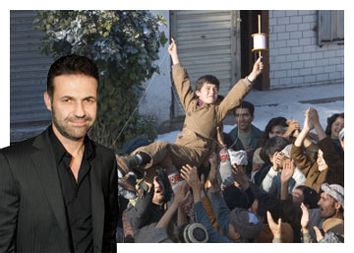
Now, as he anticipates the premiere of the movie version of “The Kite Runner,” the 42-year-old author, who no longer practices medicine and whose second novel, “A Thousand Splendid Suns,” was published in May, talks about Americans’ positive response to his book and some Afghans’ outrage at the movie, which includes a 30-second scene depicting the rape of a boy, played by a 12-year-old Afghan, Ahmad Khan Mahmidzada. (Mahmidzada’s parents said they had no knowledge of this plot point when they agreed to let their son act in the movie.) Word of the rape scene has triggered threats of violence against the three Afghan child actors who appear in the film, demands that the scene be cut, articles about Hollywood exploitation — and an ensuing P.R. disaster for Paramount, which agreed to delay the film’s release until the kids were safely out of Afghanistan. Last week, the studio announced that the children and their guardians had been relocated to an unnamed city in the United Arab Emirates, clearing the way for the film’s release this Friday.

Salon sat down with Hosseini in San Francisco in October, just before “The Kite Runner” premiered at the Mill Valley Film Festival.

To what extent was “The Kite Runner” a product of geopolitical timing? That is, just after Afghanistan and Afghans reached the headlines here and showed up on Americans’ radar, your book comes out. Did you think, “Well, now there’s finally an interest in the region” or “Now it’s a marketable story”?

The timing wasn’t intentional, but it kind of worked out that way. I really meant the book as a challenge to myself to write a novel. I had always written short stories and I’d written a short story called “Kite Runner” and I went about expanding the short story to a novel. When 9/11 happened, my wife really started talking to me about submitting a novel. I was reluctant at first, but eventually I came around to her way of looking at it, which was that this story could show a completely different side of Afghanistan. Usually stories about Afghanistan fall into “Taliban and war on terror” or “narcotics” — the same old things. But here’s a story about family life, about customs, about the drama within this household, a window into a different side of Afghanistan.

Do you think the book would have gotten the same attention if the U.S. hadn’t been in the midst of a war in Afghanistan?

It helped the novel be published, but being published and having people still embracing the book four years later are two very different things. People read the books and tell their friends to read the book because they connect with something in the story.

Americans don’t always put a human face on international news. But “The Kite Runner,” which was the third bestselling book here in 2005 and was voted 2006′s reading group book of the year, has helped demystify Afghanistan for a lot of people. Is that icing on the cake for you?

It’s a hell of an icing if that’s what it is. It’s tremendous for me. Fiction has the ability of taking the reader to a place they would have never gone before, and putting them in the shoes of characters who are radically different than they are.

One of the most common comments I get — from my Web site, e-mails or letters — typically goes something like this: “I have to be honest with you, I really didn’t know much about Afghanistan and I frankly didn’t care much, and then somebody said you have to read this book and then I kind of reluctantly agreed, and all of a sudden Afghanistan has become a real place to me and the Afghans have become real people and I see the parallels between my life here and the life of the people in this completely remote country, and now when there’s a news story about Afghanistan — be it a bombing or an attack on a village — it registers on a very personal level.” That to me, that’s wonderful.

Did you create the character of Amir as a stand-in for you?

No more than most first-time novelists who write in the first person. The setting in 1970s Kabul, the house where Amir lived, the films that he watches, of course the kite flying, the love of storytelling — all of that is from my own childhood. The story line is fictional.

What about the relationship between Amir and his servant, Hassan, a friendship that nearly transcends class lines but does not in the end. Was that based on something from your own life?

There was a Hazara man who worked for my family for a couple of years and he was much older, 38. We became pretty good friends. He helped me fly kites and I helped him learn how to read; it was a lovely relationship and he eventually went away. The really striking thing was that I finished [writing] the entire novel without once consciously thinking of him. And then when I was done I said, “Oh my God, of course that’s where this character comes from!” — which was startling to me, the powers of the subconscious.

In the story, the character of Amir spends much of his young adulthood regretting his youthful actions, his bad choices and their lifelong consequences. Are the movie’s themes of betrayal and cowardice drawn from your own experience too?

You don’t want to draw too many parallels, but if there’s a theme in the book that I have felt in real life it is having led a somewhat comfortable, privileged life amid real poverty and amid people who face a life of hardships. There’s a line in the novel and film where Amir says, “I feel like a tourist in my own country,” and I felt that way when I went back to Afghanistan [for the first time] after 27 years. There was a sense of coming home and at the same time I felt like an outsider and a tourist.

When Amir goes back to Afghanistan, after some 27 years, and rights his wrongs, the book — and now the movie — takes on a redemptive theme. Your second book, “A Thousand Splendid Suns,” for which Columbia Pictures owns the movie rights with an eye toward a 2009 release, also ends with redemption. Hollywood loves redemption. Did you envision the cinematic possibilities of an uplifting ending when you wrote the books?

I never thought “The Kite Runner” would make a good film. It felt to me that so much of the action was internal, was inside of this guy’s head, and that the meat of the book was the grappling inside Amir’s mind about his identity, the things he’s done, about who he is. It wasn’t until I read [back over] the novel a couple of more times that I saw that there was a cinematic quality about it. When I’m writing, I need to see exactly how the scene is choreographed and where characters are in relation to each other. I guess that lends itself to cinematic adaptation.

How in the world will they make “A Thousand Splendid Suns” into a film? Its depictions of cruelty to and abuse of women by their family members and the government in Afghanistan are probably even more horrific than even the most disturbing images in “The Kite Runner.”

In terms of controversy in the Afghan community, I think that book is more palatable. There are issues [addressed in the book] about women, but the issues about ethnic tension are the sensitive ones in Afghanistan. If that film is ever made, I don’t think we’ll be facing the same sort of controversy.

In the film of “The Kite Runner,” even though the rape is not explicitly shown — we only see the boy’s pants coming down — there were rumors in Afghanistan that the studio planned to use computer animation to create CGI genitals and make the scene more graphic. There have been threats against the actors. An online petition was launched to “save the ‘Kite Runner’ boys.” Had you anticipated that the rape scene would be problematic?

I thought it would raise eyebrows, but if anybody, either me or in the production, thought it would lead to the actors actually fearing for their lives, I don’t think anyone would have gone forward. Certainly, they would not have cast actors from Afghanistan. The controversy reflects that things in Afghanistan have changed to some extent, certainly in the last year or two. Things have become more violent. It’s a more dangerous place than it was. It has slid back and there’s a new element of criminality and violence there.

Would you have advocated cutting the scene to protect the children?

I don’t see how you could maintain the integrity of the film if you removed the scene. You’d pretty much have to scrap the whole thing. The scene is pivotal. Without it the story falls apart because, in many ways, that moment, the act in the alley, is so reprehensible — a simple punching wouldn’t have the same effect. It would really strain the limits of plausibility if this guy [Amir] were now marked for life [emotionally], with all the years of carrying the guilt. The scene is necessary, but I think you have to look at the film in a more panoramic way and not let one scene stand for the whole film.

I’m confused by the Afghan response. I’ve read of Afghans saying, “Rape is a taboo subject in Afghanistan, as is homosexuality” and “the culture and religion look down on those things.” Doesn’t showing the rape of a Hazara by a Pashtun reveal an underpublicized discrimination against an Afghan minority group by the dominant, majority ethnic group? Weren’t you revealing the atrocities, not condoning them?

How anybody can see this film and walk away with the conclusion that it supports rape is unfathomable to me. This is a film that denounces what happened in that alley, not one that endorses it. It brings to light some of the terrible things that have happened in that country. The scene is pivotal, but the film is not about that scene. It’s not about sexual predators.

Do you worry that the movie version of your novel, with its potential to create empathy, has been eclipsed by this controversy?

I hope this controversy hasn’t overshadowed the fact that this is a film about good things — about the virtues of tolerance, friendship, brotherhood and love and harmony — and that it speaks against violence. There’s a lovely scene in the film where Amir, in a moment of distress and personal anguish, goes to a mosque and prays. How many times have we seen Muslim characters in a film pray — in that kind of very spiritual moment, piously? Usually when they do, in the next scene they’re blowing something up. And I’m proud of the fact that Muslims around the world will see this character performing this ritual exactly in the way that it was meant to be performed.

Bud Cort

A quirky black comedy called "Harold and Maude" made him the poster boy of midnight movies. Thirty years later he said,"I've had moments where I wished I'd never done it."

  • more
    • All Share Services

Many a first date has been given an adrenaline boost as soon as each member of the dubious couple discovers that “Harold and Maude” is the other’s favorite film. More meaningful than merely cultpopular, “Harold and Maude” was a spiritual experience to many an earnest college kid who thrilled to its anti-establishment, devil-may-care spirit and its macabre sensibility, set to the tune of Cat Stevens’ glorious soundtrack.

Gloomy, ashen and nearly necrophiliac, the 20-year-old Harold Chasen, played with comic catatonia by Bud Cort, is addicted to committing suicide. Then he meets a feisty, vital septuagenarian named Maude. Under Maude’s sexualized tutelage, Harold learns to embrace life. Following her groove, Harold learns to heed Stevens’ do-your-own-thing musical creed: “If you want to sing out sing out/And if you want to be free be free/’Cause there’s a million ways to be/You know that there are.”

When the film was released in 1971, critics panned it and it promptly flopped. Eventually it found a home at college art houses and achieved a certain cult status among motley, artsy misanthropes. Ruth Gordon, who played Maude, died in 1985. Three years later the film’s director, Hal Ashby, and screenwriter, Colin Higgins, also died, the latter from AIDS. But Bud Cort, still very much alive, was one of those young stars who aged awkwardly and never really found his niche or reclaimed his fame. And a devastating car crash followed by years of physical therapy and plastic surgery further hampered the development of his career.

Now, with the 30th anniversary of “Harold and Maude” coming up, Cort is trying to convince Paramount to release a commemorative laser-disc version to go with a book he’s writing about it. Yet, with a slew of new films in the works, he is also determined to leave Harold behind.

In 1996, the Los Angeles Times called him “a generational icon a quarter-century ago, a kind of midnight movie poster boy.” While flattered to hear of his impact on young actors and fans, Cort said that “my dream is to get that reaction for new projects, for new characters.” He called his cult status both “a blessing and a curse.” He told the Times, “I was typecast to the point where I didn’t make a film for five years after “Harold and Maude.” He was offered a role in “One Flew Over the Cuckoo’s Nest,” which he rejected, explaining, “I just didn’t want to play crazy. I fought certain opportunities off because I wasn’t ready to be a brand name. In retrospect, I should have done everything.” And he says of his most famous film, “I’ve had my moments where I just cursed that movie and wished I’d never done it.”

Born Walter Edward Cox in Rye, N.Y., in 1950, Cort began his motion picture career in 1967 as an extra in “Up the Down Staircase,” which starred Sandy Dennis. He went on to study acting and do TV commercials, as well as playing a steady part in the soap opera “The Doctors.” He began performing original stand-up comedy at clubs like the Village Gate and the Bitter End in New York. He was 17 and Lily Tomlin would often drive him home late at night. He dated Elaine May’s daughter, hung out with Timothy Leary and studied with the legendary Stella Adler.

While doing stand-up at Upstairs at the Downstairs, he was discovered by Robert Altman and cast as Pvt. Boone in the 1970 smash “M*A*S*H.” Next, Altman cast Cort in the title role of the black comedy/fantasy “Brewster McCloud,” about an owlish egghead who dreams of flying through the Houston Astrodome. Having proven that he could do quirky and black, Cort was then cast as an angelic ghoul, a troubled rich kid, in “Harold and Maude.”

The movie started out as a half-hour master’s thesis when then-31-year old Colin Higgins was attending UCLA. But it would develop into a substantive film of surprising philosophical and political scope. Wiser than merely an eccentric dark comedy that kindles rebellious, daisy-tossing joie de vivre, the movie is also an impeccably subtle (actually unspoken) exploration of the legacy of the Holocaust. In one succinct shot, the camera focuses on Maude’s tattoo keepsake from World War II — a fleeting and unequivocal clue to her grab-life-by-the-balls personality.

Unfortunately, the critics never got it. Nor were they amused, and the film flopped at the box office and closed quickly. In the New York Times, Vincent Canby grumped, “You might well want to miss Hal Ashby’s ‘Harold and Maude.’” Variety called it a “tasteless offbeat comedy [that] has all the fun and gaiety of a burning orphanage.” Meanwhile, Film Quarterly wrote that the film is “one of the best movies to come out of Hollywood in years. It is a love story, a sentimental black comedy, a ludicrous tear-jerker, a grisly social satire.”

Eventually, “Harold and Maude” would play for two years in Paris, where Cort won a Crystal Star (the French equivalent of the Academy Award.) In college towns and art houses, the film found a devoted audience among disaffected youth. While the wild ones would watch “The Rocky Horror Picture Show” ad infinitum, the sensitive ones watched “Harold and Maude” again and again. One zealot claims to have seen it 201 times. “Harolding” became part of the teen lexicon: A term morose mopes coined to describe their penchant for cemetery-dwelling. Eventually, after 12 years, the film turned a profit. Meanwhile, Cort braved his cult status, with fervent fans leaving tombstones and pictures of dead babies’ graves at his door.

Wary of being typecast, he turned his attention toward the theater, making his Broadway debut in Simon Grey’s “Wise Child.” He also did Chekhov, Ionesco and Beckett. Most recently he garnered accolades as a disillusioned circus clown in “He Who Gets Slapped,” an adaptation of Russian playwright Leonid Andreyev’s tragicomedy.

In 1979, Cort was involved in a terrible car accident on the Hollywood Freeway on his way back from a Frank Sinatra concert. He broke an arm and a leg and sustained a concussion and a fractured skull. His face was severely lacerated, his lower lip cut and hanging by a thread. In 1984, he told People magazine, “When I got up the nerve to look at myself in a mirror for the first time, I screamed. I looked like a monster, with my forehead, face and lip all sewn up. I wanted to die.” Cort underwent three operations for plastic surgery and remains unsatisfied with the result. “I try not to look in mirrors,” he said.

At the time, Cort had a part lined up in a Robby Benson movie, “Die Laughing.” He expected to be fired but instead, producer Jon Peters said, “Well, you’re playing the villain anyway. Think about how good it will be for the character.” Later, Leonard Maltin wrote, “Cort is disgustingly oily as a fascist villain.”

Cort spent all of his savings on medical bills and went on to lose a $10 million suit he had brought against the driver of the other car. He found himself broke and without work. While he receives annual residual checks from Paramount for “Harold and Maude,” (the last one was for $28.77 ), he doesn’t get any profit from video distribution. “I get no participation from video sales — I’d be a millionaire if I did,” Cort has said. “I made next to nothing from that movie.”

In the past 20 years, Cort has made 30 forgettable films, including playing the role of Norman Bates’ creepy proxy in the TV flick “The Bates Motel.” After the accident, he’d stopped being choosy and uninterested in weirdo roles. His disfigurement motivated him to go into radio, where he did a bit of voice work, including a successfully syndicated reading of “The Catcher in the Rye.”

In 1991, he made his debut as a director with “Ted & Venus” a low-budget romance about a crazed poet on Venice Beach that he also wrote and starred in. While the film’s producer called the movie the “spiritual sequel” of “Harold and Maude,” the critics were not moved. The L.A. Times wrote, “Bud Cort was as appealing in the milestone comedy (‘Harold and Maude’) as he is repellent in this film.” Variety’s Todd McCarthy called it “a highly unpleasant yarn about a lovelorn sickie who endlessly torments a beautiful young woman.” The film — with cameos by Woody Harrelson, Gena Rowlands, Andrea Martin, Timothy Leary, Carol Kane and Martin Mull, went straight to video.

In the coming year, Cort will appear in four or five films, some of which already have pretty good street cred. He has a role in the highly controversial, much anticipated “Dogma,” Kevin Smith’s religious satire starring Ben Affleck and Matt Damon, with Alanis Morissette as God. And he will portray the strait-laced dad of Natasha Lyonne’s high school cheerleader in “But I’m a Cheerleader.” In the film, the girl is sent by her parents to rehab camp when it’s suspected that she’s a lesbian. He will also appear in Dwight Yoakam’s western “South of Heaven, West of Hell,” starring Vince Vaughn, Billy Bob Thornton and Paul Rubens. Further, Cort will be seen in Ed Harris’ bio-pic about Jackson Pollack and the Bono-scripted “Million Dollar Hotel,” about a murder at a skid-row hotel.

Cort may ultimately crack his typecast. Indeed, a new generation of kids is growing up that has never heard of “Harold and Maude.” But for many a poetic soul, “Harold and Maude” is bound to stay around forever. As Colin Higgins once explained, “We’re all Harold, and we all want to be Maude. We’re all repressed and trying to be free, to be ourselves, to be vitally interested in living, to be everything we want.”

Continue Reading Close

Movie Interview: “I wanted to make a beautiful movie”

"Life Is Beautiful" director Roberto Benigni talks about the Holocaust, Charlie Chaplin and how he was haunted by the idea of a happy man in a Nazi concentration camp.

  • more
    • All Share Services

Greek filmmaker Theo Angelopoulos may have taken home the Palme d’Or from Cannes last spring for his drama “Eternity and a Day,” but it was Italian comic Roberto Benigni who stole hearts and headlines with “Life Is Beautiful.” An unlikely comedy about a father’s struggle to protect his son from the horrors of the Holocaust, “Life Is Beautiful” swept the Italian version of the Oscars as well, winning eight out of 15 David di Donatello Awards — three of which went to Benigni himself for best film, best director and best actor.

Though Benigni had already challenged people’s notion of what is acceptable comic subject matter by making “The Monster” (1994), a comedy about female dismemberment, “Life Is Beautiful” has created a much greater controversy. During the press conference at Cannes, one French journalist stood up to accuse Benigni of mocking the victims of the Holocaust, declaring that he was “scandalized” by the picture. A reporter from the International Herald Tribune vocalized that she “loathed this film,” and the London Guardian wrote that it is “a hopelessly inadequate memorial to the vile events of the Holocaust.” And yet, in July, Israel honored Benigni, inviting him to screen the film at the Jerusalem Film Festival, where Jerusalem’s mayor awarded Benigni with a special commendation for “furthering the universal understanding of Jewish history.”

“Life Is Beautiful” is not, insists Benigni, a comedy about the Holocaust; it’s a movie by a comedian about the Holocaust. The character he plays might horse around, but the Holocaust is never trivialized. “There’s been some people, not a lot, but some people who felt in a very, very strong way, like I touched something untouchable,” Benigni says. “The last thing I wanted was to hurt somebody or be offensive with the memory of the Holocaust, because I started from the opposite idea, of course. I wanted to make a beautiful movie, and especially to say something poetic.”

Uncertain of what the public reaction might be, Benigni was initially frightened by his concept for the film, and he resisted it for years. “I loved immediately the idea, but I was scared, and I tried to write something different. But I could not stop thinking about this idea — a happy man in a concentration camp.”

In the film, Benigni plays the ebullient, eccentric Guido, a goofball waiter in a small town in Tuscany who falls in love with a pretty schoolteacher, Dora (played by Benigni’s wife, Nicoletta Braschi). For a time, the couple live in blissful ignorance of the growing strife in Europe and the new Fascist laws in Europe, even though Guido is Jewish. When their 5-year-old son, Giosué (Giorgio Cantarini), asks why Jews and dogs aren’t allowed into a pastry shop, Guido shields him from the truth, explaining that people can make whatever rules they want. He tells his son that one hardware store in town doesn’t let in Spaniards or horses. And when, on Giosué’s birthday, they are seized by soldiers along with other Jews and instructed to board a train, Guido tells Giosué that it is all part of his birthday surprise. “Let me on that train!” he insists. “We have reservations!”

When they are brought to a concentration camp, Guido tells Giosué that it’s a game, and the goal is to be the first to amass 1,000 points. When the boy becomes increasingly unsettled, Guido warns him, “There are three cases in which you lose all your points. One: Those who cry. Two: Those who want to see their mama. Three: Those who are hungry and want a snack. Forget about it!” Humor for its own sake is never Benigni’s goal here; it is his character’s sole survival strategy. Guido’s shenanigans are acts of resistance, and they are more touching than tickling. Guido’s attempts at merriment are acts of self-sacrifice, each intended to protect his son.

Neither Jewish nor a father, it wasn’t until the project was well under way that Benigni realized the idea was inspired by his own father’s stories about the war. A soldier in the Italian army during World War II, Benigni’s father had been taken prisoner and deported to a work camp in Germany.

“My mother, my sisters and me, a lot of time we laughed because of the way my father was telling the story. He would tell us the story in a very funny way,” he recalls. “Like in my movie, my father was telling us like it was a fable. He was afraid to make us fearful. He was protecting us, like I am protecting the son in the movie, because this is the first instinct — to protect the son.”

Benigni had long since forgotten his father’s stories, but they came back to him as he began working on the screenplay with Vincenzo Cerami. “In my mind, each day my father’s story and face came to me, and this was really moving me. I was thinking maybe my father suggested to me this movie.”

Much like Guido, Benigni’s father never understood why he was imprisoned. “He didn’t know why the German people were so mean with him. He couldn’t understand,” he recalls. “When they capture [Guido], everybody’s asking, ‘Why?’ Guido is like a lot of Jews in Italy. They did not know they were Jewish before Fascists decided to capture them.”

Though he did consult with Milan’s Italian Jewish Committee, Benigni insists that the film does not purport to be an accurate account of the Holocaust. “I am a director, not a historian, and my duty is to invent stories,” he says. “So I invented this completely. It’s a fable, but invented from the truth.”

Except for one haunting scene where, looking through a bank of fog, Guido glimpses a mound of remains, there are deliberately few reminders of the horrors of the concentration camps. “I never show [them], because we know,” Benigni says. “It’s enough to show a little sign. The less I show, the more you can imagine.”

While Benigni says that he is the first comedian to make a film about the Holocaust, he’s well aware that Charlie Chaplin preceded him by more than 50 years with his 1940 spoof on Adolf Hitler, “The Great Dictator.” In fact, the number on Guido’s prison uniform in “Life Is Beautiful” — 0737 — is a nod to Chaplin, who wore the same number in “The Great Dictator.” “Charlie Chaplin has influenced everything I’ve ever done. Just everything,” Benigni says. “[He] is the prince of each comedian in the world. Chaplin is like our Michelangelo.”

Just like young Giosué, who, in his narration, speaks of the gift that his father gave him, Benigni speaks of the film as “a gift from heaven.”

“Whether people feel that this is a film that should or should not have been made,” he says, “at that moment of my life, this was the only thing I could make. And if I could come back, I would remake this movie. It’s the thing that I love most in my life. It’s the best thing I can produce.”

Continue Reading Close