As the situation in Israel and the occupied territories descends into ever deeper circles of hell, some Israelis can cling to the threadbare satisfaction of knowing that they predicted it. For many liberals here, the collapse of the Oslo peace process, the smashing of the Palestinian Authority, the rise of terrorist attacks and the total militarization of the conflict were all preordained when Ariel Sharon was elected prime minister 15 months ago.
For months, increasing violence has threatened to explode in Israel and the territories. In late March, it finally did. For the last three weeks Israel has been engaged in the largest military operation in the West Bank since the 1967 Six-Day War. After the “Seder massacre,” a suicide bombing in the seaside city of Netanya that killed 29 Israelis, Sharon launched a furious offensive against the Palestinians. Tanks and armored cars smashed into a half-dozen West Bank cities, with helicopter gunships hovering overhead, pounding into submission densely inhabited Palestinian neighborhoods, including the historic casbah in the biblical city of Nablus. Thousands of Israeli reservists have been called up to man the guns, and the word “war” is used more and more often as a matter of course to describe the campaign’s staggering death toll and reach.
The heart of the devastation is at the Jenin refugee camp, where the number of dead buried beneath tons of rubble is unknown and a bitter and momentous controversy about what happened there is raging. Palestinians charge that a massacre took place, with hundreds killed; the Israelis deny their army did anything wrong and put the number of Palestinian dead in the dozens. Human rights groups and British and European officials, fearing that atrocities took place in Jenin (from which journalists were banned until a few days ago), have called for an international investigation. Chris Patten, external relations commissioner for the European Union, warned that if Israel did not accept a U.N. investigation, its reputation would suffer “colossal damage.”
Blasted Jenin is quiet now, but the Israeli army and Palestinian gunmen are still engaged in two tense standoffs, one in Bethlehem around the Church of the Nativity, the other in Ramallah at Palestinian leader Yasser Arafat’s West Bank headquarters, where Israelis charge that those responsible for the assassination of an Israeli cabinet minister are holed up. And Israeli soldiers are still arresting and processing hundreds of fighting-age Palestinian men — including on Monday afternoon Marwan Barghouti, the West Bank head of the Fatah political party affiliated with Arafat, a big fish Israel says is responsible for ordering terrorist attacks on Israelis. The fighting in the occupied territories has largely subsided, though shooting flared up again Wednesday at the Church of the Nativity.
The intensifying crisis led the Bush administration to belatedly get involved, sending Secretary of State Colin Powell to the region. But as many predicted, Powell departed the region Wednesday with almost nothing to show for his trip. Israeli Prime Minister Ariel Sharon continues to bluntly rebuff vacillating U.S. calls for an end to the invasion, while Palestinian leader Yasser Arafat, who has been confined to his devastated headquarters in Ramallah for weeks, refused to call for a cease-fire until Israeli forces withdraw from the occupied territories. A final meeting between Powell and Arafat on Wednesday produced no breakthrough; indeed, after Powell left, angry Palestinians asserted that his intervention had achieved nothing. Chief Palestinian negotiator Saab Erekat said, “The situation on the ground is that Secretary Powell leaves the situation much worse than he came.”
As the world waits for the next development — which painful experience indicates will probably be a dreadful one — a question arises. How did the Israeli-Palestinian situation deteriorate so far so fast? How did the so-called Al-Aqsa Intifada, which began after Ariel Sharon, accompanied by hundreds of policemen, made a controversial visit to set foot on the esplanade of the most contested holy real estate in the world in September 2000, move from riotous stone-throwing to full-fledged war?
The violence had an escalatory dynamic from the start: Israeli police brutality and the rage following the first Palestinian funerals produced increasingly violent riots. Palestinian gunmen and Israeli soldiers traded bullets. Israel’s policy of knocking off wanted Palestinian militants (and innocent bystanders) angered Palestinians who vowed revenge. And Palestinian terrorist attacks on Israeli civilians whetted Israel’s appetite for drastic military action. These are the “cycles of violence” that diplomats have urged, over and over again, both parties to break.
But for left-wing Israelis who campaigned against Sharon’s election as prime minister in February 2001, the terrible events of the last year have come as no surprise. In fact, they predicted them with uncanny accuracy — and lay responsibility for them directly at the feet of Ariel Sharon.
The left-leaning Ha’aretz, Israel’s most prestigious newspaper, reminded its readers last week of the advertisement run by Labor on television 15 months ago. The clip, which predicted in graphic detail what would happen if Sharon were elected, forecast the reinvasion of Palestinian territories, hundreds of deaths, the deterioration of Israel’s relations with Jordan and Egypt and a massive call-up of reservists. In a publicity gimmick that was much criticized at the time, mock call-up cards were also sent to reservists to stress the danger inherent in choosing Sharon, a man known for his ruthlessness and checkered military past, as leader of the Jewish nation. The admen “should be congratulated on their prescience,” wrote Aviv Lavie in Ha’aretz.
“From day one, Sharon’s main decision was to ruin the Oslo peace process and destroy the Palestinian Authority,” says Ron Pundak, one of the early architects of the Oslo accords, now director of the Peres Center for Peace in Tel Aviv. “It was just a question of timing and a matter of how tactfully and skillfully to create an environment most conducive to reducing U.S. pressure and domestic opposition to his plan. It took him a year until he reached this moment and unfortunately Arafat played into his hands.”
Ha’aretz commentator Doron Rosenblum predicted the current crisis two and a half months ago. In a savage column titled “The State Rejoices, the Nation Bleeds,” Rosenblum wrote, “[T]he inevitable and the obvious happened quite quickly: The mask of the restrained grandfather dropped. Sharon is Sharon is Sharon — escalation, provocation, complication and all. Even as prime minister, he has turned out to be a ‘one-trick pony,’ obsessively repeating the exercise of encircling, tightening and siege remembered from the days of the Second Army in Sinai, through Beirut and on to Ramallah … The suspicion arises that even the Lebanon War will turn into an aperitif to the dish Sharon is now boiling up in the territories in a huge pressure-cooker. By closing off all the openings for negotiations, sealing the lid on his personal foe and raising the temperature of the motives of hatred and revenge, it seems that he is consciously cooking up some big explosion.”
During the election campaign Sharon himself was candid about his tough intentions. He promised “peace through security,” not the other way around. And ever since the Oslo accords were signed in 1993, Sharon had harshly criticized, in opinion pieces and Knesset speeches, the land-for-peace negotiation process. This was not surprising, since Sharon’s entire career has been defined by battling the Palestinians and other Arabs militarily, on the one hand, and masterminding the building of settlements in the West Bank and Gaza to create “facts on the ground” that would make it impossible for Israel ever to give back the territories it occupied after the 1967 war, on the other.
Like other Israeli politicians, he toned down the virulence of his criticism after Prime Minister Yitzhak Rabin, the accords’ signatory, was assassinated by a rabidly pro-settlement and religious Israeli who believed that Rabin had betrayed the Jewish people. But in a well-publicized interview with Kfar Chabad, a religious weekly, last January, Sharon declared: “The Oslo agreement no longer exists. Full stop.” He said he would never give up a single Jewish settlement in the West Bank and Gaza nor divide Jerusalem. When pressed by other journalists to define his vision of a Palestinian state, he described an entity with no control over its borders, cut up by security roads, ruling over at most 45 percent of the occupied territories — in short, the status quo, preserved indefinitely through “long-term interim agreements” and elusive promises.
The Palestinian response to Sharon’s hard-line positions was equally clear at the time of his election. “What [Sharon] has proposed means that it is impossible to reach an agreement,” Saeb Erakat told the New York Times. “The result is a description of war.”
So when Sharon was elected in a landslide last February, did Israelis expect war? “Many did,” says Yaron Ezrahi, a political analyst at the Israel Democracy Institute, a Jerusalem think tank. “There was a mood after the collapse of [talks at] Camp David, that if the diplomatic general [Ehud] Barak [then Israel's prime minister] had come home empty-handed and Arafat had sent us his armed people, we needed to send them the neighborhood gangster [Sharon] and use force against force.”
There were other signs that the conflict would escalate under Sharon. Operation “Defensive Shield,” as the current campaign is known, was triggered by the deadly suicide bombing in Netanya on the first night of Passover. But the option of reinvading the West Bank and/or Gaza had been discussed as a contingency plan by politicians, pundits and generals months before. Similar operations, on a smaller scale, had been launched repeatedly over the past year: Tanks moved into Palestinian cities after the murder of the Israeli Tourism Minister Rechavam Zeevi last October, for example, and soldiers practiced urban warfare against the Balata refugee camp at the beginning of March. Those were clearly dress rehearsals for the big operation Sharon had been planning all along, says Pundak.
That Sharon’s true intention was not simply to put an end to the suicide bombings that have been crippling Israeli life but to smash everything that might make up a Palestinian state is shown by the type of people and buildings the army has targeted in the current campaign, says Pundak. “At the same time as the army is fighting the so-called terrorist infrastructure, it is ruining the Palestinian Authority, breaking in offices, destroying records and dismantling police forces.” The population registry, for example, no longer exists. While Israel pounds what remains of a crippled, ineffectual Palestinian administration, Sharon has allowed “the leadership of Hamas and Islamic Jihad [who oppose all peace agreements with Israel] to go on living happily in Gaza,” says Pundak. Ironically Sheikh Yassin, the spiritual leader of Hamas, the organization behind the most lethal terrorist attacks, hasn’t been disturbed, he says — “not even his afternoon nap.”
Other Israeli analysts, however, caution against charging Sharon with “premeditated war.” Nahum Barnea, a political columnist for Israel’s highest-circulation newspaper, Yedioth Ahronoth, says Sharon has “master instincts,” not a “master plan.” “Saying it looks like a plan is a way of relieving the burden of responsibility on Arafat, but it’s not right,” says Barnea. “From day one foreign journalists have portrayed Sharon as a very strong person. He is not. When he became prime minister, he was torn between contradictory agendas, caught in the political and military situation. It’s not easy being prime minister of Israel and go to sleep only to be woken up four times at night by news of bombs or soldiers being killed.”
Other analysts argue that Sharon did not necessarily set out to roll back the concessions made since Oslo. “There’s no question in my mind that when Sharon went to the Temple Mount he intended to derail Oslo,” says Hirsch Goodman, senior research associate at Tel Aviv University’s Jaffee Center for Strategic Studies. “Sharon saw a prime minister of Israel [Barak] ready to give back 97 percent [the actual percentage of land offered by Barak is in dispute] of the West Bank and Gaza and to divide Jerusalem and he thought he had to stop it.” But Goodman adds: “His intention was to stop Oslo where it was but not to destroy it. He was ready to have a Palestinian state declared without borders and to negotiate long-term interim agreements.”
Pundak disputes that, painting the picture of a man who would never accept a peaceful compromise on the basis of Oslo. “[Sharon] thinks Palestinians don’t deserve more than limited self-rule. He doesn’t trust Palestinians and thinks we’re engaged in a conflict that will last another hundred years. His thinking, shaped by his experience as a general and the climate of the 1960s, is that a Palestinian state would be a bridge to other outside Arab forces [like Iraq] who would use it to destroy Israel. He thinks it’s a lousy arrangement to help them with a peace process.”
In any event, “Oslo as a process was already dead after Camp David,” notes Barnea. After putting major issues like the status of Jerusalem holy places, the fate of refugees and the shape of final borders on the negotiating table, there was no going back to the incremental land-for-peace process begun at Oslo. And then there was the second intifada, in which Arafat has embraced violence. “Sharon didn’t have to send soldiers in Jenin to shoot it,” says Barnea of the Oslo diplomatic process. “He only had to bury it.”
That doesn’t mean the yearlong slide toward war was entirely involuntary. “Nothing is involuntary,” says Barnea. “Arafat and Sharon have both accomplished their basic agendas.”
According to him, “Arafat wanted to have a grand finale and not to finalize the diplomatic process. He wanted a final act involving lots of violence and he got it. It was a question of historical legacy but also because he believes he has no chance to get what he wants with a signed agreement. He sees a signed agreement as only one way of achieving his goal. When he committed himself not to use violence at Oslo, he did not mean it. That is what has offended Israel most — the notion that he resorted so easily to violence after the failure of Camp David.”
“In Sharon’s case, his agenda goes back much earlier than Oslo. Every Israeli leader has a certain amount of suspicion for signed agreements with Arabs, but Sharon takes that suspicion to the extreme,” says Barnea, who’s been observing Israeli politics up close for years. “He has a problem with having an agreement with Arafat.”
“I remember a trip in Washington in the spring of 2001,” says Barnea. “It was late at night and I asked him, to distract him, what he thought about bin Laden. This was before Sept. 11. He looked at me with surprise, as if wondering why I wasn’t asking him about Bush and Arafat, and said, ‘Arafat is bin Laden.’ I got a quote but I think it also reflects his way of thinking. His idea of Arafat was crystallized in 1982 in Beirut and he’s never changed it.” (In 1982 Sharon, using the attempted assassination of an Israeli diplomat by a dissident Palestinian faction as a pretext, launched a full-scale invasion of Lebanon with the intention of smashing the PLO and setting up Lebanon as an Israeli client. Arafat and his troops, trapped in Beirut, were forced to flee Lebanon for Tunis. Sharon recently said he regretted not giving an Israeli sniper an order to kill Arafat as he boarded the ship.) To this date, Sharon has always refused to shake the Palestinian leader’s hand — even at the Wye River Plantation where he joined then-Prime Minister Binyamin Netanyahu and Arafat for intensive talks in a secluded setting.
Then there is the question of settlements. The Jewish implantations in the West Bank and Gaza are Sharon’s brainchild and legacy, a project he has overseen in every ministerial role he has held over the decades. “When he was elected people said that now that Sharon is old, he will put the safety of his children and grandchildren before the settlement enterprise, but they’re wrong,” says Barnea. “His real grandchildren are the settlements, the ones built in the middle of Palestinian population. It would be very difficult for him to evacuate them. For him Israel has to be in Paradise, living in a state of utopia, in order to give up one settlement.”
Critics have accused Sharon of deliberately scuttling chances for a cease-fire in the past year by approving provocative military actions — in particular the so-called targeted assassinations — at times when Palestinian guns were quiet. Sharon’s ultimate goal, they charge, is to buy time and avoid reaching the phase of painful political concessions that would require freezing construction of new housing in the territories and, eventually, dismantling his life’s work by giving Palestinians control over most of the West Bank and Gaza.
Political analyst Ezrahi argues that Sharon planted the seeds of the current war simply by promoting settlement-building on conquered land. “It was terribly short-sighted and unsophisticated. Anyone who knew anything about national liberation movements knew that [settling territories conquered in 1967] would be untenable and could only end in bloodshed. Sharon was driven by narrow conceptions of history and Darwinian perceptions of the relationship between Israelis and Palestinians.”
But if the settlement enterprise was “the worst act taken by Jews against themselves since 1948,” Ezrahi stresses that Palestinians have also made a fatal historical mistake by resorting to terror: “Terrorism has profoundly infected the Palestinian movement,” he says. “It wakes up terrible memories of the Holocaust. It was the worst possible way of forcing us [Israelis] to compromise.”
The general consensus among analysts, however, is that Sharon is following his instincts and doesn’t have a long-term plan for what Israel and its relationship with the Palestinians should be. “I don’t know what his vision is. He’s a brilliant tactician but not a very good strategist,” says Goodman — who makes clear that he also believes Arafat planned all along to use Oslo as a Trojan horse that would lead to the destruction of Israel. Moreover, Sharon is not an ideologue about the settlements, he says — distinguishing him from the ultranationalist and religious parties and individuals that believe that “Judea and Samaria” were given by God to Israel. “He’s primarily concerned with security-oriented issues and he thinks settlements are key to Israel’s security.”
“It would be an error to take the positions he voiced as a member of the opposition and to project them to understand Sharon’s present behavior,” says Ezrahi. “These positions were meant to galvanize his constituency. Of course, what he does now is not entirely apolitical. He does it with the intention to crush Netanyahu who has been calling for more action [against Palestinian militants]. Netanyahu is the silent partner, the Iago in this play, inciting Sharon’s Othello to go further.”
Explaining Sharon’s “master instincts” and his failure to have a coherent endgame strategy, Barnea says, “Sharon has principles that are the product of his childhood, of his time in the army and the issues he faces on the political scene. At the same time he has to think about the survival of Israel, his coalition … All master plans melt in the Israeli sun. Israeli politics are so intensive and constantly changing, that it’s very difficult to implement a plan.”
“If there are no results to the military offensive, the [Israeli] public can easily turn left and not right,” says Barnea. “The Israeli center is zigzagging. You see it in the polls. There is overwhelming support for both military action and wide political concessions. There is no contradiction here. Israelis hate to be impotent and solutionless.”
The question, then, is whether after a year and a half of escalating violence there will be a reasonable Palestinian partner to talk to. “Without a different Palestinian voice and a different Palestinian vocabulary [from the current rhetoric of hatred and intransigence], it will be very difficult to convince Israelis who see that Sharon’s way has failed to vote for an alternative,” says Pundak, who spent many hours with members of the Palestinian Liberation Organization (then an illegal terrorist entity) secretly plotting the Oslo breakthrough. “The track record of Palestinians is bad. They have a history of doing the wrong thing at the wrong moment,” he says. “But there are still pragmatists among them and we can still make a deal.”
Pundak mentions Marwan Barghouti as an example of a Palestinian pragmatist who would embrace a deal along clear political guidelines. An hour later, Israeli television killed that hope, reporting that the Israeli army had just seized Barghouti, once an outspokenly pro-peace politician who had many meetings with Israeli doves. Israeli officials charged that Barghouti was responsible for turning the Tanzim civil guard, part of Arafat’s mainstream Fatah movement, into a militia that carried out suicide bombings against Israelis. Israeli security officials and politicians were divided about the wisdom of arresting the highly popular West Bank leader. Politicians on the right called for a public trial and Barghouti’s execution, those on the left called for his release. Centrists defended his arrest, but warned that it would lead to bloody reprisals or kidnappings.
Ezrahi joins an increasing number of observers who believe that Sharon and Arafat, two old warriors who cannot change their ways, stand in the way of peace. “It’s a tragic conflict fed by unforgivable misconceptions on both sides. Sharon and Arafat are like Siamese twins. There can be no victory of one against the other because of our territorial and demographic proximity. But the real big losers in this war are the Israeli and Palestinian people.”
When 25 North Korean refugees stormed into the Spanish embassy in Beijing last Thursday in a desperate bid for freedom, human rights activists knew that for the feat to be successful, it had to be shown around the world.
So several journalists were tipped off in advance and took positions behind trees on the sidewalk opposite the embassy. The North Koreans, refugees living in China, dressed up to look like tourists, wearing red and black “Beijing” baseball caps. And when they ran through the open gate of the Spanish embassy past stunned Chinese guards, their fate was sealed: CNN captured the dash and broadcast it worldwide. China, which normally deports North Korean defectors under a repatriation treaty with the North Korean government in Pyongyang, allowed the group to go through this time for “humanitarian reasons.” Monday, the refugees arrived safely in Seoul, South Korea.
According to Norbert Vollertsen, the German physician and human rights activist who orchestrated last week’s coup, it likely wouldn’t have happened without intense media coverage. “The embassy scene was played over and over again on CNN and on the Internet,” said Vollertsen. “When you create a big noise, then China can’t do a thing. It doesn’t want to be blamed in front of the whole world. A big noise will secure refugees.”
“The problem,” Vollertsen said, “is when there is only a small noise.”
Human rights activists now hope last week’s event created a big enough noise to inspire hundreds more to defect, and to eventually lead to the collapse of the Stalinist regime in Pyongyang in a scenario reminiscent of the fall of the Berlin Wall and German reunification. Vollertsen sees much in the comparison. “First there were dozens, then hundreds and eventually thousands of refugees piled into the West German embassy in Prague,” he recalled. “The Czech guards tried to arrest them but there were too many. A train was arranged to take them to West Germany. The Hungarian border was opened and a new flood started.”
He points out that the elite in Pyongyang do get CNN. “Some are not stupid and remember history,” he says. “They would rather have a smooth ending like in East Germany rather than a bloody outcome like in Ceaucescu’s Romania.” And the potential for violent dissent is already strong; Vollertsen witnessed scenes of riotous anger in North Korea when he worked there between July 1999 and December 2000.
The coalition of South Korean, Japanese and Western human rights organizations that masterminded the assault on the Spanish embassy had initially targeted the German embassy to impress world opinion with the historical parallel, he said. In the end, the organizers chose the Spanish embassy because they thought several members of the North Korean group were too weak to scale even a short, unguarded wall at the southern corner of the German compound. In addition, security at the Spanish embassy was known to be lax on Thursdays.
Just as the choice of embassy was the result of much thought and deliberation, human rights activists took special care to select street-savvy, hardened and determined North Korean refugees for the special operation. The six families and two orphan teenage girls who made the memorable run had been living in China long enough to know how to use cellphones and computers, sit through traffic without panicking and move inconspicuously, said Vollertsen. “They were quite sophisticated. The action could never have been mounted with refugees fresh from Pyongyang,” he said.
Anywhere between 100,000 and 300,000 North Koreans live illegally in China. Figures are fuzzy because China has systematically barred the United Nations High Commissioner for Refugees from conducting a population survey in the provinces close to North Korea. Every year the Chinese government sends thousands home under the repatriation treaty signed with North Korea in 1961. Although China has signed international conventions on refugees, it does not see North Koreans as political asylum-seekers but rather as illegal economic migrants lured by China’s relative prosperity.
And forays into China became increasingly common during and after the 1997 famine when North Koreans left their villages in search of food. Analysts believe China’s relative economic development and wealth of consumer goods opened the eyes of North Koreans to the backwardness of their own country — just as trips to Europe and exposure to Western movies shook the confidence of people living in Communist Europe in the 1980s.
But until now, China has not been a very comfortable alternative to North Korea. Vollertsen said defectors live in constant fear of being deported, change their living quarters frequently and are wary of contacts with other North Koreans, who could turn out to be spies. When defectors are repatriated by Chinese police they are usually sent to overcrowded and squalid North Korean detention centers, forced into backbreaking labor and sometimes, Vollertsen says, even executed — particularly if North Korean authorities have evidence that defectors came into contact with South Korean or Christian missionary networks who helped them along their way.
Occasionally a defector manages to walk south of the demarcation line directly to South Korea. But that is not really an option because the border is closely guarded, and the demilitarized zone that separates the two countries is laden with land mines. The Tumen River, which separates North Korea from China, is easier to cross, especially in the winter when it is frozen. From there, North Koreans often work their way through China, helped by a Christian underground, and try to cross to a third country (Mongolia, Thailand) where they can come out of hiding and apply for political asylum.
Most of last week’s defectors previously had been caught, repatriated and persecuted. Determined to die rather than be sent home again to face punishment and hunger, the refugees announced in a statement released by human rights volunteers: “We are determined to go to South Korea for life and freedom and are ready to commit suicide in the event or arrest by the Chinese police again.”
Chinese authorities first announced that it would treat the refugees as illegal migrants — which meant that they could be deported back to North Korea — but backed down the next day. Beijing said it had decided not to deport them to North Korea for humanitarian reasons, but stopped short of recognizing that the North Koreans were legitimate refugees. To avoid offending North Korea, China first flew the group to the Philippines and, only a few days later, to Seoul. Still, the rapid change of heart was impressive.
“China had an opportunity to prove it is not just a member of the WTO, with Gucci and Prada shops, but that it also behaves like a responsible country when it comes to human rights,” said Vollertsen. Faced with a choice between supporting its bankrupt, totalitarian neighbor or earning brownie points in world opinion, Beijing chose the latter.
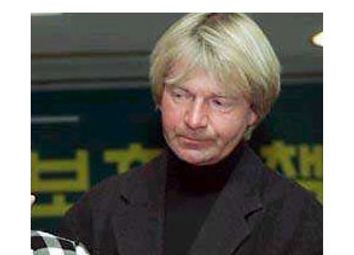
Vollertsen, who is 44 but looks like a college student with his mop of messy blond hair, has always been in favor of solving problems through direct and theatrical approaches. A self-avowed troublemaker, Vollertsen once faked his own suicide on German television in protest against medical practices in Germany. Working for German Emergency Doctors in North Korea, a group trying to improve hospital conditions there, Vollertsen became famous for joining a line of medical staff donating some of their own skin to a burn victim. When the Great Leader Kim Jong Il (son of the regime’s founder and cult figure Kim Il Sung) heard about the foreigner’s gesture, he awarded Vollertsen the regime’s first Friendship Medal.
Riding the wave of publicity, Vollertsen was treated as a national hero even in remote villages and welcomed into elite circles and formerly forbidden territory. He discovered the differences between the lifestyle of the elite in Pyongyang and the rest of the country, which is still reeling from chronic malnutrition, energy shortages and the collapse of trade and subsidies following the end of communism. He saw starving children with bloated stomachs and blank faces, primitive medical facilities, orphanages that look like prison camps and the bloodied body of a soldier, apparently tortured to death, on the side of the road.
Rather than keep his mouth shut and enjoy his relative freedom, Vollertsen spoke out whenever he could and took American journalists on an unauthorized tour of Pyongyang during then-Secretary of State Madeleine Albright’s October 2000 visit. After a rocky 18-month stay, he was eventually kicked out.
Now in South Korea, Vollertsen scorns the timidity of foreign diplomats in Pyongyang. “Sometimes they must act diplomatically and appease Pyongyang but they are too diplomatic, they don’t know their own power. They get used to the comfortable life and end up enjoying the same privileges as the elite in Pyongyang.”
Last week’s brazen action also put the South Korean government in a tough position. Under current President Kim Dae Jung, South Korea adopted the so-called sunshine policy of rapprochement with its well-armed northern neighbor. (Kim won the Nobel Peace Prize in 2000 for his groundbreaking visit to Pyongyang the same year.) The idea is to engage North Korea economically and diplomatically first and focus on human-rights abuses later. Reunification, under the guise of a loose confederation, is only a distant goal for Seoul as many South Koreans fear the cost of absorbing millions of impoverished northerners.
A sudden flood of North Korean defectors to the South would put a huge strain on the gradual improvement of the two countries’ relations. But the results of Kim’s sunshine policy have been disappointing so far; Kim’s presidency is about to end and events may already be forcing Seoul to change its cautious attitude toward defectors.
On Monday the South Korean government announced it would invest $5 million to renovate and expand the transit center where defectors are given security checks and tips on how to survive in a capitalist society. It also announced that the newly arrived families would receive financial assistance on par with the $28,000 past defectors have received. Close to 2,000 North Korean refugees now live in South Korea, and the number of people who arrive each year is growing fast: In the early ’90s, only a few dozen came to Seoul; last year there were 583; about 1,000 are expected this year.
According to a recent Los Angeles Times report, 28 percent are unemployed and their adaptation to life in the South is problematic. While the income gap between East and West Germany before reunification was 1 to 3, North Korea is believed to be 16 times poorer than South Korea.
Vollertsen acknowledges that integrating North Koreans will be challenging but doesn’t think it should stop the world from trying to topple the North Korean regime. “Maybe the cost of the reunification is the last thing we should worry about,” he said.
For Vollertsen, the climate is ripe for change. The conventional wisdom holds that the United States likes having North Korea as a scarecrow in the region so that it can maintain a large military presence in South Korea and sell more weapons. But in Washington, where he recently met with politicians and religious groups, Vollertsen suddenly found a huge interest in North Korean human-rights abuses after President Bush called North Korea part of an “axis of evil.” Human-rights activists may well succeed in convincing the United States that it should fund a large refugee center in Mongolia to help North Koreans escape their prison-state.
The mood has changed in China, too. Vollertsen was stunned to see Chinese guards applauding Beijing’s humanitarian decision. “Normally they are stone-faced. [Friday] they were relaxed, sitting in the Greek bar across from the embassy and they applauded” the convoy of North Koreans leaving the Spanish embassy, he said. “It’s an amazing sign of change.”
Vollertsen detailed another elaborate, capitalist argument for why there’s reason for optimism. “Chinese businessmen are interested in getting access to the South Korean market by land. Japan is interested in China’s cheap labor. There are plans to link Japan to Korea with a railroad tunnel like the one across the [English] Channel. Conceivably, you could go from London to Tokyo by train if North Korea ceased to be an obstacle between China and South Korea. Asian goods would get to Europe in a week rather than taking six weeks by ship.”
But even more than material calculations, world opinion may be key to moving history forward. Said Vollertsen, “If people insist on the human rights issue, there can be a critical mass against the status quo. The military threat can be used by military conglomerates to sell weapons but people can also decide to get rid of the military threat. It happened in Germany.”
Continue Reading
Close
After nuns kissing rabbis and wolves necking with sheep, Ezra and Selim could feature in Benetton’s next advertisement campaign. Ezra, an Israeli Jew, and Selim, a Palestinian Muslim, live, sleep — and hide together.
The gay couple faces arrest at any moment: Selim for being illegally on Israeli soil, Ezra for helping, hiring and sheltering him. They took time off, on Valentine’s Day, to describe their personal hell.
“We feel like rats. They run after us all the time,” says Ezra Yitzhak, the head of a successful plumbing business where Selim also works. “We have to think carefully about where to go, who to go with and always have papers ready to explain our situation.”
Their situation is unusual in the extreme. At a time when even sympathizing with the other side is enough to be called a “traitor,” an “Arab-lover” or a “collaborator,” Ezra and Selim broadcast their love for one another. And in conservative societies where sexuality is rarely discussed, the two are openly gay.
When Ezra accompanies Selim on family visits in the West Bank city of Ramallah every other week, Selim’s parents greet Ezra warmly, sometimes even arranging for armed security men to stand guard by the door. (Palestinian neighbors are not so open-minded about homosexuality and Israeli friends, so Selim chose a pseudonym for this article to avoid embarrassing his family.) Selim is also welcome in Ezra’s family in Jerusalem. Ezra’s mother would prefer that he see a nice Jewish boy, but “it’s a Jewish mother’s problem,” he says, and his brother and nephews accept Selim wholeheartedly.
“For me, it feels normal. I’ve been working with Arabs since 1967,” says Ezra. “But of course it’s totally unusual. In Israeli society, its normal for Arabs to be janitors or garage workers. But here we are on par, living together, going to restaurants and movie theaters together.”
“When people ask me [about Ezra] I say yes, I have an Israeli friend,” says Selim. “They accept me as I am.” Perhaps because he fought and was jailed during the first intifada, Selim has never been accused of being a collaborator.
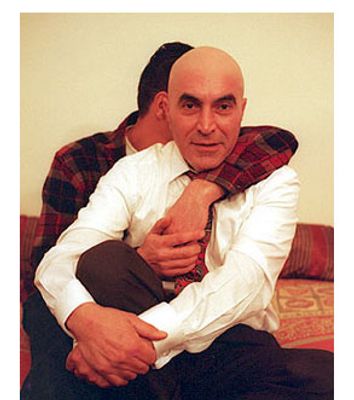
Selim, 26, is tall, shy and doe-eyed. He was locked up for two years for throwing stones as a teenager during the first intifada, released when the Oslo peace accords were signed and thrown back in jail for stealing a car. Ezra, 50, shorter and bald, has striking eyebrows, sophisticated tastes and fluent English. The pair met in the streets of Jerusalem and had a fling about six years ago. Three years later, Ezra and Selim bumped into each other again and became a steady couple. They’ve been living together in Ezra’s Jerusalem apartment ever since.
“Selim was a product of the occupation: no school, nothing to look forward to, put in jail automatically, ” says Ezra. “Since he’s been with me, it’s been the best period of his life: He’s working, his health has improved, he’s more relaxed.”
Ezra’s love opened new vistas for Selim: steady employment, clubbing in Tel Aviv, movies in Jerusalem — activities that Palestinians often don’t have access to, but the current armed uprising abruptly ended all that.
Repeat terrorist attacks in downtown Jerusalem mean people with Arab complexions can’t walk two blocks without being carded these days. “I can’t count the number of times we’ve been stopped together,” says Ezra. Usually Ezra’s eloquent patter, a few documents (including a precious letter from the Israeli security services that states Selim presents no known security risk) and well-placed phone calls solve things on the spot.
In October 2000, at the beginning of the current conflict, Selim was sentenced to eight months in jail for residing illegally in Israel. He was released after three months when Ezra appealed the verdict and the judge recognized that Selim was in Israel due to personal circumstances. The last time they were stopped was just two weeks ago in Jerusalem when security people yelled through a megaphone “Red Toyota — stop!” They were searched down to their shoes and questioned for 30 minutes until Ezra managed to convince the police to let them go.
So, apart from driving to plumbing maintenance jobs around town, they avoid going out as much as possible. “Because of the situation, [Selim] is now 24 hours a day with me. Sometimes it’s fun but sometimes it’s not easy,” says Ezra. They’ve stopped going to Tel Aviv, preferring instead the mixed Jewish-Arab port town of Jaffa, where Selim looks less conspicuous. They watch videos rather than movies. And Ezra tells Selim to wear a coat at all times in case he gets arrested.
Mixed Israeli-Palestinian couples are very rare, but in most cases marriage confers Israeli residency rights to the Palestinian spouse. In Ezra and Selim’s case, that legal option doesn’t exist. Although they signed a notarized document establishing the fact that they are domestic partners willing to share all their belongings, the move hasn’t helped their case so far. Selim’s criminal record is one obstacle; being gay might be another, although Ezra and Selim see their quandary as a case of discrimination against Arabs more than anything else. “If Selim were an illegal resident from Russia, everything would be fine,” says Ezra. “But this guy, who was born here, whose family has lived here for hundreds of years, isn’t allowed to go two to three kilometers [from Ramallah to Jerusalem].”
The Jerusalem Open House, a one-of-kind organization that provides supports for gays and lesbians in Jerusalem and in the West Bank, is helping to publicize their case. “In many ways [Selim] should have been the poster boy of the Oslo agreement,” says Hagai El-Ad, the organization’s director. “He was engaged in terror during the first intifada, and now after a turn-about he’s in love and living with an Israeli.” El-Ad hopes to raise Selim’s plight with Israeli Prime Minister Ariel Sharon in a meeting that could take place as early as today; the group wants Sharon’s government to blast bureaucratic hurdles and give Selim the Jerusalem ID papers he badly needs. (El-Ad knows of at least one precedent when the late Prime Minister Yitzhak Rabin granted residency rights to a Palestinian from Gaza who wanted to live with his partner in Tel Aviv.)
With residency rights, “I would be more quiet, less anxious. Every time I’m stopped, I get upset,” says Selim. Half Selim’s family was born in Jerusalem and therefore has Jerusalem IDs. But Selim, born in Ramallah a few miles north, has no residency rights and must tiptoe in Jerusalem, moving about like Ezra’s anxious shadow.
“I’m twice his age; I’m realistic. We’re not going to marry or adopt children,” says Ezra. “We just want to lead our life and let it develop naturally. I would like Selim to have the freedom to choose to reduce the intensity of our relationship, look for a wife, whatever. The situation has partly forced us together. I don’t want another jail for Selim. Right now, we’re together whether we want it or not.”
Last time Selim was jailed, “he looked like a caged animal; his eyes were full of terror,” recalled Ezra. “His body and soul wouldn’t survive another stay in jail. He would collapse as a person, and I would feel a sort of Palestinian need for revenge. I would hate those who killed him. I don’t want to hate my country.” Ezra sees himself as a loyal citizen: He’s politically engaged, pays taxes, served three years in the army (like most Israeli men) and fought the 1973 Yom Kippur War. “I don’t want to fight against the state,” he says.
As it is, Ezra frequently finds himself on the Palestinian side of things. He takes communal taxis with Selim and other Palestinian workers, walks through hills and valleys to avoid Israeli-manned checkpoints and has had bullets and tear gas fired in his direction by Israeli soldiers. In addition to helping Selim stay illegally in Jerusalem, Ezra also frequently breaks the law that bars Israeli civilians from entering Palestinian-ruled areas.
Several Israeli businessmen — including men like Ezra, who felt they had privileged connections with Palestinians — have been killed in Palestinian-controlled towns in the recent past. All it takes is a hotheaded Palestinian who wants to make a name for himself by gunning down an Israeli. Crazy enough to wander the streets of Ramallah in a time of war, Ezra would be an easy target. But he feels somehow immune. “Friends warn me not to do it. But unlike those who were killed, I’m not going for business. I’m going door to door. Selim’s family is waiting for me. I say this without modesty: I feel part of them, and I think I know the code.”
He was scandalized when an Israeli policeman took him aside once and asked: Aren’t you afraid Selim will kill you? “The relationship between Jews and Arabs can only be one way. We are the masters and they are the servants,” says Ezra. Most Israelis “can’t imagine an equal relationship. Palestinians are like Indian immigrants cleaning the floors at Heathrow airport — they’re transparent.”
Ezra also dismisses the suggestion that right wing Jews might target him for publicly revealing his love for a Palestinian. “I may be gay, but I’m not a sissy,” says Ezra.
Continue Reading
Close
Just when the fear of roadside ambushes and suicide bombings is crippling daily life here and the security establishment forecasts more Palestinian attacks in the near future, an Israeli demographer shows up with more bad news: Even without war, in a few decades there may be no Israel to speak of.
In 2020, Jews will be a distinct minority in what they call “Greater Israel,” the land between the Jordan River and the Mediterranean Sea, encompassing both the internationally recognized state of Israel and the occupied territories, comprising the West Bank and Gaza. According to recent predictions, Arabs will form 58 percent of the total population, up from 49.5 percent today. In Israel proper, Jews will remain a majority but their percentage will drop from 73 percent today to 68 percent in two decades. Counter-terrorism and military raids may work to stave off short-term Palestinian threats, but the demographic equation puts in doubt the survival of the entire Zionist enterprise — particularly if Israel holds on to the occupied territories.
“If we continue with the status quo, with no decision-making, we have only another 15 years,” warned Arnon Soffer, the author of a report on Israeli demography that made a big splash this summer. “If we talk about Greater Israel, we’re a minority from this year on.”
Today, the numbers of Jews and non-Jews (including Asian and Eastern European workers) are running neck and neck, at just under 5 million each. But the difference in fertility rates between Arabs and Jews is about to topple that precarious balance. While the average Jewish Israeli woman has 2.5 children in her lifetime, her Muslim Arab counterpart in Israel and the West Bank has five children, and in Gaza, one of the most densely populated strips of land in the world, a woman typically has seven. (The fertility rate of Christian Arabs is similar to that of Jews.)
“There is something hateful in counting heads and considering them a threat,” said Avishai Margalit, an Israeli political philosopher, in a phone interview recently. “But the reality is that we are now in a tribal war, so you count who’s on your side and who’s against you.”
In the ongoing competition between the Arab and Jewish national movements, the number of births, arrivals and departures may matter more than the number of people killed in skirmishes and terrorist attacks. Jewish immigration is down by roughly 28 percent compared to last year. This is partly because of insecurity created by the intifada and partly because in preceding years, years of economic distress in Russia, immigration was unusually high, according to the Jewish Agency. Unless a new wave of anti-Semitism dislodges Jews in Europe and in America, immigration will dry up almost entirely because the Jewish population abroad is becoming more scarce in countries like Russia, and generally older and more assimilated than in the past.
At the same time, a quiet Palestinian exodus is under way, as families with connections abroad and enough pocket money leave to seek safety and work overseas. But the number of departing Arabs is not high enough to assuage Israeli fears of a demographic takeover. Palestinians may be fleeing, but in the long run, the wealthiest and brightest Israelis will leave too, predicts Soffer. A veteran demographer at Israel’s Haifa University, Soffer cites the general deterioration of life in Israel, which includes the growth of relatively poor, anti-Zionist sectors of society (ultra-Orthodox Jews and Israeli Arabs will form 50 percent of the population in 2020), the worsening of daily violence, economic depression, and ethnic strife. His predictions are based on the example of Jerusalem, which young professional Israelis are deserting for all those same reasons: too many religious people, too many Arabs, too many bombs and too few jobs.
And in the Holy Land’s maternity wards, Jews will be outpaced. “Time is running out!” warned Soffer, a spry 66-year-old who relishes his position as the nation’s Cassandra.
The Israeli obsession with demographic numbers is not new. The 19th century ideology known as Zionism aimed to provide a nation-state for the Jews — a country where Jews, being a majority, would feel safer than as a scattered, often-persecuted people in the Diaspora. “Population size was critical to the Zionist enterprise,” said Calvin Goldscheider, who holds a joint appointment as professor of sociology and professor of Judaic studies at Brown University. “They saw strength in numbers. They could only do certain things if they were numerous, and they were concerned about how many Arabs there were. British policy [during the Mandate] was to control the relative proportions of Jews and Arabs, but Jews objected to this because it would mean they would be a permanent minority.”
The United Nations Partition Resolution of 1947 and the subsequent War of Independence changed that. A large piece of Mandatory Palestine became a Jewish-dominated state, to the detriment of hundreds of thousands of Palestinian Arabs who either lost their land and homes and became refugees in the West Bank, Gaza and neighboring Arab states, or were relegated to an inferior class of citizenship and became known as Israeli Arabs. Although Israel, striving to be both Jewish and democratic, gave the Israeli Arabs voting rights and required that they pay taxes, they were systematically denied equal access to land, jobs and education — a situation that continues to this day.
Later, Israel strengthened its numbers — and viability — by encouraging massive Jewish immigration from neighboring countries in the Middle East in the 1950s, and in the 1990s again by flinging its doors wide open to hundreds of thousands of Jews and their relatives from the former Soviet Union. To this day, anyone who can prove that their grandmother or grandfather was Jewish is welcomed into Zion — a sign of Israel’s desperate need to stay ahead in the race against Arab fertility and a sore point with Orthodox Jews, who insist Jewishness can only be transmitted by a Jewish mother or acquired through conversion.
Goldscheider thinks that talk of a demographic threat to Israel is irresponsible hysteria. He points out that the proportion of Arabs in sovereign Israel has remained relatively constant at about 20 percent since the 1970s, despite their greater natural increase rates, thanks to Jewish immigration.
When immigration flagged in the late 1950s, David Ben-Gurion, Israel’s first prime minister, began to talk about “internal immigration,” urging people to have more babies. “The thinking was, ‘We’ll outbreed them,’” said Goldscheider. (A “Ben-Gurion” prize was introduced to reward the mother of the year but, ironically, the winners were always Muslim Arabs, and the prize was eventually scrapped.)
Numbers are also key to understanding Israel’s positions on peace with Palestinians today. Realization of the “right of return,” for example, by potentially 3.7 million Palestinians registered as refugees with the United Nations would signal the abrupt end of Israel as a Jewish-dominated state. In addition to being impractical (most of the houses Palestinians deserted in 1948 were destroyed or taken over by Jews), it is seen by both left-wing and right-wing Israelis as an unacceptable demand, simply code for the destruction of Israel.
On the other hand, divesting Israel of the territories it gained in the 1967 Six Day War, where roughly 3 million Palestinians live, is seen as a priority by part of the Israeli public. The need to get rid of territory on which Arabs live so that Israel could remain a Jewish-dominated, democratic state was one of the underlying issues driving left-wing Israelis like Shimon Peres and Yossi Beilin to draft and sign the Oslo Accords in 1993. “The point was: Give back territory to save Israel from demography,” said Sari Nusseibeh, one of the chief Palestinian negotiators at the time and a moderate intellectual who was recently made Yasser Arafat’s diplomatic representative in East Jerusalem.
But for Israeli right-wingers, territory has always been more important than democracy in the competing list of Israeli ambitions. (Nahum Barnea, a veteran Israeli columnist, sums up the differences between the two major Israeli political factions pithily: “Likud is geographic, while Labor is demographic.”)
“People on the right usually evade the issue [of Arab numerical superiority], say the statistics are wrong or entertain Zeevi-like fantasies and want to kick Arabs out,” said political philosopher Margalit, referring to Rechavam Zeevi, the far-right minister who was assassinated this fall. Influenced by demographic projections like Soffer’s, Zeevi proposed to expel or “transfer” Palestinians from the West Bank and Gaza to neighboring Arab states. Other right-wingers, repelled by the ethnic cleansing connotations of the transfer solution, believe in hanging onto Greater Israel by increasing Jewish settlements in the territories and granting non-Jews limited rights. This is where the idea of autonomy within an Israeli framework came from, or in today’s terms, the idea of an emasculated “Palestinian state” whose borders, roads and economic life would be controlled by Israel. It is the scenario preferred by current Israeli Prime Minister Ariel Sharon and, basically, a continuation of the status quo.
“It doesn’t matter how many people you rule over. France colonized countries larger than itself. You just send more soldiers to control the colonized populations,” said Goldschieder. “Whether you occupy 3, 4 or 5 million Arabs is a security issue, not a political problem, as long as they don’t have political rights,” concurred Margalit.
But for Soffer and many other Israelis, if Israeli Jews start lording it over a population significantly larger than their own, the situation will smack of apartheid: “This is a South Africa situation with a minority of whites controlling others,” he said, apparently more worried by the negative parallels international public opinion might draw than mindful of the moral argument against abusing people’s rights, regardless of their numbers. “Voting rights is not the only thing that matters. We will be flooded by others. We already have a hard time being both Jewish and democratic. I cannot say that we have solved this problem yet.”
Israeli Arabs and Palestinians are already subject to various forms of apartheid — on the roads, at checkpoints and in the job market. But Soffer fears that pent-up frustration against state discrimination and growing Palestinian nationalism among Israel’s Arab minority will express itself in the future in a large unified voting bloc that will undermine Israel’s political stability. On war-and-peace issues, some of the 11 Israeli-Arab representatives in the Knesset already have begun showing more solidarity with their Palestinian brothers than loyalty toward the Jewish state. (Azmi Bishara, an Arab member of the Knesset, is currently on trial for calling this year for the continuation of the armed intifada against Israel at a meeting attended by members of Hezbollah, the Lebanese Islamic guerrilla group and one of Israel’s sworn enemies.) In another few years, as the representation of Israeli Arabs grows, “they will be able to decide whether the state of Israel should be a Jewish-Zionist state or whether it should turn into a state of all its citizens,” warned Soffer in his study.
Soffer also predicts that the demographic boom will turn the security situation into an even bigger nightmare than it is now. Increased numbers of Palestinians living in abject poverty in the West Bank and Gaza will feed radical movements and multiply Palestinian attempts to sneak into Israel to work or commit violent acts, he warns. If Gaza’s population doubles in 20 years as it is expected to, while its already overburdened infrastructure continues to collapse, “then one has to expect a decline in the standards of living and despondency. Such an embittered population is dangerous and it is reasonable to assume it will turn to extremist measures, from terror to holy war,” wrote Soffer in his latest study. (Palestinian population growth is already a problem for the Palestinian Authority, whose limited resources, corruption and inefficiency prevent it from addressing society’s growing needs, thereby opening a breach for Islamic charities run by radical groups like Hamas.)
Strangely, given the strong resonance that numbers have in Israeli minds, the demographic equation has not been a major component of Palestinian strategy against Israel until recently. True, Arafat has been quoted in the past referring to Palestinian wombs as his people’s best weapon, and Palestinian mothers have been known to call their children “Jihad” (Holy War), anticipating their little ones’ sacrifices for the Palestinian struggle. But Palestinian birthrates are not a conscious expression of patriotism. In traditional Arab societies, “you’re a better man if you have more children,” explained Nusseibeh. “It has nothing to do with Israel.” Even Soffer agrees: “I don’t think when they go to bed, they think of Palestine. It’s the prestige of having a large family that matters.”
According to Goldscheider, the decline of Muslim fertility in the 20th century was actually “delayed indirectly by Israeli policies that segregated Arabs and gave them very few incentives to have fewer children. Palestinians have a very high fertility rate because they are extraordinarily poor,” he said. “They have no jobs except for the work doled out by Israel, their women are subservient, the schooling system is bad and there are no benefits to having fewer children. They have children so they can work and support the family. In Jewish Israel, there are plenty of reasons to have fewer kids: You can have a bigger apartment, buy more goods, invest in your children’s education.”
(That said, bedrooms and politics do sometimes mix. Jewish Israeli fertility rates are notably higher than in the West due to religious and ideological factors, said Soffer. Ultra-Orthodox women, encouraged by their rabbis and husbands to enlarge their pious tribe, have an average of seven children — just like Gazan women. Settlers, who believe it is their duty to people the occupied territories with ever more Jews, also have huge families despite the economic incentives to have fewer children in a modern society. Even among secular Jews, “you hear people say that we have to compensate for the 6 million Jews killed in the Holocaust or that we should have more children because we live in a hostile region,” said Soffer.)
But Palestinians are starting to catch on. “More and more now, you hear people say, ‘We’re going to win by numbers,’” said Nusseibeh. In a Palestinian textbook published in 2000, 11th-grade students are told that “the increase of fertility rates is a demographic weapon that can be used in resisting the occupation. It plays a positive role in the Arab-Israeli conflict.” Although Nusseibeh himself has used demographic arguments to pressure Israel into negotiations for a long time (“I always assumed it was a good weapon — better than guns, certainly”), he said Palestinians were not interested in numbers and thought him crazy. “I was criticized by my colleagues after I was quoted in Newsweek in the early 1980s saying, ‘Let them annex us.’ I wrote: Annex us and very quickly we’ll turn Israel into an Arab or bi-national state. But other Palestinians said: We don’t want to be annexed, we want a Palestinian state.”
According to people who knew him well, the late Faisal Husseini, Nusseibeh’s predecessor as the head of Orient House, the Palestinian office representing Arafat in Jerusalem, was also fond of saying: “It’s not Israel who is giving us a state, it’s we Palestinians who are giving them one. If Israelis don’t give us a state, they’ll lose theirs.”
But Palestinian calculations have gone beyond the call for an independent state in the past few years. As disaffection toward the Palestinian Authority — a Palestinian state in embryo — grew among ordinary Palestinians and intellectuals, some Palestinians began reconsidering their whole strategy, according to Nusseibeh, and calling instead for the right of return. “The two slogans during the first intifada were freedom and independence. Return wasn’t a major concern. At Madrid [where the two-state solution was first officially proposed, in 1991] people knew return was not in the cards. But people got second thoughts when Arafat came back from Tunis and they saw what he was like, what the Palestinian Authority was like,” said Nusseibeh. “Palestinians got the worst of two worlds: Aspects of the occupation still prevailed because of the limits on freedom of movement; at the same time they saw the worst aspects of the Palestinian Authority: corruption, inefficiency, instances of brutality.”
While Arafat still publicly supports the idea of peace based on two separate states, the competing idea of a bi-national state and the call for the return of refugees (with the understanding that Arabs will vastly outnumber Jews) have become increasingly popular among Palestinians radicalized by the failure of the 8-year-old Oslo Accords to significantly improve their lot and by 15 months of brutal, costly intifada. People like Nusseibeh who dare speak out against the return of refugees today are considered traitors, while those who trumpet the issue become instant political heroes. The shift away from a two-state solution — which most analysts agree is the only practical blueprint for peace — is not final, however. “It depends on how things develop on the ground,” said Nusseibeh. “If Sharon slices [the occupied territories] up and creates four bits of Palestine, Palestinians will say it’s obviously not good enough,” and they will demand the whole pie.
On the Israeli side, numbers have also been corralled into supporting the latest fad: the building of a country-long fortified fence that would separate Israelis from their Palestinian neighbors and protect them from the hordes of terrorists pressing at their gates. The more numerous and hostile Arabs there are, the more urgent the need for the wall, says Soffer, who apologizes for “talking about walls at the beginning of the 21st century” with the standard argument that “unfortunately, Israel isn’t in Europe.” While he crisscrosses the country these days, meeting with ordinary people and decision-makers, Soffer, who describes himself as “both a dove and a hawk,” does more than spread alarm. Along with ambitious politicians who have jumped on the issue in the hope of challenging Sharon, Soffer has become one of the major advocates of “unilateral separation,” an idea first discussed by former Prime Minister Ehud Barak. “Never in my life did I get such positive feedback,” said Soffer, whose monograph is now in its third edition. “People are frustrated. They feel that they are in a cul-de-sac. But I’m coming with a threat and a solution.”
Combining the perspectives of Israel’s political left and right, unilateral separation appeals to a majority of Israelis who feel that the idea of Greater Israel and real peace are both Utopian: Israel cannot sign an end-of-conflict deal with Palestinian leader Yasser Arafat, nor can it continue occupying the West Bank and Gaza and ruling over millions of Arabs. Therefore, Israel must pull out, regroup and physically protect its new borders — a literal implementation of the “Iron Wall” against Arab hostility called for in 1923 by Ze’ev Jabotinsky, founder of revisionist Zionism and the spiritual father of right-wing Israeli leaders from Menachem Begin through Ariel Sharon.
“I prefer to be in a very strong, small ghetto than exposed to Palestinian threats,” said Soffer, summing up the feelings of many. “Of course, the ghetto can’t be too small and shouldn’t become smaller and smaller. I need to defend my area.”
But the problem is: Where do you plant the fence? Whether Israel should carve out East Jerusalem to get rid of Arab-dominated neighborhoods, transfer pockets of land in the north populated by Israeli Arabs to Palestinian sovereignty, surrender strategic assets like the Jordan Valley and evacuate settlements in the West Bank and Gaza are still highly divisive political questions that numbers alone can’t answer. Goldscheider, the American professor, dismissively sums up the arguments of those who advocate building a fence: “All the good reasons for separation and giving Palestinians their own state — political, moral, military reasons — don’t work [in convincing Israelis to end the occupation], so you might as well try neutral statistical arguments and say: ‘Watch out, they’ll outbreed us.’ But that’s not the real issue. The real issue is statehood and empowerment, Palestinians having control over their own lives.” And to address that, diplomacy, not demography, is the only answer.
Continue Reading
Close
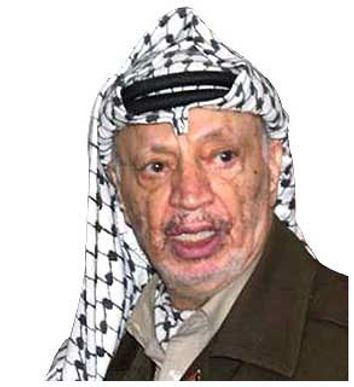
Israel cut off contact with Palestinian leader Yasser Arafat early Thursday and launched military operations in the West Bank and Gaza to crack down on militants, blaming Arafat for the latest bloody attacks that killed 10 Israelis and wounded more than 30 others.
A statement released after Israel’s Security Cabinet met in Tel Aviv said Arafat is “directly responsible for the series of attacks and therefore is no longer relevant to Israel, and Israel will no longer have any connection with him.”
Justice Minister Meir Sheetrit said there would be no more contact with Arafat or his Palestinian Authority. He added that Israel had no plans to kill Arafat.
The larger political ramifications of Israel’s move remained unclear. But its action in cutting off contact with Arafat, and possibly the Palestinian Authority which is charged with governing part of the occupied West Bank and Gaza territories on an interim basis under the 1993 Oslo agreement, probably represented a 10-year low in official Israeli-Palestinian relations, and gave rise to renewed speculation about the fate of the Palestinian Authority leader. While increasing numbers of Israelis have apparently come to believe that any alternative would be preferable to Arafat, many analysts, Israeli and Palestinian, argue that removing the 72-year-old Palestinian leader would only further destabilize the deteriorating situation.
The developments made a mockery of the latest American efforts to bring both sides to a cease-fire. U.S. envoy Anthony Zinni has spent the last two weeks trying to implement a truce agreed to last May. He has set up three meetings of Israeli and Palestinian security commanders, but the sessions have reportedly degenerated into shouting matches, with each side blaming the other for continuing violence. The latest violence followed Zinni’s call for 48 hours of peace.
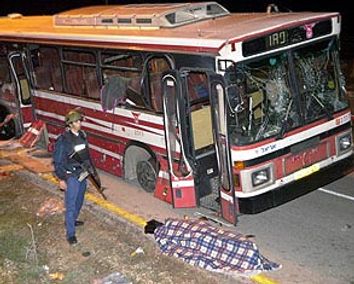
The first attack took place Wednesday evening, when a bus traveling near a Jewish settlement in the northern West Bank hit an explosive charge and was sprayed with gunfire by Palestinian assailants. Two of the people killed in the shooting, which continued after medics and Israeli soldiers arrived on the scene, were soldiers. Almost at the same time, two suicide bombers struck at settlers in Gaza, wounding four people. The attacks followed an Israeli tank raid into the West Bank city of Jenin and the death, overnight, of four Palestinians in Gaza whom Israel accused of firing mortars into Israeli settlements.
In response to the Palestinian attacks, the Israeli Security Cabinet authorized widespread military operations to arrest militants and seize weapons. Israeli forces launched an incursion into the southern Gaza Strip and fired tank shells at a Palestinian checkpoint in the West Bank city of Ramallah. Earlier, Israeli missiles pounded Arafat’s beachfront presidential compound in Gaza, a naval building in northern Gaza and the passenger terminal at the Palestinian airport in southern Gaza. Palestinians say a 65-year-old woman was killed in these strikes.
Feeling the heat from American envoy Anthony Zinni, who asked Arafat and the Palestinian Authority to move immediately against terrorist groups, Palestinian officials decided at a cabinet meeting in Ramallah late Wednesday night to close down all institutions belonging to Hamas and Islamic Jihad. If the order is implemented, it would presumably silence for the first time the movements’ political leaders (not just outlaw their military branches, as the Palestinian Authority has done numerous times in the past) and affect their charitable organizations.
Like many previous Palestinian attacks in the current intifada, Wednesday’s killings were conceived as acts of revenge for Israeli strikes. The Palestinian Authority issued a routine statement condemning the attacks, although an armed group called the Al-Aqsa Martyrs Brigade, which is affiliated with Arafat’s mainstream Fatah party, claimed responsibility for the bus ambush, as did the radical group Hamas. Just as mechanically, Israel blamed Palestinian leader Yasser Arafat for the attacks and began firing missiles at targets in Gaza in response.
But by breaking off contact with Arafat, Israel upped the ante it threw on the table when it accused him and the P.A. earlier this month of supporting terrorism. The latest developments, both politically and militarily, carried a growing risk that the two sides would depart from the well-worn scenario and usher in an ominous new phase in the almost 15-month-old intifada. Since last week, when Israeli Prime Minister Ariel Sharon called Arafat “the greatest obstacle to peace and stability in the Middle East” following terrorist attacks that killed 26 people in Haifa and Jerusalem on Dec. 1 and 2, the attacks on Arafat have become far more intense.
Almost 20 years after Sharon, then Israel’s defense minister, tried to eliminate the Palestine Liberation Organization (PLO) and its leader by invading Lebanon and ultimately bombing Arafat’s headquarters in Beirut, Israeli helicopter gunships came after the Palestinian leader’s assets in Gaza and in the West Bank, destroying his helicopters, helipad and airstrip. In an intimidating show of force, an Israeli helicopter moved toward a building in Ramallah in which Arafat was sitting at the time and fired missiles into the office next door. Although Sharon stopped short of killing the head of the Palestinian Authority, an entity he has compared to the Taliban regime because it harbors terrorists, the bombings were clearly intended to underscore Arafat’s physical vulnerability.
The blows, so far, have been mostly diplomatic — but Arafat has also inflicted some on himself. A few days after the Israeli bombings went ahead, with the virtual blessing of the United States, Arafat apparently lost all self-control and blurted on Israel’s Channel One, waving his hands hysterically: “Good lord! What do I care about the Americans! The Americans are on your side and they gave you everything. Who gave you the planes? The Americans! Who gave you the tanks? The Americans! Who gives you money? The Americans! Don’t talk to me about the Americans.” The interview, aired at prime time Friday night, startled Israelis, who suddenly saw Arafat as a raging, aging fool, not the formidable mastermind and nemesis they imagined nor the kind of negotiating partner they hoped for.
Perhaps even more humiliatingly for Arafat, the European Union’s foreign ministers put out an unusually tough-worded statement on Monday in which they asked him to dismantle the terrorist infrastructures of Hamas and Islamic Jihad and to call –in Arabic — for the end of the intifada. The statement implied that Europeans were fed up with Arafat’s double game, in which the leader says one thing in English for foreign consumption and another in Arabic for his domestic audience. Although balanced by a call for Israel to stop building settlements and cease its practice of “extra-judicial” executions — appeals noticeably lacking from the U.S. demands to Arafat — the statement carried special sting because Europe has traditionally been sympathetic to the Palestinian argument that resistance to Israeli occupation is a legitimate struggle.
This combination of strikes, clownish missteps and diplomatic pressure has many people wondering whether Arafat’s days may be numbered and given new urgency to the old question of who might represent the Palestinians if Arafat were to fall from power.
Right-wing politicians and even many centrist Israelis have come to believe that anything would be better than Arafat, whom they see as conning the world into thinking he wants peace while doing nothing to stop terrorist attacks. (In a poll published last Friday in the newspaper Maariv, 56 percent of Israeli respondents said they “support Israel’s attempt to remove Yasser Arafat from power.”) Others believe toppling Arafat would mean total anarchy in the occupied territories. Although Shimon Peres, Israel’s dovish foreign minister, says he has run out of patience with his old friend’s antics, he warned in an opinion piece recently that getting rid of Arafat “could create an alternative that is much worse and bring Hamas and Islamic Jihad down on us.”
The popularity of Hamas and Islamic Jihad, two militant groups that target Israeli civilians and, unlike Arafat, oppose compromise with Israel, has soared since the beginning of the intifada in October 2000. In part, these groups have filled a need Arafat’s Palestinian Authority has neglected: They provide an extensive and efficient network of social services in the impoverished West Bank and Gaza — something Arafat’s Palestinian Liberation Organization has become too corrupt to deliver properly. Many Palestinians, humiliated and enraged by 34 years of Israeli occupation, also support, or at least applaud, Hamas suicide bombers and other military activities that keep up the Palestinian score in the killing game played by the two sides. (According to Reuters news agency, the tally is 764 Palestinians dead to 223 dead Israelis.)
Meanwhile, Arafat’s ratings and those of his corrupt, ineffectual Palestinian Authority, have plummeted. And by stripping him of his helicopters and airstrip last week, Israel has attempted to weaken him further. “The strikes were designed to destroy the symbols of power that were granted to Arafat by the Oslo peace process and to return him to his former status of head of the PLO [as opposed to heading the Palestinian Authority],” said Gerald Steinberg, an Israeli security analyst at Israel’s Bar-Ilan University. “Now Arafat is grounded.”
Forced to his knees, Arafat reluctantly ordered the arrest of dozens of militants and a handful of key terrorists, an unpopular move that “plays into Hamas’ hands,” said Ghassan Khatib, a Palestinian analyst in Jerusalem. Many Palestinians violently reject the arrests of men they regard as freedom fighters at a time when they feel the need to strike back at Israel. Hundreds of Hamas supporters flexed their muscles last Wednesday when their spiritual leader, Sheikh Ahmed Yassin, was put under house arrest by Palestinian police. A Hamas supporter was killed in the ensuing scuffle.
Still, most analysts believe the risk of Palestinian civil war and a political takeover by Islamic radical groups, the two perils mentioned by people who argue Arafat should be cut some slack, is overblown. After last week’s bombardments, “many people subscribe to his point of view that we should save ourselves from an all-out war [with Israel] and take painful measures. Others don’t like it,” said Ziad Abu Amr, a member of the Palestinian Legislative Council and a political scientist based in Gaza. “The street is divided between resentment and understanding, but that doesn’t mean there is a risk of a civil war.”
“The risk of civil war is exaggerated, but there is a breaking point,” said Khatib. “Arafat has to be careful in his arrests.” Those Palestinians who tolerate arrests do so in large part because they understand the measures are temporary, merely cosmetic and in no way signal the end of the armed intifada. But if Arafat moves too forcefully against popular heroes or arrests people only to have Israeli helicopters target the police stations and prisons in which they are kept (something Israel has done in the past), the mood on the street could turn irrevocably hostile.
However, the end of Arafat wouldn’t necessarily signal the rise of a radical Islamic regime. Analysts note that Palestinian society is traditional but not fundamentalist. Regional conditions also make a radical Islamic regime very unlikely “unless you want to live in isolation like the Taliban,” said Abu Amr. “We’re surrounded by Israel, Jordan, Egypt — moderate regimes who would see a threat in the rise of a radical Palestinian regime. Who would support this regime? We depend on donations and material support from around the world. So the Hamas project has no chance of succeeding, unless they become moderate themselves.”
For Steinberg, the author of an article headlined the “End of the Arafat Era” in the Jerusalem Post last week, the benefits of turning the page outweigh the risks. “Almost all alternatives to Arafat would be more pragmatic — including Hamas, which would be motivated by self-interest and survival” to come to a sort of modus vivendi with Israel.
Possible successors to Arafat include Mohammed Dahlan, head of Preventive Security in Gaza; Jibril Rajoub, the security chief in the West Bank; Abu Mazen, Arafat’s No. 2; and Abu Ala, Arafat’s chief negotiator at Oslo. Although the last two are men of Arafat’s generation, Rajoub and Dahlan, both in their 40s, have extensive experience working with Israeli security services and the CIA, have cracked down on Hamas in the past and are thought of as more pragmatic than the old leader.
“These people are not necessarily more reasonable in their demands but more realistic than Arafat. They understand the situation and care for the welfare of Palestinians,” said Steinberg. In particular, Israelis have been heartened by Rajoub’s ability to produce quiet in the Bethlehem region after Israeli tanks pulled out recently. Dahlan, for his part, earned brownie points with Israelis last summer during peace negotiations at Camp David when he showed more flexibility and openness than anyone else in the Palestinian delegation. “We might see Rajoub against Dahlan or a coalition of the two to consolidate their power,” said Steinberg. “Now we basically have anarchy controlled by Arafat who gives a green or yellow light to terror, tells various groups ‘do what you want, just don’t tell me about it’ and does nothing against terror when he does hear about it.”
But most Palestinians believe Arafat is the only one who can hold the different threads of Palestinian society together. Israel’s belief that it will find local, more pliable leaders — part of a plan to effectively divide Palestine into a collection of Bantustans — is preposterous, said Khatib: “It’s what they tried to do since 1967. They tried mukhtars [a sort of mayor], intellectuals, municipal councils, all kinds of people, but they failed,” he said. (The height of Israel’s attempt to provide an alternative leadership to the PLO came in 1981 and ’82, when the Begin administration fired pro-PLO mayors and tried to set up a network of so-called village leagues in the occupied territories. The attempt failed miserably.) “I don’t know why people assume Rajoub and Dahlan would be different from Arafat — they’re his left and his right arms, they have similar views. Part of it is wishful thinking from Israel. Part of it is also that Israelis feel they helped elevate them to their current position [through the Oslo process] so they believe they own them. It’s part of their colonial mentality.”
“None of the names mentioned as potential successors to Arafat has any independent power base, even in their local environments,” said Abu Amr. “None can fly over all Palestinian sectors of society like Arafat. Even Arafat, with all his legitimacy and charisma, can barely manage.” It may be precisely because he is such an expert fence-sitter — a character trait that enrages outsiders who wish he would choose between peace deals and violence — that Arafat has managed to ride the moods of the Palestinian street and survived so long.
However much Israelis distrust and dislike Arafat, Abu Amr cautions against plotting to overthrow him. “What happens after Arafat depends on the way he’s disposed of. If he is killed or removed by force, it will be very difficult for any successor to enjoy Palestinian legitimacy. A person installed by Israel would be viewed as a traitor and could be killed. Getting rid of Arafat means Israel would reestablish its administration of the occupied territories, so his successor would be a quisling, unable to ensure political stability for Palestinians, let alone security for Israelis. It’s a very risky and dangerous way of thinking.”
“Sharon is playing with fire and that’s why Sharon will not do it,” concurred Khatib. “The Israeli security establishment and intelligence services know very well that getting rid of Arafat won’t help them reach their objectives. That’s why they did not send a missile in his lap although they could easily have.”
The Associated Press contributed to this report.
Continue Reading
Close
Osama Bahar and Nabil Halabiyeh were best friends. In their teens, they played soccer together at a club in Abu Dis, a Palestinian suburb east of Jerusalem. They practiced karate together three times a week after work. They even met for prayers at Jerusalem’s grand Al-Aksa mosque during Ramadan, although 25-year-old Nabil was not as devout a Muslim as 24-year-old Osama.
Last Saturday night they chose to die — and kill — together. They detonated their belts of explosives almost simultaneously, standing about 10 yards apart in a crowded pedestrian area in downtown Jerusalem. It was 11:30 p.m. and the streets were full of young Israelis sipping drinks at the terraces of outdoor cafes, strolling with friends and talking on their mobile phones. The double blasts, which were followed a half-hour later by the explosion of a booby-trapped car parked nearby, killed 10 Israelis — the youngest 14, the oldest 21. (One pair of victims, Golan Turjeman and Assaf Avitan, both 15, were also childhood buddies.) Scores of others were wounded, some critically, by the explosions, carefully planned to hurt as many people as possible. Hamas, a radical Islamic organization, claimed responsibility for the attacks.
Israeli soldiers searched Osama and Nabil’s houses at dawn the next morning and during a second raid on Monday. They arrested Osama’s five brothers and Nabil’s three oldest brothers (two pre-teen brothers were allowed to stay home), presumably for interrogation by the Shin Bet, the Israeli security services.
On Tuesday, Osama and Nabil’s families had not received the dead bodies yet. “Forget about it for now,” the Israeli authorities told them. Dozens of men — friends, relatives, neighbors, notables from Abu Dis, some in traditional Arab headdress — came and went on condolence calls, sitting on plastic chairs in the stark, cold interiors of the dead men’s respective houses. Since it was still Ramadan, there was no coffee served (the usual drink at wakes). Nor were there candies to celebrate’s Osama’s martyrdom.
The descriptions various relatives and neighbors offered of Osama and Nabil’s lives provide no easy explanations for the murderous attacks the two chose to carry out — just a glimpse into an increasingly common and devastatingly bitter Palestinian state of mind.
“Every Palestinian feels that if he doesn’t become a martyr, he can be killed at any moment at home. If the choice is between dying at home or on Jaffa Street [West Jerusalem's busy main artery], you choose to die on Jaffa Street,” calmly said Abdullah Halabiyeh, 32, a neighbor and distant cousin who knew Nabil well.
In the same matter-of-fact voice, Abdullah, along with a stream of visitors coming in and out of Nabil’s spare, slightly dilapidated house, described what Nabil was like: an outgoing local hero whose room was adorned with a collection of posters of famous sportsmen, karate medals and personal trophies he earned as a star midfielder for the Abu Dis soccer club. He was a popular, gregarious young man who was not particularly religious and could stay up till all hours of the night watching World Cup games on television. “His life was sport,” said Abdullah. “He started playing soccer as soon as he learned to walk.” Hardly an obvious candidate for suicide.
His best friend Osama, in a way, was his mirror opposite and better fit the profile of a suicide bomber as we imagine such villains in the West. He was an intensely pious Muslim. He was shy and reclusive. He didn’t say much.
“He was righteous and more religious than any of his brothers,” said his father, Mohammed Bahar, 51. From the age of 6 or 7, Osama went to pray at the mosque (an old mosque, just around the corner from his house), as often as he could, and during this Ramadan season he made sure to pray every night after breaking the daily fast.
“He was calm to the point that if you asked him a question that necessitated only a one-word answer, he would only give you that one word,” said Ziad Bahar, a first cousin. Osama was not engaged, and apart from Nabil, he had few friends. “He spent his time between home, work and the mosque,” said Ziad, 30.
Osama’s worldview was probably also shaped by his time in Israeli prisons: He was jailed for four years after the first intifada, for taking part in illegal activities and membership in Hamas.
But in a recent photograph of Osama and Nabil, the roles seem reversed. Osama, the one who could be dismissed as a religious fanatic, is the clean-shaven one smiling at the camera in a polo shirt that says “USA,” while Nabil, who was much less religious than Osama, looks somewhat sullen and wears a beard (or rather the fashionable goatee of a soccer player). Nabil was a better soccer player than Osama, but then, Osama was better at karate than Nabil. In short, these were two ordinary Palestinians — not people one might deem determined by birth and status to explode in Israel’s face on a monstrous Saturday night.
“They had a normal life in Abu Dis,” said Abdullah. Unlike many other Palestinians, Nabil, a plasterer, and Osama, a guard at a local bank, had not lost their jobs in this intifada. There have been no soccer tournaments since last October because players cannot move freely around the West Bank anymore, a fact that would have annoyed Nabil but was a minor vexation compared with the suffering of thousands of Palestinians prevented from going to work in Israel and stranded in towns far from Jerusalem by the military siege Israel has clamped down on the West Bank for the past 14 months.
“Nothing extraordinary happened to Nabil,” said Abdullah. “He grew up during the first intifada. He went through the same bad treatment as all other Palestinians — the routine humiliation at army checkpoints, for example. Then he grew up and saw the better life Israelis lead, a special life of luxury, and he started asking questions: ‘Why are they living a better life than us? Why are they treating us so bad?’ We all ask these questions. We used to discuss this all the time.”
Nabil was probably not motivated by religion, said Abdullah. “He wasn’t an extremist, he wasn’t particularly religious and he wasn’t intolerant.” He worked sometimes as a guard for various churches in Jerusalem and Bethany, for example. “What really prepared him for this operation was the occupation. It’s a fertile ground for such actions, and it will encourage hundreds of others to do the same thing.”
The eldest of five children, Nabil managed to support his family when his father died of diabetes 10 years ago. He made about $400 a month as a plasterer and for the past two years collected an extra $200 by working as a security guard for the Palestinian general intelligence agency. In a sign that there may have been more than soccer on his mind, Nabil quit the security job in September, forgoing a third of his income, because of political considerations. “His conscience objected to what was going on in the streets [a crackdown on Islamic terrorist groups by the Palestinian Authority after Sept. 11]. He did not want to be in a position where he would be asked to spy on his brothers and his friends,” said Abdullah.
Mohammed, Osama’s father, said the attack was probably a “sudden action.” But, he added, it was “building up over time with everything Osama saw on television: the killing of children, the mutilated bodies of assassinated people. Watching all this for an extensive period of time produced this reaction, a reaction of hatred.” Although his son did not say much when the family sat in front of the television taking in the images of Palestinian suffering that Palestinian and Arab channels aired relentlessly, “Osama was very sensitive,” said Mohammed.
The father looked tired and sad, but could not express too much grief in public. “I feel both pride and sadness,” he said. “Pride because as a martyr he will go directly to heaven and he sacrificed his life for Palestine but sad as a father for the loss of a son.”
Would he have prevented Osama from going to blow himself up had he known in advance about his plan? “I don’t know, its a difficult question,” he answers. Perhaps not wanting Palestinians to appear cold and brutal, Ziad, Osama’s cousin, jumps in: “I’m sure the emotions of a father would have prevailed.”
But nothing is less sure. Suicide bombings that kill and maim innocent Israeli civilians are seen as an acceptable means of struggle by an overwhelming majority of Palestinians, who equate them with the killing of Palestinian civilians by Israeli soldiers. (The fact that the Israeli army does not hit Palestinian civilians on purpose, at least not officially, makes no difference to them.) Recent polls show that close to 80 percent of Palestinian respondents support suicide attacks against Israeli civilians.
“Religiously, we’re not allowed to kill civilians, women, children, unarmed people — we’re even prohibited from cutting a tree,” said Abdullah. “But there’s a verse in the Quran that says: Punish the way you are punished. When we see them killing our children … Mohammed al-Durra, Fares Udeh …” he said, listing the names of famous young victims.
In a sign of the prestige enjoyed by suicide operations even in mainstream media controlled by the Palestinian Authority (which purports to be acting against terrorism and regularly outlaws Hamas), the sports page of Al-Quds newspaper carried a glowing obituary for Nabil Halabiyeh on Tuesday. “Halabiyeh joins the martyrs of the sports movement,” the caption under his photograph read. “He was an excellent player, an excellent midfielder and contributed to bringing the Abu Dis Club into the premier league.”
Terrorism has become a routine element of the conflict, which Palestinians see as their best weapon against Israeli indifference. “Under the circumstances, any Palestinian could do it,” said Abdullah. “People believe that such actions will force Israelis to recognize that Palestinians exist. Nothing else can convince them to give us our rights.”
Many Palestinians refuse to see that actions like Saturday’s might be counterproductive, even though the weekend’s terror attacks brought about a harsh Israeli reaction that has set back the Palestinian quest for statehood. The way they see it, terrorist attacks follow a logic of tit-for-tat. When I asked Osama’s cousin Ziad if he thought Saturday’s bombing might have been detrimental in fact to the Palestinian cause, he answered that the bombing was simply a reaction to Israeli provocations. “After Sept. 11, all Palestinian factions agreed to a cease-fire, but before the visit by Zinni [America's envoy], the Israelis killed five children and Abu Hanoud,” he said. “Sharon was inviting such a reaction. It’s not us who are doing this, Israel is provoking us.”
Following that same grim logic, Abdullah said that after those Palestinian deaths, “We were in fact looking forward to such an operation. We were looking forward to hearing breaking news from Al-Jezeera and hearing about some bomb in Tel Aviv, for example. We felt that there was a need for a Palestinian reaction and were slightly worried that nothing was happening. But the real surprise for us was that Osama and Nabil were the news item. There was no indication that they would get to this point. They were not deprived of anything. Since then, their status has become heroic in the eyes of the population of Abu Dis.”
Like most Palestinians, the visitors in Nabil’s house know little about the circumstances of Saturday night’s attack: who was killed, whether they were civilians or soldiers, young or old. One heard that the victims were all under 20 years old on CNN, but otherwise no one would know — Palestinian media rarely carries details about Israeli casualties. (The opposite is also true: Palestinian dead barely register in the Israeli press.) “I don’t know about the details,” said Abdullah with a shrug. “In fact, we’re not concerned with this. We as Palestinians are subject to Israeli state terror and Osama and Nabil sought to avenge this. They did not care who they killed or how they killed.”
It’s impossible to guess at the specific details of the operation. Osama may have received explosives from Hamas the night before (he disappeared after dinner Friday). And Nabil may have been recruited by Osama several months ago. After all, at the karate club (where Osama was Nabil’s teacher) or on trips to Jerusalem’s Al-Aksa mosque, they would have had plenty of time to discuss the specifics of the operation.
No one knows (except Hamas and maybe the Shin Bet) and in some ways it doesn’t matter. Osama and Nabil were ordinary guys, according to their families. When Abdullah saw Nabil heading out in his car an hour before the attack, Nabil looked absolutely normal. “He said he was going to visit a friend.”
Continue Reading
Close