Frank Hornig

Who needs newspapers when you have Twitter?

Chris Anderson, Wired's editor in chief, discusses the Internet's challenge to the traditional press

  • more
    • All Share Services

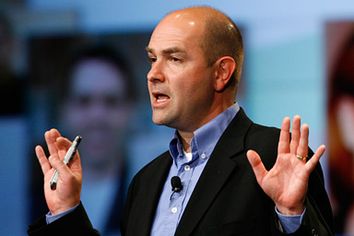
Who needs newspapers when you have Twitter?Chris Anderson, editor-in-chief of Wired Magazine and author of "The Long Tail", speaks during the Seoul Digital Forum 2007 in Seoul May 30, 2007.

Chris Anderson, the editor in chief of technology and culture magazine Wired, may be a part of the press but that doesn’t mean he depends on newspapers for his news. In this revealing interview, Anderson talks about the Internet’s challenge to the traditional press, why free is best when it comes to business models on the Web and why he would rather read Twitter than a daily newspaper.

Mr. Anderson, let’s talk about the future of journalism.

This is going to be a very annoying interview. I don’t use the word “journalism.”

OK , how about newspapers? They are in deep trouble both in the United States and worldwide.

Sorry, I don’t use the word “media.” I don’t use the word “news.” I don’t think that those words mean anything anymore. They defined publishing in the 20th century. Today, they are a barrier. They are standing in our way, like a horseless carriage.

Which other words would you use?

There are no other words. We’re in one of those strange eras where the words of the last century don’t have meaning. What does news mean to you, when the vast majority of news is created by amateurs? Is news coming from a newspaper, or a news group or a friend? I just cannot come up with a definition for those words. Here at Wired, we stopped using them.

Hang on a minute. So-called citizen journalists and bloggers have changed the meaning of “media.” But without the traditional news media they wouldn’t actually have much to do. Most of the amateurs comment on what the quality press report. So did you read a newspaper this morning?

No.

Your local newspaper, the San Francisco Chronicle, is fighting for survival. If it was to disappear tomorrow …

… I wouldn’t notice. I don’t even know what I’d be missing.

So how do you stay informed?

It comes to me in many ways: via Twitter, it shows up in my in box, it shows up in my RSS base, through conversations. I don’t go out looking for it.

You just don’t care.

No, I do care. You know, I pick my sources, and I trust my sources.

As millions upon millions trusted the classic media previously.

If something has happened in the world that’s important, I’ll hear about it. I heard about the protests in Iran before it was in the papers because the people who I subscribe to on Twitter care about those things.

The New York Times, CNN, Reuters and others can publish their best reporting on the Web and you’d never read it?

I read lots of articles from mainstream media but I don’t go to mainstream media directly to read it. It comes to me, which is really quite common these days. More and more people are choosing social filters for their news rather than professional filters. We’re tuning out television news, we’re tuning out newspapers. And we still hear about the important stuff, it’s just that it’s not like this drumbeat of bad news. It’s news that matters. I figure by the time something gets to me it’s been vetted by those I trust. So the stupid stuff that doesn’t matter is not going to get to me.

But you could also describe the endless stream of words coming from Twitter as stupid. Limited as they are to 140 characters, Twitter messages result in this mad, unfiltered and unproven impression of what is going on. The twittering can’t be any kind of replacement for fast, comprehensive and thoroughly researched reports and analysis from quality media. And with all due respect, you’re producing this yourself. You’re a member of the news media, you’re working for a magazine, you’re doing interviews and you’re creating news — or information, or content or whatever you want to call it.

True. But the problem is not that the traditional way of writing articles isn’t valuable anymore. The problem is that this is now in the minority. It used to be a monopoly, it used to be the only way to distribute news.

Because media companies used to control the printing presses and the airwaves?

Exactly. So now that you don’t need this access to a commercial channel to distribute (news), anyone can do it. What we do is still useful but what other people do is equally useful. I don’t think our way is the most important and it is certainly not the only way of conveying information. So this is why we’re in a funny phase. It’s going to take us a decade or two to figure out what it is we’re doing.

But even with this infatuation for new formats and Internet-based media, the demand for quality journalism is growing rather than shrinking. The online media has won over a huge, new audience. And for all the talk of the press becoming extinct, circulations have remained remarkably stable. The problem is the drop in advertising revenues.

Newspapers are not important. It may be that their physical, printed form no longer works. But the process of compiling information and analyzing it, and adding value to it and distributing it, still works.

But where’s the Web-based business model for it?

We’re still figuring that out.

Good luck — a future that won’t support itself.

The banner ad was invented right here in this office in 1995. That was the first answer to your question. But there’s not one business model, there are thousands. Each one of us has to figure out our own. We all make money but we don’t make enough money — and not as much as we made in print. Facebook is trying to figure it out, Twitter is trying to figure it out. We’ll get there. It’s so early.

What’s your answer at Wired?

Across the hall, there’s wired.com. It has about 120 million page views a month, it’s one of the biggest sites in the world. We pretty much run it and break even. But that’s completely arbitrary; we decide how to do it. We have paid journalists, we have blogs. There’s user-generated content and then there’s magazine content with six months of research and 8,000-word stories. Some parts are edited, others are not. We make millions of dollars in revenues, and we decide whether we want to be profitable or not.

Others don’t, or can’t, take it that easy. They made money in print and used it to build and fund their online products. Now many, like the New York Times, are losing big parts of their print revenues and don’t generate enough revenue from their Web sites. Fast-forward and you have a big problem.

The math of profit is pretty easy, revenues minus cost. You do your best on the revenue side and if you are not making money you lower your costs. The problem is not that there isn’t money to be made online, it’s just that our costs are too high.

Or maybe revenues are too low. Why do advertisers pay less online than in print? Is the audience of wired.com less attractive than readers of Wired magazine?

It’s about efficiency. Online people tend not to look at banner ads. In print people tend to look at the ads just because they’re better-integrated, better-looking ads. They’re big, full-page, beautiful photography. In many ways they are content. That’s why advertisers spend $22 to reach 1,000 people on wired.com — and $100 at the magazine. I don’t think we have discovered the perfect online advertising vehicle yet.

Except for Google. They make billions with text ads placed next to search results.

The Google idea is fantastic. But you can only do so much with text. It’s very good for transactions, but it is very poor for brands. It’s very good if you are trying to drive an action immediately, but it’s poor if you are trying to instill a desire that plays out weeks later. We need to develop a form of advertising that works as well online as glossy pages work in print. And we don’t have it yet. Again, it’s very early. This is only a couple of decades after the invention of the Gutenberg press and we’re trying to figure out what we’ve invented. But we will.

If the audience goes online, will the revenues follow?

Yes. It’s all about attention. That is the most valuable commodity. If you have attention and reputation, you can figure out how to monetize it. However, money is not the No. 1 factor anymore.

Why?

Attention and reputation are two non-monetary economies. The vast majority of people online write for free. We’ve tried paying some of our bloggers and they thought it was insulting. They’re not doing it for the money, they’re doing it for attention and reputation, or just for fun. For example, two years ago, I started this Web site called geekdad.com. It’s about being a dad and being a computer geek. We’re writing about how to do things that are fun for kids and fun for dads. It’s a community project, everyone contributes for free but we now have an audience bigger than many newspapers. And there are an infinite number of sites like this out there.

Can classic journalism, which is obviously more expensive to produce, compete with that sort of thing?

In the past, the media was a full-time job. But maybe the media is going to be a part-time job. Maybe media won’t be a job at all, but will instead be a hobby. There is no law that says that industries have to remain at any given size. Once there were blacksmiths and there were steelworkers, but things change. The question is not should journalists have jobs. The question is can people get the information they want, the way they want it? The marketplace will sort this out. If we continue to add value to the Internet we’ll find a way to make money. But not everything we do has to make money.

You just published a new book, called “Free.” Its central message is to give your product away for free …

… and monetize it some other way!

How does this apply to the Internet?

The online economy is about the size of the German economy. And it’s based on a default price of zero. Most things online are available in a free form. We have never seen an economy this big with a default price of zero. I realized that we needed an economic model to explain how an economy could be based on “free.” And we need to understand the psychology of that. We have the psychology of free, we’re drawn to it, but we feel cheated by it. If something used to be paid for and then it becomes free, we think the quality is lower. But if something has always been free, and remains free, we don’t think that.

Many companies would love it if your concept of “free” were to disappear from the Web as soon as possible.

How could it disappear? Free is the force of gravity. If we decide to resist it then somebody else will compete with something that is free. The marketplace follows the underlying economics. You can be free or you can compete with free. That’s the only choice there is. The Wall Street Journal, by the way, is very clever about this.

In what way?

They use free content to attract large audiences and then convert some of them to paid content. The idea is: Don’t charge for the most popular stuff. And never charge for exclusives because if you wall off the exclusives and other people report on your exclusive, they’ll get the traffic and you won’t. Instead charge for the niche stuff that some people will pay for.

But charging a minority of your audience won’t fund expensive reporting on Iran or Iraq.

Right. The curiosity is that, that is what is left for mass media — it’s the kind of stuff that niches don’t do well. Politics, war, disaster, scandals, et cetera. You can’t charge for it and advertisers don’t like it. Unlike in the old offline world, it turns out they would rather not have their ad for Coke be up against reports from the streets of Iran.

Conclusion: There is no convincing solution so far — even from provocateurs like yourself?

I think we will discover that whatever the business model of the 20th century was, it will be different in the 21st. Maybe we realize that selling ads is not the business we’re in. Maybe we’re into selling online content to audiences, or in creating communities or into selling events — in a similar way to which parts of the music industry is making money from concerts. Maybe companies that were built around the old business model will go away and other companies will come up, in much the same way as old record industry labels may disappear but the Apples of the world, with their iPods and iPhones, will continue to do well.

One last thing, why isn’t your book free?

You only pay for the hardcover version. The marginal cost for the digital file is zero, so I’ll give the digital text and the audio files away for free. However, if you want to have the abridged audiobook in a three-hour-version, then you’ll have to pay.

Because time is money?

Exactly.

Mr. Anderson, thank you for this interview.


This article has been provided by Der Spiegel through a special arrangement with Salon. For more from Europe’s most-read newsmagazine, visit Spiegel Online or subscribe to the daily newsletter.

Battle of the skyscrapers

A building frenzy is raging in Asia, Russia and the Persian Gulf. And cities like New York don't have the money to compete. Will the West soon look outdated?

  • more
    • All Share Services

For an entire century, New York was the city of skyscrapers, the epitome of the vertical city. It just kept growing into the sky, faster and faster. It was an exhilarating adventure in stone, steel and glass — and seemingly unsurpassable.

In “Delirious New York,” his legendary 1978 book about the giant city of skyscrapers and its magic, the young Dutch architect Rem Koolhaas raved about what he called the “colonization of the sky.”

Even the 2001 attacks on the World Trade Center have not diminished the enthusiasm the now world-famous architect has for the skyscraper as a model of success. Despite the disaster, says Koolhaas, the skyscraper is still “about the only type of building that has survived the leap into the 21st century.”

Koolhaas is apparently right. The tower has survived as both a form of architecture and a status symbol. The impressiveness of a city’s skyline is seen as a reflection of its prosperity. Skyscrapers serve as a physical expression of an economic upswing, and bear witness to an economy’s level of adrenaline.

From a Western perspective, at least, this is precisely the problem. Economically booming megacities — such as Beijing, Shanghai and Dubai — where extravagant skyscrapers are shooting up all over, mean that cities like New York are beginning to look old and outdated, despite attempts to modernize. In Europe, the eastern part is beginning to look more modern than the western part. Cities like Istanbul and Moscow are more dynamic than London, Paris or Milan.

There have never been this many skyscrapers on the drawing boards, and most of them are planned for the world’s new boomtowns. The West is eyeing this development with jealousy, all the more intense for its inability to compete. The massive downturn in the American credit market has caused the cancellation or postponement of many major architectural and urban-planning projects.

The battle for the best skyline, which has been under way for more than 100 years, is entering a new round. And it already seems clear who the winners will be: the Middle East and the Far East. Kazakhstan and Qatar could soon be aesthetically more dominant than Europe or the United States. It is an architectural clash of civilizations. One of the most ironic aspects of this development is that, in many cases, it is the West’s leading architects who are driving the transition. Working for newly enriched governments and real-estate tycoons, they are being given free rein to do what would now be inconceivable in their home countries.

An angular building in the shape of a colossal triumphal arch? One designed by Koolhaas was recently completed in Beijing to serve as the headquarters of China Central Television.

A landscape of tall, asymmetrical buildings reminiscent of icebergs? One designed by American architect Steven Holl now stands in the Chinese city of Chengdu.

A pyramid for Moscow that climbs 450 meters (1,476 feet)? It is the work of prominent London architect Lord Norman Foster, who is also designing Crystal Island, the Moscow development that will include it. According to Foster, it is the “world’s most ambitious construction project.”

The megalomania of this boomtown euphoria requires more than just tall buildings. Nowadays, spectacular shapes and glittering surfaces are in demand, eccentricities that are noticeable even from great distances. The “wow effect” is everything; it translates into structures mimicking lilies, harps, trophies, tents and other unconventional shapes.

Hamburg, Germany, architect Volkwin Marg, who runs a thriving business in China with his partner Meinhard von Gerkan, isn’t fond of this tendency toward representational building. For Marg, these “iconic buildings” lack social significance.

Peter Schweger, another architect from Hamburg, describes the current trend as “absurd, atrocious blossoms of sculptural architecture.” He has also noticed an impact on Western architectural aesthetics, where “buildings are starting to be designed like commercial products that can be aggressively marketed.” Schweger describes his own skyscraper designs, such as the reflective Twin Towers he designed for Moscow, as rational.

The investor and the other architect collaborating in the Twin Towers project are Russian, while most of the construction workers are Chinese. At 500 meters (1,640 feet), the larger of the two towers — with its so-called panorama needle — will go down in history as one of the tallest buildings in Europe.

But not for long.

Schweger has just signed a contract to design a new business park in Moscow. The development will consist of 400,000 square meters (4.3 million square feet) of office space. Compared with its surroundings, though, this almost seems modest. As Schweger puts it, the amount of new construction under way in the Russian capital “is almost difficult to fathom.”

Schweger is critical of Russian building standards. “Many buildings are 10 years behind the Western standard technologically,” he says. “The developers have no interest in questions of energy efficiency.”

There are other good reasons to criticize today’s hectic global building trend — aesthetic, environmental and ethical reasons. But few investors or architects are interested. Instead, they prefer to immortalize themselves and watch their towers grow.

Calling it “too brutal,” Schweger says he’s not interested in China. Instead, he is focusing his design efforts on a collection of skyscrapers in Dubai, part of a development somewhat cheesily named “Dubai Pearl.”

The emirate of Dubai is the promised land for real-estate speculators. It is said that half of all construction cranes in the world are in Dubai. But is architectural history really being written there?

Dubai consists of two peninsulas on its western side and an older section on the eastern side, with a kilometer-long line of skyscrapers in between. The skyscrapers look somehow familiar — and not accidentally so. Many of the building’s architectural elements, including the bell tower from St. Mark’s Square in Venice, Italy, and the silver arches of New York’s Chrysler Building, are borrowed.

Giant billboards line the highways cutting through the desert. They advertise the names of urban visions to come, names like Arabian Ranches, Emirates Hills, Springs, Meadows, the Old Town — all in English. Even the names seem borrowed from America.

“Almost everything here is paid for with oil money,” says a man employed by the ruler of Dubai, “but not our own.” The emirate has little more than a few puddles of oil left, and only 4 percent of its current economic output stems from the oil business. Instead, it has created a real-estate bonanza that is attracting billions in investment money that in the past would have gone to New York. The area’s slew of real-estate fairs — with names like “Cityscape Dubai,” “Cityscape Abu Dhabi” and “The Property Shoppe” — attest to how eager investors are to invest here.

The situation in the West is radically different. In the United States, the current guiding principle appears to be: the more glamorous the utopian vision, the more potential investors are determined to back away from the project.

Until recently, borrowing money — and even huge sums of money — was relatively easy. “If I or someone else needed money,” says Donald Trump, America’s most prominent real-estate czar, “all it took was a quick call to the bank, and they’d send the cash over in a car. There was a huge amount of money floating around.”

This is how it was — until the financial crisis hit. The crisis itself was triggered in 2007 in the United States by an overheated market for mortgage loans that private citizens had taken out to buy houses and condominiums. Since then, the banks have been far more tight-fisted. Ironically, it is more or less the real-estate industry’s own fault that it has now become so difficult to borrow money. The boom is over.

A high-profile casualty of the credit crisis is a complex in Las Vegas called the Cosmopolitan Resort Casino. The shells of the two 180-meter (590-foot) skyscrapers are already up. For the lobby, developer Ian Bruce Eichner had ordered 9-meter (30-foot) robots that would play the song “Disco Inferno” on oversize guitars.

The project is now headed for foreclosure, the Wall Street Journal recently reported. One of the investors, Deutsche Bank, is at risk of losing about $1 billion.

Another example is in Los Angeles, where construction on the Grand Avenue Project has been delayed several times. The collection of hotel, apartment and retail towers was intended to revitalize downtown Los Angeles at a cost of $3 billion. The complex was designed by Frank O. Gehry, another top name in the U.S. architecture scene known for buildings clad in stylishly shimmering materials.

The work, initially scheduled to begin last December, has now been postponed until next February. The developers, Related Cos., blamed the delays on the real-estate crisis. Soon one of the investors — Calpers, California’s largest pension fund — withdrew from the project. Now the developers hope their new primary shareholder, the royal family of Dubai, will take a more patient approach.

Yet another of Gehry’s urban improvement ventures has run into difficulties. Gehry was commissioned to transform an industrial wasteland in Brooklyn, N.Y., into a mixed-use architectural pearl. The price tag of the Atlantic Yards project — which New York Mayor Michael Bloomberg praised as a “colossal achievement of one of the world’s leading architects” — was $4 billion. But demand has been unsatisfactory, and Gehry was forced to reduce the size of the largest tower in the complex. According to the developers, construction of several of the planned buildings will be placed on hold.

It’s a tough blow for New York. For real estate aficionados, it remains the “ultimate 24-hour American city,” a place that attracts the global elite. But it takes some effort and a constant series of face-lifts to keep it that way. Where else but in New York is there so must distaste for any form of inertia?

The mayor had a plan to revitalize Manhattan, the heart of the city, with a special focus on the West Side. His vision included building a modern train station, which would have required tearing down the well-known arena Madison Square Garden. But now Bloomberg no longer knows how he is going to raise the $14 billion the project is estimated to cost.

The original plan also called for an ambitious expansion of the Jacob K. Javits Convention Center, a project that has now been considerably scaled back. And the search for an investor for the new Hudson Yards business district — a project that even jaded New Yorkers describe as “megalomaniacal” — recently became nothing short of embarrassing.

Tishman Speyer, a real-estate development company, had initially planned to cooperate on the project with German-American skyscraper architect Helmut Jahn. But then it surprisingly withdrew. Now Related Cos. has stepped in to take advantage of what may well be a historic opportunity. It could take months before the contracts are worked out and before a series of cliffhangers finally comes to an end. This in a city where the sky has traditionally been the limit.

And what about Europe? Will the Old World have to start getting used to the idea of becoming a museum — picturesque, but without any real chance of keeping pace with the iconography-rich growth of other continents?

According to a study by the Urban Land Institute in Washington, a large number of major European deals that were until recently in the planning stages are now “clinically dead.”

Perhaps Vittorio Lampugnani, an Italian architect who works in Milan and teaches architectural theory in Zurich, Switzerland, is merely trying to comfort himself when he says that he doubts whether cities like Shanghai will remain attractive in the long term. As he sees it, with their “layers of history,” European cities “offer the sort of quality of life that will be in demand in the future.” This is what Lampugnani calls “enduring cityscapes.”

At the same time, a sharp division is naturally emerging. Lampugnani admits that the newly minted architects who opt to go to Asia are essentially building skyscrapers right off the bat, while graduates who stay in Europe can count themselves lucky if their first commission is to design a weekend home for their parents.

Still, “if Europe manages its heritage intelligently,” Lampugnani says, “it can be a huge opportunity, not just for culture and the quality of life but also for the economy.”

But more than anything else, the economy is standing in the way. In Spain, for example, the association representing Spanish construction companies estimates that the number of new projects in 2008 will decline by more than 70 percent over the previous year.

Many European cities are not at all interested in becoming open-air museums. For example, London — as Europe’s most important financial center — would like to liven up its Victorian grandeur with a few more futuristic landmarks.

When Norman Foster placed a bombastic, egg-shaped tower in the center of the old city early in the new millennium, it kicked off a wave of modernization. For the most part, Londoners approached the update of their skyline with humor, and Foster’s skyscraper immediately earned the nickname of the “erotic gherkin.”

With plans to construct at least 20 other towers in the coming years, London is enthusiastically launching itself into the 21st century. Although few of these projects have left the drawing board, some have already acquired nicknames. One skyscraper project has been dubbed the “cheese grater”; another is the “splinter.” Others are called “head over heels,” “boomerang” and “walkie-talkie.”

But even in London, where prices had been headed steeply up for a long time, the real-estate industry is grappling with a softening market. Investment volume there is expected to decline by 30 to 40 percent in 2008, and Londoners are not accustomed to this sort of slowdown.

Almost all major projects in London are now considered highly speculative. And what about the fate of the controversial “walkie-talkie” venture? The investor won’t say.

Of course, shopping malls rarely prove to be aesthetic highlights, and architecture fans probably won’t bemoan the prediction that 40 percent fewer shopping centers than planned will be built in Great Britain over the next five years.

But the decline in new construction also affects more ambitious projects. A London architectural foundation that had commissioned British architect Zaha Hadid to build its new headquarters pulled out of the venture, citing “economic nervousness.” When stock prices fall, so does charitable giving, and the foundation relies heavily on private donors.

Although she made it clear that she was disappointed, Hadid has already moved on to other projects, for example, in Dubai and Warsaw, Poland. The modern architect has become a nomad. Like the itinerant tradesmen of the Middle Ages, architects go where the work is. A route that once may have taken them from court to court now leads from continent to continent.

Germany boasts 121,000 architects, the largest number in Europe. Although the country is considered one of the more stable markets, major urban projects — such as Hamburg’s HafenCity — are the exception. Architects are upset that there are so few competitions open to everyone and that the opportunities for young, avant-garde architects to prove themselves are few and far between.

Project cancellations, no matter how discreetly they are handled, are noticed. BMW, for example, decided to cancel plans to build a new “Designhaus,” although it now intends to “prioritize” other projects.

It has been only a year since the Federal Foundation for Building Culture was founded in Potsdam, outside Berlin, yet the new organization has already been sharply critical of the mediocrity of German architecture. Unfortunately, as the foundation’s president, Michael Braum, puts it, it’s been standard in Germany for quite a while “for owners to want everything, but for half the price.”

Distant lands, where developers plan in larger dimensions, seem seductive. Léon, Wohlhage, Wernik, a Berlin-based architecture firm, made a splash in 2007 when it won a competition with well-known competitors to design the new government district in Tripoli, the capital of Libya. The architects named their design “Tripoli Greens,” combining arabesque minarets with parklike settings. However, construction has been postponed and architect Hilde Léon speaks of “a holding pattern.”

As a rule, says Léon, she believes it is important to work in places where high-quality architecture is in demand. “Some countries simply have some catching up to do,” Léon says. At the same time, though, cooperating with controversial regions like Libya doesn’t seem to bother her.

Léon already has her sights set on the next market. It is only a matter of time, she says, before all of Africa will be “the next big thing.” In this context, the word “big” is no exaggeration. What a paradisiacal concept for architects: all that undeveloped land for what Friedrich Nietzsche called representative architecture’s “eloquence of power.”

Translated from the German by Christopher Sultan.

Continue Reading Close