GlobalPost

Syria’s deadly cease-fire

Despite the much-touted Annan peace plan, the last two weeks have been among the bloodiest of the uprising

In this Tuesday, April 3, 2012 photo, Syrian activists prepare signs for upcoming protests at a house in a neighborhood in Damascus, Syria. Syrian activists say there have been explosions and clashes in several parts of the country even as the government claims it has started to withdraw troops from some cities in compliance with an international cease-fire plan. (AP Photo) (Credit: AP)
A GlobalPost journalist whose name has been withheld for security reasons, reported this story from Damascus, Syria. It originally appeared on GlobalPost.

DAMASCUS, Syria — By the end of the day Tuesday, activists said the Syrian regime had killed more than 1,000 people in two weeks, making the lead-up to a much-touted, now failed, cease-fire one of the bloodiest of the uprising.

Global PostThe daily email from the acronyms told the whole story.

Earlier on Tuesday, the LCC (Local Coordination Committees of Syria), the SRGC (Syrian Revolution General Commission), the RLC (Revolution Leadership Council of Damascus) and others had noted that today was the day peace was due to return.

But as the body count rose to between 30 and 62 people killed by Syrian troops, and a further six soldiers killed by the armed rebels, the afternoon emails from activists saw little need to remind readers that Kofi Annan’s UN and Arab League peace plan had failed.

Since nominally agreeing on March 26 to pull their military and security forces out of urban areas by Tuesday, the government of President Bashar al-Assad has only escalated its assaults, according to witnesses, foreign diplomats and activists inside the country.

On Monday, at least 154 people died, while over the weekend some 243 people were reported killed, according to several activist groups.

The Syrian Revolution Martyr Database, which claims to source its death toll from a range of activist networks, reported that from March 27 through April 8 there were 1,047 people killed in Syria. Combined with the killings of the past two days, the figure rises to some 1,250 people killed since the regime agreed to abide by a cease-fire.

Due to a ban on independent media and international observers working in Syria, confirming accurate death tolls is impossible, but GlobalPost spoke with several long-standing activists who said the past two weeks has been among the deadliest of the uprising.

One leading activist, interviewed by GlobalPost in Damascus after he returned from Daraa, the first city to rise up against the Assad government, said tanks remained deployed in the very heart of the city.

“Nothing changed for us today,” said 25-year-old Khaled. “Tanks are deployed around the Omari Mosque in the old town of Daraa and there are soldiers with machine guns on every major street corner. Today, I crossed 10 checkpoints to reach Damascus.”

In Saqba and Arbeen, satellite towns near the capital, a GlobalPost reporter saw dozens of tanks and armored vehicles deployed around the main squares. He said both towns were only accessible through military checkpoints set up about every 200 meters.

“We protesters don’t pay any attention to the Assad regime’s statements, which are lies,” said Abu Rami, 40, a protest organizer in Saqba. “For the past two days we have been suffering a fresh crackdown, with dozens of activists arrested. The regime cannot implement Annan’s plan, because 10 minutes after they do, residents will come out and protest again.”

Activists also said that Syrian troops continued to shell neighborhoods in the central city of Homs today, killing 26 people.

Residents quoted in media reports said troops also launched offensives on villages in the countryside around the flashpoint city of Hama. For a month last summer, Hama had fallen into the control of the opposition. But it has since been re-taken by Assad forces.

A spokesman for the Activists News Association, a group collating and reporting news from Syria, described numerous ongoing assaults across the country.

“What is happening on the political level is nothing like what is happening on the ground,” he said. “It’s like they’re talking about a totally different country.”

Turkish Prime Minister Recep Tayyip Erdogan accused the Assad government on Tuesday of opening fire on refugees trying to flee across the border into Turkey the day before.

“They are even shooting these fleeing people from behind,” Erdogan said. “They are mercilessly shooting them, regardless of whether they are children or women. Indeed, [Assad] gave his word to Mr. Annan, but despite giving his word he is continuing to kill 60, 70, 80, 100 every day. This is the situation.”

A resident of Maraa, a town in northern Syria, told GlobalPost he witnessed hundreds of soldiers and dozens of tanks today move from a nearby village close to his family home. A day earlier, he said, Assad’s forces had attacked nearby Tal Rifaat, killing dozens of civilians.

“Three helicopters are attacking houses in Maraa and fields, setting them on fire. Thousands of civilians are moving toward Aleppo and some of these families are fleeing for the Turkish borders,” said 30-year-old Mohammed, who GlobalPost contacted by phone on Tuesday.

Speaking in Moscow, Syrian Foreign Minister Waleed al-Moualem said troops were already pulling back from some cities, a claim dismissed as a “blatant lie” by the French foreign ministry.

“The Syrian foreign minister’s statements this morning, affirming an initial implementation of the Annan plan by the Damascus regime, are a fresh expression of this blatant and unacceptable lie,” said Bernard Valero, a spokesman for the French foreign ministry.

“They are indicative of a feeling of impunity against which the international community absolutely must react.”

Hugh Macleod contributed reporting from Cairo, Egypt.

Toulouse shooting video surfaces

Arab-language station Al-Jazeera has received footage of the shooting spree at Jewish school in France

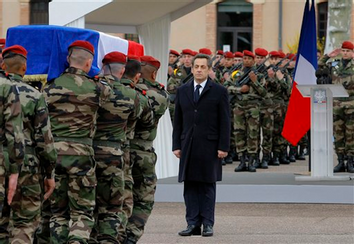
French President Nicolas Sarkozy stands by soldiers carrying a coffin during a ceremony honoring the three soldiers killed by a suspect identified as Mohammad Merah, who is also suspected in the killings of three Jewish children and a rabbi, Wednesday, March 21, 2012 in Montauban, southwestern France (Credit: AP Photo/Jacques Brinon)
This article originally appeared on GlobalPost.

The Arab-language broadcaster Al-Jazeera has received a video from this month’s killing spree allegedly carried out by Mohamed Merah, according to the French newspaper Le Parisien.

Global PostThe package was received at the station’s offices in the Montparnasse neighborhood and contained a memory card and a letter and has been given to Judicial Police who have authenticated the video, according to the newspaper.

Merah, who was shot dead on Thursday at the end of a 32-hour police siege in Toulouse, was believed to be responsible for a killing spree in the city and in nearby Montauban that left seven people dead, including three children.

Authorities had reported early on that Merah was believed to have worn a video camera as he carried out the killings.

According to Le Parisien, the package bore a postmark dated March 21, or the day Merah was cornered by police. The newspaper said investigators were working to determine if the package was mailed by Merah himself on Tuesday evening March 20 or by an accomplice on the morning of March 21.

According to Reuters, a “source close to the investigation” said the video comprised a montage and audio of Islamist war songs.

An al-Jazeera employee confirmed this account, acoriding to Reuters.

Continue Reading Close

Syria’s new war zone?

The dramatic firefight in a heavily protected Damascus neighborhood marks a major escalation in the conflict

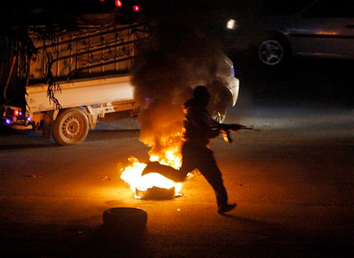
A Syrian rebel runs with his AK-47 towards a Syrian army checkpoint in a suburb of Damascus, Syria, on Saturday March 17, 2012 (Credit: AP)
This article originally appeared on GlobalPost. It was reported by a journalist in Damascus whose name has been kept secret for security reasons.

DAMASCUS, Syria — Rebel fighters landed their most serious blow yet against the Syrian regime’s security apparatus, even as dramatic but conflicting accounts emerged of what triggered an intense overnight firefight in a heavily protected neighborhood of Damascus earlier this week.

Global PostBoth the regime and the rebel Free Syrian Army (FSA) claimed as a victory the battle that eyewitnesses said began around 11 p.m. and lasted into the early hours Monday morning. The battle involved heavy machine gunfire, rocket-propelled grenades and helicopters, the witnesses said.

State-run Syria TV and Al Dunya reported that security forces attacked a “terrorist cell” living in a flat in the western Mezze district of the capital, where foreign embassies and official residences are located. It is also home to many senior figures from the ruling Baath Party, the military and security apparatus.

With armed guards on each door, security cameras and gates, Mezze is the capital’s most-secured neighborhood. Activists said Assef Shawkat, President Bashar al-Assad’s brother-in-law, a former military intelligence chief and now deputy head of the armed forces, has a home in Mezze Villas West, the scene of the fighting.

Ali Mamluk, head of State Security is said to have two houses on the same street.

Just 500 meters up the road is Mezze 86, a military housing compound home to officers and families from the army and security services, most of them Allawites, the minority sect that dominates Syria’s ruling elites.

“On this street there are dozens of the country’s senior officials and officers. They come and go in big cars with blacked out windows,” Mohammed, a 30-year-old living on the street where the fighting took place, told GlobalPost.

But for residents trying to sleep on Monday morning, the usually secure neighborhood felt more like a war zone.

“I heard shooting and looked out of the window to see large numbers of security men with Kalashnikovs and machine guns deployed around every building in the street and even on the rooftops,” Mohammed said “At about midnight there was the sound of two big bombs. We live in the most secured area of Damascus. This is the first time in my life I saw shooting.”

Official media reported three “terrorists” had been killed on an attack that left a flat burned out and pockmarked with bullet holes, while an officer and plain-clothes security member were killed.

Rami Abdel Rahman of the Syrian Observatory for Human Rights said 18 soldiers or security personnel were killed.

Speaking to Bloomberg, an FSA officer claiming to oversee the Damascus area for the rebels, said the fighting killed 50 people, 25 from each side, and had been triggered when the FSA attempted to escort a high-ranking defector from the nearby Political Security headquarters.

Maj. Maher Nuaimi said the fighting had centered on the political security building, not the flat broadcast on state-run TV, and had drawn in dozens of night guards who “didn’t even know who was fighting who.” Nuaimi claimed the defection was a success but declined to name the official.

A second eyewitness who spoke to GlobalPost said residents believed an FSA unit was indeed attempting to extract a high-ranking defector, and regime security forces had tracked them to a flat and destroyed it, killing all inside.

Syriandays, a Syrian website close to the regime, reported “an attempt to kidnap a senior officer but security forces foiled the plot.” But it did not name the officer.

A defected former member of Syrian intelligence with contacts to an FSA unit in Damascus, meanwhile, told GlobalPost the attack had in fact been an assassination attempt against Shawkat, Assad’s brother-in-law.

“There were 10 guys from an FSA unit who attacked Shawkat’s home with Kalashnikovs,” he said. “The regime sent a helicopter to light up the street so there was nowhere for the FSA guys to hide or to escape in their car. They ran to a flat used by the FSA which was destroyed with RPGs. All 10 died.”

Foreign media are banned from reporting independently in Syria and the account of the attempted assassination was impossible to verify.

Whatever the trigger for the firefight, a Damascus-based political analyst said the fact that such street fighting had come to the Syrian capital represented a serious threat to the regime’s grip on power.

“The Mezze attack opened the eyes for people in the capital about the regime’s control on the ground. This was a big escalation,” he said.

“If defected soldiers and officers can carry out such a big attack in the heart of Damascus this means they can hurt the Assad regime, even though it began to control much of Homs, Daraa , Hama, Idlib and Aleppo’s countryside. If the regime loses control of Damascus then the regime’s days are numbered.”

Hugh Macleod contributed reporting from Beirut.

Continue Reading Close

Syria’s devastated economy

The middle class stood by Assad because he delivered stability and prosperity. Then the uprisings began

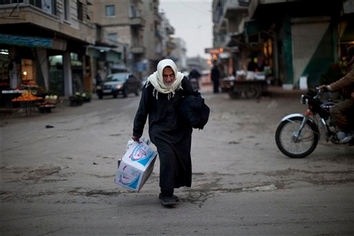
A woman walks in a street market downtown of Idlib, north Syria, Wednesday, March 7, 2012. (Credit: AP Photo/Rodrigo Abd)
This article originally appeared on GlobalPost. It was written and reported by a GlobalPost correspondent in Damascus, whose name has been withheld for security reasons.

DAMASCUS, Syria — After a 20 percent pay raise took his monthly salary to about $500 at a state-run company here, Abu Bassam was doing better than your average Syrian employee.

Global PostThen began the uprising against President Bashar al-Assad.

Now, state oil revenues have been slashed under crippling international sanctions. Tourism is nonexistent, and confidence in the economy is at an all-time low. As a result, the Syrian pound (SYP) has lost a full 50 percent of its value, falling to the psychologically hard-to-stomach yardstick of SYP100 to $1, compared with SYP48 when the crisis began.

“So now my salary is actually $250: In a year, I lost half my monthly salary while prices of commodities doubled,” said the 50-year-old, a father with four children in school and a three-room home in the struggling Damascus suburb of Hajar al-Aswad.

On his way into work, he said, the usually tight-lipped passengers on the minibus now all chat away about money and prices. And when he returns home ready to enjoy the traditional, leisurely mid-afternoon lunch, Abu Bassam now often finds his wife driven to distraction by pressures on the family purse.

“Usually my salary covers all our food and bills for the month. But this month my wife told me the money had run out after just nine days,” he said. “I don’t know what to do. She went to buy some commodities and came back from the shop very upset because the price of sugar is now 110 Syrian pound, whereas it was 75 just a few days ago.”

Staples like rice and eggs have tripled in price over the year, while cooking oil has doubled, according to residents of the capital. Bakeries, subsidized by the state, have held their price of SYP15 for eight pieces of traditional flat bread.

But with electricity blackouts 12 hours a day hitting even middle-class neighborhoods not involved in protests, the bread makers have struggled to meet demand, leading to long lines. Those who can afford it now buy bread from the black market, where it costs 50 Syrian pounds a pack.

Shortages of diesel and heating oil have also hampered bakeries, as well as transport. That has left families cold through the winter months, spawning a flourishing black market with traders buying precious supplies, often through contacts in the regime, for the subsidized price of 15 Syrian pounds per liter and selling it for 35 Syrian pounds.

For the first time in a generation, residents of Damascus have seen massive lines of cars, jostling two by two at petrol stations as the once rock steady government-backed prices begin to unravel, climbing from SYP40 for a liter of gas to SYP50 recently, and up to SYP150 on the black market.

The arrival of a delivery tanker at government-run gas stations has begun triggering chaotic scenes among drivers desperate to fill up, darkening the mood among the capital’s already stressed taxi drivers, who have hiked their prices well beyond the meter.

Last month, Faisal al-Qudsi, the son of a former Syrian president who was involved in the country’s economic liberalization, told the BBC that the economy was being crippled by foreign sanctions, particularly on the oil sector, and that the Central Bank’s reserves had fallen from $22 billion at the beginning of the crisis to about $10 billion.

Qudsi said Iran was sending “quite a lot of cash” to support Syria through Iraq, but it was not enough, adding that most of the top businessmen he knew had left because of fears for their safety.

The government initially spent $2 billion defending the local currency, but Mohamad Nidal al-Shaar, the country’s economic minister, said in January that the government’s priority would be protecting its foreign currency reserves.

Economists said the crashing value of the Syrian pound reflected a widening gap between supply and demand of hard currency dollars, suggesting the state has indeed rolled back its previous support for the national currency.

In the marketplace, the Syrian pound is losing value so fast that traders in Damascus said they were struggling to price goods one day to the next.

“I didn’t know what to do last Thursday,” said Muhanad, a 45-year-old businessman with a small electronic goods store. “I had to tell my staff not to sell anything more because I could not decide the price. One day a computer monitor is worth 38,000 Syrian pounds, but the next day it’s worth 50,000.”

But if the value of his stock is temporarily on the rise, the long-term business prospects look bleak for traders like Muhanad, a member of the Sunni middle class, whose support for a regime led by an Allawite minority has been vital over the decades.

With tight controls on hard currency savings and transfers, small businesses like Muhanad’s must pay for imported goods in euros or dollars bought with Syrian pounds. The Central Bank’s official rate may remain unchanged at just over SYP59 to the dollar, but businessmen like Muhanad know the real worth of their companies and savings are in rapid decline.

“The business class supported President Assad for maintaining the country’s economic, political and social stability,” Muhanad said. “But if these are gone, why should we support a president who wants taxes but offers nothing in return, not even protecting the national currency?”

Continue Reading Close

The Taliban vows revenge

After a U.S. soldier's alleged shooting rampage, the militant group swears it will retaliate

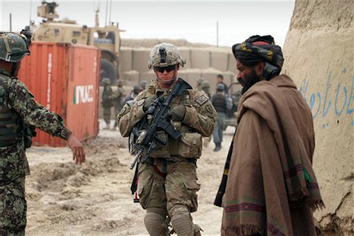
A U.S. soldier stands outside a military base in Panjwai, Kandahar province, Afghanistan, Sunday, March. 11, 2012 (Credit: AP Photo/Allauddin Khan)
This article originally appeared on GlobalPost.

The Taliban has vowed revenge against the U.S. after an American soldier allegedly went on a house-to-house shooting rampage in Kandahar province, killing 16 Afghan civilians — including children — on Sunday.

Global PostIn a statement Monday on their website, the militant group pledged to “take revenge” against the “sick-minded American savages,” according to the AFP news agency.

“The American ‘terrorists’ want to come up with an excuse for the perpetrator of this inhumane crime by claiming that this immoral culprit was mentally ill,” the Taliban statement reportedly said.

“If the perpetrators of this massacre were in fact mentally ill then this testifies to yet another moral transgression by the American military, because they are arming lunatics in Afghanistan who turn their weapons against the defenseless Afghans without giving a second thought.”

Last month, the burning of copies of the Quran on a NATO military base triggered violent protests across the country and a spate of insider attacks against Western soldiers.

Afghan soldiers killed six U.S. troops as violent protests wracked the country.

As a consequence, U.S.-led forces in Afghanistan stepped up security in case of retaliatory attacks, with the U.S. Embassy warned American citizens in Afghanistan of potential reprisals, CNN reported.

However, reports of the attack remain confused, according to NBC News.

U.S. officials say only one soldier, described in several media reports as a veteran American army staff sergeant, was involved.

CNN cited NATO’s International Security Assistance Force as also saying the soldier acted alone, and turned himself in after opening fire on civilians.

However, villagers and other Afghans claimed it was a group of soldiers, NBC reported.

Fox News cites Afghan officials as saying nine of the 16 victims were children and three were women. They said some of the bodies were also found to be charred.

The Obama administration has vowed a rapid investigation and promised to hold whoever was behind the violence fully responsible.

President Barack Obama called the middle-of-the-night killings “tragic and shocking,” CNN reported, offering his condolences to Afghans in a phone call to Afghan president Hamid Karzai.

However, Karzai reportedly called it an “unforgivable” crime.

A statement from his office said the killings took place in  the Panjway district, about 15 miles southwest of Kandahar.

Haji Agha Lali, a member of the provincial council, told CNN the soldier had attacked four houses in two nearby villages.

Continue Reading Close

The Syrian Army’s campaign of terror

When we returned to the site of a protest, the military had already been there -- and committed mass murder

A Syrian forces tank moves along a road during clashes with the Syrian army defectors, in the Rastan area in Homs province, central Syria, on Monday Jan. 30, 2012. (Credit: AP)
This article originally appeared on GlobalPost. It was written and reported by a GlobalPost correspondent in Damascus, whose name has been withheld for security reasons.

SAQBA, Syria — When a team of foreign journalists entered the eastern Damascus suburb of Saqba last Friday, they were greeted by a sight that did not bode well for the Syrian regime.

Global PostRebel fighters from the so-called Free Syrian Army were protecting about 5,000 demonstrators calling for the fall of President Bashar al-Assad. One was hoisted onto the shoulders of the protesters. Victory, it seemed, was approaching. Several other neighborhoods nearby saw rebels set up checkpoints and essentially take control.

Four days later, however, GlobalPost returned to the area and encountered a very different scene.

The Syrian army had returned.

Turning off the Damascus highway east of the city, we were stopped by several soldiers manning a checkpoint of sorts. Our driver said we were foreign journalists. He looked in and waved us on. The same incident happened twice more. The soldiers had a yellow plastic ribbon tied to their jackets that clearly indicated they were on the side of the regime.

There was little sign of life other than a line of people waiting for bread outside a bakery. Parked next to them were an ambulance, a military jeep and an armored vehicle. Two men stared with open mouths as a truck laden with gas canisters entered the area, surprised they would now finally have gas with which to cook.

We continued on in search of Municipal square, where the anti-regime protesters had gathered with such hope only days before.

When we arrived, we found a scene of devastation. Whole sides of homes had caved in, exposing the everyday household items inside. An electricity pole was smashed in half close to the ground, splinters standing vertical high into the air. Only a tank shell could have caused such damage. Local men held up large shell casings for us to see.

“They arrived Saturday and blew us away. There were Hezbollah soldiers with them,” said one man, when asked about the nationality of the soldiers. He said he knew this because he recognized their accents.

We were taken to a mosque just off the square. A gaping hole had been blasted in the side of the mosque’s minaret. I asked if the rebels had been inside.

“There was no one there — if they [the rebels] were inside they would have been at the top,” said one man. The hole was about halfway down the minaret.

A man carrying a bag of fruit whistled to get my attention and gestured for me to follow him. I hesitated, more concerned with the crowds of men gathering around us. I warned them to disperse. Military vehicles were close by. Machine-gun fire crackled in the distance. It was cold. Several angry men asked if we were from Russia, one of a dwindling number of countries that still supports the Assad government.

The streets were almost empty. A carpet of glass, rubble and metal covered the wet concrete. Fear gripped me — the area was clearly under government control once more, and there may have been snipers looking out for any remnants of the rebels.

We walked briskly, one by one, down a side street and through narrow passages dividing houses. We came to a clearing and the man with us called to another now close by.

“Do you have the keys?” he asked the second man. He then opened a large metal door that appeared to me to be the entrance to a hospital. It was, in fact, a school, long closed down. In the corner were a half dozen pine trees. Under them was an uneven lump on the ground, covered in plastic. Another man joined us and began to peel back the plastic sheeting.

It was difficult to look at the disfigured, swollen faces. One body had its eyes missing. Another was blackened.

“They killed him as he was lighting a fire in his house. Then they threw him into it,” said one of our guides.

“There are six men here, they were all killed in the last few days,” said another.

“We are hiding them here so that we can bury them ourselves. If we go to a hospital [the security] will take them and we won’t even get a burial. They already took one body,” he added, anger deep in his voice.

There was no real smell — it was too cold. Their hands were bound, as is tradition with the dead here in order to avoid the effect of rigger mortis. Photos were taken and questions asked. There were several other sites where locals were holding their dead relatives in a state of limbo, they said.

“People are burying their dead under their houses — there is nowhere else to take them,” said one man. After about 10 minutes we left the communal grave. If the army or security found us we were likely to be shot too. We were now witnesses to the regime’s death squads.

We headed back in the direction of the square and our waiting car. On the way we walked over glass and mangled metal, shops without window fronts, televisions exposed to the rain. There were no people in these destroyed homes.

We jumped back into the car where our driver was waiting for us.

“Who will pay for all of this?” asked a young man passing by in his car, pointing at the destroyed buildings around us. “We will pay. I hate the Free Army — they brought death and destruction to our homes.”

“When the army comes and they see people on the streets with guns and shooting of course they will try to kill them. They think this is their job,” he added.

Through the square, a government convoy rolled by, made up of multi-purpose vehicles painted blue to give the impression they were police, as opposed to military. In a 32-seater bus sat dozens of soldiers, guns sitting on their laps. The young man crouched next to the car out of their view.

On the way out of the town, I spotted the green of the free Syria flag painted on a wall. We stopped at each checkpoint, and at one a soldier opened the glove compartment of the car. But he let us go. The soldier guarding the next checkpoint was Alawite, said our driver, able to tell from his accent. Alawite is a minority Shiite sect in Syria to which the ruling elites belong.

“Come over here and see what the fighters did here,” the Alawite soldier urged us. We declined, keen to get out of this fresh and bloody war zone. The bizarreness of returning to the center of Damascus, where life continued in apparent normalcy, was astounding.

The men I met in Saqba were not freedom fighters, and they were not political. But the death and violence brought on by Syria’s now civil conflict have tied them up in a struggle between life and death. For them to even be seen talking to journalists would in all likelihood lead them to a tortuous end. The other districts east of the capital, which were celebrated as new centers free from Assad last week, have also now fallen.

With the withdrawal of the Arab League monitors and most foreign journalists, Syrians are again on their own. Tanks and checkpoints have returned to several other towns around the capital. Locals fear the army is gearing up for more assaults, something it can now do uninterrupted and out of sight.

Continue Reading Close
www.salon.com/writer/globalpost/index.html