A 20-foot effigy of George W. Bush was toppled in London’s Trafalgar Square last night. Around 150,000 people jammed the square to cheer, whistle and blow foghorns as the statue crashed to the ground under the imperious gaze of Lord Nelson. It was the climax of an exuberant and largely good-natured seven-hour protest against George Bush’s state visit to Britain.
Drums and dancing, whistles and songs, foghorns and chanting were the character of the day in this massive anti-Bush rally, with most of the demonstrators completely unaware of the appalling events in Istanbul. Meanwhile, organizers claimed the biggest workday demonstration in the history of the country, as many thousands of people quit work, school or college to flood the capital. And the numbers jamming London’s streets for the symbolic march past Parliament and along Whitehall were swollen by over 5,000 police officers marshaling the demonstration. Add twice that number of officers deployed in security measures around the city, while an estimated 400 U.S. Secret Service agents patrolled the shadows and the rooftops. Police helicopters buzzed overhead in constant motion.
The police in their luminous yellow jackets stood guard at the interface of two cultures. On the one hand, the pessimistic culture of Security: paranoid, sullen and suspicious. And on the other, the optimistic culture of those who feel merely Insecure, but who believe they can change things by crowding the streets with their bodies in a carnival-atmosphere affiliation of the people.
Ironically it was supposed to be George Bush, Tony Blair and the queen who were throwing the party. This was the first “state” visit of an American president since the end of the First World War. And what is this “state visit” thing? After all, Bill Clinton used to drop in on an almost casual basis and without all the pomp, never mind the protest. The difference is the “head of state” has invited the president this time. And the head of state in Britain is not the prime minister. It’s the queen.
For George Bush this would normally mean red carpets, the paralyzing corset of white-tie dinners, 41-gun salutes by guys in furry hats, the gleaming blond-plumed horse guards, and baroque open carriages trotted along the Mall as tourists and royalty junkies wave paper flags. But this year the carriage has been mothballed and the horses stabled. George was, instead, helicoptered in the dark into the grounds of Buckingham Palace in a modified gunship. A bizarre “welcome” was laid on after breakfast the following morning, with the president driven 100 yards inside the Buckingham Palace compound to be greeted by the queen and her phalanx of retainers in 18th century livery.
This exhibition of depressed panoply took place so that he wouldn’t have to see the tumultuous and ebullient demonstration about his presence going on outside.
But that doesn’t deter the marchers, many of whom have traveled great distances to join this protest. One contingent has made a grueling 10-hour overnight journey by bus from Glasgow, Scotland, but they’re buoyed up by enthusiasm for the march. Parading screen-printed orange flags bearing the slogan “Globalise Resistance,” Liam Gotch is among them, carrying his 3-month-old daughter, Rebecca, in a sling. “I’m here with my daughter to say that Tony Blair and George Bush’s foreign policy is not acceptable. We’re a peaceful group from Scotland and we’re here today to make a stand.”
Elizabeth Bashir hears us talking. She’s 60 and the last demonstration she attended was an anti-Vietnam War march. Her granddaughter found the information about the march for her on the Internet. “I fear for what we’re leaving behind for the younger generation,” she says, nodding at tiny Rebecca. Is this demonstration any different from those of over 30 years ago? “They used to be so sedate!” This march hasn’t even got underway yet and she has to shout over the sound of whistles, horns and constant drumming. “This is chaos. But I’m enjoying it.”
Globalise Resistance is typical of many of the groups comprising the march. Gill Hubbard, a striking woman in her 30s, explains to me that, “It’s a fusion of antiwar, anti-corporate and anti-capitalist groups and individuals. Bush is the biggest terrorist threat to world peace.”
And it’s clear from the multicolored variety of placards that while foreign policy is today’s focus, it draws in its wake a raft of other issues: There are banners against McDonald’s; posters against Bush’s abortion policy; billboards about the Health Service; flags about Palestine; and even a sole protester holding aloft a hastily improvised but baffling piece of cardboard imploring us “Do You Remember?” Well, OK, but the core energy, the hard middle, is all about George Bush, Tony Blair and Iraq.
The muster for the march takes place in Malet Street and is scheduled for 2 p.m., but the number of demonstrators is so great that the police hold back the march for almost an hour to clear greater passage ahead. The line is to be headed by the huge effigy of George Bush and a mock-tank, pink, decked with balloons and driven by children. There are lots of kids here. And many elderly, quite frail people. It seems an unlikely prospect among the face paintings and the constant drumming and the upbeat festival vibe of the crowd, but the nightmare for the security forces is the double threat, from the hard-case agitprop contingent hell-bent on leading the march into violent confrontation with the police, and the idea of terrorists lurking behind the carnival mask.
With bobbies called in from all over the country to buttress the Metropolitan police force, the security operation is estimated to cost 10 million pounds. London wants the rest of the country to share in the bill. Hey, only London gets to sit down at the banquet, thinks the rest of the country: It’s your bill and you can bloody well sort out the tip, too.
Though even this jaw-dropping level of security is not enough to satisfy U.S. security officials. They want closure of the London Tube network. A rumor sweeps the crowd that they have asked for immunity from prosecution for any of its rooftop sharpshooters who accidentally takes a bead on a protester. Oh, and the rumor goes, they’ve been given that reassurance. From the top.
Right.
The core of the protest is the Stop the War Coalition. It is a broad affiliation of peace activists, trade union groups, church assemblies, teachers’ and students’ organizations, Muslim groups, members of parliament and rainbow political alliances. Some impressive cells inside the complex and fluid biology of this behemoth include London American Students Against the War, the New Eton Socialist Party (er, yes, Eton, England’s most elitist private school), Ravers Against the War (a group of drum ‘n’ bass DJs, MCs and fanatics who are opposed to the war, and who organize street and field parties) and the Young Muslim Sisters London. It’s a gala of British diversity you are unlikely to find assembled under one banner under any other circumstance.
Foreign Secretary Jack Straw, a man who has the misfortune of looking like Heinrich Himmler with hair, dismissed the protest in advance as “fashionable anti-Americanism.” He would know, since he was present at a lot of marches in the days when a young careerist politician desperately needed to be seen at such fashionable events. But in Trafalgar Square, speaker after speaker goes out of his or her way to deny this. One of the most popular speakers is Vietnam veteran Ron Kovic. There are plenty of American flags at the demo, too. And one hand-painted sign reads: “Warm-hearted, Generous American People, WHAT IS YOUR COUNTRY DOING?”
Many Americans are marching. One group marches under the slogan “Proud of My Country, Ashamed of My President.” Numerous individuals have made it here. Faith McDonald, 20, is from Cape Cod, Mass., and she’s over here studying English. Faith also traveled overnight to take part. “We don’t live in a democracy. No one’s listening. Blair and Bush operate without the checks and balances that should come with a democracy. But by being here today this is democracy. This is a place to start.”
There’s a greater awareness among Brits that there is resistance in the United States. It’s just that to a lot of British people George Bush represents the worst of all things American. He’s the right-wing Christian crusader, the toxic Texan who refused Kyoto, the poll-cheat eel who undermined democracy on the back of something called chads, a notion we’ve never entirely grasped. He’s the plutocrats’ puppet. He’s the fundamentalist cowboy.
And he represents, above all else, the great failures of democracy. A word I keep hearing, mainly from younger people, is the “plutocracy.” It hasn’t eluded attention that Bush’s Cabinet is the wealthiest in history, the 16 members squatting, in their palatial bunkers, on an average of $11 million apiece. Or who his financial backers are. Plutocracy. It has a perfect nuance: chilly, inaccessible, icy-rich. This march is about democracy standing up to the bullying plutocracy.
I also frequently hear people offering up a “bushquote,” with or without Texan accent. He’s reported to have said, “More and more of our imports come from overseas.” When asked by a British child what the White House was like it’s claimed he said, “It’s white.” And to Tony Blair, he was quoted in the Times of London as saying, “The problem with the French is they don’t have a word for ‘entrepreneur.’” It seems important for the marchers to repeat these stories to establish how stupid he is. The idea that no one stupid gets to be president of the United States is shelved. Is that because dangerous and stupid is more threatening than dangerous and smart? Or less? It’s a tough call.
Tony and Her Majesty came up with this plan for the state visit two years ago, just after the Taliban had been chased into the caves. No one on the English side of things quite foresaw Iraq unfolding. In the White House — the place that is white — one suspects they did. This visit has come at the worst possible time for Tony Blair. He’s reeling from the loss of credibility in the failure to find WMD, on the basis of which this war was sold to the British public; in the wake of the public inquiry into the suicide of Dr. Kelly; and from the apparent inability to make progress in Iraq. The last thing he needs is massive and popular demonstrations against his foreign policy. George, on the other hand, stands to collect an album of regal and legitimating photo opportunities to show the folks back home. He’s got nothing to lose and plenty to gain. Just so long as they can keep him away from the noise of the demonstration. As he and Tony frequently point out, they are glad they live in countries where folks have the freedom to protest.
And, of course, cushioned deep in Buckingham Palace and surrounded by state-funded aides, flunkies, valets, servants and security men, the freedom not to listen to that protest. Tony and George might even have been cheered by a poll published the morning before the demonstration that suggested 46 percent of Brits thought that the visit should go ahead.
But the marchers think differently, and the loudest whistles and jeers and drumming frenzy is reserved for the shuffle past Whitehall and 10 Downing Street. Meanwhile the river of bodies is so broad that there are currents in the flow: faster at the edges, fast too in the midstream but inclined to eddy there, sluggish in the channels. Depending on the current you find yourself in it takes about two and a half to three hours for the stream to pull up at illuminated Trafalgar Square. When the effigy of Bush starts to topple, thousands are still marching way back and proceeding toward the electrified atmosphere of Trafalgar Square.
The toppling of the gold-painted statue, constructed from papier-mâché, chicken wire and cardboard goes ahead anyway. The effigy has Tony Blair in Bush’s pocket, holding a missile. At least it could be a missile. George nurses the weapon uncomfortably in his lap and the testicular-like bulges at the base of the missile are surely coincidental. When the statue of Saddam Hussein was dragged down in Baghdad the event was watched by about 150 people. Here by a hundred times that number, and in a finely staged moment of theater. Just as in the original event, it seems at first that the thing wouldn’t come down and we might have to ask for help from the U.S. Marines. But no, they’re just kidding, and following a New Year’s Eve style countdown George bites the dust.
It marks the end of an extraordinary day in London. One can only wonder if George and Laura, deep in the icy fastness of plutocracy’s halls of stone, ever get to hear about it.
That furry cup, when first exhibited in New York in 1936, caused an absolute sensation. Of all the surrealist art on show, this was the one that got the town talking. Well, it was a good one: funny, poetic and deeply transgressional all at the same time. It hit the spot.
After all, Meret Oppenheim’s “Object,” a cup, saucer and spoon covered in gazelle fur, is so surprising that its perversity is undermined by its brilliantly playful quality. And it’s still funny. But is it still poetic and is it still a transgression? In the U.K. there is a television comedian called Ali G who, confounding correctness, has made it his trademark to ask serious-minded lesbians if it is “good to drink from the furry cup.” Surrealism has long since found its way into the music-hall joke.
The poetry and transgression that was so much of surrealism’s anarchic force has been recruited into mainstream culture. It has been made commonplace by television and magazine merchandising, by computer games and Internet visuals, by film and MTV, by the fashion shoot. Every day the eye is subject to a thousand tiny shocks as a thousand industries compete for the eye-kick, the visual hook that will lock the consumer into product for that crucial second where the tiny — or not so tiny — leap of the imagination is made. And what does it better than sex? We’ve been educated out of the shock of surrealism, and as for the sexual frisson so central to this art movement, it sometimes seems that there isn’t a lot left to surface. Unless it runs to the very dark.
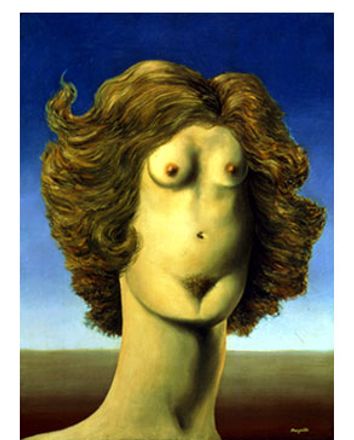
Which brings us to “Desire Unbound.” It is a wonderful, bulging compendium and, as the title suggests, the focus is on the sexual response. The surrealists saw desire as the hidden voice, the key to the true nature of the inner self. This brilliantly curated exhibition now open at London’s Tate Modern through December (and traveling to the Metropolitan Museum of Art in New York Feb. 6 to May 12, 2002) offers a kind of essay on the unfolding nature of the artists’ preoccupations with desire.
But in that there is a problem. A series of chambers, differently mooded with subtle lighting, suggest different states so that the visitor walks through a mentalistic universe. The entrance contains a spectacular hanging of that great icon of the movement, “Men Shall Know Nothing of This” by Max Ernst. The work is suspended uniquely in a black light chamber, the visitor kept at a distance, peering in, while a heartbeat throbs violently. It promises the excitement of a dream to follow, but it doesn’t quite deliver. Each chamber carries an enticing label such as “The Bride Stripped Bare,” “The Accommodations of Desire and Her Throat Cut,” and the exhibits are conceptually grouped. But sometimes it’s a bit of a stretch to go with the concept.
It’s a rationalization of swinging emotional states: clever stuff, but strangely at odds with the search for the unconscious impulses and weird poetic crossovers that surrealism is all about. Maybe the designers of the exhibition were straining a little too hard here, not entirely trusting the art to do its job. In some ways the exhibition is more rewarding if you forget about the conceptual grouping and wander the moody halls making your own connections. The overintellectualization of surrealism can be a bromide. A dream interpreted is a deflated dream.
The designers have worked hard on trying to create a distortion. In the chamber called “Before the Mirror” there are two translucent mirror doorways. Curator Jennifer Mundy describes their function. “People will come in and out of focus in the mirrors because of the way the light is arranged, and that’s a metaphor for desire: You want to see but you can’t see. Desire involves not getting what you want as much as achieving the object of your desire. This is an example of the ways we have tried to address the irrational.”
Through the distortions one can find clarity of purpose. It’s great to see in this comprehensive assembly work absolutely seminal to the surrealists, like Giorgio de Chirico’s mysterious painting “The Child’s Brain.” The story goes that Andre Breton saw this painting in a gallery window from a bus. So struck was he that he got off the bus to go and inspect it, and later bought it, displaying it prominently in his apartment for most of his life. It certainly is a painting that exudes a sense of repressed sexuality and withheld paternal love, and gloriously admits to so many interpretations that it defies reduction. The exhibition is crowded with gems.
There are many of surrealism’s greatest hits here, along with a lot more obscure material, and a considerable collection of pamphlets, publications, poetry and photographs connected with the movement. There is a copy of Robert Desnos’ booklet “La Liberte ou L’amour,” published in 1927 and, of course, censored. It stands open at his discourse on the Sperm Drinker’s Club. A translation from the French reads: “The Sperm Drinker’s Club is a vast organisation. Women are paid by it to masturbate the handsomest men throughout the world. A special brigade is dedicated to the quest for the female liqueur … Each harvest is stored in a small phial made of crystal, glass or silver, meticulously labelled and despatched with the utmost care to Paris. The founders of the club, top occultists, met for the first time at the beginning of the Restoration (1815). And since then passed down from father to son the society has continued with the dual aegis of love and liberty.”
There they go again, those top occultists.
Salvador Dali is well represented here — perhaps overly represented because the Tate owns so many of his famous works. Some of the pieces have been shoehorned into the concept, and he is one of the surrealists I least associate with Eros in the forces he conjures. For example, his “The Accommodations of Desires,” from which one of the conceptual chambers takes its title, seems, like much of his work, to be figured around neurosis, disgust and emotions of anti-desire. But Matisse, Man Ray and Delvaux and all the usual suspects are gathered for the party, photographed in full brigade turnout, with and without the husbands and wives they seemed to share in pursuit of the primal force generating surrealist art. You can even play the game of detecting “who went insane after sleeping with whom” in the hope of tracking down the original spirochete of madness if that sort of thing interests you.
The exhibition breaks exciting ground in the final two chambers, particularly with the work of some of the later and rather less-feted women practitioners. Surrealism was fond of casting women as muse creatures, as enigmatic child-women or alluring bird figures. Yet from the mid 1930s a new generation of women artists were attracted to the movement, and the self-representations move from the sexually passive to the active, to shamanistic and transformative, event threatening forms.
Dorothea Tanning’s “Birthday” is a self-portrait in which she appears bare-breasted, almost Amazonian, a scary enchantress with a skirt of swirling naked torsos and a demonic familiar spirit at her feet. Leonora Carrington’s “Cat Woman” sexualizes ancient Egyptian statuary. Eileen Agar’s blindfolded head “Angel of Anarchy” evokes a similar spooky power, as does work by Toyen and Frida Kahlo. It is clear that these women artists were working with very different elements, emotionally. (In fact Kahlo was contemptuous of the male-dominated movement.) Certainly the formulas for depicting desire are darker, and somehow more visceral.
Jennifer Mundy talks of “a sense of imminence” of this period, in which something new entered the movement. “From the 1940s,” she says, “the movement was very much connected to ideas of magic. Though many of the surrealists were uncomfortable with this turn as they felt it offered no answer to questions of Stalinism, of communism, of the atomic bomb. Though Breton himself said in 1944 that it was time to value women’s ideas over those of men, which he described as bankrupt.”
These works command a shudder of recognition that has somehow deserted many of the other, more famous, pieces, which are perhaps worn out by familiarity. Jennifer Mundy gently disagrees. “Even those who know the images well through reproductions will be drawn by the tactile, physical qualities of the exhibits. And the themed nature of the exhibition will itself have disruptive qualities.”
She goes further. “The aim of surrealism was never to be provocative for the sake of provocation only. It was to disrupt people’s way of thinking about the world and I think that challenge still poses questions for us today.”
The key to understanding the surrealists, and this exhibition, lies in the way that the surrealists saw desire as being the thing that made the imagination tick. Perhaps this is why there is a relationship between eroticism and the act of thinking itself. The imagination is not unchained at all: It is chained by desire.
The air of the visitors to the Tate while I was there was oddly muted, casual even. I did not detect the frisson, the sense of transgression one might associate with an exhibition like this. Certainly the surrealists cannot be viewed as thoroughly modern. Their preoccupations might even be said to be romantically heterosexual in character and do not confront darker matters of desire surfaced over the course of the last century — such as rape, prostitution and pedophilia.
Perhaps it is no longer possible to witness a public expression of sudden insight into the dark movements of desire in the human psyche. When a barrage of aggressive modern media has made public so much sexual content it is perhaps not surprising. Even the merchandising in the hall outside the exhibition offers a Dali Lobster Telephone Book and a surreal PVC shopping bag. Repression in the human psyche is tightly bundled. When it has been pulled out of the sprung package so often it is perhaps difficult to push it back in the box.
After all, the furry cup is on permanent exhibition in New York.
Nevertheless, this exhibition is unmissable. The sense of a movement sideways since the inception of the surrealist movement is unmissable, too: Still we strain at the bonds.
Continue Reading
Close
Everyone knows that you should never sleep with your teacher. I had an aunt who also recommended that you should never sleep with a writer, or anyone who has been on the stage. And anyone in the writing business knows that a writer should never sleep with, nor fall in love with, another writer. A worst-case scenario, then, would be sleeping with your writing teacher. You would find yourself hellbent on a desperate struggle for control of the narrative. Imagine. Two competing storytellers trying to plot an epic Russian drama. (With two writers involved, it’s not going to be a small affair, is it?)
Now, I’m not saying that Andrew Motion, England’s poet laureate, slept with his creative writing pupil Laura Fish, or she with him. As a matter of fact, what actually happened between these two people is a subject about which a really titanic struggle for the narrative is going on. For one thing, there are more than just two combatants; while it’s starting to look like Motion’s recent indiscretions with his student at the University of East Anglia are a story after all about not very much, it’s also clear that the British press have a competing interest and would like to shape a more salacious tale for their readers.
Traditionally, the post of England’s laureate goes to the cuddly poets, the relentlessly establishment Oxford and Cambridge types who mind their pens and quips when the queen is around. The laureate before the present incumbent, Andrew Motion, was Ted Hughes, an appointment that surprised everyone because Hughes was a caveman, and some sort of shaman to boot. When Hughes died, it was back to the cuddly, the safe, the reliable; and the eminently polite chap got the job. But oh dear. A sex scandal. Well, nearly a sex scandal. All right, a scandal about sex but with no sex. Certainly no Blue Dress. Please.
Motion teaches creative writing at the University of East Anglia, on an M.A. course until recently considered to be the finest in the country. He stands accused of harassment by Fish. He in turn says that Fish has been slandering him to the press, and counterclaims harassment by her. The case bubbled as the university tried to establish who did what and to whom. Meanwhile, Motion continued to give his tutorials to Laura Fish, watched over by the dear old dean of the university. Well, God bless the dean. I’ll bet you could strike a match on that atmosphere as the two politely disagree on the effectiveness or otherwise of a subordinate clause.
Neither Motion nor Fish denies that they exchanged some 40 intimate e-mails in the course of just a few weeks. Neither party denied that tutorials were concluded with a “kiss and a hug.” Also not denied was that Motion, married with three children, visited the student at her apartment. It seems that this flirtation went on for some considerable time, and to the apparent satisfaction of both parties.
Andrew Motion is not a poet in the Byronic cast. He is not dashing (except when seen hurrying away from the UEA — until recently, the only complaint about him was that he was infrequently there) and neither is “passionate” an epithet that might attach to him. On the contrary, there is about him something of the manicured and tinctured mannequin. He has a fussy — some have said foppish — obsession with grooming and exquisite designer clothes. He also speaks in an extraordinarily strangled accent, as if the snobbish and anachronistic values of Oxford gentility have only been half-swallowed. His verse is clipped, precise, brilliant and curiously antiseptic.
And the tender young mind he was alleged to have preyed upon? Laura Fish is a 37-year-old single mother. She is also the author of a published novel, and is currently studying for an M.A. at the university. Motion interviewed and accepted her into the course after being impressed by her book. She has been a teacher of writing herself, and still is.
Of course, it makes no difference how old, experienced or well-versed someone is, or whether they have a daily manicure. Harassment is harassment and the offense needs to be treated seriously. If offense it is. There is no suggestion that Motion threatened to fail Fish or adjusted grades or committed any of the other forms of moral turpitude associated with philandering professors. The exchange of “personal” e-mails had always been a two-way thing. Jan Dalley, Motion’s American wife and herself a respected writer, claimed that Fish had a “crush” on the poet and had telephoned their London home several times.
Because of the power dynamic involved, there are damned good arguments for not allowing college professors to have relationships with their students. Like lawyers and their clients or shrinks with their patients. Like agents with their starlets or editors with their writers. Like factory supervisors with their underlings or the assistant quality control manager with the subassistant quality control manager. But if we’re going to prosecute such behavior even in those cases where everyone agrees that the flirtation was mutual and authority wasn’t abused, then we’re going to need several thousand more lawyers in the land.
So what the hell was this all about? Why can’t the dear old dean be allowed to get on with his job? Well, he can now, because after a full inquiry, everyone has been exonerated. No wrongdoing of any kind found anywhere. Thank goodness.
Except that, in the process of admitting evidence, Laura Fish had a fine character reference drawn up for her by Douglas Dunn, a Scottish poet of considerable repute, an erstwhile colleague of Motion’s and — some would say — a professional rival. Motion wrote an angry letter to Dunn, hinting at Fish’s shortcomings. Dunn in turn showed it to Fish. Gosh, the press even got to hear about it. Now Fish is seeking further redress, accusing Motion of trying to ruin her reputation and endangering her chances of employment. More litigation.
Perhaps writers should never be allowed to get together in a workplace context. It’s not like studying computer science, after all. The emotions are at large, and are shared and are questioned. There is a vulnerability. Jan Dalley, a shining light in this sorry affair, has said that crushes are bound to happen in writing groups because “they talk about emotions.”
British novelist Anna Davies, who also teaches an M.A. writing course, says, “Contrary to popular belief, writers do not typically lead glamorous lives. The writer spends most of his or her time in a tiny room, trying to force words out on to a blank page or screen. It is a lonely and frequently boring existence, and sometimes you wonder if anyone is actually out there listening to you. Think how wonderful it is, then, to emerge into a room full of people who think you are something special.” Pity, then, the sap who does this for a living. And forgive him or her who thinks, when someone takes an interest, that they are living out that epic Russian drama.
Legislation against harassment has been a hard-won victory, because women in the workplace do need protection against sexual predators. But most people know the dividing line between flirting that is fun and attention that is unwelcome. Harassment legislation exists for those cases where predators persist beyond the word “no.” But after which personal e-mail does the conversation become “unwelcome”? The 40th? After how many hugs and kisses? If Fish told Motion to stop and he persisted — which doesn’t seem to be the case — then her complaint would have some grounds, but the guy is a poet, not a psychic. The mechanisms set up to protect people from workplace harassment were never created to deal with romance gone sour.
This appears to be a story of crushes and cold feet, with both people in the wrong. No one knows how it became an issue of harassment. But, with the machinery for handling genuine harassment cases in place, the university has to endure the unfolding of this nondrama as the stupidity and childishness of two “mature” writers becomes a public comedy. This is the highbrow version of running to the tabloids, a litigious rendition of kiss-and-tell. But what is most outrageous is that the dean of a university, instead of getting on with his important job, has to spend hours umpiring the cooling of an affair that never even really got going.
This isn’t the business of the dean. This is just the trailing, messy stuff of life. Perhaps it would have been better if something had happened. Closure might have come with a few bitter tears on one side or the other, instead of this endless poison dribble of litigation, feuds and press leaks. Of course, the proper, grown-up place for these writers to deal with what did or didn’t happen is on the page. With full-throttle vitriol and extreme prejudice if necessary, but neatly paragraphed and with no ineffective use of the subordinate clause.
Freud’s celebrated conclusion was that everyone who writes does so in search of “fame, fortune and the love of women.” Well, now they’ve both got the fame. Fish, who is writing a book on harassment, may even get the fortune out of all this. As for the love of women, you would have to ask Jan Dalley what she thinks of the pair of them.
Continue Reading
Close
What does celebrated English novelist Martin Amis have to do with Britain’s most grisly serial killer? Fred West was a pedophile who raped, tortured and killed, a man who even murdered two of his own children. Amis’ cousin Lucy Partington was one of West’s victims. In his new memoir, “Experience,” Amis devotes great attention to Lucy’s fate. The book flap trumpets Martin’s relationship with his father, Kingsley (a literary giant of the post-War period), and his kinship to Lucy equally. The author tells us he keeps two photos by his desk: one of Lucy and one of Delilah, his 20-year-old daughter, whom he had never met until 1995.
Now Lucy’s family — particularly Lucy’s sister Marian Partington — has gone on record saying that Amis barely knew Lucy. They claim that Amis has capitalized on his slender relationship with his cousin in order to peddle “Experience.” Marian says, “The story of Lucy is being used to sell this book.”
The Sunday Times of London recently took up Marian’s cry. Being pilloried in the press is nothing new for Amis — the British media has been air-guitaring a “greedy Martin” riff ever since he once had the temerity to hold out for a good publishing deal. He has even been accused of making money out of Auschwitz with his Holocaust novel, “Time’s Arrow.” But the complaint this time is that the tragedy of Lucy’s killing has been annexed into Amisworld, and the family is resisting his version of the truth.
Marian has contacted Amis and his publisher to complain about inaccuracies and “betrayals,” but what seems to have upset her most is the sense in which Lucy’s life has been made over by a famous author’s inauthentic account. This work, she claims, is presented as straightforward autobiography when fictional speculation often usurps the facts of the case.
Amis is dismayed. Of Marian he says that he is “distressed that she’s distressed. But I’m writing about my life and Lucy is a part of my life.” But there’s the rub: How much was Lucy a part of Martin Amis’ life?
Not much at all, according to Marian, and Amis admits to meeting Lucy on only a few occasions before her disappearance in 1973 (when Amis was 24). Yet so strongly does Lucy feature in “Experience” — in tender portraits of the two suggestive of endless country-garden English summers as childhood friends — that it’s shocking to hear claims that Amis knew the family only remotely.
Let it be said: Martin Amis has never been served well by the critics and the literary establishment in Britain. As for the tabloids, they lick their lips and their hatchets when this stuff goes down. The pyrotechnic brilliance of his style is envied and his wintry reserve is resented. But one thing generally agreed upon even by admirers is that his work is a compassion-free zone. The fashionable cynicism and frigid irony of the ’80s, during which he made his mark, are out of vogue now. He knows this.
One reads “Experience” with mounting excitement because Amis seems at last to have discovered this missing element. The memoir contains some of his best writing to date — except for this vexed subject of Lucy, where there is a dose of too much lyricism, a splash of too much manufactured sentiment.
Anyone familiar with Amis’ fiction can puzzle out the reason for this undue emphasis on Lucy, and for the artificiality of the passages about her. Amis the novelist has always had a favorite trope. His novels invariably contain working-class monsters who prey, drooling and slavering in (usually) Cockney accents, upon the innocent or naive middle classes. Amis is at his funniest and most coruscating when he makes us giggle at the dialogue, the phonetics and even the violence of these characters. Amis fils is a chip off the old block in treating anyone who speaks in accents other than BBC English (working-class Brits, country yokels, Americans) as “unbelievable,” training on them the same kind of entertained astonishment with which one might regard a chimpanzee dressed in a fez and embroidered waistcoat. He never finds a similar humor in the clipped vowels and paralyzed rhythms of British middle-class speech, and darkness always seethes, vaporous and malign, from the uneducated side of the track.
“I am a novelist,” Amis heralds at the outset of the memoir, “trained to use experience for other ends. Why should I tell the story of my life?” He pushes this further, promising “to speak, for once, without artifice.” Yet it is in turning Lucy’s story into a bit of artifice that the memoir gets stuck. Lucy is emblematic. Lucy becomes an instrument in his favorite device. The horror and the grief suffered over her fate are dissolved and reconfigured to serve the purposes of the trained novelist.
Amis tirelessly repeats that the name Lucy means “light,” that Lucy wrote poetry and studied medieval literature. An unbending ray of light, he tells us, Lucy walked into darkness, the darkness he has so often located in the predatory hearts of the working class. He juxtaposes an articulate juvenile poem of Lucy’s against a comically misspelled and Neolithic missive that the hideous West scratched out in his prison cell. When Amis learned about Lucy, he must have seen — in horrible and giant relief — confirmation of his view of the social order. His old class horror had been written in blood and light.
Amis genuinely weeps for Lucy, there’s no doubt. But he does so only because while she’s close enough to count, she’s distant enough for safety. He numbers her among his “missing,” which include his father and his long-absent daughter. At the same time he betrays no emotion at witnessing his parents’ separation, or over his own divorce; and while he squeezes out a tear when it comes to his separation from his sons after that divorce, his emotional tepidness over his “lost daughter” is — considering how much he makes of his attachment to the distant Lucy — the oddest omission of all.
For any man, meeting his grown daughter for the first time at 46 must be a scorching experience. But while Amis engages in a dignified lamentation and the construction (to say invention would be unfair) of an intense emotional response to the ultimately unknown details of Lucy’s last days, he tells us little of his feelings about the daughter with whom he is reconciled. We’re offered only the cold facts of the date and place of reunion. And yet Amis insists that his daughter’s absence has unconsciously haunted his every novel.
I don’t believe Amis ever considered that the notoriety of the Fred West case would help move copies of “Experience.” Amis is probably above all that. But in writing the book, he let the novelist take over when the memoirist should have been in charge. The underclass monster, West, and his innocent victim, Lucy, were too much like characters he could have invented himself.
Sure, “Experience” shows an evolution in Amis’ work, and a great tenderness in the portrait of Kingsley, even from a distance, as well as hurt and betrayal over his rift with writer Julian Barnes. But where “Experience” doesn’t deliver on its autobiographical promise is in its avoidance of the lesser horrors and humor of everyday defeats: the divorces, the responsibilities to your kids, the unspectacular and unsensational events.
Perhaps Martin Amis stands accused of doing no more than what all novelists do, and if “Experience” were a novel then there would be no significant charge to answer. Meanwhile, poor Lucy’s fate rightly belongs to another family’s experience, and in someone else’s memoir.
Continue Reading
Close