Greil Marcus

The rise and fall of Chet Baker

A brilliant biography chronicles the singer and musician's transition from jazz star to junkie

  • more
    • All Share Services

The rise and fall of Chet Baker

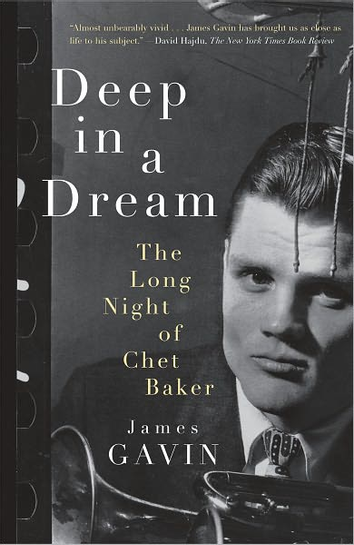
James Gavin’s book about Chet Baker, the jazz singer and trumpeter who first gained fame in the early fifties and who, only a few years later — and for the rest of his life — was better known as a heroin addict as unregenerate as any in the history of the music, was first published in 2002, fourteen years after Baker’s death in Amsterdam, at fifty-eight, almost certainly by suicide; it has only now appeared in paperback. This long lag is hard to fathom. As evidenced most strikingly in the portraits of Baker in Geoff Dyer’s 1995 “But Beautiful” and Dave Hickey’s 1997 “Air Guitar,” and in the response to Bruce Weber’s 1988 documentary film “Let’s Get Lost,” released just after Baker’s death, and screened in a restored version at the Cannes film festival only three years ago, there has always been a Chet Baker cult.

Barnes & Noble ReviewBut more than that, “Deep in a Dream” — named for a particularly affecting, cloudlike Baker recording from 1959 — is not an ordinary biography, though there is nothing unusual about its form (from birth to death and aftermath) or style (direct and clear). It is a singular work of biographical art that makes most studies of, as Hickey’s essay on Baker is so wonderfully titled, “A Life in the Arts,” seem craven, compromised, or dishonest, with the writer falling back before the story he or she has chosen to tell, for whatever reasons offering excuses or blame in place of a frank embrace of the unresolved story each of us leaves behind, producing less any sort of real entry into the mysterious country of another person’s life than a cover-up.

To put it another way: except in the rare cases of those strange creatures who, like T. E. Lawrence, create themselves to such a degree that it becomes nearly impossible to imagine that they ever experienced a trivial or even workaday moment, the dramatic sweep we find in novels or movies is not really the stuff of anyone’s life. No matter how the writer may try to have it otherwise, most biographies are simply one thing after another. The life of a junkie is not just one thing after another, it is the same one thing after another — and yet there is not a page in “Deep in a Dream” that is not engaging, alive, demanding a response from a reader whether that be a matter of horror or awe, making the reader almost complicit in whatever comes next, even when, with the story less that of a musician who used heroin to play than that of a junkie who played to get heroin, it seems certain that nothing can.

Born in Oklahoma in 1929, Chet Baker grew up in Los Angeles. He had a deep and instinctive ear for music, playing trumpet in high school, army, and junior college bands; in 1949, when he heard the Miles Davis 78s that would later be collected as “The Birth of the Cool,” Baker “connected with that style so passionately that he felt he had found the light.” That same year he was present at all-night sessions in L.A. to hear Charlie “Bird” Parker, and was shot up with heroin for the first time. He sat in with Dave Brubeck in San Francisco; in 1952 in L.A. he was called in with others to make up a group to back a wasted Parker.

That gave Baker an instant credibility in jazz. Ruined or not, Charlie Parker, with Dizzy Gillespie the progenitor of bebop, was the genius, the savant, the seer, the stumbling visionary who heard what others could not and could translate what he heard into a new language that others could immediately understand, even if they could never speak it themselves. If Parker said that Baker’s playing was “pure and simple,” that it reminded him of the Bix Beiderbecke records he heard growing up in Kansas City, that made the perhaps apocryphal story of Parker telling Gillespie and Davis, “There’s a little white cat on the coast who’s gonna eat you up” almost believable. But it was Baker’s face — as much or more than his joining in a new L.A. quartet with Gerry Mulligan, the baritone saxophonist and junkie who had played on the “Birth of the Cool” sessions, or Baker forming his own group and then headlining at Birdland in New York with Gillespie and Davis below him on the bill — that made many people want to believe it.

Well before the end of his life, after he had lost most of his teeth in a drug-related beating in San Francisco, after he had turned into as charming, self-pitying, manipulative, professional a junkie as any in America or Europe, where for decades he made his living less as a musician than a legend, Baker wore the face of a lizard. In some photographs he barely looks human. But at the start he was, as so indelibly captured in William Claxton’s famous photographs, not merely beautiful, not merely a California golden boy — in the words of the television impresario and songwriter Steve Allen, someone who “started out as James Dean and ended up as Charles Manson.” He was gorgeous, he seemed touched by an odd light, and he did not, even then, look altogether human — but in a manner that was not repulsive but irresistibly alluring.

His legend — the way in which, with the clarity and ease of his tone as a trumpeter, and the preternatural calm, quiet, and reflectiveness of his singing, the way in which he could, “somehow,” as Gavin quotes the Italian pianist Enrico Pieranunzi, “express the question mark of life in so few notes,” the way in which Baker was a cult in and of himself — was as the years went on not just a Johnny Thunders death watch, a spectacle of self-destruction, the face of the monster slowly grinding down the memory of the angel. Rather it was, through all the years of working less as a musician than as his own pimp (“One uninspired night at the Subway Club in Cologne yielded three albums”), of a self-degradation so extreme it had to be, in its way, its own reward (“Waking from a nod … he found his face crawling with cockroaches …”), the chance that the pure talent, as a thing in itself, might still be there, might still emerge on any night, in any song, and then, again, vanish, humiliating the man who could not find his voice at will or even refused to, and mocking the memories of those who could not admit that they had not heard what they thought they heard.

Behind its own face, the legend was that of the solitary betraying his own talent, his own gift, and that solitary betrayal raising the specter of the smaller but no less real betrayals of anyone in any audience, one man standing for, and exposing, the self-betrayal of everyone else. “All this criticism,” Gavin writes of Baker’s crash in the then all-important jazz polls in 1959 — after a phony cure at the federal facility at Lexington, in 1950s jazz lore almost as storied a place as any nightclub in Manhattan, after four months at Rikers,

implied Baker had let everyone down, dragging an American dream through the mud. ‘Chet had the world at his feet in the fifties,’ said John Burr, one of his later bassists. ‘He consciously turned his back on it, and used drugs as a means of doing it. That’s what he said about it.’ Baker made no apologies. ‘All the attempts to get him off heroin — he didn’t want to get off heroin,’ said Gerry Mulligan. ‘That, of course, is heresy in the modern world. You’re supposed to be going, “Mea culpa, mea maxima culpa, oh God, help me.” Chet didn’t give a damn.’

In Gavin’s hands this is a long, long story of infinite shadings, where every incident that is formally the same as every other nevertheless has its own color, tone, and sound. He never attempts to ingratiate himself into the story, to wrap himself in its putative hipness when Baker seemed the epitome of cool; he never preens in knowingness, or feigns intimacy with Baker when Baker is the epitome of everything desperate and sordid. He places hip words or drug language in quotes or follows them with explanatory parentheses (“His arms and legs were full of bloodied ‘tracks’”), at once establishing his own distance from the story and refusing to allow the reader any false empathy or easy identification — to strip the reader of his or her own putative hipness, the hipness of anyone cool enough to want to read a 400-page biography of Chet Baker.

Gavin seems to hold all of Baker’s music, piece by piece, song by song, phrase by phrase, every show, every recording, in his head, all at once. He doesn’t give the sense of merely knowing everything — while some people in Baker’s life, such as his mistress Ruth Young, plainly opened up to Gavin with extraordinary candor and perception, not everyone would speak with him — but, through imagination as well as research, to have witnessed everything, even to have experienced everything. This is Gavin on Baker’s first recording of “My Funny Valentine,” by the sixties a jazz standard and “a pop cliché,” but in 1952 a Rodgers and Hart obscurity, recommended, in the Mulligan group, by the bassist Carson Smith:

None of Smith’s bandmates knew it, so he scrawled out the chords, then sang them the melody. Rodgers had stated a haunting theme in the first phrase, then explored it over and over, changing it subtly each time. The melody kept ascending, creating a tension that built to a soaring climax under the words “Stay, little valentine, stay!”

Mulligan and Smith threw a chart together that spotlighted Baker. Here the trumpeter had no clever arrangement to hide behind, so he played the tune as written, stretching out its slow, spare phrases until they seemed to ache. His hushed tone drew the ear; it suggested a door thrown open on some dark night of the soul, then pulled shut as the last note faded. Smith countered the rising melody with a descending line of quarter notes, ominous as a clock ticking in the dark. He ended by mistake in a minor key instead of the major one in the sheet music, giving the record one last chilling touch.

The song fascinated Baker. It captured all he aspired to as a musician, with its sophisticated probing of a beautiful theme and its gracefully linked phrases, adding up to a melodic statement that didn’t waste a note. “Valentine” became his favorite song; rarely would he do a show without it, or fail to find something new in its thirty-five bars. At the same time, the Baker mystique — a sense that “cool” was a lid on an explosive jar of emotions — had its roots in that performance.

The description is so complete that when Gavin quotes Ruth Young on the 1956 album “Chet Baker Sings,” with “My Funny Valentine” at the heart of it — “None of these songs had any meaning for him, truly. He could have been singing Charmin commercials. He was coming from a musical place, and the words were mere notes to him…” — the view of an essential emptiness behind the creation of beauty takes nothing away from it.

There is Gavin’s ability to put the reader in a room — sometimes a room so archetypal it seems less to have been constructed for any practical purpose than to have been called up by the American imagination, as when, for Baker’s monthlong engagement at Birdland in 1954, Charlie Parker, “banned from the club that bore his name,” would stand out front telling customers what a wonderful musician they were about to see, and how then — like Hurstwood haunting Carrie’s backstage door, only to be chased away to wander the streets of New York, “losing track of his thoughts, one after another, as a mind decayed is wont to do” — Parker “would sneak behind the building, walk through a back alley lined with trash cans, and knock on a door that opened into the dressing room. Baker or Carson Smith would let him in, and he and Baker would play chess until showtime. Then Parker would sit alone, keeping the door ajar so he could hear the music.”

In this book, heroin, as it takes over one musician after another, one scene, one city, one country (Gavin quotes the pianist René Urtreger estimating “that by the midfifties, 95 percent of the modern jazz players in France — himself included — were hooked”), is more than a plague, more than an endless horror movie, the reels running over and over, out of order, back to front (“It was like the Night of the Living Dead,” one fan tells Gavin of a Baker show in Paris in 1955. “Dark suits, gray faced, stoned out of their minds. Everything seemed strange to me, unhealthy. They were playing the music of the dead”). By the end — “Baker filled the syringe, then held it up. ‘Bob, you could kill a bunch of cows with this,’ he said. He plunged the needle into his scrotum.” – ”The man was a walking corpse,” the Rotterdam jazz hanger-on Bob Holland told Gavin. “He was living only for the stuff. Music was the last resort to get it” — it’s as if heroin itself has agency, and seeks out bodies to inhabit, colonize, and use up, not a substance but a parasitic form of life whose mission is to destroy its host, knowing that it can always leap to another. But the essential humanity of the host — his or her actual reality as someone who planted a foot on the planet before he or she left it, to be forgotten along with almost everyone else — is, in these pages, never reduced, whether it is that of Baker, or any of the musicians, friends, wives, or lovers trailing in his wake, those he knew and those he didn’t (from one dealer’s client list: “Bobby Darin, Miles Davis, Thelonious Monk, Anita O’Day, Lenny Bruce, and the rock star Dion”), by 1981 “a growing trail of corpses.”

In this book, like Baker’s fans, listening to a radio broadcast from Hannover, Germany, on April 29, 1988, where Baker was to recreate his 1954 album “Chet Baker with Strings,” only days before playing in the street in Rome for drug money, they are somehow all present in the audience as Baker played. “With every defense shattered,” Gavin writes, “he lived the songs with a painful intensity. The concert peaked with an epic nine-minute performance of ‘Valentine.’ Baker opened it with a trumpet chorus backed by guitar only, a chillingly stark musical skeleton; from there, his hollow, otherworldly singing drifted on a cloud of strings.” And then, less than two weeks later, in Amsterdam, he propped open the window of his third-story hotel room, and crawled out.

Philip Roth’s playful, unpredictable “Nemesis”

The literary icon's latest novel considers the effects of a polio epidemic in 1940s New Jersey

  • more
    • All Share Services

Philip Roth's playful, unpredictable Nemesis, by Philip Roth

On the “Books by” pages in Philip Roth’s books, he likes to group his titles, often by their lead characters. There are the Zuckerman books, with Nathan Zuckerman leading a long quest to know both his own heart and that of his country (and these themselves grouped, with the first four, from 1979 to 1983, as a quartet; “American Pastoral”, “I Married a Communist” and “The Human Stain”, from 1998 to 2000, as a trilogy; and “The Counterlife”, from 1986, and “Exit Ghost”, from 2007, floating on their own). There are the three Kepesh books, with the increasingly curdling, unknowing David Kepesh; and Roth books, with Roth himself as a fictional character (even in “The Facts”, which suspends its subtitled premise as “A Novelist’s Autobiography” when at the end Nathan Zuckerman shows up to urge Roth not to publish it). There are Miscellany (criticism and reflection) and Other books, which include some of the most memorable: “Portnoy’s Complaint” (1969), “The Great American Novel” (1973), and “Sabbath’s Theater” (1995).

Barnes & Noble ReviewUp until now, Other is where the very short novels Roth has been publishing since 2006 — starting with “Everyman”, then “Indignation” (2008) and, at about 25,000 words, the very, very short “The Humbling”(2009) — were placed. With “Nemesis,” the four books are placed together, as Nemeses, and that is how they should be read: as a wildly varied single work, even if the group title is, for me, misleading. “Nemeses” implies different nagging, ever-present, elusive, daunting and finally indefinable and even unbeatable enemies that one must struggle against nevertheless. As I read, death is the single nemesis in these books, one after the other, even if in “Nemesis” Bucky Cantor is there at the end to tell his story — the story of a life given up to death many years before.

Those who seek to pin a novelist’s every offering to his or her real life — mining for nuggets of what people who fundamentally mistrust fiction can take as merely disguised but fact-checkable autobiographical truth, or in some way paralleling the writer’s status in life as a book appears — will not find satisfaction here. “Everyman”, set after the terrorist attacks on the United States in 2001, concerns the slow, almost mechanical death of an unnamed 71-year-old man from Elizabeth, N.J., who survives a torment of surgeries and replacements until, finally, he doesn’t. Well, with the lack of a name allowing the hero, or victim, to be everyman, or one man in particular, you could have read that as the author’s working out of his own fears of inexorable diminishment if you liked. Written in the third person, the book is stolid, mechanical, banal and unconvincing — jerry-built. It’s as if the form — the telling of a whole life as it crumbles, in not very many pages, an argument finally that at its end almost any life can feel as if it is caught up short, and thus can be caught short — defeated the writer. But then with “Indignation,” Marcus Messner of Newark is a sophomore at a small college in Ohio — or rather was, as he is telling his story from beyond a very recent grave — and Roth is speeding the tale on winds of glee, fury, rebellion, laughter and confusion (“because I was a Jew, because I wasn’t an engineering student, because I wasn’t a fraternity boy, because I wasn’t interested in tinkering with car engines or manning tugboats, because I wasn’t whatever else I wasn’t … “) that haven’t been at his back since “Portnoy’s Complaint”.

Only a year later in publishing time, with “The Humbling,” set in the publishing present, there is Simon Axler, a renowned dramatic actor in his 60s recently abandoned by his wife, overwhelmed by an all but absolute suicidal depression, then rescuing himself with an affair with a 40-year-old lesbian, an affair he convinces himself will last the rest of his life and make it new every day. Again written in the third person, the book is warm, desperate, passionate, funny, with the man and the woman springing to life in a few sentences and then sent on their way. The story goes to sexual extremes — extremes that quickly reveal one life to the man and another to the woman. But her new life is real and his is a fantasy, and so he returns himself to real life with the reality that can’t be gainsaid; as he was about to do when the novel began, he kills himself. There is no hint that it was anybody else’s fault. There was a truer rescue hidden in the story, but he couldn’t see it — or rather there was another woman in the story, no older than the woman he fell in love with, but he was not attracted to her, and without that, the hidden rescue is just the reader’s fantasy, and the novelist’s proof that, as Axler says early on to a doctor, “‘Nothing’ has a good reason for happening.”

With “Nemesis” Roth leaps back again, to Newark in 1944, in the summer, polio season — but this year, the worst outbreak of polio in a lifetime, and long before there was even a glimpse of a vaccine. The fact of the eradication of polio, an affliction unknown in the lifetime of most Americans now, only makes Roth’s recreation of the disease all but horror-movie immediate: unstoppable, unpredictable, unknowable, evading diagnosis until it is too late, with cases spreading through a neighborhood by the hour and children dead overnight or consigned to an iron lung for the rest of their lives (and what is an iron lung, any reader might have to ask, only to find out, and then be horrified at how polio could redefine everyday life?).

Bucky Cantor, excluded from the Army because of his bad eyesight, is a young playground director at a Newark public school. He comes burdened with stones: His mother died in childbirth, his father was a convicted felon, he was raised by his mother’s parents, and as the story opens his grandfather, a rock, is three years dead. Bucky — the nickname his grandfather gave him when, working in the family store as a boy, he showed guts, quick sense, pluck, bravery — has disciplined himself for life. A career as a public school teacher is as noble a calling as he can conceive — and as it is a noble calling, it will demand everything he can give. He can never surrender to fear, temptation, sloth, pleasure, doubt. As we meet him it is easy to believe that he won’t.

“Mr. Cantor had been 20 and a college junior when the U.S. Pacific Fleet was bombed and nearly destroyed in the surprise attack at Pearl Harbor on Sunday, Dec. 7, 1941,” reads an early passage, and any reader might ask — why are you telling us all this? Even if I don’t remember polio, I’ve heard of Pearl Harbor. From this point on the same page, the sentences descend steadily, doggedly, like steps, one piece of information after the other, and you wonder, why is this going so slowly?

It’s not just that Roth has changed speeds again, and again changed the way the story is being told — it reads so fully as a third-person narrative that the reader can altogether forget that there is a hint in the book’s second sentence that this is not so, and be utterly surprised when, at the end, the narrator steps forward to seal the tale. Rather information is being pieced out slowly so that the reader experiences how the events in the story were received as they happened: as explosions that no one — no matter how loud or quiet each event’s arrival, whether Pearl Harbor or an epidemic’s first death — could have imagined as the all-consuming cataclysms they would become. As polio spreads through the Weequahic district of Newark where Cantor’s playground is, he visits his mother’s grave and remembers a story his grandmother told him, about a day when she brought home live carp to make gefilte fish, keeping “them alive in the tin tub that the family used for taking baths.”

One day when Mr. Cantor’s mother was 5 years old, she’d come bounding up the stairs after kindergarten, found the fish swimming in the tub, and after quickly removing her clothes, got into the tub to play with them. His grandmother found her there when she came up from the store to fix her an afternoon snack. They never told his grandfather what the child had done for fear that he might punish her for it. Even when the little boy was told about the fish by his grandmother — he was then himself in kindergarten — he was cautioned to keep the story a secret so as not to upset his grandfather, who, in the first years after his cherished daughter’s death, was able to deflect the anguish of losing her only by never speaking of her.

This is a moment not only of peace and surcease — it is a moment where a life that once seemed real is slipping into the past, from where it can never be retrieved. Not because it will disappear from memory, but because such a secret, wrapped in love and cruelty — the way the genteel, even greeting-card prose of “his cherished daughter’s death” is ambushed, really killed, by “never speaking of her” — is precisely what life is now taking away. As the hammer begins to come down, one blow after another, nothing can be kept secret. Everybody knows which house, which playground, which summer camp, which cabin, harbors illness, contagion and death. The past is meaningless: These deaths are not the wages of any sin. Only the future matters, and the future is measured in days that, in an inversion of the commonplace blues couplet, seem like hours, in hours that seem like minutes.

“Nemesis” is never predictable. There is a sex scene between Cantor and Marcia Steinberg, his fiancee, on a wooded island in the lake of the summer camp where Cantor goes at the height of the epidemic, that — like the sex scene between Jack and Anne in Robert Penn Warren’s 1946 “All the King’s Men” — in its demureness is in literary terms so purely of the time in which it is set, and thus with all that is barely allowed to happen so thrilling, that you can imagine the joy Roth might have felt pulling it off, and for the moment pulling away from the nothing-left-out sex scene that upends “The Humbling.” But even more unpredictable is Bucky Cantor as — testing against an invisible enemy all those qualities in which he steeled himself as a boy and a young man — his presence on the page grows smaller and smaller, and the reader begins to cease to trust him.

Bucky Cantor is not very smart. For all of his self-inculcated virtues, he cannot make himself more intelligent than he is. Thinking demands doubt; Bucky Cantor cannot tolerate it. Every decision he makes he makes in a kind of self-lacerating, self-righteous panic, where there are only absolutes of courage and weakness, and the reader begins to shrink in disgust, or movie-goer refusal (No! They were made for each other! It can’t end this way!), as Bucky’s embrace of Marcia turns into self-abnegation, and all that is left of his life is pride, and here that sin really is the wages of death.

Whether or not these short novels continue to occupy Roth, under the rubric of Nemeses or not, when one reads them as of a piece, two qualities in particular stand out. One is playfulness — the creation of a field of fiction where one can play with narrators and historical time, where one can create characters and allow them to find their own ends. The other is generosity, or affection, or love.

Reading Jonathan Franzen’s “Freedom”, one can be overwhelmed by the contempt of a writer for his characters: by his proof in almost every sentence, as one person after another is introduced to the reader as a small figure of vanity, smugness, stupidity, venality or pettiness, of his superiority to his characters. Roth is not incapable of this: There is Delphine Roux in “The Human Stain”. But in his Nemeses books he not only follows his characters with empathy, as if absorbing their pain as he crafts it; in a way that speaks for the queer and implacable anonymity of the voice behind each of the books, Roth does not look down on his characters, he looks up to them.

Continue Reading Close

I believe all the polls, and none of them

Will Americans do the impossible and elect a black president? The alternative is monstrous.

  • more
    • All Share Services

I believe all the polls, and none of them

I write four days before the election, in Minnesota, where yard signs are everywhere. Here in the modest Uptown part of Minneapolis, it’s almost all Obama; in the wealthier sections you can find McCain signs that loom as large as billboards. At a family dinner one night we toasted misery on the next door neighbors. This is a very patriotic part of the country. People are proud of their convictions.

For weeks, all of the indicators, measurements, polls and calculations have pointed to an Obama victory, even an overwhelming rout. But while I read the polls many times a day and half believe them — believe them all, the poll that has Obama leading by 15 as much as I believe the poll on the same day that has him leading by 2 — I also believe absolutely none of it. My whole life, my upbringing, education, travel and talk, from working in Congress as an intern at the height of the civil rights movement in the mid-1960s to every election in which I’ve ever voted, makes it all but impossible for me to believe that, on Tuesday, a single state will turn its face toward the face of a black man and name him president of the United States.

Throughout the primary season it was trumpeted again and again that regardless of the outcome of the Democratic contest, the nation would see its first major-party ticket headed by either a woman or a citizen whose skin was not white. But it was not remarked on that, in a world where women have led Israel, India, Great Britain and Germany, a female president was not unthinkable, but that an African-American president was. “I never expected to see this in my lifetime,” the white, left-wing journalist Larry Bensky, in his 60s, said one day on the radio, bitterly, because while it was a fact, it was not necessarily true: He could not credit it. He might have been thinking that it was all an illusion, a trick the country was playing on itself. Could the election be a vast and horrible 21st century version of the now-forgotten 1950s embarrassment, Take a Negro to Lunch Day, or the nation remade as its own blackface minstrel show, with the whole thing over when the sun goes down?

 The more likely an Obama victory seems, the more monstrous the alternative has become. That is partly because McCain has made himself a monster of hate and lies, homing in on the evil that lies as a legacy in the heart of every white American: a guilt that turns into fear, less of a strangely calm, eloquent, dark-skinned man not yet 50, but of even symbolic reckoning for 400 years of racist crime.

But the specter of a McCain presidency, with Sarah Palin waiting in the wings — a Dominionist, which is to say she believes, and entered politics to ensure, that her God by right has, and by her hand will enjoy, dominion over every aspect of life in the United States — seems monstrous also because it promises, at best, in merely practical terms, to wreck the country, if not to erase it, leaving the Constitution the dead letter Bush and Cheney have worked to make it, acting, throughout their terms, as if it already were. The country that, as it has for more than 200 years, struggled both to escape and live up to its charter is still recognizable, but there have always been Americans who never recognized that America, and McCain now stands for them.

What sort of president might Barack Obama be (“If,” in the thought that crosses so many minds if not so many mouths, “he lives”)? The presidency changes people; there is no way of telling. He might be ground down, his gift for speaking of complex things in a complex way that sounds like ordinary talk breaking up into catchphrases and clichés, as on the campaign trail in its last days, Obama like McCain repeating the same lines hour after hour until even he must be nearly choking over the way a truth can feel like a lie. Or he might, with a carriage and a way with words that makes comparisons with John F. Kennedy seem to flatter Kennedy, not him, again plant seeds of possibility that anyone might harvest.

There are also comparisons to Lincoln, and these map the desert Obama as president would have to cross. “Instead of glory, he once said,” the historian Richard Hofstadter wrote of Lincoln, “he found only ‘ashes and blood.’” For the moment, for the country, perhaps for Obama too, that would be reward enough.


Continue Reading Close

The American dream

The real story of America is not about power, money or the march of armies. It is about a dream of liberty and justice and independence -- a dream that still comes true every day.

  • more
    • All Share Services

The American dream

(Delivered as a commencement address at the University of California at Berkeley, May 19, 2006.)

I’m going to start out today by going back just over a month ago. It’s Sunday night, April 16 — the sixth episode of the sixth season of “The Sopranos” is on. Vito Spatafore — the most reliable and loyal captain in the New Jersey crime family run by Tony Soprano — is on the run. The story is out — Vito has a wife, two kids, the requisite mistress, but he’s been seen in a gay bar, dressed like the biker in the Village People. The other mobsters want him dead; he’s dishonored them all.

Heading north, Vito’s been on the road for hours. His cellphone rings; he throws it out the window. He has no idea where he is. His car breaks down. He makes it into the next town, finds an inn, puts his gun under his pillow.

The next day he wakes up in a little New Hampshire village, where gay people walk the streets without fear. In a diner, looks pass between Vito and the counterman. A male couple comes in, sits down, and begins speaking a language Vito has never before heard in the light of day, only in the dark. He’s confused: What does it mean to be in a place where, for the first time in your life, you might feel at home in your own skin? Could that even be right?

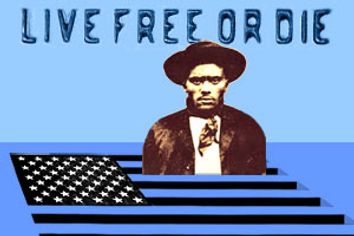
He goes into an antique shop. He picks up a vase, and the gay owner compliments him on his taste: “That’s the most expensive item in the store.” But then Vito sees something else, probably the cheapest thing in the store: an old New Hampshire license plate. “Live Free or Die,” reads the slogan across the top.

The phrase burns into Vito’s mind. You can see his face change. The words were written in 1809 by Gen. John Stark, a New Hampshire hero of the Revolutionary War, on the occasion of the 32nd reunion of veterans of the 1777 Battle of Bennington, Vt.; too ill to attend, Gen. Stark sent a toast. “Live free or die,” another man read for him: “Death is not the worst of evils.” The words echoed across the nation, down through the decades; in 1945, with the end of the Second World War, New Hampshire took the first four words and put them all over the state.

Vito stares. “Live Free or Die” — it’s as if the metal can talk. It’s just a license plate; for him it might as well be the Declaration of Independence, ringing its bell. “We hold these truths to be self-evident, that all men are created equal, that they are endowed by their Creator with certain inalienable Rights, that among these are Life, Liberty, and the pursuit of Happiness,” Jefferson wrote — and suddenly, as it has for so many for so long, through that license plate the Declaration is speaking to Vito as if it were addressed to him. “Live free or die” — what if all this, the shock in his face says, was meant for him as much as anyone?

It’s one of those signal moments when the whole weight of the national story, its promises and its betrayals, hits home — leaving the citizen at once part of a community and completely alone. It doesn’t matter that, well, yes, of course, on the fourth of July, 1776, when the Declaration of Independence was presented, everyone understood that all men meant men, not women; whites, not blacks; Christians, not Jews or Hindi or heathen; decent people, not Sodomites. The idea that “all men are created equal” was not a “self-evident truth,” Sen. John Pettit said on the floor of the Senate in 1853: it was “a self-evident lie.” It was in the midst of the debates over the Kansas-Nebraska Act; Pettit was arguing for voiding the Missouri Compromise of 1820 and opening the territories to slavery. It was a debate: “The great declaration cost our forefathers too dear,” Sen. Benjamin Franklin Wade of Ohio replied to Pettit, “to be so lightly thrown away by their children.”

Abraham Lincoln read these debates from his oblivion in Springfield, Ill.; he was a 44-year-old lawyer who had served one term in Congress before being turned out of office. Pettit’s words and the words against him brought Lincoln back to the world. Soon he was speaking as if the Declaration of Independence contained all the words the nation ever needed to hear — and in a certain sense, it didn’t matter that Lincoln did not believe that, once men and women left the hand of their creator, they were equal on earth. “Pettit called the Declaration of Independence a lie,” Lincoln said in Peoria in 1854, answering a speech by Stephen Douglas. “If it had been said in old Independence Hall 78 years ago, the doorkeeper would have thrown him into the street.” That might have been a fairy tale; the Declaration of Independence itself might be a fairy tale, but not one that can be given an ending, happy or not. The charge in the Declaration was boundless; no limits placed upon it hold.

“Life, liberty, and the pursuit of happiness” — it’s what the rest of the world understands by America when America isn’t forcing the rest of the world to understand America as something else. “We are caught in a world of limits where there’s no such thing as the self-made man,” said a graduate student in France last week; Claire de la Vigne was speaking to a New York Times reporter about the French university system, where doors are made to be closed, not opened. “We are never taught the idea of the American dream, where everything is possible,” she said. It’s what Americans understand by America, when the facts of everyday American life somehow recede, and an idea of America takes their place.

Here’s a passage from “Enthusiasm,” a yet-to-be-published novel written by a friend of mine, Charlie Haas. A man — a scientist, a businessman — is trying to recover from brain damage. His father is trying to reintroduce him to time, place, names, faces.

Dad and Barney sat at the desk with the datebook open in front of them. “Okay,” Dad said, “what’s something you might have to do this afternoon?”

“Go to a meeting,” Barney said.

“Okay. So you write that in there.”

Barney scrawled MEETING over half the afternoon grid. “We’re going to have a country,” he said. “We have some farmers coming, and some horseshoe guys.”

“Like blacksmiths?” Dad said.

“Yes,” Barney said. “So we get liberty. And we wear wigs in the room.”

This doesn’t even have the weight of a fairy tale, or of a dream you can just barely remember — and yet it’s inescapable, and unbreakable.

There’s a way in which you can see every American story as a version of the Declaration of Independence: every story an attempt to make it true, or prove it a lie. In 1941, Henry Luce called the 20th century “the American century”; he meant this was the century when America became a colossus from which the rest of the world would have to step back, trembling with awe. But if that American century was truly American, you can almost see Lincoln reminding us — or, if not Lincoln, the doorkeeper at Independence Hall — then the story of the American century is the story of all sorts of previously excluded, marginalized, scorned, despised, ignored or enslaved people — laborers, women, African-Americans, Asian Americans, Jews, Latinos, gay men and women — entering into full citizenship and full participation in national life. If not full citizenship, a more complete citizenship than even Lincoln or the doorkeeper could in fact have imagined — as, again and again, decade after decade, those echoing words of the Declaration of Independence sounded as if for the first time.

It can be easy to forget this, when people on both the left and the right tell the story of the country as if it were a story of power, not speech — a story of the movements of money and armies, not the acts of men and women, acting alone or together.

This came home to me last week, at a meeting in Cambridge, Mass. A group of 16 people — distinguished historians, critics, poets, novelists, professors — sat around a table determining what would and what would not be included in an ambitious new book: a 1,000-page, 200 chapter “New Literary History of America.” “‘All God’s Dangers — The Life of Nate Shaw,’” one person said — and there was silence. Few people there had heard of the book; only three had read it.

The book appeared in 1975, and then it disappeared. Why? It won a National Book Award; it received reviews that were like trumpets. But somehow the tale told by Nate Shaw — the name the historian Theodore Rosengarten gave to one Ned Cobb, born in Alabama in 1885, dead there in 1973, who, over hundreds of hours, spun Rosengarten the story of his life — did not fit the American story as it was being reconstructed once again. This was a man whose parents were slaves, and who reveled in his superiority — in mind, body, will, desire, courage, and wit — over other men, be they black or white. “All men are created equal” — but what men and women become is not equal, and proving himself in that arena was America to Nate Shaw.

“I was climbin up in the world just like a boy climbin a tree. And I fell just as easy, too.” It’s 1931, in the heart of the Depression, and a banker is squeezing him:

“Bring me the cotton this fall, bring me the cotton.” When he told me that I got disheartened. I didn’t want him messin with me — still, I didn’t let him take a mortgage on anything I owned. I was my own man, had been for many years, and God knows I weren’t goin to turn the calendar back on myself.

You can hear it in the cadence, in the uniqueness of the speech: “I weren’t goin to turn the calendar back on myself.” This is someone for whom liberty is real — as real in its absence as when he can all but hold it in his hands. At 21, in 1906, Nate Shaw set out to raise his first cotton crop; in 1932 he stood for the Alabama Sharecroppers Union against a gang of sheriffs sent to take over a friend’s property, and paid for his stand with 12 years in prison; he found God. He walked out of prison. He lived a new life.

From his first day on his own, he was not someone who could be reduced to a type, a symbol, or made to stand for a cause. Against all odds he had in fact achieved what the country promised him: “life,” on his own terms; “liberty,” seized, acted out, taken from him; “the pursuit of happiness” — which, at the end of his life, meant firing a revolver in the air. “I shoots it some times just to see if it will yet answer me,” he said. “I throw it to the air and ask for all six shots: YAW YAW YAW YAW YAW YAW.” The story came off the pages with suspense, order, clarity, and drama, as if Shaw had long before determined not to quit this life without leaving a piece of his own behind.

His own — all he had, to pass on to whoever might stumble upon the now-forgotten book made of his particular pursuit of happiness. But if the historians gathered to choose the books of our history had not heard of Nate Shaw — and, hearing his story, they finally chose to fold it into the story they themselves were trying to tell — if they hadn’t heard of Nate Shaw, in a certain way, Vito, standing in that New Hampshire antique store, was hearing Nate Shaw speak as he read the words on the license plate.

As Vito read “Live Free or Die,” a song began to come up on the soundtrack: a song called “4th of July,” recorded in 1987 by the Los Angeles punk band X. It’s thrilling, and it’s heartbreaking; a couple’s marriage is falling apart, but it’s the Fourth of July. The feeling is that by failing their marriage they are betraying the country: “We gave up trying so long ago.”

Can Jefferson save their marriage? Can they save the country? Like “The Sopranos,” the song doesn’t say yes or no — it makes the question real, makes it yours.

Continue Reading Close

Real Life Rock Top 10

  • more
    • All Share Services

Real Life Rock Top 10

1) White Stripes, “Elephant” (V2/Third Man)

Before my turntable broke (the vinyl version was all I could find), this sounded like the Detroit guitar-and-drums combo’s “Rubber Soul” at least as much as Pussy Galore’s “Pretty Fuck Look.”

2) “The Murder of Emmett Till,” directed by Stanley Nelson, written by Marcia A. Smith and narrated by Andre Braugher (PBS, Jan. 20)

This documentary on the 1955 lynching of a black 14-year-old Chicago boy near Money, Miss., opened with a lovely shot of the meandering Tallahatchie River — where Till’s body, weighted down with a cotton gin fan, was dumped after he was killed for supposedly whistling at a white man’s wife. Later there were images of a bridge, and I couldn’t help thinking of Bobbie Gentry’s 1967 “Ode to Billy Joe.” A girl tells the story of how her boyfriend, Billie Joe McAllister, jumped to his death from the Tallahatchie Bridge, into the Tallahatchie River — and how, her family has heard, she and Billie Joe were seen throwing something from the same bridge, into the same river, just days before. What was it? Bobbie Gentry has never said, but isn’t there a memory of Emmett Till’s murder in whatever it was?

3) Lucinda Williams, “World Without Tears” (Lost Highway)

The first song, the modestly titled “Fruits of My Labors,” begins with a shimmering, subtle progression played on a Leslie guitar. Then comes a slurred, dragging, unbelievably affected voice to tell you how deeply its owner feels: so deeply barely a single word is actually formed. Every little touch — brushes on the snare, say — is mixed up high, to let you know how carefully everything has been done. There is irony in “American Dream”: Despite the title, the song is about how bad things (poverty, drug addiction — because of Vietnam — and black lung) take place in America. But the singer will press on. “Bay swee bay ‘f’s alla same,” Williams promises, “tay th’ glore en day ov’ the fame.” Not due til April, but why wait? It’s not getting any better.

4) Robin Williams, “Live 2002″ (Columbia)

Nowhere near the action of last year’s HBO roller coaster, but it only takes him a few minutes to hit his stride — with the tragedy of the Supreme Court’s striking down the execution of the retarded. Here and there, glimpses of a man whose no could do more to change the country than any words from Tom Daschle, Joe Lieberman, Nancy Pelosi or John Edwards.

5) “Rolling Stones Live” (HBO, Jan. 19)

Mojave Sam (Howard Hampton) writes: “They’ve been worse. I thought of William Cody and his Wild West Show, fancifully reenacting Little Big Horn. Buffalo Bill preening in time-honorific Custer’d fashion, Sitting Bull on rhythm guitar (sporting traditional headdress, but what happened to his voice — is it changing back?), Annie Oakley guesting on ‘Honky Tonk Women,’ etc.; I believe ‘Can’t You Hear Me Knocking’ was their tribute to the building of the transcontinental railroad, in real time. In any case, they gave the people what they wanted, and no one was any the wiser.” Except that on “Gimmie Shelter,” backing singer Lisa Fisher, otherwise as florid as Patti LaBelle, looked Mick Jagger in the face and opened up the doors of the song.

6) Ann Charters, editor, “The Portable Sixties Reader” (Penguin)

At more than 600 pages, a definitively clueless anthology ending with bad poems about the deaths of the decade’s top 10 dead people. Count down! Ten! Hemingway! Nine! Marilyn Monroe! Eight! John F. Kennedy! “When I woke up they’d stole a man away,” says Eric von Schmidt — hey, who’s “they”? As Donovan used to say, “I really want to know,” but never mind, Seven! Sylvia Plath! Six! Malcolm X! Five! Martin Luther King Jr.! Four! Robert F. Kennedy! Three! Neal Cassady! Two! Janis Joplin! And topping the chart: Jack Kerouac! With a straight obit from the Harvard Crimson! Solid! But Janis died in 1970. If she can get in, why not Jimi Hendrix? Captain Beefheart played a soprano sax solo for him the day his death was announced that said more than anything here.

7) Bonnie “Prince” Billy, “Master and Everyone” (Drag City)

In his current incarnation as Billy, Will Oldham looks like Nietzsche on the cover of this disc, and that’s as far as it goes. What used to be Southern Gothic is now Southern hospitality — depressed, but very polite.

8) Pretty Girls Make Graves, “Pretty Girls Make Graves” (Dim Mak)

Hot punk from Seattle — and with every move in place, dispiritingly third-hand.

9) “Rude Mechanicals Financial Advisors answer the most frequently asked questions of investors and patrons alike,” fund-raising letter (www.rudemechs.com)

After advising “FULL DIVESTMENT” from the stock market and the bond market (“As long as Pierce Brosnan is cast as James Bond in the 007 movies WE CANNOT RECOMMEND ANY BONDS whatsoever. Madonna is doing the theme song for the new movie. Have some self-respect”) and answering “Is ART really a sound investment?” with a definite yes (“If you had given Emily Dickinson five dollars in 1864, your investment would now be worth more than ‘this new Value in the Soul — Supremest Earthly Sum’”), the Austin theater group concludes with a set of irrefutable graphs: “Verizon stock value over the past five years vs. Patrons of Rude Mechs Spiritual Satisfaction,” “ImClone stock value over the past five years vs. Rude Mechs Artistic Growth,” “WorldCom Market Valuation vs. Increase in Overall Artistic Fulfillment brought to Patrons of Rude Mechs,” and, bringing it all back home:

10) Helen Thomas at White House press briefing, Jan. 6

In his 1972 study “The World Turned Upside Down: Radical Ideas During the English Revolution,” Christopher Hill, poring through the annals of the 16th and 17th centuries, tried to reconstruct the beginnings of a heresy that by the 1650s was making itself known across England. There would be a document noting that a certain craftsperson had questioned the divinity of Jesus; 20 years later there would be a record of a woman denying the need to work. Across a page or so, a dozen examples of seemingly stray people claiming that all true spirits were god and that all authority was false took on a huge charge, less from the power of any given fragment than from one’s sense of how much was missing between the fragments. Reading the transcript of the exchange between 82-year-old Hearst News Services columnist Helen Thomas and White House spokesman Ari Fleischer, what was so shocking was not what she said, but, given the socialization produced by the news writing and even editorial writing in the likes of the New York Times, how bizarre it seemed — because in the context of contemporary political discourse Thomas spoke not as a reporter but precisely as a heretic:

Thomas: At the earlier briefing, Ari, you said that the president deplored the taking of innocent lives. Does that apply to all innocent lives in the world? And I have a follow-up.

Fleischer: I refer specifically to a horrible terrorist attack on Tel Aviv that killed scores and wounded hundreds. And the president, as he said in his statement yesterday, deplores in the strongest terms the taking of those lives and the wounding of those people, innocents in Israel.

T: My follow-up is, why does he want to drop bombs on innocent Iraqis?

F: Helen, the question is how to protect Americans, and our allies and friends —

Thomas and Fleischer went back and forth in several more exchanges. The president is only interested in defense against Iraq, Fleischer reiterated.

T: And he thinks they are a threat to us?

F: There is no question that the president thinks that Iraq is a threat to the United States.

T: The Iraqi people?

F: The Iraqi people are represented by their government. If there was regime change, the Iraqi —

T: So they will be vulnerable?

F: Actually, the president has made it very clear that he has no dispute with the people of Iraq. That’s why the American policy remains a policy of regime change. There is no question the people of Iraq —

T: That’s a decision for them to make, isn’t it? It’s their country.

F: Helen, if you think the people of Iraq are in a position to dictate who their dictator is, I don’t think that has been what history has shown.

T: I think many countries’ people don’t have the decision — including us.

Thanks to Chris Walters.

Continue Reading Close

Real Life Rock Top 10

  • more
    • All Share Services

1) The Best News of the Week: “Arrest in punk singer’s ’93 slaying” (Associated Press/San Francisco Chronicle, Jan. 12)

“SEATTLE — A Florida man has been arrested and charged with murder after DNA linked him to the death of rising punk-rock star Mia Zapata in 1993, police said.

“Police said Jesus C. Mezquia, 48, was arrested late Friday in the Miami area. His DNA profile matched a sample taken from the crime scene more than nine years ago, police said.

“Zapata, the 27-year-old lead singer of The Gits, was last seen alive July 7, 1993, in Seattle’s Capitol Hill neighborhood. Her beaten body was left on a street curb more than a mile away. She had been strangled with the drawstring of her Gits sweatshirt.

“Police had no leads in the slaying. The Seattle music community — including its biggest names, Pearl Jam, Nirvana and Soundgarden — raised $70,000 to hire a private investigator, but eventually the funds dried up.”

2) Donnas, “Spend the Night” (Atlantic)

“Faster than sound,” as Big Brother and the Holding Company put it 35 years ago in San Francisco, up the Peninsula from the Donnas’ Palo Alto. But Big Brother didn’t have Skyline Boulevard in their blood. Speed-shifting on the Skyline turns at midnight, way above the Stanford hills, is just what the Donnas’ new music feels like — except when it feels like X in 1980, the punk band burning their song “Los Angeles” into the pavement like rubber. Today “You Wanna Get Me High” jumps off the radio, as familiar as weather, as much of a shock as lightning hitting your house. “Take It Off” is right behind. This is what rock ‘n’ roll never forgets — or rather it’s what rock ‘n’ roll always forgets, until people like Brett Anderson, Maya Ford, Torry Castellano and Allison Robertson find it.

3) Alison Krauss and Union Station, “Live” (Rounder)

Fine, fine, but across two discs it’s the smallest sound that cuts the deepest: “Forget About It,” sung as if the singer’s walking out on a fight at 4 a.m., her tiredness indistinguishable from her contempt.

4) Michael O’Dell, letter to the editor, City Pages, Minneapolis (Dec. 4)

Among pages of letters praising City Pages editor Steve Perry’s Nov. 27 cover story “Spank the Donkey,” in which Perry argued that people of good will should abandon the Democratic Party in favor of generations of Republican rule sufficient to produce conditions conducive to the election of Ralph Nader: “You should go back to singing for Journey.”

5) Mark Halliday, “Jab” (University of Chicago Press)

Ken Tucker writes: “Pop and rock have inspired some of the worst poetry ever, from Patti Smith to Tom Clark to Jim Carroll to Exene to Jewel to Amiri Baraka (New Jersey could have avoided the controversy over Baraka’s anti-Semitism if they’d just gotten an advance of the Roots’ ‘Phrenology’ and heard him ‘perform’). But Mark Halliday consistently makes music work for him as subject matter. In ‘Jab’ he imagines a session trumpet player during the recording of Jan and Dean’s ‘Surf City’ in 1963:

“‘I see this trumpet player (was there even a horn section in that song?/ Say there was)/ I see this one trumpet player with tie askew/ or maybe he’s wearing a loose tropical foliage shirt sitting on a metal chair waiting/ for the session to reach the big chorus/ where Jan and Dean exult/ “Two girls for every boy”/ and he’s thinking/ of his hundred nights on his buddy Marvin’s hairy stainy sofa/ and the way hot dogs and coffee make a mud misery/ and the way one girl is far too much …/ Surfing — what life actually lets guys ride boards/ on waves?/ Is it all fiction? Is it a joke?/ Jan and Dean and their pal Brian act like it’s a fine, good joke/ Whereas the trumpet player thinks it’s actually shit/ If anybody asked him, a tidal wave of shit/ Nobody’s asking’”

6) Esperanto Cafe, Christmas night (114 MacDougal St., New York)

In this place that never closes, there are many volumes of “The History of Philosophy,” but no evident traces of Esperanto, the language invented in the late 19th century by a man who believed that if all people spoke the same tongue — “manufacturing a Tower of Babel in reverse,” as Lester Bangs put it — there would be no more war. As snow fell heavily outside, the Rolling Stones’ 1969 “You Can’t Always Get What You Want” was playing. Then came the killingly original blues line that opens their 1964 cover of Irma Thomas’ “Time Is on My Side,” and time really did begin to slide. It was only 107 years before, to the night, that in a saloon in St. Louis a man named Billy Lyons snatched the Stetson hat off the head of a man named “Stag” Lee Shelton, and Shelton, who some called Stagolee, shot him, retrieved his hat and walked out the door.

7) Richard Avedon, “Portraits” (Metropolitan Museum of Art, New York, closed Jan. 5)

Overfamiliar work, but in the room featuring pictures from Avedon’s “In the American West” series there was a stopper. Some of Avedon’s shots of highway bums are so lurid they’re unforgettable, in the worst, freak-show manner; “Clarence Lippard, drifter, Interstate 80, Sparks, Nevada, August 29, 1983″ was different. Instead of the lantern jaw and killer’s eyes of the other men on the walls, Lippard held himself in reserve. The countless big, dark freckles — or skin cancers — that covered his face and hands spoke for a life lived out of doors; his dark blazer and clean white shirt made it seem as if he were a gentleman farmer out for a stroll. Very handsome, in a moneyed East Coast way, with a full head of sandy hair, Lippard appeared in two photos. One — as if shot from below, showing Lippard from the waist up — softened his features, weakening his chin and turning his nose bulbous; he looked something like Kevin Kline in one of his good-guy roles. But the other picture, shot head-on and cropped at midchest, presented Lippard gazing straight out, his chin strong, his nose hard: in the way he carried himself, daring you to judge him.

His face now suggested Gregory Peck or Robert Ryan; the disease on his skin deepened his face, until you could see Lincoln along with the movie stars. And then another movie star who is not, really, a star: Bill Pullman, in the desert in “Lost Highway,” and then in “Igby Goes Down,” in the asylum.

8) “La Bohème,” directed by Baz Luhrmann (Broadway Theatre, New York, Dec. 22)

The 1896 Puccini opera updated to 1957, complete with cool Marlon Brando references and “Let’s go, cats!” dialogue, but with dying heroine Mimi looking like a leftover from a World War II movie, the men not remotely convincing as either Europeans or artists and the big Rive Gauche set altogether 19th century fin de siècle. Which didn’t matter. The change from garret apartment for Act 1 to Left Bank street for Act 2 was made in half light; when the stagehands, costumed as Paris workers, had everything in place, the audience thought the action would proceed in the shadows. Then the lights were flicked on, the tableau lit up like a firecracker, and a collective “Ahhhhh!” filled the theater. There were prostitutes draped over balconies, a patriotic parade, urchins and clochards, little rich kids in fancy coats, an English millionaire in tails with not-dying heroine Musette on his arm. The scene paid off with Musette’s (Jessica Comeau, this afternoon) long, increasingly passionate “Quando e’n vò” — which in 1959 was turned into Della Reese’s great hit “Don’t You Know.” It was a pure pop spectacle, which made the shift to Act 3, from Let’s Party to Tragedy, seem a little glib.

9) John Doe, “Employee of the Month,” from “Dim Stars, Bright Sky” (Im/BMG)

There’s something of the feel of Randy Newman’s “Vine Street” here, and as a loser’s song it’s convincing. But it’s not half as convincing as losers John Doe plays in the movies, from Amber Waves’ ex-husband in “Boogie Nights” to Mr. Werther in “The Good Girl”: characters so depressed they can barely summon the energy to look away from the camera.

10) Joe Strummer, Aug. 21, 1952-Dec. 22, 2002

“You know what they said? Well, some of it was true!”

Continue Reading Close

Page 1 of 15 in Greil Marcus