Gudjon Helgason

Icelandic volcano flings up ash, shuts airport

Event reminiscent of Eyjafjallajokull eruption that cancelled thousands of European flights last summer

  • more
    • All Share Services

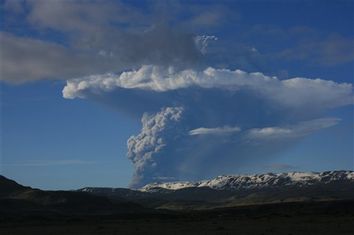
Icelandic volcano flings up ash, shuts airportCORRECTS PHOTOG NAME FROM KRISTEN TO KRISTIN Smoke rises from the Grimsvotn volcano, Saturday, May 21, 2011 in Reykjavik, Iceland. Iceland's most active volcano has started erupting, scientists said Saturday _ just over a year after another eruption on the North Atlantic island shut down European air traffic for days. Iceland's Meteorological Office confirmed that an eruption had begun at the Grimsvotn volcano, accompanied by a series of small earthquakes. (AP Photo/Halldora Kristin Unnarsdottir)(Credit: AP)

Iceland closed its main international airport and canceled all domestic flights Sunday as a powerful volcanic eruption sent a plume of ash, smoke and steam 12 miles (20 kilometers) into the air.

The eruption of the Grimsvotn volcano was far larger than one a year ago at another Icelandic volcano that upended travel plans for 10 million people around the world, but scientists said it was unlikely to have the same widespread effect.

University of Iceland geophysicist Magnus Tumi Gudmundsson said this eruption, which began Saturday, was Grimsvotn’s largest eruption for 100 years.

“(It was) much bigger and more intensive than Eyjafjallajokull,” the volcano whose April 2010 eruption shut down airspace across Europe for five days, he said.

“There is a very large area in southeast Iceland where there is almost total darkness and heavy fall of ash,” he said. “But it is not spreading nearly as much. The winds are not as strong as they were in Eyjafjallajokull.”

He said this ash is coarser than last year’s eruption, falling to the ground more quickly instead of floating vast distances.

The ash plunged areas near the volcano in southeast Iceland into darkness Sunday and covered buildings, cars and fields in a thick layer of gray soot. Civil protection workers urged residents to wear masks and stay indoors.

Iceland’s air traffic control operator ISAVIA said the Keflavik airport, the country’s main hub, closed down at 0830 GMT (4:30 a.m. EDT) for the day.

Spokeswoman Hjordis Gudmundsdottir said the ash plume was covering Iceland, but “the good news is that it is not heading to Europe,” blowing northwest toward Greenland instead.

President Barack Obama was flying Sunday night to Ireland, but there was no immediate word on whether the volcano would affect Air Force One’s flight path.

Trans-Atlantic flights were being diverted away from Iceland, but there was no indication the eruption would cause the widespread travel disruption triggered last year by ash from Eyjafjallajokull.

In April 2010, officials closed the continent’s air space for five days, fearing the ash could harm jet engines. Millions of travelers were stranded.

The Grimsvotn volcano, which lies under the uninhabited Vatnajokull glacier about 120 miles (200 kilometers) east of the capital, Reykjavik, began erupting Saturday for the first time since 2004.

Gudmundsson said the new eruption was 10 times as powerful as the one in 2004, which lasted for several days and briefly disrupted international flights. Grimsvotn also exploded in 1998, 1996 and 1993, eruptions that lasted between a day and several weeks.

Sparsely populated Iceland is one of the world’s most volcanically active countries and eruptions are frequent. Grimsvotn and Iceland’s other major volcanoes lie on the Atlantic Rift, the meeting of the Euro and American continental plates.

Eruptions often cause local flooding from melting glacier ice, but rarely cause deaths.

Gudmundsson said it was hard to predict how long the eruption would last, but it might already be slowing.

“There are some signs the eruption plume is getting lower now,” he said. “We may be seeing the first sign that it is starting to decline. In two or three days the worst should be over.”

——

Jill Lawless reported from London.

Iceland volcano erupts again, forcing hundreds to evacuate

Hundreds flee rising floodwaters after second blast in less than a month

  • more
    • All Share Services

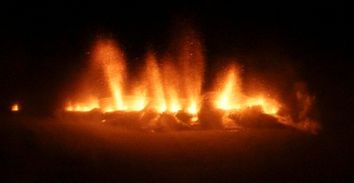
Iceland volcano erupts again, forcing hundreds to evacuateFILE -- In this Sunday March 21, 2010 file photo, molten lava vents from a rupture near the Eyjafjallajokull glacier in Iceland, as a volcano erupted. The Eyjafjallajokull volcano began erupting after 200 years of silence, threatening floods and earthquakes but drawing thousands of adventurous tourists - and their desperately needed cash - to the site where ash and red-hot lava spew from a crater between two glaciers.(AP Photo/Ragnar Axelsson )(Credit: AP)

A volcano under a glacier in Iceland erupted Wednesday for the second time in less than a month, melting ice, spewing smoke and steam, closing a major road and forcing hundreds of people to flee rising floodwaters.

Authorities evacuated 800 residents from around the Eyjafjallajokull glacier as water gushed down the mountainside and rivers rose by up to 10 feet (3 meters).

Iceland’s main coastal ring road was closed near the volcano, and workers smashed holes in the highway in three spots in a bid to give the rushing water a clear route to the coast and prevent bridges from being swept away.

Vidir Reynisson, a manager with Iceland’s Civil Protection Department, said that by late afternoon the flooding appeared to have peaked.

“But the water is still flowing down to the ocean so it will be some hours before we have a better view of what kind of damage has occurred,” he said.

Scientists said the eruption under the ice cap was 10 to 20 times more powerful than one last month, and carried a much greater risk of widespread flooding.

“This is a very much more violent eruption, because it’s interacting with ice and water,” said Andy Russell, an expert in glacial flooding at the University of Newcastle in northern England. “It becomes much more explosive, instead of a nice lava flow oozing out of the ground.”

Civil protection official Agust Gunnar Gylfason said emergency workers rescued some 70 tourists and visitors trapped near the volcano since Wednesday morning. He said the party — including Norwegian visitors — are now safe in a tourist facility and officials are trying to transport them out of the area.

No lives or properties were in immediate danger, Gylfason said. Scientists said there was no sign of increased activity at the much larger Katla volcano nearby.

Iceland’s Meteorological Office said a plume of steam rose at least five miles (eight kilometers) into the air. Scientists aboard a Coast Guard plane that flew over the volcano said the new fissure appeared to be up to 1.2 miles (2 kilometers) long.

There were no immediate signs of large clouds of volcanic ash, which could disrupt air travel between Europe and North America. Some domestic flights were canceled, but Iceland’s international airport remained open.

The volcano, about 75 miles (120 kilometers) east of Reykjavik, erupted March 20 after almost 200 years of silence.

The original eruption petered out earlier this week. But Gunnar Gudmundsson, a geophysicist at the Icelandic Meteorological Office, said there were a series of tremors overnight, and rivers in the area began rising Wednesday morning — strong evidence of a new eruption under the glacier.

Last month’s eruption struck near the glacier in an area that had no ice. Gudmundsson said the new eruption appeared to be about eight or nine kilometers (five to six miles) west of the original fissure.

“Most probably this eruption is taking place at the summit … under the ice,” he said.

Pall Einarsson, a geophysicist at the University of Iceland, said magma was melting a hole in the 650-foot (200 meter) thick ice covering the volcano’s crater, sending floodwater coursing down the glacier into lowland areas.

Residents were evacuated to a Red Cross center in the nearby community of Hvolsvollur, the Civil Protection Department said.

Iceland, a nation of 320,000 people, sits on a large volcanic hot spot in the Atlantic’s mid-oceanic ridge. Volcanic eruptions are often triggered by seismic activity when the Earth’s plates move and when magma from deep underground pushes its way to the surface.

The last time there was an eruption near the 100-square-mile (160 square-kilometer) Eyjafjallajokull glacier was in 1821.

A bigger worry is Katla, which in the past has erupted in tandem with Eyjafjallajokull.

Katla is located under the vast Myrdalsjokull ice cap. An eruption could cause widespread flooding and disrupt air traffic between Europe and North America.

The last major eruption took place in 1918, and vulcanologists say a new blast is overdue.

“So far there have been no signs of the reawakening of the Katla volcano, but a lot of things can still happen, so we are monitoring it quite closely,” Einarsson said.

——

Lawless reported from London. Associated Press writer Danica Kirka also contributed to this report.

——

On the Net:

Volcano webcam: http://eldgos.mila.is/eyjafjallajokull-fra-valahnjuk/

Continue Reading Close