Hadani Ditmars

Denis Halliday

The former head of the U.N.'s humanitarian program in Iraq says an American invasion would be an international crime -- and would make the U.S. even less safe.

  • more
    • All Share Services

Denis Halliday

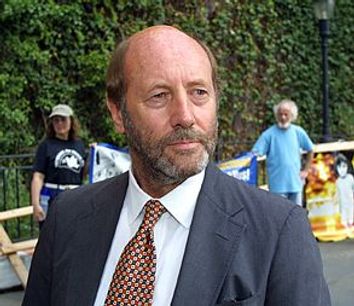
Although it’s been four years since Denis Halliday resigned from his post as head of the United Nations humanitarian program in Iraq in protest over what he called the West’s “genocidal” sanctions, he is still very much a man with a mission.

After running the “oil-for-food” program, which uses Iraqi oil revenues to distribute basic food rations and medical aid to Iraqi civilians, Halliday turned his attention to spreading the word about sanctions-related suffering.

Despite Saddam Hussein’s biochemical assaults on Iranian troops and his own Kurdish population in the 1980s, his invasion of neighboring Kuwait in 1990, his repeated threats against Israel and the U.S., and his decades-long commitment to building a secret doomsday arsenal, he now poses little threat to the world, according to Halliday. Halliday proposes a nonviolent strategy for resolving tensions between America and Iraq. In addition to catastrophic consequences for the Iraqi people, he says, an invasion would create long-term problems for the United States in an already volatile region.

Halliday will visit government officials in Spain this May with Hans von Sponeck — who succeeded Halliday as head of the oil-for-food program and also resigned in protest in 2000 — to discuss Iraq. Halliday also goes to Cuba this month as a jury member for the World Court of Women, which will examine the impact of sanctions on women in various countries around the world and forward its findings to the U.N. Commission on Human Rights.

Halliday currently teaches at Trinity College in Dublin (he is Irish by birth) and divides his time between New York and Ireland.

What’s missing, in your view, from the national discussion about Iraq?

In the U.S., there are a number of issues not being discussed. One of those is international law. The U.S. somehow doesn’t believe that international law applies to this great democracy, to this great empire. We’ve seen Mr. Bush reject various aspects of international law in the past year. That’s a failure on the part of Washington to understand that the U.S. is in fact subordinate to the charter, to the declaration of human rights, to the Geneva Conventions and protocols — all of which would protect Iraq, a sovereign state and member of the United Nations — from further harassment, attacks and killings by the United States.

[What's missing is] respect for international law and an awareness that this is not an empire — that “might” is no longer “right” in the year 2002, and that Mr. Bush does not have any God-given right to attack Iraq or its people without consultation with the Security Council. There is no legitimate way for the U.S. to wage war again on the people of Iraq. That’s one huge issue that’s missing, in my view.

Another would be the fact that American foreign policy is not understood by the vast majority of American people. And that this is due to a media that in this country is suppressed by Washington and by the owners of this media, who often tend to be corporate entities close to the [White House] and very often are arms manufacturers with a vested interest in chaos [in] the Middle East. And as a result Americans do not actually get both sides of the story.

I believe that Americans are basically decent people. If they understood that Iraq is not made up of 22 million Saddam Husseins but made up of 22 million people — of families, of children, of elderly parents, families with dreams and hopes and expectations for their children and themselves — they would be horrified to realize that the current killing of innocent Iraqi civilians by the U.S. Air Force, or what happened in the Gulf War, is being done in their name.

The Bush administration considers Saddam Hussein to be dangerous, because of his massive investment in weapons of mass destruction and his willingness to use them. To what degree is he a threat to the U.S. or to his own neighbors?

Saddam Hussein is not a threat to the U.S., although the U.S., which continues its illegal bombing campaign in the no-fly zone, is a threat to Iraq. Bush’s rhetoric is more about domestic politics than any real threat [from Iraq]. The experts say that Saddam doesn’t have the capacity to manufacture weapons of mass destruction (WMD) — and even if he could somehow acquire that capacity, he certainly doesn’t have the capacity to deliver them. This has been confirmed by [former Defense Secretary William S.] Cohen when he left the Department of Defense last year, it’s been confirmed by Mr. Powell, the current secretary of state, it’s been confirmed by people like Scott Ritter. Iraq is no military threat to its neighbors. In fact it’s probably the reverse. It’s Iraq’s neighbors, like Iran and Israel and others, who have the military weaponry, including nuclear weapons, some of which are clearly pointing from Israel at Baghdad itself, thereby justifying the anxieties and concerns of the Iraqi people and the Iraqi leadership.

The question of whether Saddam is a threat also carries with it the assumption that he wants to attack his neighbors. After his experience in Kuwait and in Iran, which had disastrous results, and considering his recent enthusiastic efforts at mending fences with his neighbors — including Iran, Kuwait and Saudi Arabia, and his calls for Muslim and Arab unity — this is an unlikely scenario.

The Europeans have asked for some kind of concrete evidence showing that he’s producing WMD’s, but no one can produce any evidence. And in terms of chemical weapons, why would he suddenly start using them now, if he didn’t use them in the Gulf War? We [the U.N.-backed coalition that fought against Iraq] used chemical weapons during that war, remember? We dropped tons of depleted uranium on Iraq — which has had devastating effects on the health of its civilian population.

The whole weapons inspection issue is really just a ruse. The real agenda of the Bush administration is a regime change — which is just a polite word for assassination. It has nothing to do with the U.N. or weapons inspectors or even human rights. I read recently that one of the generals whom the Pentagon is thinking of as a “replacement” for Saddam Hussein is the same one who ran the brutal military campaign against the Kurds.

What effect would an American invasion have on the Iraqi people?

This expression of [Colin] Powell and others — “regime change” — it’s really a nice word for murder and chaos and killing. And as we’ve seen in the case of Afghanistan, this killing takes the form of U.S. bombers dropping cluster bombs and other ghastly weapons from 15,000 feet. There’s no likelihood, it seems to me, of U.S. troops actually wanting to get involved. The consequence of that kind of (air assault) would be massive civilian casualties in the towns and cities of Iraq, remembering that Iraq is an urban country — over 70 percent of the population live in towns and cities. So I see a catastrophic impact in terms of civilians and people throughout the country.

What about the territorial integrity of Iraq? How might that be affected by such U.S. military action?

The integrity of Iraq would seem to be under attack because the Turks, who are opposed to this military venture by the Americans and have already said that, would likely invade Iraq if the Kurds were to show interest in independence — they would invade Iraq and take over Mosul and Kirkuk. In the south, the fear might be that the Shi’ah majority might take over the country, which perhaps might be OK — after all they do represent 65 percent of Iraqis — but there’s a fear in Saudi Arabia and the Gulf states that Iran and the Shi’ah majority might present a kind of united theocratic front. This would certainly be threatening to those Sunni-ruled Gulf states.

What do you think about the Bush administration’s attempt to link the war on terrorism to Iraq? [Note: Halliday answered this question before the publication of Jeffrey Goldberg's report in the New Yorker, claiming Iraqi intelligence has been in close contact with al-Qaida leaders for years.]

It’s a fiction. It’s a very large fiction, which has failed, certainly outside of the U.S., because clearly there is no linkage to Mr. bin Laden or his fundamentalist thinking nor to the al-Qaida network. It just isn’t there. I’ve been trying to challenge people to think through what is happening in Iraq and try to encourage Washington to do things differently. This impending attack on Iraq doesn’t serve the interests of the Iraqis of course, but it also doesn’t serve the interests of the U.S. I firmly believe that nothing will change in Washington until it’s understood that the vested interests of the U.S. are best served by a different approach to Iraq.

They need to invest in terms of poverty, in terms of the problems of the Middle East, the issues of Palestinian refugees. These are the issues that are creating the fear and the vulnerability in this country for the first time — the fear that terrorism is going to rise again and get Americans right in their homeland. Let them understand that the way to deal with that is not through violence, but by investing in the alleviation of poverty, the introduction of education and healthcare — all the good things that most North Americans take for granted. That’s what the world needs; without that we will never be free of this sense of vulnerability.

What is your sense of the “Iraqi street” right now?

I can only imagine that the Iraqis have become almost immune to military threats from the U.S. However, after watching Afghanistan on CNN or al-Jazeera, they must be extremely concerned that the leadership in the U.S. is out of control, that there is a spiral of crazed fascism [here] that sees military solutions to every problem. So I think the Iraqis must be deeply concerned, and they must be wondering, how is it possible that this great democracy of the United States is out of control? Where are the American people? Why are they not controlling their government, which seems to be running amok?

Neoconservative hawks in and out of the administration have embraced Ahmed Chalabi’s Iraqi National Congress [Iraq's premier opposition party], although the INC is largely discredited in the Arab world, and Chalabi — guilty of bank fraud in Jordan — is considered a crook. Do you think the INC has any chance of becoming a viable power in a post-Saddam Iraq?

Given my experience of the dignity of the Iraqi people, and the importance they place on sovereignty, I don’t think there will ever be any support for an opposition group that is financed from overseas — in particular by the United States. I think that the INC has no credibility in Iraq. I think the issue of change — if that’s what’s required — is an issue that can only be addressed by the people of Iraq, and that can best be done when the embargo is removed and when the professional middle classes that are left in the country will again have time to focus on governance. But this is not Afghanistan. In terms of opposition groups, there’s nobody on the ground. This is not an issue for the Kurds or even for the Shi’ah majority in the south. There’s no imminent armed uprising about to take place, in my view.

Many opponents of Saddam — not just those in the Bush administration — would say that the humanitarian suffering of the Iraqi people is the fault of the regime and not of the sanctions.

The thought that this is somehow the policy of the Baghdad government is rubbish. U.N. Secretary General Kofi Annan has never ever pointed a finger in that direction. He’s reported regularly that the program, in as much as it works, works. There’s no diversion of monies, or of foodstuffs. To point the finger at Saddam Hussein, of course, is very attractive. He’s the bad guy, he’s been demonized, etc., but we are in charge of the economy in Iraq so only we can change that. If you look at the history of the Baath Party and its social policies, this party stayed in power for 20 years by providing housing, employment, education and healthcare — the very aspects of life that are missing now — thanks to the U.N. and the deadly embargo of the Security Council.

If the American regime-change plan does not go through, how long do you think the “oil-for-food” program could continue in its present form? The executive director of the U.N.’s Iraq program, Benon Sevan, has just stated that, because of the restrictions on Iraqi oil exports — championed by many Western diplomats as a means to curb smuggling by the regime — the program is now close to broke. How viable is “oil-for-food” as a long-term humanitarian program?

“Oil for food” was designed to fail. It was designed to stop further deterioration in Iraq at a time when famine conditions prevailed. That’s exactly what it has done. It has maintained quasi-famine conditions for many Iraqis now for over six years. So we’ve nothing to be proud of — all we’ve done is stave off mass starvation.

Now the problem is the political game being played by Washington and London, in particular via the 661 Committee — the sanctions committee. There’s now over $5 billion worth of essential pharmaceutical and medical goods and equipment on hold. But the fact is that this program was never designed to resolve the crisis of Iraq; it was not designed to resolve the economic collapse — in fact the money is not to be used, according to the Security Council, for investment or reconstruction of important infrastructure. And as we know, in the case of Iraq today, the majority of children die from water-borne disease, not from starvation per se. So this is a program which has modest value, although it’s essential.

With the $5 billion in contracts on hold, together with the bureaucracy and the politics of the U.N. and the Iraqi desire to have some sort of kickback on oil sales — so they can use that money outside of the oil-for-food program — it’s going to be a real standoff situation where somebody will have to back down. And hopefully that will be the U.N. — in the best interests of the Iraqi people.

But hasn’t the oil-for-food program helped improve the standard of living amongst Iraqis to a certain extent?

There’s no doubt that oil-for-food has brought in basic food needs for the great majority of the Iraqi people and that the rations have become a currency — that food is often used to buy shoes for children or books or clothes or to buy animal proteins, items not included in the oil for food rations. In addition there is the money coming from Iraqis’ relatives overseas — a hugely important contribution. And I think it’s quite ruthless of the Americans to cut off a hundred dollars or so a month that helps keep families alive.

To what degree have the sanctions themselves actually entrenched the Iraqi regime’s power?

The sanctions regime in Iraq has dreadfully weakened the professional middle class. The very people who might focus on governance and might make demands for participatory government are the very people who’ve been destroyed, their incomes demolished by massive devaluation [of the dinar] and by inflation. They now have no other concern but survival. At the same time, however, the central government, given the rations distribution system and the employment of 49,000 agents, is in total control, more than ever before. Because the average Iraqi has no alternative but to accept these handouts — a survival tool for every family in the country.

What would be the best way for the Bush administration to foster democracy?

I think that the way to get democracy into Iraq is to end the economic embargo, to restore the income level and the buying power of the Iraqi people, to get people back to work, restore the high educational standards, allow people the means to travel overseas again as they used to — generally to restore the health and wealth of Iraq and the Iraqi people. That is what will bring change. Nothing else will, in my view. And we have to recognize that the only people competent to make decisions about the future of Iraq and its system of government is the Iraqi people. We cannot second-guess them long-distance from overseas.

But Saddam is a ruthless despot and remains a fundamental problem for the Iraqi people. In its condemnation of Saddam, the Bush administration certainly has a claim to the moral higher ground, doesn’t it?

I don’t think so. I mean, Saddam Hussein may not be a nice man, but neither was George Bush Sr. Anybody who oversaw the Gulf War is well aware of crimes against humanity and is responsible thereof. We don’t have to like the president of Iraq. Did we like the president of Indonesia? Or the Congo? Or Chile — Mr. Pinochet? I don’t think so.

We have no justification to punish the innocent civilians of any country simply because we don’t like, in this case, a man who was [once] a friend and ally to the United States. For example, Donald Rumsfeld visited Iraq in 1983 — spoke with Saddam Hussein, asked for an exchange of ambassadors. They know each other! Why can’t Rumsfeld go back and reopen this dialogue and begin to understand what makes Iraq tick and help to create an atmosphere in the Middle East of peace — as opposed to sustaining war, fear and terror, which the U.S. is doing at the moment.

What do you feel might be a realistic way to end the current crisis between Iraq and the U.S.?

The great challenge today is to find a solution that is acceptable to those that have power in Washington and London and those on the Security Council and those in Baghdad. We have to get all of these elements lined up, and I daresay we have to include Israel as well. We need to look at what’s viable under the charter and international law. We have to lift the economic embargo. We need to control arms and arms sales. And that means, in a sense, sanctioning ourselves, because we are the great problem: The five permanent members of the Security Council produce and sell something like 85 percent of the military weaponry in the world today. And they’re the very countries that supposedly are in charge of international peace and security. That’s quite a ludicrous situation we’ve got here.

The Americans are way out in front in terms of arms sales. We’ve got to control that and we’ve got to diminish the availability of weapons of all sort — including weapons of mass destruction in the Middle East. Then [we must] encourage Iraq to rebuild its relations with its neighbors and to deal with its own issues of civil rights, its relations with the Iraqi Kurdish population and with Kuwait for example.

All of this is possible. It’s a matter of setting the situation up in such a way that there’s no further loss of dignity and sovereignty on the part of Iraq, and that the neighboring states will no longer feel threatened and, in fact, acknowledge that there is no danger in Iraq beyond the rhetoric of the United States. It’s a big task. I’m not saying it’s easy. But I think we’re beginning to see a change and let’s hope that the meeting of the Arab League in Beirut [at the end of March] will reveal some moves toward peace in the Middle East, including the resolution of the Iraqi problem.

Let Googoosh sing

For over two decades, Iran's reigning queen of pop has been strictly forbidden to perform. Now she's got a passport, a string of sold-out U.S. stadiums and an angry government back home.

  • more
    • All Share Services

Let Googoosh sing

Googoosh, the stage name of the pre-revolutionary Persian pop diva Faegheh Atashin, is as famous in her homeland of Iran as Elvis is here. But trying to relate the importance of the singer to an American audience feels like one of those desperate Hollywood movie pitches: It’s “The Bodyguard” meets “Not Without My Daughter,” or maybe “A Star is Born” meets “The King and I.”

Maybe the closest American scenario would be to imagine that a Jerry Falwell-style revolution had taken place in the States, a brutal theocracy had been established and some sort of Barbara Streisand/Madonna hybrid had been banished from the stage on religious grounds. Then, after a decade or two of seclusion the Babs/Material Girl combo is permitted to leave the U.S. and embark on a world tour. Abroad, she’s greeted by thousands of cheering American refugees who, in their longing to return home, eat up her nostalgic offerings and beg for more.

There is no real American equivalent to the story of Googoosh. There have been no revolutions here of late, and pop singers have long lost any real political significance.

For thousands of Iranian expats, however, it’s big news that Googoosh is kicking off her yearlong world tour in North America (before going to Europe and the Middle East). Having already played to sold-out stadium crowds in Vancouver, British Columbia, Toronto, Los Angeles, New York and Houston, Googoosh has even more momentum for her dates in Oakland, Calif., Dallas, Atlanta, Chicago and Las Vegas. As for the fans who last heard her sing in pre-revolutionary Iran, the possibility of hearing Googoosh live in America hangs like some fantastic dream; in the suspended reality of Iranian politics, it could be a sign of change, or merely the red herring facade of a regime hoping to present a kinder, gentler face to the outside world.

Googoosh’s is a story many Iranians have taken to heart, her sufferings resonating with their own. She began her career as a child star, and hit her peak in the ’70s Tehran cabaret scene — condemned as “decadent” by the mullahs — as a singer, dancer and actress.

She fled Iran on the eve of the revolution, only to return a few months later. Although she escaped the fate of many artists who faced brutality at the hands of the regime, Googoosh did receive a brief jail sentence. But her real punishment came in her banishment from public performance, as the new ruling class declared women’s voices to be “demonic,” and initially prohibited almost all forms of music but prayers and revolutionary dirges. So when Mohammad Khatami’s reformist regime returned Googoosh’s passport earlier this year, the end of her 20-year seclusion — and her return to the concert stage — surprised and delighted Iranians at home and abroad.

One question hovers over the current tour: Will Googoosh return home to face threats from fundamentalists opposed to her concerts? Or, as is rumored, will she face the regime’s wrath and defect to Canada, where her brother has resided for several years, or perhaps to Los Angeles, where her son lives?

And all this at a time when Iran appears on the verge of another revolution; when President Khatami’s reformist agenda is foiled at every turn by hard-line clerics, bent on maintaining power; when scores of dissident artists and intellectuals are being harassed and even murdered by government agents both inside and outside of Iran, and when the nation’s young people (70 percent of the population is under 25), many of whom never experienced pre-revolutionary freedom, are chomping at the fundamentalist bit.

Although Googoosh is still banned from public performance in Iran (and arguably outside as well — the regime merely returned her passport, it did not explicitly OK her concert tour), her career has been kept alive by an impressive fan base at home and abroad. Her music remains potent, with its evocation of exile and inducement to nostalgia. Googoosh’s voice and image have lived on through a number of Web sites and an underground network of pirated cassettes, manned largely by fans who are too young to remember her success.

For fans in Iran, her music has become a subversive and sometimes illegal pleasure. The laws prohibiting “decadent” pop music have been relaxed; now only “trafficking” remains a crime. Possession, once strictly regulated by the pasdaran, or religious police, is allowed.

Nowhere is this more evident than in Los Angeles, home of the world’s largest Iranian expat community. Last counted at 700,000, it’s also the Iranian pop music epicenter. Many singers fleeing Iran came here in 1979, and it is from here that the illicit cassettes and CDs are now smuggled into Iran.

Googoosh’s Aug. 18 performance at the Great Western Forum in Inglewood proved the most incendiary of her concerts to date. She’d drawn crowds of up to 10,000 in Canada, but this concert sold out all 15,000 seats in two days, with scalped tickets going for as much as $1,000.

It was also the only performance so far to receive a bomb threat. The threat proved to be a false alarm — Inglewood police received an anonymous call that led to the discovery of “several flares attached to a battery.” But that a pop concert could ignite such a violent emotional response is a testament to both Googoosh’s impact and the powerful divisions within Iran and its expat communities.

No one has claimed responsibility for the bomb threat, but Googoosh can certainly boast a wide range of detractors. Some local Iranian Jews were reportedly upset by rumors that Googoosh had made anti-Semitic remarks in an underground cabaret in Iran; because the venue was forbidden in the first place, no witnesses have been willing to confirm or deny the accusation. The singer also managed to alienate many Iranian pop stars in the L.A., or “Tehrangeles,” scene, by allegedly making disparaging comments about their “lack of talent.” Of course fundamentalists in Iran, who have already condemned Googoosh’s current tour, do have their counterparts in Los Angeles.

Finally, some feel that her tour somehow legitimizes what they see as the reformist facade of a brutal regime. Sharvand, an Iranian-American newspaper, published a letter on September 1 written by Abbas Bakhtiari, the head of Pooya, an Iranian cultural association based in Paris. In the letter, Bakhtiari, who was to be the promoter for the European leg of Googoosh’s tour but pulled out at the end of August, alleged that Googoosh’s Iranian promoter, Manouchehr Khoshzaban, was working for Iranian intelligence. While both parties have been unavailable for comment, some in the Iranian-American community speculate that the accusation was no more than the consequence of a bitter business disagreement.

This argument, after all — that Iranian artists and other popular figures are used as “ambassadors” for a corrupt regime — is not new. Nor is it restricted to old Shahists; the leftist Mujahedin is also fond of this position and has foisted it upon everyone from visiting filmmakers to the national soccer team that toured North America last year. But many Googoosh fans argue that it is unfair to burden artists with political baggage. As Ramin Mahjouri, editor of Paivand, a leading Iranian newspaper in Vancouver, said, “She is just a singer. Let her sing!”

The atmosphere around the Forum concert was much more like a party than a political debate. For hours before the concert started, the streets around the venue were crammed with Mercedes and Range Rovers carrying perfectly coifed Iranian girls and their Armani-clad, cellphone toting escorts. The parking lot became an impromptu meeting place where friends and family caught up on each other’s news.

In an Iranian Robert Altman moment, an earnest young crew of Persian UCLA students, claiming to be producing a documentary about Googoosh’s tour, trained their cameras on the fracas breaking out at the box office. As fans argued with Forum employees over tickets, a stranger warned me about some of the other video cameras casually filming the fray. “Watch out — they could be agents,” the man whispered before disappearing into the crowd.

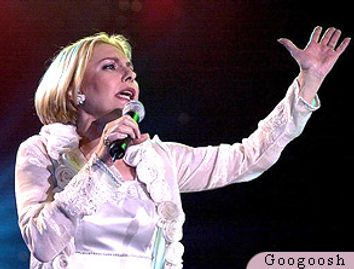
Once the outside show gave way to the inside one, Googoosh did not disappoint. Radiant in a white gown and faux-diamond tiara befitting the queen of Iranian pop, she had her audience enthralled. Silencing the thunderous applause with a regal wave of her hand, Googoosh, sporting a blond Hillary Clinton ‘do, launched into two hours of hits from her glory days.

The impressive performance was almost overshadowed by the huge emotional response of the audience. Carrying banners in Farsi bearing poetic proclamations of love and support and shouting out, “We adore you, Googoosh,” the ecstatic and often tearful fans had a quasi religious quality, ironically reminiscent of a mass Shi’ah ritual.

But in this case the opiate of the masses, and a key factor in the concert’s success, was an undeniable nostalgia. As the official program read, those pre-revolutionary times were “days of pure happiness” (despite, one assumes, the excesses of Savak and imperialist oil barons).

“I have been in L.A. for 20 years, and the whole time I’ve been listening to her old cassettes and keeping pictures of her from before,” said Mina Bajhdadi, 33. “Seeing her here tonight is like going back home.”

With her throaty, expressive alto, Googoosh proved herself a consummate performer, the kind who can work a crowd. Singing old favorites as well as a few songs from her new CD, “Zartosht,” Googoosh and her 14-piece band mixed Persian melodies, Edit Piaf-like chanson Francaise, electric guitar riffs and rumba flamenco rhythms reminiscent of the Gipsy Kings. The biggest cheers of recognition came when Googoosh sang the theme song from “Divorce,” an Iranian soap opera popular in the ’70s.

Any serious reflection on the political significance of Googoosh’s comeback was reserved for after hours at the nearby Hollywood Park Casino. As well-heeled guests looked out onto the moonlit racetrack, girls in sequined slip dresses danced to old Googoosh tunes and retro-disco hits. But for the American waiters serving roast beef on Wonder bread, it could have been ’70s Tehran.

“No one is happy in Iran with the current regime. The people feel betrayed by the false promises of the revolution,” said Hossein X, a 34-year-old investment banker who refused to give his last name citing “security concerns.” “The poor and the middle classes are worse off now than they were 20 years ago.”

Hossein added that the “decadence” of the ’70s was nothing compared to what is going on now. Promiscuity and drug abuse, he claimed, are more prevalent than ever, especially among young people, who Hossein said are simply bored. “This is their way of rebelling against the regime,” he said.

“Googoosh,” said Hossein, “is a symbol of the people’s resistance. She could even become a catalyst for a counter-revolution.”

It remains to be seen how much Googoosh’s concert tour will stir things up in Iran, but the buzz around her comeback in America is unprecedented. Miles Copeland is rumored to be considering a purchase of Googoosh’s entire catalog of songs, and Chanel has expressed interest in providing her concert wardrobe. Can major corporate sponsorship or even Hollywood be far off?

While the “Great Satan” will no doubt continue to tempt the formerly “penitent” cabaret star — to the chagrin of fundamentalist mullahs — it’s anyone’s guess how Googoosh’s story will end. A decision to return to Iran after her tour would be a big step. With violent clashes between pro-reformists and hard-liners as recently as a month ago, Googoosh could find her homeland in turmoil as dramatic as that which she fled over two decades ago.

Continue Reading Close