Hannah Gurman

Inside Hillary’s plumbers unit

The State Department scrambles to prevent another WikiLeaks humiliation

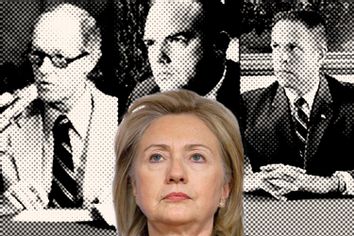
E. Howard Hunt, John Ehrlichman, H. R. Haldeman and Hillary Clinton

A joke has it that it takes three plumbers to change a light bulb: a boss to tell the plumber, a plumber to tell the helper, and the helper to get his electrician friend to do it on the side.

In response to WikiLeaks’ latest deluge, a similar entourage of official plumbers, plumber’s helpers, and even some competitors has come onto the scene, promising to plug the leak of 250,000 State Department cables, which WikiLeaks began posting on Nov. 28. In this scenario, Sarah Palin, Mike Huckabee and other critics of the Obama administration represent the competition, who, if given the job, would not just plug the leak, but cut off the head of the leaker (with Joe Lieberman offering a less medieval, but nonetheless radical measure that would criminalize the act of publishing classified sources and preemptively gag the press). The motley crew of independent contractors, whose work comprises an indirect, but important aspect of the plumbing job, includes Interpol, the international police organization that issued a warrant for Julian Assange’s arrest; Amazon, which dropped WikiLeaks from its server earlier this week; and Scotland Yard, which arrested Assange on Tuesday.

And then there is the State Department. Hillary Clinton and other department officials have come on the scene as internal plumbers, working to plug the leak from inside the diplomatic establishment.

The State Department’s efforts to contain “Cablegate” began with a letter from the agency’s top lawyer, Harold Koh, to Assange, requesting that WikiLeaks not post the classified cables in its possession. After that failed, and the leaked cables became the international media story of the week, the State Department turned to propaganda, playing the lead role in the administration’s efforts to condemn the publication of the cables as an assault on national security and diplomacy. “This disclosure is not just an attack on America’s foreign policy interests,” declared Secretary Clinton on Nov. 29, “It is an attack on the international community.” Underscoring the importance of confidentiality in diplomacy, Clinton went on to assure the nation and the world that the State Department would do everything in its power to prevent future leaks. “I have directed that specific actions be taken at the State Department, in addition to new security safeguards at the Department of Defense and elsewhere, to protect State Department information so that this kind of breach cannot and does not happen again.”

Since then, in an attempt to prevent another “Cablegate,” the State Department has made efforts to erect a set of virtual walls around the diplomatic establishment. The outermost facade is being built between rank-and-file diplomats and the public. Its main guard is the secretary of state and the department’s press liaisons. Not surprisingly, when questioned at press conferences, P.J. Crowley, the department’s head press liaison, has adamantly refused to discuss the contents of specific cables. And despite much speculation in the press about who wrote the directive to spy on foreign diplomats at the U.N. or the juicy report on the lavish Dagestan wedding, the names of the diplomats who authored the leaked cables are not being disclosed to the public. Of course, this stance hasn’t stopped the State Department from referring in broad strokes to specific documents that help advance the administration’s foreign policy agenda, such as those detailing Arab leaders’ distrust of Iran.

Then there are the intermediary walls, which are being built within the State Department and between the department and other federal agencies. As Crowley explained last week, changes have already been made to the database from which the cables were leaked, so that fewer individuals within the State Department and other federal agencies will have access to classified diplomatic reports. Parts of this structure are better described as absurdist architecture than sound engineering. Last Friday, the State Department, along with other federal agencies, barred employees who lack secret clearance from viewing the WikiLeaks documents either from their office or home computers.

Finally, there is the innermost wall, the sanctum sanctorum, which is being constructed not by senior officials but by the diplomats themselves. Many retired diplomats speculate that, in order to prevent another WikiLeaks scenario, diplomats will voluntarily “enhance” their own confidentiality policies. According to one former U.S. ambassador in the Middle East, “The consequence will be even less reporting and communication.” Diplomats will refrain from typing up the most sensitive information and they will give a higher classification to what they do document. In an effort to extend this self-censorship beyond current employees, one State Department officer and Columbia University alumnus sent an e-mail to the school of international affairs, cautioning students not to post any of the leaked documents or comments about them on their Facebook or Twitter accounts, lest they sabotage their future employment possibilities. He was clearly not as concerned about sabotaging the public’s right to debate what had de facto become public information.

The culture of self-censorship in the diplomatic establishment is nothing new. Diplomacy and secrecy have traditionally gone hand in hand. This is also not the first time that the State Department has helped to plug massive leaks of classified foreign policy documents. After Daniel Ellsberg leaked the Pentagon Papers, Richard Nixon created the White House plumbers unit, which included the now notorious H.R. Haldeman, John Ehrlichman and E. Howard Hunt, who were first sent to burgle Ellsberg’s office and who would later break into the Democratic National Committee’s headquarters at the Watergate hotel. The State Department played an important, albeit lesser-known role in the clampdown. In the wake of the Pentagon Papers’ release, department administrators made a concerted effort to prevent the public from accessing diplomatic cables, especially those that expressed disagreement with the reigning policies. This included the creation of an official dissent channel, which promised dissenting diplomats a high-level audience inside the foreign policy establishment in exchange for a public one. The State Department continues to keep a tight lid on official dissent cables and diplomatic dissent writing more generally. Hundreds of messages have been submitted through the dissent channel, but only a handful have been made available to the public. In light of rank-and-file diplomats’ relative lack of influence on policy, the promise of the dissent channel is nothing short of ironic. As Clinton has said of the WikiLeaks cables, “I want to make clear that our official foreign policy is not set in these messages.”

Over the last 40 years, the department’s internal policies and culture of secrecy have accomplished through legal means what Nixon’s notorious plumbers unit failed to do illegally. But the strategy isn’t foolproof. The State Department has never figured out quite how to build a perfect wall, and its cracks and fissures have helped the public receive some valuable information over the years. Perhaps the most important recent leak before “Cablegate” was the document that detailed Ambassador Karl Eikenberry’s opposition to escalating the war in Afghanistan. As the appearance of this cable on the New York Times’ website last January suggests, the digital age poses a new challenge to the maintenance of secrecy. With or without Julian Assange, as long as there are a few renegades on either side of the wall, the leaks will keep springing from Foggy Bottom and flowing to the Internet. In an age where information proverbially seeks to be free, if there’s one thing we can count on in this otherwise lean economy, it’s that there will be plenty of work for the State Department’s plumbing unit.

The Iraq withdrawal: An Orwellian success

The symbolic end of America's involvement in the war has arrived, but the propaganda rages on

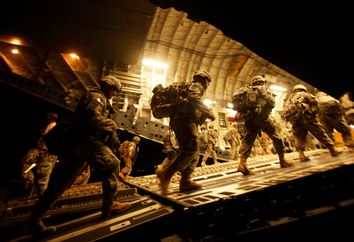
FILE - In this Tuesday, July 13, file 2010 photo, U.S. Army soldiers from 2nd Brigade, 10th Mountain Division board a C-17 aircraft at Baghdad International Airport as they begin their journey to the United States. Everything from helicopters to printer cartridges are being wrapped and stamped and shipped out of Iraq in one of the most monumental withdrawal operations the American military has ever carried out as U.S. forces flow out of the country. The move is reversing, over the course of months, a U.S. military presence that built up over seven years and dug in so deep it once seemed immovable. More than 400 bases are being closed down or handed over to the Iraqi military, some closer to small towns with elaborate dining facilities serving tacos and crab legs and gyms with rows of treadmills.(AP Photo/Maya Alleruzzo, File)(Credit: Maya Alleruzzo)

As the Second World War drew to a close, George Orwell looked back on the various prognoses of war and peace that had emerged in recent years. “All political thinking for years past has been vitiated in the same way,” he observed. “People can foresee the future only when it coincides with their own wishes, and the most grossly obvious facts can be ignored when they are unwelcome.”

Over the next several years, Orwell would elaborate a dystopian vision of the emerging Cold War, a vision in which warring superpowers would use distorted and self-serving political rhetoric to battle each other and their citizens.

In recent weeks, we have reached another historic juncture. The Iraq war, or at least the American military’s role in it, is drawing to a symbolic close. To mark this moment, the U.S. Ministry of Information has put its spin machine in high gear. Orwell would have had a field day with this one. He could not have invented a more Orwellian tale than the actual story of the U.S. withdrawal from Iraq.

Here is the official version, championed in its earlier moments by President Bush, Gen. Petraeus and the congressional hawks, and now trumpeted almost as loudly by the White House and State Department: Violence is down. Iraqis are finally (it’s about time, guys) taking responsibility for their own security. The March elections were a great step forward. Iraq, we can safely say, is on the path to a brighter future.

This story marks the last chapter in the surge narrative that took root in 2006, a narrative in which Petraeus is credited with turning the war around. Proponents of this story know better than to declare victory, a word that has largely fallen out of the official lexicon. But the word “success,” which has taken its place, is everywhere. And while it doesn’t quite afford that nationalist sense of superiority to which Americans have long been accustomed, success does provide a certain contentment and satisfaction over a job well done. It allows for that perennial optimism that never quite goes out of fashion in the American way of war.

It is telling, though not surprising, that Obama chose a military audience to deliver his official remarks on the nominal end of America’s seven-year occupation of Iraq. Like all American (and especially all Democratic) presidents, Obama rarely misses a moment to pay tribute to the troops — perhaps the only thing that no loyal American can question regardless of how unjust the wars America fights may be. “As we mark the end of America’s combat mission in Iraq,” President Obama declared, “a grateful America must pay tribute to all who served there.”

There is nothing fundamentally new in this story. It is just the latest version of a long-standing nationalist narrative in which, no matter how the story begins, the U.S. always ends up on the right side of history. For the most loyal devotees of this narrative, even Vietnam is not an exception. Were it not for that cheap Congress, those pesky journalists, and those traitorous antiwar activists, they insist, we would’ve won that war too. Never mind that we had allied ourselves with a corrupt government that cared little about the people of Vietnam. Never mind that the enemy saw this as just the latest in a decades-long war against foreign occupiers. Never mind that, as Daniel Ellsberg has said, we were not just “on the wrong side” of this war. “We were the wrong side.”

As with the hawk’s version of Vietnam’s ignominious conclusion, the tale of America’s withdrawal from Iraq is characterized by contradictions, half-truths and huge blind spots. It is a story told by officials with jobs and reputations to protect. It is a myth bought and sold by Americans who want to believe in a benevolent image of their country in the world. And most important of all, it is a fairy tale that systematically elevates the good news about Iraq and avoids any talk of the long-term devastation this war has wreaked on the people there.

In recent months, as the deadline for troop withdrawal has neared, Ambassador Christopher Hill has become a more visible prop in the administration’s official spin machine, deflecting any arrows aimed at the armor that is the official success narrative. When NPR’s Steve Inskeep asked him whether Iraq might still collapse, Hill said that he looked at the situation “in pretty optimistic terms.” That’s easy for him to say. Hill is leaving Iraq this month to become the dean of the international relations program at Denver University.

The success story is a bit harder to feed to the Iraqis who actually experience the realities on the ground in Iraq, and who, unlike Hill, will continue to face these realities on a daily basis. In an interview on Al Al-Jazeera’s “Inside Iraq” television show in April, Jassim Al-Assawi challenged the ambassador’s rosy assessment of the March parliamentary elections, pointing out that a number of elected ex- Baathist officials had been denied seats in parliament. When questioned about the legality of this measure, as well as other serious problems of Iraqi governance, Hill tried to convince his interviewer that he was not the Iraqi government. “I’m just the U.S. ambassador,” he said. “I’m not the prime minister” of Iraq. “I’m not a judge in Baghdad.”

Good thing. Because, according to the most recent Brookings index of Iraq, 135 of 869 judges in Iraq have been removed on charges of corruption. Overall, when it comes to corruption, Iraq ranks 176 out of 180 countries. Thus, it should come as no surprise that $9 billion of oil revenue intended for reconstruction has gone missing.

Of course, the state of Iraq’s political and judicial institutions have never been the strongest thread in the success narrative. The security story, on the other hand, is ostensibly on firmer ground, and has therefore figured prominently in the official version of the story. Here’s Obama on the progress of security in Iraq:

Today — even as terrorists try to derail Iraq’s progress — because of the sacrifices of our troops and their Iraqi partners, violence in Iraq continues to be near the lowest it’s been in years. And next month, we will change our military mission from combat to supporting and training Iraqi security forces. In fact, in many parts of the country, Iraqis have already taken the lead for security.

In this effort to play up the security achievements of Iraq, Obama bracketed the spikes in violence in recent months and used the word “terrorist” to avoid the deeper and more complex political history of both the Sadrist and Sunni insurgencies.

There is no denying that violence is down from its highest levels, and that is a good thing. But the Ministry of Information distorts all reality when it suggests that the Iraqi army and police are ready to “take the lead” in maintaining this security. As of December 2009, there were 664,000 Iraqi security forces. This reflects only the number of authorized personnel, however, and is not an indicator of operational readiness.

In September 2009, the Iraqi army had close to 250 battalions. But only about 50 of them were deemed capable of planning, executing and sustaining counterinsurgency operations on their own. The rest were either completely incapable or required assistance from coalition forces. This isn’t news to Iraqi military leaders. Lt. Gen. Babker Zerbari, Iraq’s most senior military officer, has said that his security forces won’t be able to take the lead until 2020 and has asked the U.S. to delay its planned withdrawal.

While the weavers of the success story have distorted the security situation in Iraq, they have hardly said a peep about the disaster that is Iraq’s infrastructure and essential services. As of February 2009, 80 percent of the population still lacked access to sanitation services, 55 percent lacked access to potable water, and 50 percent still had serious electricity shortages. As late as May 2010, Brookings estimated that 30,000-50,000 private generators were making up for shortages in the national grid.

Healthcare is also in dire straits. New studies reveal soaring cancer rates in Fallujah and other cities that were heavily targeted by U.S. forces. This news comes against the backdrop of a mass exodus of doctors from the country. Twenty thousand of Iraq’s 34,000 registered physicians left Iraq after the U.S. invasion. As of April 2009, fewer than 2,000 returned, the same as the number who were killed during the course of the war.

The shortage of doctors in Iraq is just one facet of the much bigger population displacement as a result of the war. As of January 2009, there were still 2 million Iraqi refugees living outside of the country, and as of April 2010, there were 2,764,000 internally displaced people living in Iraq.

“War against a foreign country only happens when the moneyed classes think they are going to profit from it.” – George Orwell, New Statesmen (1937)

In 2002, the State Department’s “Future of Iraq” group predicted that the toppling of the Saddam regime would usher in a period of great economic boom. That turned out not to be the case, at least not initially. Iraq’s instability kept multinational corporations out of Iraq for awhile, but in recent years, the situation has changed. In 2008 and 2009, Foreign Direct Investment went up tenfold in Iraq. Not surprisingly, officials have been framing this as great news for the country. In 2009, the website of Operation Iraqi Freedom proudly advertised that the governor of Anbar was named FDI magazine’s “Global Personality of the Year.” What the website does not advertise is that the huge oil and natural gas companies competing for Anbar’s natural resource wealth have little interest in helping the people of Anbar, but are instead focused on their bottom lines. That entails plans for using cheap foreign labor from China and other countries. It is unlikely that anything more than a small portion of their earnings will actually trickle down to ordinary Iraqis.

The oil and gas companies are not the only ones who will profit from the postwar order in Iraq. The United States military and defense industry will make out well, too. Despite claims to the contrary, this is not the end of the U.S. military presence in Iraq. In addition to the several bases that will remain active, housing the soldiers and private contractors whose titles will change to advisors, there will be an indefinite state of dependency on U.S.-manufactured weapons and technology. Defense companies, such as ARINC will continue to make hundreds of millions providing Mi-17 helicopters and other military hardware and logistics to Iraq.

While the Ministry of Information does not advertise the reality of America’s enduring military presence in Iraq, it is quick to announce a civilian “surge” in the country. Along these lines, officials have been boasting about the massive U.S. embassy in Baghdad. “Along with the Great Wall of China,” said Ambassador Hill, “its one of those things you can see with the naked eye from outer space. I mean, it’s huge.” Indeed. At 104 acres, it is the largest U.S. embassy in the world. In addition to six apartment buildings, it has a luxury pool, as well as a water and sewage treatment plant. Stop for a second and reflect on these last two amenities. They give you some measure of what American officials really know but aren’t saying about the state of drinking water and sanitation in Iraq. The State Department has requested a mini-army to protect this Fortress America — including 24 Black Hawk helicopters and 50 bomb-resistant vehicles. Again, stop for a minute and ask yourself what this really suggests. The shadow army says a lot more than the official pronouncements do about the true state of security in Iraq.

“Who Controls the Past Controls the Future. Who Controls the Present Controls the Past”George Orwell, “1984″ (1949)

Given all the damage that remains in Iraq, it is no wonder that some Iraqis are confused and angry at the rosy pronouncements about Iraq’s path to progress. Without masking his hostility and frustration, Jassim Al-Assawi pressed Ambassador Hill to explain why, despite all the problems Iraq is currently experiencing, he remains so optimistic. After waxing poetic about the heroism and drive of the Iraqi people, Hill simply insisted, “There’s no going back, only forward.”

This last statement encapsulates what is perhaps the most important function of the success narrative. All this talk about moving forward is also an insistence on not looking back, especially not to 2003. The U.S. has sought to control the past of the Iraq war by rejecting and effectively erasing it, willfully marginalizing the very act that got this whole story going in the first place. The Bush administration needed to scratch 2003 out in order to minimize its own role in the destruction of Iraq and the suffering of its people. Now, the Obama administration has picked up the eraser in order to convince everyone that this is a “responsible” withdrawal.

No matter how much the U.S government erases the past or predicts the future of Iraq, ordinary Iraqis will continue to face the more messy and complicated realities of the present. I dare Obama and everyone else in the spin machine to go to Iraq and look a child in the eyes. A child who, seven years after the U.S. invasion, still lacks adequate housing, drinking water, sanitation, electricity and education. Now, tell that child that the war in Iraq was a success.

Continue Reading Close

Changing generals changes nothing in Afghanistan

McChrystal is out and Petraeus is in, but "victory" is as elusive as ever

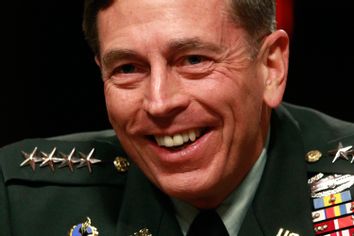
Gen. David Petraeus

I spent the better part of Wednesday morning trying to keep up with the flurry of news about Gen. McChrystal’s recall. Everyone wanted to know, would he stay or would he go?

Between checking for updates on the New York Times and the Small Wars Journal and listening to George Packer and Fred Kaplan on NPR, I opened a package that had arrived in yesterday’s mail. It was a book: “A Question of Command: Counterinsurgency From the Civil War to Iraq,” by Mark Moyer. As the title suggests, the book argues that the success or failure of a counterinsurgency strategy depends on the quality and commitment of the individuals leading the fight.

Those who spoke out against McChrystal’s dismissal made the same argument. We can’t change leadership at such a crucial moment in the battle, they say. As one NPR reporter put it, “McChrystal is the war in Afghanistan.” Thus, many believe that the success or failure of the counterinsurgency strategy depends on him.

This just isn’t true. First of all, it’s unlikely that the administration’s policy in Afghanistan will change with McChrystal’s resignation. Like Petraeus, who has now been named to fill the job, everyone else mentioned as a possible replacement for McChrystal shares his emphasis on the clear-hold-build strategy of counterinsurgency and the importance of building up trust between the local population and the Afghan government.

Perhaps more important, the idea that this war will be won or lost by a brilliant general is problematic. Everyone agrees that both McChrystal and Petraeus are exceptional individuals. They therefore fit nicely into the standard narrative of counterinsurgency as told by many of its proponents. According to this narrative, there are enlightened generals who “get” COIN and dimwitted generals who don’t. The classic example comes out of Vietnam lore. As the story goes, the blockhead general, William Westmoreland, who gauged the war in terms of body count and bombs, was replaced in 1968 by the more astute and versatile Creighton Abrams, who made pacification and political reform a more central aspect of the war effort. A similar narrative emerged from Iraq. Here, the dimwit was Gen. Casey. He was replaced by the brilliant Petraeus who turned the war in Iraq around by revitalizing the lost doctrine and practice of counterinsurgency.

Surely, generals play an important role in winning and losing wars. But it is misleading to imagine that they — or any other individual — determine the outcome of a conflict whose causes stem from the underlying political and social system. Despite the counterfactual argument that we would’ve won in Vietnam if we hadn’t cut the rug out from under Abrams, the larger truth is that the South Vietnamese government remained unwilling to engage in serious reform, thus making lasting victory in Vietnam impossible. Critics of Petraeus argue that the decreased violence in Iraq was largely the result of political developments within the insurgency, rather than a direct response to the surge. If establishing a viable infrastructure, building a stable political system, and getting electricity to the population are part of winning, then we can’t credit Petraeus or anyone else with succeeding in Iraq.

The political and social barriers to success in Afghanistan are even steeper. As did McChrystal, Petraeus will face the superhuman challenge of refashioning a political system that resists change and garnering popular support for a government that cares little about the populace.

In the scramble to follow the latest news on whether McChrystal deserved to go, the question of whether it will make any difference seems to have gotten lost. This is rather ironic, considering the article in Rolling Stone that ignited the flames in the first place. Anyone who reads the full article will see that the jabs at Obama, Holbrooke and Ikenberry by McChrystal and his aides play a relatively small part in the piece. Much more time is spent considering the blowback from the rank-and-file military and the larger problem of nation-building in Afghanistan. By the end of the piece, Hastings has poked serious holes in the inflated wish that McChrystal or any other hero general can succeed in Afghanistan. “Winning, it would seem, is not really possible,” he concludes. “Not even with Stanley McChrystal in charge.” In the meantime, though, we can count on the 24-hour news cycle to focus on the people and personalities — to pretend for the moment that the war in Afghanistan is really just a question of command.

Continue Reading Close
www.salon.com/writer/hannah_gurman/index.html