HDS Greenway

Obama should support Palestinian statehood

If the president wants to foster peace and be on the right side of history, he must back the Palestinian U.N. bid

  • more
    • All Share Services

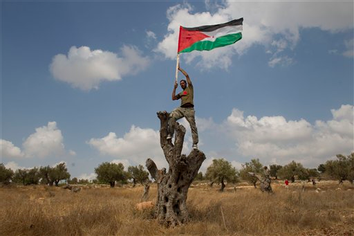
Obama should support Palestinian statehoodA Palestinian waves a flag during a demonstration in the West Bank, Friday, Sept. 9, 2011

BOSTON — President Obama should not veto Palestinian national aspirations in the United Nations Security Council.

The president is not wrong in thinking that this would be better handled in negotiations between the Palestinians and Israel. It would be wonderful if Israel itself were to sponsor a Palestinian state, but this is not going to happen as long as Prime Minister Benjamin Netanyahu is in power.

He has spent his entire career trying to avoid Palestinian statehood with delaying tactics and maneuvers — seemingly willing to negotiate everything anywhere, but in reality putting up every obstacle he can in the path of peace and permanent settlement with the Palestinians.

Not that the Palestinians are guiltless in this stand off. They have had offers and opportunities they have not taken. But the entire Middle East is now in a state of flux and transition, and, as a practical matter, to try to keep the Palestinians frozen in their status as an occupied people without political rights is to ask for serious trouble — both for Israel and the U.S. The next Intifada will be far more destructive than the last two.

As a moral matter it is simply time to let the Palestinians have their state just as Harry Truman recognized that the Jews, after all they had been through in Europe in World War II, should have their state in 1948.

Many Israelis understand this. Former Defense Minister Binyamin Ben-Eliezer told The New York Times that “the world is tired of this conflict and angry at us because we are viewed as conquerors, ruling over another people. If I were Bibi Netanyahu I would recognize a Palestinian State. We would then negotiate borders and security.” But Netanyahu comes from the so-called “Revisionist” wing of Zionism that is reluctant to give up any part of what they consider the biblical land of Israel.

When David Ben Gurion on May 14th, 1948, declared that the state of Israel would come into being at midnight, America responded with de-facto recognition almost immediately. But the Soviet Union came through first with de-jure recognition, something the U.S. did not grant until an elected government had been formed in January of 1949.

Even with the two superpowers onboard, the U.N. Security Council did not grant Israel U.N. membership until May 11, 1949 — a full year after the state was declared — and after a long fight to physically secure its borders.

Palestine might come into being in reverse order — declare sovereignty now, gain admittance to the U.N., and then negotiate the borders with Israel, as Ben-Eliezer suggested.

There are many who say there are dangers involved in a Palestinian state, and they are right, just as those in Truman’s State Department, including George C. Marshall, were right in warning that the creation of a Jewish state would cause a sea of troubles.

And there are those who say that the Palestinian problem is exaggerated, that it doesn’t really matter if they remain an occupied people, because giving them their freedom would not solve all the issues of the Middle East or placate Islamic extremists. And they, too, are right. Giving the Palestinians their state would not solve all the issues of the Middle East, but it would surely help. Again and again, year in and year out, the centrality of the Palestinian problem never goes away. Even General David Petraeus, from his command post in Afghanistan, recognized that Israel’s occupation of the Palestinians was hurting America’s war efforts as far away as Pakistan and Afghanistan.

Richard Perle and David Frum, in their book, “An End to Evil, How to Win the War on Terror,” submit that “in the Arab and Muslim World, the Palestinian issue has never been about compassion, mercy, or even justice. First and always, this issue has been about vengeance…”, i.e., “the destruction of Israel and the re-conquest of the Holy Land.” This might be true of some, but this is akin to saying the Jews in Israel want to take over Jordan just because that was an original “revisionist” goal back in 1947, or because David Ben Gurion once put feelers out to the British and French in 1956 that Jordan should be divided up between Israel and Iraq. Yes, some Arabs still might want to destroy Israel, just as some Israelis want to expel all the Palestinians, but that does not represent the vast majority nor government policy in either Israel or the Arab world.

The Obama administration tried its best to talk the Palestinians out of going to the United Nations to legitimize their state but failed. Given the administration’s record, this failure was entirely predictable. Obama came into office seeming to promise a renewed energy toward trying to solve the Palestinian problem, following President Bush’s near-total support for whatever Israel wanted.

Obama went eyeball to eyeball with Netanyahu over settlements, and the Palestinians saw that Obama blinked first. It was obvious then that Obama might talk a good game, but that the Israeli tail was always going to wag the American dog. The sight of Netanyahu who, having defied and insulted the American president, addressing a joint session of Congress with congressmen and senators of both parties jumping to their feet like jack-in-the-boxes to show their support, was all anyone needed to understand Israel’s power in the American Congress.

The Democratic Party has to be mindful of pro-Zionist political support. But it is in America’s strategic interest, and ultimately in Israel’s interest too, to lance the boil of the Israel-Palestinian conflict.

If it was the right thing to do to recognize the state of Israel when it was first born, it is time now to grant the same rights and privileges to the Palestinian people. The Obama administration is always talking about being on the right side of history in the Middle East. The United States could abstain, if it must, but vetoing Palestinian nationalist aspirations would put us on the wrong side of history.

How will Norway cope with terrorism?

The attack by a homegrown Christian militant leaves the peace-seeking nation looking for answers

  • more
    • All Share Services

How will Norway cope with terrorism?Candles and flowers are arranged on the ground near the blast site to mourn victims of the attacks

There is very little darkness in Norway this time of year. The summer solstice may have passed, but north of the Arctic Circle the sun never really sets. Further south, in Oslo, night is merely an afterthought in the pearl grey lingering of the day.

July is holiday time in Norway, and a bad time to set up appointments. The king leaves his palace to go sailing, and ordinary Norwegians flock to their mountains and their seashores as the country goes into a kind of exhilaration, as if on a high from so much light lasting so long.

In Oslo, Norwegians flock to their water-front restaurants and bars, perhaps to stroll by the yachts in the harbor, or gawk at the ever-bigger cruise ships that bring boatloads of tourists to their fair shores.

I have written in this space about how Norway’s foreign policy is hard-wired into conflict resolution and trying to bring peace to the many wars that have plagued the world since the end of the Soviet Union. The “Oslo Accords” that almost brought peace to the Israel-Palestine conflict is only the best known.

Norwegians are proud of the fact that the inventor of dynamite, the Swedish Alfred Nobel, chose Norway, then joined with Sweden, to be the site of his Peace Prize, the world’s most important and prestigious award.

But trying to bring about peace and good will, shedding light unto the world has not protected tidy little Norway, with a population of only about 5 million, from the darkness of the human soul, or a mass-murderer who would go to a holiday island to slaughter children.

Norway used to be one of the poorest countries in Europe, with little to export except timber, fish and human beings, who fled poverty in their thousands, many to the American Midwest. The discovery of North Sea oil has changed all that, and today Norway is one of the richest.

Norwegians are relentless egalitarians, and happy with a welfare state that would drive the Tea Party in the United States to distraction. The last thing Norway wants is a politician to come along and tell them they need to lower taxes.

Perhaps because Norway was a colony itself for so long, first of Denmark, and then of Sweden until 1905, Norwegians have always been sympathetic to the plight of colonized people, and when formal colonialism ended, to the down -trodden of Asia and Africa.

Hail a cab in Oslo and there is likely to be a Pakistani driving it. In Bergen it might be a Congolese. I have seen African faces in the little seaport towns high up above the Arctic Circle, where Norway arches over Sweden and Finland to meet Russia. They are testimony to the generosity of Norwegians towards asylum-seekers.

The comfortable, happy life of Norwegians, insulated by their strong currency from the troubles of the euro zone further south, and largely protected from the economic ills of so much of the rest of the world, has now been shattered. Good fortune, peace-making and generosity have not shielded them from the new scourge of Europe: right-wing, anti-immigrant groups that see Europe as under siege from Africans and Asians, especially Muslims.

When the news of the Oslo bombing first came through, some thought it must be the work of Al-Qaida, revenge, perhaps, for Norway’s admittedly small contingent in Afghanistan. Others thought it might be retaliation for Norwegian planes bombing Tripoli. Still others thought it might be a spillover of Muslim hostility toward Denmark, where cartoons depicting the Prophet so riled the Muslim world five years ago.

It was, of course, none of these, but a home-grown Christian fanatic who turned mass-murder against his own countrymen. There will be much soul-searching in Norway in days, months and years ahead.

Not too long ago violence in Europe came from the left, the Red Brigades of disaffected youths who murdered bankers and politicians in Germany and Italy. Today it is the right that is turning to violence, turning against the dark faces in their midst in an exaggerated fear of Muslims. Right-wing, anti-immigrant political parties are moving out of the margins of politics and gaining support all over Europe.

I used to think this would not happen in the United States. But the fuss over whether a mosque could be somewhere in the vicinity of where Manhattan’s twin towers showed me that Americans, too, were susceptible to irrational anti-Muslim prejudices. Indeed, we now learn that Norway’s murderer, Anders Behring Breivik, may have been influenced by anti-Muslim bloggers in America.

In the end, I am convinced that tolerance will win out over prejudice at least in Norway. I wish I could say the same thing for the rest of the world.

Continue Reading Close