Hooman Majd

Ahmadinejad’s own U.S. presidential campaign

As I spent time with the Iranian president in New York, the central purpose of his trip to the United Nations became clear: Getting reelected back home.

Iranian President Mahmoud Ahmadinejad returned to New York this week to attend the opening of the United Nations General Assembly for his fourth visit — and perhaps his last, should he fail to win reelection in next summer’s Iranian presidential contest. But he aims to be reelected in June 2009, and his trip here revolved precisely around that goal.

Ahmadinejad clearly relished his opportunity on Tuesday to speak to the world from the same stage that the U.S. president does, and on the same day. But he also enjoys spending as much time as he can with the media, members of think tanks, and even college audiences during his short, State Department-restricted sojourns on American soil. As such, this year he hosted two iftar dinners (it still being the month of Ramadan). One was exclusively for Iranians and Iranian-Americans living in the Tri-State area — at least those on a list of citizens the Iranian government maintains as not opposing the Islamic regime. The other was for American think-tank scholars whom the Iranian delegation views as important. Needless to say, Haleh Esfandiary of the Woodrow Wilson International Center for Scholars, who spent some months in jail in Tehran in 2007, was not invited, although two of her colleagues were.

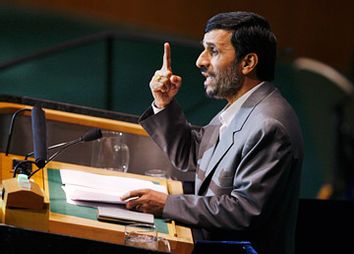
Ahmadinejad’s speech Tuesday at the U.N. (one I had a hand in translating) was an uncomfortable blend of sermon and anti-Zionist rage, bordering at times on the anti-Semitic. There were times, as I read the speech in English at the U.N. for a worldwide audience, when I was hoping perhaps to hear something a little more conciliatory or even something new — and at times it was hard to keep a straight face (or, rather, a straight voice), particularly in the section where he repeated claims from the long-discredited “Protocols of the Elders of Zion.” But Ahmadinejad’s speech, this last year of his first term in office, was even more geared to an Iranian domestic audience than in years past. Indeed, that was the central purpose of this trip to the U.S., something that become increasingly evident as the trip wore on. When I was in Tehran at the end of this summer, there was much talk of former President Khatami’s thinking of mounting a challenge to Ahmadinejad in 2009, and Khatami, whose generally positive image abroad is viewed with pride by many Iranians, could pose a threat to Ahmadinejad, particularly in the foreign policy area.

To the viewing audience in Iran, Ahmadinejad’s speech was another defiant statement that Iran would not be bullied into giving up its rights, nuclear and otherwise — and the logic he employed, perhaps lost to Western ears amid the inflammatory anti-Zionist tirade, was not altogether flawed. Iranians, and indeed many in the Third World, see a certain hypocrisy in the U.S. position: that Iran, a country that doesn’t possess nuclear weapons and has not invaded or attacked another country in centuries, must not be allowed certain nuclear technologies (that might allow them to one day build an atomic bomb), while the U.S. itself is in breach of its disarmament obligations, builds new generations of nuclear weapons and is the only nation to have ever used them to attack another country. (Not to mention, under the Bush administration, regularly threatens other countries with military force or even invades them.)

Ahmadinejad knows that this argument doesn’t win many fans in the U.S., but it plays well to a domestic audience predisposed to believe that American foreign policy is hegemonic by nature. Ahmadinejad also knows that the anti-Zionist rhetoric plays well in Iran, as it does across the Arab world. Only the intellectual and highly educated classes in the region find it self-defeating if not noxious — and the Iranians in this class are in any event unlikely to be voting for him in 2009. Well aware of a powerful political movement back home to challenge him for the presidency next June, he likes to use his visits to New York to burnish his image as a defender of Iranian rights. Nor does it hurt to have on display his status as a world leader afforded wide media coverage, his cultivated image of piety, and his willingness to engage Americans and even the U.S. government.

A few days before he left Tehran, Ahmadinejad had said at a press conference that he would be interested in debating the two U.S. presidential candidates during his stay in New York, and he repeated that offer, which he noted was ignored, at a press conference immediately after his speech at U.N. headquarters. The press conference, extensively covered by the Iranian media, was notable for Ahmadinejad’s eagerness to answer questions from the Iranian media (and other Muslim reporters) at the expense of the American media, whose Farsi-speaking Christiane Amanpour of CNN left early, after failing to get the attention of his aides despite her loud pleas and furious arm waving. That helped ensure maximum coverage in Iran and the surrounding region of his presence at U.N. headquarters. (Al Jazeera, a network that has had its bureau in Tehran shut down by the authorities on occasion, was called upon, as was Press TV, Iran’s own answer to Al Jazeera English.)

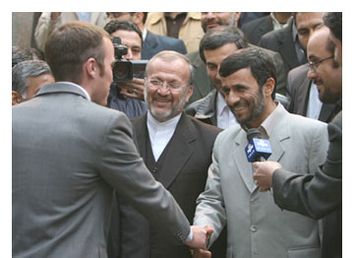
Immediately following the press conference, Ahmadinejad said his iftar prayers, had a small bite to eat and then joined a private dinner at his hotel for some 45 invited guests (where he didn’t eat the dinner placed in front of him). The Iranian ambassador to the U.N., Mohammad Khazaee, introduced the president, announced that the dinner meeting was off the record, and explained, rather unconvincingly, that the television cameras in the room would not film those in attendance and would not be broadcasting the event. Ahmadinejad listened carefully to the opinions voiced and the questions asked, taking notes, and responded to each individually as the guests finished their meals, all while the cameras were rolling. That some of the footage, showing a reasonable, charming and open president chatting amiably with American “scholars” would end up on the president’s Web site, or would be used in a campaign commercial next year, was to my mind in no doubt.

The following evening, President Ahmadinejad held another iftar dinner, this time for Iranians living in the New York area, which, as in past years, was again covered only by the Iranian media and the president’s videographers and photographers. This year more than most, it clearly was a priority for Ahmadinejad to be seen holding court with a few hundred Iranians, to show an audience back home that the president still has his fans among those in America, especially sophisticated New Yorkers who are the least likely, in the minds of ordinary Iranians back home, to be his supporters.

If there were any doubts that Ahmadinejad wanted this trip to the U.N. and all of his media appearances — including Larry King, which is widely viewed in Iran — to set the stage for his reelection campaign next year, those doubts were dispelled by something he said as an aside at the end of Tuesday night’s dinner. Gently complaining about the U.S. State Department’s issuing him a visa (something the U.S. is required to do as host country of the U.N. headquarters) only at the very last minute, he also mentioned that some in his entourage were actually denied visas. A close aide, he said, who had been present the previous year right by his side, was one of those refused entry. He was referring to Mojtaba Hashemi-Samareh — his own “Karl Rove,” the architect of his first presidential campaign, and undoubtedly his next one. He was, apparently, sorely missed.

McCain on Iran: Bush all over again

An alarmist John McCain is using Iran as a political weapon against Barack Obama -- even as he misjudges our Middle East adversary.

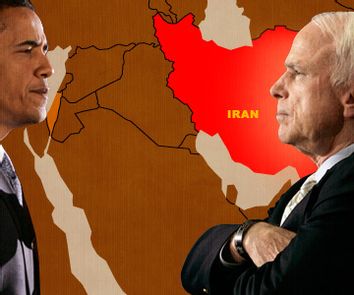
In the race for the White House, John McCain has trumpeted Iran as a paramount threat to the United States (and its close ally Israel), and has asserted that Iran will be the No. 1 foreign policy problem facing the next administration. McCain uses Iran as a prime example of what he depicts as his opponent Barack Obama’s naive and guileless approach to U.S. foreign policy. Just like the president he hopes to succeed, McCain has sought to deploy Iran as a political weapon of mass destruction.

In an interview with the Atlantic in late May, McCain said that “Iran is hell-bent on the destruction of Israel, they’re hell-bent on driving us out of Iraq, they’re hell-bent on supporting terrorist organizations, and as serious as anything to American families, they’re sending explosive devices into Iraq that are killing American soldiers.” In a speech to the American Israel Public Affairs Committee this month, McCain again mocked Obama’s willingness to enter into dialogue with the Iranians, saying, “The idea that they now seek nuclear weapons because we refused to engage in presidential-level talks is a serious misreading of history.”

The problem with McCain’s alarmist rhetoric throughout the presidential primaries and now in the general campaign is that he’s got the Iran problem almost entirely wrong. Notwithstanding his deep résumé on national security matters, his statements seem to reflect little understanding of the realities America faces in terms of dealing with Iran. Moreover, despite how highly he rates the problem, and his own foreign policy credentials, McCain seems to have no clear plan for actually dealing with Iran.

McCain has campaigned with little to offer the American people when it comes to domestic or economic policy (aside from boilerplate Republican rhetoric), and is concentrating on national security and the fight against terrorism as his strong suits in the presidential race. Americans remain genuinely concerned with both the war in Iraq (which McCain has been one of the most vocal supporters of) and potential future threats to homeland security in the form of terrorism. On the latter, McCain has shown no reluctance to follow the George W. Bush playbook, stirring up fear to support his position. Terms such as “Islamist,” “jihadist,” “Islamic terrorism” and “radical Islam” are still likely to make many Americans sit up and take notice. But although McCain has attempted at many turns to link those terms directly to Iran and the threat it poses to America, they have little relevance to our problems with this adversary. McCain may see Iran as the boogeyman he needs to help him defeat Obama this fall, but solving our real problems in the Middle East will require a fundamental decision about foreign policy that McCain seems unprepared to make: either negotiate with Iran, or go to war with Iran. There is no other choice at this point that is in the interests of the United States, and to pretend otherwise is pure sophism.

There are four main issues that the U.S. faces with Iran: the nuclear issue, Iran’s role in Iraq, Iran’s support of Hezbollah and Hamas, and Iran’s perceived threats against our ally Israel. The biggest issue revolves around the concern that Iran is gaining the knowledge and capability to build nuclear weapons. Short of launching another war — an endeavor that the vast majority of national security experts believe would be a terrible idea — is there a way to negotiate a solution to prevent a nuclear-armed Iran?

In September 2006, a year after the Iranian presidency had been transferred from Mohammad Khatami to Mahmoud Ahmadinejad, former President Khatami visited New York. At a private dinner for about 30 people then, I heard Khatami suggest to several influential American policy thinkers that while Iran would not suspend enrichment activities, it might be willing to settle for a “research” uranium enrichment project with perhaps 164 centrifuges. (That number was approximately the number of centrifuges Iran possessed at the time.) I’ve always known Khatami to be a cautious politician, and his statement was undoubtedly cleared by Iran’s Supreme Leader, Ayatollah Ali Khamenei (the true center of Iranian power). Given the audience, which included former high-level U.S. officials, Khatami’s statements undoubtedly were communicated back to the Bush administration.

Needless to say, the U.S. did not pursue diplomatic negotiations on the matter, following that apparent opportunity or other ones. Today, Iran is known to have at least 3,000 centrifuges running, and is expected to have as many as 50,000 within a year or so.

The Bush administration’s refusal to engage Iran without the pre-condition that Iran first suspend all uranium enrichment — a policy supported by McCain — demonstrably does nothing to prevent Iran from gaining nuclear knowledge and capability. Meanwhile, U.S.-led sanctions at the U.N. Security Council have had no discernible effect on the Iranian government’s perseverance with its nuclear program. Without either real negotiations or war against Iran, the nuclear issue will not be solved satisfactorily, and Iran could be fully capable of building a nuclear weapon, without outside assistance, in a matter of a few years.

On Iraq, McCain has joined the Bush administration in emphasizing allegations that Iranian-supplied weapons have been used by Shiite militias against American soldiers. Those allegations have been supported by scant or dubious evidence, and they distract from the overarching issues concerning war-torn Iraq. In fact, Iran’s interests in Iraq are not radically different from America’s: a relatively strong central government dominated by Shiites and Kurds (albeit from Iran’s view, Shiites and Kurds who would remain beholden to Iran’s interests), and a withdrawal of U.S. forces from the country. Unlike the U.S., Iran would probably like to see the various competing Shiite factions in the Iraqi government and the various militias remain strong enough so that no one party or militia can dominate the others. But that shouldn’t necessarily be at odds with American interests at this point. We are looking for a graceful exit from a costly and unpopular war, that accomplishes some relative stability in the region — ensuring that Iraq doesn’t collapse as a failed state and become a long-term breeding ground for terrorists who may one day strike further west. (The notion that the American goal is for Iraq to become a beacon of democracy in the Middle East has long been debunked and is no longer even a pretense.)

Iran’s influence in Iraq is of such significance that even the Bush administration, although loath to talk to Iranians under nearly any circumstances, decided to engage the Iranian ambassador to Baghdad on several occasions last year. Iran’s role in the recent Basra cease-fire and in quelling the violence in Sadr City is well documented, and President Ahmadinejad’s state visit to Iraq earlier this year, ceremoniously upstaging any visit by President Bush, reiterated that Iran will play a major role in Iraq for years to come.

The Bush administration has complained that the ambassadorial-level talks with Iran in Baghdad have been fruitless — but surely they were designed to be. The talks last year were limited to only the subject of Iraq itself, and, according to two senior Iranian government officials familiar with the talks (with whom I spoke around the time of the talks, in spring 2007), the discussions consisted largely of accusations by the U.S. ambassador about Iranian “interference” in Iraqi affairs and Iranian support of violence against U.S. forces.

The Iranians, as they have said on many occasions, are not particularly persuaded by lectures or accusations, and are unlikely to help the U.S. with the Iraq predicament unless they are offered something in return. More sanctions and saber-rattling are not likely to do the trick. McCain has said often that he believes that the U.S. should not withdraw from Iraq until “victory” is achieved there. But it is clear that any “victory” will not come without Iranian help, and Iranian help will not be forthcoming without real, fruitful talks that encompass more than just the continuing violence in Iraq.

Iran’s support of Hezbollah, the Lebanon-based militant group, is the chief reason it is labeled a state sponsor of terrorism, a categorization played up by McCain and other hard-liners. (The message intended for the American public is that Iran is, ultimately, supporting terrorist attacks against innocent Americans or Europeans.) Iran’s support for Hezbollah is also a reason why the Iranian Revolutionary Guard’s Qods force, the foreign expeditionary arm of the force, has been labeled a terrorist organization by the U.S. Senate (in a resolution voted for by both McCain and Sen. Hillary Clinton, and now, apparently, one supported by Obama as well).

But although Hezbollah has an active military wing, it is also a political party and is now part of the government of Lebanon — a government the U.S. supports. The Bush administration has in the past refused to talk to Hezbollah. But without Hezbollah, the recent 18-month government deadlock, which left Lebanon perilously without a president for six of those months, would not have been resolved. The subsequent power-sharing deal gave Hezbollah a stake in the government, even if the U.S. is reluctant to recognize that. (Secretary of State Condoleezza Rice recently engaged in talks with Hezbollah officials in Beirut.)

The reality is that Iran’s influence in the Levant has grown, not diminished, because of our refusal to talk with either Hezbollah or its patron, Iran, and Hezbollah will not disappear from the Lebanese scene simply because we ignore it. If we want to increase our influence and check Iranian influence in the region, then we have to either talk to Iran and Hezbollah, and try to find a way to ally our interests with theirs (which would certainly have to include Hezbollah ceasing their attacks on Israel) — or we have to bomb Iran and hope that bombing will make them rethink their support of Hezbollah.

Hamas, the militant Sunni political party that runs Gaza, is also unlikely to disappear through U.S. refusal to engage them. Iran is one of the only countries offering financial and material support to Hamas, a fact that has elevated Iran’s prestige in the region and across the greater Muslim world while U.S. prestige has waned. Mahmoud Abbas of the Palestinian Authority, in recognition of the reality that ignoring Hamas has produced no favorable outcome, suggested recently that he would negotiate with Hamas in order to unite the Palestinians in their quest for a homeland. Even Israel, whose long-stated pre-condition of not talking to Hamas until it first recognized Israel’s right to exist, finally came to the conclusion that it had to negotiate with Hamas or otherwise plunge much deeper into military conflict. With Israel’s citizenry overwhelmingly in favor of talks, and with its military wary of the ramifications of a full assault on Gaza, Israel reached a cease-fire agreement with Hamas, announced on Tuesday.

The current Iranian president’s ongoing “threats” against Israel represent perhaps the easiest of the issues to resolve by talks. President Ahmadinejad relishes the attention his contemptible outbursts bring, such as when he called Israel a “stinking corpse” during Israel’s 60th anniversary celebrations in March, or when he again suggested Israel’s demise in a recent speech commemorating Ayatollah Khomeini’s death: “You should know that the criminal and terrorist Zionist regime which has 60 years of plundering, aggression and crimes in its file has reached the end of its work and will soon disappear off the geographical scene.”

McCain jumped at the opportunity to play up Ahmadinejad’s rhetoric as indicative of a dire danger. “Foremost in all our minds is the threat posed by the regime in Tehran,” he said in his speech to AIPAC in June. “The Iranian president has called for Israel to be ‘wiped off the map’ and suggested that Israel’s Jewish population should return to Europe. He calls Israel a ‘stinking corpse’ that is ‘on its way to annihilation’.”

But while Ahmadinejad’s bluster pays dividends for him in the Arab and Muslim street, and perhaps helps to distract the Iranian people from the painful economic problems that have compounded under his presidency, in reality it is no realistic reflection of Iranian foreign policy. Even if Ahmadinejad were really intent on waging war against Israel, he has no real power or authority to do so: He is not the commander in chief of Iran’s military; the supreme leader is. If Iran ever were to build a nuclear weapon, it would not be its president’s finger on the button, it would be its supreme leader’s. Ayatollah Khamenei has made it clear that Iran will never attack another country first, and it is certainly in its interest not to do so. Every Iranian official, and all the clerics including the supreme leader, know full well that an attack on Israel will mean suicide for the regime (if not the country more widely) — and the No. 1 priority, especially for the clerics, is to maintain the continuity of the regime.

Iranian rhetoric, prior to Ahmadinejad’s presidency, has always been pro-Palestinian and anti-Israeli (or anti-Zionist, as the Iranians claim) — but even today, most Iranians do not view Ahmadinejad’s excessively belligerent remarks as a direct threat to attack Israel. Ahmadinejad is up for reelection in 2009, but whether he is reelected or not, Iran’s policy toward the Palestinian-Israeli conflict in particular is not likely to change. That policy — reiterated to me by President Khatami in his last days in office in July 2005, repeated by officials in the Ahmadinejad administration and stated publicly by the supreme leader himself — is that Iran will support whatever the Palestinian people decide for their fate. Iran could be brought in as a participant to talks on a Palestinian state, or it could agree, in talks with the U.S., to sit on the sidelines. If Mahmoud Abbas engages Hamas as he has suggested, and comes to an agreement with Hamas, then Iran will be at the table anyway, unless, of course, America is at war with Iran.

Ultimately, John McCain’s position on Iran — in lockstep with the Bush administration’s — is one of refusing, as he puts it, to “appease” the enemy. Shortly after President Bush’s speech to the Israeli Knesset in May, in which Bush characterized potential negotiations with Iran, Hamas or Hezbollah as appeasement, McCain said to reporters in Ohio: “Yes, there have been appeasers in the past, and the president is exactly right, and one of them is Neville Chamberlain.” He continued: “I believe that it’s not an accident that our hostages came home from Iran when President Reagan was president of the United States. He didn’t sit down in a negotiation with the religious extremists in Iran, he made it very clear that those hostages were coming home.”

Bush, McCain and their hard-line Republican supporters have managed to redefine the word “appeasement” with this line of reasoning. Appeasement, as any student of history (or even anyone with a dictionary handy) knows, means to placate by acceding to demands, such as when Chamberlain, the British Prime Minister, acceded to an invasion of Sudetenland in the hopes of placating Hitler. It is unclear what the U.S. would be acceding to if it were to engage in talks with Iran, a state that is relatively puny in military terms and in that regard is in no way comparable to Hitler’s Germany.

What Iranian demands would the U.S. face, then? That they be allowed to enrich uranium for civilian energy purposes, a right they are granted under the Nuclear Nonproliferation Treaty? They’re enriching now, and will continue to do so whether we talk with them or not.

The bottom line is that Iran is not, and never will be, a serious military threat to the United States, centrifuges spinning or not. Militarily, it is incapable of standing up to Israel (even if it were to develop a nuclear weapons capability, that capability would pale in comparison to Israel’s), let alone the U.S. But not negotiating with Iran can only help strengthen its position, and weaken ours, in a vitally strategic region. Iran will continue to reap unprecedented income from its oil exports (oil that booming countries such as China cannot afford to embargo). It will continue to use its wealth and its standing in the Muslim world as a bulwark against American hegemony in the region. And it will continue to grow its power and influence.

At this late date, the U.S. faces a rather obvious, stark choice in the matter. Yes, Senator McCain, you could, as you joked last year, “bomb, bomb, Iran.” Or you can talk, talk to Iran. It will have to be one or the other.

Continue Reading Close

A new face for American diplomacy

Barack Obama is perceived by Muslims abroad like no other candidate. He would begin a presidency with tremendous potential to heal U.S. relations with much of the world.

When I was in Tehran, Iran, a year ago, I was asked by several senior government officials, including former President Mohammad Khatami, what to make of Barack Obama’s candidacy for president of the United States. The young senator from Illinois was still barely on the international radar then. My response was that I couldn’t see Americans nominating, let alone electing, a black man whose middle name was Hussein. My answer, clearly wrong in hindsight, stirred smiles and raised eyebrows among the Iranian leaders because they’d had no idea that Obama had a Muslim father. Even more surprising to them was that he carried, apparently without shame, a Muslim name. From Khatami this elicited an “Ajab!” — Farsi for, essentially, “You’ve got to be kidding!” There were also many nods of agreement with my conclusion about Obama’s chances.

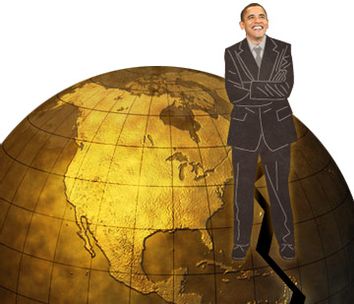
At this point in the presidential race, although it is deeply heartening that I was so wrong in my judgment of American voters, Obama’s great potential to connect with the Muslim world, and to change how Muslims perceive the United States, is conspicuously absent from our national debate. A crucial question about who should be the next president is whether Obama, Hillary Clinton or John McCain is most likely to be able to heal the rift between the U.S. and much of the rest of the world, a rift not created but dangerously widened by the administration of George W. Bush. What is abundantly clear now — at least to many foreigners and particularly to Muslims in the Third World — is that Barack Obama is the candidate by far the best suited to begin healing that rift and restoring America’s global reputation, and perhaps even to begin reversing decades of anti-Americanism. Obama would begin a presidency with a huge advantage in terms of world perception.

Here in America, Obama’s personal connection with Islam — slight as it is in truth — has provoked some telling atmospherics. His Muslim name, and even his perceived Muslim past — a fiction peddled by Fox News last year and quickly debunked by other media — remains an issue for some Americans. Some voters freely (and shamelessly) admit to pollsters that they are “uncomfortable” with a candidate who might have Muslim sympathies or sensitivities. During one of the Democratic debates, Obama’s own response to a question on this issue was overly cautious and, frankly, disappointing. He denied ever having been a Muslim — but he neglected to point out, Seinfeld-like, that there would be nothing wrong with that. Indeed, there continues to be a lingering sense in this country, a sense that played into my conclusion in Tehran, that Muslims are by definition enemies of the West.

That’s hardly surprising, after more than six years of fear-mongering by the Bush administration in its war on terrorism. Likewise, all the tough-guy rhetoric from the Republican presidential candidates about battling “Islamic fascists” has perpetuated the unease. The conspicuously churchgoing Obama, who has made a point of describing his Christian faith on the campaign trail, seems to have so far overcome the faux obstacles contained in his name — a surname rhyming with the name of America’s Public Enemy No. 1, and a middle name common to the Arab world and evoking the vanquished former dictator of Iraq. But knowing the Republican playbook, if Obama does become the Democratic nominee he will surely face insidious attacks on his profile meant to exploit Americans’ fears. It is perhaps for this reason that there has been no outpouring of sentiment for Obama in the Arab or Iranian media — something that the Muslim world knows only too well could arm the Republican attack machine and dampen Obama’s chances of winning the election.

While most Americans care little about foreign policy or foreign relations, unless direct risk to American life and limb is involved, how those endeavors apply to the Muslim world will figure more prominently in the general election. McCain, the presumptive Republican nominee, has little else to distinguish himself with than the issue of national security. The war in Iraq will still be destroying American life and limb. And there will still be a sense, here and abroad, that America remains at war with the Muslim world.

If foreign relations are viewed to be as important as foreign policy, as they should be, Hillary Clinton has big weaknesses as a candidate. Her initial, and later revised, support for the war in Iraq leaves her judgment suspect in the eyes of many in Europe, the Middle East and Asia. With the exception of maybe Europe, it is hard to imagine that Clinton will be viewed beyond U.S. shores as much different than any other recent American president when it comes to the dynamic of U.S. relations with the rest of the world. Earlier in the campaign, Clinton mocked Obama’s willingness to sit down with foreign adversaries such as Iranian President Mahmoud Ahmadinejad, arguing that the “prestige” of the United States would be put at risk by negotiating with such enemies without their meeting pre-conditions. (Clinton has since sought to clarify her position, saying that the U.S. should directly engage in “diplomatic processes” with nations such as Iran and Syria — but she has not rescinded her position of doing so conditionally.)

Clinton’s attack on Obama illustrated that she has very little concept of where American “prestige” currently lies — namely, in the gutter as far as millions around the world are concerned. Maintaining a unilateral attitude toward U.S. adversaries will be perceived elsewhere as a policy similar to that of President Bush, and will hardly be a step toward improving America’s reputation. In effect, Clinton’s posture signals to much of the world that although she is smarter, more likable and far less threatening than Bush, U.S. foreign policy under her would continue to be one of arrogance and dominance.

Rightly or wrongly, Obama, who opposed the Iraq war from the start, simply will not be viewed as having the same attitude. This is not just because he’s the son of an African immigrant or that he’s black, although those elements certainly factor in, but also because he does not come across as (nor is he) someone from the privileged American class who believes America should impose its wishes on the rest of the world.

The most important foreign policy issue of relative concern to Americans may be the wars in Iraq and Afghanistan — but in truth, the most important long-term issue, the one that may most affect our standing in the Muslim world, is the Israeli-Palestinian conflict. (President Bush was rather late in recognizing this, and despite some 11th-hour activity is unlikely to succeed in solving the problem at all before leaving office.) Here, Clinton will have little, if any, credibility with Palestinians (or other Muslims) as an impartial broker in any peace process. There are several reasons for this: Many in the Muslim world believe that with the Oslo peace process Bill Clinton tried to force Yasser Arafat to accept a treaty more beneficial to Israelis than Palestinians, and then blamed Arafat unfairly for the failure of the process. There is also suspicion among Muslim leaders and across Arab media of Hillary Clinton’s deep ties to the American Israel Public Affairs Committee, the powerful conservative lobbying group.

Obama would not carry the same kind of baggage into U.S. attempts at mediation. And the basic perception, right or wrong, of him as someone with sympathies for oppressed people, and for Muslims in particular, will give him a tremendous negotiating advantage, whether with Palestinians, other Arabs or Iranians, for that matter, who largely view themselves as oppressed. There is a natural empathy in the Muslim world for anyone who carries a sacred Muslim name, such as there was for Muhammad Ali (even though his brand of Islam, the Nation of Islam, was as foreign to most Muslims as Mormonism is to mainstream Christianity). But while Muslim and third-world leaders will have little doubt about Obama’s allegiance to American principles and American interests (unlike those Americans who might question his loyalties), they also will have little doubt as to his compassion for and understanding of their grievances. They may believe Obama’s mantra of “change” even more than Americans do.

Either an Obama-McCain or Clinton-McCain race will be viewed with as much interest around the world, obviously, as it will be in the United States. McCain, honorable though he may be with his many years of service, will be viewed abroad as the candidate representing the belief that America’s problems can be solved through military might. He will be viewed as the candidate who believes that America is under threat from what he himself calls “Islamists.” With her own record and political history, Clinton will be viewed abroad as someone who is easily willing to resort to force, and who embodies the same foreign policy philosophies — particularly as they apply to the Middle East — as every recent president before her. Obama, on the other hand, will be viewed as an American presidential candidate unlike any prior one.

Iran will continue to pose one of the prime foreign policy challenges for the next U.S. president. In Tehran, I know, politicians and ordinary Iranians alike would welcome an Obama presidency — particularly as Iran’s own presidency is up for grabs six months after the next U.S. president takes office. Even Iran’s Supreme Leader, Ayatollah Ali Khamenei, may well be looking forward to a day when he has no more excuses to avoid talking to the “Great Satan.” In January, he made an unprecedented announcement about relations between Iran and the United States: “Not having relations with America is one of our main policies, but we have never said this relationship should be cut forever,” Khamenei said in a speech in the central province of Yazd, as reported by Iranian state television. “Certainly, the day when having relations with America is useful for the nation I will be the first one to approve this relationship.”

Even Iran’s arch-conservatives have realized that Iran’s chronic economic problems as well as its long-term growth, political stability and national security will be better addressed by a thaw and gradual normalization of relations with the world’s leading superpower. With Obama as president, the “Great Satan” would surely have to be renamed anyway; Satan, after all, could not have the middle name of Hussein.

While some Americans might be uncomfortable with a President Obama running around the world making deals with what they consider unsavory regimes and characters, perhaps they shouldn’t be so worried. If anything, it’s the Republicans more than the Democrats who have run around the world in the past making deals with unsavory regimes and characters. (They conveniently just don’t call them unsavory at the time, knowing that Americans by and large are incurious about foreign affairs.)

Obama has spoken clearly about his vision for defending American security and interests. “We can create the kind of foreign policy that will make us safe and will lead to renewed respect of America around the world,” he reiterated in a speech Tuesday night, at a campaign rally in Houston, Texas. “You know, as your commander in chief, my job will be to keep you safe … And I will not hesitate to strike against any who would do us harm. I will do whatever is required.” That would include hunting down terrorists, securing loose nuclear weapons, and deploying the U.S. military wisely, he said. He further underscored his foreign policy paradigm: “I want to rediscover the power of our diplomacy. I said early in this campaign I would meet not just with our friends, but also with our enemies … I remember what John F. Kennedy said. He said we should never negotiate out of fear, but we should never fear to negotiate. Strong countries and strong presidents talk to their adversaries, and tell them where America stands, and try to resolve differences without resort to war. And when we do that, I believe the world is waiting. I want to go before the world community and say, ‘America’s back, and we are ready to lead.’”

Obama has also surrounded himself with capable and respected foreign policy advisors, including seeking advice from a preeminent and forceful U.S. negotiator, former Secretary of State Colin Powell, whose reputation overseas is less sullied than it is back home. With foreign policy, there is no indication Obama will give away the store or, contrary to what his opponents might charge, that he will be a Chamberlain-like appeaser.

Rather, a President Obama will likely engage the world in the way it should be engaged — with respect, understanding and a clear sense of purpose. He will be, at the very least, a symbol of what can restore greatness to America — a greatness that millions of people outside America want to believe in, but have up until now had difficulty reconciling with the facts. From their perspective, if a black son-of-an-immigrant with a Muslim name can become an American president, then anything truly is possible in America. And that’s a country that would be very hard to be enemies with.

Continue Reading Close

Ahmadinejad’s New York state of mind

My time with the Iranian president this week underscored how the U.S. media has overlooked his political savvy.

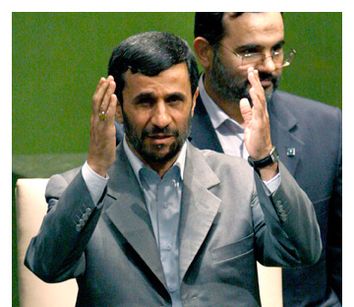
President Mahmoud Ahmadinejad of Iran wrapped up his trip to New York on Wednesday and headed south for Bolivia and Venezuela, where he will undoubtedly meet with a kinder reception than the one afforded him by Americans this week. Much has been made of the Iranian president’s proposed-but-thwarted trip to ground zero, his controversial appearance at Columbia University and his theatrical speech at the U.N. But lost in all the criticisms and caricatures of Ahmadinejad as statesman — which are often wildly off-mark in terms of gauging the president’s overall authority and influence in Iran — has been serious consideration of what his now yearly trips to attend the U.N. General Assembly signify for the Iranian political landscape and for the future of Iran’s foreign policy.

I’ve had the opportunity to attend events with President Ahmadinejad on his three trips to the U.S. (including serving as the interpreter for his U.N. speeches for the last two), and have spent time with his aides and Iranian diplomats during the New York visits. This visit felt perhaps the most politically charged yet, and was certainly the most controversial, even for the Iranians. But amid all the theatrics, Ahmadinejad’s political savvy and strategic intentions in New York should not be underestimated.

Ahmadinejad is a shrewd politician, a populist who tailors his remarks and speeches for specific audiences, and plays as good a propaganda game as anyone in the Byzantine maze of Iranian politics. Although his tactics backfire as often as they succeed, he once again managed to forcefully project himself onto the world stage with the welcome assistance of the press, and accomplish much of what he set out to do within the boundaries of his authority. The raison d’être of his visit, a declarative laying out of Iranian policy in front of the world body — including a reiteration of Iran’s nuclear ambitions — would have to closely reflect the views of Supreme Leader Ayatollah Ali Khamenei, the true center of Iranian political power. But the words uttered in Ahmadinejad’s address to the U.N. would be his own, and he is not one to lose an opportunity to further his own agenda, especially in the media capital of the world.

Beyond a firm and sincere defense of his country’s rights, Ahmadinejad’s agenda was to inflate and burnish his image at home as well as in the Third (and particularly Muslim) World. His first stop in New York was an evening with Iranian expatriates, an event open only to Iranian media. He knew that images of Iranians inside America cheering a president who is losing popularity at home could only help bolster his image as a nationalist leader revered beyond Iran’s borders. His rebuffed request to lay a wreath at ground zero conveyed to his constituents at home and abroad that whenever he tries to extend a hand of friendship, it is the Americans who rudely slap it away. His appearance at Columbia served to illustrate his graciousness in the face of open hostility by the West. And his meeting with gift-giving rabbis — albeit from the fringe anti-Zionist Neturei Karta group from Brooklyn — furnished images, broadcast in Iran but virtually ignored here, portraying him as something less than the bigot or anti-Semite that his accusers make him out to be. Ahmadinejad’s Holocaust denial, or Holocaust questioning if one were to be generous, may be abhorrent, but the insistence in the West on inflating its (and therefore his) importance only serves to bolster his image in the Middle East. The focus there is on the second part of his infamous skepticism of the Holocaust — “If it happened, then why do the Muslims have to pay?”

In the eyes of Muslims, his day at the U.N. served to show him as a world leader of great importance, and audiences watching throughout the Middle East undoubtedly noticed not only that the television cameras turning on him frequently as President Bush spoke, but that he politely sat and listened to Bush’s speech at all. In contrast, worldwide telecasts showed the U.S. delegation rising and walking out en masse, as they customarily do whenever an Iranian president takes to the lectern. Diplomacy, which is fundamentally about reciprocity, often means that if one party snubs another, the other responds in kind — but Ahmadinejad’s tactical refusal to play by those rules and to instead show respect to the leader of the U.S., begged the question, “Who’s the unreasonable man?”

Though Ahmadinejad may wish otherwise, his role in Iranian politics is in reality sharply constrained. Notwithstanding perhaps a rise in impolitic language, Iran’s foreign policy is unchanged since Ahmadinejad assumed office, despite our efforts to portray him as one who has moved Iran from an accommodating and increasingly compliant and Westward-leaning society to a belligerent, defiant and threatening rogue state of the Middle East. While Ahmadinejad’s speeches rely heavily on religious references — he seems to assume that most Americans are deeply religious and will respect his piety — very little of what he has to say, at least on issues of import, veers from what the Supreme Leader and other clerical leaders have said for years. Iran, for example, has consistently asserted that it will not be bullied into suspending or abandoning uranium enrichment, a right it has always maintained is inalienable, including under the mild-mannered, reform-minded President Khatami. Iran has also long insisted that it will never be the aggressor in any war, including against its arch-enemy Israel, a point Ahmadinejad was obliged to repeat in a press conference during this trip as well.

Ahmadinejad’s dinner with members of the media and various think tanks on his last night in New York, a few hours after he delivered his address to the U.N. General Assembly, was again covered only by Iranian television cameras. It served to illustrate his reasonableness again, as he patiently answered sometimes difficult questions by tough interlocutors. Ahmadinejad, exhausted as he was by his schedule and the unfortunate timing of Ramadan, which meant his lips did not touch food or water during daylight hours, appeared satisfied and lively at the dinner. Harried Iranian diplomats accompanying him from Tehran and those based at Iran’s U.N. Mission here may have had doubts about the wisdom of some of his appearances and his reception in the U.S. — Ahmadinejad even referred to those concerns among his colleagues in comments at the dinner — but he himself seemed to have none. The other top diplomats’ voices are certainly heard in the corridors of clerical power in Tehran, and Ahmadinejad will likely face some criticism when he returns to Tehran — but he was undoubtedly confident that his publicity was doing him, as well as his country, far more good than harm.

It is difficult to predict what the long-term implications of Ahmadinejad’s circus of a visit to New York this year will be. If the U.N. Security Council is persuaded once again to impose a new round of sanctions on Iran, Ahmadinejad may be criticized back home for having been unable to move Iran’s nuclear issue away from conflict by insisting on using forceful, belligerent and undiplomatic language. If, as President Bush and Congress seem to be intent on, the U.S. designates Iran’s elite Revolutionary Guards as a terrorist entity (a theatrical notion of its own that would ultimately be for the propagandistic purpose of demonizing the Iranians further and keeping the Dick Cheney-backed military option close at hand), Ahmadinejad might face charges from more reform-minded clerics and politicians that his visit only pushed the Americans in making their decision. His unconventional personal views, such as declaring Iran devoid of homosexual culture (rather than his declaring Iran as literally devoid of homosexuals, as was erroneously translated in much of the U.S. media), will be seen to have contributed to Americans’ notions of an irredeemable regime.

On the other hand, if Iran succeeds in delaying further action against it at the U.N., if it suffers no further uni- or multilateral sanctions that have hurt the economy — an area where Ahmadinejad is most vulnerable — and if the talk of war diminishes, he may well be credited for his provocative approach to foreign policy.

The Ayatollahs of Iran are never comfortable with too much attention — and Ahmadinejad brings plenty of unwanted attention — and they are very wary of an Iranian president establishing a cult of personality. (Khatami suffered this fear of the leading mullahs, so much so that he banned photographs of himself in government offices.) At times Ahmadinejad appears to be pushing the boundaries in cultivating his own image, especially with his grand displays in New York. But in the end the mullahs are most concerned with the endurance of the Islamic Republic and its system of government. They crave a measure of economic stability and a strong sense of strategic security — and Ahmadinejad’s fortunes will continue to rise or fall based very much on the degree to which he is seen as serving those goals.

Continue Reading Close

Bush’s big Iran problem

The White House is foolish not to recognize that the only way out of the Iraq mess now includes serious negotiations with Iran.

Whenever the issue of an exit strategy for Iraq becomes headline news, as it seems to often in this summer of discontent for George W. Bush, I am reminded of a story from my days in the music business. Legend had it that back in the glory days of payola and illegal and quasi-legal business practices in the 1960s, a young entrepreneur set up shop hoping to cash in on a terrain that seemed to be wide open, little regulated and required no specific skills. A well-known independent record promoter (indeed, it was still called the “record business” then) with ties to an unnamed Italian organization visited this upstart, and suggested that large sums of cash could be paid to ensure radio play for any act that the entrepreneur would market. “How can I be sure that if I pay you my records will get played?” the record promoter pressed. “You’re asking yourself the wrong question,” was the entrepreneur’s reply. “You shouldn’t wonder whether your records will get played if you pay me. You should ask yourself whether I can stop your records from being played if you don’t.” Needless to say, the executive paid, his records got played and he built a successful label.

George W. Bush may well have landed himself in a similar situation with his own entrepreneurial adventure in Iraq. Sure, he’s got plenty of resources and muscle, but apparently he doesn’t yet see that now he’ll have to “pay to play” if he wants to succeed. The price of anything that could remotely be called a victory in Iraq at this point, or at least not a defeat, is negotiating with Iran. And that means being willing to give Iran some of what it wants from us, including, for example, assurance that we’re not going to shock and awe Iranians if they simply don’t do as they’re told. It is foolish for the Bush administration not to negotiate seriously with Iran at this point, thanks to circumstances largely of its own making.

From the beginning of the Iraq war, it was clear that Iran would be a major beneficiary, even if unintentionally, of regime change in Baghdad. The evidence was right there in the open: Almost all the Iraqi opposition groups (nearly all Shia) — including neocon favorite Ahmad Chalabi — who would by definition be the heirs to Mesopotamia, were funded, armed and trained by, or spent years in exile in, (Shia) Iran. Iran’s enemy to the east, the Taliban, had been vanquished; now her enemy to the west, Saddam, was meeting the same fate. What was there not to understand about Iran’s ascendancy, and what would amount to a quiet and costless regional victory for her?

Three and a half years after the start of the war, the Iraq Study Group proposed (in its most “duh” moment) that the U.S. would need to engage Iran in order to stabilize Iraq and find a way out of a mess of its own creation. It was a belated idea that still the Bush administration rejected. A few months later, as it perhaps started to dawn on the White House that the ISG’s James Baker and Lee Hamilton had a point, the U.S. agreed to a much ballyhooed meeting with Iran at the ambassadorial level in Baghdad. It was here that the U.S. had the opportunity to ask the right questions, but clearly did not. Instead it essentially reiterated a demand: that Iran stop interfering in, but also help stabilize, Iraq — a demand undoubtedly fielded by an Iranian negotiating team struggling to suppress their guffaws.

Perhaps out of Persian politesse, or perhaps for more sinister strategic reasons, the Iranians didn’t respond to the strong-arming promoters of the U.S. agenda in the way of the upstart entrepreneur. And perhaps they did not need to state the obvious: that the issue was not whether the Iranians could or would help stabilize Iraq, but whether they might choose to destabilize the country further, or sabotage a U.S. exit strategy, if the U.S. was not willing to deal with them and compromise on some key issues. Recently, the Iranians have indicated (with a nudge from the Iraqis, whose president seems to visit Iran as often as he smokes a cigar) that they are willing to sit down with the U.S. again in Baghdad to discuss ways to reduce the bloodshed in Iraq. But it will be a pointless exercise unless the Bush administration is willing to ask the right questions of itself and its adversary.

Iran, squeezed by sanctions and forced to retreat once again into its shell of Islamic revolutionary politics, in reality wants détente with the West. It wants to be a respected member of the international community. For all the bluster of its president, Iran suffers from deepening economic woes — partly because of government incompetence but also largely because of U.N. and U.S. sanctions that have caused capital flight and put foreign investment in a deep freeze. Iran will not admit it openly, but the ayatollahs who are really in charge are largely pragmatists who would like nothing better than to find a way out of their internal problems. Iran can, if asked diplomatically and given the right incentives, be critical in smoothing the way for U.S. forces to leave Iraq with a smattering of dignity left — a goal that Congress and the American people appear increasingly keen to realize.

The time has come for the Bush administration to abandon its policy of unilateral preconditions for any wide-reaching negotiations with Iran, and get down to the business of give-and-take, which could potentially resolve Iran’s nuclear issue as well as help us out of the mess in Iraq. Iran once before, in 2003, suggested “talking points” for moving forward with comprehensive discussions on all Middle East issues, but the gesture was ridiculed and ignored by the Bush administration in the vainglorious days of “Mission Accomplished.” That full range of talking points may not still be on the table (unlike “all options” said to be on the table by those from the warmongering Dick Cheney school), for Iran is in a far stronger negotiating position today. But Iran has indicated enough times that if the U.S. really wants to chat and get down to business, it is ready.

There’s every reason to believe that the Iranians will be sincere in negotiations — it is in their best interest, particularly with President Ahmadinejad under fire from a domestic constituency that is restless for improvement. The same can well be said of the American president; to engage Iran now, Bush has very little left to lose.

The Bush administration insists that the U.S. is also ready to negotiate, but not before Iran lives up to the unilateral precondition that it suspend uranium enrichment. Much as the Bush administration would like to treat the nuclear issue as unrelated — as evidenced by its willingness to engage with Iran on the issue of Iraq alone, without any preconditions — the Iranians consider it entirely related in terms of its own security. Iran is unlikely to do much to help the U.S. in Iraq without receiving something significant — both in terms of its economy and its security — in return. In the meantime, while George W. Bush continues asking himself, and the Iranians, the wrong question, Iran continues enriching uranium, and Baghdad continues to burn.

Continue Reading Close

The tortuous road to Tehran

From Cheney's bellicosity to Rice's coy diplomacy, the U.S. approach to Iran has seemed schizophrenic -- and may have unexpected consequences.

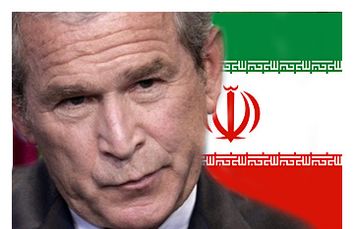
Lately, it has been easy to wonder whether the Bush administration has fallen into complete disarray when it comes to its Iran policy. Judging by its actions in recent months, it is difficult to see whether the White House truly wants war or wants détente with Iran, a card-carrying member of George W. Bush’s “axis of evil” and more than ever a linchpin of the Middle East. On the one hand we have the provocative roundup of Iranians inside Iraq and further bellicosity from Vice President Dick Cheney. On the other, we have diplomatic meetings between the U.S. and Iranian officials not seen in decades, important if not critical to shoring up the mess in Iraq.

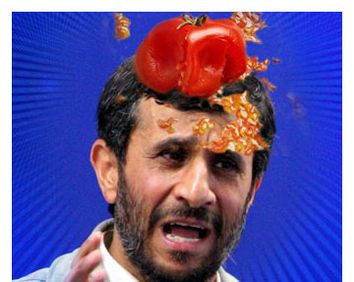
Whether or not this seemingly schizophrenic approach is intentional, and I suspect it is not, it will produce some interesting consequences of its own. The irony is that the apparent disarray in and mixed messages from Washington may be quite effective toward Bush’s apparent goal of weakening the Iranian leadership. A vacillation between threats of war and diplomatic engagement may hurt the government of President Mahmoud Ahmadinejad because it helps preserve a stagnant political status quo inside Iran — and that leaves Ahmadinejad’s citizens, who are suffering from a sharp economic decline under his leadership, increasingly restless. Inside Iran there has been talk of imminent war with the United States for at least two years now. But war has not come, and at some point the distraction from other concerns wears thin, allowing day-to-day problems, such as the soaring price of tomatoes, vegetables and other commodities to take over.

Meanwhile, a decisive move at this point in the direction of either war or détente could play directly into the hands of the most reactionary and right-wing elements in the Iranian power structure. If the U.S. managed to coax Iran to the negotiating table — apparently able to do so only from a position of relative weakness and with the help of Shiite leaders in Iraq — it would lend legitimacy and credibility to a government (or “regime,” if you prefer) that the U.S. has spent the past three decades demonizing as undeserving of recognition. It also might be the only way to reach a face-saving solution to the nuclear crisis. It would lift sanctions and give a dramatic boost to the Iranian economy by jump-starting foreign investment, allowing Ahmadinejad to take credit for the single most important foreign policy breakthrough since the Islamic Revolution. Further, if normalized relations with the U.S. ensued, it would represent a grand success that the more moderate-minded reformers in power in the late 1990s and early 2000s were unable to achieve, and thereby cement the conservatives’ claim to power.

If, on the other hand, the Bush White House continues with the neoconservative wet dream, taking a military road to Tehran and regime change, then the Iranian hard-line politicians and clerics will claim to have been proved entirely right in their distrust of the great superpower, or “Global Arrogance,” as they have taken to calling the United States of late (an updating of “Great Satan” in line with current worldwide sentiments about the nation under Bush). They would undoubtedly be able to rally the Iranian military and people to their side, most political and military experts agree, and inflict great harm on U.S. interests — another way in which to cement their domination of Iranian politics for years to come. In either scenario, Ahmadinejad and his ilk would stand to benefit politically; if neither materializes, they will continue to suffer politically as they have been.

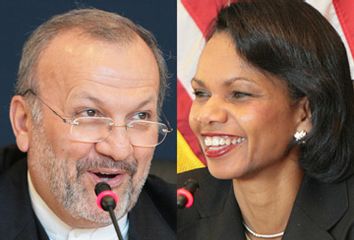
Condoleezza Rice, who told reporters at a summit in Sharm el-Sheikh, Egypt, in early May, “I’m not given to chasing anyone,” played a coquettish secretary of state, fawning after Manouchehr Mottaki, Iran’s foreign minister. Even President Bush, who has always insisted that the United States does not negotiate with terrorists or their state sponsors, suggested that since Rice was “polite,” she was well suited for the diplomatic endeavor.

But Mottaki’s avoidance of a full-fledged conversation with Rice at the conference, which was widely covered by Iranian media, was put into further perspective when he later said that Iran was not interested in “chance” meetings with the U.S. involving casual conversation or small talk. (Mottaki had dodged a dinner with Rice ostensibly because it included a performance by a violinist clad in a Western-style dress, offensive to conservative Islamic sensibilities. But as the event was arranged by Arabs, one has to wonder whether some Sunni Arab leaders fear a U.S.-Iranian reconciliation even more than the neocons — for they most certainly know the rules of Iranian diplomacy, which pointedly do not include parties with female dancers, singers or performers wearing anything less than the hijab.) Iran, he emphasized, would meet with the U.S. if and when a formal request was made (apparently having occurred since, leading to another diplomatic meeting in Baghdad, Iraq), along with a proposal for a definitive agenda. Mottaki, it seems, was not looking to be “chased” by Condi Rice in Egypt, but if he ends up one day in a chat with her over a nice cup of tea, Iran will claim that it was she who came begging and her government that capitulated to the mighty Islamic republic.

But in the meantime, the nuclear issue appears to be taking on new urgency, with International Atomic Energy Agency leader Mohamed ElBaradei — who is hardly a Bush booster — warning in mid-May that the Iranians have advanced their ability to enrich uranium. And only a week after Rice’s relatively polite outreach to Mottaki, Cheney, the rather impolite gunslinger of the Bush administration, appeared on one of the two U.S. aircraft carriers within spying and striking distance of Iranian shores to once again put Tehran on notice.

Speak loudly, and carry a big stick; speak softly, and ask for help getting your stick out of Iraq — ordinary Iranians watching in Tehran must really be starting to wonder what the deal is.

Yet while support for Ahmadinejad’s government continues to erode among even conservative Iranian citizens, it is important to recognize a distinctly different Iranian perspective on the grand chess game between Washington and Tehran. The recent arrests in Iran of a former senior nuclear negotiator, Hossein Moussavian, who worked for the Mohammad Khatami government, along with the imprisonment of high-profile Iranian-American academic Haleh Esfandiary, affiliated with the Woodrow Wilson Center in Washington, appear to many to be part of a rising internecine political battle between supporters of former moderate President Akbar Hashemi Rafsanjani and reformist President Khatami and those of Ahmadinejad.

But there is also continuing paranoia about the true intentions of the Bush administration: Many Iranians are still inclined to oblige Dick Cheney and believe that the regime in Washington will in fact decide to go for broke in its quest to recast the Middle East in the name of democracy. Thus, spies may be lurking. In the United States, we may have a certain affection for hyphenated citizens, but there is no such love in Iran, a country that not only doesn’t recognize dual citizenship but has long considered the acquisition of another nationality (even under the shahs) to be treasonous. Under Iranian law, an Iranian cannot become the citizen of another country unless he or she abandons Iranian citizenship. The catch is that also under Iranian law, if one abandons Iranian citizenship, then one is forever prohibited from entering Iranian territory on another passport. This means that Iranians who have American passports always travel home, if they travel there at all, on Iranian passports and maintain the myth, at least officially, that they have but one nationality.

American commentators have suggested recently that the high-profile Iranian-Americans under arrest in Iran are “soft hostages,” but that is erroneous: Iran considers them Iranians and is not looking to send a message to the U.S., or to extract any concessions in order to release them. Rather, the message is to Iranian exiles: As long as Iran is under threat of a military attack by the U.S. (one it can indeed play up with Cheney’s renewed help), its government considers any Iranian who works for the U.S. government (as in the case of one Radio Farda employee who has not been allowed to leave the country) or even an independent American think tank (such as the one Esfandiary works for) under automatic suspicion of being a spy. At the very least these Iranians might be seen as beneficiaries of the State Department’s largess in agitating for democratic reform or a “velvet revolution” in Iran, as Iranian authorities have claimed in Esfandiary’s case. Notably, inside Iran, those who normally protest the detentions of reformists or activists have been silent on the issue of the Iranian-American detainees, a privileged bunch who have for years avoided the kind of harassment that those who are politically active inside Iran face constantly.

With the prospect of a third round of United Nations sanctions in the coming weeks over Iran’s refusal to suspend uranium enrichment, Ahmadinejad’s government will continue to look for ways to divert attention from the harmful stagnation of its policies. Since Ahmadinejad was elected in 2005, Iranians have had to suffer worsening unemployment, inflation and a sputtering economy. They have been told they may have to suffer further sanctions in the name of unity and nuclear pride, but at the same time they now see the U.S. reaching out to their government, albeit while making a fist with the other hand. They are not necessarily willing to have improved relations with the West at any cost, but impatience with Ahmadinejad is growing by the day, and average Iranians want the matter settled, one way or another, sooner rather than later, so they and their government can get back to improving their lives.

Continue Reading Close

Page 1 of 2 in Hooman Majd