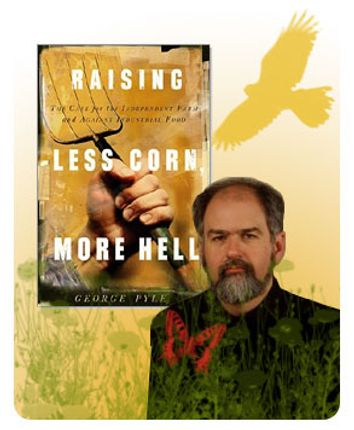
Bill McKibben has been writing about global warming and the recklessness of oil-addicted economies since George W. Bush was a part owner of the Texas Rangers, Al Gore was the junior senator from Tennessee, and informed adults could still speak of climate change as hypothetical. If the stretch of history that has followed seems all too familiar, so will many of the players in McKibben’s new book, “Deep Economy: The Wealth of Communities and the Durable Future.” You’ll recognize the ticking time bombs (climate change and peak oil), the villainous corporations (Wal-Mart and ConAgra), the do-nothing politicians (pretty much all of them), the consumerist and apathetic citizenry (pretty much all of us), the cadre of witch doctors with their trickle-down pablum (the Federal Reserve and the World Trade Organization), and of course the plucky heroes (small farmers and grass-roots activists). But with “Deep Economy,” McKibben does more than just stage another culture-war drama. He offers both a compelling account of what brought us to this perilous moment in history and a credible vision of a more promising future.
The supply of fossil fuels that has put an end to scarcity in much of the Western world and continues to drive the dizzying economic growth of China and India, McKibben argues, is “a one-time gift.” And rather than continue to gorge, we ought to be investing our surplus in figuring out how to live on less. The good news is that while we have already made our planet sick, we are beginning to notice when we have consumed enough: when more no longer makes us happier. Here and there we have begun to scale back our economies, to try to get more of what we need from our neighbors, both because we want to do less damage and because we enjoy it.
McKibben takes up the cause championed by the economist E.F. Schumacher in his classic book “Small Is Beautiful” and by the Kentucky farmer Wendell Berry (to whom the book is dedicated) and gives it fresh urgency and a human face. He chronicles a year spent eating exclusively from the valley around Lake Champlain in Vermont, where he works as a writer in residence at Middlebury College — mainly to prove to himself that it can be done without suffering too great a deprivation. He visits with local farmers, politicians and brewers, but also makes trips to factories and sprawling cities in China and a tiny refusenik village in Bangladesh to see how the oil-mad global economy and its alternatives are playing out in the developing world.
“Somewhere there’s a sweet spot,” McKibben writes, “that produces enough without tipping over into the hyper-individualism that drives our careening, unsatisfying economy. The mix of regulation and values that might make such self-restraint more common is, of course, as hard to create in China as in the United States; far simpler just to bless an every-man-for-himself economy and step aside. But creating those values, and the laws and customs that will slowly evolve from them, may be the key task of our time, here and around the world.”
McKibben spoke with Salon from his home in Vermont about the blind spots of economists, the marginal utility of a teddy bear, and where not to be when the climate crisis gets into full swing.
What does a deep economy look like?
It’s more a trajectory than a utopian vision. It tends to draw in its supply lines instead of extend them. It produces using more people instead of fewer. It’s an economy that cares less about quantity than about quality; that takes as its goal the production of human satisfaction as much as surplus material; that is focused on the idea that it might endure and considers durability at least as important as increases in size.
How would the idea best be condensed into a bumper sticker?
My friend Todd Murphy, who started the Farmers Diner in Barre, Vt., printed up stickers that said, “Think globally. Act Neighborly.” I think that that’s very close to what we need. We’re talking about rebuilding economies on the kind of scales that people are actually comfortable with. If we could make it happen, I think it would appeal to everyone except for the 2 or 3 percent who are getting unbelievably rich off of the system that we have now.
How is that not a centralized command economy?
It’s the opposite. We are lucky, in having survived the 20th century, to have a good list of things that don’t work. No. 1 on the list is a centralized command economy. Markets work very well, but as global warming illustrates, they don’t solve every problem by themselves. We need to start figuring out how we put real, profound limits on them. I think some of those limits are going to be geographic.
What is your answer to those who would see this as a nostalgic and misguided attempt to turn back the clock?
There are good things from our economic past that we’d do well to try to re-create in the present, but there are also all kinds of possibilities that we’re offered by the tools we have now. We can now imagine economies that are local without being suffocatingly parochial. The Web, for instance, allows us to trade recipes, so to speak, instead of trading commodities.
But who are we, as Westerners enjoying the fruits of centuries of market capitalism, to turn around and wag our fingers at people in the developing world?
We have no standing in that court. The Chinese have no more interest in listening to lectures from us on global warming than they have in listening to us sing Dixie. They are paying no attention, and at the moment we don’t want them to pay any attention. We’re perfect co-dependents in this energy relationship — we are each the other’s best excuse for doing nothing. But the only thing that will make any kind of global deal on climate stick is if we realize that we’ve spent 100 years creating a surplus by filling the atmosphere with carbon and take some of that surplus, in the form of technology, and transfer it to China, India and the rest of the world so that they don’t need to follow our particular path.
It’s been almost 20 years since you warned of global warming in “The End of Nature.” But it was just a couple of months ago that President Bush finally brought himself to utter the words “climate change.” Do you feel at all frustrated and angry?
There is some of that. Unfortunately, the science on global warming has grown steadily worse and the situation is much grimmer now than it was 20 years ago. But there have been changes in the last couple of years that have made me hopeful. We’re figuring out that the endless increase in our consumption, which drives global warming more than anything else, actually isn’t making us very happy. That seems to me a very powerful idea. If it were making us happy, we’d be out of luck, because no matter how much trouble it was causing we’d just keep pushing the lever.
But there’s at least a potential for change because the solutions to two of our major dilemmas lie in more or less the same direction. Another reason I’m willing to be hopeful right now is the straightforward one that more people are finally beginning to take these things seriously. I helped launch StepItUp2007.org in early January, hoping that we would be able to organize at least a couple hundred rallies on climate change by April 14. As of early March I think we had 835 scheduled in 49 states.
But is it too late? You’ve written that even if we do everything right from here on out, we’re still going to see serious increases in temperature.
There’s no stopping global warming. We’ve seen some and we’re going to see some more. The only question is whether we can keep it from being catastrophic, and it may be too late for that. If we manage to make it through this, it will be by the skin of our teeth and I’m not at all sure that we will. I remember a friend of mine at the Kennedy School during the late ’80s saying that global warming may turn out to be the public policy problem from hell because there are so many interests involved. And we happen to be realizing it just at the moment that the Chinese and the Indians and the rest of the world are starting to burn fossil fuel in appreciable quantities.
So why shouldn’t I learn to use firearms and stockpile some canned food and head for the highest ground?
I think there’s a part of everyone that thinks about that. You hear people make nervous jokes about where to buy real estate. But if you stop to think about it, you start to understand that the communities we need to build in order to slow down global warming are the same kind of communities that are going to be resilient and durable enough to help adapt to that which we can’t prevent. In the not very distant future, having neighbors is going to be more important than having belongings. Membership in a community is going to become important once again both psychologically and physically in the way that it’s been for most of human history.
But if the change is abrupt, are we going to be able to build those bonds fast enough?
Some places will fare better than others. The suburbs of Atlanta don’t seem to me to be a great place to be living right now.
What kind of world do you envision for your daughter?
I hope that the community she lives in will be much stronger than the community I’ve grown up in, that she’ll have closer and more friends, that she’ll need her neighbors and they will need her, and that this human community will compensate to some degree for the physical instability that’s going to be her lot.
You write about encouraging developments in the field of economics, especially the growing recognition that personal satisfaction tends to level off after a certain point in material gains. But why wait for economists to start to figure these things out when our traditions of literature, philosophy and religion have been teaching them for a long time?
That’s a good question. We’ve been overwhelmed by an economic idea of the world in the last hundred years. As a society we’ve made every decision based on whether or not it will make the economy grow, so now it’s hard for us to resurrect the good sense found in just about every world religion and most great literature that having more stuff is not the path to happiness.
So how did the mantra of economic expansion gain such momentum?
Because it works up to a point. Economists have been extremely good at showing us how to produce more. But they have confused that with an end. They’ve decided that because they’re good at doing it, therefore that’s what should be done. The basic idea goes back to Adam Smith, who was prescribing for the human condition in his time, a condition of essential scarcity. We moved away from that a long time ago in the U.S. The marginal utility of another stuffed animal for my daughter, for example, is unbelievably low, but for the girl working in a shower curtain factory in China, whom I describe in the book, who brims over in tears the second she sees it, it’s very high. One of the confusions of economics has been that getting a stuffed animal is the same experience for both.
You mention your visit to China. It’s seems obvious that the pace of growth happening in China and India right now simply can’t go on forever. Why do seemingly intelligent people such as Thomas Friedman and Jeffrey Sachs, both of whom you mention in the book, not seem to get it?
It’s fairly easy to fool yourself when it comes to environmental problems. The kind we’ve dealt with so far tend to yield an increase in the standard of living. If your problem is too much carbon monoxide coming out of tailpipes, you need to be able to afford catalytic converters, and the richer you get the cleaner your air is going to get. But carbon dioxide is different. There’s no catalytic converter for it, and the more tailpipes you have, the more of it you release. That’s the situation we find ourselves in with global warming and it’s essentially the same situation we find ourselves with resource scarcity issues such as peak oil. The world harvest of fish is down year after year. The world harvest of grain has plateaued. And just try to imagine a world where people in China own automobiles at the same rate as Americans. It’s literally not possible.
You use the term “sweet spot” a couple of times to describe the happy medium between freedom of markets and individuals and the demands of ecological and cultural health. How do you know when you are in the sweet spot?
It’s always going to be an ongoing calibration, but we are constantly making similar ones. Since I live in a college town, the great example for me has to do with beer. You watch a freshman come in and discover that three bottles of beer make him very happy and then spend a year figuring out that 13 bottles of beer make him less happy. That’s not an exercise we’ve figured out how to do as a society. Having a little privacy and having enough stuff made us happier, but we haven’t yet cottoned to the fact that doubling the size of the house and moving 50 miles out to the next suburb in fact isn’t yielding any increase in satisfaction.
You also write about the way in which the Christian religion, at least in America, has been co-opted by this vision of market capitalism. Is that something that you see changing?
I do. In the last year there has been a sudden engagement of religious communities, including evangelical ones, in environmental politics, particularly in the fight over climate change. It reminds us of the potentially subversive role that they might play, since they draw their inspiration from a gospel that, if taken seriously, would blow the minds of most Americans. Organized Christianity had largely succumbed to the hyper-individualist view of the world, which is ironic for a religion whose central tenet is to love God and love your neighbor as yourself. We’d gotten away from that, but there’s potential for getting back toward it.
A lot of the business models you use as examples in the book are ones that turn a profit but don’t grow at the rate that Wall Street demands. Do you consider publicly traded companies and the stock market compatible with a deep economy?
I think we need to figure out, probably through changes in tax policy, how to reduce the demand for 24 percent returns on everything. In a sane regulatory scheme, you wouldn’t be able to put 300,000-square-foot stores in every county in America and destroy the local businesses. Hence there would be nobody offering Wal-Mart-size returns on investments. One of the ironies of all this is that Adam Smith imagined capitalism as encapsulated in quite local communities, where it makes a lot of sense. It works pretty well when you have a local bank and local bankers who know the local people and when businessmen are careful to guard their reputation so that the bank will continue to loan them money and so on. It was a virtuous circle for quite a while until it reached gargantuan proportions.
What about what we’re doing now? I contacted you through a P.R. person for Henry Holt, who is hoping to sell as many copies of your book as possible. Salon, in turn, is hoping to generate traffic based on your reputation as a writer, which would help drive ad sales and so on. Are we in the sweet spot?
One of the great problems always with trying to change anything about the world is that you are operating in the existing one. I have hypocrisies that run much deeper than that. I’ve spent much of my life flying and driving around the world to tell people to use less carbon. My great hope is that when St. Peter finishes his accounting I will have ended up two or three gallons to the good — that I will have persuaded just enough people to change their habits a little bit that it will make up for what I’ve burned. I piously buy my offsets and all, but I’m under no illusion that there’s not a great deal of hypocrisy involved.
I’m not trying to point out hypocrisies so much as figure out just how different the world would be.
I think it’s hard to know until we get there. In the book, I write about the music industry, for instance, and the possibility that maybe we’d move away from a world where we have a few mega-stars known to everyone who make a gazillion dollars and instead have lots of semi-stars in any general region of the world who make a good living. One of the beautiful things about the Web is that it allows us to have our cake and eat it too in this regard.
What do you say to someone who says, “I’ll tell you when I’ve had enough. If I want another car, that should be my right.”
All I’m saying is this is a democracy. I don’t have much patience for the argument that no one should tell me what to do ever. In a democracy we work on figuring out what kind of society we want to build. And if you want to make the argument that we’d be better off with all of us buying whatever car we want until the end of time, then you’re going to have to deal with those of us who are pointing out some of the drawbacks.
On the long trip from the soil to our mouths, a trip of 1,500 miles on average, the food we eat often passes through places most of us will never see. Michael Pollan has spent much of the last five years visiting these places on our behalf. “Industrial food,” as Pollan defines it, “is food for which you need an investigative journalist to tell you where it came from.” We have been eating such food for so long that most of us have no memory of the much shorter and less complicated food chains that once tied people to the land. We need someone, in other words, to tell us where food of any kind comes from. A longtime writer on food for the New York Times Magazine and author of the bestseller “The Botany of Desire,” Pollan is a good man for the job.
In his new book, “The Omnivore’s Dilemma: A Natural History of Four Meals,” Pollan traces meals across four different food chains, or, if you prefer, markets, arranged in order of popularity: a McDonald’s drive-through meal, a Whole Foods dinner, a meal raised on a “beyond organic” pasture farm in Virginia, and what Pollan labels the “Perfect Meal,” one whose ingredients he hunts and forages for himself. In the course of his investigations, Pollan comes across an unlikely collection of people — from Iowa corn farmers, Kansas feedlot managers and food processing scientists, to rebel farmers, San Francisco Bay area gourmands and fanatic mushroom foragers — yet manages to approach all of them with a common sympathy. As he sees it, the corn farmer dumping nitrogen on his fields, the veterinarian loading corn-fed cattle with medication, and the hog farmer snipping pigs’ tails to prevent stress-induced chewing in close quarters are all driven by the same pressures. He lays the blame for our destructive and precarious system, if at all, on those in Washington and on Wall Street — at the USDA and Archer Daniels Midland — who set the rules of the game. But then they too, he knows, are responding to a set of pressures that come from all of us and our appetites.
“The Omnivore’s Dilemma” is equal parts exposi and invitation — a rolling together of “Fast Food Nation” and “The Moosewood Cookbook” to make the case for saner, more pleasurable eating habits. “Our ingenuity in feeding ourselves is prodigious,” Pollan writes, “but at various points our technologies come into conflict with nature’s way of doing things, as when we seek to maximize efficiency by planting crops or raising animals in vast monocultures. This is something nature never does, always and for good reason practicing diversity instead.”
Pollan caught up with Salon recently at Le Pain Quotidien in Manhattan to discuss the hard plight of American farmers, the trouble with labels at Whole Foods, and the lure of the Big Mac.
In your book’s introduction you write that “The Omnivore’s Dilemma” probably isn’t for people who are perfectly content eating at the end of an industrial food chain. What do you mean by that?
Well, there are a lot of people who are happy to eat at McDonald’s a couple times a day. They don’t see it as a problem, and I’m not expecting to turn everybody around. Those of us who are concerned about food issues often make the mistake of preaching too much. But when it comes to food, doing the right thing is often the more pleasurable thing. That’s why I like the Slow Food approach. When McDonald’s came to Rome, they didn’t drive a tractor through the plate glass the way José Bové did in France. They set up a table outside and had Italian grandmothers cook their favorite traditional dishes as a way of saying, “Isn’t this better? Isn’t there more pleasure at this table than at that one?” It’s a better strategy to invite someone to a better table than to turn over the table they are at.
Was access much of problem in writing this?
Yes, it’s amazing that it should have become so hard. I wasn’t able to get into the factories where corn is turned into high-fructose corn syrup, which you wouldn’t think would be so controversial, and I wasn’t able to get onto the kill floor of a large meat plant. They allowed me to see everything but the knocker who actually administers the fatal blow. It’s become more difficult since Sept. 11. The food industry has a new argument, which is partly sincere. They’ve recognized that with such a centralized food supply, somebody dropping a vial of bacterium into a vat of hamburger could reach tens of thousands of people. But it has also become an excuse to keep the prying eyes of journalists away from how our food is made, which is unfortunate because we would be better off if we had more transparency in our food system. If there was a right of access to meat slaughterhouses, they wouldn’t be slaughtering 400 beefs an hour, allowing manure to be smeared on carcasses, and going so fast that live animals get cut open. The best we could do for the safety of our food supply, for the beauty of our landscape and for the quality of our water would be to decentralize meat and agriculture.
So why don’t we see more pressure to change the regulations?
The food industry takes advantage of the fact that we’re really out of touch. I mean, some people would be shocked to learn that you can’t get a steak without killing a cow. And for some reason food policy is treated as a parochial issue in this country. It’s a debate between the senator from Nebraska and the senator from Iowa. The senators from New York and California don’t think they have a dog in that fight, which is an enormous error, because these are the rules of the game in which we all play as eaters. And we’re giving the right to set these rules to a very small number of interested parties. Maybe we need to start calling it a food bill instead of an agriculture bill. Maybe then people in New York and California would pay more attention. I know as a writer I’ve learned that you can’t pitch a story on agriculture to an editor in New York, but if you call it a story about food, suddenly people are interested. And the same goes for the politics of it. I mean, why are we essentially subsidizing high-fructose corn syrup when we have an epidemic of obesity? These connections don’t get made. But I’m hoping that in this next farm bill, since the obesity crisis has come to the public’s attention recently, that we’ll figure out a way to make public health a consideration.
How would you do that?
I’m not exactly sure, but we need to create a set of rules so that the produce aisle would be competitive with the junk food aisle. That’s the beginning of the solution. People living on junk food aren’t stupid. If you go into the supermarket with little money, you’re going to buy the most calories you can get for a dollar. And a dollar will buy you a couple thousands calories’ worth of potato chips, but only a few calories worth of carrots. So the decision to eat badly is rational in that those are the calories we subsidize. Our food policy is geared toward the overproduction of corn and soybeans in order to keep raw materials cheap for the likes of ADM, Cargill, Coca-Cola and General Mills, who happen to exert an enormous control over the farm bill.
So the obesity epidemic, or at least the fact that the average American’s daily caloric intake has jumped 10 percent since 1977, is not exactly an accident.
Well, the logic of the food business and the logic of human biology and ecology are fundamentally in conflict. I don’t think we can get around that. The American population is growing at about 1 percent per year, and we can only eat about 1,500 pounds of food per year. So if you’re in the business of selling food, your natural growth rate would be about 1 percent a year. But Wall Street will not tolerate a company that grows that slowly. They want 5 to 10 percent growth as a minimum. So how do you get those kinds of margins? One way is to get people to pay more for the same 1,500 pounds of chow, and the other is to get them to eat more. And the food corporations pursue both strategies. Coca-Cola is the perfect example. It’s a penny or two in raw ingredients, mostly high-fructose corn syrup and some water. And people will pay you pretty well for that. It’s very hard, on the other hand, to make money selling whole foods, the supermarket chain of that name notwithstanding.
If cheap corn is at the root of the problem, why not just get rid of the $19 billion a year in subsidies?
People tend to assume that if you removed the subsidy the price would go up, but from everything I’ve been able to learn, that may not be the case. The subsidies we have are a response to the price collapse of the Depression. We started a system in which the government would lend farmers the value of their crop so that they wouldn’t have to dump it on a weak market. They would hold it until the market got stronger, sell it and then pay back the government. It was a pretty good system. But beginning with the Nixon administration, there was a switch from loans to direct payments. For the farmer it seems like the same thing, but it makes an enormous difference to the system. Say there’s a target price of $2 for a bushel of corn but the price at market falls to $1.50, you can lend the farmer $2 until he sells it at a better price or you just cut him a check for 50 cents. But if you’re cutting the check, he’s free to sell into that bad market and crash it even further. You’re not shrinking the supply.
So if they made you secretary of agriculture tomorrow would you go back to a reserve system?
[Laughs] I don’t have to worry about that. But the problem with that system would be making it work in an era of global trade. If you’re artificially holding up prices in this country, then you also need a system of tariffs so other countries don’t dump on our markets. The trouble is that Cargill doesn’t care where they buy their corn from. They will go anywhere in the world. And even if we don’t allow corn in, they’ll just manufacture high-fructose corn syrup overseas. So then what? Do you keep that out?
Why shouldn’t we be happy for a system that keeps food cheap?
To think that this food is cheap is a failure to see all the costs involved. The real price is not reflected at the cash register, but in your healthcare bill, in your tax bills, or in your bills for bottled waters after the water supply has been contaminated by industrial chemicals. There’s an argument often made that buying the right food is elitist, because it is more expensive. And I’m not going to defend the prices at Whole Foods, because there’s certainly profiteering going on in the organic food industry, but, in general you’re paying closer to the real costs when you buy organic or local. Organic food is not subsidized in any way. And organic food does not put as much burden onto the public health system.
But, from the perspective of a consumer, buying organic isn’t going to reduce your tax bill, it just costs more.
Yes, but I think most people could afford to spend more money on food in this country. There is a segment of the population, probably less than 10 percent, that can’t spend more than they’re spending now. And we need to help those people by designing food aid that points them to the produce aisle and away from the snack food aisle. But say we already help that 10 percent to feed themselves in healthier ways, the other 90 percent are spending less on food, as a percentage of income, than any people in the history of mankind. We spend 9 percent of our income on food, which is less than we spent 10 years ago or 20 years ago. If we could get that up a few percentage points, we could build a much more sustainable food system. So I think people just have to dig down in their pockets and spend more for food. We seem to be able to afford spending $50 to $100 a month on television and cellphones. I’m not saying people shouldn’t have cellphones or pay television, but that it’s finally a decision about what you value. And the elitism charge is often used simply to defend bad practices. I’m dubious about any situation where McDonald’s can occupy the moral high ground.
But it’s more than an issue of money, isn’t it? I know plenty of people who would love to buy and prepare fresh, local food more often but don’t feel that they have the leisure time.
It’s true. That is an issue. It does take more time to eat well. People have to spend more time choosing what they buy and they have to reacquaint themselves with the kitchen. It’s odd, to judge by the Food Network and the fame of chefs and the popularity of Viking stoves, we’re obsessed with cooking in this society, yet we don’t really cook anymore. Cooking has become more of a ritual than a habit — a high ritual that happens once a month. But it’s true that to get off of processed food, you might have to join a CSA [community-supported agriculture program], where you get a box of produce every week and you have to figure out what to do with all that chard or butternut squash. And a lot of people don’t feel they have time for that, partly because of the $50 to $100 they’re paying for cable television and the Internet. Again, it’s a matter of priorities. The good news is that there’s a great deal of interest in eating whole foods. Farmers markets are appearing and thriving all over the country. And there’s a movement taking shape to source school food and other institutional food locally, which could make a huge difference given that we eat half of our meals away from home. The one upside to having a monopolized food system is that a single company can make a dramatic difference. When McDonald’s got out of selling genetically modified French fries, that product disappeared in a year. I was once told — though I couldn’t confirm this — that if McDonald’s gets just 25 unorganized calls or letters on a particular customer concern, the matter will get on the agenda at a board meeting. And I think that that’s exactly what happened with genetically modified potatoes.
We may have that leverage, but McDonald’s still has that unmistakable taste, which you aptly describe as “a fragrance and flavor only nominally connected to hamburgers or French fries.” It’s a flavor that, once tried, you tend to crave. I expect a part of me, anyway, will always be attached to the flavor of a McDonald’s cheeseburger.
Yeah, you probably grew up on it — that salty, meaty, hard-to-describe taste that is not really the product of any cow or chicken but of food science. It’s a part of our culture now and it’s not going to go away. But, I wonder whether or not you can turn that craving back with good food. I’ve seen many children who lost their taste for fast food after being exposed to really good food. A grass-fed hamburger, for instance, takes some getting used to but it’s such a wonderful taste. I know I’m ruined for a fast food hamburger now. But that’s partly because I know too much. Food is not simply a matter of taste bud to brain. There are memories involved and they can play both ways. You may have the memory of your childhood Big Mac, but I have the memory of a slaughterhouse. Junk food does have the advantage of being designed to push our buttons. We’re hard-wired to take in as much sweet and fat as we can get when it’s available because, for most of human history, we never knew if it would be around tomorrow. But now it will be around tomorrow. So there’s a disconnect between our genetic inheritance and our food environment. And fast food companies are good at manipulating that, at designing flavors that will seduce us. But nature’s been designing flavors to seduce us for 10,000 years or more, so I still think they’re a pretty good match.
But this line between “artificial” and “natural” has become increasingly difficult to locate, as evidenced by the rise of what you call “big organic” or “industrial organic.” What do those terms mean?
I use them as a way to describe how the scaling up of organic agriculture has led to a diminishment of the core principles of the movement. Now you have 5,000 cow organic dairies that are organic only in the narrow sense that the cows are eating organic grain. It’s probably less important to a cow that its feed be organic than that its food be what it was evolved to eat, which is grass. There’s a perversion in taking an animal off the food that it’s evolved to eat and feeding it organic grain just because some consumer thinks pesticide is the worst thing in the world. And as organic farms get bigger, there’s a push toward monoculture because large buyers would rather get all their corn from one farm. If you’re making organic corn chips, you don’t want to be writing 50 contracts with 50 small farms, you want one honking big organic corn farm. You see it with Whole Foods. Farmers used to be able to go to the back door of Whole Foods in California after they were done at the farmers market and sell whatever was left over. But as Whole Foods grew, it went to this regional distribution system and now most of their produce comes from two companies. Still, the fact is that even that big organic corn farm is better for the environment and better for the eater than a conventional one. The idea is not to condemn Whole Foods or the organic movement but to hold them to a higher bar.
Which leads us to the genre you call “supermarket pastoral.” What is it exactly?
Walking through Whole Foods, I joke in the book, is a literary experience. You need to be a pretty good literary critic, in other words, to figure out what’s really being said on these labels. They’re written in what I call supermarket pastoral, which is a very persuasive form. I read a lot of labels and I’m still a sucker for it. Free-range chicken, for instance, can mean nothing more than a 20,000-bird shed with a tiny little lawn and a little door that’s opened two weeks before the hens are slaughtered. These little yards are purely symbolic. Chickens don’t use them because they’re too careful. They’ve never been outside before; there’s not enough room for all of them and they’re a flock animal. So it’s a conceit to appeal to the consumer. When you see “free-range,” it’s not happening, but if you see “pastured” chicken, which you sometimes will at a farmers market, that’s real. And pastured eggs, by the way, are a superior product in every way. I know a farmer in California who grows them. They’re $6 a dozen and I consider them worth it.
So is pastured the new organic?
It’s certainly an important thing to look for as a consumer. But again, when you see “range-fed” beef that also doesn’t mean anything, because all beef is range fed until the animal is 6 months to a year old. You can’t put them on the feedlot right after they’re born because the corn will kill them. So you shouldn’t be fooled. What you’re really looking for is grass-finished, which can still be hard to find, but is becoming much more common. For my money, grass is nature’s great free lunch. When you eat animals at the end of a grass-based food chain, you’re eating food that comes from the sun and not from fossil fuel.
But are any of these alternative food chains up to the task of feeding large cities?
Well, I think it’s a challenge. People in cities are probably always going to have to access larger markets. The definition of their food shed is going to be larger, but cities offer advantages as well. The farmers markets in our big cities are more vital than those in our small towns because there’s so much buying power. Agriculture around the San Francisco Bay area is thriving precisely because you have a large and discerning population not too far from farms so farmers can get a really high premium on their food. In a way, the solution to the Iowa problem is to have a bigger city in the middle of Iowa. But it’s really important and increasingly difficult to protect the greenbelts around cities. The best way is to patronize those farms, but no matter how much local food you buy, the temptation for farmers to sell their land is often tremendous. Farmers are going out of business not because they can’t survive on their sales, but because their land is so valuable they decide to sell it and retire on the income. I read one projection that by the end of this century, there won’t be any farms left in California’s Central Valley. I don’t feel so good about that. However you feel about free trade with regard to your computer or your car, my guess is that, if you thought about it, you’d feel differently about your food. A situation where America no longer produces its own food is not only disturbing at a visceral level, but a national security crisis waiting to happen.
Continue Reading
Close
If you go to Google Maps, search for Hazard, Ky., and select the satellite view (or just click here), you will see Appalachian hills as they appear from above: thin gray lines, like lightning, against a background of undulating green. These are some of the oldest and most diverse woodlands in North America, a mixed mesophytic forest — 290 million years in the making — that is home to nearly 80 species of trees. Scattered in this green landscape, you will also see oblong patches of gray and brown. These are the scars left by a coal-mining technique known as mountaintop removal, in which hillcrests are blasted and scraped away to expose coal seams, and the leftover topsoil and rock is dumped into valleys below. When this satellite image is next updated, there will be many more scars, as by now half of the mountains of Perry County have been sheared, a small fraction of the more than 500 square miles of forest that have been cleared in all of Appalachia.
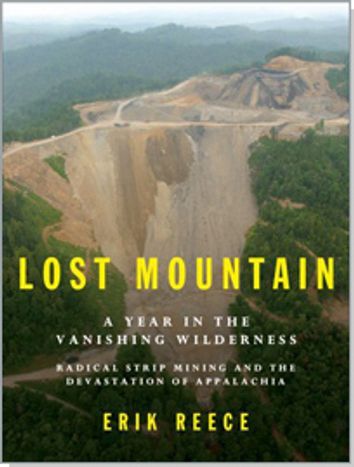
Among the newly shorn is Lost Mountain, a once modest peak a few miles north of Hazard that Leslie Resources Inc., a Kentucky coal company, began stripping in the fall of 2003. As it happened, journalist and University of Kentucky writing professor Erik Reece was looking for a doomed Appalachian hill to be the focus of his reporting on mountaintop removal for Harper’s magazine; Lost Mountain had the perfect name. So over the course of the following year, Reece made frequent, covert visits to its slopes as Leslie clear-cut its trees, blasted and bulldozed its topsoil and rock, and hauled away its coal. “Lost Mountain: A Year in the Vanishing Wilderness,” parts of which first appeared in Harper’s in April of last year, is Reece’s full account of what he witnessed and of the broader effects of this radical form of strip mining.
The chapters of “Lost Mountain” alternate between monthly updates on the peak’s devastation and episodes in the history, economy and politics of coal mining in America. All in all, it’s a grim picture. On his visits to Lost Mountain, Reece watches bulldozers shove piles of felled trees into burning pyres; trucks send hundreds of tons of sandstone and slate spilling down the mountainside; and blasts of ammonium nitrate and fuel oil transform hillsides into plumes of debris and acrid yellow smoke. Reese’s description of his last trip to the summit typifies his tone of controlled, yet piercing anger: “Stepping over a final berm of spoil, I find myself standing where the capstones once sat. Now all the vegetation has been shaved away. A long yellow fuse winds up to what once was the mountaintop but is now only an awful black knob.” Reece surveys his surroundings — “gray mounds of rock,” “black pools of rainwater mixed with coal” and a “wide black crater” — and concludes: “I am standing in the middle of a wasteland, a dead zone, a man-made desert.”
The shame and sadness of such a scene — of a richness built up over millions and millions of years undone in a matter of months — should be obvious, but many would no doubt argue that the destruction was worth it for the energy supplied and the money made, that plenty of other mountains remain untouched, and that this one will be made into something as good or better after “reclamation” — the term for coal companies’ legally mandated efforts to restore mined land to equal-to or better-than pre-mining conditions. The intervening chapters of “Lost Mountain” are largely an effort to address these arguments. In them, Reece exposes the moral, economic and ecological bankruptcy of mountaintop removal with a forcefulness to match the drag lines by which it is done.
Reece unravels the tortured and absurd language of environmental regulation whereby poisonous waste is reclassified as benign “fill material” and prisons, tourist stops and abandoned industrial parks count as “higher or better uses” for land than forests that serve, in essence, as the planet’s lungs, storing carbon and releasing oxygen in complementary inverse to our own lungs. He uncovers the shell game by which large coal companies set up smaller outfits in order to protect themselves from state regulators: “These [small] operations lease equipment from the ‘good’ company, and post a small bond that will supposedly cover the cost of reclamation should the company declare bankruptcy. Which is exactly what they do. The shell company forfeits its bond, which is never enough to complete the reclamation, and local communities are left with cracked foundations, a contaminated creek, poisoned wells, and steep slopes that pour mud down when it rains because there is no vegetation to hold the soil in place.” Reece further observes that surface mining accounts for only 4,000 jobs in eastern Kentucky and has failed to bring greater wealth to Appalachia, where the poverty rate has hovered at 31 percent for four decades. And he notes that, as wilderness areas grow smaller and more isolated, we are witnessing the sixth mass species extinction since the beginning of life on earth.
The list of social and ecological damage done by strip mining is long, but most bitter of all is the simple fact that we know better. The information, traditions and laws that would keep us from such ruinous behavior are out there; we have simply chosen to ignore them. Much of what we know about the costs of strip mining is codified, for instance, in the Surface Mining Control and Reclamation Act (SMCRA), which Jimmy Carter signed into law in 1977. Were it enforced according to its original wording and intent, SMCRA would change the practice of coal mining substantially and for the better. The requirement that coal operators restore mined land to its “approximate original contour” would make mountaintop removal practically impossible, as would the stipulation that “no damage will be done to the natural watercourses.”
But the will to enforce SMCRA has vanished since Carter left office. Instead we have men like Steven Griles, George W. Bush’s deputy secretary of the interior and a former coal industry lobbyist, who, while still collecting $284,000 a year from his former employer, has gone about hedging the language of SMCRA with phrases such as “to the extent possible” that render the act close to meaningless. Of all the episodes of negligence, corruption and greed that Reece recounts in “Lost Mountain,” none better illustrates the government’s betrayal of public trust and evasion of responsibility than the Martin County disaster of October 2000, when a coal slurry impoundment broke through an underground mine shaft and spilled 300 million gallons of toxic sludge on the eastern Kentucky community of Coldwater Creek. Though it was 30 times the size of the Exxon Valdez disaster, the spill garnered little public attention.
Under the pressures of corporate patronage, what should have been declared a Superfund site instead received a perfunctory and cosmetic cleanup, and what should have been a damaging criminal negligence suit against the responsible company, Massey Energy, instead ended in a $5,500 fine. This is what happens when Bush’s appointee for labor secretary, Elaine Chao, who oversees the Mine Safety and Health Administration (MSHA), is the wife of Kentucky Sen. Mitch McConnell, who has received millions of dollars in campaign contributions from the coal industry. Chao appointed a former mining company manager to take over the Martin County investigation and he produced a report that let Massey off the hook with barely a slap on the wrist. The wolves have been put in charge of the sheep.
When the bankrupt Horizon Resources, the parent company of Leslie Resources, sold its assets in the summer of 2004, the Lost Mountain mine came under the control of New York billionaire Wilbur Ross and his International Coal Group (ICG). Ross has made a lucrative practice of buying bankrupt coal and steel operations, canceling their employees’ healthcare and retirement benefits with the permission of the federal courts, and then unloading his investments at a steep profit, effectively shifting the costs of the business onto the working class and the profits to the investment class. (The Sago Mine in West Virginia, where 12 miners died last month and a 13th slipped into a coma after an explosion left them trapped for more than 40 hours, is, incidentally, another of the operations ICG acquired from Horizon. Sago had a long history of serious safety violations for which it had been fined a negligible $24,000.)
While it is both appropriate and easy to curse dishonorable politicians and ruthless corporate moguls, the difficult truth remains that we are responsible both for their power and for the energy demands that drive their actions. U.S. coal companies now extract a billion tons of coal per year, 70 percent of which comes from surface mines like the one on Lost Mountain. The overwhelming majority of that coal feeds coal-fired power plants that provide electricity to more than half of American homes, whose demand for electricity has risen 70 percent in the last 20 years. There is a good chance that as you read this review — and as I wrote it, and as Reece wrote the book that it is about — we are all participating in the destruction of Appalachia.
Reece’s acknowledgment of this shared responsibility and his sensitivity to how the controversies over strip mining play out in the culture help make “Lost Mountain” more than a mere screed. Though he lives in Lexington, Ky., and once worked as a janitor at a coal-fired power plant in Louisville, Reece knows that in the eyes of many in Appalachia his residence in western Kentucky and status as a professor make him just another outsider who cares more about trees than he does about country people. In one passage, Reese surveys a protest and counter-protest in Lexington over the release of the Department of Interior’s Environmental Impact Statement on mountaintop removal (the handiwork of Steven Griles) and deftly sums up the cultural divide. “You’ve seen them before,” he writes of the protesters. “They wear tie-dye shirts, Birkenstock sandals, and earnest expressions. They give fiery speeches about corporate greed and human arrogance. They play bongos.” And the counter-protesters: “You’ve seen them too — the golf shirts, the khaki shorts. They hang out in cigar bars and like the president.”
Yet, despite the embarrassing small-mindedness of the culture wars, Reece is unafraid to throw in his lot with the bongo players, at least for now: “The fighting between conservationists and the coal industry — between an ethic and the economy — will rage for years. That’s clear. And the fight might have to get quite ugly before substantial, sustainable change occurs,” Reece writes. “We will have to choose sides, it seems, to reach the point where we realize there are no sides, and that there are no sides because there is no outside.” This is the refrain of “Lost Mountain,” that we’re all in this together, and Reece can be forgiven if he sometimes hits us over the head with it. He cannot reshape the lost hills of Appalachia, so he aims to reshape our consciousness to conform not to the flat and barren logic of the market but to the health and wisdom of an old-growth forest.
But what kind of an economy would such an ethic construct? Would it survive being “mugged by reality”? To this Reece offers the example of the Ecovillage, a collection of apartments, gardens and greenhouses on the campus of Berea College outside of Lexington that is devoted to housing single parents. The Ecovillage recycles its own wastewater and, thanks to careful design, uses 75 percent less energy and water than the average American neighborhood. Its residents, meanwhile, live a perfectly comfortable lifestyle with washing machines, fluorescent lights and all the rest.
On a grander scale, Reece suggests that a carbon tax be levied on coal and other fossil fuels and that a large part of the revenue be used to subsidize reforestation projects. (The carbon tax is a notion that New York Times columnist Thomas Friedman has recently begun pushing as part of his “geo-green” political agenda.) Or failing that, Kentucky could at least raise its coal severance tax (which is levied on coal operators per ton of coal extracted) to a par with other coal-mining states and dedicate the extra revenue to fostering regional economies based around “furniture makers and cabinetmakers, tree farmers, fish farmers, foresters and people raising non-timber forest products such as mushrooms and herbs.” For many years, the people and hills of Appalachia have been paying a stiff price for the cooling, heating and lighting of our homes. Much of what weve taken cant be returned, but we can at least begin to create a system in which health and wealth are returned to their sources. We can, in the words of the ecologist Aldo Leopold, begin to “think like a mountain.”
Continue Reading
Close
Women like to talk about feelings and relationships; men do not. Be it self-fulfilling prophecy or biological reality, it’s an idea that American culture accepts completely. In the course of doing research for his book “VoiceMale: What Husbands Really Think About Their Marriages, Their Wives, Sex, Housework, and Commitment,” Neil Chethik found the stereotype to be true, but only on the surface. During in-depth interviews with 70 husbands scattered across the country, Chethik discovered that men were indeed hesitant to talk about feelings, yet had plenty of ways of expressing them, if you knew where to look. Affection, for instance, can be found in the meticulous way that Roger Warden makes the bed every morning with an extra blanket spread across his wife’s side; in Randall Hutchins’ glances at his wife as she dozes in the passenger seat; and in pleasure that Jake Morrison takes in his wife’s company as they tear the old wallpaper out of their home.
Hundreds of hours spent with husbands ages 22 to 95 led Chethik to conclude that men get a bad rap when it comes to committed relationships — that what is often identified as emotional deficiency is simply a different approach, no better or worse than its female counterpart. And after three decades of cultural upheaval in gender relations, Chethik believes we have reached a point where the “male style of loving” can be accommodated without trespassing on the gains of feminism. If men can learn to cuddle, cry and change diapers, women can learn to see the romance in an afternoon spent spackling or watching sports.
Based on a randomized telephone survey of 288 American husbands, plus the 70 face-to-face interviews, “VoiceMale” outlines how men “do marriage” — not as problem to be fixed but as a practice to be understood. Chethik begins with chapters on the basic phases of courtship and marriage — from the first spark to the empty nest — then grapples, one at a time, with the major tensions of a long-term relationship. With the security of anonymity, Chethik’s subjects talk frankly about all of it — from sex and adultery, to money and chores, to in-laws and children. Chethik, for his part, acts as both emcee and editor, allowing the men to speak for themselves and organizing their various accounts into a coherent whole. Through their voices he has created a snapshot of marriage as men know it but rarely discuss it in the outside world.
Chethik is a writer in residence at the Carnegie Center for Literacy and Learning in Lexington, Ky., where he lives with his wife and son. He spoke with Salon by phone about the reasons men still want to get married, the influence of feminism on the institution, and the link between housework and good sex.
Tell me a little about your methods. How reliable do you think these interviews and phone surveys are, especially in terms of husbands reporting honestly? They talk about some pretty intimate and sometimes shameful things such as adultery and domestic abuse.
The phone survey was what they call a random digit. The University of Kentucky Survey Research Center called random homes across the country and asked if there was a man there over 18. Almost 50 percent of the 600 or so eligible men agreed to answer the questionnaire. At the end of the survey they would ask the subject if he was willing to allow his name and phone number to be given to me, the writer. Then I contacted those people individually, not all of them, but as close to a representative sampling as possible. I was able to look at their answers from the survey, so when someone said, “I have struck my wife before,” I would ask about that when I did the follow-up on the phone or in person. Usually they would talk pretty openly. I am always wondering exactly what’s going on behind the answers, but I felt like they were mostly true.
There was a sharp divide in your research and in your interviews between husbands who thought that you always admit to everything, including affairs, and those who thought that it wasn’t always necessary. Did you come down on one side or the other?
I think it is very difficult for anyone to hide that from a spouse. And for the most part I think it’s got to be brought into the open or it will become a barrier. I did talk with men who had never told their wives. My overall sense is that they thought their wives knew and that there was a tacit agreement that it was OK to not talk about it because it was over and the issues that had to do with the relationship had been worked out, so why hear the nitty-gritty of what he did when you weren’t looking?
You also report that four in 10 husbands say that they use porn, and most of them say that they masturbate. Were they open about that with their wives? Were their wives OK with it?
The responses were all over the map. Sometimes the woman was equally interested in using pornography as part of their sex life. Other times women were appalled that their husbands did and the husband had to reconsider. For most husbands it was kind of a respite or a refuge, somewhere to be alone and have his own sex life. That doesn’t mean he’s not having a good sex life with his wife. Maybe he likes to have sex twice as often, so rather than appeal to her and be rejected or appeal to her and have her do it when she doesn’t want to, why not do something nice and easy?
You also find a link between housework and sex, that there was a correlation between the wife’s satisfaction with the division of labor and the husband’s satisfaction with their sex life. Can you describe that in a little more detail?
That’s a correlation, but it’s not causal. So the anecdotal part of my research involved asking men, What’s the deal here, have you seen a link? And a good number of men had seen it. There were more men who reported that the sequence was, he does housework, then she has sex — as opposed to, she has sex with him and then he does housework.
You quote one husband who says, “My wife told me that she’s never more turned on to me then when I’m doing housework, and she’s proven it again and again.” In a cynical view it looked like a quid pro quo, but also it seemed sort of sweet.
Well, and that’s exactly what that man you just quoted says a little later. At first he thought she was kind of holding out on him. His initial reaction was to resist that because it did feel like a quid pro quo. But then he realized that it was more about her feeling appreciated. It seems that women who feel their partners are paying attention to them, and to the household, are more appreciative and less tired.
You say you noticed in your interviews that men tend to have a hard time with the word “feelings.” Why is it mystifying?
Men have a tendency to compartmentalize. There are some evolutionary psychologists who say that for most of history, men have been at the outskirts of communities looking out, side by side with other men, while the women have been closer to the center. So there may be a tendency for men to be more action oriented and more spatial. They kind of feel a person next to them, but don’t necessarily have to be face to face with them. So I think maybe some of that came through our biology, and then our culture reinforces the message that boys don’t cry, that men have to hold back emotion and present a stoic front.
It’s a big thing in sports, for instance, to be able to control emotion. I remember one of the men I spoke with for my previous book, “Father Loss,” told me that when he heard his father had died, he wanted to cry, that he could feel it building in his throat, but he swallowed it. And later, when he wanted to cry for his father, he couldn’t get it back.
So this combination of biology and socialization leaves men backpedaling a little bit. And when a woman, on the other hand, has been well-educated about feelings, has had a lot of personal, face-to-face conversations with other girls and women, then we’re particularly unsteady as men because we’re afraid we’re not going to be able to be an equal and that we may get hurt.
That was one of the main themes of your book — that there is male style of loving and a female style, and that over the last 50 years the male approach has been disparaged or devalued, at least in the context of home life and marriage. What is the male style and why is has it been devalued?
The male style is less oriented towards words and more towards action, less oriented towards face-to-face interactions than side by side. In my own marriage, for instance, there was a long time when my wife was quite disturbed that I wasn’t affectionate toward her in the ways she wanted me to be. She wanted more touching, kissing and saying “I love you.” Those things didn’t come easily to me. But over the course of 15 years she’s come to recognize that when I leave her a note or spend hours working to make our backyard a refuge, that’s my way of doing those things. At the same time, I’ve recognized that she needs those direct expressions and I’ve made an effort to meet her halfway.
As for why the male style is devalued, I think there was a long time when male voices did rule, so to speak. And so as women’s voices became clearer and more insistent, men kind of backed away. Thirty-plus years ago, the home and family relationships tended to be the one domain where women had authority as far as who knew better how things should be done. And I think they were reluctant to let it go until they gained more power in places outside the home. So in a sense, we’re at the point now where men can speak more. But what has happened, I think, is that our popular culture has turned men into goofy incompetents.
Like Homer Simpson?
Yes, Homer and so many others. I watch some of these TV commercials where the man is like, “Oh, I don’t know how to change a diaper,” or, “Oh, I don’t know what I’m doing here with the laundry.” We’ve become laughingstocks, but I didn’t see that in the study. I saw men who weren’t laughingstocks, who were doing a lot around their homes, who were involved in their children’s lives.
But isn’t this image of the bumbling man projected largely by men? I mean isn’t it convenient for us, since it sets low expectations?
Yes, I think men are torn. We want to perpetuate it because it’s easy and safe, but in my experience there’s a greater desire to change now than ever before. A lot of men in my generation and older, men in their 40s and 50s, felt disconnected from their own fathers and they want to be more available to their own children.
Were you at all worried that there’s a danger in saying, Wait a minute, why are we devaluing this male style? — that you might be cutting into the gains that feminism has made?
I came of age in the late ’60s and early ’70s, which is right at the time that things were changing radically, and I never felt feminism to be a threat. Now, I know there were some angry people, angry women in particular, who I thought were sometimes wielding a broad brush by saying that you can’t trust any man, that all men want is sex, or that they are uniformly dangerous and abusive, but I never really felt angered by that because I believed that, in the bigger picture, both men and women stood to gain from the larger feminist goals of equality and removing biology as destiny.
I’ve seen that in my own life. I married somebody who has her own career, who’s very good at what she does. She also supports me at times as I’m chasing my dream of writing books. So my philosophy is that we can be pro-female and pro-male and pro-relationship if we are reasonable with each other. And I sense that women, even very strongly feminist-oriented women, are open to hearing what men have to say.
Still, were you at all afraid of perpetuating the stereotype that men are intellectual and women are emotional or that men are doers and women are talkers?
I can see that it might be misinterpreted that way, sure. But I look at it more as a masculine style. In the relationships I’ve seen, there’s maybe one out of four where the female is more oriented to the masculine style, so I hope it doesn’t push stereotypes. I think if people read the book, they will see the diversity of men’s perspectives, and we wouldn’t be stereotyping them into this one way. But I use that idea because there’s a tendency in certain directions for men — toward action over words, or side by side over face to face. And if we can see it not as a bad way of loving but a different way of loving, then everybody may benefit.
You also write that the cultural upheaval of the ’60s made marriage unnecessary in a sense, since men could live with, sleep with and raise children with a woman without getting married. Yet you found that men still want to get married anyway. Do you think it’s become pretty much a matter of choice? Aren’t there still some serious pressures to get married?
I don’t know if I would say that marriage is culturally unnecessary, but it’s not demanded by the culture the way it used to be. There’s a somewhat lower marriage rate than there was 30 or 40 years ago because the options have grown with more women being financially responsible for themselves. But I do think that the idea of marriage as a core to a family, as two loving partners who teach love by being in it, is a human need.
There were many examples of self-denial in the book, of husbands sacrificing things that they wanted, out of a commitment to the marriage. One of the husbands you talked to was in a sexless marriage and said he had no intention of leaving. He said. “You have to accept the things you can’t control.” That struck me as an unfashionable sentiment. In popular culture anyway, the message seems to be that a lack of passion destroys a relationship rather than helping to maintain it. Yet, in your book, self-denial seemed to be both a constructive and a destructive force.
For those who married before 1965, I think self-denial was an expectation of marriage and family. There was a certain point where you put childish things away and you “became a man.” Today, we don’t deny ourselves as much; self-denial has become less emphasized. But this sometimes wreaks havoc on our relationships. We tell ourselves that it’s OK to sleep with somebody else. And when we do, we cause damage that we weren’t expecting. The culture is lurching forward and backward when it comes to the meaning of marriage and family.
Do you think on balance there’s been more progress?
I do. I think the biggest progress is having women as equals in marriages. When that happened, it created the possibility of really deep, important relationships and, at the same time, made it possible to try work out the differences that are inevitable in every relationship. However, I think we’ve been in upheaval over the last 30 years or so since this happened. We had a spike in divorce rates, which has leveled off and possibly even dropped a little bit in the last 15 years, depending on what kind of data you use. I think that’s because we’re beginning to understand a little bit more how to negotiate long-term relationships without the old rules that the man has to work and the woman stays home, and if he doesn’t, he’s not a real man and so on.
You write that husbands “recognize that marriage takes work and work pays off.” And you quote a husband who says, “Marriage is a job, a hard job and a low-paying one.” Are you familiar with the book “Against Love,” by Laura Kipnis? Her critique of marriage is essentially that it’s too much work and not enough play.
I think there is some truth to that. I think, actually, that men are of the opinion that we should have more fun. When I talked with them I heard, “I wish my wife would want to talk less about the relationship and just enjoy it.” Men seem to weigh four or five good things against two or three bad things in a relationship, and that means good enough. A woman might say, “Look, we’ve five good things and three not-so-good things. Let’s try to work on them and really make this the best it could possibly be.” There’s a gender gap there that we need to bridge.
Continue Reading
Close
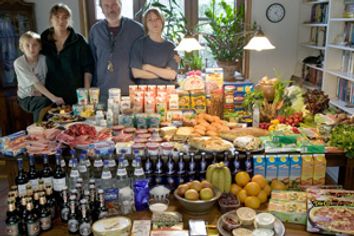
Twelve 2-liter bottles of Coca-Cola line the back of the table in the Casales family portrait that appears in “Hungry Planet: What the World Eats.” The Casaleses are a mother, father and three young sons living in Cuernavaca, Mexico, and the six gallons of Coke are part of their weekly diet. They drink it with nearly every meal. The oldest son, 7-year-old Emmanuel, is already overweight. Like his parents, he has come to resemble the squat, narrowed-at-the-neck bottles that are slowly killing him. And the Casales family is not alone; 65 percent of the Mexican population, the world leader in per-person consumption of Coca-Cola, is now obese or overweight.
But “Hungry Planet” is not a book about obesity or corporate villains; it’s something much grander. Its premise is simple to the point of obvious and powerful to the point of art. Peter Menzel has photographed 30 families in 24 countries along with the food they will consume in the course of a week, while his partner, Faith D’Aluisio, has written a brief profile of the eating habits of each. Menzel and D’Aluisio are the same pair that produced the 1995 bestseller “Material World,” a collection of portraits of “statistically average” families, and their worldly possessions, in 30 different countries. “Hungry Planet” follows the basic pattern of the earlier book. Each family’s food for the week is cataloged and priced, and each profile is accompanied by a statistical breakdown of their country and a family recipe. Alongside all this are hundreds of richly colored and quietly composed photographs and six short essays from food-writing luminaries. The cumulative effect is that of being welcomed into the homes of 30 working families around the world.
Meet the Browns of Riverview, Australia, a three-generation family of seven that eats 60 pounds of meat in a week; the Madsens of Cape Hope, Greenland, whose diet is built around hunted musk ox, walrus, geese and polar bear; the Manzos of Sicily, who are surprised to discover that, as a couple, they smoke 20 packs of cigarettes per week; the Natomos of Kouakourou in Mali, a Muslim family of 15 in which the two wives take turns cooking millet porridge each morning; the Melanders of Bargteheide, Germany, whose $500 worth of groceries — spread before the four of them in neat rows of cartons and bottles — includes $90 in vitamins and supplements; and the Aboubakars, six Sudanese refugees encamped in Chad who subsist primarily on a 40-pound ration of unmilled sorghum.
That the Melanders can spend 400 times more money on food than the Aboubakars are able to earn in a week suggests that the distribution of resources worldwide remains distressingly out of whack. In “Hungry Planet,” the difference between the half of the world’s population that still lives on less than $2 a day and the rest of us is made visible in the contrast between the families sitting, often on dirt floors, behind sacks of grain or root crops and those standing around tables piled with cellophane-wrapped meats and branded foods. Many readers, I’m guessing, will share in my uneasiness at the thought of the indictments to be found in a picture of one’s own family standing next to a week’s worth of food. In my case, there would be an alarming number of to-go containers and bottled beverages and too few fruits and vegetables.
The dominant sentiment evoked by “Hungry Planet,” however, is not one of shame but one of anxiety. Out of the 30 family portraits emerges a larger picture of a global civilization rushing headlong toward an economy in which food is a thing produced remotely by machine labor and a handful of experts and then sold (or given away) by multinational organizations — an economy in which we identify a piece of food by its logo rather than by its biology. This is an economy already familiar to many of us in what is called the developed world, and it is growing grab by grab on the international market.
This transition to industrial food is manifest on almost every page of “Hungry Planet,” from the Bhutanese monk swigging from a bottle of Pepsi at a celebration of the arrival of electricity in his village to the Polish family navigating the new “hypermarket” built on countryside once given over to collective farms.
The main marker of the jump to an oil-dependent, cash-crop economy is the same as that of the divide between rich and poor — a diet shift away from cereal grains and fruits toward animal fats and refined sugars. This shift brings increased rates of obesity, which is fast becoming epidemic. As Alfred W. Crosby writes in one of the book’s six essays, “The number of us who suffer from the diseases of overeating may be, for the first time in history, approaching that of those suffering from undereating.” The problem is particularly acute in the United States. In another of the essays, Francine Kaufman notes that “one in every three children born in the United States in the year 2000 will have diabetes some time in their life.” Clearly the main beneficiaries and victims of the new food economy are the generations that grow up within it.
Over and over again in “Hungry Planet,” these massive economic changes are played out in the fears of grandparents, the aspirations of parents and, most of all, in the appetites of children. Kids everywhere, it appears, crave McDonald’s. In Riverview, Australia, 5-year-old Sinead Brown charms her grandfather, who grew up rustling porcupine in the bush, into buying Happy Meals for her five or six times a week: “Pop, do you think we could do something about Mackas?” she asks, using the Aussie slang for McDonald’s. Her mother repeatedly tries and fails to cook fries to match that unmistakable Macka’s taste. In Beijing, a father beams with pride at his teenage son’s twice-a-week McDonald’s habit, “He’s growing up differently than I did.” The Cui family in rural China has yet to encounter Western fast food, but attitudes toward it are already divided along generational lines. Six-year-old Cui Yuqi looks forward to trying some. His mother “apprehensively” says she would try it. His grandparents “want no part of it.”
Centuries-old traditions and deep reserves of local knowledge are, of course, lost in the transition to a McDonald’s economy — as, often enough, is even a rudimentary knowledge of kitchen work. The 52-year-old grandmother in Riverview, Australia, tells of the time her children and grandchildren were confused at the sight of her boiling tea from loose leaves. “Haven’t you been educated in anything?” she asks them. But since the traditions lost usually involved long hours of stooped labor for a meager existence — such as the reconstruction of earthen watering troughs performed daily by 12-year-old Amna Mustapha and the other daughters of Dar Es Salaam Village in Chad — the changeover to a cash economy is usually counted as progress. Homegrown is just too much work when you can have store-bought.
Or so the choice is frequently presented. We can lead sedentary lives and grow comfortably fat on uniformly bland food or we can go back to laboring dawn to dusk at the edges of hunger. The mothers in Turkey, Bhutan, Mongolia and the Philippines who do this kind of work — and it is women who carry the heaviest burdens throughout the book — are united in a desire to see their children escape it. “I want them to make a good living using their minds, not their bodies,” says 33-year-old Melahat Celik of Istanbul of her three children. Melahat, who cooks and cleans for six different families in the city, is expert in the preparation of Turkish pastry and baffled by her children’s attraction to fast food. But on the rare occasions when she can spare the money, she takes them to the McDonald’s at the local mall.
Perhaps we are simply destined to live in a world where local cultures exist only as residue preserved for the sake of tourists. If our children’s children want to know about hand-grinding barley on a stone or spreading manure on fallow fields, they can read about it in “Hungry Planet.” A review of the book, really, should be written 50 or 100 years from now. What will they say then about a time when half of China’s workers were still agricultural and Kuwaitis ate their pick of the world’s bounty in the middle of a barren desert? Will the women of Todos Santos in Guatemala still cook their own tortillas? And on All Saint’s Day will a mob of men on horseback still “race back and forth down the main road into town stopping at each end of the course to take a pull of hard liquor” until the last rider gives up or passes out, as Menzel describes in one of his field notes?
The softly voiced hope of “Hungry Planet” is that the other half of the population can join us in having enough to eat without all of us living in a McWorld. Corby Kummer of the Atlantic Monthly argues in his essay that the best way to fight fast food may be to subvert it: “Those who wish to return to regionalism, to a more equitable farming system, and to a safer environment need to be more inventive than simply deciding to declare war on fast food.” Kummer suggests we invent a compromised version of the chain restaurant — one that treats workers better and that buys a meaningful percentage of its food from local growers. “A serious rival should start,” he writes, “with streamlined, bland recipes that make spurious claims of Mexican and Wild West connections. Aim for anonymity and consistency. Spend a fortune promoting an image of young people having fun.” This third way may be the best we can hope for until the day when “fast food will be a distant memory.”
For the Casales family back in Cuernavaca, a change can’t come soon enough. Between the time that Menzel took their portrait and D’Aluisio wrote their profile, Marco Antonio closed the family’s convenience store (which he had opened after losing his job at a brewery) and crossed illegally into the U.S. in search of better wages. So far he has only been able to find 20 to 30 hours of work a week, at $5 an hour. The money he sends home is not enough to support the family’s old Coke habit so they are down to four quarts a week. The indignities suffered by the Casales family in the churning of the global economy — the all too common story of a father separated from his family and working for inadequate wages without legal protection — make the hard of life of the Aymes family in the mountains of Ecuador seem almost ideal. Ermelinda and Orlando Aymes have to work ceaselessly to secure the $35 worth of potatoes, rice, flour and bananas that sustain them and their seven children for the week, but they work together and they own the sources of their livelihood.
It is no accident that Orlando is a voice of reason when it comes to fast food. He tried it once while studying in the nearby city of Ambato. “It was meat on bread,” he says. “It was okay, but a bit strange. And I wasn’t able to see how it was made.”
Continue Reading
Close