Andrea Yates was, in the words of a psychiatrist who treated her for one episode of postpartum depression with psychosis, one of the five sickest patients the psychiatrist had ever treated. She neglected to bathe or to drink water, she acted bizarrely and she suffered from severe delusions and hallucinations that experts say made her a clear danger to herself and others. But just days before she drowned her five children in a bathtub, Andrea Yates’ doctor decided to take her off her antipsychotic medications — a mistake, in hindsight, that may have cost her children their lives.
What if we took humans out of the equation? What if a dispassionate computer had been making the decisions about Yates’ care, rather than a human doctor sitting across a desk from her? Would a computer have left her on medication? Would her children still be alive?
Three years ago, the National Institute of Medicine estimated that medical mistakes kill between 44,000 and 98,000 people per year in hospitals. If that’s true, it means medical errors kill more people each year than car accidents, breast cancer or AIDS. Efforts to reduce such errors get only a fraction of the attention — and funding — that goes to AIDS research, but arguably it would be far easier to substantially reduce life-threatening medical errors than it has been to create an AIDS vaccine.
While some researchers have successfully poked some holes in the estimates of the number of patients killed by errors, the real effort should be aimed at ways to change the practice of medicine to make it safer. One doctor declaiming loudly that something should and can be done to reduce errors is Atul Gawande, a surgical resident in Boston, a staff writer for the New Yorker and now the author of a new book, “Complications: A Surgeon’s Notes on an Imperfect Science.”
Gawande is arguably the best nonfiction doctor-writer around; his talents are a source of envy among the rest of us, and this collection showcases his work well. He’s prescient and thoughtful, in awe of the medicine he practices without being an unthinking cheerleader. He is able to enter a story, but never overstates his own role as some doctor-writers are wont to do. The title of Gawande’s book recalls the title of author and scientist Lewis Thomas’ essay collection “The Youngest Science: Notes of a Medicine Watcher.” That’s apt, because Gawande’s work is well on its way to becoming the heir to Thomas’ humble, insightful and brilliantly crafted oeuvre.
Gawande’s greatest contribution, however, is that he has no fear of fighting the myth of the infallibility of doctors. At times, machines can best man. In 1996, attempting to diagnose heart attacks, a Swedish cardiologist read 2,240 electrocardiograms (EKGs) — the squiggly lines that show the electrical rhythms running through the heart. Of 1,120 heart attack readings, the cardiologist picked up 620. A computer, reading the same 2,240 EKGs, found 738. Neither was perfect, but the computer had won. Deep Blue had defeated Gary Kasparov.
Computer-based diagnostic systems have been in existence some 30 years, and more than a decade ago a philosopher suggested that “diagnosis without doctors” would be an improvement over human-based systems. For the most part, however, the medical community has seized on the limitations, not the promise, of such systems. The last major study, in 1994, found that they made correct diagnoses only about half to three-quarters of the time, making them suitable only for teaching medical students how to diagnose hypothetical patients.
It turns out, though, that doctors may have been too quick to reject computerized diagnostics across the board. Hospitals have found that computerized systems are invaluable when used to help make highly specialized decisions such as which antibiotics to use in an intensive care unit and which patients with HIV should be on medicines to prevent deadly pneumonias. Machines are also at least as good as pathologists when it comes to reading Pap smears — and as the Swedish study showed, you may want a computer, not a cardiologist, to check your EKG.
So why not have computers decide which patients — such as Andrea Yates — who suffer from psychotic disorders or depression should be taking medication? If the evidence of her illness was as clear-cut as it seems, wouldn’t a dispassionate computer have left her on medication, instead of bowing to pressure from her or her husband?
Doctors, after all, make mistakes. The central message of Gawande’s book is that despite medicine’s great strides, it’s a fallible and human art often confused with a science. One of the most powerful essays here, “Education of a Knife,” which ran last February in the New Yorker, finds Gawande suspended between the need for doctors-in-training to practice and the needs of patients to have the best healthcare available. It’s an uncomfortable place to be, as Gawande acknowledges.
Gawande tells the story of his own reaction to a cardiology fellow who offered to treat Gawande’s son for a congenital condition that had been stabilized. Gawande turned him down in favor of a senior doctor, even though he knew that the fellow, as a resident, needed the experience. Another doctor, an advocate for asking patients to allow residents to treat them, admitted to Gawande that he and his wife had not allowed residents into their delivery room.
Gawande describes the morbidity and mortality conference, a brutal weekly dissection by his department’s surgeons of the week’s errors. His experiences are similar to those of every medical student, resident and faculty member who has ever sat through an M&M. I remember one irascible senior surgeon from my medical school faculty who used to analyze particularly error-laden cases by asking residents, “So, why didn’t you just take him out back and shoot him?” And when patients do die, doctors analyze their mistakes through autopsies, as Gawande relates in another essay — although they don’t do as many as they should, many experts say.
Dispassionate analysis of errors, in which blame is not assigned and the analysis is carried out by an outside agency, is key to turning the lessons of M&M’s and autopsies into better medical practice, Gawande writes. Just as the Federal Aviation Administration has used these principles to improve airline safety, the American Society of Anesthesiologists has been at the forefront of preventing medical errors. Other groups are coming on board the effort, although the prevailing culture of medicine — God complexes are not uncommon — has slowed progress.
There are any number of little things that could be done to dramatically improve patient safety. Making sure all doctors entered prescriptions into computers would allow a double check, preventing two similarly sounding medicines from being confused and stopping ubiquitous doctors’ bad handwriting from leading to incorrect prescriptions.
Still, even Gawande has some reservations about the wholesale mechanization of medicine. “Western medicine is dominated by a single imperative — the quest for machinelike perfection in the delivery of care,” Gawande writes in an essay in which he visits Shouldice Hospital, a “hernia factory” outside of Toronto. At Shouldice, named for a pioneering hernia surgeon, doctors do nothing but perform hernia repairs, all identical according to a standard protocol. But the experience left Gawande cold.
“Maybe machines can decide,” he writes, “but we still need doctors to heal.”
He’s right, because healing takes more than diagnosis and treatment. Andrea Yates and her husband Rusty, however, were hardly ideal patients. Dr. Park Dietz, a psychiatrist who testified for the prosecution in the Yates case, told the court that the couple had repeatedly ignored medical advice in the past. When doctors had told her to stay on her medications, avoid future pregnancies and undergo shock therapy, she refused. Patients with the disorders suffered by Andrea Yates are often in denial of their illnesses and are understandably loath to take medications that can have serious side effects. They often complain of feeling sluggish, both physically and mentally. In Yates’ case, she and her husband may have feared endangering future pregnancies.
A computer might have continued Yates’ prescription, but it could not have convinced her to actually take her medications. To do that, we need doctors, perhaps with a little help from machines. If anything, leaving certain analyses and decisions to computers could help doctors work on their bedside manners, which many patients say have declined as a result of managed care.
On May 4, Ellen Roche, a healthy 24-year-old woman, inhaled a drug known as hexamethonium as part of an experiment at Johns Hopkins University designed to figure out what nerves are at work in asthma attacks. Although approved by the Food and Drug Administration for intravenous use in patients with high blood pressure until 1997, the drug was known to cause serious lung problems and was never approved for inhalation. But Roche, a laboratory worker and veteran medical research subject, didn’t know any of that, because the consent form the researcher, Dr. Alkis Togias, had her sign didn’t mention it.
It seems that Togias had missed the lung toxicity in his review of the literature and didn’t think the FDA’s pulling of the drug from the blood pressure market was important enough to mention in the consent form. (A simple search on Google in July turned up reports of the drug’s toxicity, and even if you can’t believe everything you read on the Web, the search results, if Togias ever sought them, would have given him cause to investigate further.) Neither he nor the internal committee charged with reviewing the study deemed it necessary to apply to the FDA for approval to use the drug in the trial. Even when the first volunteer to take hexamethonium developed a cough, Togias ignored the symptom and failed to report it to the internal review committee, saying that it was a respiratory infection going around campus.
On May 9, Roche was admitted to Hopkins’ intensive care unit, where she eventually needed a ventilator to breathe. She died on June 2.
“Hers was a truly noble act,” said a Hopkins statement reporting the findings of an internal review on July 16. By emphasizing Roche’s nobility, Hopkins implies that her death was akin to a casualty in a good war, a necessary loss of life on behalf of a greater cause. But in wars, soldiers know the risks. When information about other risks, like those attendant to Agent Orange, is suppressed, governments are rightly condemned. What makes Roche’s death an unconscionable tragedy is that had Hopkins followed the rules and Roche known the risks, her untimely death might not have occurred. Hopkins said it was taking full responsibility for Roche’s death, but it then laid the blame at Togias’ feet, criticizing his work and pledging to improve its research review procedures. It thought that would be enough to placate the feds.
It wasn’t. On July 19, the agency shut down all of the 2,400 or so federally funded human trials at the medical center. The response from Hopkins was a sputtering, angry press release that included the statement “We strongly believe that this action was taken in utter disregard of patients’ health and potentially of life.” To an outside observer, however, it would seem that it was Hopkins — in approving Togias’ protocol, including his utterly flawed consent form — and not the government that was guilty of such utter disregard. (The funding was reinstated, with provisions for strict supervision, on July 23.)
While still taking “responsibility,” Hopkins has also attempted to place the blame on the FDA’s shoulders, saying that the agency had, by not responding to December 2000 and April 2001 letters requesting approval of Hopkins’ recently revised research procedures, effectively bestowed that approval. That dishonest spin doctoring should be considered reprehensible in the face of the needless death of a healthy 24-year-old woman.
The self-righteous outrage evinced by Hopkins following the government’s action revealed an institutional arrogance that should give any potential human research subject pause. The list of institutions spanked by the federal government for bad research protocols includes Duke University, the University of Oklahoma, the University of Alabama at Birmingham and the University of Pennsylvania, where 18-year-old Jesse Gelsinger died in a gene therapy trial gone bad.
Important human trials have always included risks, but have also vastly improved our longevity and quality of life. So are they worth it to the participants, who often don’t benefit directly? And is there a cavalier attitude throughout medical research circles that makes the danger as great as recent events suggest? Those are questions that make Susan Quinn’s new book an important read. The book, aptly titled “Human Trials,” is a revealing inside look at the drama and frailty of our system of human experimentation. Quinn spent time with participants in trials of drugs for multiple sclerosis and rheumatoid arthritis, two autoimmune disorders in which the immune system mistakes the body’s own substances for foreign invaders.
For the most part, the risks taken by the patients in the trials in this book are minimal and fall well within the acceptable bounds of medical ethics. What’s not particularly reassuring are the ways in which industry attempts to minimize and offset its own risks.
The book’s main character, Harvard Medical School professor Howard Weiner, is an earnest, likable and ultimately very human doctor. Weiner’s journal, quoted liberally throughout the book, paints him as an occasionally stubborn pragmatist who will sidestep cumbersome rules to do what he thinks best for patients. He’s a respected academic, trained by leaders in the fields of immunology and neurology, where he has made important contributions, but markers of success seem to come more slowly to him than to some of his colleagues.
That may be due to his brand of optimistic contrarianism, which leads him to believe so strongly in a theory known as “oral tolerance,” upon which the drugs in these trials, Myloral and Colloral, are based, that he is heedless of scientific critics. The basic idea is that the immune system can become tolerant to those substances it’s destroying in autoimmune disorders if those same substances are introduced to the digestive system. The theory has been around for some time, and has support from some scientists, but no drugs based on it have ever been proven effective as a treatment for disease. Other researchers are skeptical, noting the theory’s similarities to homeopathy, whose effectiveness also remains unproven.
His slow progress in academia appears to drive Weiner into the arms of venture capitalists. They help him start a company, AutoImmune, that sets up an office in Lexington, Mass., and eventually goes public, with its shares now traded on the NASDAQ. From the start, there are conflicts everywhere. Corporate officials become nervous when Weiner brings a video camera to document meetings and presentations. Clinicians enrolling patients at their offices are put off by the contract research organization hired by AutoImmune to standardize the trials. (In her character development, Quinn occasionally missteps as a writer. References to things like “a lion getting a blow-job from a beautiful girl” and “Jew-boy” seem unnecessary.)
After going public, AutoImmune officials seem to become interested only in their stock price, and not in the efficacy of the drugs. The night before the rheumatoid arthritis trial results are to be announced, Weiner has a happy dream “that AutoImmune stock was trading at $32 — the trial had worked.” Significantly, he mentions the stock price first, not the successful trial on which that price is based. Citing time constraints, the company decides to skip Phase II trials of Myloral, an unorthodox step. (Phase I tests the safety of a new drug on a small group of healthy volunteers; Phase II tests the safety and efficacy of a new drug on a small group of sick patients; and Phase III tests safety and efficacy in a large group of patients.) And just like Abiocor, manufacturer of the artificial heart recently transplanted into a man in Louisville, Ky., it chooses secrecy over openness in describing its data.
Ultimately, Myloral and Colloral fail to outperform placebos in their trials. But just because a drug doesn’t work doesn’t mean you can’t sell it. According to a recent press release, the company has plans to market Colloral as an over-the-counter drug for rheumatoid arthritis, with FDA clearance. Quinn herself said that the failure of the trials made the story less of a “slam-dunk” narrative.
Still, that’s the important element that many overly optimistic researchers forget when creating human trials. Most of the drugs they test will fail, and given that, researchers must be supercareful when constructing trials. Quinn’s book shows that it’s easy to let things like stock prices distract you from issues of safety and efficacy. Some doctors criticized AutoImmune’s strict protocol, designed to produce the “cleanest” or most indisputable results possible, for leaving study participants without effective treatments for their illnesses while they were involved in the study.
Toward the end of the book, Henri Termeer, CEO of Genzyme and a member of AutoImmune’s board, argues that AutoImmune should have done its research in an academic center. “Biotechnology has been good for innovation,” he told Quinn, “but bad for investment.”
But who would say that academic centers treat their human subjects any better? It’s unlikely that Ellen Roche’s family would. Hopkins, in fact, has just become involved in a second imbroglio, this one involving one of its researchers conducting human trials in India. As more and more drugs are hyped earlier and earlier by journalists and investors, researchers need to be more and more careful how they conduct trials. Potential subjects need to be able to honestly assess the risks they’re taking when enrolling so they can be confident that the studies they are generous enough to participate in are as safe as possible.
Continue Reading
Close
It isn’t many medical conferences that end with a rousing prayer from a pastor. Then again, a session titled “Ascending Life — Catholic Elders Living Purpose-Filled Lives” isn’t the sort of thing most doctors expect to get continuing medical education credit for. In early March, however, both were on the agenda of a rather unusual medical conference at Duke University. For two days, doctors, clergy and volunteers spoke on the healing power of faith, particularly in the elderly.
The essential message was that volunteering — especially through religious organizations — could keep people healthier and living longer. Sounds a bit far afield from most medical conferences, which are more concerned with the latest treatments for cancer, heart disease and the like. But by focusing on charts and graphs illustrating the explosion of elderly in the United States, speakers did their best to convince that religious involvement and volunteerism would save Medicare and our healthcare system.
OK, give the elderly something meaningful to do, give them the belief in some purpose, and they’ll be healthier. That’s not too controversial. But if you read social epidemiologist and gerontologist Jeff Levin’s new book, “God, Faith, and Health: Exploring the Spirituality-Healing Connection,” you might start believing that remote prayer, bioenergetic fields and mysticism would do the real work of healthcare, if doctors would only let them. Of course, none of those theories holds much water scientifically. Levin starts by summarizing the more reasonable ideas well. But he can’t resist overstating the research, then veering into talk of the healing powers of subtle energies and morphic fields.
It’s a shame that Levin and some others overstate the connection between religion and health because such polemics undermine the grounded scientific studies that make a less dramatic but very important case for the medical benefits of religion and spirituality. Others are more rigorous. For example, Harold Koenig, M.D., who led the Duke conference and has compiled 1,200 studies that look at the religion-medicine connection, found an association between religious involvement or spiritual belief and decreased risk of conditions including stroke, heart disease and depression. One study showed that spirituality increased average life span by seven years; and a review of 42 studies published last year found that if two groups of people, one religious and one nonreligious, were followed for 10 years, those in the religious group would have a 29 percent better chance of still being alive at the end of the period.
And why shouldn’t religious belief and activity promote health? As Levin points out, religious involvement generally promotes healthy behavior and lifestyles and positive thinking. It offers social support and discourages isolation. Doctors who discount the participation of the hospital chaplain are being foolish, and researchers are realizing the important role stress — mitigated, in many instances, by religious involvement — can have on the immune system. If you don’t believe any of this, you can agree that at the very least, attendance at church or synagogue services — a main measure used by many studies — selects those who are healthy enough to get out of bed and may live more moderate lives. Put most plainly, if you’re out late drinking on Friday or Saturday night, you’re not very likely to make it to synagogue Saturday or church Sunday. And if you’re very ill, you won’t make it, either.
Richard Sloan, a psychologist at Columbia University, is one of the more outspoken critics of this statistical sleight of hand and some of the deeper philosophical problems of the notion that religious belief leads to good health. He has published fairly severe critiques of such ideas in the Lancet and the New England Journal of Medicine. Sloan worries, rightfully so, about the negative effects of religion on health. A patient who believes that illness is the result of insufficient faith or prayer may be plunged into dangerous despair and self-reproach by the diagnosis of a major disease like cancer. And from a statistical point of view, many of the studies cited by proponents of the religion-health link are flawed, either because the researchers did not originally set out to measure religious beliefs or practices or because other factors — lifestyle, diet, genetics — are not adequately taken into account.
Levin acknowledges some of these problems, but barely. To some extent, he’s spinning the data, making an effort to come off as a hard-scientific epidemiologist but falling short. For example, he cites evidence that several religious groups are less likely to die from certain diseases. The death rate from heart disease among one Mormon sect is only about 80 percent of that of other citizens of the sect’s state. Seventh-Day Adventists are less likely to suffer from high blood pressure. Jews are less likely to suffer from cancers of the uterus, cervix and penis.
But there’s a better explanation than beliefs or church attendance at work here. None of these communities are particularly heterogeneous, nor are they random samples of the population. They’re tightly woven groups that discourage intermarriage and have, as a result, concentrated their genes, good and bad. So it’s no surprise that they have lower rates of a particular disease with a strong genetic component like cancer.
This is particularly true of Ashkenazi Jews. Sure, Ashkenazi Jews have a lower rate of some cancers. (Some of that may even be a result of circumcision, in the case of penile cancer, although that’s a controversial theory.) But research also indicates that other groups of Jews have at least a slightly higher risk of breast or colon cancer, risks that also have a genetic component. Why not acknowledge that? Similarly, why not acknowledge that once a group has a lower rate of high blood pressure — whether because of genes or prohibitions against eating meat, drinking alcohol and smoking — it’s pretty much guaranteed a lower rate of heart disease?
But the most significant problem with the religion-health connection — and the most troubling part of Levin’s book, even though it’s really just two chapters — arises when proponents give more credence than they should to the idea that patients are helped by remote prayers spoken by others. It’s a provocative idea, and one that has the backing of several studies. The most-often-cited one was of coronary care unit patients, published in 1988, but a larger study in 1999 confirmed the basic findings of the first, and an even larger study of some 2,000 patients is currently underway at Harvard Medical School. The subject is worthy of more study, even if it sounds outlandish. No one is ready to suggest that doctors prescribe prayer, although at least one survey found that patients wished their doctors would pray with them.
Levin, however, takes it too far. When he starts talking about “psychoenergetic systems” and “interconnections among subtle energies, physiological systems, chakras and meridians,” I think readers can be forgiven for puzzled looks. This stuff is decidedly non-Cartesian and backed up by zero evidence. One of the studies he cites is so bizarre I had to read it twice to make sure I wasn’t hallucinating. In it, doctors actually inflicted 44 male college students with wounds to test a highly questionable “modern subtle-energy-based healing technique” called “noncontact therapeutic touch,” whose powers Levin attributes to the realm of the “superempirical” — rather than the “supernatural.” When all else fails, he invokes “nonlocal” physics to explain how someone praying miles away from a sick patient can heal the patient.
Levin recognizes the value of rigorous peer review in medical journals, but seemingly only when it suits him. When there are no studies that meet his needs published in such journals, he turns to such rigorous experts as New Age health guru Andrew Weil. At another point, he cites “1,385 medical journal articles reporting cases in which cancer and many other serious chronic diseases seemed to miraculously disappear following treatment believed to be inadequate, or with no treatment at all.” Cancers spontaneously remit all the time. That doesn’t prove the placebo effect; it just proves we don’t know enough about cancer.
Levin can also overstate the acceptance of his own theories. In his introduction, he crows about a paper he and colleagues published in the Journal of the American Medical Association in 1997. The honor of being featured in JAMA even makes it into his book jacket bio. But read almost 200 pages further, and you learn that Levin claims to have been “shocked to discover that parts of my final manuscript had been excised.” Well, a few facts should be set straight. Levin published his paper in Pulse, the medical student section of JAMA — of which I was co-editor in chief at the time. The part of the article that was cut was the least substantiated, most speculative section of the piece. As he himself acknowledges in the book, “the evidence linking prayer to healing in humans, in my opinion, is less conclusive.”
Levin does a good job summarizing much of what we know about the connection between spirituality and health. Readers new to the field will probably find themselves willing to believe that religious affiliation and activity are probably a good marker for improved health, and may even promote it. But they should be leery of those who try to take the evidence much further than that, and be conscious of the bad effects religion can sometimes have. Read a history of the crusades for even more evidence on the negative effects of religion on the public’s health.
One member of the clergy attending the Duke conference, prefacing a question by wondering why a conference on faith was being held on a Sunday morning when he and others would ordinarily be ministering to their congregations, expressed doubts about the importance of the subject matter. Religion is for praising God, not for healing, he said. The response from a panelist was that if one of the “side effects” of religious involvement is health, why not acknowledge it?
To that, I say, “Amen.” But don’t risk incurring God’s wrath by pushing it any further.
Continue Reading
Close
In 1986, Yale surgeon and author Sherwin Nuland was sitting on a bioethics committee that was hearing the case of a heart surgeon who wouldn’t operate on a patient with AIDS because he had abused intravenous drugs.
The patient needed a lifesaving procedure to replace one of the badly infected valves in his heart, but the surgeon said he couldn’t justify the operation for an intravenous-drug user. He rank-ordered patients with HIV, he said unapologetically: He would operate on hemophiliacs who had contracted the disease through blood transfusions and on gay men who had contracted the disease through sex, but he wouldn’t operate on drug abusers who had contracted it through dirty needles. Dumbfounded, Nuland realized at that moment that, for doctors, “the lives that have the most value are those with which we most identify.”
Not much has changed in a decade and a half, and a growing number of studies suggest that perceptions, race and gender do have an effect on the care provided to patients. When I show up in an emergency room with my inevitable heart attack, a number of studies suggest that I will have a much better chance of receiving lifesaving therapy than a white woman, a black man or a black woman, in that order, does. Hispanics in Los Angeles and blacks in Atlanta were much less likely than whites to receive pain medication when they came to the emergency room with broken legs, according to other studies. When they leave the hospital, according to a recent study, many minority patients can’t find the powerful painkillers they need in their neighborhood pharmacies. The disparities, including those in organ transplantation, go on.
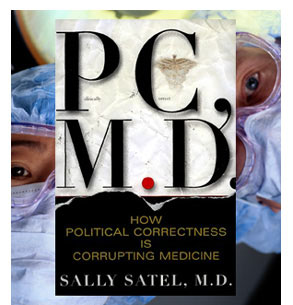
But Sally Satel, a practicing psychiatrist, isn’t worried. In her new book, “PC, M.D.,” she dismisses these studies and others as seriously flawed outgrowths of a politically correct movement that’s taking over medicine and threatening to put patients in danger. Satel is more worried that patients are being discouraged from taking greater responsibility for their health. They’re no longer being counseled about improving their diets, taking preventive measures against sexually transmitted diseases or quitting drugs; instead they’re being encouraged to accept their status as victims of an unjust healthcare system founded on racism and sexism. By claiming oppression, groups from nurses to former psychiatric patients are overrunning medicine and championing causes — “therapeutic touch,” “multicultural counseling” and affirmative action in medical school admissions, among others — that are at odds with good patient care. “At best, they create distractions and waste money; at worst, they interfere with effective treatment,” Satel writes
To be sure, there are problems with some of the studies that suggest that racism exists in medicine. For example, a study on differences in the treatment of lung cancer between blacks and whites never asked whether black patients, who fared more poorly, showed up at doctors’ offices later in the course of the disease. But pointing out flaws like this doesn’t make the studies completely invalid. Many studies have flaws; we still base clinical decisions on them. When the sheer mass of studies, each with minor flaws, points in a certain direction, we act on them. When a whole bunch of studies says basically the same thing, we should probably be worried about it.
Most damning to Satel’s argument, however, is that she doesn’t try to deny that minorities don’t have the same access to care that whites do. She just says that the studies fail to prove that these inequalities are due to racism. Unfortunately for her, that’s a pretty major concession. Even if we can accept that all Americans don’t have equal access to country clubs, most of us believe that we should have equal access to healthcare. The data says we don’t, and whether that’s a result of conscious racism, institutional racism or no racism at all, it’s a reality that decent people want to remedy.
Satel also has a real problem differentiating fringe academics from in-the-trenches doctors, or even mainstream doctors. For example, she dwells at length on Brown University public health professor Sally Zierler, whose theories on HIV seem to eschew practical prevention (i.e., condoms) in favor of victimology (i.e., those who don’t use condoms are “seeking sanctuary from racial hatred through sexual connection”). That sounds scary, and it is. But who’s listening? No practicing doctors I know, and Satel doesn’t provide any evidence for any, either.
If Satel’s statistical deconstruction of studies of racism in medicine is convincing to some, she fails completely in her attempts to show that the menace posed by political correctness to medicine is anywhere near as serious as she contends. (“Indoctrinologists,” as Satel terms “politically correct practitioners” of medicine, have “infiltrated” respected academic journals. I think the ghost of Sen. Joe McCarthy is smiling.)
In only a few places in the book does Satel bother to provide any quantitative evidence that “political agendas … are diverting resources from vital clinical tasks” or that political correctness can have “life-or-death consequences.” In one, we learn about a $200,000 teaching grant from the Department of Health and Human Services and a $355,000 research grant from the Department of Defense — both on the subject of a very questionable technique known as therapeutic touch. The technique is crap, as I’ll readily acknowledge; Satel points out, correctly, that a 9-year-old was able to debunk it in a study published in the Journal of the American Medical Association. A similar debunking was posted to Medscape General Medicine, an online medical journal, just last month. But with each department’s annual budget on the order of hundreds of billions of dollars, I just can’t get that exercised about these small grants.
Nor could I get excited about “$40 million in grants [made] available to applicants who wanted to develop trauma programs for women” in 1999, although at least in that case it’s a slightly more substantial sum of money when compared with the $2 billion to $3 billion budget of the grant-making federal agency, the Substance Abuse and Mental Health Services Administration. Even if one agrees with Satel that such grants are a bad thing (hardly self-evident, since in addition to the questionable trauma claimed by many, there is real trauma faced by battered women), she doesn’t say whether the grants were actually made; they were only “made available,” which often means unclaimed.
It would be useful to compare the funds spent on all of the studies and programs Satel finds flawed or useless with the total healthcare budget or some segment of it. That would help determine just what part of the healthcare budget was siphoned off, according to Satel, by the $5 million awarded by New York, the $1.6 million awarded by New Jersey and the $1.2 million awarded by Tennessee to “consumer-run” health organizations in 1995.
Satel’s backup material is sloppy elsewhere as well. In trying to counter the charge that women aren’t included in clinical trials of drugs, rather than find real numbers, Satel simply relies on a professor of psychiatry at Yale and the former head of a Food and Drug Administration division who told her that “women were routinely included” in studies of antidepressants in the 1950s and 1960s. No counts. No data. She lists the percentages of women overall in government-sponsored trials, but the important question is how much of medicine being practiced on women today is based on trials performed on men years ago — and she doesn’t address that.
Satel’s lack of attention to total costs — and to real analysis of data like the number of women in trials — is unacceptable in any sort of rigorous argument. Search high and low for evidence of a larger trend, and all you’ll find is Satel suggesting that “the anecdotal cases I have uncovered are probably the tip of the iceberg.” Simply attacking what Satel considers common-sense health programs can get you painted with the same politically correct brush as the true wackos. In Charleston, S.C., in 1989, police and health officials created a harsh policy that basically equated drug use during pregnancy with child neglect or delivery of drugs to a minor. Of course, the ACLU and other groups were up in arms. Satel launches a tirade against those who opposed the policy, seeming to forget that putting pregnant women in jail is a pretty horrible idea, and that the basis of the policy — that a fetus is a minor — violates Roe vs. Wade.
When Satel decries affirmative action in medical school admissions, she sounds a typical conservative alarm filled with tautologies presented as stunning conclusions. For example, because of fewer opportunities at the high school and college level, minority students admitted to medical school are less prepared for the curriculum, so they do relatively poorly in their courses (and some fail and have to drop out). Then, of course, they do poorly on medical board exams. None of these revelations seems particularly earthshaking, and dwelling on them ignores the intangibles that are probably equally as important as grades in being a doctor — intangibles that Satel spends just a page and a half on. And she offers without comment the idea that women are not rising more quickly through academic medical ranks because they’re taking time off to raise families. It’s 2001. Most reasonable people agree that husbands can and do now shoulder some of that burden.
The thought control Satel is trying to promote seems more dangerous than the wacky ideas of a few public health school faculty members. Satel is trying to wrest control of medicine back from patients, whom she sees as ignoramuses who can’t possibly know what’s good for them. Big, paternalistic government is bad, according to conservatives, but paternalistic medicine is evidently good, according to Satel, who doesn’t seem troubled by the contradiction between diminishing patient autonomy and encouraging patients to take responsibility for their own healthcare. She’s arguing for a remarkable sort of paternalism.
This all fits in nicely with managed care’s plans for the world: Cut down the amount of time doctors can spend with patients, who will then run to the Internet for medical advice. But there they’re more likely to find charlatans and snake-oil salesmen than reasonable medical opinions. Managed care, which presents more clear and present danger to the public’s health than anything denounced in Satel’s book, is barely mentioned. When it is, it’s praised for cutting down lengths of stay in long-term mental hospitals and defended against charges that minorities aren’t well represented in physician rosters. Similarly, Satel ignores the influence of politics on the medical arena when she agrees with certain policies, such as those against abortion.
Satel’s thesis would be less troubling if she presented a clear vision of how to equalize the inequities in healthcare, which she acknowledges, even though she doesn’t think they’re the result of sexism or racism. She seems at one point to encourage “cultural competency” — defined by the American Medical Association as familiarity with the “beliefs, values, actions, customs, and unique health needs of distinct population groups” — although this itself is a politically laden term and her message is muddled.
Satel approvingly cites Anne Fadiman’s “The Spirit Catches You and You Fall Down,” the well-received 1997 book about the cultural clash that resulted when the immigrant parents of a young Hmong girl with severe epilepsy resisted American doctors’ attempts to treat her. “In this account there are no villains,” Satel writes. That’s what the reviews all said, but has Satel actually read the book? While I agree that the book is a more balanced and powerful account of such a story than can be found elsewhere, I finished reading it with the distinct impression that the doctors were the villains, even if well intentioned. (That impression was only bolstered by hearing Fadiman at a recent conference refer to the girl’s persistent vegetative state as being the fault of a medical mistake.)
Satel is a conservative ideologue in a doctor’s white lab coat. Unfortunately, her voice is likely to carry a lot of weight among those who will be setting health policy in the Bush administration. Even Satel agrees that there is a problem in the delivery of healthcare to minorities. Rather than lambasting those who are trying to identify the source of the problem, conservatives should join liberals in trying to figure out how to solve it.
Continue Reading
Close