James Foley

Syria’s “cease-fire” strategy

On the day violence is supposed to be suspended, we look at Assad's efforts to retake the country by force VIDEO

Syrian youth stand in a building damaged by tank shells in a neighborhood of Damascus, Syria, after a raid by Syrian troops killed several rebels and civilians Thursday, April 5, 2012. Syrian troops launched a fierce assault Thursday, days ahead of a deadline for a U.N.-brokered cease-fire, with activists describing it as one of the most violent attacks around the capital since the year-old uprising began. (AP Photo) (Credit: AP)
This article originally appeared on GlobalPost.

SARAQEB, Syria — By late March, the Free Syrian Army in this restive city was bracing for trouble.

Global PostAlthough the rebels had controlled Saraqeb for months, government troops had just finished their conquest of surrounding cities, including the provincial capital, Idlib.

Saraqeb would no doubt be next, attacked by forces far better equipped than the rebels. The night before, rebel commanders had heard the tanks were coming on the military radio channel they monitored.

On the crisp, sunny morning of March 24, they saw the ominous sign of a full-blown government assault. A column of T-72 tanks rolled into the city center, emerging and disappearing between the city’s street blocks.

It was typical of the strategy Syrian forces had deployed to reclaim rebel strongholds throughout the country. From Hama to Homs and beyond, the tanks rolled in, shelling rebel positions before launching a broader attack. Once they controlled the city, activists said, regime militias would go door-to-door, arresting or executing anyone suspected of aiding the rebels.

It is this kind of assault that Syrian President Bashar al-Assad has promised to halt as part of cease-fire negotiated by the United Nations and Arab League.

On the day that Assad had agreed to withdraw his tanks and troops, GlobalPost correspondent James Foley reveals how a violent government strategy has at least partially succeeded in reclaiming control Saraqeb.

MARCH 24:

When the tanks first arrived here in Saraqeb, a city of about 40,000, the rebels knew they were in trouble.

All that stood between them and a dozen or so 60-ton tanks was a smattering of AK-47s and a few RPGs. On street corners, the often-inexperienced rebels psyched themselves up for the impossible.

“Boom,” the first tank shell drove into the side of a multi-story building, clouding the air with plaster and dust and spraying fist-sized pieces of shrapnel into the street.

The fighters responded with shouts of “Allah Akbar!” as if it was their victory. It wasn’t. Soon one of their wounded volunteers was dragged off with an arterial bleed from his thigh. He would likely bleed to death.

One young fighter, a sweatband around his head, darted into the line of fire. Balancing an antiquated RPG launcher on his shoulder, he fired a rocket. But it wasn’t able to even puncture the tank’s frontal armor. In desperation, other fighters rolled out propane tank bombs.

But it was all in vain.

With their distinctive engines humming above the screams and gunshots, the tanks continued to crawl through the streets.

Sniper shots cracked over the heads of rebels who dared venture into the open. Eventually, the Free Syrian Army fighters who hadn’t already fled found themselves boxed into the central market.

“We have only God,” one fighter said.

Teens on opposite street corners peered at the approaching tank, some filming it with their cell phones. Syrian Army machine-gun bursts ran up the white tower of the central mosque. One fighter from a small village on the outskirts of the city attempted to fire his RPG. But it flamed out the wrong end like a defective Roman candle.

Maher Al Sufi, a well-known rebel fighter who had taken on tanks before, was not so lucky this time. He lingered in view of the T-72 for too long, or maybe at the wrong moment.

After the explosion and the cloud of white dust cleared, his rebel friends dragged his headless body around a corner, leaving a thick trail of blood. It appeared he’d taken a direct tank shell to the head.

“La illaha illa Allah,” cried his comrades, who then called his name as his body was taken away in the back of an open car trunk.

By late afternoon the fighters were in full retreat. The Al-Nour brigade, which claims to have more than 300 men, evacuated the school they had used as their base for months.

Remaining rebel fighters huddled together as darkness fell. Abdullah, a commander, sped his Toyota pickup through a maze of alleys, stopping to yell at his young volunteers for failing to signal as the tanks drove over a bridge he’d packed with explosives.

Although all could hear the heavy tank engines in the darkness, the opportunity, if there was one, had passed. Abdullah emptied his 9mm pistol clip into the night in frustration.

All of a sudden the cracks of an AK-47 rang down from the night sky. The fighters, confused, scattered back into alleys for cover.

The rebels frantically packed their blankets, water pipes and guns into trucks. Collecting as many families as they could, they sped into the night. They regrouped in the surrounding farms and small villages, plotting a return at the crack of dawn.

MARCH 25:

By early morning a ragtag group calling themselves the Al Farouk Katiba had gathered in an olive grove on the outskirts of the city. The fighters could hear the Syrian Army pressing forward with a full-scale attack in the distance.

In the field an old man hammered a screwdriver into the head of an antiquated RPG rocket in attempt to fix it. Young men watched, smoking.

The Al Farouk commander said 30 more tanks had come from the west that morning. The Syrian army had effectively locked the city down.

Some rebel fighters tried anyway, weaving through olive groves, skirting along partially constructed buildings and shuttered family homes, and dodging occasional sniper fire.

But two tanks were positioned along the highway, guarding a footbridge into the city. Spotting the rebels, the tanks started shelling in their direction. Explosions landed in the field beyond.

Before long, another mass retreat had begun. The group fled back through the houses and into the fields. Cars sped over hills and flat beds packed with youth followed through the hamlets, passing the faces of other men who’d also lost their cities. The shelling continued in the distance.

It took less than two days for the Syrian regime to regain control of Saraqeb, just as it had the city of Idlib a few weeks before.

“What can we do? Do we need to have 100 or 200 die a day for the world to help?” asked one rebel, who had defected from the Syrian army.

MARCH 26:

While the Syrian regime now controlled Saraqeb by military force, the Syrian government appeared to turn its attention to the families who live here and who it suspects are quietly loyal to the opposition.

So as the final phase of its strategy, it sent the Shabiha.

The Shabiha, a devoutly pro-regime militia, has operated in the shadows for decades. They control smuggling routes, and have earned a reputation for being above the law. Their name comes from the Arabic word for “ghosts,” and is now associated with regime torture and murder. There is little average Syrians seem to fear more.

Two activists living outside the country said Shabiha agents go house-to-house searching for names on their well-kept — and extensive — wanted lists.

“If they can’t find the son, they’ll take the father and hold him until the son comes,” said Nouri, a Syrian activist based in Belgium. “The Shabiha want to take revenge. The army is not driven in this way. They’re just doing their job.”

Residents all over Idlib Province say they won’t leave their immediate surroundings for fear of crossing an army checkpoint and finding out that their names had landed on one of these lists.

Even inside rebel strongholds like Saraqeb, Syrian intelligence forces were able to get names of protesters, fighters and those who associate with them, Nouri said.

Sermin, the small town of 15,000, shows what happens after Syrian security forces conquer a rebel stronghold. Sermin was shelled several days before Saraqeb. Its mosque was nearly destroyed. Some houses burned. And some of its residents executed by the Shabiha, leaving a town seething with anger.

“I want to show the world how [Assad] is a strong criminal,” said one 60-year-old mother. She said the Shabiha killed three of her sons. “I want to take the Kalshnikov. Bring me a Kalashnikov and I will go fight them. I will kill Assad’s men.”

Idlib Province is predominantly Sunni, a branch of Islam to which most Syrians belong. Assad and most government officials are Allawite, a smaller Islamic sect that is the minority here.

Wherever one goes in Idlib Province, the Sunni villagers are anxious to talk about how Assad is killing his own people. And they remind the few foreign correspondents traveling through this area that the opposition needs weapons to defend themselves.

“We need weapons if from the sky,” said Malik, 42, an unemployed taxi driver from Bennish. “I have seven children. I’m willing to give my children to get weapons to kill Assad.”

“Bashar uses the same strategy as his father. He thinks if he uses power, all will fall. But if he destroys Homs, Hama is coming, if he destroys Hama, Idlib is coming.”

Idlib has fallen. And, now, so has Saraqeb. But the countryside is awash in revolutionaries who say they are planning more attacks as soon as they can collect enough ammunition — cease-fire or not.

Inside Syria’s latest tragedy

Four days after the rebels took control of the Syrian city of Saraqeb, the regime's tanks rolled in

In this citizen journalism image taken on Saturday, March 24, 2012 and provided by Edlib News Network ENN, a Syrian boy stands next to damaged cars which were attacked from Syrian government forces shelling at Sarmeen town in Idlib province, northern Syria(Credit: AP)
This article originally appeared on GlobalPost.

SARAQEB, Syria — Just four days ago the Free Syrian Army had total control of this city, the second-largest in Syria’s northestern Idlib province.

Global Post

Then the tanks rolled in.

The Syrian regime’s assault began March 24. It started in the same way it has so many times before — in the cities of Idlib, Homs, Hama and elsewhere — in this country gripped by more than a year of conflict.

A column of tanks first rolled into the city center, making precision strikes on roving bands of Free Syrian Army fighters.

The mishmash of Syrian army defectors, doctors and former shop owners had tangled with the tanks before and attempted to stop them. They would sneak up to the tanks at night to take pot shots and plant roadside bombs, neither of which had any effect.

At one point a strong-jawed youth proceeded down a parallel avenue, holding an antiquated rocket-propelled grenade launcher, the kind that still uses a chain link strap.

He darted around the corner into the “death zone,” and launched a rocket that was unable to puncture the tank’s front armor, where it is the strongest. Other fighters rolled out propane tank bombs attached to wires.

Despite their efforts, the tanks continued to shell the city, supported by snipers on rooftops.

By Monday, the Syrian forces had ousted the rebels and regained control of Saraqeb. The city is now on lockdown. No one is able to move in or out without passing through Syrian checkpoints — a risk few are willing to take.

“This is the second time in five months that tanks have entered the city,” one rebel fighter told GlobalPost at the scene. “We have only God.”

Idlib Province and its cities are predominantly Sunni. Based on two weeks traveling through the province, most appear to support the rebels.

Outside the major cities, residents willing to speak to the press say they are fed up with President Bashar al-Assad and his government. In these parts, the rebels move freely.

But in recents weeks, Syrian security forces have attempted to retake the province, moving methodically from town to town. Earlier this month Syrian forces assaulted the city of Idlib, the largest in the province. That city too remains on lockdown. Few will go anywhere near it.

As Syrian forces moved to secure Saraqeb on Monday, rebel fighters packed their blankets, water pipes, and odd laptops and guns into trucks. Along with many families, including women and children, they sped off into the night. Red tracers flew overhead. Once safely outside, they slept in farms and small villages, plotting their return.

But with Saraqeb secure, activists still inside said they feared the “Shabiha” — plain-clothed mercenaries loyal to the regime. The Shabiha began patrolling the streets, rounding up anyone suspected of helping the Free Syrian Army. Activists said that as many as 40 people had so far been killed.

At a small hut outside the city that had been transformed into a field hospital, medics tended to an old woman with deep shrapnel wounds to her ankles and forearm. Another man arrived with shrapnel embedded in his backside. To their internet contacts, activists read off the names of seven killed that night. One activist said his wife and baby were still inside the city.

“All they can do is stay behind the doors,” he said.

Activists outside of the country are concerned about house to house roundups, in search of those on their wanted lists.

“If they can’t find the son, they’ll take the father and hold him until the son comes,” the activist, Nouri, said from Belgium. “The Shabiha want to take revenge.”

These feared lists contain the names of protesters and rebel fighters — and anyone associated with them. Being on the wanted list can prevent whole villages from leaving their confines for fear of having to cross an army checkpoint and getting nabbed, activists said.

“They have the best database in the Middle East,” Nouri said. “The last time I was in Syria in April, I found I was on the list. I thought I was helping anonymously, but my name was on the list from Idlib intelligence.”

The small town of Seramin, about 20 kilometers away, might be an indicator of how Saraqeb will look after the Syrian security forces are done with it. A week ago, regime forces shelled Sermin before entering. Shells obliterated its mosque. And then Shabiha burned houses belonging to revolutionaries. Activists claim a handful of people were executed.

“Everyone listen,” Nor Haj Hussein, a mother in mourning cried, pointing to a charred corner of her house. “They killed my three sons. They shot the three in the head, and after they burned them in front of my eyes.”

Continue Reading Close

When I was captured by Gadhafi’s forces

After the Libyan rebels we were embedded with came under fire, we became hostages of the regime VIDEO

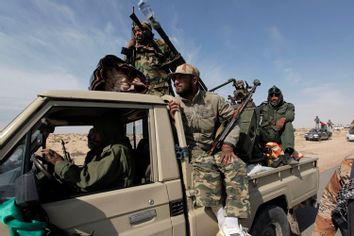
Libyan rebels head towards the front line outside the eastern town of Brega, Libya Friday, April 1, 2011 (Credit: AP)
GlobalPost correspondent James Foley spent 44 days in captivity inside Moammar Gadhafi's Libya. This first chapter of his story originally appeared on GlobalPost. For the full series, click here.

There is a single main highway along which lies every major city between the rebel stronghold of Benghazi in the east and the capital Tripoli in the west. It snakes along the coast and passes through Ajdabiya, Brega, Sirte and Misrata, cities made world famous by months of back and forth, and deadly, conflict.

Global Post
The four of us were riding in the back of a blazing red minibus at the beginning of April, approaching the strategic oil town of Brega, where the worst fighting of the conflict had been taking place. Our driver was a teenage boy, like his friend in the passenger’s seat. The so-called front in this war was always changing. But we had already passed the last rebel checkpoint and we knew whatever front existed was beginning to reveal itself.

Our goal was to learn, and then report, who was in control of Brega.

We were getting nervous. We knew the boys driving were scouting the road ahead, and maybe on their own initiative. Anton, the most experienced journalist in the group, mumbled something about it being risky. We could feel our guts begin to tighten. Manu and I looked at each other. But said nothing.

Two armed trucks raced toward us from behind, filling up our back window before soaring past. This was how the rebel convoys seemed to form, like schools of fish that hunted together, but have no clear leader or command structure.

Over a small hill we saw some men, boys really, standing around a sedan. We leaped out to do some interviews. Clare asked how far away Gadhafi’s forces were. The boy said 300 meters. 300 meters? I looked at Clare. It seemed impossible. But as a precaution, we hustled off to the side of the road. A static mortar or a rocket position could have easily dialed in on us from that distance. The small convoy rolled ahead, leaving us behind in what we thought was relative safety.

We watched the rebels push forward. They weren’t 200 meters away, at the rise of the next hill, when they sped back around. We watched for a second as they beared back down on us, followed by a barrage of machine gun fire. The loudest I had ever heard. Our small group of journalists — Anton, Clare, my fellow American, and Manu, a Spanish photographer — took off running.

“We need to get to the vehicles,” Anton shouted. But the rebel trucks were retreating too fast and the ones in pursuit were firing wildly. There were two Gadhafi military pickups — tan with large machine guns mounted on the back. The trucks were overflowing with armed men.

With all the bullets flying, we pressed ourselves as close to the ground as possible. The rebels faded into the distance and the Gadhafi trucks slowed to a stop. The shooting continued. The roar of bullets overhead sounded like machines eating up metal. AK-47 rounds ripped past us from less than 50 meters.

Libya: Tripoli scenes from the uprising:

I crawled back toward Clare and Manu, who were under several small trees. The shooting intensified. We tried to speak, to yell for each other. But the bullets tearing overhead deafened everything. In a corner of my mind I hoped that we were in a cross fire, that behind us the rebels were shooting back. I crawled forward toward a larger sand dune with my camera rolling. Anton crouched in front of me. The bullets streamed directly over my helmet and shoulders. This was no crossfire. They were shooting at us, and they were shooting to kill.

“Help, help,” I heard Anton cry. His voice was weak. My mind tried to convince me of something I knew was not true. Maybe he had just fallen and twisted something. Another barrage of bullets passed over me. “Anton, are you OK?” I shouted between bursts of fire.

“No,” he said, in a much weaker voice.

****

I’ve heard journalists say that Libya was the perfect war. A reporter could get to the front line, close enough to hear the shells coming in, and back to a comfortable hotel in Benghazi, with a solid Internet connection, by evening.

But in reality, this war was anything but perfect — something I’d soon come to learn. It was a war led by confusion, abductions and an oppressive sense of the unknown. This latest spasm of the Arab Spring had none of the idealism of Tunis or Cairo. For me, it began with a rifle butt to he head, which bled into weeks of uncertainty, crushing captivity and ended, however improbably, in a four-star hotel in the besieged Libyan capital.

Along the way, between blindfolds and quiet conversations with fellow captives deep inside the country’s brutal prison system, I witnessed the last gasps of the Gadhafi regime — a corrupt and corrupted system that for more than 40 years ruled this tribal, oil-rich land.

I had done several tours as an embedded reporter with U.S. troops in Iraq and Afghanistan. So, for me, the frontlines felt natural. And I believed it was my job. But the freedom with which you could maneuver was deceptive. There was no highly-trained U.S. platoon to escort you. And the rebels were said to be some of the worst trained soldiers in the world. Most had never held a gun before the end of February, when they stormed Benghazi’s “katiba” and took them by force.

I tried to hold farther back after a few close calls — a near miss by a Girad rocket, for instance, or a tank shell ripping over the heads of Manu and I outside Ajadibya. Our ears popped. But the front kept calling.

As is common among freelancers, Clare Gillis, a 34-year-old from Connecticut, Manu Brabo, a 29-year-old from Gijon, Spain, and myself had been sharing rides and interviews together for several weeks. Anton Hammerl, a South African photographer who covered much of Africa — from the townships during Apartheid to child soldiers in the Congo — came late to our little group.

With all the rebel offensives and retreats along the coastal highway, we felt we had to get to the front every few days or risk completely losing track of the story. So on April 5, we headed out.

Our plan was to try to get a sense of who was really controlling Brega, a strategic oil town that had been the scene of some of the most deadly fighting since the uprising began several months earlier. A rebel general told us that if the rebels took Brega, they would hold it without advancing right away, thus learning from earlier mistakes where they stretched themselves too thin and were forced into whole scale retreats.

But Brega was dangerous. Manu and I had been caught in heavy shelling outside the town days before. I had seen two shells bounce off the ground a hundred meters away. A rebel was killed by shrapnel to the head in the truck Manu and I had leaped into for escape. We went with them to the hospital, hugged the bawling comrades afterwards and shot some eerie photos of them washing blood off their grenades.

Still, Brega was where the front was, so we woke up early to beat the crush of reporters. The four of us went in a Mercedes van piloted by a teen. We stopped at the only manned checkpoint some 20 kilometers outside town, where a crowd of the usual disheveled men, many of them teens, milled about waiting for the real fighters to assemble. We got out into the early sunshine and told our driver he could leave us there. It was just after 10 a.m.

We waited. Usually, with shouts of “Allah Akbar,” a convoy would push ahead, and we’d jump into one of the rebel vehicles heading to the front.

The red minibus started moving and we hustled on. It drove ahead with us as its only passengers, the young driver and his friend in front looked nervously from side to side. We stopped after a kilometer to inspect two smoldering pickup trucks, blackened crisps in the road. It appeared to have been a rebel ambush.

“Hit by a Sam 7,” Anton said pointing out the expended launcher and wire guidance system leading to the cindered vehicles. I took note of his wealth of knowledge. He’d been forced to join the South African infantry as a young man and hadn’t relished it.

****

The firing continued all around us. The men had gotten out of their vehicles and were now approaching. “Anton!” I shouted again. He was silent. The terrifying reality grabbed hold of me. The soldiers firing probably didn’t know that we were reporters. Rebels didn’t dress in regular uniforms and many were often not even armed. I had to surrender or we’d all be gunned down.

I leaped up from where my head had been buried in the sand to face the group of wild men shooting uncontrollably — it seemed our only hope. I held up my hands and yelled, “Sahafa! Sahafa!” It was one of the few Arabic words I knew. It means “journalist.” I walked slowly toward them.

There were three or four skinny, Arab-looking soldiers carrying AK-47s and a larger, darker one to the right. My eyes drifted toward Anton as I stumbled past the dune ahead of me. He was lying face down in the sand, his body askew, cameras still strapped around his shoulders, his legs splayed out.

As soon as I reached the soldiers, the dark one slammed me across the chin with the butt end of his AK-47. I dropped my camera. He smashed his rifle down on my head. My helmet and Oakley sunglasses were thrown off and he punched me in the eye. Another one crushed my head several more times with an AK-47. All my instincts for self-preservation gathered within me. I went completely limp and complacent. The adrenaline was coursing so heavily through my body. I felt no pain.

I was thrown into the back of one of the pickup trucks. An Army boot pushed my face onto the floor. I glanced back and saw Manu and Clare being pulled off the ground.

A crazed looking soldier looked down and jeered at me in English, “You go on patrol! You go on patrol!” as if he knew exactly what we’d been trying to do. A cell phone was pushed close to my face. A picture was snapped. “Gadhafi Meia Meia,” a younger one said, thumping his chest, “Gadhafi 100 percent.” These words terrified me. After weeks of being with rebels who said things like, “Fuck Gadhafi,” with regular consistency, we had now found ourselves with the other side, the ones who had pledged their dying allegiance to the country’s dictatorial leader of more than four decades.

Clare and Manu were also forced down into the bed of the truck. Manu was face down and Clare, pushed against his side, was facing me. I looked at her for the first time. She had a purpled eye. She saw blood running from my scalp.

“Jim, are you OK?” she said, pleadingly. I nodded, and took stock of the blood pooling in the back of the truck. With a boot again on my face, my hands were bound behind me with a plastic cord. We sped away from the scene.

You can read Part 2 of James Foley’s story here.

Continue Reading Close

Eyewitness recounts Gadhafi’s death

Rebel fighter claims to have witnessed the Libyan dictator's final moments

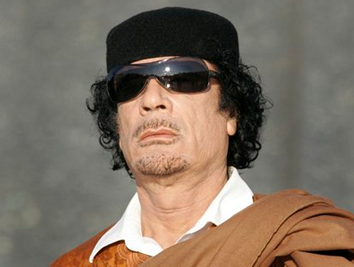
(Credit: AP Photo/Sergei Grits, File)
This article originally appeared on GlobalPost.

SIRTE, Libya — Imad Moustaf, a rebel fighter, said he witnessed the capture and killing of toppled Libya leader Moammar Gadhafi Thursday in Sirte, the ruler’s hometown.

Global Post

Moustaf said Gadhafi had been shot in the head and close to the heart on the outskirts of the western roundabout of Sirte, where he was hiding in a hole surrounded by bodyguards. Moustaf claimed to have been in the ambulance with Gadhafi when he died. The BBC, who spoke to another Libyan rebel, also reported that Gadhafi had been hiding in a hole. The BBC also reported that Gadhafi yelled, “Don’t shoot,” before he was killed.

Other rebel fighters said that Gadhafi’s body, along with dozens of loyalist prisoners, was being taken to Misrata.

Motassim Gadhafi, the fifth son of Gadhafi and a Libyan Army officer who is believed to have been directing the final stand in Sirte, was also confirmed dead. His body was seen at a local field hospital.

Libya’s interim government confirmed Thursday that Gadhafi was killed as well.

“A new Libya is born today,” Mahmoud Shammam, the chief spokesman of the Transitional National Council, said Thursday as reported by The New York Times. “This is the day of real liberation. We were serious about giving him a fair trial. It seems God has some other wish.”

A rebel military official in Tripoli later confirmed to Al Jazeera that the rebels had captured and killed Gadhafi but did not release further details about his death. The U.S. State Department has yet to confirm Gadhafi’s death.

Libyan rebels first took arms in February after a popular protest movement gripped the eastern part of the country. The conflict was largely a stalemate until NATO forces began flying sorties over the country in late March. Although the capital of Tripoli fell last month, loyalist soldiers holed up in Sirte, Gadhafi’s hometown, had been making a last stand for several weeks until Thursday morning, when rebel forces finally gained control of the entire city.

Continue Reading Close

Inside Libya’s most notorious prison

How a 1996 massacre at Tripoli's Abu Salim sparked the nation's current uprising

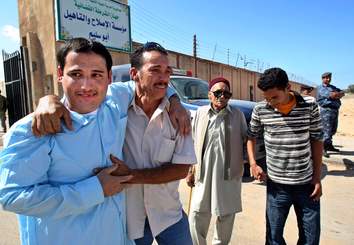
A former Libyan prisoner, left, is greeted by his relatives after being released from Abu Salim in Tripoli, Libya, Thursday, Oct. 15, 2009

TRIPOLI, Libya — “Welcome to hell,” a Libyan prison guard told several new inmates. “This is Abu Salim.”

The words sent chills through Dr. Ahmed’s already badly beaten body. He had been helping an Al Jazeera reporting team in March, during the early days of the Libya uprising, when forces loyal to Muammar Gaddafi surrounded the western city of Zawiya, capturing him and his colleagues.

After days of interrogations and torture, he was dropped under the cover of darkness in a large prison outside Tripoli known as Abu Salim. It was there, 15 years ago, that a now infamous massacre of political prisoners took place, an event that would ultimately lead to the open revolt that is now gripping the country.

It was 1996. Prisoners at Abu Salim began to riot over poor prison conditions. In response, the Gaddafi regime said it would send negotiators. Instead, it sent in a firing squad and systematically gunned down 1,200 people.

Hussein Al-Madni, 38, was there at the time.

He had been arrested for his involvement in political Islam — a movement Gaddafi long perceived as a threat to his rule — and imprisoned at Abu Salim in 1995, along with his twin brother Hassan, whose only offense was having a similar name.

Hassan was jailed in the wing where the riot took place and was taken out to the square with the others that day.

“After lining them up in a row, the soldiers used AKs and RPGs on them. Everyone was killed in one hour and 45 minutes,” Al-Madni said in an interview with GlobalPost from his home in Benghazi. “They killed adolescents, education professionals, community leaders.”

Although he knew what happened to his twin brother, many other families were left in the dark. Authorities quietly buried the bodies under the prison and the prison guards acted for years as if the captives were still alive when families came to deliver food and clothes.

In 1989, Libyan internal police came to the pharmacy where Ramadan Osman, 22, had been working. They arrested him on charges of being a Muslim fundamentalist. The family learned of his arrest when a colleague dropped off the keys to the pharmacy that evening, according to his brother, Osman Faraj Osman.

The Osman family tried to visit Ramadan many times at Abu Salim. They brought care packages but never saw him face to face, and never spoke to him on the phone. After word began to leak about the massacre, Osman had a feeling his brother was dead.

The families of those killed hail mostly from the eastern city of Benghazi, what has now become the rebel capital. Frustrated by a lack of information regarding their loved ones, a group of 30 families filed a complaint in a Libyan civil court in 2007.

In 2008, in an unprecedented action, the relatives began to gather each Saturday in front of the Benghazi courthouse to demand answers.

It was these protests that laid the groundwork for the rebel movement that is now, aided by NATO, fighting Gaddafi forces and pushing toward Tripoli, the capital.

The Libyan government, anxious to rehabilitate its international image and end its longstanding diplomatic isolation, attempted to appease the families, issuing death certificates and compensation.

“After 15 years, the system just gave us a paper,” Al-Madni said. “To us, this document indicated your son or brother has no value.”

“We demanded the bodies and punishment of those responsible,” Osman said. “They offered a compensation of 200,000 dinars. We considered it a bribe to be silent.”

During the protests they held signs that read, “Subject: Collective execution, Location: Abu Salim, date: 29-6-1996.” Some carried framed photos of their missing. A girl carried a homemade poster that said, “My father, what happened to him?”

The collective call for answers began to breathe new life into the shattered families.

“We felt we broke the barrier of fear against the system,” Osman said. “I felt I refreshed the remembrance of my brother.”

The Libyan government began to photograph them during the protests and secret police followed them home. A handful were arrested and detained for days at a time. In detention, they were asked to sign a document saying they had received compensation.

“They said, just accept this money. But we refused to put our signatures to it,” said Mohammed Gouba, whose brother was also killed at Abu Salim.

In February, Fathi Terbil, a lawyer for the first Abu Salim families to come forward, was arrested, sparking one the largest public demonstrations in more than four decades. Hundreds joined protests in Benghazi demanding the lawyer’s release.

Terbil was eventually released, but the demonstrations didn’t stop. Instead, they grew, and began to demand an end to the Gaddafi regime altogether.

It was the beginning of a full-scale revolution.

“Our group was the first group to demand the rights for those without voices,” Al-Madni said. “You can say we were the spark for all this.”

According to former prisoners at Abu Salim, things have not changed.

When Dr. Ahmed arrived in March, he was placed in a solitary cell with no windows and given just enough bread and water to stay alive. Guards would summon him at all hours for interrogations, during which he was tortured — electrical shocks from a charged cattle prod applied to his head and groin, repeated blows to the head and whippings across his back with rubber hoses.

His experiences aren’t that different from the events that made Abu Salim internationally known, except he survived.

“There are 1,200 prisoners buried underneath you,” the guard told Dr. Ahmed upon his arrival. “So don’t even hope for escape.”

Dr. Ahmed was tortured so badly at Abu Salim that he cannot hear out of one ear and his teeth are ruined. He said he prayed as much as he could while in solitary confinement.

“That was all there was to do,” he said. “Your life was in God’s hands. I’d certainly bet Abu Salim is worse than Guantanamo.”

On his last night at Abu Salim, they brought him out of his cell and made him kneel outside in the darkness. He heard other prisoners kneeling beside him. They waited. He heard steps behind him and the charging of a rifle. Two AK-47 bullets rang past his ear.

The mock execution was his send off to another prison — Al Jadida, where treatment in communal cells much improved and he told GlobalPost this account.

In Al Jadida he reunited with other Abu Salim veterans, who cried for joy thinking he had been executed that night.

Dr. Ahmed was eventually freed and has left Libya for his own safety.

Abu Salim remains.

Continue Reading Close
www.salon.com/writer/james_foley/index.html