CHAME, Nepal – In a dim, dusty stockade in this small Himalayan town, Krishna Lama contemplated his ruined life – a dead father, a college career cut short and criminal charges, all because of a potent fungus that promises the vigor of youth and sexual prowess for men.
A devout Buddhist, Lama was a 20-year-old college student home on holiday in 2009, when he was compelled to join a posse protecting the lucrative fields near his home village of Nar, at altitude 13,450 feet and a steep two-day trek from the Annapurna trail in the Manang district.
What ensued was one of Nepal’s most gruesome mass killings – over the fungus called yarsagumba.
Fearing their fields had been poached by interloping yarsagumba pickers from Gorkha, a mob from Nar beat two men to death and threw their bodies into a deep crevasse. They rounded up the five other men and savagely beat them to death with sticks and stones. To conceal their crime, they cut the corpses into small pieces, wrapped them in plastic and threw them into a glacial torrent. The killers, 65 men and boys, swore an oath never to tell anyone what happened, not even their wives.
“Yarsagumba brings a curse,” Lama said. “Our entire village has had to suffer. Even my father had to face that fate.”
Two years before the massacre, Lama’s father had died. He, too, was beaten to death with sticks, though the exact circumstances of his murder remain unclear.
Lama’s story – that he was among the last to arrive on the scene and didn’t witness the killings – is corroborated by police, but as he awaited trial, he had no idea whether the court would accept his version of events or if it would be enough to get him acquitted.
The murders have torn the tiny village apart. Interviews with several of the accused in their stockade in Chame and their families in Nar reveal that they are more fearful of the punishment of their souls in the afterlife than of any judgment meted out by a court of law.
“I am cursed,” Lama said. “I have no hope.”
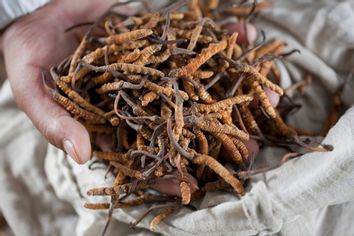
Lama’s story is just one from a gold rush in the Himalayas. Fortunes are being made – and lives are being ruined – not over gleaming metal nuggets, but in the reckless pursuit of yarsagumba. A rare hybrid of caterpillar and mushroom that grows only in the high alpine meadows of Tibet, Nepal and India, it has been prescribed by traditional healers in Asia for centuries to treat lung and kidney diseases, build up bone marrow and stop hemorrhaging. But it is prized above all for its reputation as a powerful aphrodisiac, earning it the nickname “Himalayan Viagra.”
Yarsagumba – also known by its scientific name, Cordyceps sinesis – was unknown in the Western world until 1994, when two female Chinese athletes at the Asian Games in Hiroshima, Japan, set new world records for mid- and long-distance running.
The astonishing times they posted gave rise to suspicions that they were using illegal performance enhancers such as anabolic steroids, but post-race drug tests revealed no trace of illegal substances. The runners’ controversial coach, Ma Junren, told foreign reporters that the women got their championship edge from daily doses of Cordyceps.
Thus began the yarsagumba boom. It is difficult to find an accurate estimate of the total production of yarsagumba, owing to the high degree of cross-border smuggling to avoid paying taxes and bribes. But according to Daniel Winkler, a botanist specializing in the fungus, it quickly has become the most expensive herbal remedy in traditional Chinese medicine.
Winkler estimates the annual yarsagumba harvest at between 85 and 185 tons, and in some areas, the crop represents the most significant source of income for residents, even greater than mining and industrial production. One official in Tibet’s Dengqen County estimated that 37,000 of the area’s 60,000 inhabitants had participated in fungus collection, Winkler reported in a recent scholarly journal.
“Among the wealthy and powerful in China,” Winkler wrote, “Cordyceps has come to rival French champagne as a status symbol at dinner parties or as a prestigious gift.”
The explosive growth in the yarsagumba market beggars the most extravagant superlatives: In 1992, a pound of the stuff sold for $3; today, the same quantity retails for around $9,400.
Nathan Lee, an apothecary in Hong Kong, said he has customers who spend thousands of dollars a month for daily doses of yarsagumba. “They give their children three to seven pieces a day, to promote good health and help them study,” he said. “They mix it with their breakfast cereal.”
The lucrative trade in the mushroom has transformed the economy of the Himalaya region. An ancient, yak-based culture that survived for centuries in one of the most extreme environments on earth is now unraveling in a tragic collision with the global marketplace.
Tibet is the main source of Cordyceps, but the trade may be having its most profound impact on Nepal, where extreme poverty and decades of political instability have led to deepening social entropy.
Rural economies, which had largely converted to tourism in the early 1990s, languished with the steep decline in foreign arrivals after a Maoist insurgency provoked civil war in 1996. That sent adventurous herb hunters into new terrain in search of the golden mushroom.
Harvesting the exotic fungus
Yarsagumba is the result of a bizarre parasitic relationship between fungus and insect. Spores of the Cordyceps mushroom invade and consume the larvae of the Himalayan bat moth, which live underground at altitudes of 10,000 to 16,000 feet for as long as five years, feeding on roots before they commence their metamorphosis into moths.
After the fungal spores have killed and mummified the larvae, they send up a spindly brown stem, a tiny knob-headed mushroom – and then they are very likely to be picked.
There have been many attempts to farm yarsagumba, but none has ever succeeded. The only way the precious fungus can grow is by the fortuitous concurrence of spore and larva in alpine atmospheric conditions – and brave collectors must be willing to risk their lives to collect it.
On a visit to the Annapurna district of Nepal during the midsummer weeks of the prime harvest season, ancient villages stood nearly deserted as most of the able-bodied population headed up to the picking fields. Schools shut down as students dropped out en masse – with the teachers themselves joining in the rush to find instant wealth.
Some 300 men and women, mostly from the Gorkha and Dhading districts, converged on a spectacularly picturesque place called Ice Lake, surrounded by snow-mantled mountains, more than 13,000 feet above the Annapurna trekking trail. Ice Lake is a relatively new collecting site.
“The collection of yarsagumba around here began eight years ago,” explains Karma Gurung, the 27-year-old manager of a tourist guesthouse in the village of Braga. “Before that, the yaks got it all. A few local people noticed that the yaks up on the mountainside were more active and started collecting it, but it was still small scale. Now, 90 percent of the people collect yarsagumba.”
The pickers, ranging in age from 15 to 40, with the majority males in their teens and early 20s, set up a temporary tent town as the base for their fungal prospecting.
Few of the collectors were well off enough to bring a proper tent; for most of them, sheets of industrial plastic anchored by rocks would serve as their home for the six to eight weeks of the harvest season. They rose at first light in near-freezing temperatures and ate rice, dal and boiled stinging nettles. By 8 a.m., they were climbing the steep incline to the yarsagumba fields.
The collectors spend much of their day on all fours, crawling over the sparsely vegetated plain for a close view. An American visitor spent a good 15 minutes staring intently at a few square feet of turf and saw nothing; then a young man wearing a Chicago Bulls hoodie came to his side and pointed out the tiny stem of a mushroom and carefully excavated it with a spoon.
Once the wrinkly caterpillar carcass was extracted, the man, Padam Bahadur, cleaned away the clinging bits of earth with a toothbrush. The best collectors at Ice Lake might get a dozen to 15 pieces in the course of the day.
At day’s end, having eaten nothing since breakfast except a few dry crackers, the exhausted collectors straggled back to camp. As they neared the settlement, they spotted an itinerant herb dealer coming their way.
A compactly built man in his 30s, Prem Ashok sat on his haunches as the prospectors gathered around him to sell the week’s harvest. Each collector waited in turn as Ashok expertly assayed their haul, wrapped up in paper sacks or instant-noodle packages. Ashok gave them a quick glance, an expert sniff and squeeze.
After rejecting broken or rotten pieces and sorting the ones he wanted to buy according to size and freshness, he paid the collectors from a fat wad of bills in his knapsack.
It was all over quickly. Bahadur was paid 21,000 rupees for a week’s harvest, nearly $300. A hard-working yarsagumba picker can earn as much 200,000 rupees, about $2,500, or more in a season – this in a country where the average annual income by some measures is just $500.
“Some of the collectors use the money to pay for school or give it to their parents to start a little shop,” Bahadur said.Yet he conceded that many young collectors take their money to Katmandu and go on a spree – like gold prospectors everywhere. As the sun set, the collectors were too tired to celebrate their payday. After another meal of rice, dal and nettles, with a pot of boiled potatoes, they relaxed around the fire singing and telling stories until they crept into their makeshift tents to sleep.
Pickers face harsh environment, greed
The camp at Ice Lake shows the yarsagumba boom in Nepal at its most beneficial, a peaceable group of poor people literally scratching a good living from the earth.
Yet it is hard, dangerous work. In 2010, 16 yarsagumba collectors were buried alive by a snowstorm in the Dolpo region while they slept at a camp like the one at Ice Lake.
In May, six yarsagumba pickers died after an avalanche at a high alpine lake called Surma Sarobar, in the Bajhang district. In the same week, a 25-year-old collector fell to his death from a cliff on Mount Churen Himal in western Nepal; the body of a 21-year-old collector who had succumbed to altitude sickness was discovered in the Mugu district. In June, three students in their teens were buried by another avalanche in Dolpo.
Yet the most notorious fatalities in the yarsagumba trade are the result of greed, at the hands of other collectors. In the grisly massacre that ensnared young Krishna Lama, the seven victims were murdered after they were found poaching.
On June 9, 2009, a herder from Nar who was searching for a lost yak spied the intruders from the neighboring Gorkha region, most of them still in their teens, sneaking into yarsagumba fields that were considered as being under the exclusive control of Nar. The herder ran to the village to spread the alarm.
The elders organized a posse to apprehend the poachers – or claim jumpers, in gold rush vernacular. By the communal law that rules rural Annapurna, one man from each of Nar’s 60 households was required to join in the defense of the village’s collective wealth. Because Lama’s father had been murdered two years before, the young man, as head of the household, was compelled to join the posse.
At dawn, a force of the fittest youth stormed the Gorkha camp and attacked the interlopers. The plan had been to capture the intruders, but the violence quickly got out of control.
The men from Nar kept their secret for a month. When relatives of the victims arrived at the Manang district capital of Chame and reported them missing, the police went to Nar and found the decomposing bodies of the two victims in the crevasse.
They arrested most of the adult male population of the village and marched them to Chame. It was the first violent crime to be reported in the district, and Chame did not have a jail; the district education office was converted to a stockade to confine the accused. Many of them were released on parole, but by midsummer of this year, 27 men were still awaiting trial, two years after they were charged.
In June, on the second anniversary of the massacre, the village of Nar postponed the start of the yarsagumba-collecting season to perform a weeklong puja, or purification ceremony.
All the residents who were able to read Tibetan, the language of their religion, convened in a lamasery to chant rituals seeking forgiveness for their collective crimes. A lama danced in a trance for hours, then led a boisterous parade of musicians banging drums and blowing on conchs to dispel evil influences, as the lama blessed the women of the village, who came out to kneel at the crossroads.
Finally, on Nov. 15, sentences were handed down by the court in Chame: The six men who committed the murders were given life imprisonment, and 13 more were convicted as accomplices and sentenced to time served. The rest – including Lama – were acquitted.
The Nar case is now closed, but it reveals the extent to which yarsagumba is entwined with every aspect of life in Nepal – including the nation’s chaotic political situation.
In the 1990s, the Maoist insurgency bankrolled its military operations with the burgeoning yarsagumba trade. And then in July 2009, after the accused murderers were confined in their improvised jail, a delegation from Gorkha descended on Chame, demanding restitution in cash. The Gorkha district is a Maoist stronghold, while the Manang district generally supports the Katmandu government.
They demanded compensation from the Annapurna Conservation Area Project, a quasi-governmental agency that charges foreigners to hike the Annapurna trail. According to Lal Prasad Gurung, director of the agency, the demonstrators grew rowdy and threatened the defendants’ lone lawyer with violence. Eventually, the Maoist-backed Gorkha families won their unprecedented claim for 1 million rupees, nearly $14,000, for each murder victim, which was paid in cash.
The shocking circumstances of the Nar massacre brought international scrutiny. Johan Olhagen, an observer from the United Nations Office of the High Commissioner for Human Rights, supported the defendants’ claim that “they were forced confessions;” while avoiding the word “torture,” he claimed that “the Nepali police were rough with the accused.”
Olhagen said the 36 defendants shared one lawyer, who was denied access to his clients until the case went to trial. The Brooklyn, N.Y.-based International Legal Foundation also sent a representative to Chame.
Since the Nar killings, the police have sent patrols to the collecting fields to avert violent disputes, yet reports of crimes in the highlands continue to emerge.
On June 18, a collector named Satya Raj Bohora was thrown from a cliff on Laki Mountain in the Bajhang district, murdered for his haul of the fungus. It’s impossible to assess accurately the scale of crime committed in rural districts. The Nar murders may have been the first to be reported to the police, but according to Karma Gurung, the guesthouse manager in Braga, “people were killed here before that for poaching yarsagumba, but it was kept secret. It was up to the village to impose justice.”
The perils of the yarsagumba business extend beyond the picking fields to every level of the trade. In July, a gang of bandits held up three herb traders at gunpoint and stole their seasonal take of 5 million rupees, about $70,000, and a large quantity of yarsagumba. Itinerant dealers like Ashok are forced to pay “tax,” a euphemism for a shake-down, to as many as 20 groups, mostly political parties and corrupt local officials in the districts through which the harvested fungus is transported. The trade in Cordyceps is legal, but permits are required at every level of bureaucracy, creating an ancillary gold mine of opportunities for corruption.
The United Communist Party of Nepal, the political arm of the Maoists, is a leading collector of illegal “donations.”
Nepal’s most wanted criminal is Kali Bahadur Kham, a member of the party’s central committee, who was charged with the 2008 torture and murder of a businessman in Koteshwor, a suburb of Katmandu.
In July, police raided Kham’s house in the capital, seizing “a huge cache of arms, cash and illegal yarsagumba,” according to police reports. In a viral video, Kham taunted the police and claimed, “The yarsagumba the police exposed to the media was legal, but they have destroyed the documents (in an attempt) to prove it illegal.” Kham remains at large.
Prem Namdu Lama, a wholesaler of herbal products, said: “Here in Katmandu, it is also dangerous to keep large quantities of yarsagumba at home.” At harvest time, he said, he hires young men with guns to protect him.
As reputation grows, so does demand
The aura of danger that surrounds the yarsagumba trade only adds to its golden glamor. The fabulous prices paid for the mushroom by wealthy consumers are the direct result of the most familiar principle in retail economics: rapidly rising demand and shrinking supply.
Beginning with the publicity arising from the performance of Chinese athletes on a yarsagumba regimen and continuing with international news reports about the Nar murders, the awareness of Cordyceps – and particularly its status as an aphrodisiac to boost male sexual performance – has raised the demand exponentially.
In the West, dietary supplements containing trace amounts of inferior-grade Cordyceps and Cordyceps extract have capitalized on the growing notoriety of yarsagumba. But these supplements do not have anything approaching the potency of the premium-grade fungus purveyed by traditional Chinese apothecaries. There are no restrictions on the importation of yarsagumba to the United States, as it has no psychoactive properties and no significant side effects.
The fungus’s reputation is powered by the anecdotal reports of consumers as much as by ancient tradition: In other words, it appears to work. And medical research has backed up claims for its efficacy. A study at Stanford University’s medical school found an increase of 17-ketosteroids in the urine of men taking daily doses of yarsagumba, which indicates an increased production of androgen and other sex hormones in the adrenal gland and testicles.
Controlled animal tests offer credible evidence that regular yarsagumba use decreases recovery time between orgasms and increases the volume of semen production. In another blind trial on human subjects, 65 percent of Cordyceps eaters reported an enhanced sex drive.
Yet despite local prospectors’ informal exploration of the Himalayas for new collecting fields, the available supply is steadily shrinking. Prem Namdu Lama estimated that the total harvest had declined 20 percent over the previous year. Some conservationists claim this is the result of overharvesting, though neither Cordyceps sinesis nor the moth host of yarsagumba appears to be in any danger of extinction.
Prem Namdu Lama believes that the contracting supply is the result of changes in the weather. “The reason for the decline is there was no snow, no rain,” he said. “If the snow falls, the yarsagumba will come back.”
I‘ve spent much of my time over the past 12 years traveling around Asia, but I didn’t take the plunge and find a place to live here until this year. In April, I signed a one-year lease on a house in Bali. Indonesia’s been in the news a bit more than one would like recently, but Bali, I am happy to report, has been blissfully dull. The biggest event on the island this year was the cremation of the last rajah of Gianyar, a massive, gaudy party with traffic jams that made the Santa Monica Freeway at 5 p.m. look like a country lane. There’s also a big kite contest going on at the moment, but I’m not here to tell you about Bali.
If you stay in Indonesia on a tourist visa, you must leave every 60 days to renew it. We pseudo-ex-pats call it a visa run. The most popular destination is Singapore, because it’s the closest and the cheapest, and you can buy all the good Western stuff they don’t sell in Bali. But on my last visa run, I decided to go to Hong Kong. I hadn’t been there since 1996, when everyone was in a bother about the imminent hand-over of the crown colony to China. There was ominous talk of a brain drain, the impending death of democracy and, worst of all, a decline in capital. Most of the scare talk came from the Brits; I vividly recall my guide, a well-educated Chinese woman in her mid-20s, telling me, “Even if things get worse, it will be better, because we will be with China again.”
I wanted to see for myself if things really were better or worse.
The most obvious difference this time was arriving at the new airport. No one who ever landed at Kai Tak, the old airport which closed to commercial airline traffic in 1998, will ever forget it: It was one of the most thrilling aeronautical experiences a civilian could have. The plane swooped out of the sky over Kowloon and dropped through the skyscrapers onto the single runway. Pilots had to undergo special training and licensing before they were permitted to land there. Once you were on the ground it was a terrible airport, virtually devoid of services and obviously too small for such a busy port.
The new airport at Chek Lap Kok, miles out of town on a patch of reclaimed land on Lantau Island, is everything a new airport should be, a vast ultra-modern palace of glass and steel, a smoothly functioning machine (once they got all the bugs out — the first few weeks were a disaster). But I missed Kai Tak. The new airport lacks character; it’s almost indistinguishable from the vast ultra-modern palace of glass and steel they built for the new airport in Kuala Lumpur. These new monster terminals in Asia have the same agenda as the cathedrals of medieval Europe: Make the visitor feel tiny and insignificant, and do a lot of walking.
There are a lot of interesting things to do in Hong Kong, but if you’ve been there before, the most enticing activities are shopping and eating. I’m not much of a shopper, though I did break down and buy a digital camera so I could send snapshots home. With a bit of haggling I beat the best price I could find in the U.S. by $50. However, I’m an expert eater, and there’s no better place in the world to do it. Hong Kongers are the foodiest people in Asia, with the possible exception of Tokyo. They love to eat out here, and they are as finicky as New Yorkers. If your shop’s noodles are too limp, or not limp enough, you’ll be out of business soon.
On my first few visits to Hong Kong, I explored the fabulous universe of Chinese food: Succulent Peking duck, delicate Cantonese, fiery Sichuan, rich Shanghainese, exotic Chiu Chow and that world unto itself, dim sum. It ruined Chinese food at home forever. But on this trip, it wasn’t Chinese food I was hankering after. The main advantage to living in Asia, as opposed to traveling here, is that you can eat at home. What’s more, you don’t have to be rich to have a maid who will cook it for you, and do the washing up after. I love Indonesian food — it’s rich, oily and spicy, like the food I grew up with in Texas. But every once in a while I get homesick for a steak, for real pasta, for something cooked in butter and smothered with a fancy sauce, served after the soup and before they bring the dessert menu.
That’s a problem throughout much of Asia — it’s just not in the culture. Families eat at home, and if they go out, it’s more for the fun of it than what we in the West rather dourly call “fine dining.” And generally, they want to eat the same food they would have at home. In Bangkok, the locals like to go out for Thai; in Jakarta, Indonesian food is amazingly popular. The restaurants serving foreign cuisines throughout most of the region exist almost entirely for foreigners, the tourists and ex-pat residents. There are hundreds of restaurants in Bali catering to the island’s visitors, but almost none of them measure up to even a casual international standard. A week before I left for Hong Kong I met an American friend for lunch at the Chedi, one of the swankiest hotels on the island. Salads and sandwiches with wine, dessert with coffee came to $85 for the two of us. The view of the rice fields was lovely, but the food was ordinary at best. In New York or San Francisco the place would be DOA.
Right, my story is about Hong Kong. It goes without saying that Chinese food is hugely popular here, since there’s no better food anywhere on earth (with the possible exception of a certain barbecue place in Port Arthur, Texas, but never mind). However, Hong Kongers aren’t only finicky, they’re cosmopolitan. If you go to a Spanish or an Italian restaurant and if the place is crowded, all the faces there may well be Chinese. So I decided to take a dumpling-free tour of Hong Kong, to try as many different cuisines as I could. It was only a four-day trip, so I didn’t get around to trying out any of the Russian, Scandinavian or British restaurants — but then, I never bother with them at home in New York, either.
My Indonesian buddy Rendy, who had never been to Hong Kong, came along for the ride. We stayed at the Harbour Plaza, a huge new hotel in Hung Hom, Kowloon. It’s a bit off the beaten track, but a nearby ferry offers regular service to Hong Kong Central, and the rooftop pool commands spectacular views. It’s also a bit goofy: When I arrived, the hotel had been transformed into a Caribbean theme park. A Jamaican steel drum band was playing in the lobby, next to a pile of sand with a dinghy perched atop, arrayed with caged parrots. The Chinese man at the reception desk, who was wearing a tropical-print shirt and a straw hat, informed me that the chain is opening a new property in Grand Cayman. It was the first theme experience in a trip that would prove to have a theme theme.
My priority was steak. A friend had told me that the signature restaurant at the Harbour Plaza, the Harbour Grill, had the best steaks in Hong Kong, so I made a reservation for dinner there as soon as we got to the room. The Harbour Grill, like most haute-cuisine restaurants in Asia, is posh to a degree that seems a bit quaint from a Western perspective: It’s furnished in fake French antiques, with lavish displays of fake flowers, dramatic spotlights and tuxedoed waiters who murmur. But there it was on the menu — “The Best Beef in Town.” The Harbour Plaza has an exclusive with Stock Yards Packing Co. of Chicago, which, the menu informed me, “has been supplying America’s most exclusive steak houses with steak for over 100 years. Their magnificent meat cuts are individually weighed, hand-trimmed and inspected before shipment. It is this careful attention to quality that makes their steaks so juicy and tender.”
Everything they said was true. My rib-eye steak was juicy and tender, and it could have been a textbook illustration of medium rare (even at some good restaurants in the States, I find, they think you really mean “medium” but are afraid of being uncool). It was served with a perfect biarnaise sauce, french fries, slightly underdone garden vegetables and Frank Sinatra’s greatest hits. It was everything a steak dinner should be, but I confess I was a bit disappointed. I eat steak rarely, but when I do, I find it’s like taking a secret puff on a cigarette when you’re quitting — the event never measures up to the expectation. It’s only a steak. We eat fish every day in Bali, and I had been thinking about that steak for weeks before the trip, but nonetheless I found myself eyeing Rendy’s Dover sole enviously.
Since it was his first visit to Hong Kong, we had to go to Victoria Peak to take in the spectacular view. The last time I was in Hong Kong, they had just begun to build a new viewing tower, and I was curious to see what it was like. Peak Tower is a massive titanium fortress, with a bizarrely shaped anvil-looking thing suspended above the viewing terrace. I’m afraid it had the same effect on me that the new airport had: The old terrace was just fine. The new tower justifies its existence by giving children a chance to wheedle their parents into taking them to Ripley’s Believe-It-or-Not and the Rise of the Dragon, “a spectacular ride that brings Hong Kong’s colorful past to life, designed by the creators of the ‘Jaws’ and ‘Earthquake’ rides at Universal Studios, USA.” Hooray. But it was a clear day, and the view had its usual effect on the jaw.
For lunch we had delicious tempura and cold buckwheat noodles at a Japanese restaurant called Yorohachi. I was trying to find a Mexican restaurant, which had apparently gone out of business, but when I saw three Japan Airlines stewardesses going into Yorohachi, we followed them. The restaurant is in a short, crooked street in Central called Lan Kwai Fong. Originally a strip of ex-pat gin mills, Lan Kwai Fong is now lined with chic, pricey restaurants representing every major cuisine in the world except Chinese, and they’re jammed with local office workers at lunchtime.
A competitor to Lan Kwai Fong has sprung up in Tsim Sha Tsui, Kowloon, on a little lane called Knutsford Terrace. We had dinner there at a restaurant called El Cid: Tasty anchovy toast and potato salad, followed by a delightful paella, with a pitcher of robust sangria. The decor was as kitschy as the name, and the strolling musicians played Mexican, not Spanish, music. In other words, it was like most Spanish restaurants everywhere in the world except Spain. There were a few Japanese tourists, but otherwise the place was full of Hong Kongers. Afterward we stopped off for a nightcap at a Bahama Mama’s, a Caribbean theme bar next to the restaurant, but it reminded me too much of the hotel, so we headed for Delaney’s. Walk in the door and you’re transported to a pub in Dublin, complete with whimsical, vintage Guinness posters. Delaney’s has recently reopened in a new location, but no effort was spared to make the place look authentic. The walls were even streaked with a golden wash, to simulate the patina of decades of cigarette smoke.
The most enjoyable culinary event of the trip was a visit to an entertainment restaurant called Igor’s. The theme is Hollywood horror: Cocktails in the King Tut bar (which, for some reason, has a boa constrictor hanging from the rafters), then a hokey haunted house populated by surly hunchbacks and ghouls and finally a medieval banqueting hall hung with gruesome portraits of vampires and witches. Before the show began, the M.C., an actor in Bela Lugosi get-up, asked the tourists to stand. There were a group of Japanese girls, a Singaporean family, an Australian couple, one Indonesian and one American. The other 100 or so customers were all locals.
Places like this are always more fun than I expect them to be. The show was a ridiculous rock musical borrowing liberally from “The Rocky Horror Picture Show,” which revolved around the insatiable sexual appetite of Vampira, who is courted by a blond knight of uncertain sexuality named Sir Wanksalot. His main attraction is his spiky, 2-foot-long bad thing, which looks like an overgrown armadillo. In the last act, he is transformed into Sir Elvis Wanksalot (complete with a fringed, white satin canopy for the hunk-o’ hunk-o’ burnin’ love). This is communism? How ironic that this bawdy pastiche of American entertainment is being performed in China for the Chinese. If it came to New York, Mayor Giuliani would probably shut it down as a danger to public morality.
The food was fine, though it put me off to see the roast beef and ham being carved on a plastic sculpture of a corpse. The theme should stop where the food begins. Hong Kong seems to be going theme-crazy. There’s another elaborate new entertainment restaurant called the Hong Kong Puzzle, where the theme is local history, but I decided against learning while I ate. Theme bars are springing up everywhere as well. There’s the Bruce Lee Cafe; the concept is camp, but at least it makes sense here. My favorite is a place tersely named the Sex Bar, which has museum displays of items such as a mechanical flogging device and a pair of masturbating machines, one for boys and one for girls. Don’t ask.
We also tried a disappointing Australian restaurant in Quarry Bay, and ate hamburgers that were actually bad. If that’s what you want, in Asia you’re better off at McDonald’s or Wendy’s than at high-priced places with names like “The Great American Hamburger Joint.” On a lazy hotel day I checked pasta off the list with an excellent mess of carbonara at the Harbour Plaza’s Italian restaurant/late-night pub. Dino’s has a Formula One racing theme, with a fake race car poised on a track in the middle of the dining room.
By the last day, all that cholesterol was taking its toll on my liver, which has grown accustomed to a diet of fish, fruit and rice, so I signed up for something called the Healthy Living Tour, which is given by the Hong Kong Tourist Association. The morning begins bright and early with a Qiqong martial arts class, complete with a recording of bamboo flute music on the boom box. Then we toured a famous Chinese traditional pharmacy called Eu Yan Sang, to see the thousand-dollar ginseng roots. After a midmorning snack of bird’s nest soup, we wandered through the Nam Pak Hong district, where they sell traditional medicaments such as dried seahorses and deer penises. It was a fascinating tour, and I recommend it.
Not least for the lunch, a special tonic menu at a place called the Treasure Inn, in the top floor of the Western Market, an Edwardian brick building over-restored as only the British know how to do it. Everything on the menu did something good for you: Lotus leaves to improve the circulation, lily bulbs to improve the eyesight. Or was it the other way around? Anyway, it was all good for the palate. You didn’t really think I would go to Hong Kong and not eat Chinese food, did you?
Continue Reading
Close
When you visit Australia’s two leading cities, Sydneysiders are always explaining to you that, as gracious and elegant as Melbourne is — well, it’s a bit dull, and their own city is Australia’s great metropolis. Meanwhile, Melbournians are quick to tell you that as big and brash and exciting as Sydney is, it’s really a bit vulgar, and theirs is the country’s classiest city. In certain ways, Sydney wins the contest hands down: The harbor is one of the most spectacular metropolitan sites in the world, on a par with Rio de Janeiro and San Francisco, and the city’s larger population enables it to support a more flourishing and diverse arts scene, symbolized by and headquartered in that fabulous opera house. But now the battlefield has moved on to the dinner table, and here Melbourne holds its own. With a population of 3 million, it has more than 4,000 restaurants, a considerably higher per-capita count than Sydney. In Melbourne, they’re even building a residential high-rise in which some of the apartments will not have kitchens.
On a recent visit Down Under, I appointed myself umpire and supreme arbiter in the culinary duel between Australia’s two great cities. There were no rules, except to eat and drink as much good food and wine as I could without endangering my health. I don’t want to create any false suspense, so I will tell you at the outset that as far as food and cooking goes, it was a tie: Virtually everything I ate was good, much of it was excellent, and there were a few unforgettable dishes. However, I will give Melbourne a slight edge in service. At even some of the best restaurants in Sydney, the service can be slow and amateurish. Some of this is cultural, of course: Australians view the restaurant experience as the evening’s entertainment, not something to be fitted in around the theater or a movie. And with the choices available to them, it easy to see why: For delicious foodstuffs and creative cookery, with a wide choice of complex, satisfying wines to accompany them, there’s no better place on earth right now than Australia.
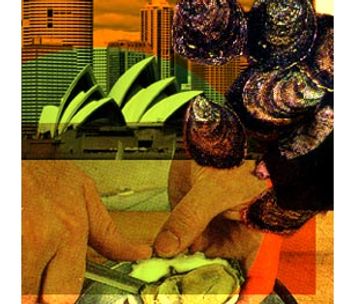
My Australian foodie friends carefully vetted my choice of restaurants, so I went to some of the best the continent has to offer. But not even the fanciest meal gave me more satisfaction than the half-dozen freshly shucked oysters I ate at a stand-up kiosk on an afternoon jaunt to Manly Beach, Sydney. A cool breeze was blowing, the antipodean springtime sun glinted warmly off the waves and the oysters were cold and briny, served just as I wanted them to be served, with a lemon wedge, black pepper and Tabasco sauce.
My first dinner in Melbourne was at Circa, in the newly renovated boutique hotel the Prince, in St. Kilda, a suburban seaside resort (imagine chic Coney Island, if you can). It was a spectacular meal: I started with ravioli stuffed with foie gras — I always order foie gras if it’s on the menu, it’s one of my little rules — and had for my main course a roast barramundi, a rich, white fish from local waters, which was garnished with seared scallops. It was all beautifully cooked, bright and alive with fresh flavor, and served expertly but without a big fuss. Yet it’s my breakfast there the next morning that I remember most vividly: This was just scrambled eggs, but they were the best scrambled eggs I have ever tasted, rich and satiny smooth and steaming hot.
In recent years, both Sydney and Melbourne have become home to large immigrant populations, so they abound with good neighborhood Vietnamese and Turkish joints. Eighty-six national cuisines are available in Australia — at least that’s what someone told me, but I’m not sure I could even name 86 countries — and none of them is more enticing than what is officially known as modern Australian, though it’s usually called Mod Oz. It’s like American cuisine, in that there’s really no such thing, not in the way that French or Chinese or Indian cookery is an integral part of the national identity and governed by ancient traditions. Yet — again, as with American cuisine — it is precisely this lack of tradition that permits Australian chefs to be so creative.
They’re certainly serious about their food. In Melbourne, one of the newspapers publishes a glossy, full-color, 268-page book called the “Good Food Guide,” devoted to the city’s restaurants — rather like Zagat’s, except written by restaurant critics, and not based on the opinions of people with nothing better to do in their leisure time than answer questionnaires. To give you an idea of just how serious they are about food in Australia, here’s what the “Good Food Guide” says about Circa: “Truly great restaurants, everywhere, transport. Like good cinema or literature, they take us out of ourselves to another, more pleasurable place, and leave a lingering glow of contentment. Circa is indisputably such a place.”
Nobody loves good food more than I do, but I have to say, the person who wrote that got carried away. Shopping for baking apples takes a connoisseur’s eye, and making a flaky pie dough is a skill that not everyone can master. But there has never been an apple pie that could take the place of “Leaves of Grass” or “A Touch of Evil.” I’m sorry, but food really isn’t art: Once you’ve eaten it, it’s gone forever. Remember “Ars longa, vita brevis”? Food is definitely vita.
Still, the anonymous reviewer did get one word right: pleasurable. Eating a truly great meal closely resembles another activity even more popular than reading or going to the movies, which gives intense pleasure and leaves you with a lingering glow of contentment. And if there’s any place where food gives sex a run for its money, it’s Oz. Here is my completely scientific and carefully researched list of favorite restaurants in Sydney and Melbourne, with the proviso that another list with a completely different set of names might be just as good.
Melbourne
Best food: Circa, at the Prince. It may lack Whitman’s metric inventiveness and Welles’ trenchant social observation, but it has a great wine list (2 Acland Street, St. Kilda, tel. 61 3 9534 5033).
Most fun: Radii. This place has almost everything I object to in a restaurant: The music is too loud, the outrageous post-modernist design bewilders the eye, the lighting is absurdly theatrical. The cliche of the open kitchen is multiplied here, with smoke plumes and leaping flames on one side, a baker decorating a cake on the other. (And what does that name mean? I thought I was through with radii after I took the SATs.)
But somehow it works. Maybe it’s because Radii wants you to be wowed so much that you would feel churlish if you didn’t oblige. More to the point, the food is spectacular: A truffled polenta with a poached egg and shaved parmigiano is as delicate and complex a dish as you will ever meet; squid baked in a wood oven with chorizo, or roasted swordfish accented with Moroccan spices and preserved lemon, as hearty as a matey slap on the back (1 Parliament Square, tel. 61 3 9224 1211).
Best service: Ezard, in the basement of small downtown Adelphi Hotel, has a mission: to rehabilitate the good name of fusion. Moroccan, Mediterranean and Chinese are here in good measure, and I’m sure if I looked harder, I would have found Lao and Peruvian. It also has a philosophy: Every dish contains ingredients with hot, sour, sweet and salty flavors. It’s more complicated than that, but by the time the chef was expounding it to me, my date and I had already finished a bottle of Delatite Dead Man’s Hill, a delightful Gewurtztraminer from Victoria state, and had started on the champagne the chef himself gave us, so I couldn’t really follow what he was saying.
But it must be a good philosophy because the food is wonderful: I had Japanese-style oyster shooters with mirin, wasabi, tamari and seaweed; a gratinee of potato gnocchi with blue cheese, shaved pear and toasted walnuts; and seven-spiced crispy-skin duck with wok-fried water spinach, Chinese mushrooms, burnt honey soy and sesame-chili oil dressing. I have enumerated all the ingredients in those dishes so that I can tell you that far from tasting as contrived as they might sound, in each case the combination of tastes seemed inevitable — complexity melded into a rich unity. The reason I cite Ezard for service is because it was the best I encountered on my entire visit, and the elegant dining room was very full, just a month after opening (187 Flinders Lane, tel. 61 3 9639 6811).
Coziest: Donovan’s. I had high hopes for this recommendation: It came from an Australian friend of Italian descent who, when I asked her for the best Italian restaurant in town, replied that she never went to any of them, because her mother was the best Italian cook in Melbourne. I couldn’t get in at my first choice one night, so she sent me here. Actually, Donovan’s was fully booked, too, but the man on the phone genially said, “Oh, come on, we’ll find a table for you.” I like an optimistic host.
To my dismay, Donovan’s turned out to be an American restaurant, probably the only cuisine I didn’t want to try in Australia. But it also turned out to a be a great recommendation. Donovan’s is decorated like a posh beach house in Malibu, with stuffed armchairs, floor lamps and family photographs on the walls, and a lovely view of the beach at St. Kilda. I deployed one of my favorite restaurant-critic tricks, and ordered the most unimaginative meal I could devise, what my father would order at a fancy restaurant in Houston 30 years ago when the family went out for dinner.
The Tasmanian oysters were divine (they’re only the best in the world), the Black Angus T-bone a cookbook illustration of medium rare, the fried potatoes so tasty I didn’t want to share and the little tossed salad just what it ought to be. As the sunset lingered over the bay, and the bombe Alaska came out, the atmosphere was so dense with romance I thought we had somehow blundered into a cologne advertisement (40 Jacka Boulevard, St. Kilda, tel. 61 3 9534 8221).
Sydney
Most famous: For most foodie pilgrims, Rockpool is the Mecca of Australian cuisine, the country’s Chez Panisse, the place where it all began. Candor compels me to admit I have never been to Rockpool: Whenever the subject comes up, whether in guidebooks or in conversation, the description always emphasizes how expensive it is and tells me to get dressed up. I don’t mind paying for good food, but I don’t like worrying about whether I’m dressed up enough (107 George Street, tel. 61 2 9252 1888).
Grooviest: Salt. When you first walk into this place, with its modular furniture and sleek, minimalist design, you think you’ve somehow stumbled into SoHo in the ’70s, or TriBeCa in the ’80s. Are you allowed to come here if you’re not wearing black and haven’t done something slightly odd to your hair? Salt is the epicenter of trendiness in Darlinghurst, Sydney’s trendiest neighborhood.
It’s also a great restaurant, unlike so many of its groovy counterparts in the States. A flawless margarita quickly made me realize that Australian attitude isn’t like the kind in New York, where some people need to be cool so badly they can’t have any fun. Everybody here was having a ball. The food is Mod Oz with a solid foundation in French technique, with an emphasis on unexpected harmonies: A starter of tuna two ways came robust, grilled and splashed with spiced yogurt, and delicate, raw with ginger and shallots, garnished with a light grilled eel salad. The roasted wild barramundi was rich and meaty, served with celeriac puree, zucchini and basil, accented with pinenuts and zesty currants. My only objection to Salt is that the tables are jammed so close to each other — though that did make for some great eavesdropping (229 Darlinghurst Road, 61 2 9332 2566).
Best service: Vault. Located in a restored Victorian bank building in the Rocks, the historic district at the mouth of the harbor, Vault is unapologetic about catering to power lunchers who want a hunk o’ meat (pot au feu with smoked bacon), but also offers some creative, lighter dishes: Tiger prawn salad with cucumber, lime and salmon roe was as ravishing to the palate as anything I tasted on my trip. A perfect brulee flavored with Australia’s delicious passionfruit (no point in searching for an analogy, it doesn’t taste like anything else), served on coconut dacquoise with passionfruit sauce, was superb. The restaurant occupies three floors and a small terrace, and though it was packed at lunchtime, the service was impeccable, professional and friendly (but not too friendly), the best I’ve ever encountered in Sydney (135 George Street, tel. 61 2 9247 1920).
Best people-watching: GPO. A lot of places claim to have something for everybody, but this food complex in the basement of the newly restored General Post Office, a red brick Victorian castle in the center of the city’s financial district, really does: everything from a stand-up espresso bar to a clubby steakhouse, and in between a retro-chic cocktail lounge, a raw bar, a sandwich shop, a stylish seafood bistro and sushi-on-a-conveyor-belt — not to mention a Dean & Delucca-style gourmet grocery, so you can shop for home on your way out. All the food outlets except the steakhouse are exposed to a street-level promenade, and at lunchtime there’s a great deal of gawking and neck-craning as office workers stream down the grand staircase to choose their restaurant du jour. At Post, the seafood bistro, I had a fresh, satisfying crab salad with citrus and a luscious hunk of salmon, simply presented yet anything but plain. The owner, Stan Sarris, calls it “good, honest seafood,” and that’s what it is (No. 1 Martin Place, tel. 61 2 9229 7744).
Continue Reading
Close
Singapore is the poor little rich girl of Asia: All dressed up in gleaming,
modern skyscrapers, she’ll house you in elegant hotels and feed you delicacies from one
of the world’s great culinary traditions — but nobody loves her. Mention
Singapore to most Americans, and you will hear about two things: caning and
chewing gum. Which gives about as complete a picture of the place as
saying that London is expensive and damp, or that everything in Rome is old
and crumbling. Well, yes, but …
Even the so-called experts are unkind. Articles about Singapore in
travel magazines always tell the same story: The repressive regime of Lee
Kuan Yew tore down the charming colonial city of Kipling, Conrad and
Somerset Maugham and built a plastic, squeaky-clean shopping mall. The
implication seems to be that if it’s not squalid, it’s not really Asia. Yes,
the government is repressive — but since when do we choose our travel destinations
based on the niceness of the governments? And since when do we require countries to remain primitive for our enjoyment?
I agree that there are far too many rules and regulations and that
caning criminals is a really lousy idea. But let’s look at the chewing-gum ban.
Yes, it’s true, chewing gum is illegal in Singapore. If gum-chewing is your primary leisure activity when you travel, you’d better go to Paraguay or Chad or some fun place like that. But as a longtime resident of New York who has stepped on his share of warm,
sticky wads of the stuff on subway platforms, I don’t think this is the worst
law in the world. It’s a ridiculous law, and I don’t say I approve of it, but
I don’t understand why people get so riled up. I mean, in China they make
women have abortions, and put Tibetan people in prison for believing in the
real Dalai Lama — what’s a chewing-gum law compared to that?
I’m being defensive, I know (actually a very Singaporean way to be).
You’d think I owned a stake in a hotel there. I don’t. I just happen to
believe that fair’s fair, and that Singapore has gotten an unfair rap. It’s like
Los Angeles: People who say they hate L.A., who tell you it’s bland and
boring, that there’s no there there and so forth, when pressed will usually
admit that they’ve never actually spent much time in that vigorous,
inexhaustible city. Just so with Singapore. If all you know about it is
that it has a lot of shopping malls and a law against chewing gum, then you
won’t be much inclined to visit. But you will be missing one of the most
sophisticated, fascinating cities in Asia — not to mention all that great
shopping.
First, an important snatch of history, essential to understanding the place:
Unlike the other great cities of Asia, Singapore is quite young, even by New
World standards. In 1819, when Stamford Raffles arrived at this small island, 26 miles across at its broadest point, which dangles like a pearl drop at the
tip of the Malay peninsula, there was no one living in its pestilential
swamps but a bunch of pirates and fishermen. He claimed it for the British
East India Co., and laid out the plan for a modern city. People who
complain that Singapore doesn’t look like Asia must take into account that,
unlike most cities in the region, which grew up higgledy-piggledy over
centuries, the basic design of Singapore — its wide boulevards and spacious
lawns and gardens — was created by a loyal subject of King George, a knight
of the realm (who had one of the coolest names of all time).
It was always a strange, hothouse hybrid, this English city populated by
Chinese, Malays and Indians. And while it’s true that a lot of the fine old
colonial architecture was torn down to make way for office towers and
shopping malls, much of it remains. It’s quite possible to put together a
four-day itinerary that consists entirely of places that would have been
known to Somerset Maugham, at least, if not to Kipling and Conrad. I know: I just did it.
I started with a Chinese morning. First, coffee at the Tiong Bahru coffee
shop, located in a district of low-rise art deco apartment buildings put up
by the British in the 1920s. The coffee is so-so, lightened with sickly
sweet condensed milk, but the music is lovely: Early in the morning, Chinese
men come here from all over the city with their birds, which they hang in the
open air for singing contests. There are two leagues, the tiny mata puteh,
“white eyes,” in exquisite bamboo-and-ivory cages, and the larger, thatched
bulbuls. Most of the bird owners are old guys, dressed in standard old-Chinese-guy attire — baggy T-shirt, baggy shorts and sling-back sandals
with black nylon stretch socks pulled up to the knees. There were a few
younger men there, too. One of them told me, “The birds love to compete. It’s
in their nature. They all want to be the best.” I was about to ask him how
they can judge which birds sing the best when there are a hundred of them
all warbling away at the same time, but then his cell phone rang, putting an
end to the conversation.
I wandered across the road to have a look at a little Taoist temple. There
was nothing special about it — incense burning in great brass urns, oranges
and little cups of tea set out as offerings, as usual. A small, crude statue
of the god of fortune had a smear of raw opium across his mouth, to keep him
happy. (So much for the famous mandatory death sentence for
drug trafficking.) There were two people worshipping there, an old Chinese
woman about four feet tall and a glamorous Indian woman wearing a purple
silk sari. There was no doubt she was Hindu; she had a fresh spot of crimson
on her forehead. After she left, I asked the caretaker about that. Why would
a Hindu come to pray at a Taoist temple? The old man shrugged. “Today
Saturday. Horse races today.” Paths are many; payoff is one.
Then I headed out to the East Coast Road, on the outskirts of town, for
breakfast. When people ask me what my favorite restaurant in Singapore is, I
always say the Chin Mee Chin Confectionery. It’s a pretentious choice, really
– the Chin Mee Chin is a crowded, un-air-conditioned hole in the wall. There
are a hundred better restaurants in Singapore, but not one of them has better
kaya. Kaya is something really divine, a kind of custard jam made from
coconut milk, egg yolks and sugar, flavored with the pandanus, the leaf of
the screwpine, which has a mild taste rather like vanilla. Kaya is the Malay
word for rich, and it is. Most coffee shops in Singapore serve canned kaya,
but the Chin Mee Chin makes its own, boiling away in tin vats. It’s served on
freshly baked soft buns, with a slab, not a pat, of butter, and a soft-boiled
egg dashed with salty soy sauce on the side. You’ll want a second round, but
be prepared to trundle your liver away in a wheelbarrow.
Nowhere in Asia can you find food like the food in Singapore. It’s not that it’s
necessarily better than everywhere else — it would be lunacy to say that any
place on earth has better food than Hong Kong — but for variety and
consistently high quality, it’s on a par with San Francisco and New York, and
I can’t think of any praise more glorious than that. Singapore likes to call
itself the multicultural city — not exactly a snappy nickname, but it has
the virtue of being accurate. In Hong Kong what you eat is great Chinese, in
Jakarta great satay, in Bombay great curry, in Malacca great nonya food. When
you go to Singapore, you get all of these, and every bit as authentic. There are
also sizable Thai and Korean communities, so there’s excellent tom yum and
Korean barbecue as well. After a few days in Singapore, you will begin to run
out of interesting places to visit, but you won’t run out of great restaurants.
After my Chinese morning, I spent the day in Little India, shopping for lurid
posters of Hindu gods and goddesses, dolls (Barbie in a sari) and fragrant
yellow mangoes imported from Madras. I visited the Abdul Gaffoor Mosque, a
fabulous Victorian Moorish fantasy, like a miniature Indian train station
painted in popsicle colors. I wandered through the spice market, the
betel-chewer’s accessory shop and the goldsmiths’ row, but it was basically just
killing time until I could decently stop for — lunch: fiery fish-head curry
at the Banana Leaf Apollo, the most famous in a strip of banana-leaf
restaurants (so called because the food is served not on a plate but on a
fresh clean leaf, cut into an oval). Once you get used to the idea of your
lunch looking at you, the curry is astonishingly delicious.
I could tell you about my stroll through the Singapore Botanic Garden, possibly
Raffles’ most beautiful brainchild, laid out in elegant Regency style, with
outstanding collections of orchids, gingers and palms. Or my visit to the
history museum, a stately Victorian dowager, trimly restored and filled with
jade and porcelain and neat little dioramas of scenes from Singapore’s
history. Or my sunset cruise down the Singapore River on a bumboat (I asked
why it’s called that, but got only lame jokes for my trouble), to get
a close-up look at those much-maligned skyscrapers. Some of them are pretty
cool, actually. But I see no reason not to move straight ahead to dinner: I
chose the Blue Ginger, which was my favorite restaurant in Singapore until I
discovered the Chin Mee Chin.
“Nonya” seems to be the name that has caught on in the United States, but
here they call this piquant hybrid of Chinese and Malay cuisine either
Peranakan or Straits Chinese. I visited the Blue Ginger when it first opened
a few years ago, and had the exciting experience (increasingly rare as one
logs more mileage) of tasting something completely different. The dish was
ayam buah keluak: “ayam” is chicken, and “buah keluak” is translated on the
menu as “Indonesian black nut.” The nut, the size of a big chestnut, is
poisonous when it’s still on the tree, so it must be buried in ash for a long
time, and then soaked in water for a few days before it’s used.
The flavor is — well, it’s not like anything you’ve ever tasted. The first time I tried it
I thought it tasted a bit like Mexican molé, spicy and chocolatey at the same
time, but it’s not, really. The cooked nut is hollowed out, and the core is
ground into a paste and then stuffed back into the nut. The dish is served
with tiny teaspoons for scooping out the buah keluak, which is smeared on a
bite of chicken with a drop of chili sauce. Once you’ve tasted it, you’ll
never forget it.
I gave my Singaporean friend the menu, because I knew she would order way too
much: Besides ayam buah keluak, we feasted on pork stewed with cinnamon bark,
prawns sautied in coarse black pepper, squid simmered in tamarind gravy
flavored with lemongrass. Plus fried dumplings. And crab soup. For dessert we
had chendol, an extravagant creation of red beans and weird little
bright-green slivers of jelly, topped with crushed ice and drenched with
fresh coconut milk and palm sugar. I ordered it laced with a purie of durian,
the insanely rich (and notoriously stinky) fruit of Southeast Asia, a
specialty of the Blue Ginger.
After dinner I wandered, very slowly, back to my hotel, passing an Italian
restaurant, a Sumatran restaurant, three Chinese restaurants, a Pizza Hut, a
country-western bar called the Lone Star, a gay discotheque, a Korean
barbecue place, a Thai seafood restaurant and an English pub. I can happily
recommend my hotel, the Duxton. It’s a stylish little boutique in a row of
converted shops done up in Instant Colonial style with chintz, teak
and brass, and amusing period prints hung on the walls. Fifteen years ago,
some Chinese merchant was probably selling tires or charcoal where there is
now a swanky lobby stuffed with satin sofas and potted palms, but in my
opinion the Duxton has more charm than the grandest old hotel in Asia — one of
the most famous hotels in the world, in fact — which is just a mile down the road.
It’s practically a law that visitors to Singapore stop by Raffles
Hotel for a Singapore Sling at the Long Bar or tea in the billiards room.
(Yes, it was there that the last tiger in Singapore was shot, but don’t get
too excited — it had escaped from the circus next door.) But this labored,
clumsy exercise in over-restoration is a great disappointment. I never saw
Raffles in its days of seedy grandeur, and you have to look pretty hard to
catch a glimpse of what the place might have been like. Everywhere you turn,
there’s another shadow box full of Raffles memorabilia, in case you’ve
forgotten what a historic place it is.
The most impressive thing about Raffles now is the merchandising, which would do Lucaspielberg proud. You have your choice of Raffles coffee mugs, Raffles key chains, Raffles neckties, scarves, watches, magnets and umbrellas. Raffles cook books.
Singapore Sling mix, glasses and posters. Raffles sewing kits. Raffles toy
tigers. Raffles chocolate. An embroidered Raffles patch for your blazer, to
show what a classy guy you are.
The place reeks of greed. On the night of Dec. 31, 1999, you can book a
standard “suite” — it’s really just a single room with a tiny entrance
alcove — for the round sum of $2,000 Singaporean (about $1,200 U.S.). That
comes with a “special commemorative millennium memento from Raffles Hotel,”
the press release informs me, and admission to a countdown celebration, “an
elegant evening reception of the finest cheese and cavier [sic], amongst
other delights, to be savoured with rare 1900 port wines, all in an exquisite
setting at the poolside, themed to the reflect [sic] the imperial ‘Russian
Czar.’” Don’t these people know what happened to the czar?
In some ways, the Shangri-La, an opulent ocean liner of a luxury hotel built
in 1971, is more traditional than Raffles. When the management decided last
year to refurbish the hotel’s huge tower wing, in addition to hiring
architects and interior designers, the Chinese owners also brought over their
favorite feng shui master from Kuala Lumpur to make sure the renovation
would be auspicious (the Chinese euphemism for lucrative).
I met the hotel’s general manager, John Segreti, for a cup of coffee in his new lobby,
a resplendent place, huge windows overlooking a gorgeous garden and a
swimming pool the size of a lagoon. Segreti is a big, rugged American fellow,
with the shoulders and powerful personality of a guy who was a football star
in high school. “Singapore may look Western,” he said, “but it’s not. Scratch
the surface of the modern city, and you’ll find old Singapore underneath. You
see that escalator there?” He pointed to an escalator leading down to the
hotel’s coffee shop. “I paid $1 million to move it 10 yards. It used
to be in the middle of the lobby, and the feng shui master said that it was
making money flow out of the hotel. That was a 10-second decision.”
The feng shui master also told Segreti that he had to have a silver sculpture
of a rooster in a particular place in his office. What if he didn’t want a
silver sculpture of a rooster in his office?
“Tough,” Segreti replied with a grin.
I hope that by now I’ve said enough nice things about Singapore to be allowed
some grousing. The government really is high-handed and dictatorial. One of
the places Singaporeans want to show off to you is called CHIJMES, a
19th century Gothic convent that has been converted into a complex of
restaurants and shops. (The strange name incorporates an acronym of the
previous tenant, the Convent of the Holy Infant Jesus.) It’s all been very
stylishly done, with open-air music and arts performances, but what they
don’t tell you is that the convent was a thriving educational institution
until the government kicked it out a few years ago.
At the Duxton Hotel, I
met a young Chinese woman who had attended school there. She was disgusted by
what they had done to her alma mater. When I asked her what she thought about
the fact that a production of “Nunsense” was currently playing at the
convent’s de-sanctified chapel, her eyes widened in horror and she covered
her face, speechless.
Now they’re going after Chinatown with a new project to “revitalize” the
neighborhood. No one seems to like the idea, neither the residents nor the
environmentalists, who claim that the scheme will turn the area into an
Oriental theme park. When I walked through on a Sunday afternoon, the place
was positively bursting with vitality: People were lining up at durian
stalls; outdoor vendors were selling cheap dresses and shoes; tourists were
thronging the jewelry shops. I stuck my head in the door of a karaoke bar
specializing in traditional Chinese opera. An old lady was wailing away
while her friends sipped tea and nodded their heads in time. But several
people told me that it didn’t matter what anyone said: Once the government
made up its mind to do something, that was it. It was just a matter of time.
And yes, there really are way too many rules here. On my last day in town, I was
having drinks with a friend at the bar of the Four Season Hotel, and we
thought we would order some snacks — sinful stuff like pbte and fried brie.
The brie was delicious, but difficult to eat with the little bamboo picks it
was served with, so I asked the bartender for a fork.
“I’m sorry, sir, it isn’t allowed.”
“What do you mean, not allowed?”
“We’re not allowed to use silverware in bars here.”
I couldn’t believe my ears. Why the hell not?
The barkeep shrugged. “Singapore law.”
Well, what about coffee? No spoon with your coffee?
“Ah, that’s an exception,” he said, smiling obligingly.
I thought about pulling a Nicholson and ordering coffee — hold the coffee,
hold the cup and saucer, just bring the spoon — but I thought better of it.
On one of my first visits to Singapore, someone explained the rationale for
the chewing-gum law to me. It seems that at one time a favorite prank of
teenage kids on the subway was to stick their chewing gum between the doors,
so that when the train stopped at the station and the doors opened, the gum
would stretch across the entrance and make it impossible for people to board
the car. So the government outlawed the stuff, earning the gratitude of
grown-up commuters and making their country look forever ridiculous in the
eyes of the world. But at least there’s a reason. What were they thinking of by
outlawing knives and forks in bars? Were they afraid that foreign businessmen
staying at the Four Seasons would get bombed on G&Ts and run amok, stabbing
each other with forks?
I licked a dribble of warm brie off my wrist. It was so sensual, so
delicious. Maybe that was the reason, I thought. After all, we come to Asia
to experience strange and exotic folkways. Perhaps Singapore has just discovered a better
way to eat fried cheese.
Continue Reading
Close
“When opera singers try to expand their repertoire into the popular realm, they usually humiliate themselves — except when they sing the folk songs of their native lands. Some of Jussi Bjvrling’s finest recordings are those of Swedish folk songs; Enrico Caruso will be remembered as much for his Neapolitan songs as for any of his stage roles. The great British contralto Kathleen Ferrier was criticized for singing English folk ballads such as “I Know Where I’m Going” and “Blow the Wind Southerly,” on the grounds that they were “artistically inferior,” yet her recordings of them have proved to be her most beloved legacy.
Dawn Upshaw, the finest American soprano of her generation, grew up in Park Forest, Ill., a suburb of Chicago, and the folk music there is the American pop song: Gershwin, Rodgers and Hart, the Broadway tunes of Blitzstein, Bernstein and Sondheim (there’s a limerick or a law firm in there somewhere). While continuing to create new roles for the opera stage, Upshaw, in the middle of her career, has discovered the classic pop songs of her parents’ and grandparents’ generation, and performs them in a classy style
that re-creates what they might have sounded like when they were new.
We have become accustomed to hearing most of these standards performed by jazz musicians: “Thou Swell” swings when Ella Fitzgerald sings it; Chet Baker finds every blue note in “Someone to Watch Over Me.” But they were written for the stage, and were originally sung by Broadway babies backed up by a brassy
Broadway orchestra. Upshaw’s pure, limpid soprano, liquid sunshine, is ideal for this repertoire, and her acting experience in opera has honed her diction and delivery to the point that Ira Gershwin and Lorenz Hart seem wittier than ever.
Upshaw and her producer at Nonesuch Records, Tommy Krasker, go about their work in an almost scholarly way. Their most recent collaboration, “Dawn Upshaw Sings Vernon Duke,” is a good example. Vernon Duke (1903-69), born Vladimir Alexandrovitch Dukelsky, composed ballets for Diaghilev and symphonic works for Koussevitzky that are now forgotten. And after he emigrated to America, he wrote pop songs such as “April in Paris” and “I Like the Likes of You,”
which will be heard as long as men and women want to go on dates and drink cocktails. Some people, fancying themselves purists, object that Upshaw’s performances of these pop songs are too pretty, lacking the grit and verve that the material requires. But that’s just the point: Duke wrote “I Like the Likes of You” for the Ziegfeld Follies of 1934, and Upshaw’s recording recaptures the lilting, goofy charm the tune might have had on its first night
out. Light lyric sopranos such as Barbara Cook and Julie Andrews are Broadway every bit as much as Ethel Merman.
Upshaw’s career, thus far, has been remarkable for its creative vigor and complete absence of errors. Over the past 12 years, I have interviewed most of the major opera stars in the world, and I can state without hesitation (and without naming names) that, as a group, few of them are highly intelligent people. I don’t say they’re dumb, but like athletes and dancers, their gift is one of the flesh, not of the mind. If they’re lucky enough to find good management, they put together a portfolio of a dozen roles that suit
them, and stick with them to the ends of their careers. Others blunder into repertoire that is completely wrong for them: the lyric soprano who inexplicably imagines herself as a Wagnerian heroine, the Verdi tenor who always wanted to try his hand at Viennese operetta.
Upshaw is one of a handful of classical singers whose genius lies as much in her choice of material as in the delivery of it. The careers of most opera singers are as good as the advice they receive; yet hers, almost from the beginning, has unfolded as though following a script. “From the beginning,” she says thoughtfully, “I’ve had a certain vision of how I wanted things to go. Sometimes I feel I’m one step ahead. In my relationships with my managers,
record companies and so forth, I’ve been fortunate enough to be in the lead, walking ahead.”
Like all young musicians, she had to establish her talent before she was able to exert that sort of control. In Upshaw’s case the gift was so readily apparent that it was a relatively swift process. She grew up in a musical family, but not the sort that usually leads to the opera stage. Born in Nashville, Tenn., and raised in Park Forest, as a child she performed folk music and
sang civil-rights protest songs with her parents and sister. Calling
themselves the Upshaw Family Singers, they played at churches and town halls. They were a close-knit family: In 1972, at the age of 12, when she attended the famed Interlochen music camp (she was an oboe player at the time), instead of staying at the dorms like the other kids, she went camping on the dunes by Lake Michigan with her mother.
She discovered classical music while studying music at Illinois Wesleyan University with the man who would eventually become her father-in-law, musicologist David Nott. “Suddenly I was entering this new world of music and thinking, Wow! This was a world and a repertory I needed to investigate. The possibilities seemed endless.” After graduating from college, she attended the
Manhattan School of Music, where she studied with the legendary voice teacher Ellen Faull. Even more influential, perhaps, were the summers she spent at the Aspen Festival, where she studied with the late American mezzo-soprano Jan DeGaetani. DeGaetani instilled in her a love of contemporary music, and taught her that in all vocal music, the text is supreme.
In 1984 Upshaw won a place in the Young Artists Development program of the Metropolitan Opera. Later that year she made her debut with the company in “Rigoletto,” in the role of the Countess Ceprano. “I had two lines,” she recalls with a chuckle. Thus began and ended her career as a Verdian; she has never had any use for the standard Romantic repertoire that most opera singers concentrate on.
Within five years, she had established herself as the Met’s leading soubrette (pace la Battle), distinguishing herself in romantic, girlish Mozart roles such as Susanna in “Figaro” and Pamina in “The Magic Flute.” James Levine, the Met’s music director, made a project of her. As early as 1986, he brought her to Berlin for a debut at the Philharmonie, in Mahler’s Symphony No. 4. He also cast her in two Wagner roles at the Met: as the Wood Bird in “Siegfried” and the Shepherd Boy in “Tannhauser.” They’re tiny roles — the Wood Bird is actually sung offstage — but the radiant freshness of her voice, sparkling with youth, made Upshaw ideal for the parts.
Any other opera singer of her stature would be far too grand to sing the Shepherd Boy’s hymn to May, an exquisite ditty lasting scarcely a minute, but she returned to the Met to sing the part just last season. “In the Met production, they don’t use makeup for the Shepherd Boy, and since I wear my hair short anyway, I can just step into the costume and sing. I feel like there’s nothing between me and the audience. There’s something really pure about it.”
When I first interviewed her in 1990, I wrote, “There is a refreshing down-to-earth quality about Dawn Upshaw, almost as though she is reserving all her sophistication for her music.” I cringe as I reread that sentence, which seems to imply that offstage she is a doltish clod. Yet it’s true: There’s not a trace of diva temperament about her. Four years ago, she revealed to a reporter for the New York Times that she still scrubs the bathrooms in the house in Westchester County, N.Y., where she lives with her husband, Michael Nott, and her two young children. “Oh, yeah. I still do.
I do lots of scrubbing. I don’t think of myself as some sort of queen,” she said. “We have a very ordinary household.” (Just try to picture Callas rolling up her sleeves and scrubbing the bathtub.)
Yet the choices she has made as a musician reveal a subtle, brilliant — and, yes, sophisticated — mind at work. When I met her for that first interview, Upshaw had recently won the Grammy award for the first of her solo recordings with Nonesuch Records, “Knoxville: Summer of 1915,” with the Orchestra of St. Luke’s conducted by David Zinman, with whom she has since collaborated often. There’s nothing particularly inspired about the choice of the title work, a haunting, elegiac piece by Samuel Barber, setting a reminiscence of childhood by James Agee. In fact, it’s something of a chestnut, and was probably selected in the hope that the popularity of the piece would give legs to the artist’s debut recording with the label. But look at how she fills out the
disc: the aria “What a Curse for a Woman is a Timid Man,” from an obscure one-act radio opera by Gian Carlo Menotti called “The Old Maid and the Thief”; John Harbison’s evocative, at moments ecstatic, settings of visionary poems by a 16th century Indian woman named Mirabai; and Anne Trulove’s thrilling aria “No Word from Tom,” from Igor Stravinsky’s “The Rake’s Progress.” It’s a perfect little program. The theme is longing, the forms it can take — nostalgia, sexual desire, spiritual quest — but it’s not overstated. It’s an
all-American album (let it not be forgotten that Stravinsky composed “The Rake’s Progress” in Hollywood while Auden and Kallman were writing the libretto in Greenwich Village). It brings attention to a composer who, by 1989, had begun to be neglected (Menotti) and champions a contemporary composer (Harbison) by putting him on a platform with Barber and Stravinsky. And it is divinely sung.
“Knoxville: Summer of 1915″ and all of its successors have been quite different from each other, yet they have all been chosen boldly and performed with exquisite refinement. An Upshaw program is immediately recognizable by its mingling of the familiar and the obscure, the homely and the exotic, yet it always makes musical sense. Most programming of contemporary music attempts to lure the audience in by including some golden oldies, sweetening the Scandinavian atonality with Mozart or Haydn. It’s done in the name of eclecticism, but the result is often illogical, and, despite learned program notes searching for a rationale, it creates a puzzling, unreal sound world. Upshaw’s programs, on the other hand, are pure and organic, like a musical garden.
The follow-up to “Knoxville” was a set called “The Girl With the Orange Lips,” which included Ravel’s famous settings of Mallarmé; some songs by Stravinsky based upon Russian and Japanese poetry; a rapturous lyric to Psyché by Manuel de Falla; four hypnotic Hindu songs by Maurice Delage, a minor student of Ravel’s; and, anchoring the program, a haunting suite by the contemporary American composer Earl Kim, setting Apollinaire and Rimbaud, from which the album takes its title. The result is a voyage into an ethereal realm of myth and illusion, shimmering with fabulous, gemlike color. In 1991 “The Girl With the Orange Lips,” like “Knoxville: Summer of 1915″ before it, won the Grammy for best classical vocal performance.
Later that year, Upshaw sang the solo part on the bestselling classical album ever, Henryk Górecki’s Symphony No. 3, subtitled “Symphony of Sorrowful
Songs,” performed by the London Sinfonietta conducted by David Zinman. The disc has sold more than 1 million units worldwide. This is a serious work, a skillful exercise in polyphony (one critic said that if Bach were alive today, he might be writing
music like this) that weaves an evocative mood of misery, woe and lamentation. It is one of the most depressing pieces of music ever written, and its popular success remains a complete mystery to me. The texts that Upshaw sings are a 15th-century Polish prayer known as the Holy Cross Lament, a prayer written by an 18-year-old girl on the wall of a Gestapo prison during World War II and a Polish folk song about a mother in wartime trying to find the body of her dead baby son. Hardly the stuff of platinum, one would have thought. Yet when it came out, David Zinman said, “It changes people’s lives. They’re stunned. They don’t know what it is. I’m told people stop their cars when they hear it on the radio.” Upshaw’s performance is a fine one, ranging in tone from uninflected purity to intense passion, but it remains an anomaly in her career.
Aside from the five minutes of music for the Wood Bird and the Shepherd Boy, the Countess Ceprano’s five seconds and an occasional Christmastime performance as Gretel in Engelbert Humperdinck’s children’s opera, the 19th century remains a void in Upshaw’s opera career. She is a woman of two centuries, the 18th and the 20th: Mozart and Handel, Debussy and Stravinsky are her composers. In 1992 she appeared in the role of the angel in Peter Sellars’ production of Olivier Messiaen’s sole opera, “St. Francis of Assisi,” the first since the work’s premiere. The staging was controversial, using a blinding array of fluorescent tubes and video
monitors to illustrate the life of the simple saint, but everyone, critics and audience alike, agreed that Upshaw was radiant as the angel. (She sang the role again last summer, when the production was revived at the Salzburg Festival.)
Soon Upshaw will be a singer of two millennia: on Dec. 20 of this year (with performances extending into next January), she will create the role of Daisy Buchanan in John Harbison’s new opera, “The Great Gatsby.” If you’re one of those people who think it’s interesting to insist that the millennium doesn’t begin until 2001, she is also scheduled to take part in the world premiere of Finnish composer and conductor Esa-Pekka Salonen’s first
opera, “The Woman and the Ape,” at the Aix-en-Provence Festival of that year. She devotes much of her time to looking for new music — of course, it is every young composer’s dream to be championed by Dawn Upshaw. Yet, she says, she is very picky, choosing no more than 5 to 10 percent of the compositions that are submitted to her: “Most of what I receive does not touch me,” she explains, “but I’m still fascinated by what’s out there.”
If Dawn Upshaw has a flaw as an artist, it’s that she is too nice. Wisely, she has chosen the stage roles that suit her sunny good nature — angel, romantic servant girl, princess lost in a fairyland of bird-catchers and dragons. It will be interesting to see how she copes with the emotionally darker world of F. Scott Fitzgerald, as created for her by Harbison.
In her pop collections, she has chosen the breezy over the torchy, the sweet over the bittersweet, which can lend a note of sameness to the discs. (Of course, the same might be said of a collection of Wagner arias by Birgit Nilsson, or of Caruso’s discs of Neapolitan songs.)
For her Rodgers and Hart collection, typically, she dug up a few rarities that only the most devoted Broadway fanatics had heard: Come on, did you really know “He Was Too Good to Me,” a number cut from “Simple Simon” (1930)? She ranges effortlessly from moods of wistful yearning to sentimental warmth to sheer euphoria. Some critics complained that compared with the jazz singers who took this material and made it their own, Upshaw isn’t sexy enough.
They may be right about that, but I would respond that she sure knows how to flirt. And if you have too much euphoria in your life, there’s always Górecki.
Continue Reading
Close