Jeanne Carstensen

Iran? The U.S. should mind its own business

Iranian-American journalist Hooman Majd separates facts from fantasies about the Iranian protests

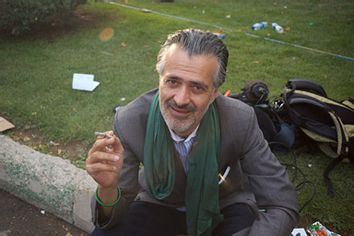
Hooman Majd at the Mousavi rally on May 23rd in Tehran.

“A friend once told me that I was the only person he knew who was both 100 percent American and 100 percent Iranian,” writes Hooman Majd in his book on Iranian culture, “The Ayatollah Begs to Differ: The Paradox of Modern Iran.”

The consummate insider and outsider, Majd served as the English-language translator for Iranian President Mahmoud Ahmadinejad’s now infamous 2006 speech at the United Nations, and also wrote about the experience for the New York Observer.

The son of an Iranian diplomat under the shah, and grandson of a powerful ayatollah, Majd grew up mainly in the United States where he worked for many years in the entertainment industry before launching his career as a journalist and author. Although openly linked with the reformists — he wore green Iranian slippers on Bill Maher’s program last week and has also translated for former President Mohammed Khatami (to whom he is related by marriage) — Majd’s views on Iran are distinguished by their nuance and fierce independence. Indeed, in his status as a sophisticated global citizen and Iranian American sympathetic to the core ideals of the Islamic Republic, he embodies the paradox of contemporary Iran that is the subject of his book.

Majd was in Iran in April for a recent Newsweek cover story about his journey from his ancestral home of Yazd through the Iranian heartland to the sprawling capital city of Tehran. He returned again in May during the run-up to the elections and has since been in daily contact with friends and family about the crisis in the country from his home in New York City.

Salon spoke to Majd (who has been a regular contributor to these pages) by phone about whether or not the Ahmadinejad victory was rigged (yes), what reform candidate Mir Hossein Mousavi really wants (Islamic democracy), and why the neocons are Ahmadinejad’s best friend.

How are you getting most of your news? From family? Are you following Twitter?

I’m not following Twitter so much. I get reports from people I trust and the media to the extent they are covering it. The rest is all from family and friends in Tehran. They tell me what they feel and what they know, as much as they can. People have to be careful with phones given since many phones are tapped now. I speak to Tehran at least once a day.

What about the influence of Twitter?

It really isn’t the Twitter revolution. I can’t remember the numbers but I think it’s like 30,000 registered Twitter users in Iran.

I think it might be even lower, like 19,000.

It’s minuscule. More people have access to the Internet in Iran than other Middle Eastern countries but often it’s dial-up, it’s slow, they don’t do it like we do all day long. There is no BlackBerry. There are iPhones but they don’t work because there’s no data plan. The depiction of the Internet revolution isn’t quite accurate. We’re putting our own image onto Iran. Of course there are people Twittering from the demonstrations; they’re just not representative of the vast majority of Iranians. What was so heartwarming about this whole thing is that the Iranian people stood up in mass and said you can’t take this away from us. You can’t take away our vote. We believed you when you said we have an Islamic democracy. We came out and voted. Now that you’ve said we could have change you’ve taken it away from us. That’s what people are angry about.

Let’s talk about Obama. At his press conference on Tuesday he once again condemned the government violence against the protesters.

That’s appropriate.

But he also said that the crisis is about Iran, not the U.S. and the West. What do you think of this policy, and what impact is it having with the various parties inside Iran?

People in the West, especially in America, tend to think we have more influence than we do. Iranians are more concerned with their own issues than whether the U.S. is with them or against them.

What are the issues that brought such huge numbers of Iranians out into the streets?

There were too many irregularities for this election to have been fair. Even if Ahmadinejad did win more votes than Mousavi, he couldn’t possibly have won on this scale. It would have probably gone to a second round if everything had been fair. And in the second round Mousavi probably would have won.

What they’re fighting for is reform inside Iran, within the system. The initial protest was about the vote. That’s the one thing, the one democratic thing Iranians knew they had — the vote. It had always been fair up until now.

After the first protests, what happened?

It turned into something more, partly because of the government’s reaction, which has not been what the reformers had been hoping for. It was an out-and-out rejection of their complaint.

But this is an internal matter. For the U.S. to get involved in any way is a huge mistake in my opinion. It makes Iranians very suspicious. One reason they were able to get 3 million people out on the streets from a broad socioeconomic spectrum across all political lines — you don’t get 3 million people on the streets of Tehran if they’re all students like in 2003 — is because the lower class, the middle class, the upper class, students, old people, families, religious families, women in chadors, men in beards, they all came out. These people also voted against Ahmadinejad or felt the vote wasn’t fair.

At first, none of them would have believed that the U.S. had a hand in this. But the government is now trying to say that’s what’s happening. The story could start to stick if Obama or Western governments start coming out strongly on one side. Nationalism starts to come into play. The government’s own propaganda machine, which is pretty strong, will be able to label a lot of people in the opposition as being stooges of the CIA.

What does Mousavi, the most public face of the reform movement, want right now?

What he wants is a return to the law. Mousavi is a child of the revolution. He believes in the revolution.

The Islamic Revolution?

Absolutely. He believes in the system that was created in the aftermath of the rule of the shah in 1979. He also believes that system is in need of reform. This is my articulation, but I think he and other reformers believe Iran should move into a post-revolutionary phase, whereas Ahmadinejad and the Supreme Leader Ayatollah Ali Khamenei think it should remain a revolutionary state. That doesn’t mean giving up the ideals of the revolution. It doesn’t mean bringing down the system.

The United States went into a post-revolutionary phase almost immediately when George Washington became president. It almost immediately made nice with Great Britain. But the ideals of the American revolution and the Constitution were never changed. The Iranian constitution may not need to be changed, or it may be amended as in the United States, over time.

This idea of moving into a different phase is in keeping with Shia theology. Shia theology allows for Islam to be adapted to the ages. That’s one of the reason the Sunnis hate us. And the Taliban. Because we adapt. We have ayatollahs. We have a clergy that is empowered to adapt Islam to the ages.

Mousavi is someone who is very much an Islamic democrat.

So he doesn’t want secular democracy?

I don’t know if that’s something he wants deep in his heart, but it’s certainly not something he would admit.

Iran is not a secular nation. The majority of Iranians are deeply religious, and even though it sounds paradoxical to us, they believe in an Islamic democracy. They want most of the elements of democracy: They don’t want the state to jam religion down their throats; they want a lot of freedom. But they also understand that to be guided by Islam, which is basically how they live their lives anyway, is not counter to democracy.

There’s nowhere in the constitution of the Islamic Republic that says votes should be rigged if you don’t like the candidate or that the president should have no power. There’s nowhere it says that the people’s choice does not count.

So it’s entirely possible for someone like Mousavi or Rafsanjani to believe that Islam and democracy are compatible.

What about the role of the supreme leader?

Some people believe he shouldn’t be the commander of the armed forces, that this should be in the hands of the president. But the reformers want to work this out internally, through democratic change, and not through violence or an uprising. And certainly not with assistance from the West.

Have you seen any signs of division in any of the military forces? So far they seem to have remained loyal to the Supreme Leader.

There have been rumors but we are unable to confirm them; for example, that one of the senior Revolutionary Guard commanders was arrested for refusing to put down demonstrations. Having met some of these people, I do know that the Revolutionary Guard is not monolithic. Some of them would have voted for Mousavi, and many have sympathies for the reform movement. Seventy percent of the Revolutionary Guard voted for Khatami in 1997 and 2001.

During the revolution, under the shah, the military actually decided it was going to be neutral, which was what ended the shah’s rule. But I doubt that will happen now. It’s in their self-interest to keep order. As has been proven, the security forces can stop people from coming out on the streets. They can either kill them or they can manage the traffic patterns of a big city like Tehran in such a way that it becomes impossible to actually gather in one place. They’re good at that.

I’m not speaking for the government when I say this, but it seems to me that the biggest threat it faces isn’t the street protests, but the divisions among the leadership. This is the first time in the 30-year history of the Islamic Republic that they’ve become so public.

Do you know where Rafsanjani is? Some say that he’s in Qom and is actively organizing against Supreme Leader Khamenei.

Those are just rumors. But what we do know is that his mere absence from Friday prayer was a public sign of his disagreement with the supreme leader. The fact that his children were intimately involved in the Mousavi campaign and that he was rumored — and I think there’s a lot of truth to this — to have funded part of the campaign, indicates he’s been very involved. Whether he traveled to Qom or not, we don’t know, but I doubt he has to be outside of Tehran right now. He’s probably at home, heavily guarded. I think he’s in contact with the clerical leadership, which he of course has close relations to. As chairman of the Assembly of Experts, he can call an assembly whenever he wishes; I don’t think he has yet.

I’m only speculating but I assume he’s counting votes in case it comes down to a battle royale over who’s going to be supreme leader. Khameni would be aware of this since he knows Rafsanjani has this ability.

I think it’s undoubtedly true that Rafsanjani is working behind the scenes to see what he can do to end this impasse to the advantage of the reformists. It’s clear he does not want Ahmadinejad to be president for another four years and doesn’t think that outcome is in the best interest of the Islamic Republic. The fundamental disagreement between Rafsanjani and the supreme leader may be less about who’s president and more about what’s good for the stability and longevity of the Islamic Republic, which they are both sworn to uphold.

Of course it’s hard to know any of this since they won’t speak to anyone directly and are unlikely to do so in the near future.

If the supreme leader and Guardian Council don’t change course, the election will be certified and Ahmadinejad will be declared the winner. Will the opposition accept this and if they don’t could it lead to more violence?

It’s impossible to say whether they’ll accept it or not. I don’t know. I think that there’s going to be a lot of pressure on them to accept it. There’s going to be a lot of backroom discussions to figure out how to get them to accept it for the sake of the country.

There’s a little bit of an analogy back to 2000, the Florida vote, and Al Gore taking it all the way to the Supreme Court, and finally accepting the Supreme Court’s judgment to the disappointment of many who didn’t want George W. Bush to be president at the time. It’s not a completely fair analogy. The whole thing in 2000 was that, well, we have to accept the Supreme Court and the Supreme Court has obviously made a political decision and not a legal decision. But they made it to preserve the stability of the United States, the national interest of the United States. That’s an argument I think that Khamenei and his supporters will make to the opposition.

What they are willing to give them in exchange for accepting this is another story. We don’t know. It’s unlikely that Mousavi will want to go as far as going against the entire leadership of Iran if in fact the leadership does coalesce around the supreme leader at some point. But that’s not clear yet. Right now there are ayatollahs and clerics fighting with the opposition.

You said earlier that by the time the shah went down, he had virtually no support left in the country. The current conflict is not so one-sided, it seems.

I don’t think Mousavi has forgotten that not only the supreme leader, but Ahmadinejad himself, still has substantial support in Iran. If what Mousavi believes is true and the actual results of the election were opposite to what the government claims, even then Ahmadinejad won 34 percent. That still gives him a solid 10 million people. Plus the military. Plus the guns.

During the revolution, a few loyal troops did fire on crowds, but no one came out on the streets in support of the shah. But Ahmadinejad and the supreme leader have ordinary people, not just people with the guns. This of course raises the danger of civil war.

Ahmadinejad may have solid support, but haven’t the bogus elections put the legitimacy of the government at stake?

It’s pretty clear that Mousavi probably won this election; at minimum, Ahmadinejad didn’t win a plurality of more than 50 percent. Even if the Guardian Council certifies it, I think people will accept that Mousavi is putting up a righteous battle and will maintain his credibility. But his supporters could go further and turn this into a fight against the system, and say that the system that produces and certifies this result is a bad system and we have to change it. That’s a danger the government does face.

Do you see any stereotypes being used in the media coverage of the current crisis that may cloud our ability to understand what’s going on?

That the people who want change in Iran all want liberal democracy and reject the Islamic Republic. Many do reject it, but when the New York Times puts a big photo on Page One of tens of thousands of protesters and in the center of the photo is a woman with her scarf pushed to the back of her head with Chanel sunglasses and blond streaked hair I think it gives the wrong impression of who these protesters are. Yes, there are people like that but they would not have gotten 3 million people in the streets if that’s all who came. Those people are still a minority. I’m not saying their cause is unjust or they shouldn’t have the freedom not to wear head scarves or drink alcohol. I’m just saying they are still not the majority in Iran. The Mousavi protesters who came out included men with beards, women in chadors, deeply religious people who voted against Ahmadinejad.

If violence continues, if more protesters are killed, is there ever a scenario in which a more activist or interventionist policy from the U.S. or Western nations would be helpful or necessary?

Absolutely not. I don’t know what the U.S. could even do, short of invading the country, which would be a disaster because you turn everybody against the United States and for the government. Other than to say it’s unacceptable for a government to kill its own people who are peacefully protesting, and to make that point strongly, I don’t know what else the U.S. should do.

Let’s think about U.S. interests. Obama is there to protect the U.S. national interests. We don’t have a dog in this fight. We don’t have a preference. We should have a preference for the rule of law and for people’s rights being respected. If Ahmadinejad is president, the United States is going to have to deal with him whether or not his election was the will of the people. Clearly it’s not the will of the people for Hosni Mubarak to be president of Egypt. It was the will of the people to have Hamas represent the Palestinian territory and we decided not to deal with the will of the people there. I think we have to be careful. If we come out on the side of the reformers and say we can’t accept Ahmadinejad, it would be the equivalent of Iran saying we can’t accept that Bush is president because we don’t agree with the Supreme Court ruling.

Would you say that the neoconservatives’ extremely vocal calls to intervene on behalf of Mousavi are playing into the hands of the most conservative forces in Iran?

The neocons know nothing about Iran, nothing about the culture of Iran. They have no interest in understanding Iran, in speaking to any Iranian other than Iranian exiles who support the idea of invasions — I’ll call them Iranian Chalabis. It’s offensive, even to an Iranian American like me. These are people who would have actually preferred to have Ahmadinejad as president so they could continue to demonize him and were worried, as some wrote in Op-Eds, that Mousavi would be a distraction and would make it easier for Iranians to build a nuclear weapon and now all of a sudden they want to be on his side? Go away.

I’m not saying Obama is the most knowledgeable person on Iran, but he’s obviously getting good advice right now. He understands way more about the culture of the Middle East than any of the neocons. For them to be lecturing President Obama is a joke. I have criticized Obama; for instance, I criticized him for having a patronizing tone in his Persian New Year message. But right now I think he’s doing a good job. The John McCains of the world, they’re Ahmadinejad’s useful idiots. They’re doing a great job for him.

Why churches fear gay marriage

The crusade for Proposition 8 was fueled by the broken American family, explains gay Catholic author Richard Rodriguez.

For author Richard Rodriguez, no one is talking about the real issues behind Proposition 8.

While conservative churches are busy trying to whip up another round of culture wars over same-sex marriage, Rodriguez says the real reason for their panic lies elsewhere: the breakdown of the traditional heterosexual family and the shifting role of women in society and the church itself. As the American family fractures and the majority of women choose to live without men, churches are losing their grip on power and scapegoating gays and lesbians for their failures.

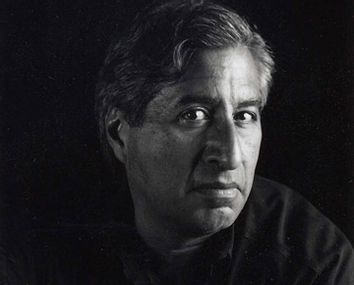
Rodriguez, who is Mexican-American, gay and a practicing Catholic, refuses to let any single part of himself define the whole. Born in San Francisco in 1944 and raised by his Spanish-speaking Mexican immigrant parents to embrace mainstream American culture and the English language, he went on to study literature and religion at Stanford and Columbia. His first book, “The Hunger of Memory: The Education of Richard Rodriguez,” explores his journey from working-class immigrant to a fully assimilated intellectual — angering many Latinos with his view that English fluency is essential. “Days of Obligation: An Argument With My Mexican Father,” which was a Pulitzer Prize finalist in 1993, continued his investigation into how family, culture, religion, race, sexuality and other strands of his life all contribute to the whole, a complex “brownness” of contradictions and ironies. “Brown: The Last Discovery of America” completes the trilogy — but not his insatiable intellectual curiosity, which he is now shining on monotheism.

Rodriguez’ stinging critiques of religious hypocrisy are all the richer for his passionate love of Catholicism and the Most Holy Redeemer parish in San Francisco, where he and his partner of 28 years are devoted members. Today, Rodriguez is at work on a new book about the monotheistic “desert religions” — Christianity, Judaism and Islam. Ever since Sept. 11, “when havoc descended in the name of the desert God,” Rodriguez said in one of his Peabody Award-winning radio commentaries for PBS’s News Hour, he has been trying to understand the strands of darkness that run through these religions.

Salon spoke to Richard Rodriguez by phone at his home in San Francisco.

What was your reaction to California voters’ going heavily for Obama and also passing Proposition 8, banning gay marriage?

I was like a lot of other Americans at the moment when the West Coast tipped the balance in favor of Obama. I didn’t so much think it represented the end of racism but the possibility of change. At the same time, I also knew that large numbers of Californians in religious communities were voting against gay marriage and that Latinos and blacks were continuing to take part in this terribly tragedy. We persecute each other. The very communities that get discriminated against discriminate against other Americans.

The Spanish language newspaper La Opinión called the results an “embarrassment,” saying “California still has two faces.” Do you agree?

La Opinión represents the opinion of a lot of Latinos who are more educated and — what should I say? — more cosmopolitan. But Latinos in both my family and the Catholic Church belong to a more traditional America. This is a troubling aspect of the way our country is formed right now. It is a time of great change but also a time when people are afraid of change.

You said recently the real issue behind the anti-gay marriage movement is the crisis in the family. What do you mean?

American families are under a great deal of stress. The divorce rate isn’t declining, it’s increasing. And the majority of American women are now living alone. We are raising children in America without fathers. I think of Michael Phelps at the Olympics with his mother in the stands. His father was completely absent. He was negligible; no one refers to him, no one noticed his absence.

The possibility that a whole new generation of American males is being raised by women without men is very challenging for the churches. I think they want to reassert some sort of male authority over the order of things. I think the pro-Proposition 8 movement was really galvanized by an insecurity that churches are feeling now with the rise of women.

Monotheistic religions feel threatened by the rise of feminism and the insistence, in many communities, that women take a bigger role in the church. At the same time that women are claiming more responsibility for their religious life, they are also moving out of traditional roles as wife and mother. This is why abortion is so threatening to many religious people — it represents some rejection of the traditional role of mother.

In such a world, we need to identify the relationship between feminism and homosexuality. These movements began, in some sense, to achieve visibility alongside one another. I know a lot of black churches take offense when gay activists say that the gay movement is somehow analogous to the black civil rights movement. And while there is some relationship between the persecution of gays and the anti-miscegenation laws in the United States, I think the true analogy is to the women’s movement. What we represent as gays in America is an alternative to the traditional male-structured society. The possibility that we can form ourselves sexually — even form our sense of what a sex is — sets us apart from the traditional roles we were given by our fathers.

I think Proposition 8 was also galvanized by insecurity around gay families.

I agree. But the real challenge to the family right now is male irresponsibility and misbehavior toward women. If the Hispanic Catholic and evangelical churches really wanted to protect the family, they should address the issue of wife beating in Hispanic families and the misbehaviors of the father against the mother. But no, they go after gay marriage. It doesn’t take any brilliance to notice that this is hypocrisy of such magnitude that you blame the gay couple living next door for the fact that you’ve just beaten your wife.

The pro-8 campaign calls itself the Protect Family Movement, even though the issue of family was the very reason gays needed to have marriage. There are partners in gay unions now who have children, and those children need to be protected. If my partner and I had children, either through a previous marriage or because we adopted them, I would need to be able to take them to the emergency room. I would need to be able to protect them with the parental rights that marriage would give me. It was for the benefit of the family that marriage was extended to homosexuals.

Religions have the capacity for being noble and ennobling but they are also the expression of some of the darkest impulses in us — to go after the “other.” For Christians, if the other isn’t the Muslim, it’s the homosexual. That is the most discouraging part.

Speaking of hypocrisy, churches have plenty of sexual skeletons in their closet.

Right. The Mormon Church has this incredible notoriety in America for polygamy and has been persecuted because of it. The very church that became notorious because of polygamy is now insisting that marriage is one man and one woman. That is, at least, an irony of history. But as a number of Mormon women friends of mine say, the same church that espouses the centrality of family in their lives is also the church that urges them to reject their gay children.


Then there is the Roman Catholic Church, my own church, which has just come off this extraordinary season of sexual scandal and misbehavior in the rectory against children. The church is barely out of the court and it’s trying to assume the role of governor of sexual behavior, having just proved to America its inability to govern its own sexual behavior.

Look at the evangelicals. In their insistence that people be born again, they know Americans are broken. In their circus-tent suburban churches, you find 10,000 people on a Sunday morning. You find people who have been divorced, people who have had drug experiences, people who have been in jail. These churches touch upon a dream that people can put our lives back together again.

Now these churches are going after homosexuals as a way of insisting on their own propriety. They are insisting that they have a role to play in the general society as moral guardians, when what we have seen in the recent past is just the opposite. I mean, it’s one thing for the churches to insist on their right to define the sacrament of marriage for their own members. But it’s quite another for them to insist that they have a right to define the relationships of people outside their communities. That’s really what’s most troubling about Proposition 8. It was a deliberate civic intrusion by the churches.

I wonder if these churches sense they’re losing some of the influence they’ve had for the past eight years.

To my knowledge, the churches have not accepted responsibility for the Bush catastrophe. Having claimed, in some cases, that Bush was divinely inspired and his election was the will of God, they have failed to explain why the last eight years have been so catastrophic for America.

Now I think evangelicals are falling back on issues that have been reliable for them in the past. Mike Huckabee, a Baptist minister, who said that children of immigrants should be educated, was essentially frightened away from that position by Mitt Romney. The tentativeness of the evangelicals on immigration only allowed them to be more vociferous on the gay issue. That’s traditionally easy for them — to go after the sinner. But it doesn’t convince me of their ascendancy; it merely convinces me that they are retreating. They don’t know how to extend their agenda beyond gay marriage and abortion.

There’s going to be an ongoing legal battle over Proposition 8. How do you think  gay activists should proceed?

I think gay activists should be very careful with this issue. We should not present ourselves as enemies of religion. I am not prepared to leave the Roman Catholic Church over this issue. The Catholic Church is my church. I was a little concerned about the recent protests outside the Los Angeles Mormon temple. I’ve seen this sort of demonstration escalate into a sort of deliberate exercise of blasphemy.

For example, in the most severe years of the AIDS epidemic, activists from ACT UP went into St. Patrick’s Cathedral, took the communion wafer and threw it on the ground. That is exactly the wrong thing to do. One should be respectful of the religious impulse in the world. If we decide to make ourselves anti-religious, we will only lose.

But religious communities must be challenged too. I was in Jerusalem a couple of years ago for Gay Pride. All the leaders of religious communities — Muslim, Jew and Christian — were brought together by their mutual animosity toward gay activism to protest the parade. There was the grand patriarch of the Eastern churches, the high rabbi of Jerusalem, the Roman Catholic archbishop, the mullahs, and they were all united in one cause. The police outnumbered the parade participants. One marcher was attacked and stabbed by an Orthodox Jew.

We have to be very clear about male violence within the monotheistic religions. This is a failure within churches and we can’t be casual about it. But we can’t be casual about the importance of religion either. We need to be both respectful of religion and critical of religion. Otherwise I suspect we won’t get very far at all.

What do you think about gay rights as universal rights? Many argue that it’s a cultural issue and that specific communities, such as Latinos and blacks, have their own understanding of homosexuality and shouldn’t be messed with.

 In my own my family, and my parents were not well educated, it would have been impossible for them to have dealt with the words “gay” or “homosexual” in my relationship with them. But there was no way for them to reject me either. I was a member of the family and I couldn’t sin my way out of it.

Once my partner became part of my life, he became part of their life too. They didn’t want it said, they didn’t want it named or defined, but they assumed it and accepted it. At family events, when my partner wasn’t there, my mother would get on the phone and call him and insist he come over.

These communities have very intricate ways of dealing with these things and they are not necessarily the highly politicized tactics that you see in traditional middle-class society in America.

I have not been to a Mexican family without some suspicion of homosexuality in children or grandchildren. But people deal with it within the larger context of family. That’s why I suspect the revolution will come not from the male church but from how women treat their children, and whether or not women are willing to reject their children. I don’t think they are. I saw too many times during the AIDS epidemic that when death came and the disease took its toll, if one parent was there, it was almost always the mother and not the father. That bond is so powerful.

I also think about the role of gays as caregivers to the elderly parent while siblings are too busy with their children. At the Most Holy Redeemer Church in San Francisco, which is the gay Roman Catholic parish, a number of old Irish women essentially adopted the gay parishioners, and were adopted by them, because their children had moved to the suburbs, or Pennsylvania, or Orlando, and were no longer in a position to care for them. That’s a bond that no one really talks about.

My partner has taken care of many elderly people over the years. They know who he is and they know who I am. But it’s unspoken. I don’t know how they voted on Tuesday, but I do think that it is their responsibility now to speak out.

Are you saying individual relationships will ultimately be more powerful than organized religion?

Well, I’m working right now in the Middle East on monotheistic religions because I’m very worried about the direction of religion. Ever since Sept. 11, when I heard that prayer being spoken at the moment the planes hit the World Trade Centers, I realized how much darkness there is in religion compared to how much light there is. I am very much concerned with whether or not these religions can be feminized.

The desert religions — Judaism, Christianity and Islam — are male religions. Their perception is that God is a male god and Allah is a male god. If the male is allowed to hold onto the power of God, then I think we are in terrible shape. I think what’s coming out of Colorado Springs right now, with people like Tony Perkins of the Family Research Council, is either the last or continuing gasp of a male hierarchy in religion. That’s what’s at stake. And women have a determining role to play. Are they going to go along with this, or are they going to challenge the order?

Well, yes, but then we have the rise of someone like Sarah Palin, who is just one example of how complicated things get in this issue.

Yes, you have Sarah Palin. But you also have women deciding to leave marriages. When a woman decides to leave the kitchen and seek a career outside the family, when a woman decides not to take on the name of her husband, when a woman wants to be more than simply the mother of children, when she wants to have some place in the world that is not defined by her family or her husband, that seems to suggest something comparable to what gays experience when they come out of the closet. Notice that both those metaphors of getting out of the kitchen and getting out of the closet are domestic images.

But are you saying Palin represents this?

I’m not that kind of optimist!

It does seem she wants to have a career separate from the family, but in many ways she embodies the old conservative order. 

Clearly, what you say is true. I don’t see women challenging the male order of things in every case. Wives tolerate all kinds of behavior of fathers toward their children. But I do think it’s important that some woman are starting to challenge that. The divorce rate suggests that women are not happy with the relationship they have with men. And whatever that unhappiness is, I would like people to know that, as a gay man, I’m not responsible for what’s wrong with heterosexual marriage. On the other hand, whatever is wrong with the heterosexual marriage does have some implication for the world I live in. Women are redefining sexuality in a way that’s going to make it easier for me to be a gay man.

The formal role of women is also undergoing change in some churches, right?

That’s right. The Episcopal Church in America is now under the leadership of a woman. Feminism is going to change a great deal. The most radical people in the Roman Catholic Church are women. They’re challenging everything from the priesthood to the male God to what it means to be married. I don’t expect to see gay marriage enter these conservative institutions in my lifetime. But I do see change.

I belong to a Catholic parish in San Francisco, where my partner and I are acknowledged by the other people in the parish as a couple. We take communion together, the priests know who we are, they’re supportive of who we are, and what we are, and they see us in various roles — giving eulogies to dead friends but also helping to baptize little babies. We’re very much a part of that community. That’s why I’m not prepared to lose it because some archbishop in Colorado or cardinal in Los Angeles is behind Proposition 8. It is not my church that they’re talking about, it’s not even my experience of love.


Continue Reading Close

Bill O’Reilly is very afraid of San Francisco

The drug- and homeless-infested city portrayed in a Fox report shows what the whole country will become under Obama.

Here in San Francisco, the lines to buy pot at our many neighborhood cannabis clubs are even longer than the lines to vote for socialist Barack Obama were on Nov. 4.

Homeless people, high on drugs, freely roam the streets, escorted by police officers who know everyone by first name and distribute special Cracker Jacks with actual crack as the prize.

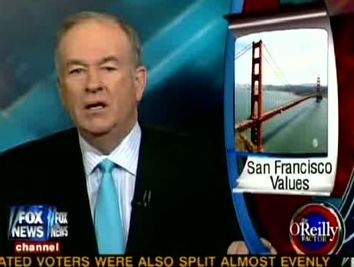
If you think I’m kidding, then you haven’t seen this segment from Bill O’Reilly’s show, which was first spotted by the Huffington Post. Yes, people, Bill wants his viewers to know what Obama is going to do to the country. He’s going to destroy “traditional America” and turn it into “secular progressive America” — just like San Francisco, the capital of drugs, homeless, hippies and degenerates of all shapes and sizes.

Unfortunately, as hilarious as it is to see O’Reilly’s contorted Reefer Madness vision of San Francisco, it’s also offensive. Fox used blacks and Latinos, transgenders and gays, and poor people to represent the progressive Obama nightmare that his “radical left” government is supposedly going to unleash. And the good “traditional” America? Yup, white mothers with strollers.

Right-wing San Francisco-bashing is hardly new or even notable. But O’Reilly has taken it to new extremes of paranoia in this little production. You gotta see this for yourself. 

Continue Reading Close

A big gay Mormon wedding

The Church of Latter-day Saints has pumped millions into Proposition 8 to ban gay marriage. But for one devout family, the politics are personal.

“Love each other, be selfless, negotiate,” George E. Redd III said to his son Jay on his wedding day recently. Gazing at his 36-year-old son standing next to his beloved, in the Swedenborgian Church in San Francisco, Redd III quoted Paul, Ringo, John and George: “All you need is love, love is all you need.”

It was hanky time inside the chapel, a cozy wooden Arts and Crafts building that could have been airlifted in from a village in Scandinavia, or perhaps the Shire. There’s nothing like the father blessing the son at a wedding, with Irish folk musicians strumming in the background, to get the tear ducts flowing. Especially when the son’s gorgeous spouse is another man.

A few weeks after the wedding, Jay, a movie director based in Los Angeles and San Francisco, told me that his father’s Beatles reference had taken him totally by surprise. “When Dad said, ‘And to quote the great Western philosophers,’ I thought for sure he was going to read from Scripture,” Jay said. But to his great relief, the advice his father doled out came from John Lennon and not John the Baptist. After all the pain Jay had endured, wondering whether his devout Mormon father would even attend his wedding, those Liverpool lyrics were music to his ears.

While same-sex weddings are daily events in California these days, especially since the California Supreme Court legalized gay marriage earlier this year, it’s easy to overlook the fact that it’s still a strained personal issue inside many families. With Proposition 8 on the ballot this Tuesday, which would amend the California Constitution to ban gay marriage (effectively overriding the recent Supreme Court ruling), the strain has taken on a renewed political intensity.

The Yes on 8 campaign has become a national conservative cause, with churches from around the country, led by the Church of Jesus Christ of Latter-day Saints, pumping millions into the Golden State in support of the measure. If it passes, Proposition 8 would throw Jay’s marriage, as well those of the approximately 12,000 other same-sex couples who have married in the state since June, into legal limbo. As of Thursday night, polls showed the measure to be in a statistical dead heat.

But the story of Jay and George Redd shows that blood is often thicker than holy water. And as much as the Mormon church, or any church hierarchy, seeks to dictate how people live their lives, the heart won’t be so easily chained.

Jay’s parents are reverent Mormons from Utah and have long been challenged by his sexual orientation. According to Jay, they never stopped loving him, and have invited his same-sex partners into their home. But they never gave up wanting him to reform, to get back on “the right path” of heterosexuality. “You know what the church says,” they told him. “You know what we believe, you know what God has taught us, you know what the Scripture says, you know the right thing to do.”

For Jay, the right thing to do this year was marry the love of his life, Brian Dietrich. Jay met Brian, a 41-year-old psychotherapist, last year, and they immediately knew they wanted to commit to each other for the long haul. When Jay called his parents to invite them to their wedding, the line between Salt Lake City and San Francisco seemed to fizzle out. “Dear, that’s nice, very nice,” his mother, Marsha, said lukewarmly. “I’m not sure how your father’s going to deal with this,” she added. “I don’t think your dad is going to come.” Jay wasn’t surprised exactly. But it still hurt.

When he spoke with his father directly, Jay’s heart sank. “He didn’t say, ‘We’re happy for you,’” Jay said. “Not, ‘congratulations.’ It wasn’t passive-aggressive. It was just, ‘Well, OK.’”

Jay was ripped up inside. “I respect and understand my father’s position because I grew up in it,” he told me. “I wanted to give him the benefit of the doubt for how far he’s come all these years.” But he was also angry and frustrated. His father had celebrated the marriages of his sister and brother, and he longed for the same paternal blessing.

He left an urgent message on his father’s voice mail: “Dad, you always told me you just want me to be happy. This makes me happy to be marrying Brian. I’m asking you to be there to support us in our happiness.”

The days were ticking away to the wedding on Oct. 5; his father still hadn’t returned his call.

“I was anticipating that something like this might occur, just knowing what the times are and how things are moving,” Jay’s father, George E. Redd, told me when I reached him by phone at his home in Salt Lake City. George, a 62-year-old banker, who is active in the Mormon church, was a bishop when Jay was growing up. He kindly answered my question about how he might have felt a year ago if someone had told him he would be celebrating his son’s marriage to another man. “I said, Well, I hope that doesn’t happen, but if it does, I’m not sure how I would feel about it and react to it. Probably not very positively at the time.”

When George got the call from Jay asking them to attend his wedding, he plunged into reflection, talking with his wife, praying, reading biblical and Latter-day Saints scriptures. Love for Jay was never a question, and they had met Brian “and thought he was a wonderful man as well.” But the marriage was a conflict for him because of his Mormon beliefs. He was reticent to express it, but in an interview overflowing with positive words about his son, he admitted, “My ideal situation would be my son marrying a woman. That’s what I believe the family unit is, the marriage of a man and a woman.”

George and Marsha raised their kids inside the Mormon church in Utah in the 1970s. Jay remembers that there were four temples within about a mile of his house. As a young man, he served as a deacon and belonged to a young Mormon men’s group where he learned that masturbation is an “abomination” that leads to being gay. According to the teachings, “It’s a sin next to murder to be gay, which was really hard to hear,” Jay said. When he came out to his father at age 23, “ironically, in a church parking lot,” Jay felt so guilty that he agreed to go into reparative therapy to overcome his “same-sex attraction disorder.” But he moved on quickly and grew to embrace his life as a gay man. Now the Mormon church acknowledges homosexuality, but says gays and lesbians must remain celibate.

After much contemplation about what to do about his son Jay’s marriage, George realized that “the most important thing is to love and support our son in the decision he’s made.” He and the family would drive from Utah to San Francisco for Jay and Brian’s wedding.

Jay recalls hearing the phone ring at 4 o’clock one morning. When he listened to the message later, it was his father. “I’ve been praying about this. I love you. You’re my son. I want you to be happy, and if this marriage to Brian makes you happy, then I’m happy.”

Jay sobbed.

Later, he asked his mother what she had said to him to influence his decision. “I didn’t say much,” she said. “I only asked him one question — what do you think Jesus would do in this situation?”

- – - – - – - – - – - -

Mormons have poured over $11 million into supporting Proposition 8, or 40 percent of the total raised so far. When I asked George how he felt about the proposed constitutional ban on same-sex marriage, which would put the legal status of his own son’s union in jeopardy, he didn’t want to go there. “This discussion has been based on feelings of love, of concern for the happiness of my son and I’d just leave the politics out of it,” he said gently.

“I’m not surprised at all,” Jay said when I told him what his dad had said about Proposition 8. For all his life, George has “left politics out of it.” But “based on his actions and his words at our ceremony,” Jay believes in his heart that he supports equality for all.

When Jay’s father agreed not only to attend the wedding, but to speak, Jay had “this weird Darth Vader moment,” he told me, laughing. “No, he’s not Darth Vader! But the analogy here is this spark of amazing grace in him.”

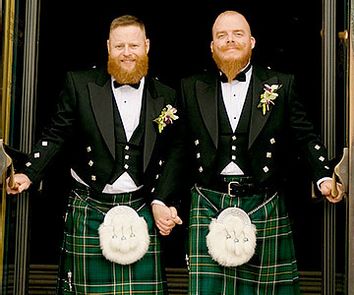
Many of us at Jay and Brian’s wedding were indeed deeply moved by George Redd that day. A man of medium stature, with close-cropped fine gray hair and glasses, he spoke eloquently and lovingly to his son and new son-in-law. We only had a small inkling of the journey he’d been on to reach that moment of accepting and blessing his son’s union with Brian, but we knew he was reaching out across a cultural and religious abyss to do so. “Jay, who has blue eyes, red hair and a red beard, told me he met someone who makes him incredibly happy,” he said, looking over at the grooms, who were seated nearby, fingers entwined. “And that man,” he said looking at Brian and smiling, “has blue eyes, red hair and a red beard …” It was hanky time again.

Jay does not feel the same kind of grace from the Church of Latter-day Saints, however. Regarding its aggressive campaigning for Proposition 8, he is sad and angry. “I feel cast out for who I am,” he says bluntly. “Though I no longer identify as a practicing Mormon, it still burns. This is a church that has been persecuted for its flavor of Christianity, for its past marriage practices, for its past religious practices. And here they are turning around and persecuting another group of people. I feel like it’s very shortsighted and it’s not a very Christian way of treating people.”

In the end, Jay’s dad even helped them finance the wedding. Jay was worried about “how far to push the envelope with him.” His ex, David, even told him, “It’s good enough that they’re coming out. Don’t push it too far.” But ask, and you shall receive.

“I feel like they really sacrificed,” Jay said. “My father’s not a big fan of freeways and big cities, but they drove for two days from Utah to come to our ceremony. They really went the extra mile.”

Continue Reading Close

MIA at convention: Anti-Bush swag

All the Obama memorabilia is great, but why so few jabs at our supremely unpopular president?

DENVER — OK, the smirker in chief is not totally absent.

But besides the Bush Legacy Tour Bus, a traveling museum of George W.’s failed policies, the pickings are surprisingly thin.

Among all the Barack Obama T-shirts, hats, buttons, mugs, key rings and teddy bears for sale from vendors on every street corner, I found only a few anti-Bush souvenirs — all buttons, all pretty ho-hum.

There’s a dumb-looking Bush with the words “Good Riddance,” McCain and “McSame,” and Bush, Cheney and Rummy dressed as the Three Stooges. Snore.

Don’t get me wrong. I am a sucker for a lot of the Obama-wear and will pack my bags with a selection of fabulous T-shirts and other memorabilia. And there’s some great Hillary Clinton swag, too.

My question is this: Where is the boogeyman? The lack of Bush swag on the streets is a metaphor for the relative lack of Bush-bashing in the campaign. This is a president with the worst approval ratings since Atilla the Hun, so why aren’t the Dems taking better advantage of it?

Hillary Clinton’s line from Tuesday night, “It makes sense that George Bush and John McCain will be together next week in the Twin Cities. Because these days they’re awfully hard to tell apart,” was one of the best lines of the convention so far. Where’s the T-shirt? I want to buy it.

Continue Reading Close

Denver cop convention

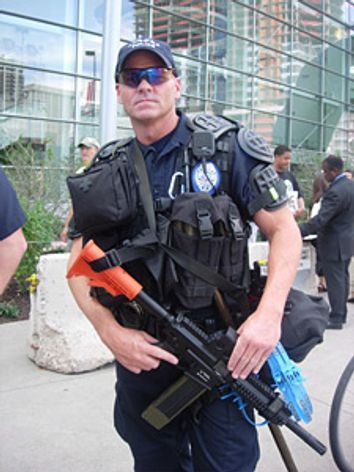
Police in full riot gear are out in force in downtown streets.

Photo by Jeanne Carstensen

Officer Wells of the Aurora Police Department outside the Colorado Convention Center in Denver.

Cops are everywhere on the streets of Denver, many of them decked out in intense riot gear. Outside the Colorado Convention Center, where delegates stream in and out all day for caucuses and other meetings, police are stationed every 100 feet or so.

“We’re not turtled up for any direct confrontation,” Officer Wells of the Aurora Police Department tells me when I ask him about the heavy duty equipment dangling from his body, including what looks to me like a machine gun. “This is soft gear,” he explains with a chuckle, pointing to the orange handle of his weapon. In the world of law enforcement, the color orange signifies “less than lethal.” Maybe, but I wouldn’t want to find myself on the other end of that gun, which is loaded with round projectiles of pepper spray that Officer Wells says are used to “disable people.” When he saw my concerned expression he clarified what he meant, “you know, it stops their actions.”

Wells and the other Aurora cops are also decked out with three-foot-long police clubs, canisters of tear gas hanging from straps criss-crossed around their chests, black protective pads on their arms and shoulders, riot helmets, gas masks and heavy-duty blue plastic restraints.

According to Wells, there are 325 officers from the nearby town of Aurora on the streets of Denver for the convention, but he couldn’t tell me how many cops are deployed all together in the city. I wait around for an hour to interview a Denver Police Department Public Information Officer about security at the convention but in the end he or she never shows.

So far, I haven’t seen violence of any kind between police and protesters. (Joan Walsh did, however. See her post below.) But whatever happens, there is a major display of force on the streets surrounding this convention.

Continue Reading Close

Page 1 of 2 in Jeanne Carstensen

www.salon.com/writer/jeanne_carstensen/index.html