Jeannine Aversa

U.S. adds jobs, but unemployment up to 9 percent

268,000 new jobs were created last month -- a far higher number than most had been expecting

  • more
    • All Share Services

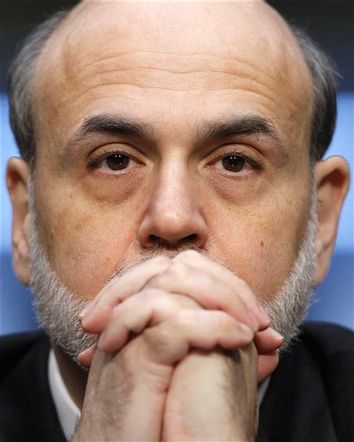
U.S. adds jobs, but unemployment up to 9 percentFILE - In his March 1, 2011 file photo, Federal Reserve Chairman Ben Bernanke tetsifies on Capitol Hill in Washington, before the Senate Banking Committee. The United States has never defaulted on its debt and leaders from both parties say they don’t want it to happen now. But with partisan acrimony running at fever pitch, and Democrats and Republicans far apart on how to tame the deficit, anything could happen. (AP Photo/Alex Brandon, File)(Credit: AP)

Employers added more than 200,000 jobs in April for the third straight month, the biggest hiring spree in five years. But the unemployment rate rose to 9 percent in part because some people resumed looking for work.

The Labor Department says the economy added 244,000 jobs last month. Private employers shrugged off high gas prices and created 268,000 jobs — the most since February 2006.

The gains were widespread. Retailers, factories, financial companies, education and health care and even construction companies all added jobs. Federal, state and local governments cut jobs.

The data suggests businesses are confidence in the economy despite weak growth earlier this year.

Still, unemployment increased slightly from the 8.8 percent in March. It was the first increase since November.

Unemployment aid requests fall to near 3-year low

Even though economists think the unemployment rate edged up to 9.1 percent in February, this is good news for jobs

  • more
    • All Share Services

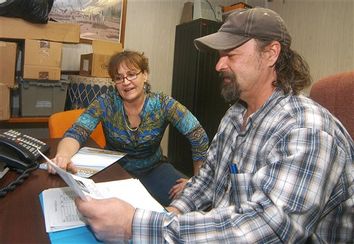
Unemployment aid requests fall to near 3-year lowIn this Jan. 18, 2011, photo Tanya Fiddler and Mark Shupick of the Four Bands Community Fund look over a case file in Eagle Butte, S.D. Four Bands teaches residents basic financial skills, looks for ways to bring in jobs and help those who are fighting unemployment and poverty. In the barren grasslands of Ziebach County, there's almost nothing harder to find in winter than a job. This is America's poorest county, where more than 60 percent of people live at or below the poverty line. (AP Photo/Doug Dreyer)(Credit: AP)

The number of people requesting unemployment benefits last week plunged to a nearly three-year low, bolstering the likelihood that companies will increase the pace of hiring this year.

Applications for unemployment benefits fell by 20,000 to a seasonally adjusted 368,000, the Labor Department said Thursday. It was the third decline in the past four weeks. Applications are now at their lowest level since May 2008.

The four-week average for applications, a less volatile figure, fell last week to 388,500. That’s the lowest level since July 2008, the last time the four-week average was below 400,000.

Applications that remain consistently below 375,000 tend to signal steady declines in the unemployment rate. Unemployment benefit applications peaked during the recession at 651,000.

Analysts are predicting strong job gains in the February employment report, which the government will release Friday. Brightening the outlook for more aggressive hiring, the service sector expanded at the fastest pace in more than five years in February, and the manufacturing sector grew last month at the fastest pace in nearly seven years. And retailers are reporting solid gains for February after the best holiday shopping season since 2006.

Stocks surged after the economic data was released. The Dow Jones industrial average rose by more than 180 points in morning trading.

“Often at this stage of the recovery, when these signals are in place, we see a surge in hiring,” said John Ryding, an economist with RDQ Economics.

Economists estimate that employers added a net 175,000 jobs in February. That would mark an improvement from an anemic 36,000 jobs in January when severe winter weather held back hiring.

At the same time, economists think the unemployment rate edged up to 9.1 percent in February. Unemployment rates often tick up when an improving economy causes out-of-work people who haven’t been looking for jobs to start. People out of work aren’t counted as unemployed unless they’re job hunting. During a weak economy, some people become discouraged and stop looking.

Separately, retailers reported revenue gains for February, extending the spending momentum seen during the holiday season. Limited Brands Inc. and Macy’s Inc. reported gains that beat Wall Street expectations, while Target Corp. announced an increase slightly below analysts’ projections. The figures are based on revenue at stores open at least a year and are considered a sign of a retailer’s health.

The service sector, which employs about 90 percent of U.S. workers, grew in February at the fastest pace in more than five years, according to the Institute for Supply Management. It marked the sixth straight monthly increase. The sector covers a broad range of industries including retail, health care and financial services.

Another report Thursday confirmed that workers boosted their productivity in the final three months of 2010 at the fastest pace in nine months.

The downward trend in applications for unemployment benefits suggests that companies are easing the pace of layoffs now that the economy is strengthening consistently. During the recession, companies slashed work forces, cut or froze workers’ pay and took other aggressive steps to reduce costs.

Stronger job creation is needed to steadily reduce unemployment. Economists say it would take up to 300,000 new jobs a month to reduce the unemployment rate significantly.

Thursday’s report also showed the number of people receiving unemployment benefits dropped to 3.77 million, the lowest level since mid-October 2008. That doesn’t include millions of people enrolled in emergency unemployment benefit programs funded by the federal government.

An additional 4.5 million unemployed workers received benefits under the extended programs during the week ending Feb. 12. Altogether, 9.2 million people were on the benefit rolls that week.

Continue Reading Close

Deficit makes up biggest share of economy since 1945

President Obama's $1.6 trillion deficit has some economists worried about a spike in interests rates down the road

  • more
    • All Share Services

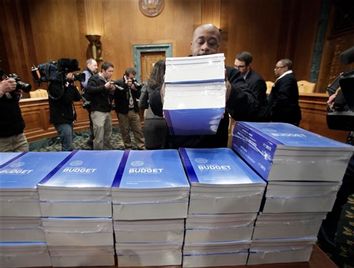
Deficit makes up biggest share of economy since 1945Copies of President Obama's 2012 budget are delivered to the Senate Budget Committee, Monday, Feb. 14, 2011, on Capitol Hill in Washington. (AP Photo/J. Scott Applewhite)(Credit: AP)

Not since World War II has the federal budget deficit made up such a big chunk of the U.S. economy. And within two or three years, economists fear the result could be sharply higher interest rates that would slow economic growth.

The budget plan President Barack Obama sent Congress on Monday foresees a record deficit of $1.65 trillion this year. That would be just under 11 percent of the $14 trillion economy — the largest proportion since 1945, when wartime spending swelled the deficit to 21.5 percent of U.S. gross domestic product.

The danger is that a persistently large gap in the budget could threaten the economy. Investors would see lending their money to the U.S. as riskier. So they’d demand higher returns to do it. Or they’d simply put their cash elsewhere. Interest rates on mortgages and other debt would rise as a result.

And if borrowing turned more expensive, people and businesses might scale back their spending. That would weaken an economy still struggling to lower unemployment, revive real estate prices and restore corporate and consumer confidence.

So far, it hasn’t happened. It’s still cheap for the government to borrow money and finance deficits. But economists fear the domino effect if all that changes.

“The moment when markets react negatively to our budget deficit cannot be known in advance, but we are absolutely in the danger zone,” says Marvin Goodfriend, an economics professor at Carnegie Mellon University’s Tepper School of Business.

Higher interest rates would also raise interest payments on the federal debt. It would be costlier for the government to finance its operations. The interest payments themselves could then make the deficit increase, creating a vicious cycle.

Under the projections in Obama’s budget, the deficit as a share of the overall economy would narrow from 10.9 percent this year to 7 percent next year and eventually to 2.9 percent by the 2018 fiscal year.

But after that, in the remaining years of this decade, the deficit would widen slightly as a percentage of the economy. It would average about 3.1 percent because of escalating costs for programs like Social Security and Medicare as baby boomers age and receive benefits.

Economists generally say cutting the deficit to about 3 percent or less of the economy would be healthy. Deficits at that level are considered “sustainable” — meaning they could be easily financed and wouldn’t make investors nervous about the government’s finances.

Most economists don’t think the deficit should be cut deeply now. They say the economy remains so fragile — unemployment is at 9 percent — that it needs big government spending to invigorate growth.

In this camp is Federal Reserve Chairman Ben Bernanke. He’s argued that now isn’t the time to slash government spending or raise taxes. Instead, Bernanke has urged Congress and the White House to preserve federal stimulus — including tax cuts — in the short run but draft a plan to reduce the deficit over the long run.

A presidential commission last year made recommendations that Bernanke and other economists say could help curb the deficit over the long term. Its suggestions included raising the Social Security retirement age and reducing future increases in benefits. It also proposed increasing the gasoline tax and eliminating or scaling back tax breaks, like the mortgage interest deduction claimed by many Americans.

Obama embraced none of these proposals in his budget. But his plan is designed to cut $1.1 trillion from the deficit over the next decade, two-thirds of it from spending cuts. The rest would come from tax increases, such as limiting the deductions for high-income taxpayers.

In Bernanke’s view, a long-term plan to reduce future deficits would mean lower long-term interest rates and increased consumer and business confidence.

For months, though, longer-term rates have been creeping up, driven by prospects of stronger growth and concerns about higher inflation. The yield on the 10-year Treasury note is now 3.61 percent. That’s up sharply from 2.48 percent in early November.

That increase is making other loans, including mortgages, more expensive. The average rate for a 30-year fixed mortgage just rose above 5 percent for the first time since April.

Rates are still extremely low by historical standards. In 1983, during Ronald Reagan’s first presidential term, the deficit soared to $208 billion, about 6 percent of the economy at the time. The rate on the 10-year note topped 10 percent. And getting a 30-year mortgage meant paying 13 percent.

Economists say that if investors trust that Congress and the White House will curb budget deficits over the long haul, interest rates could stabilize — even if deficits exceed $1 trillion over the next year or two. But if investors lose confidence that Washington policymakers can curb the deficits, rates could rise sharply.

“It’s all about perception,” says Lou Crandall, chief economist at Wrightson ICAP, a research firm.

So far, China, the biggest buyer of U.S. debt, and other countries have maintained their appetites for Treasurys. Foreign demand for Treasury debt has helped keep U.S. interest rates historically low.

The reason is that the United States is still considered a haven for many foreign investors. That point was underscored by Europe’s debt crisis last year, when money poured into dollar-denominated Treasurys.

If the United States had to finance its debt through U.S. investors alone, the government, along with American companies and consumers, would have to pay higher rates.

Last year’s budget deficit totaled $1.3 trillion. That was just under 9 percent of U.S. economic activity. The first time the deficit topped $1 trillion was in 2009.

The growth of U.S. budget deficits has reflected the costs of the wars in Iraq and Afghanistan, the continuation of broad tax cuts, the worst recession since the 1930s and a surge in spending on Social Security, Medicare and the military. The recession prompted higher government spending to stimulate the economy and cushion the effects of the downturn. It also reduced tax revenue.

The Organization for Economic Cooperation and Development estimates that the United States’ deficit as a share of the U.S. economy will be smaller — around 8.8 percent– than the president’s budget estimates.

Still, that would be a higher figure than for other major industrialized countries. The OECD projects, for example, that Britain’s deficit this year will be about 8.1 percent of its economy. Germany’s deficit is expected to make up 2.9 percent of its economy, Japan’s 7.5 percent.

“So far, investors haven’t been bothered by large U.S. budget deficits,” says Jim O’Sullivan, economist at MF Global, an investment firm. “The fear is that could suddenly change. It’s not clear whether investors will remain patient once the U.S. recovery is on track.”

Continue Reading Close

Bernanke defends Bush’s tax cuts, inflation

In a "60 Minutes" appearance, the Fed chairman continues to champion his $600 billion bond-purchase plan

  • more
    • All Share Services

WASHINGTON (AP) — Federal Reserve Chairman Ben Bernanke is stepping up his defense of the Fed’s $600 billion Treasury bond-purchase plan, saying the economy is still struggling to become “self-sustaining” without government help.

In a taped interview with CBS’ “60 Minutes” that aired Sunday night, Bernanke also argued that Congress shouldn’t cut spending or boost taxes given how fragile the economy remains.

The Fed chairman said he thinks another recession is unlikely. But he warned that the economy could suffer a slowdown if persistently high unemployment dampens consumer spending.

The interview is part of a broad counteroffensive Bernanke has been waging against critics of the bond purchase plan the Fed announced Nov. 3. The purchases are intended to lower long-term interest rates, lift stock prices and encourage more spending to boost the economy.

Critics, from Republicans in Congress to some officials within the Fed, say they fear the Fed’s intervention could spur inflation and speculative buying on Wall Street while doing little to aid the economy.

On other issues in the “60 Minutes” interview, Bernanke:

– Argued that unemployment would have been far higher — “something like it was in the Depression, 25 percent” — had the Fed not provided extraordinary aid to Wall Street firms, banks and other companies to ease a credit crisis.

– Said it could take four or five more years for unemployment, now at 9.8 percent, to fall to a historically normal 5 percent or 6 percent.

– Reiterated that the Fed is prepared to buy even more than $600 billion in Treasury bonds over the next eight months, should it decide the economy needs the fuel of even lower interest rates.

– Argued that the risk of inflation is overblown. Bernanke said he’s “100 percent” confident the Fed will be able to ward off inflation, when the time is right, by raising interest rates and unwinding its stimulative programs.

– Called the risk of deflation — a prolonged drop in prices, wages and the values of homes and stocks — “pretty low.” He said the likelihood would have been greater if the Fed weren’t maintaining super-low interest rates.

– Urged Congress to improve the nation’s tax code “by closing loopholes and lowering rates” for individuals and companies. He said doing so would create greater incentives for people to invest.

In material from the interview that didn’t make CBS’ broadcast but was later posted online in video form, Bernanke reiterated his view that an artificially low Chinese currency is “bad for the American economy because it hurts our trade.”

It isn’t helpful for China, either, he said, because it makes it harder for Beijing’s policymakers to keep China’s economy and inflation from overheating.

Critics who fear the Fed’s bond purchases are raising the risk of inflation have complained that the purchases mean the Fed is, in effect, printing more money. In the interview, Bernanke called that a “myth.” He insisted the Fed isn’t printing money when it buys Treasurys and said the program won’t expand the amount of money in circulation in a “significant way.”

Lou Crandall, chief economist at Wrightson ICAP, said Bernanke is right that the Fed’s purchases won’t significantly change the amount of money circulating in the economy. That’s mainly because banks aren’t lending most of the money they already hold in reserve. When the Fed buys Treasurys, it increases the reserves in the banking system. For those reserves to actually “create” money, the banks would have to lend it.

Still, Crandall suggested that the bond-buying program creates the appearance of printing money, something that could put the central bank’s credibility at stake.

Bernanke’s appearance Sunday night is part of a public-relations blitz he’s mounted since the Fed announced the program Nov. 3. In private and public appearances, Bernanke has sought to explain and defend the program to ordinary Americans, investors and lawmakers on Capitol Hill.

His efforts have included an Op-Ed article in The Washington Post and discussions with students in Jacksonville, Fla., economists in Jekyll Island, Ga., business people in Columbus, Ohio, central bankers in Europe and members of the Senate Banking Committee.

Criticism has come from both home and abroad. Officials in China, Germany, Brazil and other countries have argued that the Fed’s plan is a scheme to give U.S. exporters a competitive edge by keeping the value of the dollar weak. A weak dollar makes U.S. goods cheaper abroad and foreign goods more expensive in the U.S.

It’s rare for a sitting Fed chairman to grant an interview, whether for broadcast or print. But this was Bernanke’s second appearance on “60 Minutes.” His first was in March 2009. At the time, he was facing anger over Wall Street bailouts and rising anxiety about the economy.

In the interview that aired Sunday, Bernanke pointed out that the economy is growing at an annual pace of around 2.5 percent — far too slow to reduce unemployment. For a self-sustaining recovery, consumers and businesses would need to spend more, so the economy could grow faster.

Bernanke has said he hopes the Fed’s bond-buying program will help lift stock prices. In part, that’s because lower yields on bonds would cause some people to shift money into stocks.

Higher stock prices would boost the wealth and confidence of individuals and businesses. Spending would rise, lifting incomes, profits and economic growth. Bernanke has referred to this as a “virtuous cycle.”

But when asked in the interview whether the recovery is self-sustaining, Bernanke responded: “It may not be. It’s very close to the border.”

Given the economy’s still-weak growth, he said: “We’re not very far from the level where the economy is not self-sustaining.”

Continue Reading Close

Economic growth slightly faster than first thought

Commerce Department says GDP increased at a 2.5 percent annual rate in the July-September quarter

  • more
    • All Share Services

The economy grew slightly faster last summer than first thought, benefiting from stronger spending by U.S. shoppers and improved overseas sales of U.S. goods.

The Commerce Department reports that gross domestic product increased at a 2.5 percent annual rate in the July-September quarter. That was better than the 2 percent pace initially estimated last month.

More brisk spending by American consumers, especially on autos and other big-ticket goods, and stronger sales of U.S. exports to foreign customers were the main reasons for the upgrade.

Still, the modest improvement isn’t enough to drive down the 9.6 percent unemployment rate.

Federal Reserve orders new “stress tests” for banks

Considered a key part of ensuring financial system's stability, but results will not be made public this time

  • more
    • All Share Services

The nation’s largest banks must undergo new stress tests to show they can weather another recession, and the Federal Reserve said those that pass them can boost dividends paid to investors.

Banks would need to show the Fed’s bank examiners that they’re in good financial health and that they have adequate capital to absorb potential losses over the next two years.

The Fed oversees Wall Street’s biggest banks, including Citigroup, Bank of America, JPMorgan Chase & Co., and Wells Fargo.

Banks have to file plans to the Fed showing that they would have sufficient capital cushions to cover any losses under different economic scenarios — including if the economy were to fall back into a recession, Fed officials said.

All of the 19 largest banks overseen by the Fed must file the plans — even if they don’t intend to increase their dividend payments. The plans must be filed by Jan. 7, 2011.

The upcoming round of “stress tests” are a key part of the Fed’s ongoing efforts to make sure that banks — and the entire financial system — are stable. The safety and soundness of the banking system is an important ingredient to the economy’s health.

The Fed’s first stress tests were conducted in 2009 as the country was still reeling from the worst recession and financial crisis since the 1930s. Those results were made public in a move to boost confidence in the then-fragile U.S. banking system. The results of the upcoming exams, however, won’t be made public, Fed officials said. That’s in line with banking regulators’ long tradition of keeping such information confidential.

Banks wanting to boost their dividends also would need to show the Fed they have a plan to comply with stricter global capital requirements recently agreed to in Basel, Switzerland.

During the financial crisis, banks cut their dividend payments. By boosting their payments, banks may be able to attract new investors. JPMorgan Chase is among the banks interested in boosting dividend payments.

Continue Reading Close

Page 1 of 2 in Jeannine Aversa