Jeff Horwitz

“Make levees, not war”

Rita and infighting among organizers threatened to make the day a washout, but Saturday's massive antiwar protest took Washington by storm.

  • more
    • All Share Services

Though Saturday was the first day a permit had been granted for an antiwar march past the White House since the Iraq war began, one could be forgiven for having low expectations for the event.

To begin with, the joint organizers, International ANSWER and United for Peace and Justice (UFPJ), feud so regularly that they had to sign a pact promising not to attack each other until the event was over.

Then there was ANSWER’s rejection of message control — its leadership demanded that each of its component organizations be allowed to protest issues besides the war. Starting at 9 a.m., therefore, the Palestinian boosters took over Farragut Square with their own signs and chants, while bands of anarchists, affordable housing advocates, and Hugo Chavez supporters staked out intersections around D.C.’s downtown.

Finally, rain was in the forecast, and Hurricane Rita was already sure to dominate the next morning’s lead news slot.

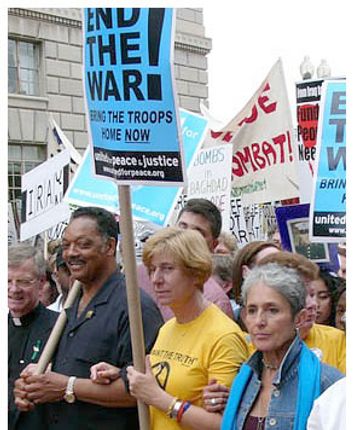
But yesterday’s protesters beat the odds and pulled off what was certainly D.C.’s biggest antiwar demonstration since the Iraq occupation began. Organizers claimed as many as 250,000 demonstrators attended; though D.C. police estimates were more conservative, none pegged the crowd at below 100,000. By the time the rally convened at 11:30 a.m., scores of demonstrators filled the Ellipse, spilling onto the Mall, the streets around the White House, and the Washington Monument — a hopeful sign that the effectiveness of the peace movement may have reached a turning point.

While the half-dozen UFPJ and ANSWER speakers held forth on incongruous topics ranging from discrimination against American Muslims to the illegitimacy of Bush’s 2000 Florida victory, their two principal demands were an immediate withdrawal of American troops from Iraq and a new federal focus on the devastated Gulf Coast. “National security begins in New Orleans, homeland security begins at home,” Jesse Jackson told the crowd. “Bring the troops home now.”

Other speakers made the same Baghdad-New Orleans link, reminding the crowd that many Louisiana National Guardsmen were fighting abroad when the hurricane struck. Demonstrators waved signs bearing the phrase “Make levees, not war” in response. “I think that it’s broadening the focus,” Baptist Peace Fellowship demonstrator Tom Burkett said of the combined antiwar and disaster relief message. “Are we going to be a better country by spending another $200 billion [in Iraq] or spending it on the Gulf Coast?”

It would have been a stretch to call the speech given by bereaved military mother turned peace activist Cindy Sheehan memorable, but those gathered loved it anyway. In a strained voice, she copiously congratulated the audience for coming and condemned the moral abominations of torture and preemptive war before demanding that American troops be immediately brought home. “We’re going to say not one person should have died, not one more should die,” she said with the White House lawn at her back. “Can you scream that to the White House?” The audience could.

For Sheehan, it was the final stop on the Bring Them Home Now Tour. Operating out of a tent dubbed “Camp Casey” in honor of her dead son, the military family organizations that have traveled with Sheehan were neither the protest’s largest nor its most vocal contingent. As the afternoon march began, several such families opted to sit it out. “Can’t march,” said Phil Waste, a sturdy 65-year-old who sat on a bench with his wife, Linda, watching demonstrators carrying dozens of flag-draped cardboard coffins stream by. “My knees are shot.” With three sons and two grandchildren currently serving in the military, the Shellman Bluff, Ga., couple had been traveling with Sheehan for the last six weeks as members of Military Families Speak Out. Seeing her in Crawford, Texas, they said, had convinced them they owed it to their children to protest.

“They’re being misused,” Phil said. “They’re forward observers, and now they’re being used as policemen, driving up and down the streets of Baghdad like ducks in a shooting gallery. They’re not trained for that.” The couple believes stress is taking a great toll on their family: One of their sons brought a backpack full of disposable cameras with him on his first deployment, Linda said, and “when he got home, he threw them all away. He said he never wanted to see the pictures.”

Demonstrators like the Wastes and Cindy Sheehan added gravitas to an event in search of it. As folk musician Steve Earle would bluntly state later in the afternoon, “Cindy simply has credentials that a lot of us do not have. We needed her.”

The press coverage in the run-up to the protest — which has hardly been favorable to the antiwar movement in the past — this time characterized the protesters as a more mainstream force to be reckoned with. “Antiwar Rally Will Be a First for Many,” the Washington Post’s front-page headline announced Friday. “Focused Message Draws Protesters of All Types.” Associated Press reporter Jennifer Kerr somehow found Paul Rutherford, a 60-year-old lifelong Republican-cum-peace activist from Vandalia, Mich. “President Bush needs to admit he made a mistake in the war and bring the troops home, and let’s move on,” Rutherford declared.

Although there must have been a few other Rutherfords scattered throughout the crowd, the overwhelming majority of attendees were committed activists whose politics ranged from progressive to leftist — the sort of people who always go to war protests, or at least stay home and feel guilty about it.

That’s not to say Sheehan and crew didn’t have a profound impact on the protest — they did — but it was largely an internal one. Lauren Sullivan, a Lawrence, Kan., graduate student who took a hiatus to staff Sheehan’s now-mobile Camp Casey, believed Sheehan cleared much of the static out of the antiwar movement’s message. “Cindy got it down to ‘What noble cause?’ and ‘Bring them home now,’” Sullivan said. Everywhere Sheehan went on Saturday, she was mobbed by well-wishers, seeming to escape the often-fractious ideologies of protest politics: Even bandanna-masked anarchists said she’s cool.

Whether due to Sheehan’s media juggernaut or the fallout over the Bush administration’s continuing stumbles at home and abroad, some of the organizers of Saturday’s protest spoke for the first time like politicians with something to lose. “We are at a tipping point whereby the antiwar sentiment has now become the majority sentiment,” ANSWER coordinator Brian Becker proudly proclaimed. Nowhere does he touch upon his former statements to Workers World regarding Iraq’s “long, proud tradition of anti-colonial resistance.” Good polling data can do strange things to people.

That’s not to suggest that the antiwar movement has come down with anything resembling military discipline. In the frequently carnivalesque march that looped around the White House and downtown, one could spot just about any slogan imaginable, from the 9/11 conspiracy theorists to the simply unintelligible: Riding a green ladies’ bicycle, a white-bearded hippie sanctimoniously coasted past a line of stationary D.C. cops, holding aloft a poorly lettered sign reading “WHY? Motherfucker$.” Four of D.C.’s finest double over laughing in his wake. “The city prefers the officers to keep a straight face,” their sergeant said. “Sometimes that’s hard.”

Earlier that afternoon, a group of anarchists splintered off the parade route onto K Street NW, overturned newspaper boxes and, according to Jeremy Hammond, a self-described “anticapitalist traveler,” controlled the street for two hours. The police arrested one or two, and chased the rest out on motorcycles. Later, Hammond says, the anarchists regrouped in front of a military recruiting office, and succeeded in being shot at with rubber bullets. (The skirmish has not appeared in any other published accounts.)

In front of the J. Edgar Hoover FBI Building, a few hundred counterprotesters drew notice far out of proportion with their numbers. Organized by Karl Singer, a New Jersey I.T. technician from a military family, the “Support the Troops” rally lined a block heavily fortified by barriers and police, baiting the less pacifistic protesters through a bullhorn on everything from abortion to personal grooming. “Even people in the military don’t want to fight wars,” Singer admitted in a reflective moment. “But sometimes wars are necessary.” Behind the counterprotesters’ lines, a solidly built young man with two prosthetic legs rode a Segway up and down the block like a general patrolling his ranks.

These are all minor ripples, though, not much more of a crisis than the light drizzle that fell for a few minutes at the march’s beginning.

In the late afternoon, the protesters, tired after the slow-moving march, begin to put down their signs and disperse. A Salvation Army employee named Kevin Lindsey, who says he is “embarrassed he didn’t get involved in war protests earlier,” has gotten stuck with the front end of one of the flag-draped coffins. He isn’t sure which of the dozens of organizations the prop belongs to — he just took over, he says, because “somebody was getting really tired.” As he nears the Washington Monument, Lindsey, not sure what to do with it, says, “I know I can’t just put it down.”

My right-wing degree

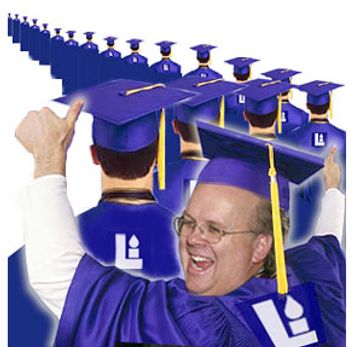
How I learned to convert liberal campuses into conservative havens at Morton Blackwell's Leadership Institute, alma mater of Karl Rove, Ralph Reed, Jeff Gannon and two Miss Americas.

  • more
    • All Share Services

My right-wing degree

One recent Sunday, at Morton Blackwell’s Leadership Institute, a dozen students meet for the second and final day of training in grass-roots youth politics. All are earnest, idealistic and as right wing as you can get. They take careful notes as instructor Paul Gourley teaches them how to rig a campus mock election.

It’s nothing illegal — no ballot stuffing necessary, even at the most liberal colleges. First you find a nonpartisan campus group to sponsor the election, so you can’t be accused of cheating. Next, volunteer to organize the thing. College students are lazy, and they’ll probably let you. Always keep in mind that a rigged mock election is all about location, location, location.

“Can anyone tell me,” asks Gourley, a veteran mock electioneer, “why you don’t want the polling place in the cafeteria?”

Stephen, a shy antiabortion activist sitting toward the rear of the class, raises his hand: “Because you want to suppress the vote?”

“Stephen has the right answer!” Gourley exclaims, tossing Stephen his prize, a copy of Robert Bork’s “Slouching Toward Gomorrah.”

The students, strait-laced kids from good colleges, seem unconvinced. The lesson — that with sufficient organization, the act of voting becomes less a basic right than a tactical maneuver — doesn’t sit easy with some students at first. Gourley, a charismatic senior from South Dakota and the treasurer of the College Republican National Committee, assures them: “This is not anti-democracy. This is not shady. Just put [the polling place] somewhere where you might have to put a little bit of effort into voting.” The rest, Gourley explains, is just a matter of turnout.

When the state or national candidate you’re backing wins by a suitably large margin, as he or she surely will, have the nonpartisan group that sponsored the election sign off on your prewritten celebratory press release and send it statewide. Reporters will almost certainly ignore it, but after a dozen similar victories, they’ll start dashing off articles about the youth phenomenon behind your candidate’s campaign — or better yet, just start plagiarizing your press releases.

There is no better place to master the art of mock-election rigging — and there is no better master than Morton Blackwell, who invented the trick in 1964 and has been teaching it ever since. Blackwell’s half-century career in conservative grass-roots politics coincides neatly with the fortunes of the conservative movement: He was there when Goldwater lost, when Southern voters abandoned the Democratic Party in droves, and when the Moral Majority began its harvest of evangelical Christian voters. In the 1970s, Blackwell worked with conservative direct-mail king Richard Viguerie; in 1980, he led Reagan’s youth campaign. Recently, he’s been fighting to save Tom DeLay’s job.

Yet Blackwell’s foundation, the Leadership Institute, is not a Republican organization. It’s a nonpartisan 501(c)(3) charity, drawing the overwhelming majority of its $9.1 million annual budget from tax-deductible donations. Despite its legally required “neutrality,” the institute is one of the best investments the conservative movement has ever made. Its walls are plastered with framed headshots of former students — hundreds of state and local legislators sprinkled with smiling members of the U.S. Congress, and even the perky faces of two recently crowned Miss Americas. Thirty-five years ago, Blackwell dispatched a particularly promising 17-year-old pupil named Karl Rove to run a youth campaign in Illinois; Jeff Gannon, a far less impressive student, attended the Leadership Institute’s Broadcast Journalism School.

The institute’s classes aren’t tickets into an exclusive and shadowy club, however: I am also an institute graduate. In March, I attended its Youth Leadership School, a one-weekend, 28-hour crash course in political organizing. Registration was open to the public and cost $60, which got me a sourcebook, six free meals, up to three nights in a dorm, and a six-hour lecture on political principles delivered by the 65-year-old Blackwell himself. The morning I arrived at the Leadership Institute, I identified myself as a reporter for Salon. “That’s great,” said communications director Michelle Miller. By the end of the weekend, Blackwell took me on a tour of the headquarters, chatted with me for nearly an hour, and gave me a copy of the institute’s antisocialism in-house film, “The Roots of the Ultra Left.” The institute is a very friendly place.

Over the last 25 years, more than 40,000 young conservatives have been trained at the institute’s Arlington, Va., headquarters in everything from TV makeup for aspiring right-wing talking heads to prep courses for the State Department’s Foreign Service exam. Classes are taught by volunteers recruited from the ranks of the conservative movement’s most talented organizers, operatives and communicators.

The Leadership Institute has succeeded, in part, because it’s had little to no competition from the left. College campuses may still be havens for liberal thought, but the right-wing students are the ones organized enough to win major battles. Perhaps expecting that American youth would organize themselves as they did in decades past, progressive organizations have been outstripped by their conservative counterparts in professionalizing the ragtag world of college activism. “When it comes to campus controversy, from affirmative action to free speech, the right wing pumps in money and expertise and shows [students] how to out-hustle their opponents,” says David Halperin of the liberal Center for American Progress.

Still, Blackwell says conservatives are underdogs on college campuses. Conservative students may be better organized, but they’re still outnumbered. The Leadership Institute contends that liberal higher education is robbing the conservative movement of new blood — and thereby handicapping the institute’s efforts. “You know, the most conservative students are the freshmen,” Blackwell told me. “There is an acculturation there.”

And that’s where the institute is taking its fight. For most of its 25-year history, it has focused on grooming students to work in conservative politics; it’s now increasingly devoting its efforts to making campuses more conservative places. Through its Campus Leadership Program, the institute is leading a growing effort to found and support a national network of conservative student groups and publications capable of permanently altering the intellectual and social environment of universities to conservatives’ advantage. That goal alone is a stark rejection of the standard conservative complaint that post-Vietnam War higher education is not just grossly liberal, but irredeemably so. Already, the program has shown considerable success. Asked about his campus initiative, Blackwell simply says, “You’re talking about the major project for the rest of my life.”

In the wake of the 2004 election, some progressive groups have been working to reinforce their positions on campus. Last February, the Center for American Progress launched Campus Progress, a student activism support center, to combat what Halperin describes as “30 years of effective organizing” by conservative groups like the Intercollegiate Studies Institute, Young Americans for Freedom, and of course, the Leadership Institute. But Blackwell is unfazed by the competition. “If they asked me, which they haven’t, I could let them know that it’s a lot harder than it appeared on the surface,” he told me. “You’ve got to work years before you see any results.”

And Blackwell has put in those years. A young Louisiana Republican in the days when Democrats owned every statewide office, he cut his political teeth on Barry Goldwater’s doomed 1964 presidential bid. “Don’t fully trust anyone until he has stuck with a good cause which he saw was losing,” is an institute maxim rooted in Blackwell’s own political education. “After Goldwater’s defeat, the number of people who would admit to being movement conservatives could all have fit into an average phone booth,” Blackwell said in an interview. “And among us, we didn’t have a dime for a telephone call.”

That was a long time ago. According to Blackwell, allied “movement conservatives” took the first steps toward outmaneuvering their party’s moribund minority leadership in the ’70s. More than a test of character, conservatism’s formerly abject status provided the key to those gains. With a wealth of political talent but few resources or constituencies, conservatives had no choice but to look beyond the two- and four-year cycles that dictate traditional political strategy. Instead of fighting an intra-party struggle they were certain to lose, they built an infrastructure outside the Republican Party dedicated to promoting talent, not winning the next election.

The Leadership Institute is a perfect example of that strategy, according to Peter Murray, a progressive management trainer who studied the institute’s model before launching his own nonprofit political training organization, the Center for Progressive Leadership, last year. “Being a 501(c)(3) not only means they can get tax deductions for their donors and build endowments, but they’re forced to look long term,” Murray says. “They’re not allowed to endorse candidates and get sucked into electoral politics. Year in and year out, all they do is build leaders.”

It’s an approach, Murray believes, that has long since paid off. “Sure, [Blackwell] has trained Karl Rove and Ralph Reed and Grover Norquist and 223 other legislators and members of Congress,” Murray notes, “but more importantly, he’s trained 40,000 other local organizers.” The institute’s graduates, in other words, are part of a movement. “We spent $2 billion trying to win this last election,” Murray says of progressives. “They already spent 25 years, and nearly $100 million, building the talent pool that won the election. And which will consistently win them elections for the next several decades.”

The structure of Blackwell’s Campus Leadership Program is simple. The Leadership Institute trains promising conservative college graduates over the summer and dispatches them to campuses in the fall with a mandate to start conservative student organizations. Need $500 and some ideas to start a combative right-wing campus publication? The institute would love to help you. Is the campus administration discriminating against your Second Amendment club? The institute will help you take your cause to the Internet. No one on campus at your Christian college has ever heard of the institute? Staffers will be glad to drive down, take you to a steakhouse, and talk it up. Last year, the CLP doubled in size, to 418 clubs and counting. By the end of 2006, Blackwell is confident he will have created 1,000 conservative campus organizations.

Unlike chapter-based political organizations, CLP clubs are unaffiliated with either the Leadership Institute or each other. According to Blackwell, this trait offers a serious advantage: “No purges.” The clubs’ independence also comes with the benefit of plausible deniability. “You can get away with stuff that you would take a lot of flak for doing in the College Republicans,” says CLP director Dan Flynn. “Because we’re independent, we can do activities that push the envelope,” agrees University of Miami senior Sarah Canale, whose CLP-organized Advocates for Conservative Thought threw an affirmative action bake sale last year in which the price of a cupcake varied according to the race of its buyer. That it was controversial, she believes, was a victory in itself.

The Leadership Institute teaches the same principle. Controlled controversy — making your point in a manner so bombastic that your opponents blow their cool — is a Blackwell specialty. Before the 2004 Republican Convention, the conservative elder personally went to a drugstore and bought little pink heart stickers, bandages and purple nail polish. At home, he made the “Purple Heart Band-Aids” that he later distributed in Madison Square Garden to mock John Kerry’s war wounds. From Blackwell’s perspective, the Kerry camp’s outrage at the gag was a tactical disaster. Democratic Party chairman Terry McAuliffe, Blackwell says, kept the story alive for days by “running around like a chicken with its head cut off.”

A stunt is one way to get press — but a more effective and sustainable method is to start your own publication. The Leadership Institute trains around 250 students yearly in its student publication workshop, and CLP staff assisted in launching 22 campus publications last year alone.

The Rutgers Centurion is a conservative monthly that got off the ground this fall with institute help. Rutgers student James O’Keefe founded the magazine after coming across a conservative publication at Tufts. “I said, why don’t we have this?” O’Keefe remembers. He taught himself a page-layout program and got in touch with the Leadership Institute, which dispatched a staffer to take him and his coeditors to dinner at an upscale local brewery. The institute gave O’Keefe books on starting a publication, awarded him a $500 “Balance in Media Grant,” and suggested never-fail places on campus to ferret out liberal excess. “They were really excited,” O’Keefe recalls.

The Rutgers Centurion has since analyzed faculty campaign contributions that favored John Kerry over George W. Bush 104 times over, and it accused one of Rutgers’ most esteemed alumni, African-American author and actor Paul Robeson, of being a Stalinist. The magazine has published poetry about abortion from a fetus’s point of view and run allegations of prejudice against Condoleezza Rice, “The Black Woman Liberals Love to Hate.”

The Centurion’s favorite subject, however, seems to be people who don’t like the Centurion. Rutgers student Tabitha Rice earned the February “Liberal of the Month” title for allegedly defacing copies of the Centurion’s previous issue, and in the spirit of Valentine’s Day, the editors framed an excerpt from their hate mail — “‘F*** [The editors of The Centurion.] F*** Them till they’re dead’” — in a heart-shaped box.

The Centurion’s assertion that campus liberals are intolerant lends its vitriolic criticism of leftists the veneer of the free speech movement. CLP coordinator Flynn, the author of “Why the Left Hates America,” recalls that during a speech at Berkeley, he encountered “a Nazi-style book burning” of his work and an attempt to rip his microphone cord from the wall. That might not have quite the allure of Mario Savio’s rallying a crowd from a squad car’s roof during Berkeley’s student protests, but it’s a start.

CLP publications play a crucial role in publicizing such run-ins. Right-wing watchdog groups like Accuracy in Media have railed against liberal bias in the classroom for years, but as outsiders, they lack both standing and a direct connection to campus life. CLP publications have both, allowing them to monitor bias in every classroom. In December, the editor of the Louisville Patriot, a CLP-organized publication at the University of Louisville, reported that sociology lecturer John McTighe had made a very, very tasteless joke about how religious conservatives who had voted for Bush ought to be shot. With sufficient outrage, the story jumped from the Patriot to the local media and the Internet, resulting in McTighe’s suspension and a thoroughly public debate of liberal bias in, of all places, Kentucky.

Sparking such scandals is “absolutely” a part of CLP’s plan, Blackwell says. “In the last year or so, not taking into account the flap over Ward Churchill, you have no doubt noticed more news coverage about complacent leftists’ abuses on campus,” he says. “Academia is the last unbreached citadel of the left, and I believe we are today over the moat.”

There’s still plenty to do before then. Chris Stio, an institute staffer who directed the Bush-Cheney field operations in northeast Michigan, warns his students not to buy into second-term crowing about America’s irrevocable slide into conservatism. “Enough people were yelling and screaming about the president that if they’d actually picked up the phone book and started calling, they might have won,” he says. “They went to concerts, they bashed the president, but they didn’t work. If enough people had, maybe we’d have a different president. The election was not inevitable. And too many think it was.”

Some progressives have come to that conclusion as well. “This was certainly needed 25 years ago,” says Peter Murray, of the Center for Progressive Leadership. “Investing beyond any individual election cycle is the way that we’re going to develop the progressive movement into a more robust, coordinated, compact force that can win elections.” But getting donors to think beyond 2008 is a tough sell. “Our budget this year will be just over a million. We’d love to be bigger than that,” he says. “It’s really going to be up to the progressive donor community as to whether they’re going to look long term and invest in a superstructure. If they do, we can build it relatively quickly.”

In the meantime, the Leadership Institute will continue its work. Blackwell has found plenty of humor in his recent vilification as the evil genius that smoothed fake reporter Jeff Gannon’s path to White House press briefings. “If they want to believe that there’s a vast conspiracy, and they want to waste their time trying to decide who gives all the orders to the conservative movement, well, let ‘em spend their time on that,” he says, laughing.

The Leadership Institute has better things to do, Blackwell says, than conspire to put a male escort up to lobbing softballs to White House spokesman Scott McClellan. For example, training the next generation of Karl Roves.

“Everyone knows that for certain breeds of dogs it is customary to cut their tails short when they are a few weeks old,” begins Blackwell’s lecture to us on the importance of releasing negative information on your opponent incrementally. “Every time you clip the puppy’s tail it hurts. It hurts. You might traumatize the puppy for life.”

“The moral is that if it’s your tail that’s being clipped, you want it clipped once,” concludes Blackwell. “But if you get a chance to clip your opponent’s tail, clip that puppy as often as you can.”

It may be hardball, but it isn’t cheating, and it would be far less effective if it were. “These are powerful techniques,” Blackwell tells the class at the end of his marathon lecture. “So I don’t want anyone going out of here and acting unethically. It’s not necessary.”

Continue Reading Close

A new kind of orange alert

  • more
    • All Share Services

Negotiating the transition between government and the private sector can be tricky; luckily for Tom Ridge, he won’t have to do it alone. Home Depot announced yesterday that it has hired the former Homeland Security chief to sit on its board of directors. Considering how much Ridge has already done to promote novel uses for duct tape and plastic sheeting, his $110,000 yearly base salary must seem like a bargain.

“An explosion waiting to happen”

Iraq expert Amy Hawthorne discusses the possibilities -- but mostly the pitfalls -- of Sunday's elections.

  • more
    • All Share Services

In Iraq, in the White House and around the world, all eyes are fixed on Sunday, the day of Iraq’s elections. Will those elections prove to be the start of a brighter day for the violence-torn country — or the beginning of an even grimmer chapter?

Last week, in what would once have seemed a breathtaking display of honesty but now comes across as a simple acknowledgment of reality, the commander of American forces in central and northern Iraq admitted to a USA Today reporter that he could not protect Iraqi voters on Election Day. “I wouldn’t begin to say that,” Maj. Gen. John Batiste said when asked whether Iraqis could safely cast ballots. “It’s very possible there will be some of … the suicide vests and everything.” It is also possible, Batiste conceded, that some of the Iraqi security personnel entrusted with guarding polling stations would themselves be insurgents.

It’s hard to pinpoint when the Bush administration’s public optimism about the elections began to falter, but by now even the always-upbeat president is heavily hedging his bets. “The fact that they’re voting in itself is successful,” he told reporters Wednesday, setting the bar low enough for any banana republic to pass.

To get a sense of the landscape of post-vote Iraq and the possibilities and pitfalls of Election Day, Salon spoke with Amy Hawthorne, a former analyst at the Carnegie Endowment for International Peace whose work has focused on promoting democracy in Arab countries. “It’s almost surreal to think about the circumstances under which these elections will be taking place,” Hawthorne told Salon. “But like almost everything in Iraq, the United States finds itself with no good options.”

Do you think if officials in the Bush administration weren’t bound to the Jan. 30 election date they would have wanted to postpone it?

It’s difficult to say because the administration is driven by a political timetable that isn’t completely tied to the realities on the ground in Iraq. That said, there are three contradictory pressures on the administration that have made the timing of the election very difficult. The first is the administration’s own desire to demonstrate to the Iraqis and the American public that we aren’t going to be staying in Iraq indefinitely, and what better way to signify that we’re moving forward than by holding an election? It’s the ultimate symbol of political progress in a post-conflict situation.

The second pressure is obviously the insurgency, which would argue for delaying the election until the violence subsides.

But the third factor is that a lot of people in Iraq — most notably Shiite political forces — are very keen on having an election because they want to gain political power for themselves. If the elections were to be postponed, there is the possibility that key players among the Shiite community would turn against the United States, and that’s a very strong pressure to hold the elections quickly.

So now’s as good a time as any?

Well, I want to be clear: I think it’s a very bad time. It’s almost surreal to think about the circumstances under which these elections will be taking place. But like almost everything in Iraq, the United States finds itself with no good options.

Sunni Muslims aren’t expected to widely participate in the election, but even if they did, they’d still end up being a distinct minority. Why is their participation so crucial to the success of the election?

Many observers of Iraq really believe that the division of the country along ethnic and sectarian lines would be a very dangerous trend for the country. And an election that does not have at least a decent amount of participation from different groups in Iraq risks setting up the conception that political groupings are based primarily on ethnic or sectarian identity, and consolidating the de facto divisions we already see taking place among the Shia, the Sunnis, the Kurds, etc. So the vote does matter, and it matters who takes part, and how many votes they get, because you’re planting the seeds for a future system.

From what I can tell, there are Shiite political players in Iraq who are interested in having the constitution-drafting process not be exclusionary, and including Sunnis in the process by appointing them. That is a positive development, obviously, but there is a kind of legitimacy that comes from being elected. With a National Assembly where the vast majority of the members were elected by voters and some people were appointed, the process would be skewed.

There have been very divergent estimates of what turnout will look like. You wouldn’t want a hazard a guess on that?

I have no idea. In our own country, people can poll and predict turnout, and if it’s raining that day, the turnout might be very low. In a situation like Iraq, it’s difficult even to know what kind of information is being disseminated at the community level. From what I can tell from talking to people who have recently been there and reading news reports, there is a large degree of enthusiasm about the process but a lack of information about what these elections are actually for. I’m not sure that the voter education program has managed to explain to people what they’re voting for.

Also, we don’t know how powerful the intimidation campaigns are. If there are rumors going around that people’s families are going to be killed if they go and vote, that will keep people home. I think what might be just as interesting as the turnout in a way is seeing how the Bush administration spins the turnout numbers. I guess some of their polling suggests that the turnout might be about 60 percent, and now administration officials are saying, “Well, that’s what the turnout was in our presidential election, and that was legitimate.”

Considering how confused the campaign season has been, how do you think people will decide whom to vote for?

I’m just purely speculating, but my guess is that because of the nature of the election system and the security situation — many candidates are not campaigning openly, and their names aren’t even being published — the information that people have about whom they’re voting for is limited.

There are many social forces in Iraq that are probably more powerful than the media and whatever information campaigns the U.N. might be sponsoring. People are going to be making decisions based on those kinds of forces: who people in their family are voting for, what is being said at the mosque and so on. People will vote for candidates from their community whom they know, and the Shiite-affiliated candidates have a really powerful network of mosques and other religious institutions behind them.

From what I can tell from media accounts, a lot of people know maybe the number of a particular candidate list, and maybe that [Grand Ayatollah Ali] Sistani encouraged them to support that list. And that’s what they’ll be voting on.

How much of Iraq’s vote is Sistani going to control?

I can’t hazard a guess in terms of numbers, but the Shiite religious institutions, and especially the ones in Najaf that Sistani influences, are very powerful. There’s probably nothing in terms of organizational ability that comes close. There aren’t strong political parties, there isn’t a strong civil society, and there isn’t a strong media. And while it’s not that religion is the only influence, Sistani is the biggest player in the most powerful institution — so far — in the country.

In light of Iraq’s colonial history, would you say that an Iraqi national identity really exists? Are we trying to hold an election in a country where people don’t primarily think of themselves as citizens of that country?

All I can really say is that you get two very different answers to that question from Iraqis themselves. Some believe there is a very strong Iraqi identity, similar maybe to Egyptian nationalism in the sense that it’s historic. Other people I talk to take the complete opposite view, saying, “No, there isn’t any such thing. We’re a nation that was cobbled together, and now that the repressive system holding us together has been broken apart, there’s no way we can stay together.”

I think that how people answer that question will ultimately be based on how successful the reconstruction process is. Seeing economic success, security and a workable pluralistic system will encourage them to believe in a national identity. But if Iraq continues to be a state that cannot provide security or jobs for many of its citizens, Iraqis are more likely to say, “A national identity doesn’t make sense to us. We need to subdivide.”

Apparently there isn’t going to be on-the-ground election monitoring. What do you suppose the odds are that the election will be widely perceived as nonfraudulent?

I’ve worked on election observation issues a lot in the past, and it’s important to keep in mind that the presence of international observers does not forestall the perception that the election was fraudulent. Observers can help, as we just saw in Ukraine, but just having them doesn’t necessarily mean that they’ll give legitimacy to the process.

This is going to sound strange, but in a situation that’s as politicized as this one is, it may be better in some ways that there aren’t going to be international monitors. I think that the political pressure on monitors to pass a judgment on the quality of the election would be very strong, so I think that even if the observers themselves had lots of integrity, it would still be tricky.

I think the legitimacy of the process will be contested based on the results. This is not an election after a war when all the key players have come together and negotiated a framework for the country to move forward, and agreed to accept the results no matter what happens. There hasn’t been that coming-together process in Iraq, even though the U.S. has tried to foster it.

The violence in Iraq has recently moved from being implicitly sectarian to overt, such as Abu Musab al-Zarqawi’s anti-Shiite message and the bombings of Shiite mosques and weddings. Are those tied to the election, or is this just the beginning of a religious and ethnic war?

If you’re asking if attacks on sectarian targets will end after the election, no, I don’t think they will. The people who are carrying them out are highly organized, are highly motivated and seem to have abundant resources and recruits willing to blow themselves up. The election will not be definitive enough or successful enough to deter them.

What’s interesting is that although many of the recent attacks seem to be aimed at Shiites, Shiite forces have not responded in kind. Overall, the Shiite political leaders have urged restraint and are satisfied for now to let the American forces do their fighting for them against what I assume are Sunni insurgents.

That might change in the next few months if the Bush administration shifts to a strategy of emphasizing American military advisors and having Iraqi security forces — many of whom will be Shiite — fight their fellow countrymen. The tensions may get worse then because the forces in Iraq that have been holding themselves back may not once they’re in power.

What election results would be acceptable or unacceptable to the Bush administration?

They obviously haven’t addressed that question much directly, but from what I can tell the U.S. has two unofficial but clear red lines. One would be for the new government of Iraq to demand that U.S. forces leave immediately. I think that would be an unacceptable result.

The other bad result, which some administration officials have talked about publicly, would be if a government came to power and said, “We are going to create a new Iraq that is based on Islam in every facet.”

Those are the two red lines, and I think neither is likely to happen in the near term. But even if one of those red lines were crossed, what are we going to do about it? Are we going to say, “No, you can’t have the government you want,” or “No, we’re not leaving”?

However flawed the elections are, they will produce an elected Iraqi government. And how is the Bush administration going to balance what it would like to see happen with what the Iraqi leaders would like to see? Things get more complicated after Jan. 30, not less.

There are a number of different major Shiite slates. What are the differences among them and, in particular, what are the fault lines?

Again, we’ll know more after the election, but one of the big fault lines is between parties that were in exile during the time of Saddam and political forces that worked underground or weren’t backed by a major power like Iran or the United States. That’s a big division, and from anecdotal reports, it seems like a lot of Iraqis really resent parties like SCIRI, whose leadership was abroad and sat out those years while Iraqis suffered. On the other hand, the parties that were on the outside are much better funded and have a much better organizational structure, which makes up for what they lack in grass-roots support.

The second fault line is between the parties that have a strong religious character and the parties that have Shiite members who are playing up their Shiite identity but have less of a religious character, such as the Iraqi National Congress led by Ahmad Chalabi. Whether voters are going to be looking at the religious character of the parties or bread-and-butter patronage issues is unclear. And how much debate about the constitution is taking place — which is after all what this elected government is supposed to produce — isn’t clear either.

You mentioned Chalabi, and I wanted to ask what he’s up to. He has been working with the Sadr-ists, alleging that $300 million was covertly shipped out of Iraq, and has been threatened with deportation to Jordan. What’s going on?

From what I can tell, the guy has amazing political skills. He was one of the driving forces going back a decade ago for mobilizing political support in Washington for the overthrow of Saddam Hussein. You’ve got to give the guy credit.

So those who counted him out and thought that he was a lackey without any influence misunderstood him. The guy knows how to play the game. As for how much appeal he has inside Iraq, I have no idea. He’s willing to cut deals and build alliances with all kinds of people, and it’s hard to see what his agenda is other than getting himself into power. In some ways, he seems implausible, but he’s also a political survivor with an ability to work patronage networks, which counts for a lot in Iraq.

What about Kirkuk? There’s been a massive influx of Kurdish refugees, and Kurds will likely dominate the vote up there both in this and future elections. How will that sit with the rest of Iraq?

Everywhere you turn in Iraq, there’s an explosion waiting to happen, literally or politically. Most of the Western media reporting has focused on the insurgency, but there are other festering problems, like Kirkuk and the whole question of Kurdish autonomy, that could come to the fore at any time. The Kurds are taking part in the election, and they’re highly organized and will do well for themselves. But they’re also trying to figure out whether it’s better for them to stay within Iraq or push to become independent. And so far, they’ve chosen to stay within the country, but they’re hedging their bets. And if Kurdish political forces believe they aren’t going to be able to bring Kirkuk within their own political orbit, you could see a lot of problems.

What would you say is the best, worst and most realistic outcomes of the election?

In a country where there isn’t already a consensus, we hope the elections go relatively smoothly and that the violence is maybe less than we anticipate. But I think that this election process, because of the conditions under which it’s being conducted and all the pressure being put on it from different forces, may actually cause more conflict than it resolves.

The way we look at the elections here is as a date-driven process. June 30: Iraq is sovereign. Jan. 30: The election takes place. We expect that the next day the situation will change. I think the positive step of this election is just that there’s no other way to produce a parliament to write a constitution that will have some sort of local legitimacy. But the issues the Iraqi National Assembly will be debating are so contentious that we should be ready for more rocky times ahead, not less. I’m always a pessimist when it comes to the Middle East, but I think the election could be conflict-provoking. It’s not just that there’s a group of insurgents attacking people who want to vote and everyone else is agreed on what kind of country Iraq is going to be. Once you’ve got people in power and people out of power, the stakes get a lot higher.

Continue Reading Close

Remember when Social Security went bust in ’88?

  • more
    • All Share Services

Over at Talking Points Memo, Josh Marshall takes us back to 1978, when future president George W. Bush tried (and failed) to convert his family name into a seat in the House of Representatives.

From a 1999 Texas Observer Article:

“According to Gary Ott, who was then a reporter for the Plainview Daily Herald, Bush stopped by the paper’s little office ‘maybe five or six times [during Bush's 1978 congressional run]. He’d sit down at my desk; he was a fun guy. He was very outgoing, very friendly, and we would argue politics since I was a liberal. We’d argue over Carter policies.’ Bush criticized energy policy, federal land use policy, subsidized housing, and the Occupational Safety and Health Administration (‘a misuse of power,’ he said), and he warned that Social Security would go bust in ten years unless people were given a chance to invest the money themselves.”

As it turned out, the president’s math was a little fuzzy. In the 1980′s, Congress tackled the problem, approving a two-percentage point increase in Social Security taxes that guaranteed the program’s solvency for decades. But now that Bush is proclaiming the second coming of the Social Security “crisis” (looming over us as soon as 2042), simply raising taxes to cover any baby-boomer shortfall isn’t on the table.

More hawkish talk on Iran

  • more
    • All Share Services

Earlier this week, Condoleeza Rice called Iran one of “six outposts of tyranny,” while President Bush refused to rule out a military strike against Iranian nuclear installations. Hawkish chatter on the issue has picked up alongside Seymour Hersh’s telling exposé out this week regarding secret U.S. military operations allegedly taking place inside Iran.

Now, Vice President Dick Cheney is openly speculating that if Iran continues to develop its nuclear program, Israel might take matters into its own hands. Cheney’s suggestion of an Israeli strike without American approval notches up the administration’s brinksmanship over Iran’s nuclear program — Israel has floated the idea for some time, but this is as close as the administration has come to rubber-stamping it publicly. Cheney chose to buttress the administration’s posture on Iran during an appearance yesterday with Mrs. Cheney on the talk radio show “Imus in the Morning.”

After questioning Cheney about diplomatic options, host Don Imus asked whether the administration might opt for a military strike. From the show’s transcript:

IMUS: Why don’t we make Israel do it?

CHENEY: Well, one of the concerns people have is that Israel might do it without being asked, that if, in fact, the Israelis became convinced the Iranians had significant nuclear capability, given the fact that Iran has a stated policy that their objective is the destruction of Israel, the Israelis might well decide to act first, and let the rest of the world worry about cleaning up the diplomatic mess afterwards. We don’t want a war in the Middle East, if we can avoid it. And certainly in the case of the Iranian situation, I think everybody would be best suited by or best treated and dealt with if we could deal with it diplomatically.

IMUS: We already have a war in the Middle East, don’t we?

CHENEY: Well, we do in Iraq certainly.

Continue Reading Close

Page 1 of 20 in Jeff Horwitz