Jenn Kepka

WaPo blames bloggers for “ground zero mosque” hysteria

Of course, the Post bears no responsibility for treating right-wing nuts as credible sources

Today, the Washington Post had a really terrible headline on its front page: “Bloggers turn mosque into national spectacle.” Here’s a shot:

Yessss. It’s bloggers who’ve turned this into a national spectacle, not at all the politicians and mainstream media reporters who’ve decided that there’s worth in repeating the drivel that fringe conservatives put up on the web without any due diligence. Take the phrase “Ground Zero Mosque” that’s so prominent here. Or, hey, let’s take a look at the piece that’s under that headline.

Long before President Obama waded into the vociferous debate over the so-called Ground Zero mosque, a group of conservative writers and bloggers critical of Islam had seized on the issue and helped transform it into a national political spectacle.

While some have dismissed them as bigoted attention-seekers, their attacks on the proposed Islamic center in lower Manhattan have gained currency in recent weeks among some Republican leaders. And their influence appears to be growing.

Did you catch that? Some people — don’t know who, but they sound disreputable — think that the people who write about the Park 51 Islamic Community Center being some kind of wellspring for birthing American-born terror babies are nuts. But not the Washington Post! The Post takes those bigots seriously, because they’re influential.

Sigh. There’s more:

They are organizing a Sept. 11 rally against the proposed Islamic center in lower Manhattan that will feature former U.S. House Speaker Newt Gingrich. They advise the FBI and other government security agencies on the threats posed by Islamic radicalism, headline “tea party” events and attract millions of readers concerned or curious about Islam to Web sites with names such as Jihad Watch, Creeping Sharia and Stop Islamization of America.

“People on the Hill, their staff read these sites, they show their bosses. . . . They push these subjects into the spotlight, often at a time when major media isn’t doing that,” said Cliff May, a columnist and former spokesman for the Republican National Committee who runs a think tank focused on religious extremism and religious freedom.

So, they “advise” the FBI. Doesn’t that sound official? Strange how JihadWatch isn’t listed as an active partner on any of the FBI sites. I’m sure that the reporter, Ms. Boorstein, just failed to mention her source on that one, too. Surely it was someone at the FBI, not just an eager conservative who lists “advises FBI” on his resume because, once upon a time, someone at the field office picked up when he placed his eighteenth “THERE ARE MUSLIMS OUT THERE OMG!” call of the day.

But hey, don’t worry. This piece has all kinds of serious reporting going on. Boorstein took the time to talk to a real expert in the field, Daniel Pipes, about Robert Spencer, who runs Jihad Watch:

Jihad Watch is widely read in many quarters in Washington, particularly among conservatives.

Daniel Pipes, perhaps the most prominent U.S. scholar on radical Islam, said he considers Spencer a “serious scholar.”

“I learn from him,” said Pipes, director of the Middle East Forum, a conservative think tank, who writes a biweekly column for the National Review.

Hey, wait, is that the Daniel Pipes whose appointment to the U.S. Institute of Peace the Washington Post editorial board once called “a cruel joke” that should be “rescinded”? Oh, yep, it is. And Michelle Boorstein knows it: She even blogged about how Pipes is “certainly considered hostile to Islam by many Muslim-Americans and Arab-Americans” today, in a separate piece at the Washington Post. Of course, if I were just reading the front-page news, I’d never know that Pipes is raising money for the defense of a Dutch politician “who has advocated banning Muslim immigration to his country and the Quran,” or that Pipes sees “an attempt to impose Islamic law, sharia, in the West” as a major threat.

This whole piece is a disappointing, troubling mess. I’m willing to grant the premise that attention on some conservative blogs may have gotten the ball rolling on the Cordoba House initiative, but what’s kept it going is the absolute unwillingness of mainstream media writers and television reporters to call this what it is: not some movement of thoughtful, scholarly people, but an explosion of bigotry.

What the ruling against Arizona’s immigration law means

A breakdown of what parts of the law Judge Bolton enjoined and why

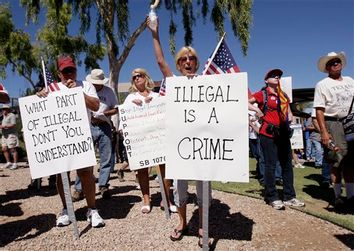
FILE - In this June 5, 2010 file photo, Judy Schulz, center, cheers as her husband Richard Schulz, left, both of Glendale, Ariz., joined hundreds supporting Arizona's new law on illegal immigration as they listen to speakers near the capitol in Phoenix. At the heart of the debate over Arizona's tough new immigration law is frustration with how the U.S. deals with the estimated 11 million illegal immigrants within its borders. The federal government says its policy is to focus on dangerous, criminal immigrants, not the average worker who is just trying to earn a living and keeps his nose clean. There is just no way the government can find, arrest and deport so many people, they argue. (AP Photo/Ross D. Franklin, File) (Credit: AP)

Yesterday, a federal judge put a hold on parts of the Arizona Immigration law, known as SB 1070/HB 2162, that was scheduled to take effect today. Four sections of the 14-section law were ruled to have parts that were pre-empted (overlapped!) by existing federal law and have been enjoined (stopped!) pending further prosecution of the government’s case against Arizona and its law.

U.S. District Judge Susan Bolton ruled that the United States was likely to succeed in its challenges to four specific sections of the law: Sections 2, 3, 5, and 6. The offensive parts were summarized this way in the Court ruling:

Portion of Section 2 of S.B. 1070 / A.R.S. § 11-1051(B): Requiring that an officer make a reasonable attempt to determine the immigration status of a person stopped, detained or arrested if there is a reasonable suspicion that the person is unlawfully present in the United States, and requiring verification of the immigration status of any person arrested prior to releasing that person

Section 3 of S.B. 1070 / A.R.S. § 13-1509: Creating a crime for the failure to apply for or carry alien registration papers

Portion of Section 5 of S.B. 1070 / A.R.S. § 13-2928(C): creating a crime for an unauthorized alien to solicit, apply for, or perform work

Section 6 of S.B. 1070 / A.R.S. § 13-3883(A)(5): authorizing the warrantless arrest of a person where there is probable cause to believe the person has committed a public offense that makes the person removable from the United States

Judge Bolton issued injunctions against these four parts (but not against 10 others that the U.S. government had requested) for a variety of reasons that mostly boil down to this: Arizona can’t make laws that preempt federal laws, and Congress has quite clearly staked out most areas of immigration law as the sole territory of the federal government.

In Section 2(B) and Section 3, the government had two reasons for requesting enjoinment. One relates to the above-mentioned federal right to manage and enforce immigration policy. They also argued, and the judge agreed, that Arizona’s requirements for seeking immigration verification from the federal government would impose a significant burden upon the Immigration and Customs Enforcement bureau.

Don’t think so? Consider this: In 2009, Tucson “used the cite-and-release procedure” authorized under Arizona law to briefly arrest 36,821 people. Imagine now if a fraction of those folks had to be detained for much, much longer while they waited for the federal government to verify their immigration status. This would increase “the intrusion of police presence into the lives of legally-present aliens (and even United States citizens), who will necessarily be swept up in this requirement,” according to the ruling.

The government also argued, in objecting to Section 3, that many legally-present immigrants won’t have ready proof of their right to be here, including those traveling to Arizona from the 36 countries currently part of the Visa Waiver Program (hello, Spanish tourists). The government also noted that U.S. citizens are not required by federal law to carry identification at all times, therefore creating two conflicts: 1) there’s a good likelihood citizens would be taken into custody if unable to quickly prove their citizenship and 2) the government has consciously made the decision not to require identification, which can’t be countermanded by Arizona’s decision. Arizona would also be stepping on foreign policy and immigration toes by placing new restrictions on travelers.

Section 5 doesn’t fly because Congress, in passing previous immigration laws, considered but left out specific provisions punishing employees, choosing instead to focus sanctions on employers who hired undocumented immigrants. Federal law already exists making it a crime to knowingly lie about immigration status in order to obtain a job. Thus, Arizona’s attempt to make it illegal for undocumented immigrants to search for or take work is a double conflict with U.S. law: In addition to being targeted in such a way that it nearly ensures anyone who looks Hispanic will be subject to police curiosity if they gather in a place — say, at a Home Depot near the contractors’ entrance — to see if anyone needs workers, it is also pre-empted by federal legislation that already prohibits such potential employees from deceiving employers about their immigration status.

Section 6 was written expressly to give police officers the ability to arrest without a warrant anyone whom they suspected might be an undocumented immigrant if they had broken an Arizona law in another state. If that sounds confusing and convoluted, you’re not the only one who thinks so. Judge Bolton seems to have struck down this provision in part because she’s not sure what it means:

Because A.R.S. § 13-3883 already provides for the warrantless arrest of a person who commits a felony, misdemeanor, petty offense, or one of certain criminal violations in connection with a traffic accident, the effect of Section 6 on warrantless arrest authority is not entirely clear. Indeed, the Arizona officer training materials state that the revision to A.R.S. § 13-3883 “does not appear to change Arizona law.” Implementation of the 2010 Ariz. Immigration Laws – Statutory Provisions for Peace Officers 11 (June 2010), http://agency.azpost.gov/supporting_docs/ArizonaImmigrationStatutesOutline.pdf. Both the United States, in its Motion, and Arizona, at the Hearing, suggested that the revision provides for the warrantless arrest of a person where there is probable cause to believe the person committed a crime in another state that would be considered a crime if it had been committed in Arizona and that would subject the person to removal from the United States. (Pl’s Mot. at 32-33; Hr’g Tr. 46-48.) What is clear is that the statutory revision targets only aliens — legal and illegal — because only aliens are removable. See Hughes v. Ashcroft, 255 F.3d 752, 756 (9th Cir. 2001) (citing 8 U.S.C. § 1227).

Emphasis mine. Basically, this section may have been created to give police officers in Arizona the power to decide, on the spot, whether a criminal offense was punishable by deportation. Since that’s a decision that’s always left to a federal judge, the section was ruled likely to be stricken when the case advances.

The real meaning of this ruling is complex, but also very simple: Parts of this law are predictable overreaches. Parts of this law, though, are unlikely to be struck down, because some gray areas exist in terms of what states can enforce regarding the presence of undocumented immigrants within their borders. Some of the challenges that the government lays out here could be defeated by a law with craftier wording, because the burden is on the government to prove that the law could on its face result in harm or preemption of federal law.

This means that some people in Arizona can breathe a small sigh of relief today, knowing that tomorrow, they’ll be a little less likely to face unjust arrest or detention. This could still be reversed; the injunction is a temporary stay. Governor Jan Brewer has already vowed to take the case to the Supreme Court if she has to — and let’s hope it doesn’t come to that, though I expect it will. The current Court might not be as forward-thinking as the Court in 1941 that decided the Hines case upon which much of Bolton’s ruling rests.

For now, this granting of partial enjoinment means the tricky fight for immigration reform has a long, mine-covered march ahead of it. Yesterday, though, was a good day — a respite in the battle for a sane immigration policy.

Continue Reading Close

John Edwards: The movie!

Is this really a story we need to keep hearing?

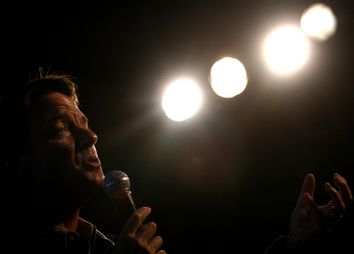
US Democratic presidential candidate and former Senator John Edwards (D-NC) speaks at a town hall meeting during a campaign stop in Conway, South Carolina January 22, 2008. REUTERS/Joshua Lott (UNITED STATES) US PRESIDENTIAL ELECTION CAMPAIGN 2008 (USA)(Credit: Reuters)

Aaron Sorkin has apparently won the right to write and direct the John Edwards movie based on Andrew Young’s book, The Politician. Variety (via Wonkette):

Aaron Sorkin — best known for creating “The West Wing” — will make his feature directorial debut with a John Edwards biopic.

Sorkin’s adapting and producing Andrew Young’s “The Politician: An Insider’s Account of John Edwards’s Pursuit of the Presidency and the Scandal That Brought Him Down.” Project’s not yet set up at a studio.

Young, a longtime Edwards aide, gained notoriety during the 2008 presidential primary when he admitted — then later recanted — an affair with Edwards’ mistress Rielle Hunter and claimed Edwards’ child from that relationship as his own.

I don’t know how to feel about that. Somehow, since “The West Wing,” everything Aaron Sorkin’s been involved with has made me feel a little slimy for admitting any desire to see it. The new Facebook movie? Man, I have almost zero desire to see that film, except that the director is David Fincher and it was written by Aaron Sorkin. A movie about John Edwards? Again, I’d rather tune out, but now they’ve got Sorkin and probably soon they’ll cast, I don’t know, Colin Firth or Chiwetel Ejiofor (as… no idea), and then I’ll have to see it.

I think Sorkin is using his reputation as a guy who can make serious stuff entertaining (“The West Wing” was charming in part because it was funny as often as it was serious) to now try and make the audience take seriously things we’d normally just overlook as trash. The drama behind the founding of Facebook? Come on, there’s no way that’s not a typical college story of dorm-mates stabbing each other in the back — only this time it was over a multi-million dollar software platform instead of the only girl in the world “who really gets me, man.”

John Edwards’ story of inspirational aims and extremely stupid infidelity was a lot more interesting when it was the story of John F. Kennedy, who actually did some stuff (like being elected president) instead of just acting like he could possibly have the potential to do some stuff and then flaming out on the way up.

I’ve loved Sorkin’s political movies — “A Few Good Men” is maybe the best movie Tom Cruise has ever starred in, and “The American President” was quite moving. “The West Wing” proved that Sorkin wasn’t done with the political sphere, and I think “The Politician” shows he’s still got more to say and show.

I just can’t decide whether this is a story I want to keep hearing.

Continue Reading Close

Court makes a $#%!ing cool ruling on free speech

The 2nd Circuit in Manhattan strikes down the FCC's ludicrously vague indecency policy

Hot damn:

A federal appeals court has tossed out a government policy that can lead to broadcasters being fined for allowing even a single curse word on live television.

The 2nd U.S. Circuit Court of Appeals in Manhattan on Tuesday found the policy to be unconstitutional. It says the policy violates the First Amendment.

That’s via the AP. You can also read the full opinion in Fox Television Stations, Inc. v. FCC at the Circuit Court’s decisions page.

This decision has been a long time coming. In 2004, the FCC changed its own rules to state “that a single, nonliteral use of an expletive (a so-called ‘fleeting expletive’) could be actionably indecent” in response to a slew of complaints the agency got after Bono dropped the f-bomb at the 2003 Golden Globe Awards when receiving the award for, I don’t know, the Last Relevant Album by U2.

Since then, the FCC has been regularly and aggressively fining companies for indecency violations — and they’ve multiplied the fines by the number of member stations the word was broadcast on to, vastly increasing their indecent haul. As the Court writes here, “the fine for a single expletive uttered during a broadcast could easily run into the tens of millions of dollars.”

This fleeting expletive fine has always seemed a dumb rule to me. The point of a fine is to make bad behavior a financial nuisance to an individual, thus encouraging a change in said behavior. For instance: I don’t speed in part because I can’t afford the ticket (and also safety concerns, etc.).

This particular fine, though, punished a network for putting on air a broadcaster or entertainer who might let slip an exclamatory and accidental phrase. The only way to guard against that would be a conscious campaign of not only eliminating such language from your own head — difficult — but also from your environment. No more hanging out with salty Uncle Mort. No more watching television after 10 p.m. Cancel the HBO subscription. No movies over PG-13. Don’t want those curse words to slip in. Also, no one invite Bono to any live-filmed awards show ever.

This, it appears, is similar to what the networks who challenged the FCC’s “fleeting expletive” policy argued:

The Networks argue that the FCC’s indecency test is unconstitutionally vague because it provides no clear guidelines as to what is covered and thus forces broadcasters to “steer far wider of the unlawful zone,” rather than risk massive fines.

Even without exaggerating this (as I did) to an Amish-like existence, it’s clear to see how a vague rule about what constitutes offensive language could chill both speech and behavior on live TV. That’s where the First Amendment comes in to play.

It’s also not hard to imagine how this could have an effect on political discourse, not just the random outbursts of peppy pop stars. What if the word “torture,” which has been so very controversial in the media for the last few years, began to be considered indecent because it conjures up disturbing images? What if having a live, televised debate between two presidential candidates became too much of a financial risk for a television station, because one of them might insist on discussing it? Could TV stations be fined for showing photographs of what American service members did to prisoners in Iraq? Would they be willing to take the risk and find out?

The Court ended up agreeing with the networks in the fleeting expletive case. The FCC’s argument was, basically, that it needed flexible (read: vague) rules to keep up with the many different ways that people can say offensive things. The Court responded, “Hell, no”:

The English language is rife with creative ways of depicting sexual or excretory organs or activities, and even if the FCC were able to provide a complete list of all such expressions, new offensive and indecent words are invented every day. For many years after Pacifica, the FCC decided to focus its enforcement efforts solely on the seven “dirty” words in the Carlin monologue. See Infinity Order, 3 F.C.C. Rcd. 930, at ¶ 5 (1987). This strategy had its limitations — it meant that some indecent speech that did not employ these seven words slipped through the cracks. However, it had the advantage of providing broadcasters with a clear list of words that were prohibited. Not surprisingly, in the nine years between Pacifica and the FCC’s abandonment of this policy, not a single enforcement action was brought. This could be because we lived in a simpler time before such foul language was common. Or, it could be that the FCC’s policy was sufficiently clear that broadcasters knew what was prohibited.

It seems clear which of those possibilities — we used to live in simpler times or the FCC used to have its act together — the Court endorses. Good work, Court. Hope it doesn’t get reversed on appeal this time.


Continue Reading Close

Obama won’t live up to his word on immigration

The president's speech today called for reform, but the administration's efforts won't address the real problem

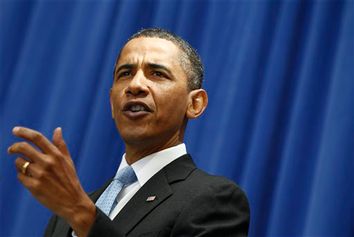
President Barack Obama speaks about immigration reform, Thursday, July 1, 2010, at American University in Washington. (AP Photo/Charles Dharapak)(Credit: Charles Dharapak)

President Obama gave a major policy speech today encouraging immigration reform (without outlining what exactly he thinks that will mean). Speaking at American University (nice optics), he talked about finding a “middle ground” between expelling all illegal immigrants and granting them all amnesty, and about the need for border security. It sounds like the White House strategy will be to bring the bill up after November, when the lame-duck Congress won’t have to worry so much about getting re-elected (sure).

Finding “a path to legal status” for immigrants currently in the United States is certainly an important goal; strengthening the border is certainly an important political goal. Yet the signals from the White House before this week have been iffy at best and troubling at worst about which one of these points President Obama and his team will pursue with the most diligence. I already expect the pattern of health care reform and banking reform to be repeated: liberal desires (amnesty!) will be tied to a conservative selling point (border security!); amnesty will get watered down, while the conservative side will get beefed up, and, in the end, no Republicans will vote for the damn bill anyway.

Here, though, we’re not talking about the future — health care being phased in, or a bank tax being created to stave off subsequent crises — but the present. There are at least 11 million people living “illegally” in America, working in America, paying American sales tax, dreaming of sending their (often American) children to American schools so that they might, one day, realize the American dream. They are every day subjected to a kind of wait-and-see horror: Will they be pulled over tonight? Will they need to provide identification to get treatment at a hospital? Will they make enough to send some money back home?

What America needs to decide is what the punishment should be for coming to this country without the appropriate paperwork. For most of our history, the punishment has been a life of hard work. Sometimes, as in the case of the Chinese and Irish immigrants tricked and drafted into building the intercontinental railroad, the punishment has been deadly work. Increasingly, the suggested punishments come very close to wishing for some kind of government-backed death sentence. Just listen to the cheers being raised by Governor Jan Brewer, R-Ariz., about the predator drones the United States is about to deploy at the border.

Take yourself back a couple of generations. What would have happened if the early United States had simply shot people on sight as they neared the U.S. border? I doubt I’d be here today. I doubt very many in the Midwest — settled largely by pioneers who couldn’t find work, because of immigration status, or because they’d come from agragrian-based cultures, elsewhere — would be here either.

Whatever legislation comes from this push, it will, I predict, address only the symptoms of the nation’s actual immigration illness. We’re the number-one consumer of cocaine in the world, and yet the violence that our demands spark in foreign countries — the violence that makes Mexican citizens want to flee north — seems to us a distant problem for which we bear no responsibility. There have been three political assassinations in the last two weeks in Mexico. Ninety percent of the weapons used by the drug gangs there come from the United States. Still, all our political conversations about immigration discuss the issue as though it is a singularly south-coming-north problem, never as though we’re part of the problem.

We pride ourselves on our liberty and democracy. Yet, we teach our children the values of oligarchy, being more willing to stand up for big bankers than we are for the poor and hungry at our doorsteps. Instead of providing foreign aid to our neighbors, we provide guns.

Let’s hear a speech about how to fix that.

Continue Reading Close

Afghanistan has been artfully ignored

Two presidents and the mainstream media have worked hard to keep the war off our minds

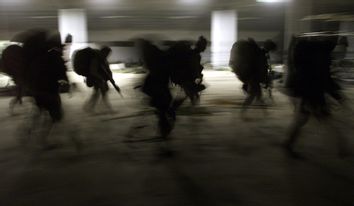
United States Marines from Bravo Co. of the 15th MEU (Marine Expeditionary Unity) march into a barracks in full battle gear as they arrive early November 29, 2001 at the US Marines forward base in southern Afghanistan. [Already hemmed into a shrinking swath of mountain and desert by nearly eight weeks of U.S. bombing and ground offensives by their Afghan foes, the Taliban now face another threat, hundreds of U.S. Marines pouring into a remote desert airstrip within striking distance of Kandahar, their spiritual cradle.](Credit: © Jim Hollander / Reuters)

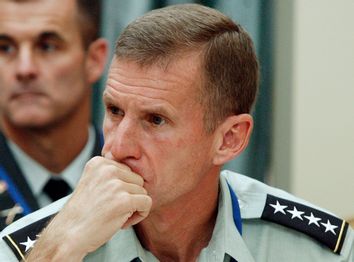
I was asked Friday about why the McChrystal story, of all the tales of woe and misbehavior in Afghanistan, made the news. I had two answers: 1) It was in Rolling Stone, not Foreign Affairs or even The New York Times, and 2) Gossip is easy to understand. The war-weary American public doesn’t really get the ground game in Afghanistan — quick, point to the Helmand province on a map! — but they do understand gossip and back-talk, and they understand that’s not their picture of the American military.

As I’ve had more time to reflect, though, another question has come up: Why doesn’t America care about this war? We cared deeply after 9/11, in a vengeance-is-mine kind of way. What’s changed? Is the sting now too distant? Was Iraq a distraction? Is it the anti-Muslim bias of the Western world?

Sure, all of those, but also more: We’ve been led to ignore this war. The Bush administration and now the Obama administration have both worked to keep Afghanistan off our minds and out of our daily lives. Bush worked harder: His was the administration that prohibited photos of caskets being delivered at Dover, after all, and that routinely sent officials out to castigate journalists for not reporting more good news on the ground in both wars.

Obama hasn’t exactly been reminding Americans of the great sacrifices being demanded on the ground (civilian and military), either. He shook up the leadership, sure, and he set a time line, but he’s done it mostly with addresses to military organizations that get covered lightly on the news (if heavily in the blogosphere). His first Oval Office address, after all, was about the oil spill, not the increasingly un-winnable war to the east.

Journalists are complicit in this, particularly television journalists. Iraq has been an easier war to report: people know more about it (thanks to that other war there); people have stronger, clearer views on it (Never Should Have Gone There, Had to Do It Sooner or Later, or Saddam Was Coming For Us); and people recognize most of the terminology being used. Maybe your average American can’t tell you the difference between Sunni Muslims, Shia Muslims, and Kurds, but they know there’s a difference.

In Afghanistan, you have tribes people haven’t heard of (Pashtun what?); a leader no one knows; no common enemy except Al Qaeda, which isn’t the government (so not a Saddam corollary) and the Taliban, which didn’t bomb us; war lords that are good; war lords that are bad; neighboring Pakistan playing an up-and-down role; an easy victory that’s dragged into a terrible nightmare; and dozens of scandals and corruptions instead of one single, signature mistake (Abu Gharib), all led by generals who are Not Petraeus, until now.

There’s been little to no effort made by the government to clarify these matters for the public. No big speech on our goals (besides getting the hell out) and no big explanation of our status since the election; no great definition of immediate danger even when we invaded. It’s a mission that maybe the top commanders understand, but the civilian population mostly gets that people are dying, some of them “ours,” some of them “theirs,” and that’s as far as we’ve been told.

What’s our objective? What’s our end game? Afghanistan is crucial to our interests? We’re getting out in 2011? We’re not getting out in 2011? We’re staying until the end of time? We like President Hamid Karzai? We don’t trust him? We need him? We’re cut out of the peace talks? We’re happy about that? We’re targeting the drug trade? We made it worse? Our allies are the number one destination for opiates? They’re bailing on the war?

Bringing the war home is more than opening up Dover to cameras and making the Secretary of Defense available to Congress. It should involve information coming to the people. The government is clearly not offering it, and the mainstream media is too entrenched in ratings pursuits to chase the stories. It should also involve sacrifice, outside of that demanded of military families. The Obama administration took a right step when it added the costs of the war to the budgeting process, but that only made the war real to those who understood what those numbers meant. Americans should have been asked to get engaged from the start; they should have had a full-court involvement press from day one, instead of an encouraged “life as usual” celebration from the originator of this debacle.

Informing the public and drawing them into the war effort would be a worthy use of the weekly YouTube address for the president. It would be a worthwhile series of fireside chats. Of course, to do that, the administration would have to have answers to the questions above, and I don’t think they do.

That, of course, is part of the answer. Afghanistan is ignored because the administration and the military now want it to be. What should have shocked people in the Rolling Stone article was McChrystal’s staffer admitting that truth:

Even those closest to McChrystal know that the rising anti-war sentiment at home doesn’t begin to reflect how deeply fucked up things are in Afghanistan. “If Americans pulled back and started paying attention to this war, it would become even less popular,” a senior adviser to McChrystal says. Such realism, however, doesn’t prevent advocates of counterinsurgency from dreaming big: Instead of beginning to withdraw troops next year, as Obama promised, the military hopes to ramp up its counterinsurgency campaign even further. “There’s a possibility we could ask for another surge of U.S. forces next summer if we see success here,” a senior military official in Kabul tells me.

The advantage has always been the military’s to lose in this war, so long as the White House conspired to keep the people in the dark. A little light now wouldn’t be welcome, but it might also not be too late.

Continue Reading Close

Page 1 of 5 in Jenn Kepka

www.salon.com/writer/jenn_kepka/index.html