Jessica Roy

Five most sexist iPhone apps

Because there's plenty to choose from!

An iPhone app released by Pepsi attracted harsh criticism a few months ago for a premise so blatantly sexist that it was eventually yanked from the store. But “Amp Up Before You Score,” which doled out pickup lines pegged to 24 female stereotypes, is but a twinkling star in the galaxy of offensive apps that have snuck past Apple’s notoriously stringent store guidelines. Without further ado, I present to you the five most sexist apps of the year.

PMSTracker: Unlike apps designed to help women keep track of their own menstrual cycle, this one is meant specifically for men. It “allows you to quickly track the approximate time each woman in your life has PMS” using a color-coded method that functions much like the U.S. government’s terror alert system — only it’s red alert, severe chance of PMS attack! 

Shake That Booty: This app allows you to manipulate an image of a woman’s butt — or, as the official app description calls it, “BOOTY!” — by physically shaking your phone. Of course, this jiggle fest is presented as something that she desperately wants so players don’t have to feel guilty. Look at that: Everyone wins!

Pole Dancing: “Get these hot girls to spin around a stripper pole by shaking your iPhone/iPod touch from side to side! Even better, clap, yell, make some noise and they will spin around at your command.” Control her without even forming complete sentences — just a few claps or grunts will do! 

Michelle: She’s your brand “new virtual girlfriend” and “can be who you want her to be.” You can take Michelle “to the beach or pool and choose which bikini or bathing suit she should wear.” Guess this one’s for the guys whose parents never let them play with dolls.

iControl Her: Here’s another riff on the apparent desire of many app developers to have complete power over virtual women. iControl Her is an actual remote that appears on the iPhone screen, with such clever buttons as “Stop Whining,” “Clean” and “Give Me Beer.” Here’s an idea: Develop a remote for women with a button that reads, “Delete that app and stop being such a jerk.”

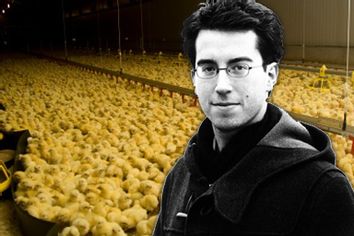
Jonathan Safran Foer’s beef with factory farms

The polarizing author and vegetarian discusses his new book, "Eating Animals," and the hefty cost of cheap food

Jonathan Safran Foer is a strict vegetarian, but his most recent book, “Eating Animals,” is not a screed against meat. It is, rather, an indictment of the corrupt, large-scale factory farming that dominates the American meat market. A journalistic work with a novelistic feel, the book is the result of three years investigating the U.S. meat industry, and it weaves together animal activist and farmer interviews with statistical research and even memoir to provide a sweeping account of Big Beef and its social, economical and environmental impact. Descriptions of animals suffering on the “kill floor” are enough to incite squirms from even non-animal lovers, but cruelty is not Foer’s only grievance: There are health concerns and devastating environmental damage at issue as well.

“Eating Animals” may be Foer’s first big swing at nonfiction, but primary themes hearken back to Foer’s two critically polarizing novels, “Everything Is Illuminated” and “Extremely Loud and Incredibly Close.” Family folklore and ideas about the complexity of memory permeate each; “Eating Animals” begins with a section titled “Storytelling,” about Foer’s grandmother, a Holocaust survivor (and passionate carnivore). “The story of her relationship with food,” he writes, “holds all of the other stories that could be told about her.”

The book is not without controversy, of course. Food politics gets at the very heart of what it means to be American — alas, human — and the subject of how and if we eat meat stirs up intense feeling. Last week, Natalie Portman kicked up a tiny tempest when she wrote about “Eating Animals” in a column on Huffington Post, championing Foer’s argument but adding her own painfully tone-deaf riff about rape. (The controversy took place after the Salon interview but when I reached him afterward via e-mail, Foer had this to say about Portman’s column: “It was such a thoughtful and generous piece of writing. I felt gratefulness more than anything else.”)

I met with Foer recently in a coffee shop near his home in Park Slope, Brooklyn, where he spoke about what’s wrong with PETA, how he finally went so local he ditched Amazon — and what Americans can do to help put an end to the evils of factory farms.

This is not a straightforward case for vegetarianism. What is this book making a case for?

It’s an explanation of my own vegetarianism, and it’s a straightforward case for caring and thinking, and for the ideas that matter. These little daily choices that we’re so used to thinking are irrelevant are the most important thing we do all day long. An enormous and very destructive force — historically, it’s unprecedented how destructive our farm system is — has taken over America and is starting to take over the world. And unlike so many other horrible systems, this one doesn’t require electing a new government or raising billions of dollars or fighting a war. It can be dismantled just by people making different choices. I think there are a lot of different choices people can make that will lead to dismantling the system. It’s not like everybody has to go vegetarian. There are plenty of people who feel like, for whatever reason, they just can’t stop eating meat, but if they bought meat at the green market, from farmers they know by name, that’s as effective a rebuttal.

What if you live in a city and you don’t live near a farm? I’m sure there are tons of people like that in New York. What’s your suggestion for them?

Well, in New York everybody is near a green market. Everybody is near a source of family-farmed meat. In fact, cities are frankly the best place to be in terms of that. But you ask a good question because there are a lot of times when you don’t have a choice. Like, in a restaurant, you never have a choice, with the exception of — maybe there’s 10 restaurants in New York City. In restaurants people are often faced with this problem, like, “Well, I’m either going to have to leave my values at the door and just eat this stuff, or eat vegetarian.” Those are the only two choices we have. And then people think, what does it mean to care about something if you don’t act on that care? Even if it makes things less convenient, even if it makes your meal less enjoyable — which is totally possible. But we make decisions all the time guided by our values that make our lives less convenient and less enjoyable. We do them because they’re things that matter more to us than a momentary pleasure, momentary comfort. I don’t know why food would be an exception.

How has writing and researching this book changed the way you and your family eat?

We were vegetarians before, and we continue to be, and we’re raising our kids vegetarian. One thing that has interested me about my response to this whole project is that it’s made me care about other things. I mean, caring is contagious. It’s very hard to care about one thing and not care about its neighbor. For example, I was not a huge advocate of buying things locally, not food but like books — anything. I would buy books on Amazon all the time. But for whatever reason, the subject does not have anything to do with that, but the process of writing it made me much more concerned about buying things locally, supporting my neighborhood stores, it mattering that I know the person who’s selling me something. That’s something that’s great about food is that so much intersects there. Tolstoy famously said, “If there were no more slaughterhouses there would be no more battlefields.” I don’t think that’s true, and I don’t think all battlefields are bad, but what is true is that when you start to care about food and think about the animals and how we raise them, it encourages you to have lots of other thoughts.

This is your first nonfiction book.

Well, it’s my first and my last. I don’t think I’ll ever do it again. It’s not something that interests me. I felt a little bit like dressing up for Halloween. Although, my interests at the end of the day were never really journalistic and it always did feel personal. And the themes that this book falls back on are the themes that my novels fall back on, like, how are lessons transmitted through generations and families, how do our decisions matter, how do they influence others? So, part of what inspired me to write about this was not that I cared about it so much but that nobody was writing about it. There are a lot of things I care about, but great people are writing about them. And there hasn’t really been a mainstream book about meat, despite the fact that it’s everything. I mean, if it isn’t the biggest, most important issue in our country right now, it’s up there.

Did any specific authors or works influence your book?

Many. Of course, Michael Pollan, Eric Schlosser, Peter Singer. I mean if any of them had written the thing that I wanted to read, I wouldn’t have had to write my book. See, Pollan is wonderful, but he doesn’t really get into meat too deeply; he sort of goes up to the edge of it and then stops. The same with Schlosser. Peter Singer writes about meat very directly, but in a way that I feel doesn’t include enough of the messiness of being a person in the world and having cravings, having personal history, having family. Reason has something to do with our food decisions, but not a lot. Most food decisions are made out of emotions or psychology or impulse, and so I wanted a book that included those things.

What were some of the most surprising or disturbing things you found in your research?

The most disturbing thing is not any instance, but the rule. It’s a shame in a way that PETA videos or slaughterhouse videos are most people’s exposure to factory farming because it gives the impression that the horrible things are the exception, when in fact they’re the rule. So an animal running and getting beaten up or running around with its neck slit open: That is the exception, even on the worst farms it’s still the exception. But the rule that happens even on the best factory farms is animals are genetically modified to the point of being unable to reproduce sexually, animals that never see the sun and never touch the earth, animals whose cages are never cleaned. These things are not as shocking and don’t work as well in a video, but they’re something to be concerned with much more because they’re happening to billions and billions of animals every year. It’s the way that the notion that an animal is a thing has been systematized and it’s part of the business model and that everyone thinks this way. That was the most surprising thing.

You also talk about your dog George, and consider why people will eat farm animals but not dogs. Can you elaborate on that?

The book in the beginning sort of presents two approaches. One is philosophical — is it right or isn’t it right? Why do we do this at all? And the other is practical. I side with the practical. I mean, the book moves in the direction of the practical because in a way the philosophical questions are irrelevant. “Is it right to eat an animal, is it not right to eat an animal?” That’s how most people talk about vegetarianism. But to me it doesn’t even matter. The truth is I actually don’t know what I think about that question. What I know is that it’s wrong to do it the way that we’re doing it. And we could sit here and argue about a perfect farm where animals are treated perfectly and slaughtered perfectly and whether that’s right. But if it exists at all it exists in a place that is impossible for us to find on any regular basis. So what we should be talking about is how upward of 99 percent of animals are raised and what it does to them, what it does to the environment, what it does to rural communities, what it does to farmers. And that’s bad; I mean, those things are bad. And that conversation preempts the philosophical conversation.

Your grandmother was a huge influence on your concept of food, and you also say she’s an unapologetic meat eater. How did she react to the book?


I don’t think she’s read it yet. I think she will agree with a lot of what I said. I don’t think she’s going to change. I think she’s past changing. But I’ve had pretty frank conversations with her about what’s right and what’s wrong, and she’ll agree — as will everybody, by the way. There’s not a reader of this interview who will say it’s right to make animals suffer unnecessarily. So then it becomes a question of what is suffering to different people and what is necessary to different people. And people can have all kinds of different, very respectable differences of opinion on this question, but I’ve spoken to my grandmother about why this might be wrong and she doesn’t disagree. It’s sad. She said in a very upfront way, “I don’t think about it, I’m not going to think about it.” For someone like my grandmother — frankly, for a lot of people — I don’t really push it. I think for people who are still forming their habits, like high school students or college students, that kind of willed ignorance is lame at best and something much worse because they’re most able to change. They’re the ones who are ultimately going to have to foot the bill of factory farming and are more required to do the uncomfortable thinking that a 90-year-old doesn’t.

Can you talk a little bit about America’s obsession with food?

There’s never been a culture that wasn’t obsessed with food. The sort of sad thing is that our obsession is no longer with food, but with the price of food. Factory farming supplies a demand for cheap meat. That’s it. It doesn’t taste good, it’s not healthy for us. The only good thing about it is that it’s cheap. But the thing is that it’s not cheap. It’s cheap at the cash register, and it’s sold as cheap — that’s the defense for factory farming, “Look, we’re making affordable food for normal people and all other arguments are elitist.” But in fact factory farming is like the ultimate elitism because it’s the most expensive food ever produced in the history of mankind. We pay very little at the cash register, but we pay and our kids are going to pay for the environmental toll, obviously the animals are paying, rural communities are paying. And for what? So that corporations can prosper. The huge agribusiness — companies make hundreds of millions and sometimes billions of dollars, not in the name of feeding the world, but in the name of making something that’s so cheap that people become literally addicted to it.

Aside from getting green meat and eating locally, what are things that both vegetarians and meat eaters can do to help the transition from factory farms to something better?

First of all, they just have to say no to factory farms always. Not sometimes, not most of the time, but always, which means eating vegetarian a lot of the time. I think this issue is frankly more important than our conversation about the environment, because it is the No. 1 cause of global warning. The World Watch just released a report that showed that they thought animal agriculture was responsible for 18 percent of greenhouse gases, but it turns out it’s 51 percent. So to talk about the environment and not talk about this is not to talk about the environment. This conversation has to be totally mainstreamed. There has to be a consensus behind it that factory farming is bad and we’re not going to support it and we’re done with it. And it has to be unacceptable either to pretend these problems don’t exist or not to actively engage with them. I’m not saying everybody has to reach the same conclusions, but they do have to agree on the common enemy.

Continue Reading Close

Slipped through the cracks

Plus: A woman will give birth live on webcam, and Kate Winslet wins her libel suit

Two rather contradictory topics — abortion and parenthood — seemed to dominate the news this week. At Broadsheet, we investigated an ex-Planned Parenthood employee’s decision to defect to the anti-choice movement, and talked about women who have done the exact opposite by switching to the pro-choice side. We also explored the struggles of parenthood — from the tragedy experienced by the mother of Neda Agha-Soltan, the young women who in death became symbolic of the Iranian protests, to the trouble of handling a child’s poor behavior in public. While these topics, and others, commanded our attention this week, some stories inevitably slipped through the cracks.

Don’t mess with (DNA tests in) Texas
In a legal event reminiscent of HBO’s cult hit “Big Love,” Texas prosecutors are struggling to peg FLDS leader Raymond Jessop with charges of statutory rape, as the woman involved in the case has refused to cooperate with authorities. The prosecution’s evidence rests on DNA samples that indicate, with a 99.9 percent probability, that Jessop fathered the girl’s child. But the defense is working overtime to cast doubt on the DNA data, proposing that mistakes with DNA samples have occurred before, and Jessop should not be convicted based solely on this evidence.

Born on the Internet
If you thought live-tweeting a birth was bad, prepare to be further floored: a woman in Minneapolis has decided to broadcast the birth of her first child live on the Internet. Having tracked her experiences with pregnancy for the past few months on the motherhood site MomsLikeMe, 23-year-old Lynsee decided to air the birth on the site “to document the pregnancy and create a one-of-a-kind memento for our baby to have forever.” Lynsee’s due date is November 19th, and she’s inviting the whole world to join in on every detail of her child’s birth — “tastefully,” of course.

Forget sexting, think contraceptexting
A new experiment conducted in high schools in the UK has attracted more debate over birth control access for teens. Students at six schools deemed “high risk” due to their elevated level of teen pregnancies were given the option of texting requests for emergency contraception. Instead of automatically having their requests filled, the five students who participated were given an appointment with a nurse to evaluate their needs and answer questions.

School sued for considering MySpace their space
After posting risqué pictures of themselves taken at a sleepover to their MySpace accounts, two Indiana high school students were suspended from extra-curricular activities and forced to apologize to the athletic board for their “inappropriate” behavior. Now, ACLU lawyers have taken on the case, arguing that the students’ right to freedom of expression were disregarded. With students’ lives moving further into the public sphere of the Internet, ACLU staff attorney Catherine Crump stated that, “this is something that’s happening more and more.”

The sexual dysfunction you never knew you had
You’ve probably seen the commercials for the much-questioned Restless Leg Syndrome, but did you know that your vagina can develop a similar condition? On Tuesday, AlterNet reported on a “Journal of the American Medical Association” study that stated that “43% of women experience some degree of impaired sexual function.” By coining new diseases that may afflict that 43 percent, pharmaceutical companies are able to hock some rather laughable medical solutions. The larger slight here is that Big Pharma seems to think that if you’re not screwing like a porn star, you’re clearly a frigid nun incapable of orgasm.

Kate Winslet’s revolutionary road
On Tuesday, Academy Award winner Kate Winslet won the libel suit she filed against the “Daily Mail,” which accused her of lying about her exercise habits. The newspaper was forced to pay her $40,000 in damages. Winslet is a well-known critic of the media for its part in perpetuating body image issues. “I was particularly upset to be accused of lying about my exercise regime,” she said, “and felt that I had a responsibility to request an apology in order to demonstrate my commitment to the views that I have always expressed about body issues, including diet and exercise.”

Continue Reading Close

Slipped through the cracks

Where have all the punk girls gone? Plus: British women ditch their heels, and do Democrats hate strong women?

This week, the themes of gender-bending, motherhood and race reigned supreme. We examined the decision of Moorehouse College to forbid cross-dressing, and debated the implications of a Mississippi school’s refusal to run a senior portrait of a female student in a tuxedo in their yearbook. We took a look at society’s impact on parenting methods, and wrote about Republican moms campaigning to legalize marijuana. And we lauded Mattel for creating a new black Barbie while also arguing that the doll is far from perfect; and covered the uproar that occurred at a historically black college when a half-white, half-Southeast Asian woman won the school’s homecoming crown. Given this supply of weighty topics, it’s no surprise several stories slipped through the cracks. Here’s your guide to what we missed.

Bloodlusting for Liz Cheney?

Washington Examiner columnist Noemie Emery took issue with some Democrats’ treatment of conservative activist Liz Cheney, arguing that her feminine looks and Republican views rile Democrats to exact vicious verbal attacks on her. As the daughter of Vice President Dick Cheney, many Democrats are eager to villainize her, but Emery believes that their problems with her extend beyond political ideology; she contends that Democrats are just as afraid of powerful women as their Republican counterparts. “That’s why Liz, and those like her, bring out the witch-hunting bloodlust in liberals,” Emery writes, “why ‘gutsy’ and ‘tough’ in a Hillary Clinton become ‘savage’ and ‘rough’ in a female conservative. They ought to get over this fear of strong women. It’s what they told us to do.”

DNA Profiling Leading To Rape Justice

The New York Times reported on Monday that rape cases that have gone cold are being re-opened and heading to trial due to an innovative prosecution procedure. In order to skirt statute of limitations laws, prosecutors are indicting DNA profiles instead of suspects themselves, so that rapists can no longer go uncharged for their crimes after a certain amount of time has passed. “There is no reason for people to get away with rape because of the statute of limitations,” the paper quotes John Feinblatt, Mayor Bloomberg’s criminal justice coordinator, as saying. “They shouldn’t be able to hide behind it; they shouldn’t be able to race for time and get over the finish line and leave a victim without a case being solved.”

Punk Girls Gone Soft

In a post on British music magazine NME’s website this week, Rae Alexandra wondered what has become of all the fierce, feminist punk girls. Lamenting the fall of 90’s bands like Bikini Kill and Sonic Youth, she cites the rising popularity of soft-core porn sites like Suicide Girls as a defining reason for the degradation of the punk lifestyle. Though acknowledging that there are many reasons for the cultural shifts within the punk movement, Alexandra believes the Suicide Girls are one of the most prominent causes of its transition from outspoken, controversial movement to tattooed aesthetics. “It has fetishized punk rock girls to a degree probably never seen before,” writes Alexandra, “and taken all those bold, young potential musicians, writers and photographers and reduced them to a voiceless sea of breasts and body art.”

High Heels Be Damned

Yesterday in The Guardian, Linda Grant investigated the reasons for the dichotomy between the runway’s penchant for 6-inch heels and the masses’ devotion to flat, comfortable shoes. Despite magazines’ incessant chatter about fashionable but impractical footwear, Grant noticed that most women, regardless age or devotion to trend, are donning flats. It’s a relieving departure from the spiky heels models teeter on, as well as the painful lack of arch support ballet flats provide. The last sentence of her article speaks volumes about many women’s attitudes towards heels: “I like the look of beautiful shoes,” she writes, “but until the manufacturers start including a sedan chair and two attendants with each purchase, I shall wear ugly shoes.”

Continue Reading Close

Slipped through the cracks

To wax or not to wax? Plus: Women are more religious than men, and the New York Times dives into the cougar trend

It was damn near impossible to miss the bizarre balloon-boy saga that unfolded yesterday afternoon, and the story just keeps getting weirder. At Broadsheet, we took a closer look at storm-chaser dad Richard Heene’s misogynistic TV and YouTube clips. We also caused a kerfuffle with a post that claimed GQ had Photoshopped its voluptuous January Jones cover, but — oops! — the mag’s photo editor, Dora Somosi, e-mailed to assure us it was all tricks of the light. We weren’t the only folks tripping into controversy: Over at DoubleX, “Friend or Foe” columnist Lucinda Rosenfeld caused a ruckus with some pretty bad advice to a letter writer. Meanwhile, Meghan McCain fought back against the haters who deemed her a “slut” after she posted a picture to Twitter displaying her cleavage, going on to write a Daily Beast column about positive body image. (But was the backlash real?) The fashion industry could take a tip from McCain, after Karl Lagerfeld dished that “no one wants to see curvy women” on the runway. Considering this week’s maelstrom of absurd news, it’s understandable that a few stories slipped through the cracks.

Why are women more religious than men?
A recent study conducted by Trinity College found that a sizable gender gap exists between men and women believers, with 19 percent of men ascribing to atheism compared with only 12 percent of women. Reasons for this phenomenon range from belief as an evolutionary imperative to scientific research demonstrating that women’s brain chemistry may allow for easier acceptance of the divine. The study is particularly interesting considering how pervasive sexism is in many of the world’s religions, and as Lauren Sandler wrote in DoubleX, “It’s hard not to compare women sticking with faith to wives confined to bad marriages: They’re so committed to the institution that they’ll willingly shrink under mistreatment just to maintain their own status quo.”

And the army marched on … in miniskirts and boots?
Celebrating the 60th anniversary of Mao’s victory over Chiang at a parade a few weeks ago, the women of China’s People’s Liberation Army donned miniskirts and sexy knee-high boots. Luckily the uniforms were for a parade, not a battle, because it might be tricky to fight the enemy in skirts that short. But the sartorial choice does raise an interesting question about female sexuality in the military. The U.S. Army seems apt to squelch femininity with the kind of bulky, functional gear integral to performing a soldier’s duties; why does China seem to embrace their female soldiers’ sexuality, and is doing so a good or bad thing for these women?

Cougars will not go gentle into that good night
On Wednesday, the New York Times Styles section tackled the cougar trend again. Though many anticipate that the cougar character will quietly slip from the media’s view by 2010, the article argues that cougars’ current popularity represents “a real demographic shift, driven by new choices that women over 40 are making as they redefine the concept of a suitable mate.” With women waiting longer to get married, and many men still dating younger women, it seems like a natural progression for women — who already have higher life expectancies — to seek out younger men. But not all women happily embrace the “cougar” nickname. “[Demi Moore] has been described as a cougar,” the author writes, “but so have sex-starved women slinking through bars for young men to satisfy nothing but physical needs.” It’s this latter cougar stereotype that many women take issue with, the predatory imagery conjuring an air of pity that shames instead of empowers.

Wax on, wax off: The great Brazilian debate
Nerve editor at large Jack Harrison and writer-turned-lawyer Elizabeth Wurtzel debated the pros and cons of Brazilian waxing in a surprisingly satisfying, counterintuitive he said/she said exchange. Wurtzel defended her painful beauty regimens (waxing, facial peels), while Harrison pushed for a more bohemian bodily embrace: “I’ve found myself complaining that my girlfriends showered too much or felt shy about having sex during their “time of flowers” (as it was called in the Renaissance). To me, those weren’t bad things because they were part of her.”

Continue Reading Close

Slipped through the cracks

Serena Williams poses nude for ESPN Magazine. Plus: Ellen Page becomes an HBO writer, and brides trash their gowns

 In a strange twist to this week’s David Letterman extortionist plot, feminists were accused of not being humorless enough (!) due to the minimal outrage the scandal provoked among women. Of course, we were also accused of being too humorless, when we expressed disgust at a high school in Texas that printed T-shirts depicting a woman having sex with two horses. But it wasn’t all bad: Here at Broadsheet, we also noted that an ad run by a Las Vegas restaurant was taken to task by the University of Nevada, Las Vegas campus newspaper, demonstrating that young feminists are indeed out there. Meanwhile, in Oklahoma, a shocking new law mandates that women must disclose a host of personal information about their abortions for display on a public website. And in Egypt, officials banned a kit that would allow women to fake their virginity.

Maybe we got a little too distracted by this nine-year-old’s creepy remake of Britney Spears’ “Toxic,” because here are some articles we missed:

ESPN has Body Issues

Celebrating the beauty of the athletic form, ESPN Magazine released its Body Issue today, which will run six different covers, each featuring a different athlete. Serena Williams posed completely naked on one version, and her healthy figure is a refreshing departure from the stick-thin models that usually grace magazine covers. Other women featured in the issue’s covers include martial artist Gina Carano and triathlete Sarah Reinertsen.

Ellen Page pregnant … with HBO comedy!

“Whip It” alum and “Juno” smart-aleck Ellen Page is slated to write a new comedy about three hipsters relocating from Williamsburg, Brooklyn to its LA equivalent, Silver Lake, in pursuit of their shared dream to become artists. Page will also be executive producing the project along with friends Alia Shawkat (“Arrested Development”) and Sean Tillmann, and potentially starring in it as characters that sound reminiscent of the disenchanted youth portrayed in another HBO hipster ode, “Bored to Death.” Assuming “honest to blog” will never be uttered, we look forward to seeing how the show turns out.

Take this expensive, luxury wedding dress and shove it

On Tuesday, “The Today Show” aired a segment devoted to brides’ stories of how they destroyed their costly wedding dresses post-ceremony. At both Double X and Jezebel, writers took issue with the practice, comparing it to an article in British Marie Claire that highlighted the fact that many women, specifically refugees in Uganda, are happy to even receive a special dress for their wedding day. Whether you think the tearing of the dress is an act of self-expression or a symbol of selfish American consumerism, there are no doubt less wasteful ways to shake off the shackles of traditional weddings.

Where are all the female astronauts?

An article in Wired this week explores the history of the female astronaut, citing newly released medical studies as a testament to the fact that women astronauts in the 1950′s were “just as cool and tough” as the men sent to the moon. In 1959, Randy Lovelace founded the Women in Space program, which trained 19 female astronauts — 13 of whom graduated from the program, boasting a success rate higher than the men’s. The program was eventually discontinued in 1961, with officials citing concerns about menstruation and pilot inexperience as excuses to not send the women into space. As such, we had to wait until 1995 for the first female-piloted mission, but as the article states, “Collins was the first woman to become a space pilot, but not the first woman who deserved to.”

House rules: Sexual orientation included in hate crimes law, finally

On Thursday, the U.S. House of Representatives passed a motion that would define attacks fueled by gender or sexual orientation as hate crimes. Attached to a must-pass defense bill and already supported by President Obama, the legislation will be voted on in the Senate next week. It’s a motion worth celebrating, but one that is undoubtedly long overdue.

Continue Reading Close

Page 1 of 2 in Jessica Roy

www.salon.com/writer/jessica_roy/index.html