Jill Savitt

China’s deadly Darfur games

Slick P.R. moves around the '08 Olympics can't hide the fact that China is still complicit in the Darfur genocide.

  • more
    • All Share Services

China's deadly Darfur games

The Chinese government can be very persuasive when it wants to be. China persuaded the International Olympic Committee to award Beijing the 2008 Olympic Games — marking the first time in more than 20 years that the Games will be held under an authoritarian government.

Now, China is attempting to persuade world leaders, the media and the public that Beijing has suddenly become a leader for peace in regard to Darfur. But there are many signs that China’s recent efforts have been little more than a public relations campaign to spare the Olympic host from continued negative publicity about its complicity in the Darfur genocide.

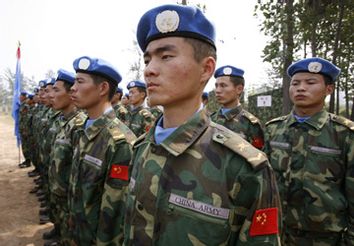
For four long years, China was a major, if not the chief obstacle to international efforts to bring security to Darfur. Beijing blocked, vetoed or diluted resolutions at the U.N. Security Council that would have authorized a protection operation or sanctions on Khartoum for continued intransigence.

Suddenly this spring — as China’s role in Darfur was discussed publicly in light of the upcoming Olympics — China took some new, high-profile steps to address Darfur. Beijing appointed a special envoy for the region. It announced that it would send 300 engineers to Darfur, and in a major turnaround China voted on July 31 for a U.N. resolution authorizing an African Union-United Nations “hybrid” force of up to 26,000 troops and police for Darfur.

Beijing insists — in media interviews and in face-to-face meetings with Darfur advocates, including myself — that its new and improved positions on Darfur have not come in response to pressure from activists pointing up the hypocrisy of simultaneously sponsoring a genocide in Africa and an Olympics at home. Beijing has said its position on Darfur is based on principle.

But if China’s Darfur policy is indeed based on principle rather than public relations, there is far more it could do to help bring security to Darfur. It could begin by speaking honestly about the realities on the ground there. After a visit to Darfur in May, China’s special envoy Liu Guijin said, “I didn’t see a desperate scenario of people dying of hunger.” Rather, Mr. Liu said the people of Darfur thanked him “for the Chinese government’s help in building dams and providing water supply equipment.”

Since then, in fact, the security situation in Darfur has gone from bad to worse. Humanitarian organizations are pulling out their personnel, and African Union forces were recently attacked and killed by a splinter group of rebels.

China could put a moratorium on oil ventures with Khartoum. Beijing contends that its purchase of oil from the regime in Khartoum — more than $1 billion each year — and its massive investment in infrastructure should be viewed as entirely separate from the violence and murder in Darfur. But it is oil revenues from China that continue to fuel the Sudanese regime’s buying of planes and bombs, and its backing of hired killers, the Janjaweed.

China could suspend arms sales to the Sudanese regime, and demand that all other nations follow suit. Human rights reports document that weapons sold by China to Khartoum have been used against the innocent people of Darfur. This fact is all the more troubling given that by selling arms to the regime, China is recouping some of the money it spends in Khartoum buying oil.

China could publicly urge the regime to disarm the Janjaweed and cease aerial bombing campaigns. It could also criticize the Sudanese regime’s harassment of the world’s largest humanitarian operation — and cry foul when humanitarian workers are ousted, as happened recently to the director of CARE in Sudan.

While China has widely touted its U.N. vote for the “hybrid” force, it has of course been silent about the central role Beijing’s diplomats played in weakening the resolution — by stripping provisions that would have applied sanctions and provided a mandate to disarm threatening combatants.

China was persuasive enough to convince the international committee that it is worthy of being an Olympic host. Now it must act like one, and live up to the grand slogan it has chosen for the ’08 games — “One World, One Dream” — especially when the stakes are so much greater than athletes winning medals.

Is Darfur still doomed?

The peace agreement was a key step, but ending the genocide demands bigger strides by the U.N. -- and the U.S.

  • more
    • All Share Services

Is Darfur still doomed?

After two years and seven rounds of peace talks, the government of Sudan and a main rebel faction signed an 85-page peace agreement on May 5. The agreement outlines in detail how the Janjaweed will be disarmed, as well as how the parties will address power and wealth sharing, security, compensation for victims, and self-governance for the Darfur region.

There is now a temptation for many in the global community to breathe a sigh of relief, and even pat themselves on the back. International leaders worked hard in the final days of negotiations as deadlines passed and were extended. Concerned citizens also played a part: Tens of thousands of people turned out for rallies in Washington, D.C., and other U.S. cities. In turn, the media devoted coverage, putting increased pressure on global leaders, and on the negotiators.

But any broad claims of victory would be woefully premature — the agreement is just a first step along an arduous road to peace. There are an African desert’s worth of miles to go before anyone can be assured that more innocents will not be slaughtered, raped and displaced in Darfur — and there’s even farther to go before the 2 million Darfurians can return home, rebuild their lives and have a say in their future.

“The world should be under no illusions that peace will break out easily here in Darfur,” said Jan Egeland, the U.N.’s top humanitarian official, after the deal was done. “We have to have an enormous effort from the international community and the parties themselves to enforce this peace agreement.” The top U.S. diplomat involved, Deputy Secretary of State Robert Zoellick, noted that Darfur “remains a very violent place.”

For starters, not all of the rebel groups have signed the agreement, and some rebel leaders do not support it — and have even denounced it. This opposition is creating real instability on the ground: Commanders and soldiers of these factions do not believe they have agreed to anything, and they are still battling the Janjaweed. Civilians still face serious danger, as do those guarding them. Last week, an African Union interpreter was hacked to death at a refugee camp. The international community has called for U.N. forces to be deployed to Darfur to protect civilians and supplement the struggling African Union forces, but even under the most hopeful scenario, U.N. troops will not be on the ground for months.

And even that is in doubt. While the Sudanese regime promised that U.N. troops would be allowed into Sudan once there was a peace deal, the regime said it was reconsidering before the ink on the deal had dried. Khartoum has reneged on far too many promises to be trusted to ensure the peace on its own. It must feel the pressure of the United Nations, and equally important, of the United States.

Indeed, the same pressure that was applied to bring the Darfur Peace Agreement into being needs to be reapplied — and even redoubled — to make its provisions a reality. Darfur needs a peace envoy, someone with the ear of the U.N. secretary general and the ability to communicate directly with the Oval Office. The international community should designate an international figure of the highest stature, appointed by the United Nations and backed by the U.S. and other governments, to oversee the enforcement of the peace every single day — for as long as it takes. This envoy must have the authority and skill to put unrelenting pressure on Khartoum to live up to its word.

The envoy strategy has worked in the past: In the Balkans (former Ambassador Richard Holbrooke), Northern Ireland (former Sen. George Mitchell), Burundi (former South African President Nelson Mandela) and in Sudan’s north-south conflict (former Ambassador John Danforth). Any of these men would be excellent candidates for the envoy position — as would former Secretary of State Colin Powell, the first U.S. official to label the situation in Darfur a genocide.

The envoy’s first task would be to give Darfurians a sense of security by getting U.N. troops on the ground there immediately. The U.N. Security Council approved the troops in February, but nothing has happened yet. The envoy would work the corridors of the U.N. and the halls of foreign capitals to push for the rapid deployment of a well-equipped and well-funded force. Most helpfully, the envoy could persuade Western governments with military and logistical capability to lead the peacekeeping effort.

Next, the envoy would comb through the 510 paragraphs of the peace agreement, noting every promise and timetable. As deadlines approach, the envoy would alert the world and then report on compliance. As written, the agreement calls for the African Union to verify implementation, but the African Union alone is not up to the task. It does not have the resources or the authority, and is highly susceptible to influence by Khartoum. An envoy with the highest levels of access needs to lead this effort — and to exact swift censure for noncompliance.

All involved in the peace negotiations have said that an essential element for long-term peace is making sure Darfurians have a say in the government and their own future. The peace agreement details how this critical process should be carried out, and an impartial leader of the highest stature needs to make sure Darfurians are able to start the process of democratic participation without interference. All of this needs to happen before the eyes of the world. A high-profile envoy would make sure the media maintained full access to Darfur, and would help keep Darfur’s unfolding peace process a priority for the media.

The peace agreement is less than two weeks old, and Darfur has already disappeared from TV screens and the front pages of world newspapers. This is, of course, exactly what the Sudanese regime wants. It would like nothing more than for the international community to pat itself on the back about the peace agreement, and move on to other issues and crises. Without a top-level leader devoted to keeping up the pressure, for the people of Darfur the recent cry of “never again” is in danger of becoming “yet again” all too soon.

Continue Reading Close