Jim Paul

Tolkien and terror

A tale of good and evil battling under the dark cloud of fear, Tolkien's masterpiece resonates with a wisdom that our recent horror allows us to understand.

In one of those odd zeitgeisty moments, when one finds oneself a creature of the culture without even trying, I picked up J.R.R. Tolkien’s “The Lord of the Rings” recently, for the moment forgetting about the three-movie hobbit extravaganza about to be visited upon us. I found one of the three volumes on a shelf and wondered what I’d think of it now. I’d loved it when I had read it before, in the flower power era. I ended up reading the entire work, all 1,000 pages.

It surprised me. I am not a fantasy buff. My friend Harry simply said he would never read a book that long that had elves in it, and I had to agree. But what I recalled about the book and what I found still true was that it was scary. Evil flying things cast shadows of despair across the land, and these things, the Nazgul, still had a potency that got me through dozens of pages of elves and dwarfs.

The book has its other points. Tolkien was a serious and learned scholar of Anglo-Saxon myth and language, and an Oxford Don, and this, his life’s work, remains monumental and beautifully written, if seriously eccentric. As amazing as ever is the minutely detailed geography of Middle-earth, as well as the fully foliated language system for each of the various races in it. Tolkien the philologist wrote that the book was “fundamentally linguistic in inspiration,” a story written to provide a world for his invented languages.

There is, it hardly needs to be said, no sex on any of the thousand pages of the work. Hobbits seem to procreate through poetry. Tolkien was a devout Catholic born in the 19th century and was Victorian about matters sexual. In a letter advising his son he wrote, “The hard spirit of concupiscence has walked down every street and sat leering in every house since Adam fell.”

But never mind that. The book is still scary, in some ways scarier than when I last read it. What surprised me about the novel is how current it seemed. For Tolkien’s book is a story of war, and its theme is one we’ve heard a lot about recently: the nature and power of evil. This work of hobbits and elves and wizards, innocence and far-sightedness and magic, is all about terror, it turns out, and about the difficulty of countering evil deeds.

The dark days of 2001 are more like the days in which Tolkien wrote the book than any since. The first of the three volumes of “The Lord of the Rings” appeared in 1954. Tolkien began the work in 1938 and wrote it throughout World War II. And though he discouraged readers from reading any “‘allegory,’ moral, political or contemporary,” into the work, it’s clearly the product of war years and dire times, no less so than Ian Fleming’s James Bond novels, with which it shares the fantasy of total victory, the quest of the doughty individual hero against an unredeemable enemy and an obsession with magical technology, if not sexual conquest.

“The Lord of the Rings” is a war story; more particularly it is story of grim war coming to an innocent country, the Shire, the home of the race called hobbits. Short and furry-footed, hobbits are unmistakably English, tidy homebodies, natives of “a well-tended region,” colloquial connoisseurs of a good smoke and a good brew.

What the hobbits do best, though, is make foils for the evil characters, bad guys still perfectly terrifying and memorable. Sauron, Tolkien’s arch villain, embodies absolute evil, and never appears in person in the book. Both near and far, everywhere and nowhere, the Dark Lord Sauron in his tower in Mordor controls things from a distance, watching events through his “seeing stone” and emitting clouds of smoke and stinking ash to cover the movements of his armies and his emissaries.

The principal thrill of the book still comes from the fearsomeness of Sauron’s black-cloaked outriders, the Nazgul, hooded phantoms sent into the far reaches of Middle-earth to do his will. The scariness of these emissaries themselves also arises from their indefiniteness. Beneath their dark mantles, they have no expressions — only a deadly gleaming pair of eyes.

We hear about these Black Riders before we meet them — always good practice in presenting a villain (“Hissed at me, he did,” reports the Gaffer. “It gave me quite a shudder.”) — and they first appear on horses, pursuing the little hobbits through the woods of the Shire. Part of the terror of the riders comes from their presentation through the eyes of the hobbits, who besides being innocent and ignorant of the evil in the larger world, are only 4 feet tall. When we first glimpse one of these Black Riders we peer up at them from the undergrowth. “Only his boots in the high stirrups showed below,” writes Tolkien. “His face was shadowed and invisible.”

In later chapters, the Nazgul appear in the air, riding huge flying creatures like pterodactyls. “Ever they circled above the City, like vultures that expect their fill of doomed men’s flesh.” The potency of these evil messengers comes not from physical strength or acts of violence but from their psychological impact on their foes. They spread paralyzing terror. Ordinary mortals fling themselves to the ground when the Nazgul pass unseen overheard and think “no more of war, but only of hiding and crawling, and of death.”

But however scary these creations, evil entirely evil and evil entirely other is ultimately neither nuanced nor very interesting and is of course a staple of melodrama, not great art. What makes “The Lord of the Rings” work now, in this time when villains entirely evil and entirely other are often invoked, is that Tolkien’s presentation of evil is deeper than that. Tolkien complicates the over-simple moral scheme and gives evil its due.

For the evil in Middle-earth does not simply reside in Sauron and his emissaries. It enters every character, and indeed infects the hero. The central object in “The Lord of the Rings,” the magic ring, stolen from the wretched Gollum by the hobbit Bilbo and given to his nephew Frodo in the books that follow, makes its wearer invisible and confers other powers, but it is ultimately an evil thing, having been created in the first place by Sauron. It must be destroyed, by tossing it into the volcano in which it was forged. This is Frodo’s quest.

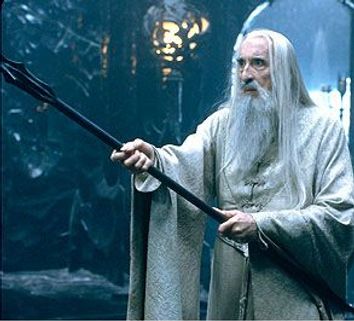
But all who come in contact with the ring — high and low, hobbits and men — are corrupted by it. Under its influence, the wizard Saruman, who once led the Council opposing Sauron, turns traitor to the cause. A member of the Fellowship of the Ring itself, a man of Gondor named Boromir, cannot withstand the temptation to power that the ring offers, and his treachery dissolves the company that undertakes the quest.

So Frodo and his faithful servant Sam must go on alone. But even the hobbits are not immune, and Frodo himself fails, finally, in his quest. He cannot relinquish the ring of power in the ultimate moment. “I will not do this deed,” he cries on the brink of the volcano. “The ring is mine.” And so there is not finally in Middle-earth an absolute good to counteract its absolute evil. Tolkien writes expressly about this in his letters. “The power of Evil in the world is not finally resistible by incarnate creatures,” he notes, “however ‘good.’”

Does the irresistible power of evil then make the hero’s quest futile? No — the hero’s effort is necessary but not sufficient. Tolkien’s other insight is that evil itself will take evil down. For one thing, evil offers no basis on which to organize anything. In Book 5, when Frodo is taken captive by evil Orcs, he is liberated not just by Sam’s rescue, but by the Orcs themselves, who fight over the spoils and kill each other off. And evil lacks clarity. The smokes and vapors that the Dark Lord sends out of Mordor, to cloak his armies’ movements, are finally the cover that Sam and Frodo need to infiltrate the evil realm.

In the end, it is the greed of Gollum, not the virtue of Frodo, that casts the ring to its destruction. One might even say that the ring annihilates itself, as Gollum’s consuming desire is one effect of its evil power over him. On the brink of the volcano, Gollum attacks Frodo, severs his finger and recovers the ring at last, but when he lifts his eyes to gloat on his “precious,” he falls into the cauldron, where it and he are destroyed.

So this hobbit book, on the surface an escapist fairy tale, in the end offers some wisdom, and for this reason it has flourished for 50 years and in 50 million copies. “The Lord of the Rings” addresses the ancient crisis that arises in a dire time like this one, when it is not so much what we do to confront evil that wins the day, but what we must refrain from doing.

The medieval mind of George Lucas

Though he draws on our century's pop culture for his raw material, his vision arises from the Middle Ages.

In August 1976, George Lucas was exhausted and desperate. He had been in London, directing the actors in “Star Wars,” a film he had every reason to believe would fail. The usual turmoil and sheer labor of the set had been made worse by the lordly British studio unions, who quit promptly
at 5:30 for tea, and by the money people back in Burbank, Calif., who in the end pulled the fiscal plug on the filming. At the end of 16 weeks of shooting, Fox gave Lucas three days to finish two weeks of work, a cost-saving move that appears at least ironic now that “Star Wars” and its succeeding
films have gone on to gross billions. At the time Lucas had to hire triple crews and divide the stage into three sets, on each of which he directed the action for the final three days. “I cared about every single detail,” he recalled (including the duct-taping of Princess Leia’s breasts — “No jiggling in the Empire,” noted Carrie Fisher). By the end of shooting
Lucas was pale, ill, ready to drop.

At that point he flew from London to Los Angeles, where Lucasfilm was headquartered in those days, and found that his special effects unit, having spent more than $1 million of its $2 million budget, had completed only three shots. Lucas was outraged. He made arrangements to assume control of the unit, then flew home to San Francisco, where he began having chest pains. He was taken to Marin General Hospital, diagnosed with exhaustion and held overnight. The next morning he took a vow. “That’s when I really confirmed to myself that I was going to change,” he told biographer Dale Pollock. “I wasn’t going to make more films, I wasn’t going to direct anymore. I was going to get my life a bit more under control.”

George Lucas has more or less stuck to his vow. He has made more films, but at a distance, as a producer. The release
of “The Phantom Menace” will show us George Lucas the director for the first time since the original “Star Wars.” Indeed, Lucas also seems to have gotten his life “a bit more under control.” In interviews of late he has described the last 20 years as being taken up with parenting his children and recovering from his divorce. But this puts a homey gloss on an
astoundingly successful and labor-intensive enterprise.

Much that eluded him in the beginning is now within Lucas’ grasp. He has amassed and consolidated his fortune (in the last 10 years his net worth has gone from about $25 million to somewhere near $2 billion) and made solid investments, so that now he can finance his films entirely. Never again will someone give George Lucas three days to do what should take two weeks.

- – - – - – - – - – - – - – - – - – - – -

George Lucas’ gifts are difficult to categorize in conventional film-industry terms; he has defied Hollywood’s expectations all along. In his early days as a rebel filmmaker, he made a student film called “1:42:08: A Man and His Car,” which mostly consisted of a yellow race car doing laps at speed. Escape from and defiance of authority have always been a central theme for Lucas, both in his films and in his career as a whole. In his first feature, “THX-1138,” the hero flees an oppressive, sexless, bureaucratic society, where robotic police give up the chase only when they exceed their budget for the operation. In perhaps his farthest-out moment, in 1969, Lucas was hired by David Maysles to shoot the Rolling Stones in concert at Altamont. (Pollock reports that Lucas “can’t remember” whether he filmed a young black man, Meredith Hunter, being stabbed to death by Hell’s Angels, as Mick Jagger sang “Under my Thumb.”) In any case, Lucas continued to challenge the industry through the 1970s and ’80s, when it represented the Evil Empire, and does so even more profoundly now, as lord of the manor on Skywalker Ranch in Northern California’s Marin County.

Though he has said of directing “The Phantom Menace” that it was “much more fun than it used to be,” his dislike of directing live actors has been evident since his first days as a filmmaker. Lucas is said to be standoffish and quiet, a man who prefers
working with special effects to working with human beings. In the past he has chosen to work with unknown actors, whom he can then fill with his own ideas. Said Anthony Daniels, the actor who portrayed C-3PO, “I think George would like to freeze a lot of people and bring them out only occasionally.”

Nor is writing Lucas’ favorite activity. He wrote the
original script for “Star Wars” by hand, in his tiny printing, with sharp No. 2 pencils. The work gave him stomach pains and headaches; in his frustration he took to clipping off bits of his hair with a pair of scissors. Lucy Wilson, his assistant and pencil supplier, told Pollock that Lucas’ wastebasket “had tons of hair in it.” The result of this effort was dialogue like “I recognized your foul stench when I was brought
aboard, Governor Tarkin,” lines the actors often had trouble wrapping their mouths around. Playing Obi-Wan Kenobi to the rubber model of Yoda, Sir Alec Guinness complained about one speech to Irvin Kershner, the director of “The Empire Strikes Back.” Guinness’ suggestion: “Why doesn’t the little green thing do this one?”

While Hollywood’s other creative geniuses stake their success on writing and directing talents, Lucas’ brilliance is due at least in part to his wizardry as a film editor. “He knows the secret of what an editor can do to a movie, how he can enhance a film,” Steven Spielberg told Pollock. “I would trust George with any movie I ever direct to reedit in any way he sees fit.”

One reason Lucas is a great editor is that he makes each film mentally before any shooting starts, then harnesses the stubborn will to see his vision through. His is not the extemporaneous approach to filmmaking; the moments in filmmaking when this process of realizing the vision is most
apparent — in the drawing of the original storyboards, in the overall art design and in the editing suite — are Lucas’ best. On the set of “The Empire Strikes Back,” Kershner would often redo the scenes from the storyboards, attempting to find something better on the spot. “George would never do that,” said producer Gary Kurtz. “He’d stick to the storyboards
and fix it in the editing room.”

This gift — “obsession” might not be too strong a word — for realizing a vision has driven all of George Lucas’ activities. “I used to do it with cars, then I did it with film, now I do it with the ranch,” he told Pollock in the late ’70s, when Skywalker Ranch was still in the planning stages. The ranch itself is a piece of artwork, a simulacrum of the past composed of postmodern elements; Lucas planted thousands of mature trees around the ranch’s buildings, each of which has been made to look old and assigned its own fictional history.

Lucas’ visionary way of working has ancient antecedents. In the Middle Ages, the illiterate masses received and stored
their information in complex visual signs, or icons. In pictures of the saints, every detail had some prescribed meaning — the color blue for the Virgin, a dove for the Holy Ghost. The Dark Invader, Darth Vader, is an icon, too — an effective visual sign, instantly familiar from our own cultural catechism, black and caped and evil. In this way “Star Wars” proceeds iconographically, its characters straight out of stock, figures from ancient ritual and matinee melodrama, recloaked in every age. The Kid, the Girl, the Hero, the Sidekick, the Evil Counselor, the Wise One, the Ultimate Villain — we
know them in advance.

Also familiar to medievalists is the main “Star Wars” theme, the questing knights in the Evil Empire. Though Lucas draws on our century’s pop culture for his raw material, his grand vision arises from that other epoch, from the romantic, adventurous, moral, magically effective medieval world, where Malory and Spenser, the pre-Raphaelites and Tennyson and Errol Flynn have gone before. The place Lucas takes us — never mind the spaceships — is the Middle Ages.

Medieval times have provided a screen upon which each succeeding epoch projects its fantasies. For our own fantasy myth of the Middle Ages, we’ve imagined a place where we are still the center of the universe, where will — human or divine — still rules everything, often in the form of supernatural influences and inspired heroic deeds. No tree falls without significance in this cosmos, created expressly for human beings and ruled by a deity quite like them, only better and more powerful. Though it may or may not have anything to do with the actual epoch, this mythic Middle Ages has everything to do with our feeling that we are not quite at home in the current moment. And in the face of this unease, the systematic, good-over-evil “Star Wars” universe is comforting.

Like the medieval world, which rested on the collective memory of the long-gone past, the “Star Wars” universe is a recombination of old and familiar elements. “Star Wars” is Flash Gordon Conquers the Universe. It’s Fritz Lang and Walt Disney, Kurosawa and Castaneda, Oedipus and E.T. Reprised in its footage are the cliffhanger sci-fi serials of the ’30s and ’40s and the aerial sequences from “The Bridges of Toko-Ri” and the Battle of Britain. We find Tolkien’s hobbits in Lucas’ ewoks, Castaneda’s Don Juan in Lucas’ Obi-Wan.

Lucas’ postmodern zest for appropriation may seem ironic, given that his vision itself is a complete throwback to knights errant and ladies in waiting, wizards and dragons and a universe with a personality. As a work of art, “Star Wars” shares something with the famous Watts Towers in
Los Angeles, cathedral spires of whatever — hubcaps, freeway guardrails, balcony railings, all kinds of recognizable modern stuff welded together by a single driven man and raised in Gothic tribute to the sky.

“It’s not important how you do the shots,” Lucas instructed the
special effects crew on “Star Wars.” “It’s important what they look like.” As a filmmaker, Lucas is a synthesizer, prizing effectiveness above all. He has the hot rodder’s love of blending the various rough inputs exactly and minutely to produce a smooth and singular charge. This may be part of his attraction to myths and icons, which, first and foremost, are effective. Icons are supercharged images, each bearing its own significance — there’s none of that messy, Chekhovian getting-to-know-you about meeting Han Solo, say — and thus combining efficiently and speedily in a narrative.

So helping actors embody complex emotional realities was never Lucas’ intention. Rather, it was his job to withhold the actors from their full meaning. Real live actors generally make bad icons; the ones who are great at it, like John Wayne, are almost wholly one-dimensional in their acting. Managing this restraint was Lucas’ backbreaking labor on the “Star Wars” set; he had to turn the actors into ciphers for the formula: Mark Hamill into “The Kid,” Carrie Fisher “The Girl.”

As befits a neo-medievalist, Lucas cares everything for the vision and not a whole lot for the means of expressing it. “I don’t think, as a craftsman, that my films are extremely well made,” he has said. “They’re kind of crude.” This could be false modesty, certainly, though as a visionary and a perfectionist Lucas would tend to focus on the ways in
which the product doesn’t come up to the prototype. In the medieval world view, too, the actual manifestations of a vision are always unworthy, flickering shadows that can never fully
re-create the dream. “The moving image isn’t any more truthful than the cave paintings,” Lucas said in Premiere. “The artist finds the truth behind the ‘truth.’”

That’s why, though he has been described as the avatar of high-tech filmmaking, Lucas’ attachment to technology is more evidence of his readiness to employ whatever works in the realization process — be it computer graphics or C.S. Lewis. “I’m not that keen on technology,” he said in Premiere. “I’m a storyteller, but to enable me to tell my stories, I’ve had to develop the necessary technology.”

Lucas’ reliance on classical mythology is similarly an item in his tool kit. His version of the hero’s journey may have supplanted its precursors for the generation of viewers who saw “Star Wars” in their formative years. Yet what Lucas sought from the classics was first of all a stripped-down way of telling stories, a distillation intended to reveal a narrative formula for his iconographic characters. What Lucas lost in nuance, he gained in immediacy.

What this describes is bigger than “Star Wars,” of course. In part it is the Zeitgeist at work. We are in many ways
neo-medieval. In our historical moment, visual icons have once again become the predominant means of relaying information. We too live in a present deeply referenced to the past (to 1977, say) and deeply apprehensive about an apocalyptic future. We too have spent much of our epoch recombining elements, placing the age-old icons in new, deracinated contexts. Sure, we have technology now, though postmodern culture has given us the benefits of the Enlightenment without its technical underpinnings. We illuminate things like Merlins, flipping light switches. It’s one big special effect. Once again, effortless will appears to rule. Magic seems to be everywhere.

George Lucas has shown a genius for encapsulating all of this and giving it back to us as myth. He’s been able to anticipate the popular mind of our time, and has been richly rewarded for it. George Lucas, guy from Modesto, Calif., has become Saint George, iconmaker for the era. Lucas has worked hard to achieve this, but make no mistake: George Lucas is us and we are George Lucas. Complaints that instant iconography and sound-bite mythology amount to a starvation diet might just as well be directed toward the culture as a whole.

Continue Reading Close

Confessions of a real-time TV addict

From shots of deflated airbags on Mars to a camera aimed at Mt. Fuji, live-feed television reminds us that the real world is the best show on the air.

maybe I’m weird this way, but I thrill at the sight of partially deflated air bags. Take the one that may have been blocking the Mars rover’s ramp earlier this month. I watched for hours as engineers tried to lift a metal petal, turn a little wheel and spool up some air-bag fabric. Good, close pictures of metal sprockets and bumpy surfaces! This was a real-time TV fanatic’s dream come true. I was in heaven.

There’s nothing like live-feed TV. For me the high point in the weekend-long Mars coverage wasn’t even on Mars; it was the live feed of an office at the Jet Propulsion Labs in Pasadena, Calif. In this office, workers did ordinary office things. Occasionally someone would call one of the staffers on the phone, to tell them they were on TV, and then he or she would look up at the camera and wave, but mostly they just hung out, waiting, as I was, for the next news from Mars. A guy unwrapped a sandwich. A woman added up numbers, on paper yet, and using a pencil. Boffo. Two thumbs up.

I wish this kind of thing were on all the time. I wish there were a real-time channel, several of them, a real-time empire to rival Disney’s — just broadcasting live feeds of everyday moments. The closest network TV gets to this, unwittingly, is when it broadcasts golf, which when you think about it is mostly shots of sky and grass and water, the tiny white ball — the significant part — allotted about two pixels in the picture somewhere.

About once a year now, all of us go to live feed. A war starts, a major suspect is picked up, and suddenly we are all in that real-time space, witnessing events as they happen, in a narrative that could end anywhere, in which something entirely new, entirely unpredictable, might happen. Some people think this is the best part of real-time. I watch it, too, of course, and enjoy the real-time aspect, though it makes me suspicious when real-time bears too much significance. Significant events acquire sponsors, intermediaries, multiple camera angles. To my way of thinking, when an event is significant, you can’t be so sure of the life in the live feed.

Live-feed fanciers have probably noticed that pure real time is making some inroads on the tube. Occasionally C-SPAN puts a stationary camera on the street — in Boston in front of a funeral parlor, I saw once. Somebody famous had died and they showed the crowd for a couple of hours. I watched it as long as it was on. This is still cable, of course: Thus far C-SPAN and Court TV pose no threat to Mickey’s non-real-time empire.

Real-time Web sites speak to the same basic impulse. I tune into Mount Fuji on the Net, to an open camera aimed up at the mountain. Usually when I think to look it’s night there, and I get a black screen with jet beacons. Another live feed site shows an intersection in Colorado, complete with stoplight. With current technology (mine, at any rate) you can only get snapshots of real time on the Net. So I reload, to watch the light change: green, yellow, red. Other sites show somebody’s parrot, a bus stop on Wilshire Boulevard in Beverly Hills, various computer labs around the world, even their coffeepots and Coke machines — these sites were set up at first so that workers could check their caffeine supply. For a while an open camera under someone’s bed showed letterboxed pictures of feet. This was my favorite.

These images are deep into duh, and that’s what’s attractive about them, at least to me. I love the basic live feed, sans significance, sans suspense. If tying one’s shoes were shown on TV, narrated in progress, Mars coverage-style — “the left string is now being wound around the right in such a way as to form a simple knot” — people like me would stand around, agape.

But what’s this impulse all about? I had to wonder about this as I watched the Mars staffers mill around as the hours swam by. Why not, for instance, just look out the window? Real trees are out there, moving in real wind. Well, I suppose I could have. But I didn’t. Part of it is context, of course. Really dull stuff, simple mechanical contrivance: This is cool on Mars. Even a shot of people in an office, waiting for a picture from Mars, is kind of cool. These events don’t have to be earth-shaking. Things get enhanced by any frame. A framed picture of a tree always gets more attention than a tree.

Another part is permission. Somehow it’s not permitted just to look out the window. Paying that kind of attention to nothing seems like wasting time. The real beauty of live feed is that this ordinary minutia is on TV, where anything is interesting, deemed worthy of our attention, OK’d — or at least let slip by — by the powers that be. And so many of us run around in the most blithering state now, channel surfing from one significance to the next, that being allowed to give our whole attention to some undemanding, insignificant actuality can be refreshing in the extreme.

So among the much vaunted thousands of channels — available once the cabling comes in — I would like to request, please, Marscam, a continuous pan of that red dust and rubble, that one horizon. Also JPLcam, just so I can keep up with those folks in the office. I’ll even watch the inevitable TimesSquareCam (when Disney gets into the act), though the old Times Square would have been preferable, at least on TV. I’d love Surfcam, too, not highlights of surfers shredding up Maverick’s or Backdoor, but just the waves the way they happen to be just now, and Dancecam, ordinary people dancing somewhere at that moment — because it’s always time to dance, somewhere.

Or just give me a live feed to a green riverbank, and delivered from my indolence by the empty promise of the tube, I’ll watch it all day long. Imagine, just grass and water in the changing weather — and no golf ball anywhere in the frame.

Continue Reading Close

All Rivers Run to the Sea: Memoirs

Jim Paul reviews Elie Wiesel's autobiography "All Rivers Run to the Sea: Memoirs".

In the late fifties, Elie Wiesel took a voyage to Brazil. By then his starving student days were behind him, and he had begun to have some success as a journalist in Paris. In fact, he was traveling on assignment to write about a group of Jews, unhappy with life in Israel, who had taken the Catholic Church’s offer of free transatlantic passage plus two hundred dollars in return for a promise to convert.

Wiesel himself was fresh from a romantic triumph. A woman named Hanna, a teasing beauty whom he had adored for years, unexpectedly asked him to marry her. Wrestling nonetheless with his decision, he got on the boat. Then, at sea, Wiesel locked himself in his cabin and began to write, “feverishly, breathlessly, without rereading,” composing an account of his concentration camp years.

It had been more than a decade since the Nazis rode into the Hungarian shtetl of Sighet, since Wiesel’s family went in a sealed cattle car to Auschwitz, since he emerged, only sixteen and among the walking dead. In the intervening years, he and his surviving sisters hadn’t talked about it at all. Then on this voyage, when his new life had undeniably taken hold, came this torrent, this testimony. The account would become “Night,” Weisel’s first book.

In this memoir, Wiesel recalls events spanning from his own birth to Israel’s 1967 war. After his voyage to Brazil, he wrote many more books and won the Nobel Peace Prize for his work on behalf of Soviet Jews. But no event in “All Rivers Run to the Sea” was of more moment for Wiesel as a writer than this one, the instant in which the personal expressed the epochal, in which Wiesel began to reclaim his past and so could proceed.

Continue Reading Close
www.salon.com/writer/jim_paul/index.html