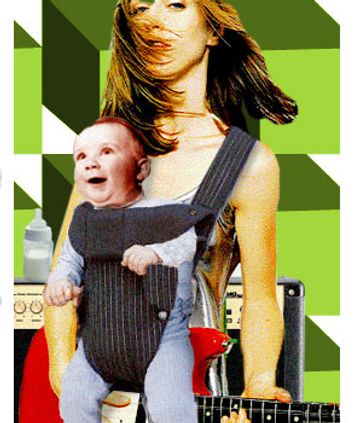
There is perhaps nothing quite so unglamorous for a musician as going backstage after a set and having to change the baby’s diapers. And sippy cups and nursing bras were certainly the last things on the mind of whoever coined the phrase “sex, drugs and rock ‘n’ roll.” But musician moms today, like working moms everywhere, aren’t about to give up their careers just because they’ve had children. Artists of all stripes — rockers, blueswomen, country divas — are managing to combine making music with motherhood. Macy Gray, Susan Tedeschi, Erykah Badu, Celine Dion and two of the three Dixie Chicks are just a few of an increasing number of women who have had kids without significantly interrupting their careers.
That’s not to say that the transition is seamless or without difficulty. There are obviously more demands on time, emotion and energy. There is less space for creativity and fewer hours for practice. And there are even more basic questions to deal with. Like, how do you tour with a 1-year-old in tow? Does the venue have a highchair? And who takes care of the baby while you’re onstage? To get a sense of all that is involved, we talked with four artists about the choices they made.
Erstwhile indie rock queen Liz Phair, post-punk rocker Corin Tucker, folkie Linda Thompson and alt-country crooner Kelly Willis may not have much in common musically, but there is a tie that binds them. All four are performers, singers and songwriters who have kept their careers on track after having children.
Phair has just released “Liz Phair,” the first album she has recorded since the birth of her son Nicholas six and a half years ago. Tucker, of the band Sleater-Kinney, has a 2-year-old son, Marshall Tucker Bangs, and has managed to change plenty of diapers and still thrive in a band that is considered by many critics to be one of America’s best. Thompson, of Fairport Convention fame, took some time off when her three children, Muna, 28, Teddy, 26, and Kami, 21, whom she had by former husband and musical partner Richard Thompson, were born. She has since stepped back into the arena to rekindle her solo career. And singer Kelly Willis, who has a 2-year-old son, Deral Otis Robison, and 4-month-old twins, Benjamin James and Abigail Esme Robison, managed to complete a video during the eighth month of her recent pregnancy.
In separate interviews, Phair, 36, who lives in Los Angeles; Willis, 34, who lives in Austin, Texas; Tucker, 30, who lives in Portland, Ore.; and Thompson, 55, who lives in London, talked about how motherhood has affected their creativity, how they’ve struggled with guilt and separation anxiety, and the multitude of sacrifices, joys and frustrations of being both a full-time mom and a musician.
Do you find that making music is more important to you or less important since you’ve had a child?
Willis: During the first year my son really took precedence. He was my world and still is. But I started to feel that I needed to do some balancing and adjusting. Music was a part of my life that I needed to protect and cherish and so I wanted to get back into it and get back to performing.
Phair: Well, both really. My career really became more important. I used to think of myself more as an artist than a performer and I never really liked performing. But after he was born, I thought, you know this is a pretty cool job. And I stopped being so worried about performing. I stopped being scared of going up onstage and started enjoying it a lot more. But in other ways my career didn’t mean anything. He was the only thing that mattered to me.
Tucker: Music is a great outlet when you’re taking care of this little being all the time, and catering to its every need. But at the same time, it’s easy to become selfish when you’re playing music, so it’s rewarding to focus on your child instead.
Thompson: Music is really important to me when I’m doing it, but I was never driven to do it all the time. You know, I was watching a documentary about Sammy Davis Jr. the other night and he had throat cancer and apparently he wouldn’t allow them to take his voice box out. It could have saved him, but he said, “If I can’t sing, I don’t want to live.” And I thought, Wow, that’s great. But I never felt that way. There are people for whom it’s everything. It was never exactly everything for me.
Is it important to you what your kids think about you as an artist or a performer?
Thompson: I’ve been asked a lot of questions since I made this record ["Fashionably Late"], and that’s the best one I’ve ever been asked because the sole reason I did this record was to make my son Teddy proud of me. I knew how proud he was of his dad’s [ex-husband Richard Thompson] music. But one night he sat in the control room and I played “Banks of the Clyde.” He hadn’t heard it before and he burst into tears. And I was thrilled. I said, My God, he’s really moved. That just made the whole thing worthwhile for me. If my kids can be proud of me, oh, I’m so happy. And they are proud of me.
Tucker: Hmm, how’s he going to think of me? [Laughs] I do worry about it, but I hope he’s just going to understand what I was doing. I hope he’ll know that if I censored myself, I would never write.
Willis: I’ll want them to be proud of me for taking chances. And for doing something that means so much to me. And hopefully they’ll like the music I made too.
Phair: [Laughs] Well, I don’t know, he doesn’t like my music now and never has. I used to think I’d pick up my guitar and play songs for him, but even as a baby he’d start wailing right away. So, I don’t know what he’s going to think of these songs when he’s older.
Liz, some of your lyrics are incredibly graphic. Do you worry about what your son will think of these songs when he’s a teenager and old enough to understand them?
Phair: It’s funny, people have just started asking me what he’s going to think of them. And I never even thought about it before. Well, I guess he’s just going to have to muddle through. I’m sure he’ll get teased or whatever, but you know, at 15 or 16, he’s probably going to have to hate me for something anyway, so he might as well have that.
Has motherhood affected your creativity?
Willis: One of the real changes is that I don’t have as much time. I used to be less organized and would just work on my music at the spur of the moment. I could wait until the last second. But now I have to schedule time to go write. But on the plus side, becoming a mother gave me a lot more confidence as a musician. I’m not as terrified of little things that might go wrong. It doesn’t seem to matter.
Tucker: I’ve found that it’s incredibly hard to get that creative space, that head space, where you can just write and write and write. I’ve always had to kind of force myself to write, except when I was 21 and had my own apartment and was depressed. You can do that when you’re young, but when you’re older you really need to set aside time. So now Carrie [band mate Carrie Brownstein] and I will work on stuff together. If I didn’t have her pushing me along, I don’t know how I’d do it. She writes a lot of the guitar stuff and then we make up the lyrics at the last possible moment.
Phair: It’s such a hard question. But there’s something about having a child that changes you completely. It’s not theoretical anymore. You can think all you want about what having a child is like, but until you do, you don’t know how it will change you. So as far as being an artist, I think it made me freer and not as concerned with what other people were saying about me. Not as worried about what critics or fans thought of me. That was probably the biggest change.
Are there songs you’ve written either about or for your children?
Tucker: “Sympathy” is about Marshall being born really early. Nine weeks early. It was a really scary time. I wrote it way after he was born and the song is like therapy for me because it felt so traumatic at the time. He was in the hospital for a couple of weeks and I was just so worried for so long.
Thompson: I have, but you know I’m the senior citizen here, so I can’t remember what. I wrote a song called “Only a Boy” when Richard and I split up. I have sung and written other songs for my kids, but Jesus, I can’t remember.
Phair: Yes, “Little Digger” from the new album, which is about my son meeting my new boyfriend. It wasn’t a hard song to write, but recording it and performing it is really hard. Just the other night at sound check, I started to play that song and just started crying. I wrote it when he was 2, so I’ve had a lot of time with it, but I haven’t really played it since recording it for the album and it still has a huge impact on me when I play it.
Willis: I guess there’s sort of a joke that every musician who becomes a mother writes “that” song. But yeah, “Reason to Believe” is about my son — it’s sort of a lullaby to him.
Linda, your divorce from Richard Thompson was well chronicled in the music press. Were you worried about the kids having to watch you go through a public breakup and divorce?
Thompson: Well, we weren’t that famous, except in the folk world. What impacted the children was the divorce, not that it was in the papers, because they were too young. If we had been Mick Jagger and Jerry Hall, it would have been different. But you know, divorce is just very, very painful for children. Personally, I would have stayed with the devil himself, just to not put the children through that. Of course, I’m not suggesting that Richard is the devil — I mean, he’s a nice guy.
What about touring? How did you deal or do you continue to deal with taking a baby on the road and to shows?
Tucker: Well, we’re going on tour with Pearl Jam and we’ve already toured the U.S. twice with this record ["One Beat"]. Part of the time I take Marshall with me and part of the time he stays home with my husband [Lance Bang]. But being away from him is like slow torture. It’s like you’re going out of your mind. And it’s definitely the hardest thing about touring. I know it affects the shows. As the days go on and I’m separated from him I become more and more unglued. You do what you have to do to get through everything and the trade-off is that I get to be at home with him all of the time when we’re not on tour. And I get to do something that is really great and that I love.
Willis: I’ve mostly made short five-day runs to avoid being away from home for too long. I did a longer tour with my husband [Bruce Robison] and it was a nightmare. After a show we’d go back to the hotel and spend an hour cleaning baby bottles. I haven’t talked to other musicians, but I would like to know how they handle touring. Especially if they are on my level, you know, not someone like Faith Hill who has the whole world catering to her.
Thompson: I don’t think it’s quite as difficult as some people may imagine, because you can take them with you on the road. Up until they go to school, that is. Well, except the minute I said that, I thought, What a fucking stupid thing to say. It is very difficult because you’re with the baby all day, then you have to get someone to watch them during the set, and then you’re with them again afterward. Come to think of it, it was pretty tiring.
Phair: In the last year my ex-husband has really stepped up. My son stays with me during the day and then with his dad, who lives five blocks away. When I’m on tour he stays with his dad or with his grandparents. The separation was much harder when he was younger. I’d go crazy after just a week of being away from him. [Laughs] Now that doesn’t happen until the third week or so on the road.
Did you ever resent having kids because it may have made it harder for you to have a career? Although, maybe “resent” is too strong a word.
Thompson: Well, I think “resent” is a pretty good word. Again, it’s not a very parental thing to say, but your kids take you for granted. And that’s as it should be. But sometimes you think, You know something, they’re a pain in the ass, they really are. But did I think I could have had a better career without them? No. The only time I’ve slightly envied childless people is that they don’t worry so much. If you’ve got a child, even when they’re grown up, you just worry all the time.
Phair: No, I resented my career. [Laughs] I kept complaining about having to write and make records and perform. I just wanted to spend all of my time with my son.
Willis: Anyone who has a baby, no matter what they do, is going to take themselves out of the running for some things. So, I’m not going to be up all night out with friends and running around town. I just don’t worry about it much.
What was the biggest change for you as an artist and musician once your child was born?
Tucker: It’s just definitely a challenge to do creative work and have a career when you’re a mother. We managed because we had a nanny and Carrie would come over to our house every day and that’s how we wrote the record. If I didn’t have really supportive band mates, I don’t know how we would have done it. They understand that if we were to remain a band we would have to really tailor things so that we could still do it. But it’s not easy.
Willis: You know, I started making music when I was 17, and I was 32 when I had my son. So it was actually a welcome change in a lot of ways to stop making music for a while and to focus my attention on someone else.
Phair: Well, I sobered up. I used to have a few drinks and smoke pot and sit around and write songs. But after he was born I couldn’t fuck around like that anymore. So, I have less time, but I get more done when I’m writing. I’m much more focused.
Thompson: Well, although it’s kind of a sexist thing to say these days, it’s perfectly true that when you have children your ambition changes, if you’re a woman anyway. Biologically, something happens. You wouldn’t die for a gig, but you would die for your kid. Maybe it happens to men, I don’t know, but it certainly happens to women.
There was something creepy about seeing new releases by Madonna, Sade and U2 in 2000. It was like traveling back to the late ’80s. On their newest effort, “All That You Can’t Leave Behind,” U2 include a song titled “Stuck in a Moment You Can’t Get Out Of,” which would be a great joke if you believe that Bono and his mates have a sense of humor.
And yet anyone not predisposed to despise U2 will agree that the band’s latest is an elegant reawakening. It’s shimmering and mystical, as if they have found a reason to believe in music as a healing force unlike any other.
But three recordings by the ’80s icons, despite their considerable merits, don’t reflect the year in music. Of the tens of thousands of songs released to the buying public or their (circle one) thieving/borrowing Napster-using counterparts, the only song that crossed divides of culture, generation, income and ethnicity was “Who Let the Dogs Out” by Bahama’s Baha Men. Groan if you must, but that was the extent of America’s shared musical experience.
There was of course “The Thong Song” and “Oops … I Did It Again,” but grandparents didn’t chant those two at Mets games. Of course, all the “woof-woofing” eventually became annoying, but the absence of any other such wildly popular song is just one more piece of evidence that America’s common musical culture has continued to evaporate. There is no longer a vast cross section of the population sharing musical tastes and residing in the same musical spectrum.
And that’s probably not a bad thing. The country may be split down the middle politically, but musically we are as fractured as the Italian Legislature.
Of course, the music industry produced more than barking-dog songs in 2000. A great deal of trash was served up on those shiny little platters, but there was an awful lot of beauty and brilliance as well.
The depressing news — if you let this sort of thing get you down — is that so much of what was bad sold in such amazing quantities. In the first week in stores alone, combined sales of new offerings by Britney Spears, ‘N Sync and Limp Bizkit topped 4.5 million units. At $16 a pop, that’s a quick and very cool $72 million.
Those numbers shouldn’t be troubling. Romance novels consistently outsell literature and no one worries that Danielle Steel will undermine an entire civilization. In fact, the outlook for music fans seeking a respite from the boy bands, bubblegum divettes and rap/metal blowhards is not in the least bit bleak. It’s just that with rare exceptions, most of the music worth hearing is being played below the charts.
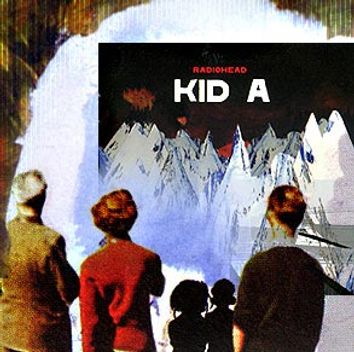
Most noteworthy among artists who achieved both critical acclaim and top sales was Eminem, whose “The Marshall Mathers LP” has sold millions and, though they struggled with the implications, most critics admitted they loved. Also sneaking through was the English group Radiohead, whose mostly lauded (though not by this writer) album “Kid A” charted at No. 1 on its first week on the charts with almost zero radio airplay and the fiercest nonpublicity campaign ever waged. Atlanta rap duo Outkast and neo-soul crooner D’Angelo also managed the rare double of succeeding with both critics and the record-buying public.
But for the most part the top of the charts wasn’t where you wanted to look for great tunes. You had to be open to music of all styles and be willing to experiment. Miles Davis, a famous objector to separating music by category, said in his autobiography, “Good music is good no matter what kind of music it is.”
With that in mind, it helps to be reminded that plenty of good music of all kinds was released in 2000. Here are just 25 examples.
1. Whether you despise Eminem or admire him — and it makes perfect sense to do both — “The Marshall Mathers LP” was the most intriguing musical offering of the year. Critics tripped all over themselves to praise his talent while acknowledging that, just perhaps, his homophobia and misogyny and corrupted social standards were untenable. But as off-putting as Eminem’s lyrics can be, in real-world terms he has less to answer for than, say, the state of Florida. Or the Supreme Court. His violent fantasies are tiresome, but he is among the cleverest wordsmiths in the rap game.
2. As a relative newcomer to thug life, however, Eminem could learn a thing or two from Merle Haggard. Haggard has done some time in prison, but, at 63, he’s put troubles behind. On his heartbreakingly good new album, “If I Could Only Fly,” he sings, “I knew some day you’d find out about San Quentin/And your heart would break and your faith would go away/But it’s time you knew the truth about your papa/I’ve not always been the man I am today.” Imagining Eminem in his 60s is difficult enough. Imagining him with the grace of a life-hardened Haggard is almost impossible.
3. The North Mississippi All-Stars made a strong case for the future of the blues with their album “Shake Hands With Shorty.” Forging the Southern rock of the Allman Brothers with the country blues of their native Mississippi, young brothers Luther and Cody Dickinson and bandmate Chris Chew quickly established themselves as the most in-your-face, alive and exciting blues/rock group since Jon Spencer threatened to steal your girlfriend.
4. Erin McKeown is a relative unknown, but the 22-year-old singer-songwriter’s release “Distillation” is certainly one of the most inventive and interesting albums of the year. Plumbing the disparate strains of a century of American music — Tin Pan Alley, jazz, country, ragtime, swing, folk and blues — she has created a remarkable collection of songs that manage to sound modern and anachronistic at once.
5. Steve Earle is another ex-con making up for lost time. When he isn’t traveling about the country advocating an end to the death penalty or at home producing bands for his E Squared record label, the frighteningly prolific Earle stays busy writing gritty on-the-road songs. Traversing country, bluegrass and Beatles-esque rockers, “Transcendental Blues,” his 11th album, is the Nashville rebel’s latest map for life’s blind seekers and searchers.
6. Rap didn’t need to be saved, but Outkast did it anyway. “Stankonia,” the duo’s fourth album, kicks off with the incendiary “Gasoline Dreams” and follows that with songs that are alternately funny, furious and funky — and usually all three at once. Tracks like “Humble Mumble” (featuring a guest spot by Erykah Badu) and “Ms. Jackson” are the “Me, Myself and I” and “Mary, Mary” of rap’s new age.
7. Straight out of El Paso, Texas, the quintet At the Drive-In arrived in 2000 with “Relationship of Command,” which with its abstract lyrics and feverish, punk-fueled music echoed the sound, if not the politics, of Fugazi and the Minutemen. Fierce and uncompromising.
8-9. Sisters Shelby Lynne and Allison Moorer share a terrible, shocking story, even within the tragedy-rich history of country music. As teenagers, both were at home in Alabama when their father shot and killed their mother before killing himself. That was 15 years ago, but there’s no shedding that kind of trauma. You can hear the lingering anguish and anger in new albums by Lynne and Moorer. Country-tinged, but all over the place stylistically, Lynne’s “I Am Shelby Lynne” rages magnificently one moment and aches despairingly the next.
Moorer’s “The Hardest Part” is a decidedly more country effort than her older sister’s, but it is also wrapped in the same sadness: On the title track she sings, “The hardest part of living is loving, ’cause loving turns to leaving every time.” Moorer’s record also includes a poignant (and unlisted) final track that addresses her family’s devastating past.
10. Philadelphia hip-hop poet and soul singer Jill Scott made an impressive debut with her cleverly titled record, “Who Is Jill Scott?” a lyrically rich, musically rewarding gem that includes the wonderfully nostalgic “Do You Remember?” and “Getting in the Way,” a girl vs. girl slapdown that should have been dedicated to Diana Ross and Mary Wells.
11. Neko Case’s “Furnace Room Lullaby” is a country record fed by a punk spirit. Or maybe it’s the other way around. Either way, it’s belligerently brilliant and Case’s tornado of a voice knocks over everything in its path. When she sings “Mood to Burn Bridges,” it sounds like a threat, while “Thrice All-American” just may be the saddest, proudest song ever written about a crumbling U.S. city.
12. England’s Damon Gough is better known as Badly Drawn Boy and his beautiful debut record, “The Hour of Bewilderbeast,” received a much-deserved buzz after being awarded Britain’s Mercury Prize for best new album. There’s something of a laid-back hippie vibe to many of Gough’s songs — he can come across as a Donovan for the slacker electronica age — but his writing is far more interesting and the lush arrangements and production give this record an imposing, full sound. If you’re not convinced, he’s the guy who sings that pretty song in the new Gap commercial.
13. Björk may be Iceland’s best-known pop export, but Sigur Ros are closing in. Their album “Agaetis Byrjun” is a creation of spare, breathtaking beauty with lyrics that sound like slow-motion banshee wails. It’s a record that feels like it was deposited from another planet. Or Iceland.
14. The steamy confluence of soul, R&B and hip-hop hit its peak early in the year with D’Angelo’s “Voodoo.” The sexiest release of 2000, the funky pleasures here are as sultry and mysterious as the album’s title suggests. D’Angelo might not yet be mentioned in the same breath as Sylvester Stewart or Al Green, but songs like “Devil’s Pie” and “Chicken Grease” are going to get him there.
15. No one explores America’s decrepit spiritual underbelly with results as fascinating as Modest Mouse’s. Despite jumping to a major label, the band remained true to its indie-rock roots with “The Moon and Antarctica,” a captivating and eerie follow-up to their breakout album “The Lonesome Crowded West.” Led by enigmatic frontman Isaac Brock, the Seattle trio creates music that is disconcertingly disconnected — and disconcertingly good.
16. Hailing from Long Island, N.Y., Wheatus are a guilty pleasure. The trio’s eponymous debut combines full-on Fountains of Wayne-style pop with humorous Ween-esque lyrics. In other words, they’re funny and they rock. “Teenage Dirtbag” is a classic loser anthem.
17. Who knew P.J. Harvey was such an optimist? The good feeling shines through on her sparkling new album, “Stories From the City, Stories From the Sea,” a superior work filled with crystalline hard-rocking tunes that are as aggressive as they are accessible. There have been pretenders before her, but Harvey’s vivid imagery and raw vocal intensity make her the legitimate heir to rock-poet Patti Smith. When she howls, on the opening track, “Look out ahead/I see danger come,” it sounds like an invitation for a wild ride you wouldn’t think of turning down.
18. Musical expressions, both ancient and futuristic, are woven together on Tabla Beat Science’s “Tala Matrix,” a fascinating recording conceived of by producer Bill Laswell. The tabla — the two-headed Indian drum — has found its way into the background of Western recordings of all kinds over the past couple of years. Here, though, it is the featured instrument. Traditional tabla players collaborate with electronica musicians and there is an almost spiritual quality to the hypnotic, deliriously percussive results.
19. A number of compelling oddities are included on Billy Bragg and Wilco’s “Mermaid Avenue II,” their overlooked second collection of performances of songs by Woody Guthrie. Mixed in with the socially conscious material are flights of fancy not normally associated with the Dust Bowl balladeer, including a hymn to flying saucers and a tribute to Joe DiMaggio’s hitting streak. Bragg and Wilco’s interpretations are superb, but Natalie Merchant’s charming delivery on the wonderfully nonsensical “I Was Born” steals the show.
20. For those not familiar with him, Damien Jurado is a much, much sadder Elliott Smith. That may seem impossible, but Jurado’s newest release, “Ghost of David,” and last year’s “Rehearsals for Departure” are two inconsolably grieving records. While that sort of unabashed misery is not for everyone, Jurado’s haunting voice is so intimate and imperfectly pure, and his songwriting so jaggedly despairing, that he makes melancholy start to feel like its own reward.
21. Rob Garza and Eric Hilton, the Washington electronica duo better known as Thievery Corporation, have developed quite a reputation as avatars of trip-hoppy dance grooves. Their stylishly seductive “The Mirror Conspiracy” borrows beats from the Middle East, Europe, the Caribbean and South America and mixes them to create an international lounge of cool.
22. The problem with consistency is that it gets taken for granted. Sleater-Kinney, one of America’s most reliably excellent rock bands, delivered their fourth stellar album in five years when they released “All Hands on the Bad One” in May. The now veteran trio of Carrie Brownstein, Corin Tucker and Janet Weiss put their two-guitars-and-drums approach to the task on an album that bristled with energy and emotion. “You’re No Rock & Roll Fun” should have made them millionaires. Or at least earned a place in Rolling Stone’s Top 100 pop songs.
23. Lambchop, the off-kilter Nashville collective, returns with “Nixon,” an odd and laconically beautiful album inspired by the late Richard Milhous. Seriously. The liner notes even provide a reading list on the dead prez.
24. Glamorous and grand, the Dandy Warhols’ “Thirteen Tales From Urban Bohemia” is a rock album dense with images and stories that could be pulled from Lou Reed’s songbook: “Bohemian Like You” is a snarky poseur putdown and the opening 16-minute trilogy of “Godless,” “Mohammed” and “Nietzsche” must be some kind of epic-rock statement.
25. The Brit-pop throne has been vacant since the implosion of Oasis, but if there is a band ready to ascend to that vaunted seat it is Coldplay, whose full-length debut, “Parachute,” is sublimely melodic and artful. There may be no replacing the hype that surrounds the feuding Gallagher brothers, but Coldplay’s sweeping and smart harmonic pop is, along with Badly Drawn Boy’s “Bewilderbeast,” the best of Britain’s musical exports this year. And yes, that includes Radiohead’s “Kid A.”
Continue Reading
Close
Andrew Goodwin: The critic Theodor Adorno, dismayed by the possibilities for classical structures in a broken world, once argued that “art of the highest caliber pushes beyond totality towards a state of fragmentation.” He wasn’t writing about rock music in the 21st century. And he didn’t write the liner notes for “Kid A.” But his words were, as ever, prescient in the extreme.
Alongside Oasis, Elastica, Pulp and Blur, Radiohead were one of five candidates to head up the so-called British Invasion of the 1990s, and if Blur’s Damon Albarn isn’t choking on his press cuttings right now, I for one will be surprised. Like Blur, Radiohead took one look at “success” and decided to rewrite the rule book.
Think about it. Elastica? Six years to follow up their debut album, and they come back with … more of the same. Pulp? The inspiration for a thousand sad bedroom soliloquies have been silent for over two years. Oasis? Their implosion was as ugly as it was predictable. Only Blur and Radiohead have lasted the course; and their tactics, like U2 before them, consisted of following up a brace of smash-hit records with a barrage of dirty, spaced-out noise.
To read the reviews, you might imagine that Thom Yorke has invented a totally new kind of music, rewritten the rules of tonality and taken the tools of multitracking to a new level. He has done no such thing. That Yorke has been listening to Aphex Twin is no secret — the influence of Richard James on this material is transparent. If you are a rock fan looking for new kicks, for something more shocking than the sound of the Gallagher brothers disappearing up their own Beatletudes, then “Kid A” will surprise you.
Otherwise, you will hear an uneven collection of songs weighed down by a paradoxical combination of overambition and underproduction. Some of it is brilliant — expect “Idioteque” and “Optimistic” to feature in Radiohead set lists for years to come. Some of it is mundane: Listen to the faux-jazz screeching of “The National Anthem” next to the inspired honking of Primal Scream’s similar exercise, “Blood Money” (from “Exterminator”), and be embarrassed — be very, very embarrassed.
The first five notes of the first song, “Everything in Its Right Place,” seduce so compellingly that you find yourself listening to the entire album just for the thrill of going back to the beginning. And they also sum up the whole gig. A magical hint of a 1970s Fender Rhodes electric piano lures us in, but with enough synthetic edge to announce something beyond nostalgia. Is it old? Is it new? No, it is something borrowed — the oldest trick in the Book of Rock. This is the Art Move. Radiohead have replaced rollicking power chords and anthemic stadium chants with ambiguities and fragments. This is the pop equivalent of cinema’s Dogme 95 and Brit Lit’s New Barbarians — strip it down, sort it out, detonate the bombast. It is a new thing, and an old thing — the album as its own remix.
The lyrics are a Rorschach test. What do you hear? “I’ve lost my way.” “You can try the best you can/The best you can is good enough.” “I’m here in the studio, suffering for my art/My bandmates are down the pub, drinking beer and playing darts.” These lines quite possibly exist somewhere in the mix, buried beneath backward-masked voices, clapped-out beat-boxes and arrangements that suggest, rather comically at times, that the rump of the band repeatedly abandoned Yorke and his producer Nigel Godrich in the middle of a song.
The Beatles invented the (modernist) Art Move. And indeed, “Kid A” does bear comparison with “Sgt. Pepper” on at least two counts. First, it is the most anticipated release in a decade — albeit for a lost tribe of rock fans whose numbers and confidence in themselves have declined precipitously. Second, “Kid A” is a fine and confused piece of work endangered by the overwrought criticism heaped upon it. We should not blame Yorke for this; we might want to have a word with the Radiohead PR machine, but they, after all, are only doing their jobs. Probably this is nothing more than a hackneyed concept album about cloning — 40-something minutes of music to follow up on 1997′s seven-minute epic, “Paranoid Android.”
Soon enough, no doubt, Radiohead will surprise us one more time, with a grungy, in-your-face, hook-laden Rock Move. Meantime, there’s Poor Thom, fretting on his guitar, strutting at the mike. He’s consumed with anguish about his role as the savior of rock — I must zig when they zag, he thinks, determined not to let stardom undermine his mission to shock. But his fears are unfounded. Radiohead are a good band, but they’re not that important. “Kid A” is a fine album. Rather than losing sleep, Yorke might just realize that until he writes a record as strong as “Definitely Maybe,” “Parklife” or “Different Class,” the anguish is all for naught.
Michelle Goldberg: Until I heard “Kid A,” I thought Radiohead were overrated. Sure, I was enraptured by the supersaturated pathos of “Fake Plastic Trees” from the 1995 album “The Bends,” but except for the rushing triumph of the song “Let Down,” the much-heralded magic of “OK Computer” eluded me. When that record came out there was a lot of hype about it making rock relevant again. Maybe because I’m part of the first generation in decades that’s not defined by rock — since, that is, its death doesn’t presage my own — I’ve always thought that if rock needed to be saved so badly, perhaps it didn’t deserve to be.
“OK Computer” was celebrated in part for articulating a futuristic, dystopian anxiety, but drum ‘n’ bass, hip-hop and trip-hop have been doing that for years. I suspect part of the reason so many rock critics swooned over the album was because it took a contemporary sense of dazed, pained disorientation and expressed it in an old, comfortable idiom.
On “Kid A,” though, Radiohead have reworked their musical language altogether. The record is a panicked, gritty, gurgling mélange of droning rock, electronic effects and jazz freakouts, full of strange, aching beauty. Unlike musicians such as Tori Amos and Madonna, who have simply injected electronic beats into their work to bring it up to date, Radiohead have created something that transcends fashionable pastiche. There are moments where “Kid A” recalls other records — the lullaby synth melodies on the title track are intensely reminiscent of the genius German electronic minimalist B. Fleischmann, while the hypnotic guitar grind and wild horn stabs of “The National Anthem” are pure Death in Vegas. As a whole, though, the album sounds like nothing else out there, at once dazzlingly experimental and intensely lovely, delicate and grandiose.
Yet while “Kid A” is a big stylistic departure for the band, it captures the same sense of vulnerability and paralysis in the face of frenzied, overwhelming change that coursed through “OK Computer.” It’s more powerful, though, because here the terror and yearning in Yorke’s reedy singing is echoed so powerfully by the music’s very structure. On the first song, “Everything in Its Right Place,” his voice seems to be struggling through something viscous and suffocating, while fuzzy echoes, funereal keyboards and warped, choppy vocal samples conjure confused ennui. It embodies the insomniac, brain-whirling feeling that’s one of the worst side effects of living at unprecedented velocity.
The song “Kid A” is similarly both unnerving and stunning. With its beguiling toy-piano melody, diaphanous sound washes, submerged drums and robotically processed vocals, the song combines icy bleakness with tenderness, suggesting a beloved child reluctantly brought into an unforgiving world. Again on “Idioteque,” which begins with a tired break beat but turns ravishing with the addition of Yorke’s slurred, devastated, looped and layered singing, Radiohead render creeping unease and desolation incandescent. I’m reminded of Joy Division, another band that alchemized gloomy, banal alienation into crepuscular beauty. “Kid A” is one of the loneliest records I’ve heard in ages. Perhaps because of that, it’s also one of most comforting.
Joe Heim: The critics are dead wrong when they say Radiohead’s “Kid A” does not quite measure up to its predecessor, “OK Computer.” In more ways than one, it is every bit as mediocre. Ponderous, self-absorbed and ultimately stultifying, it’s a sucker punch that mixes a few brief shards of brilliance with a mostly boring collage of gratuitous electronic noodling and lyrics that range from vague to vacuous. In fact, they are less lyrics than mutterings. “Yesterday I woke up sucking a lemon,” the band’s lead singer and primary architect, Yorke, repeats through a burbling swirl of atmospheric noise on “Everything in Its Right Place,” the album’s first track. On “Optimistic” we get the incantation “You can try the best you can/The best you can is good enough.”
Hmm.
“Kid A” is not about lyrics, of course. It is an imaginative thematic screed against consumerism and the increasing technological manipulation of humanity. Or at least that’s what its apologists insist. The critics and adoring fans point to the album’s hidden sonic nooks and delicate spacey flourishes as proof that there is much here to be discovered. They argue that this is a recording that slowly reveals itself. That to understand it requires patience, flexibility and openness.
But the all too speakable truth is that “Kid A” is imaginative only in the number of ways it discourages repeated listening. It is not particularly inventive or groundbreaking and the only there there is what the listener brings there. That’s not an innovative musical breakthrough; that’s a Rorschach test.
Which isn’t to say the album is without a few breathtakingly good moments. The caterwauling free jazz conclusion to “The National Anthem” is vigorously rebellious. And “Optimistic” provides some sense that Yorke and company have not forgotten how to rock. That’s the tradeoff with Radiohead: The band can occasionally produce transporting music, but listeners must endure excruciating drudgery and torpor to hear it.
It is heresy of course to speak ill of this band. A single doubting word is a call to arms. But there is no question that Radiohead are the most vastly overrated band of the past decade. That is both their fault and the fault of a coterie of critics and their followers who are determined to anoint any band with more than just a flicker of promise as the saviors of rock ‘n’ roll.
Radiohead simultaneously revel in the tag and abhor it. “Kid A,” like “OK Computer” before it, is a “we don’t want to be rock stars” record. It is an anti-record really. But ironically, in its attempts to refute its conferred star/savior status, the band is making unnecessarily grandiose statements. “Kid A” is a damning of categories, a thumb in the eye to expectations and a strong rebuke to the ever-increasing commercial nature of popular music. Choosing those product-unfriendly values may be an admirable decision, but that doesn’t somehow make the band great.
Andy Battaglia: More than any other rock band working nowadays, Radiohead know how to push buttons. Quite literally, they push the buttons that turn studio software into beautiful soundscapes with the skill of haute electronicists. But more than that, they push the buttons of an implacable musical audience for whom the notion of the “important” record is something to scoff at. Chart-topping albums aren’t supposed to matter as much as “Kid A,” and Radiohead seem almost combative for so sheepishly making one that does. Part of this has to do with their love of irony and coy ways with the press, but it also speaks for a musical climate in which a word like “important” can hardly be uttered without scare quotes acting as a safety net.
If “Kid A” is important — and I think it is — it’s because it was artfully constructed by a rock band that has warmly embraced the most determinably obscure movements in electronic music these days. Lots of rock bands, like Stereolab, Broadcast and Pram — not to mention insanely progressive R&B producers like Timbaland — are mining similar ground. But “Kid A” is cartoonishly difficult in ways otherwise exercised only in the most arcane realms of the techno sphere, where militantly elusive figures equate impenetrability with progress. That world is full of intrigue, all catty micro-genric infighting and scandalous ideological defections, like Kid 606 pissing on his peers in the Intelligent Dance Music scene, Photek ditching drum ‘n’ bass on his new album or Aphex Twin giving up on music altogether. But those disputes rarely amount to anything more than scientists arguing over hypothetical contingencies in string theory to people who have things other than music on the brain.
This is where Radiohead comes into play. It goes without saying that it’ll be a long time before some act from the white-hot minimal techno scene in Cologne, Germany, debuts at the top of the Billboard chart. But when “Kid A” did, it brought a lot of ideas out of their willfully hidden corners and blew up microscopic movements into widescreen relief.
None of this would be anything more than novel if the members of Radiohead weren’t almost scarily good electronic musicians — and not just for a rock band. The sounds and textures on “Kid A” are top-of-the-line in every way, taking cues from the electronic underground but also expanding on them and smartly assigning them more immediately affecting, song-based duties. Radiohead borrow from the electronic underground, then outrun it by relegating aesthetics to a secondary science. The album is too haunting and beautiful — not to mention overtly rock-indebted in parts — to be dressed down as binary code.
In fact, it’s even hard to dress it up in wholly appropriate terms. Either because it’s still relatively new or because it has been successful in skirting the language developed around rock ‘n’ roll, electronic music usually gets talked about in fleeting terms. Even staunch loyalists are reduced to using laughably ineffective words — “bleeps,” “bloops,” “clicks,” “cuts,” etc. — to discuss vastly different sounds with vastly different effects. Of course, this is part of electronic music’s allure. But it’s also what leaves critics trying to paint “Kid A” as an important record looking a bit like straw men walking into a barn full of hungry cows. Because their terminology is better developed, it’s easy for naysayers to write off the album as overhyped drivel while supporters struggle to articulate the alien purposes of alien sounds.
That said, Radiohead have helped the cause by contrasting their electronic experiments with complements derived from the pop-song form, and vice-versa. On the album-opening “Everything in Its Right Place,” Yorke sings, “Yesterday I woke up sucking a lemon,” over a womblike field of imploding synth lines that sweeten his sour words. It’s a supremely effective juxtaposition that tugs you by the ear just close enough to pucker along with his sentiment. Similarly, the mind-melting vocal manipulations on the title track drip over sizzling beats before ending with the ambient equivalent of a palette-cleansing sorbet served after an entree of shattered glass.
Flipping the template over, otherwise soothing songs get poked and probed with antagonistic gibes lifted from electronic music’s soul-shunning elements. The wistful acoustic guitar chords that begin “How to Disappear Completely” roll over a seething drone that makes the melody anything but wistful. “The National Anthem,” the closest thing to a rock song on the album, is excruciatingly compressed to the point of madness. The raw bass line barely varies, making its three notes sound like one and the same in spite of their differences. Even the song’s free jazz-like ending is less a crescendo than a tightly wound taunt, hinting at much-needed outward release but instead collapsing in on itself.
From start to finish, it’s like Radiohead are ripping out your brain with one hand and rubbing your thigh with the other. In this way, “Kid A” owes a huge debt to contemporary experimental electronicists like Oval, Aphex Twin, Authecre, Thomas Brinkmann, Vladislav Delay and scores of others. But while even the best electronicists stir up seductive sonic sparks, Radiohead have created something more like a backdraft in “Kid A.” It throbs and pulses, hiding behind a closed door and sucking up all the oxygen in its vicinity. Open that door out of burning curiosity, and nature puts on a doozy of a show. But Radiohead see to it that you’re just as content to watch the eerie spectacle play out by your feet, slowly breathing its lifeless breath.
Continue Reading
Close