Joe Lauria

Novelist, dentist and defender of democracy

Alaa Al Aswany on his country's democratic revolution

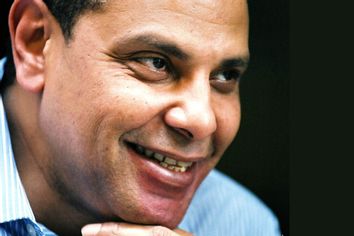
Alaa Al Aswany (Credit: AP/Mohamed al-Sehety)

CAIRO — On the morning of my appointment with Alaa Al Aswany, the Islamists were out in full force. The roar of “Allahu akbar!” rose at 5:30 a.m. from Tahrir Square. The response from hundreds of thousands of agitated men in white jalabiyas and knit caps, filling the square down to the Nile, reverberated through the surrounding Downtown streets.

By late afternoon, the crowd had spilled onto El Kasr El Aini Street, past the Soviet-built Mogamma building (the heart of Egyptian bureaucracy), the Ministry of Transport and the People’s Assembly to Al Aswany’s office in Garden City. Dozens of bearded men with welting prayer marks on their foreheads — bused in from around the country in the dead of night — slept on the dusty pavements.

Al Aswany’s office is in a fairly rundown building on Diwan Street. There is a sign with mismatched lettering hanging from the building over the sidewalk. It reads:

Dr. Alaa EL Aswany

Dentist

D.D.S (Cairo University)

M.S. University of ILLINOIS

4th FlOOR


Al Aswany’s tiny waiting area leads into a slightly larger examining room. The floor was covered in a pinkish Formica, reflecting lines of fluorescent light. In a darkened alcove stood his dentists’ chair. An over-sized ashtray was arranged in the middle of a glass coffee table. After a few minutes he walked in, dressed in gray trousers and a striped shirt.

“So the Islamists had their day,” he said by way of a greeting. We moved to his small desk made of the same pinkish Formica in a corner of the room.

Alaa Al Aswany is one of Egypt’s best living writers. He’s probably the most known Arab novelist in the West since the 2002 publication of “The Yacoubian Building,” which was made into Egypt’s most expensive film. It tells the story of the thoroughly corrupt Mubarak-era through debased characters who are tortured, sexually harassed and crushed by poverty. It is the story of an aging playboy, a wealthy protagonist longing for the cosmopolitan splendor of pre-Nasser Downtown. The characters live in the Yacoubian — a once grand apartment block on Talaat Harb Street.

Despite the fame it brought him, Al Aswany continues to fix ordinary Egyptians’ teeth. He’s caring for patients as he listens to their desperate stories. His latest book, “The State of Egypt,” a collection of his newspaper columns, describes in painful detail the coming social explosion against Mubarak and his cronies, whom he eviscerates on every page. The only plausible explanation for why the authorities never arrested Al Aswany is that his international notoriety would have caused Mubarak more trouble than it was worth.

The book disproves a widely held belief in the West that no one saw the uprising coming. In February 2010, 11 months before the January 25th Revolution began, Al Aswany wrote: “We have to move to the confrontation stage. It is no longer any use begging for our rights by appealing to the regime, because it will not listen. But if a million Egyptians went out to the streets in protest or announced a general strike, if that happened, even once, the regime would immediately heed the people’s demands. Change … is possible and imminent, but there is a price we have to pay for it.”

Then in April 2010, nine months before Tahrir Square was occupied, he wrote: “I don’t know how President Mubarak thinks, though I imagine, based on the theory of ‘dictator solitude,’ that his conceptions are completely detached from the reality of what is happening in Egypt. The reality is liable to produce an explosion at any moment.”

As it turned out, Al Aswany was in the Square during the crucial — and most violent days — of that explosion. “We participated in this revolution from the very first moment, and I faced myself death, three times,” he told me in his examining room. “Once early in the morning of the 26th, and twice on the 28th. I was about to suffocate because on the 26th they became crazy. They were bombing us with [tear] gas bombs.”

“I ran with the people, but I was really about to suffocate,” he said. “I could stand some gas, but not too much. I smoke and have problems already with my lungs. We were running in Tahrir Square, but they were putting soldiers in our way just to put us again in the field of bombs.”

Al Aswany’s intimate knowledge of every warden of Downtown, the setting of the Yacoubian Building, may have saved his life. “I was lucky, because I know downtown very well,” he told me. “I went through a very little street. And I said to myself, ‘They don’t know the area very well, so probably they did not block this street.’ They didn’t block it, and that’s why I escaped.”

Two days later they brought in the snipers. The killing had already begun around the country, in Alexandria and Suez, but it was the first time live ammunition was used in the capital.

“In Cairo they were shocked at the numbers, and they tried to control it without killing and it didn’t work,” he told me. “For the first time I saw soldiers from the Central Security running away because there were 20,000 people coming from Darb Ibn al-Baba — a very popular neighborhood. When they absorbed the shock of what was happening, they began to act at 12:30 a.m. on the 26th.”

As Al Aswany stood in the crowded Square at that moment, a man approached him. “He said, ‘You must write about this revolution.’ And I said, ‘Yes.’ He said, ‘Promise?’ And I said, ‘Promise.’” The man then stepped away and his head exploded in front of Al Aswany. “I mean it’s one bullet,” he said. “They were very professional snipers.”

* * *

Al Aswany was born in Cairo in 1957, the son of Abbas Al Aswany, himself a celebrated novelist and lawyer. He gave his son a cosmopolitan upbringing. He also advised him to get another job to support his writing habit. Al Aswany chose dentistry, which he studied in Chicago. It became the setting of his second novel. “Chicago” (more…)

www.salon.com/writer/joe_lauria/index.html