John Aravosis

President Obama betrays the gay community

We supported you. Time to live up to your promises

  • more
    • All Share Services

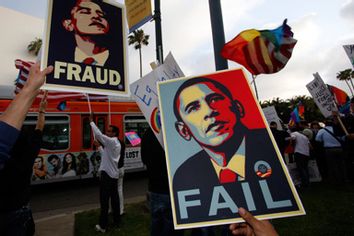
President Obama betrays the gay communityDozens of gay rights protesters demonstrate outside the Beverly Hills hotel, where U.S. President Barack Obama attended a Democratic Party fundraiser in Beverly Hills, Calif. on Wednesday, May 27, 2009.

Team Obama keeps telling lesbian and gay Americans like me to be patient. If we just wait a little longer, administration officials whisper to us lovingly (and out of earshot of the media), after the White House finishes with healthcare reform and getting the troops out of Iraq, your time will come. In the meantime, cheer up — we put a gay band in the inaugural parade!

Everyone loves a parade, but we don’t like being betrayed. And while gay and lesbian Americans were initially willing to cut our new president some slack, the president’s now-clear reticence to follow through on even one of his many campaign promises to the gay community has put the Democratic Party on the precipice of an ugly and very public divorce with this once-solid constituency.

During the presidential primaries, then-candidate Obama promoted himself as the biggest defender of gay rights since Harvey Milk. He would be a “fierce advocate” for our rights, he promised, and he even out-gayed Hillary Clinton: telling gay and lesbian voters that while she was for a partial repeal of the so-called Defense of Marriage Act (DOMA), he’d get rid of the whole damn thing.

And there was much rejoicing.

Then, not so much.

About a year before the November election, primary challenger Obama invited Donnie McClurkin, a homophobic gospel singer who claims to have been “cured” of his own homosexuality, to lead a series of concerts in the South in order to woo the black vote. The gays were not amused, but candidate Obama held firm. The gays forgave the Big O until a year later, when then-President-elect Obama chose evangelical preacher (and well-known homophobe) Rick Warren to give the inaugural prayer. Again, the gays expressed their ire, Obama wouldn’t budge, and his advisors continued to whisper sweet nothings in our ears about how glorious the future would be once Dear Leader was finally in office.

But a funny thing happened on the way to equality. Rather than clouds opening up and angels descending from on high, Barack Obama became president and things never got better for the gays. In fact, they got decidedly worse.

On taking office, Obama immediately announced that he was doing away with the Clinton-era concept of special assistants who served as liaisons to various communities like gays and Latinos. He then went ahead and appointed special liaisons to some of those communities anyway, but never to the gays. Around the same time, the White House Web site, once detailing half a page of presidential promises to the gay community, overnight saw those pledges shortened to three simple sentences. Gone were five of the eight previous commitments, including the promises to repeal both Don’t Ask Don’t Tell and DOMA. Adding to a growing sense of angst, senior White House officials kept telling the media that they weren’t sure when, if ever, the president would follow through on his promises to the gay community. Then there were the Cabinet appointees. Three Latino nominees but nary a gay in sight. And finally, last week our president had his Department of Justice file a brief in defense of DOMA, a law he had once called “abhorrent.” In that brief, filed on the 42nd anniversary of the Supreme Court ruling in Loving v. Virginia (which outlawed bans on interracial marriage), our own interracial Harvey Milk, not lacking a sense of historical irony, compared our love to incest and pedophilia.

Shit, meet fan.

Tonight, President Fierce will try to make amends by signing either a memorandum, a directive or an executive order, directing some federal agencies, but not others, to provide some benefits, but not others, to some gay federal employees, but not others, at some undisclosed time in the future. (And the benefits may reportedly go away when Obama leaves office.)

First problem, federal agencies already have the right to provide these benefits to gay employees — and several, including at least one DOD agency, do. Second problem, the administration can’t tell us exactly which benefits they’re talking about and for which employees. That’s because this was all hastily thrown together after the incestuous and pedophilic gays nearly brought down a Democratic National Committee gay pride fundraiser scheduled for next week. A gay blogger got hold of the event’s guest list and published it, and once D.C.’s gay paper, the Washington Blade, announced that it would be staking out the entrance to the event with camera and video, the $1,000 a head attendees started dropping like flies.

In other words, the only reason we’re getting anything: The gay ATM ran dry.

Don’t get me wrong. Some federal employees getting some benefits at some future point is definitely something. But it’s not an answer to why this president directed his Department of Justice to defend a law he previously opposed when he didn’t have to. It doesn’t explain why the DOMA brief linked a key Democratic constituency to pedophilia and incest. Or why this president has already overseen the discharge of 253 gay service members, and has refused to issue a stop-loss order ceasing those discharges. Or why he won’t lift a finger to push Congress to repeal Don’t Ask Don’t Tell.

The president would like us to believe that he’s awfully busy being president, and if we only wait a little while longer, we’ll get our rights. Of course, the president isn’t too busy to stab the community in the back by continuing the military discharges, defending DOMA, and comparing us to pedophiles. (On Wednesday, White House spokesperson Robert Gibbs was given a chance to repudiate the DOMA brief’s language about incest and pedophilia and would not.)

When, Mr. President, will be a good time to set my people free? When will the leader of the free world get a breather, a presidential timeout as it were? (And I thought this was the administration that could walk and chew gum at the same time.) Are we really to believe that 2010, a congressional election year, will be any more timely than today? Or 2011, the beginning of the presidential primaries? Or 2012, with a congressional and presidential election? There is quite literally no time like the present.

The real problem is that Team Obama is stuck in 1993. Perhaps some advisor has convinced our once-fierce advocate that gay rights is the third rail of presidential politics. Just look at what happened to President Clinton 16 years ago when he tried to help the gays, the insider is likely warning.

But 2009 is not 1993. Sixty-seven percent of Americans now favor granting same-sex couples the right to marry or join in civil unions. Sixty-nine percent support letting openly gay men and lesbian women serve in our military, including a majority of Republicans (58 percent), conservatives (58 percent), and even churchgoers (60 percent). And an overwhelming number of Americans have long since supported passing legislation banning job discrimination against gays.

The controversy is in President Obama’s mind — at least it was until it became real and moved to the Democratic Party’s pocketbook.

What can the president do to avoid outright rupture with the gay community? He needs to start fulfilling his campaign promises — even one would be a nice start. He needs to stop the discharges, and stop the Falwellian legal briefs in support of a policy he opposes. He needs to push — really push — for legislation banning job discrimination, repealing DOMA, and lifting Don’t Ask Don’t Tell.

Many of us were willing to cut our new president some slack. Not anymore.

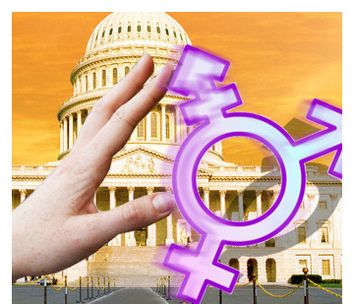
How did the T get in LGBT?

The 30-year fight for a federal gay civil rights law may fail because activists insist on including rights for transgendered people too. Has gay inclusiveness gone too far too fast?

  • more
    • All Share Services

How did the T get in LGBT?

Like an ever-expanding mushroom cloud of diversity, every few years America’s gay leaders and activists welcome a new category of member to the community. Wikipedia walks us through our complicated family history:

“LGBT [lesbian, gay, bisexual and transgendered] or GLBT are the most common terms [to describe the gay community] … When not inclusive of transgender people it is shortened to LGB. It may also include two additional Qs for queer and questioning (sometimes abbreviated with a question mark) (LGBTQ, LGBTQQ, GLBTQ2); a variant being LGBU, where U stands for “unsure”, an I for intersex (LGBTI), another T for transsexual (LGBTT), another T (or TS or the numeral 2) for two-spirited people, and an A for straight allies or asexual (LGBTA). At its fullest, then, it is some permutation of LGBTTTIQQA.”

In simpler times we were all gay. But then the word “gay” started to mean “gay men” more than women, so we switched to the more inclusive “gay and lesbian.” Bisexuals, who were only part-time gays, insisted that we add them too, so we did (not without some protest), and by the early 1990s we were the lesbian, gay and bisexual, or LGB community. Sometime in the late ’90s, a few gay rights groups and activists started using a new acronym, LGBT — adding T for transgender/transsexual. And that’s when today’s trouble started.

America’s gay community, or rather, its leadership, is apoplectic over the imminent passage of the first federal gay civil rights legislation, the Employment Non-Discrimination Act, or ENDA. ENDA would make it illegal for an employer to fire, or refuse to hire or promote, an otherwise qualified candidate simply because of their sexual orientation (gay, straight, lesbian or bisexual). (Contrary to popular belief, it is legal to fire someone for being gay under federal law and in 31 states.) You’d think this would be cause for celebration, but not so much.

ENDA was first introduced 30 years ago. In all that time, it only protected sexual orientation and never included gender identity. This year, that changed, and gender identity was added to the bill. Coincidentally, this year is also the first time that ENDA actually has a real chance of passing both the House and Senate — but only if gender identity isn’t in the bill. So the bill’s author, openly gay Rep. Barney Frank, D-Mass., dropped the transgendered from the bill, and all hell broke loose. Gay activists and 220 national and local gay rights groups angrily demanded that gender identity be put back in the bill, guaranteeing its defeat for years to come. Many of them, suddenly and conveniently, found all sorts of “flaws” with legislation that they had embraced the previous 29 years. They convinced House Democratic leaders to delay action on ENDA till later in October. They’d rather have no bill at all than pass one that didn’t include the transgendered.

Then an odd thing happened. I started asking friends and colleagues, ranging from senior members of the gay political/journalistic establishment to apolitical friends around the country to the tens of thousands of daily readers of my blog, if they thought we should pass ENDA this year even without gender identity. Everyone felt bad about taking gender identity out of ENDA, everyone supported transgender rights, and everyone told me “pass it anyway.”

Their main argument, which I support: practical politics. Civil rights legislation — hell, all legislation — is a series of compromises. You rarely get everything you want, nor do you get it all at once. Blacks, for example, won the right to vote in 1870. Women didn’t get that same right until 1920. The Civil Rights Act of 1964 provided a large umbrella of rights based on race, religion, sex and national origin, but failed to mention gays or people with disabilities. People with disabilities were finally given specific rights under the Americans with Disabilities Act of 1990, but gays as a class have still to be granted a single civil right at the federal level. If we waited until society was ready to accept each and every member of the civil rights community before passing any civil rights legislation, we’d have no civil rights laws at all. Someone is always left behind, at least temporarily. It stinks, but it’s the way it’s always worked, and it’s the way you win.

I have a theory about revolutions. I’ve always believed that you can’t force a country to have a revolution, and then expect democracy to stick. Yes, you can launch a coup, topple a government, and execute a Saddam, but for a revolution to stick — for democracy to survive — a country’s citizens need to be responsible for, and vested in, the social change happening around them. Otherwise they have no ownership of it, as it wasn’t their revolution.

I have a sense that over the past decade the trans revolution was imposed on the gay community from outside, or at least above, and thus it never stuck with a large number of gays who weren’t running national organizations, weren’t activists, or weren’t living in liberal gay enclaves like San Francisco and New York. Sure, many of the rest of us accepted de facto that transgendered people were members of the community, but only because our leaders kept telling us it was so. A lot of gays have been scratching their heads for 10 years trying to figure out what they have in common with transsexuals, or at the very least why transgendered people qualify as our siblings rather than our cousins. It’s a fair question, but one we know we dare not ask. It is simply not p.c. in the gay community to question how and why the T got added on to the LGB, let alone ask what I as a gay man have in common with a man who wants to cut off his penis, surgically construct a vagina, and become a woman. I’m not passing judgment, I respect transgendered people and sympathize with their cause, but I simply don’t get how I am just as closely related to a transsexual (who is often not gay) as I am to a lesbian (who is). Is it wrong for me to simply ask why?

I wrote on my blog last week about this issue, and shared my doubts and concerns and questions. And I was eviscerated for it. While the majority of my readers either agreed with me, or found my questions provocative and relevant, a vocal minority labeled me a bigot, a transphobe, a rich, white boy living in a big city who didn’t care about anyone but himself, and worse. An old activist friend even told me that my words were prejudiced, wrong and embarrassingly uninformed, and that no one of any consequence shared my concerns, and if they did, they were bigots too.

I know firsthand that it’s not safe in the gay community to ask questions about how the transgendered fit in. I also know that I am not alone in my questions, or my fear of asking them. While I’ve been taking abuse for my position, I’ve also been amazed by the number of phone calls, e-mails and people stopping me on the street here in Washington, both straight and gay, thanking me for asking the questions I did, for voicing the doubts that they share. (Not surprisingly, many of these expressions of solidarity have been off-the-record.)

It would have been easy to simply write a blog post, or an article here today, about how I respect and support transgendered people and their rights (and I do), but how it was unfortunately political necessary to cut them out of ENDA. I could have chosen to never touch upon the question of the role of the T’s in the LGB community. But that kind of self-imposed censorship is the reason we’re in the pickle we are today. For 10 years now, the right questions never got asked, never got answered, and as a result, support for the inclusion of transgendered people in the gay community remains paper-thin for a sizable number of gays. Normally that wouldn’t matter. But when we are asked — well, told — to put our civil rights on hold, possibly for the next two decades, until America catches up on its support for trans rights, a lot of gay people don’t feel sufficiently vested in trans rights, sufficiently vested in the T being affixed to the LGB, to agree to such a huge sacrifice for people they barely know.

I remember sitting at lunch a few years back with Gloria Feldt, then president of Planned Parenthood. I was talking about the looming threat to Roe v. Wade from the Bush court, and Gloria told me that for all intents and purposes Roe was already dead. Conservatives had so whittled away at abortion rights over the past 30 years, with small amendments and ballot initiatives here and there, that it didn’t matter that the courts had yet to overturn Roe itself. Roe had already been repealed through attrition and few to no abortion rights remained.

Conservatives understand that cultural change is a long, gradual process of small but cumulatively deadly victories. Liberals want it all now. And that’s why, in the culture wars, conservatives often win and we often lose. While conservatives spend years, if not decades, trying to convince Americans that certain judges are “activists,” that gays “recruit” children, and that Democrats never saw an abortion they didn’t like, we often come up with last-minute ideas and expect everyone to vote for them simply because we’re right. Conservatives are happy with piecemeal victory, liberals with noble failure. We rarely make the necessary investment in convincing people that we’re right because we consider it offensive to have to explain an obvious truth. When it comes time to pass legislation, too many liberals just expect good and virtuous bills to become law by magic, without the years of legwork necessary to secure a majority of the votes in Congress and the majority support of the people. We expect our congressional allies to fall on their swords for us when we’ve failed to create a culture in which it’s safe for politicians to support our agenda and do the right thing. ENDA, introduced for the first time 30 years ago, is an exception to that rule. It took 30 years to get to the point where the Congress and the public are in favor of legislation banning job discrimination against gays. It’s only been five months since transgendered people were included in ENDA for the first time.

I support transgendered rights. But I’m not naive. If there are still lingering questions in the gay community about gender identity 10 years after our leaders embraced the T — and there are — then imagine how conflicted straight members of Congress are when asked to pass a civil rights bill for a woman who used to be a man. We’re not talking right and wrong here, we’re talking political reality. Our own community is still grappling with this issue. Yet we expect members of Congress, who took 30 years to embrace a gay ENDA, to welcome the T’s into the bill in only five months.

Passage of ENDA, of any federal gay civil rights legislation, would be a huge victory for the gay community. Not just legally, but culturally. Hell, we could pass the legislative equivalent of “Four Minutes, Thirty-Three Seconds,” the famous avant-garde musical composition that contains no notes and is nothing but silence, and it would still mark the beginning of the end of our long struggle for equality. I’m not joking. We could pass a bill titled “Gay Civil Rights Law” that contained no language whatsoever. The fact that the United States Congress finally passed legislation affirming gay and lesbian Americans as a legitimate civil rights community, as a protected class of American citizens rather than a group of mentally disturbed pedophiles, would empower our community, demoralize our opposition, and forever place us among the ranks of the great civil rights communities of the past and present.

That’s why James Dobson, Tony Perkins and the men at the Concerned Women for America are so hell-bent on defeating ENDA. To the religious right, ENDA without gender identity isn’t a weak, meaningless bill fraught with loopholes. Our enemies know that passage of any federal gay civil rights legislation is a legislative and cultural milestone that would make it that much easier for all of us — gays and lesbians, bisexuals and eventually even the transgendered — to realize all of our civil rights in our lifetime.

I’ll take that half-a-loaf any day.

Continue Reading Close