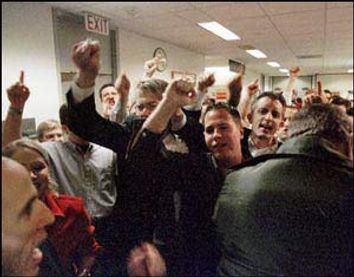
On the surface, it looked like the good people of Miami at their worst again. Last week’s melee at the county offices here — followed by the local canvassing board’s abrupt cancellation of a hand recount — had all the trademarks of Miami’s notorious tantrum politics. Screaming, shoving, fist-waving, intimidation, ties to Elian Gonzalez and even hints of good ol’ Cuban-American political corruption.
But the fact is that the fracas at Miami’s recount headquarters was engineered and carried out by Republican Party operatives imported from the heartland, far from South Florida. They might have reminded viewers of Elian’s Army — and might even have taken lessons from the Cubans — but, by all accounts, the city’s strident conservative exile community was very much in the minority. As one observer put it: “There were no guayaberas. This crowd looked tweedy. They were from out of town.”
Indeed, all on-the-scene reports coming out now indicate that the Miami protest was carried out by rent-a-rioters flown in by the Republican Party. GOP spokespeople have said that at least 750 Republican activists have been sent into South Florida from around the country to oppose the recount, with the party picking up the tab for a number of them. And last Wednesday, when a gaggle of protesters sprang into action in Miami, those efforts seem to have paid off.
The halt of the Miami-Dade County hand count, where 10,750 ballots remain uncounted — more than enough to flip the outcome of the Florida election or further buttress George W. Bush’s lead in the state — dealt a devastating blow to Al Gore’s presidential campaign. The vice president’s attorneys are arguing that intimidation influenced the canvassing board’s decision to stop the hand recount and that it should be resumed.
The incident — the ugliest single set piece of the Election 2000 epic and possibly the most decisive one — was set in motion by one imported GOP operative: Rep. John Sweeney, R-N.Y., who from an office in that same county building has led the Miami fight against the recount.
But Sweeney wasn’t alone. According to the Miami Herald, he had a few helpers, including Elizabeth Ross, a staffer for Senate Majority Leader Trent Lott, R-Miss., and Thomas Pyle, an aide to House Majority Whip Tom DeLay, R-Texas.
London Sunday Times correspondent Tom Rhodes, who was present during the protest, says he overheard one GOP protester on a cellphone in the midst of that political mosh pit bragging that he had tipped off Bush campaign strategist Karl Rove about the rally. “I just told Rove,” Rhodes overheard. As with the presence of Ross and Pyle, the call demonstrated that these weren’t just protesters lured off the streets by the party, but connected, dyed-in-the-wool party operatives.
Wednesday’s upheaval came suddenly and unexpectedly. With the Sunday deadline mandated by the Florida State Supreme Court fast approaching, the three-person canvassing board decided to scrap a total recount and tally only contested ballots. The board also announced it would move its operation to a smaller room closer to the computerized ballot-scanning machines in order to speed up the count. Despite the fact that observers and pool media could still be admitted, the GOP’s Miami team, which had been decrying possible corruption in the count all along as Gore picked up another 157 votes, decided it was time to act.
On hearing of the decision to move the vote tally, Sweeney uttered a three-word order to his troops: “Shut it down.” Those words were reported by Paul Gigot, who was in the room with GOP operatives, in his Wall Street Journal column Friday.
Within minutes, some two dozen GOP recount observers and other Bush supporters had begun pounding on the doors and windows of the county elections tallying room on the 19th floor of the building. They demanded to be admitted and chanted, “Stop the count. Stop the fraud.” Television cameras showed the protesters trying to force their way into the room.
According to Gigot, who was with Republican leaders at the protest, the GOP forces also threatened to unleash the vociferous Cuban-American community on the recount workers. “One thousand local Cuban Republicans were on the way,” they said. But they never seemed to materialize.
“There were two or three loud Cubans but most of the people I talked to were white, mostly men, from Oklahoma, Texas, mostly Southern states,” says Sunday Times correspondent Rhodes. “They were talking on cellphones, probably to people nearby, telling them to get in there right away and bring as many people as they could.”
One of the main targets of the demonstrators was Democratic County Chairman Joe Geller. Geller, who had gone to the elections office to request an unused sample ballot, was mobbed by the protesters as he left those offices. They accused him of stealing a ballot.
“I requested it, which I’m entitled to do,” says Geller. “It was clearly marked ‘sample ballot for use by Democratic Party.’ The whole transaction was out in the open and all very calmly done. This Republican observer — a woman with blond hair, a suit and clipboard — was watching the whole thing. But the moment I started to walk away, she sicced the crowd on me. She said I was stealing a ballot and they surrounded me. It was all orchestrated,” he alleges.
Television cameras captured those frantic scenes and broadcast them to a riveted global audience.
“Suddenly, I was surrounded by a screaming, shoving, insane crowd, shouting that I had done something I hadn’t done,” Geller says. “People grabbing at me and my clothes and there was almost no security. I couldn’t believe those people weren’t arrested.”
Geller was unhurt, but he raised the question of the lack of security in County Hall and criticized Democratic Cuban-American Mayor Alex Penelas, who basically broke with the party after the Elian affair and did not campaign for Gore in the city. In fact, some two weeks before the election, he led a trade delegation from the county to Spain, and did not return until just before the balloting took place. Penelas has said publicly that he chose to “stay above the fray.” A spokesman for the mayor said Monday that he had done everything possible to facilitate the recount.
But rumors abound in Miami that Penelas may soon switch parties.
Geller, who himself wants to gain support for his party in the exile community, mentions more than once that there were few Cubans in the rowdy crowd.
“This was not a Miami moment. It was outsiders, Hitler youth, sent in by the Republicans to intimidate the election officials,” he says.
Only a few hours after the protest, the board members did exactly what that mob was asking: They halted the count. The move left the indelible impression on many in Miami, especially Democrats, that they had caved to the protesters.
But members of the commission deny such charged allegations. David Leahy, the county’s supervisor of elections and a member of the canvassing board, denies that the protest had any effect on the decision to end the recount.
“At no moment was I intimidated,” he said earlier this week in a televised interview. The denial came after the New York Times story reported that the protests had been a factor in the board’s decision to end the recount.
The board has maintained that the state Supreme Court deadline, not GOP pressure, drove the canvassing board’s decision to abandon the count. But the Democratic Party says the protests did cause the halt, and the Gore team has made the alleged intimidation a major prong in its legal strategy.
The board is composed of Leahy and two county judges, Lawrence King and Myriam Lehr. King is a registered Democrat and the other two are independents. They are all appointees.
King and Lehr are both clients of controversial political consultant Armando Gutierrez, who was spokesman for Lazaro and Marisleysis Gonzalez during the Elian telenovela earlier this year. Successful candidates for Miami-Dade County and circuit court judgeships routinely turn to Gutierrez for help. In exchange for his $15,000 consulting fee, Gutierrez assures the support of the Cuban community, which means the judges will almost certainly run unopposed. According to the Miami Herald, as of mid-October Gutierrez had collected $351,750 in consulting fees for representing those judges in this election cycle alone, including King and Lehr.
Tony Alfieri, a professor of law at the University of Miami and a commentator on legal ethics, said Monday there were no allegations of corruption against the judges, but he decried the way in which they had been pulled into the political process and how that created “the appearance of corruption. And that appearance affects not only this election result, but public participation in the process.”
In a telephone interview, Gutierrez says he was in Toronto the day of the protest and didn’t play a role in it. “Those judges don’t run again for six years,” he said. “I won’t see them until then.”
For many, the melee at County Hall was a vivid reminder of the rhubarbs outside the Miami home of Elian last spring. As with almost everything in Miami these days, it’s not hard to find symbolic connections between the election recount, Elian and also to the political climate of the 1990s, which was rife with corruption.
Republicans used to have it real good here. In 1960, Richard Nixon crushed John Kennedy 62 to 38 percent. In 1984, Ronald Reagan ripped Walter Mondale 186,000 to 116,00. Four years later, George Bush Sr. did a job on Mike Dukakis by 37,000 votes. Democrats couldn’t crack the GOP stranglehold in Palm Beach County.
Meanwhile, Jews and blacks once had it very bad here. Until the 1960s, Jewish people weren’t allowed to live in many parts of the county, not to speak of joining the area’s country clubs — the settings of Town and Country magazine spreads. Blacks, outnumbered and outspent, had little or no political power.
But that has all changed, much to the chagrin of the GOP.
Cornelius Vanderbilt, William Rockefeller and their friends who once lived and played in the wildly wealthy town of Palm Beach — a Republican fortress separated from rest of the county by a waterway — must be rolling over in their burial vaults. The money is still here — there’s no GAP or Banana Republic on the main drag of Worth Avenue, only Chanel, Valentino, Armani and Gucci. But the local political power has gone “across the bridge to the mainland,” as people here call it.
Liberal elderly Jews have been pouring into the county steadily since the 1960s, joining the area’s growing black community. In 1992 and 1996, they helped Bill Clinton win landslide victories in Palm Beach County. According to the first tally of the 2000 vote, they endowed Al Gore with an even larger winning margin — 117,000 votes more than George W. Bush.
Now the same two political forces are leading the angry fight for a revote in the county. Their effort, which they say will make Al Gore president and send Bush back to Texas, has drawn international attention. Since Tuesday’s vote, Palm Beach County has become the epicenter in the Florida election controversy, with growing protests and vituperation between political partisans. In addition to the Buchanan vote ambiguities, more than 19,000 ballots were discarded in the county because individuals voted for two presidential candidates. On another 10,000-to-11,000 ballots, no presidential candidate was chosen, indicating that the computers may not have detected holes in the cards. The county began a hand recount of ballots Saturday — a process the Bush campaign is seeking to halt in court.
“We have an historic alliance, the blacks and Jews,” the Rev. Jesse Jackson said Thursday night in a fiery speech inside the New Macedonia Baptist Church in a black political stronghold “across the bridge.” He cited a long history of Jewish and black cooperation for civil rights causes.
Some 10 elderly Jews — looking fragile and way out of place in that black church — sat in the front pews, avidly applauding and pumping their fists. They represented tens of thousands of other Jewish residents who are calling for a revote.
A confusing ballot caused the votes of many Jews and blacks to be disqualified, they say. Even worse, because of the confusion, some Jews say they mistakenly voted for Reform Party candidate Pat Buchanan, who once described Adolf Hitler as “a man of courage.” While the Bush campaign later insisted Palm Beach County was a bastion of Buchanan support, offering statistics for the county’s Reform Party voters, Buchanan himself and his Florida organizers have conceded that many of his 3,407 votes in the county were probably cast in error. They claimed only about 300 to 500 supporters in Palm Beach.
“When I took one look at that ballot on Election Night … it’s very easy for me to see how someone could have voted for me in the belief they voted for Al Gore,” Buchanan said on NBC’s “Today” show Thursday.
Speaking at the Baptist church, Jesse Jackson, for once, agreed with Buchanan — on the ill-designed ballot. “We’re fighting for our vote to count — together,” Jackson told the Jews gathered at the Baptist church. He said the two groups would meet together, march together, “even go to jail together” in order to achieve a revote in the county.
The alliance Jackson is advocating would have been impossible 30 years ago. And the change in the politics of Palm Beach has been caused, more than anything, by the astounding immigration of Jews to the county.
“It used to be very tough to be a Jew here,” says Ken Swart, spokesman for the Jewish Federation of South Palm Beach County, based in Boca Raton. “If you go back to Boca Raton in the 1960s this used to be a restricted city. No Jews allowed. If you tried to buy a house or join a golf club, forget it,” Swart says.
But the barriers came down during the 1960s. Today, some 130,000 Jews live in a three-town area in and around Boca Raton, and they comprise 43 percent of the population. According to local Jewish organizations, it’s the fastest growing Jewish community in the United States.
Another 101,000 Jews live in the rest of the county. In Boynton Beach alone, the Jewish population grew from 9,262 in 1987 to 37,444 today, according to the Jewish Federation. Some 10,000 Jews live in one sprawling condominium complex called Century Village between West Palm Beach and the sugar cane fields to the west.
“We’re about 65 to 70 percent Jewish here out of a total of 14,000 people, with a sizable Italian population as well,” says Marvin Zwiebach, president of the congregation at Synagogue Anshei Sholom, which is within the walled complex. “The people who have come here, both Jews and non-Jews, come from the northeast mostly and some from Chicago. Those people tend to be liberal. And that has been liberalizing the southern part of Florida.”
Zwiebach, who always wears a yarmulke and a guayabera, stands next to a shrine in the synagogue dedicated to the 6 million Jews killed in the Holocaust. Asked about almost 200 votes that were recorded at Century Village for Pat Buchanan, Zwiebach shakes his head.
“Bush maybe — some of my best friends are Republicans — but Buchanan never,” he says, attributing the votes to the confusing ballot.
Kurt Weiss, president of the United Civic Organizations at the village, scoffs at the totals. “The people here who are truly for Buchanan, you could fit them in a phone booth,” Weiss says. “They screwed up the ballot … We need a fair vote.”
About 10 miles away in Riviera Beach, a town of some 30,000 people 70 percent of whom are black, the Rev. Herman McCray says he believes the balloting process was unfair. McCray’s barbecue ribs takeout business looks out on a weedy road called Old Dixie Highway.
McCray, 59, who was born in the county, doesn’t just see Old Dixie here; he lived it — and not that long ago, he says.
“Thirty years ago, there was still an ordinance in force in this town that said blacks couldn’t go to the white beaches.” Sitting on a tree stump on the porch of his business, he points to the remnants of a 4-foot-high cinder block wall next to his building. “That wall right there used to divide the black community here from the white community. That’s why they built it. That was in the ’50s. You went over that wall into the white neighborhood, they drove you out of there or they arrested you … You talk about racism? It was here … and it’s still here in this election.”
In 1967, the town experienced a major race riot — a low point in local political history. But little by little, blacks became the majority in Riviera Beach, and in 1970 it became the first town in Florida with a significant racial mix to have a majority of blacks on its town council. The “wall” came down.
“Because we’re the majority here, people in Riviera Beach are used to their vote making a difference, on the local level especially,” said McCray. He said in the national race between Gore and Bush those black voters also have crucial interests that demand a revote.
“We’ve seen what Bush’s brother has done here in Florida,” he says, referring to Gov. Jeb Bush. “We’ve seen him propose a plan which he calls affirmative action but really just snuffs out affirmative action. We expect his brother to do the same. Just like their daddy did. Who else but George Bush could have put somebody like Clarence Thomas on the Supreme Court? We don’t need more.”
Continue Reading
Close
According to a memo distributed to poll workers in Palm Beach County Tuesday afternoon, the county’s supervisor of elections was already aware that voters were struggling with the confusing butterfly ballot her office had prepared.
More than 19,000 ballots were nullified in Palm Beach County because voters selected more than one candidate as their presidential choice. Reform Party candidate Pat Buchanan received a surprising 3,407 votes — more than three times the votes the ultraconservative candidate received in any other Florida county, and almost 20 percent of his total in the state. Some complained that they had erroneously voted for the Reform Party candidate, and three voters filed suit Wednesday to force a revote in the county.
The Election Day memo, written by Theresa LePore, states “Please remind all voters coming in that they are to vote only for one (1) presidential candidate and that they are to punch the hole next to the arrow next to the number next to the candidate they wish to vote for.”
Florida State Rep. Irv Slosberg, who was rallying voters at the Whisper Walk precinct near Boca Raton, says workers at that polling place weren’t given the memo until sometime in the afternoon, at least five hours after the polls had opened.
Slosberg aide Lawrence Victoria, who was working at nearby Century Village, says poll workers there didn’t receive the letter until sometime between 12 and 1 p.m. Due to complaints about confusion, Democratic volunteers began telling voters to “punch number five if you want to vote for Gore.” But Victoria was unaware whether similar efforts were undertaken elsewhere in Palm Beach County.
Slosberg says he’s outraged by Tuesday’s outcome. “It was an illegal ballot. We threw the penalty flags down and now we want the refs to come and declare first and 10.
“It’s not frivolous,” Slosberg says. “I think there’s strength in numbers. We have 20,000 people disenfranchised here.”
According to Salon’s Jake Tapper, LePore’s memo was written after DNC officials complained to her in an 11:24 a.m. fax. The DNC missive stated “apparently certain presidential ballots in several precincts in Palm Beach County are quite confusing … You should immediately instruct all deputy supervisors and other officials at these precincts that they should advise all electors (and post a written advisory) that the ballots that the presidential race list is two pages long and that the electors should only vote for one presidential candidate.”
But Slosberg aide Victoria says the DNC complaint wasn’t the first. While visiting one of several precincts on his get-out-the-vote tour around Boca Raton, Victoria says he overheard one Democratic volunteer calling to complain to LaPore’s office about the confusing ballot at 8:30 a.m.
Continue Reading
Close
As the nation waits for a recount in Florida to decide who the next president will be, all eyes are focused on Palm Beach County, the liberal, Democratic stronghold that gave Reform Party candidate Pat Buchanan a surprising 3,407 votes — more than three times the votes the ultraconservative candidate received in any other Florida county, and almost 20 percent of his total in the state.
Three Palm Beach voters sued late Wednesday to force another vote in the county, alleging that the badly designed ballot was illegal and caused Democrats to cast their votes for Buchanan when they were trying to vote for Vice President Al Gore. Even Buchanan jumped into the fray Thursday, telling NBC’s “Today” that “it seems to me that these 3,000 votes people are talking about — most of those are probably not my vote and that may be enough to give the margin to Mr. Gore.” Shortly after, a federal judge agreed to hold an emergency hearing on the lawsuit Thursday afternoon.
At the end of the day Wednesday, the Palm Beach County mystery deepened when it was reported that over 19,000 ballots were nullified for having more than one hole punched for a presidential candidate.
It’s hard to imagine that liberal Palm Beach County, with its many Jewish voters, would turn out to be a Buchanan bastion. Buchanan is widely considered to harbor anti-Semitic sentiments, once praising Adolf Hitler as “an individual of great courage, a soldier’s soldier in the Great War, a leader steeped in the history of Europe, who possessed oratorical powers that could awe even those who despised him.” He has also written admiringly of Nazi Germany’s efforts to counter the Soviet threat.
In 1992, the Anti-Defamation League charged that Buchanan had shown “a disregard or hostility toward those not like him and a consequent displeasure with the exercise of freedom by these others … [a] displeasure expressed in a 30-year record of intolerance unmatched by any other mainstream political figure.”
But where Buchanan earned three-tenths of 1 percent of the votes Florida cast for president, he drew eight-tenths of a percent of the presidential vote in Palm Beach County.
Gore’s team dispatched a delegation of 50 workers to Florida to monitor the recount and to investigate the many reports of polling problems. Former Secretary of State Warren Christopher headed to Tallahassee to monitor the vote recount for the Democrats, while his Republican counterpart, James Baker, secretary of state in the Bush administration, performed the same duty for the Republicans.
The notion that a state led by Bush’s brother Jeb holds the key to the election is a twist out of fiction, and raised intense concerns about the fairness of the election. The network’s flip-flopping predictions about the Florida outcome throughout Election Night further heightened the mystery. Gov. Jeb Bush recused himself from responsibility for the recount. Meanwhile, Florida Attorney General Bob Butterworth, a Democrat and close Gore advisor, took a leading role in focusing attention on the alleged voting irregularities. Political analysts pointed to recent cases of rampant electoral corruption in Florida, including the last mayoral race in Miami, raising the possibility that the state’s presidential vote may also have been sullied.
At the end of the day Wednesday, Bush’s margin over Gore in Florida had fallen to a mere 790 votes, as Palm Beach County’s recount added nearly 1,000 votes to Gore’s tally.
Meanwhile, the Rev. Jesse Jackson flew to Miami early Wednesday and led a rally to protest possible voter fraud and intimidation. Democrats received reports that African-American voters were harassed by police in Wakulla County. “Highway Patrol troopers were stationed outside of those precincts with lights flashing and ticketing people,” Florida Democratic Party chairman Bob Poe told ABCNews.com. “It was bizarre; it was like going back into the early 1900s,” he said.
Other complaints focused on Volusia County, where Democrats complained that Gore’s vote count dipped by 10,000 at one point, inexplicably.
But the most explosive complaints came from Palm Beach County, where officials said that Democratic votes that inadvertently went to Buchanan could provide the margin of victory for Gore.
“You look at ballots where people voted straight Democratic tickets, except that they voted for Pat Buchanan, and that tells you something is wrong,” said state Sen. Ron Klein, D-Boca Raton. Klein said he had been assigned by the Gore-Lieberman organization to monitor the recount at the Palm Beach County Elections Department.
“You also have votes that were disqualified because people voted twice for the presidency. That also indicates that people were confused. This could be of such magnitude that legal action could be called for.” He said that Democrats might seek a court order from a federal judge that would lead to repolling in the district.
Klein had no firm numbers for how many ballots might have been affected or if it would be enough to change the outcome in Florida and the awarding of its decisive 25 electoral votes. Absentee ballots arriving from outside the country could also affect the final balance.
Republicans branded the polling controversy a ruse. Victorious GOP Rep. Mark Foley said the Buchanan vote tally, only 0.8 percent of votes cast in the county, was not particularly high. He said that in his Florida district race, the Reform Party candidate had drawn 2,651 votes, indicating more Reform Party voters than anticipated. But Democratic county commissioner Bert Aaronson disagreed.
“I don’t think we have 3,000 Nazis in Palm Beach County,” he said, referring to the Buchanan votes.
Luckily for Republicans, the controversial ballot design was approved prior to the election by a Democrat, Palm Beach County supervisor of elections Theresa LePore. It featured the names of six presidential candidates on one page and four on the facing page. The names were staggered so that the holes to be punched would not be directly next to each other, but one atop the other. Arrows pointed at which hole should be used. But according to Democrats, the design still made it unclear which hole to punch if you wanted to vote for Gore and which to punch for Buchanan. Although Gore’s name was the second on the left-hand side of the ballot, the hole that corresponded to his name was third.
According to the Democrats, Florida law specifies that voters mark an X in the blank space to the right of the name of the candidate they want to vote for and therefore the design used in Palm Beach violated the law.
“Right means right, doesn’t it?” said Jeff Liggio, a lawyer for the county Democrats. “The state law says right; it doesn’t mean left.” But GOP officials said that since Democrats had accepted the ballot prior to the election, it was legal.
LePore defended her work Wednesday. She said the two-page layout allowed larger print to be used.
“I was trying to make the print bigger so elderly people in Palm Beach County can read it,” she said. “We sent out sample ballots to all registered voters and no one said a word.”
But some voters voiced their complaints Tuesday and Wednesday. “I was confused so I asked for help,” said John Lazet, 66, a retiree who lives in the town of Lake Worth. “I asked which hole do I punch for Gore. The woman working at the polling place told me to punch the second hole. Then she came back and told me she had made a mistake and that it was the third hole. She didn’t even know, but she brought me a new ballot. I complained that it was too confusing and that others wouldn’t know what to do.”
Lazet said he went to LePore’s office to complain and got into an argument with the elections supervisor, who defended her work.
Anita Rizzo, who runs a preschool in the town of Loxahatchee, said she also found the ballot difficult.
“‘This is a little confusing,’ that’s what I said to my husband,” said Rizzo, 57. “If Gore is the second name, then you figure you punch the second hole, but, no, it wasn’t like that. Then I heard another person, an older lady, two booths down, yell out that she needed help. She said she was trying to vote for Al Gore. She was obviously having a problem. I didn’t think more about it. Since then I’ve spoken to at least two other people who had problems, including one woman who punched the wrong hole and had to ask for another ballot. Why did this county have a ballot different than other counties’? I called the [state] attorney general to complain, but the more I hear about it the more frustrating it is.”
According to Democrats, the design of the ballots hurt Gore, but not his Republican opponent.
“If you voted Republican you had no problem because the first name was Bush and the first hole corresponded to him,” said Eileen Klasfeld, 50, a psychologist from Boca Raton. “But if you were voting Democrat, you could have trouble. I have a doctorate and I had trouble.”
Continue Reading
Close
Invoking the spirit of the civil rights movement and the historical alliance between blacks and Jews, the Rev. Jesse Jackson called for a “national rally” here on Thursday to demand a new election in Palm Beach County.
Before a noisy crowd of 2,500 people, Jackson said the high vote count for Reform Party candidate Patrick Buchanan was the result of a “misalignment” — a reference to the controversial “butterfly” design of the ballot in Palm Beach County, which led to erroneous votes and the nullification of 19,000 votes.
“When you’re going down the road and your wheels are not aligned, you have a wreck,” Jackson told the crowd. “We’ve had a wreck here in Palm Beach County … We will march until we have fairness in this election.”
“We want not just a recount or a revote, we want a fair first vote,” said Jackson.
The rally was spirited and, at moments, angry. The crowd consisted largely of Gore supporters and reflected the area’s large black and Jewish populations. Representatives from both of those groups criticized the ballot.
“Today, you see an exercise,” said Mikel Jones, aide to Rep. Alcee Hastings, D-Fla. “We’re fired up, we won’t take it anymore.” Jones’ comments drew some of the loudest cheers of the day.
One supporter of the revote, Robert Hirst, 65, of Boynton Beach, sounded a warning about possible upheaval.
“There may be civil disturbances, but I hope not,” he said. “We want this determined by law, and we should abide by that verdict.” James Harper, a state representative from Riviera Beach, had harsher words. “The Bush brothers do not own this country; it is owned by the people, for the people,” he said.
Gustav Sallas, 36, of Lake Worth, offered this impeachment analogy: “During the Lewinsky matter,” he said, “the GOP was telling us they wanted to avoid the appearance of impropriety. Well, this is much more important than the Lewinsky matter or the Arkansas land deal. We are talking now about the White House. We need a revote to avoid the appearance of impropriety.”
Sallas minced no words when speaking of Theresa LaPore, the county’s commissioner of elections. “She’s a Democrat, I know, but let’s face it: In this case, she screwed the pooch.”
Toby Loveler, a West Palm Beach polling place inspector, said she realized there would be problems with the butterfly ballot the first time she laid eyes on it. “When I was starting to bundle the ballots, I could tell right away that an unusual number of people had voted twice for president. There was obviously something wrong,” she said.
The rally and criticisms weren’t the exclusive reserve of Democrats. One Bush supporter at the rally, Katheryn Lewis, 18, said, “I voted for Bush, but I believe there has to be a revote. We have so many senior citizens who could have made mistakes. I’m a Republican and I voted for Bush, but what happened is unfair.”
Three Palm Beach voters sued late Wednesday to force another vote in the county, alleging that the badly designed ballot was illegal and caused Democrats to cast their votes for Buchanan when they were trying to vote for Vice President Al Gore. Even Buchanan jumped into the fray Thursday, telling NBC’s “Today” that “it seems to me that these 3,000 votes people are talking about — most of those are probably not my vote and that may be enough to give the margin to Mr. Gore.”
Continue Reading
Close
The threat of secession is dividing the deep South. A confederacy of Miami voters, incensed by the Elian Gonzalez affair, is pressing for a recall of the Cuban-American mayor, and, possibly, a partition of the city.
“If we can’t live with them — I mean with the radical Cuban element — then let’s live without them,” says Annette Eisenberg, a fomenter of what has become known as the Bayshore Secession movement. According to the rebels’ plan, the predominantly non-Cuban neighborhoods that hug Biscayne Bay — including the liberal enclave of Coconut Grove and the downtown business center — would break away from Miami and form a city known as Bayshore Miami.
On Thursday the action in the Elian saga moves to Atlanta, where lawyers for the Miami Gonzalez family on one side and Elian’s father on the other will battle in federal court over the boy’s right to be considered for political asylum. Whatever the court decides, the hearing will keep alive an issue that many Miami residents are ready to see resolved.
The idea of a Miami confederacy is a long shot. Attempts to divide or dissolve the city have failed in the past due to legal technicalities and the voting power of Cuban-Americans who don’t want to cede relatively affluent areas of the municipality.
On the other hand, a movement to recall Cuban-American Mayor Joe Carollo is dead serious, its supporters say, and it may have political legs. They are organizing in the wake of a series of divisive moves by Carollo after the federal government removed Elian from the home of his Miami relatives April 22.
First, Carollo ordered the city manager, Donald Warshaw, to fire Police Chief William O’Brien after learning that O’Brien knew ahead of time about federal plans to snatch the boy, but didn’t notify him. When Warshaw refused to do so, Carollo canned Warshaw. O’Brien then resigned. “I refuse to be chief of police when someone as divisive and destructive as Joe Carollo is mayor,” O’Brien announced.
Those events sent City Hall and the largest city department, the police, into turmoil. But the mischief wasn’t over. Warshaw briefly fought his dismissal and accused Carollo of having violated the law in the past by secretly requesting illegal surveillance of 20 people — city commissioners, political foes and journalists, including the publisher of the Miami Herald.
Carollo denied those accusations, breaking new ground in hyperbole, in a town known for hyperbole. “These are outrageous lies,” the mayor said. “Warshaw is the most evil man I have met. He makes Rasputin look like a child.”
Some citizens challenged Carollo’s comparison between Miami and czarist Russia. They preferred the term “banana republic,” and delivered bunches of bananas to the front steps of City Hall as tribute to the mayor. But most people aren’t joking. Many non-Cubans in Miami are outraged that strictly Cuban political issues have been allowed to unhinge their civic affairs and have led to the firing of experienced non-Cuban public servants.
Both the police chief and city manager were replaced by Cuban-Americans, creating an ethnic stranglehold on power in the city, and angry non-Cubans blame Carollo. Several citizens’ groups have cranked up the recall campaign. The activists include George De Pontis of Coconut Grove, a chief political strategist in Carollo’s past campaigns for city commissioner and mayor.
“I’ve always been in his corner in the past. But Miami really needs leadership right now and what is the mayor doing? He’s throwing gasoline on a smoldering city,” De Pontis said. “Many people who have lived here all their lives are getting the message that this is not their city. Many feel they are not being represented,” De Pontis said.
The recall campaign is targeting six Miami neighborhoods, including the Carollo stronghold of Little Havana. “We feel that even there you’ll find large numbers of Cuban-Americans for whom this has all been an embarrassment,” he said.
This week, members of the recall movement applied for legal recognition as a political action committee from the state government in Tallahassee, the first step in any Florida recall movement. They say they will soon start circulating petitions. De Pontis said they need 6,000 verifiable signatures to achieve the first legal requirement, but they are aiming to get 6,000 in each of the six neighborhoods. With
35,000 bonafide signatures, the Carollo opponents can then demand a citywide
vote on whether the mayor should be recalled. If Carollo loses that vote, he
must stand for reelection. Neither Carollo nor his spokesperson was
available for comment on the recall Wednesday.
In relatively affluent Coconut Grove, where residents pay 15 percent of the taxes and receive only five percent of the services, the movement should be extremely strong. Organizers also expect to get major support from the city’s two African-American bastions, Overtown and Liberty City.
In polls, 92 percent of South Florida blacks opposed Carollo’s position on Elian, and relations between blacks and Cubans have always been rocky. “People in our part of the city are overwhelmingly in support of recalling that nut,” said Nathaniel Wilcox, executive director of PULSE, a black community organization, referring to Carollo. “The only people in this city who could support him are other nuts.”
The recall movement comes on the heels of a tumultuous several years in Miami city government. In 1997, a citizens group tried to pass a referendum to do away with the city government altogether, and have it come under county management. This occurred after the city was brought to the brink of bankruptcy by a $68 million budget deficit and the Cuban-American city manager, Cesar Odio, among others, was indicted for corruption. Odio ended up in prison.
But the Cuban-American voting majority defeated that effort overwhelmingly, rather than lose its political power base. In that same election, Xavier Suarez was elected mayor in a runoff against Carollo. But the courts later ruled that many of Suarez’s absentee ballots were illegal — including at least one cast by a dead man — and Carollo was declared the winner.
Then City Commissioner Humberto Hernandez, a Suarez ally and the young darling of the exile community, was convicted of voter fraud, as were other campaign workers. Hernandez remains in prison on that and other charges involving mortgage fraud. With the backing of the courts, Carollo swept back into office, the city started recovering from its economic travails and settled down, to a degree.
Earlier this year, political foes of Carollo tried to rewrite the city charter so that he would have to face reelection this year and not next, as scheduled. A judge turned them down and trouble at City Hall subsided.
But then came Elian and the war over his custody, an issue that has divided Cubans and non-Cubans more than any other in the city’s history. During the standoff, Carollo and County Mayor Alex Penelas both proclaimed that their police departments would not aid the feds in removing Elian from Miami, declarations that gained them nationwide notoriety and the outrage of non-Cuban South Floridians.
“Ever since then Penelas has been trying to pull his foot out of his mouth while Carollo has been shoving his farther in,” says Coconut Grove activist Glenn Terry, another leader of the recall movement. “Some Cubans take offense when Miami is called a banana republic, but a banana republic is an entity run by irresponsible and unpredictable people. That’s what we have here. This isn’t anti-Cuban. In fact we need the support of those Cubans who see the need for change. Crazy Joe is getting crazier.”
Carollo has been known as “Crazy Joe” for much of his checkered political career. His risumi includes work for George Wallace during the 1976 presidential campaign, a stint on the county police force and a seat on the City Commission at the tender age of 24. During that first stint on the commission he systematically made enemies at almost every level of civic life. He called the police chief “a two-bit punk. “
He also won the enmity of Cuban exile patriarch Jorge Mas Canosa, founder of the powerful Cuban American National Foundation, by revealing that a would-be business partner of Mas Canosa’s in a city deal had ties to communists in Europe. Mas Canosa, who said he felt he was being red-baited, challenged Carollo to a duel. Carollo declined, but still ended up with the moniker “Crazy Joe.”
“And who can argue with the fact that Joe is bananas,” said Glenn Terry. Terry spoke at a small rally in Peacock Park in Coconut Grove, where the new Citizens for a Better Miami was cranking up its recall campaign. The group sold banana cake to raise funds and folks threw rotting bananas at a likeness of Carollo. Terry referred to Carollo as “a paranoid fruitcake” and made up a recall campaign anthem to the tune of “I’m a Little Teapot.” It’s called “I’m a Little Despot.”
Recall organizers say they hope to have Carollo out of office by November. Marie Petit, who lives across town from De Pontis in Belle Mead and also worked in Carollo’s past campaigns, has joined the recall movement.
“In the past it has been hard to get some people around here involved in politics,” she said. “The Cuban-Americans are a majority of the voters in the city, about 60 percent, and the candidates come out of that population. Many voters just didn’t want to see two Cubans beating up on each other. But I think the whole Elian think has changed the climate. People are angry. I think this recall movement is a serious one.”
But not everyone believes the recall campaign can work. “The fact is, Joe is stronger than he has ever been,” said Tucker Gibbs, a Coconut Grove civic leader. “People say he’s crazy, but what he’s done is really very smart. He has overwhelming support in the Cuban community now. Lots of people won’t sign those petitions. It’s a McCarthyite thing. They’ll be frightened.”
Jude Bagatti, who attended the Coconut Grove rally, said she wouldn’t be afraid to take the petitions door to door. “I don’t like people who fly American flags and then act like fascists,” she said. “He’s gotta go.”
Continue Reading
Close