John Marks

Stephen King’s God trip

On the 30th anniversary of "The Stand," the novelist confesses what haunts him about religion and today's politics.

  • more
    • All Share Services

Stephen King's God trip

In 1927, a little-known writer of horror stories named H.P. Lovecraft tried to put into words the secret of his diabolical craft. “The one test of the really weird is simply this,” Lovecraft wrote in the introduction to “Supernatural Horror in Literature,” “whether or not there be excited in the reader a profound sense of dread and of contact with unknown spheres and powers; a subtle attitude of awed listening, as if for the beating of black wings or the scratching of outside shapes or entities on the known universe’s utmost rim.”

That’s a mouthful, and yet I swear, two decades or so ago, I had the very experience that Lovecraft describes while on an overnight bus trip from Dallas to a Christian youth camp in northern Minnesota. Most of the other teen campers flirted or gossiped or joked around. Some endured the long hours by reading Scripture, and in their own way, may have been grappling with “the beating of black wings or the scratching of outside shapes and entities.” I was mesmerized by a less prescriptive but equally god-smitten work: Stephen King’s epic of apocalypse, “The Stand.”

This year, the novel “The Stand” turns 30, and far from fading into the dustbin of bygone bestsellers, King’s great tale of plague seems more prescient than ever. Fundamentalist religion, biological weapons, monster viruses, nuclear destruction, ecological havoc, mistrust of government, the breakdown of democracy — it’s all here. The 1,153-page novel recounts the story of a nasty airborne bug that decimates the population of the United States, leaving behind a remnant to wage a battle for the soul of humanity. The children of light are drawn to Boulder, Colo., where they follow a version of Moses named Mother Abagail, a 118-year-old black woman subject to supernatural visions, while the children of darkness gravitate to Las Vegas and come under the sway of a “dark man” named Randall Flagg, who wears faded blue jeans and worn cowboy boots and can turn himself into wolf, weasel and crow.

King has described his 1978 novel as an American version of “Lord of the Rings,” and part of the originality of the work lies in its splicing of that narrative steeped in Northern European myths and sagas into a radically different setting: the state highways and national interstates of the United States. We get terrific set pieces: the deadly encounter between a psychopathic arsonist nicknamed the Trashcan Man and a sociopathic Elvis impersonator named the Kid; the escape from a biological weapons facility in Vermont, during which a ghoul utters the immortal line, “Come down and eat chicken with me, beautiful. It’s soooo dark.” Finally and unforgettably, we get a trip through a tomblike Lincoln Tunnel, thick with the bodies of the plague dead.

Though I didn’t see the connection at the time, it made sense that I would read this particular novel on that particular trip. King has called “The Stand” a work of “dark Christianity,” and in fact, the book resonated deeply with the themes in the Bibles opened on either side of me. In time, I walked away from the New Testament and became a novelist of, among other things, horror. To this day, I consider that reading experience aboard the bus a turning point in my life.

King has seen more than 50 novels, short story collections and novellas into print, one bestseller after another. His latest collection of stories, “Just After Sunset,” arrives in bookstores in November, and in a brief, spooky squib of apocalypse like “Graduation Afternoon” or the Lovecraft-inspired epistolary tale “N.”, King reminds us again of his power to unhinge with a single line or image. A master of the storytelling craft, he gets his ghastly fingernails right beneath the skin.

But it’s “The Stand” that strikes me as the cornerstone of his legacy, an oft-criticized epic of a uniquely American apocalypse, a quasi-religious vision that has cast its shadow over everything from Cormac McCarthy’s “The Road” to the “Left Behind” series of the Rev. Tim LaHaye and Jerry Jenkins. Its traces can be felt in the Hellmouth horrors of “Buffy the Vampire Slayer” and has been cited by the creators of the ABC series “Lost” as a model for their dystopian island fantasy. The late David Foster Wallace cited the novel as one of his favorites.

In 1990, at the behest of fans, King released an expanded edition of the novel, restoring 400 pages that had been cut from the original version. In 1994, a mediocre television miniseries version starred Gary Sinise, Rob Lowe and Molly Ringwald. A Marvel Comic version of the tale appeared this fall, and next year, the graphic novel arrives.

Beyond the pop culture feast, at the novel’s heart resides a much older myth, our founding myth, you might say, the tale of a manifest destiny, steeped in Jesus and gone horribly wrong. In the age of the $700 billion bailout of Wall Street, faced with the prospect of another Great Depression, I can’t think of a more relevant fantasy with which to chase away — or embrace — the gloom.

I spoke to Stephen King recently about the novel 30 years on, his new collection of short stories, religious faith, presidential politics and the possibilities of the afterlife.

It’s 30 years since the publication of “The Stand,” which was written, as you say in “Danse Macabre,” “during a troubled period for the world in general and America, in particular.” We’re in another troubled period now. Do you feel yourself itching to write another apocalypse?

I just did. I finished a very long book called “Under the Dome,” and it isn’t like a worldwide apocalypse or anything like that, but it’s a very long book, and it deals with some of the same issues that “The Stand” does, but in a more allegorical way.

As you worked on it, was “The Stand” at all in your mind?

Not really, because it has a different setup than “The Stand,” but beyond that I don’t want to say too much about it, because it’s got to be rewritten and spruced up and everything. But you’re right, the two eras are very similar. I just finished reading a book called “Nixonland,” and the parallels to the Nixon campaigns and McCain campaigns are just depressing. He’s doing a lot of events that are supposed to be populist but are in reality completely managed. He’s got a vice president who’s Joe Six-Pack. The parallels just go on and on. You’ve got the unpopular war, economic problems, gasoline problems. Whatever goes around, comes around. “The Stand” even says that. Life is like a wheel. Sooner or later, it always come around to where you started again.

Do you find that Americans have become a lot more apocalyptic in their thinking in the last 30 years?

Americans are apocalyptic by nature. The reason why is that we’ve always had so much, so we live in deadly fear that people are going to take it away from us.

“The Stand” feels prescient to me. The central threat of the plague virus seems more real now than it did in 1978. The concern with terrorism, the religious elements, the concern about the environment, the preoccupation with the basic tenets of democracy — all that stuff is there. You’ve said that “The Stand” was very much a work of its time, but did you also feel that you were being, well, sort of prophetic?

No, you never know if you are or not, and you never know how long a book is going to last, and how long its concerns are going to hold true. I’ve always wanted to go back to “Firestarter,” for instance, which was written about that same period, written after “The Stand,” and see how that one holds up. Some of the books have been prescient. There’s a book called “The Running Man,” which ends with a guy crashing a hijacked jetliner into a skyscraper, and that’s the first thing I thought of after 9/11, was my God, somebody actually did that. If I were to write “The Stand” today, I might very well have the bug released by suicide bombers. It would have been some kind of act of ultimate terrorism instead of an accident. At that time, we were all haunted by the idea that accidents could happen. This was around the time of Chernobyl and Three Mile Island, and that kind of thing.

Questions of politics are never very far away in “The Stand.” Once the plague has come and gone, society has to be reformed. Do you think of it as a political novel, in any sense?

I did see it that way. I’ve always been a political novelist, and those things have always interested me. “Firestarter” is a political novel. “The Dead Zone” is a political novel. There’s that scene in “The Dead Zone” where Johnny Smith sees Greg Stillson in the future starting a nuclear war. Around my house we kinda laugh when Sarah Palin comes on TV, and we say, “That’s Greg Stillson as a woman.”

How do you see your influence, in general? It’s hard to think of many other figures who have had such an enduring impact on contemporary American popular culture.

Some of it is chronological accident. I’m a baby boomer, and I’m an old baby boomer. I was born in 1947. You can’t say I’m the oldest of the old, but I’m close to it. I was the first in that generation to become a best-selling writer in my own right, so I was the guy, the first guy, I think, I can’t think of anyone else, to become a bestseller and join people from the old guard like Irwin Shaw, James Michener and Herman Wouk. I was the guy who wrote best-selling books who had also marched in demonstrations against the war in Vietnam. I brought that sensibility first, whether it was foremost in my mind first. A lot of people reacted to that, the idea that here was somebody who was writing about pop music that they knew, for instance.

Earlier in my career, I was just excoriated by the critics. I was just drubbed unmercifully, and I think I got more of it because the books were successful, and they were just horrified because they sensed it was something that was working in the popular context. It was different than what had gone before. And the thing they settled on was all the brand names. There was review after review that said this can’t be up to anything serious because it’s so ephemeral, because he’s talking about Excedrin, he’s talking about Prestone antifreeze, whatever it was. What they never took into consideration was that there was a whole generation, a huge generation, suckled on television.

What did you learn while writing “The Stand”?

I wrote the book in Colorado for the most part, and at that time, there was a lot of discussion on the news, and on local TV stations about chemical dumps and chemical weapons in Nevada, and so that played a constant background in my thoughts while I was writing it, and at the same time, that’s the edge of the Bible Belt, and there were a lot of radio preachers, and one night I heard this guy raving about once in every generation, a plague will fall among them, and I started to think about that dichotomy between the spiritual and the technological, and that became the great subject of the book.

In the introduction to the expanded edition of “The Stand,” you also called the novel a work of “dark Christianity.” What did you mean by that?

I was raised Christian, and I was raised to believe in the idea of the Antichrist. My wife said that — she was raised a Catholic — the attitude of the Catholic Church is, give them to me when they’re young, and they’ll be mine forever. It isn’t really true. A lot of us grow up and we grow out of the literal interpretation that we get when we’re children, but we bear the scars all our life. Whether they’re scars of beauty or scars of ugliness, it’s pretty much in the eye of the beholder.

I’m interested in the concepts. I’m particularly interested in the idea that in the New Testament, you’re suggesting a moral code that’s actually enlightened. Basically what Christ preached: get along with your neighbor and give everything away and follow me. So we’re talking pretty much about communism or socialism, all the things that the good Christian Republicans in the House of Representatives today are railing about in light of this bailout bill. Of course, Christ never preached give away everything to Wall Street, so they might have a point.

I was able to use all those things in “The Stand.” It’s an effort to say, let’s give God his due here. Too often, in novels that are speculative, God is a kind of kryptonite, and that’s about all that it is, and it goes back to Dracula, where someone dumps a crucifix in Count Dracula’s face, and he pulls away and runs back into his house. That’s not religion. That’s some kind of juju, like a talisman. I wanted to do more than that. I wanted to explore what that means to be able to rise above adversity by faith, because it’s something most of us do every day. We may not call it Christianity. I wanted to do that. I wanted it to be a God trip.

Running throughout your body of work, there is this thread, a running internal argument about God. I’m thinking, in particular, of the story “Ayana” in the new collection.

It’s a mystery. That’s the first thing that interests me about the idea of God. If there is one, it’s mysterious and powerful and awesome to even consider the concept, and you have to take it seriously. I understand where Bill Maher is coming from when he says, basically, the world is destroying itself over a bunch of fairy tales about talking snakes and men who are alive inside fishes. I’m very sympathetic to it, but at the same time, given the cosmos that we’re living in, it’s very persuasive, the idea that there is some kind of first cause that’s running things. It might not be the god of Jerry Jenkins and Tim LaHaye, it might not be the god of al-Qaida, and it might not be the god of Abraham, but something very well could be running things. The order of the universe as we see it, the interlocking nature, and the way things work together, are persuasive of the idea that there may be some overarching first cause.

The other thing that’s interested me ever since I was a kid was the idea that’s baldly articulated in “Desperation,” and that is that God is cruel. I always in my mind equated Mother Abagail with Moses, and the story of Moses taking credit for the water coming from the rock and being forbidden to get to the Promised Land because of that one thing, that one slip, where God is cruel, and I wanted to use those things and say two things. First, that the myths are difficult and suggest a difficult moral path through life, and second, that they are ultimately more fruitful and more earth-friendly than the god of technology, the god of the microchip, the god of the cellphone.

In your new book of stories, a lot of your characters face their own natural mortality. How does an artist who has always faced mortality head-on cope with the increasing sense of mortality that is supposed to come with age? Do you find that your years spent in the trenches of morbid curiosity adequately prepared you for the aging process?

Take the story “Ayana.” There’s a joke buried in that story. I wrote that story when I was reading for “Best American Short Stories” for Heidi Pitlor. One of the things we talked about was how many of the stories had apparently been written by people who were facing for the first time parents who were getting old and getting feeble and having terminal problems, cancer or whatever it happened to be. It was a leitmotif, taking care of the dying parent. When I started to write “Ayana,” which is a story about who gets cured and who doesn’t, I thought to myself I’ve got to put some old parents here who are dying, so I did.

A personal question about the apocalypse. If you had to handicap which major catastrophe will take down human civilization in your lifetime, where would you put your money?

Nuclear weapons. No doubt about it. There are days when I get up and say, I cannot believe, I cannot fucking believe that it’s been more than 50 years since one of those things got popped on an actual population. There are too many out there. One will get away, or someone will make one from spare parts and put it in a knapsack or blow it in Bombay or New York or San Francisco.

Like in your story in the new book “Graduation Afternoon.” That one got to me. Large numbers of Americans believe in heaven and hell. Do you have a vision of the afterlife, what you expect?

No, I don’t. I’m not sure there is an afterlife. OK. If there is one, here’s what I think it is. I think it’s whatever you think you’re going to get. Those suicide bombers, if they really believe that they are going to wind up in heaven with 71 virgins, yeah, that’s probably what they’re going to get in the afterlife.

This is sort of predicated on the idea that there’s a part of your mind programmed to create the way that dreams are created what you’ve been expecting to kind of ease you out of this life.

So we get to choose, but implicit in the idea is that you really have to believe. You can’t hedge on it.

Think of it this way. I think of the brain as this great, big, crenelated library with many rooms, billions and billions of books, rooms without number, but at the very end of all those rooms, there’s a little tiny box that says “pull lever in case of emergency,”  because that’s the door out, and when you go out, you get pretty much what you expected, because some chemical in your brain is programmed to give you that particular dream at the very end. If you’re expecting [H.P. Lovecraft's] Yogg Sothoth, there he’ll be, along with the 900 blind fiddlers, or whatever it is.

So much for singing nuns

The rise of Joerg Haider forces Austria to face the truth about its history -- and puts the European Union in a bind.

  • more
    • All Share Services

So much for singing nuns

Last week, as hundreds of demonstrators took to the streets of Vienna to protest the entry of Joerg Haider’s anti-immigrant Freedom Party into the Austrian government and as European leaders denounced Haider himself for xenophobia and extremism, an odd little statement of outrage appeared on the Freedom Party (FPV) homepage.

“We were informed in September 1999 that a counterfeit of our website existed on the Internet,” the statement begins. “We distance ourselves expressly from the altered content and the links on this website. We have no relations whatsoever with these cyberterrorists.”

The cyberterrorists in question, as yet unidentified, have played a grim joke. On a site otherwise resembling the FPV address, tucked away under the heading Blue Links, are a few cheerily nationalist German phrases where lists of regional party headquarters should be. Each phrase hides a link. “Crusaders for our time” links to the Ku Klux Klan homepage. “We don’t understand the language, but the symbols are right” connects to France’s National Front, the right-wing party of Jean Marie Le Pen. And “Songs from the Homeland,” the most incendiary link of all, contains banned hate groups and their songs — everything from “Fuehrer, Fuehrer” by Romper Stomper and “Into the Oven” by Macht und Ehre (Power and Honor) to “Six Million Lies” by No Remorse and “Coon Shootin’ Boogie” by Aryan.

The butt of the joke may be Haider and his party. But the punch line touches on Europe’s deepest fears. The European Union members have reacted vehemently to the rise of the Freedom Party, imposing diplomatic isolation on Austria and, in the case of Belgium, hinting at expulsion. Having rebuilt themselves upon the ruins of two world wars, having survived a bloody century, the states of the EU have gone to great lengths to assure the rest of the world — and themselves — that the next century will be different.

In 1999, they adopted a single currency. Border controls have all but vanished (it is now possible to drive from Calais in northern France to Bari at the southern tip of Italy without a customs check). In November, several of the countries will begin to formalize a new military alliance. Slowly but surely, inch by bureaucratic inch, EU countries have been working toward a comfortable peace with one another, toward a trade-based harmony of languages, currencies, flags and cuisines.

Now, just as the road ahead seems clear, as the Balkan wars wind down, and even Turkey and Greece look ready to settle long-standing disputes, they find themselves confronted by Haider’s party, and everything that it represents — everything that the counterfeited links grotesquely imply — in the government of one of its own member states.

Austrians have not been thrilled by the EU’s reaction. Many have expressed shock at the threat of diplomatic isolation. After all, Haider’s party did not stage a military coup. It won seats in a legitimate election and stands to win even more if this new coalition falls apart and new elections must be held.

Some EU countries, Italy in particular, seem uncomfortable with the overweening tone of the response. In 1994, a neo-fascist party, the National Alliance, joined the government in Rome. Despite a lot of hand-wringing, nothing much happened, and like so many Italian parties, the National Alliance vanished as quickly as it had come.

The EU has not backed down so far, but its bark will be worse than its bite. Already, economic sanctions have been ruled out, if they were ever seriously considered.

In a sense, the message of the member states is not for Haider and the Austrians. It aims to cow far-right parties in their own countries, and to discourage coalitions with them. In France, where the National Front remains a force, this is a concern. And in Germany, where the mainstream conservative party faces the worst scandal in its history, politicians fear the possibility that large numbers of right-leaning voters will defect to the handful of extremist parties. To make themselves clear on this point, the Social Democratic governments that make up the bulk of the EU are more than willing to wax anti-democratic.

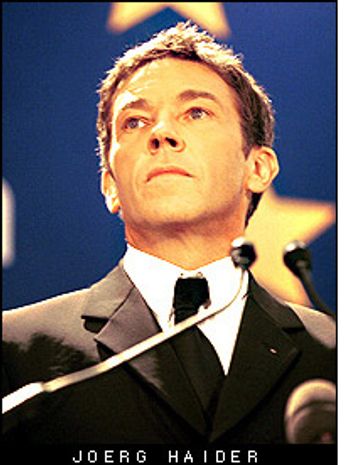
Haider, who recently turned 50, is a whisper of the past. His parents were committed National Socialists. He has praised the employment policies of the Third Reich and sympathetically addressed groups of aging SS veterans. His last name begins with H and has six letters. And the final blow, a taunt from ghosts: He’s an Austrian, as was Adolf Hitler. “Europe is no longer in the 1930s,” France’s foreign minister Hubert Vedrine said on French radio last week, as if to remind himself that it was so.

Austria had a catastrophic 20th century. It began as the 600-year-old, multi-ethnic Hapsburg Empire, run by a decrepit Kaiser and covering a territory that included most of what we now call Eastern Europe. One hundred years later, it ended up a prosperous but insignificant modern republic smaller than Maine and populated largely by Catholic German speakers. The metamorphosis explains some of the country’s current woes. To this day, Austrians haven’t quite let go of their Hapsburg pretensions, a superiority complex steeped in parochialism.

Other parts of the past haven’t been as readily embraced: Hitler, for instance. The future leader of the Third Reich was born in the crown lands and spent his formative years as an aspiring artist in Linz and Vienna, watching the erosion of Germanic culture and political authority by the empire’s bric-a-brac of ethnic populations, by its Slavs, Jews and Gypsies.

In 1938, Germany annexed Austria and Viennese crowds cheered Hitler’s arrival. But after World War II, Austrians painted the happy union as a hostile invasion. Hitler (the Austrian par excellence) and his cronies became de facto Germans. Austrians became their victims, the civilized, deeply horrified heirs of Beethoven (who was in fact German) attacked by ugly Teutons.

Pop culture lent a hand to cleaning up Austria’s image in the 1960s. The Broadway musical “The Sound of Music” transformed Austria into a land of musically gifted, politically persecuted children, nuns and admirals. In a coup de grbce, at the end of the 1965 movie version, a crowd of Austrians sings the country’s national anthem under the hostile glare of a Nazi official outraged by this show of national defiance.

In 1986, the truth about Austria’s past began to emerge. The country’s president, a former chief of the United Nations, Kurt Waldheim, had served with the SS, and he was castigated for this record internationally. The United States banned him from entering the country.

Under siege, the country made efforts to correct the record. “There has been some movement,” Edward Serotta, a well-respected chronicler of Jewish life in East Central Europe and a Vienna resident, told me. “Not enough, but there is some.” School textbooks now include the Holocaust, and, as in Germany, documentaries on the subject run frequently on national television. Austrian chancellors have visited Israel and admitted their country’s guilt; a Holocaust memorial is under construction.

But the past as an explanation for Haider only goes so far. His rise to power is more easily explained by popular discontent with the country’s ruling class than it is by an appeal to right-wing extremism. Ever since the end of World War II, Austria has been a fiefdom of two parties: the Social Democrats and the Christian Social Party. For most of the Cold War, when the country was officially neutral, the system worked well. Tourism boomed; the country’s inhabitants had one of the best-financed welfare states in Europe. Flush with cash, the two parties usually forged a coalition, dividing the spoils of government between them.

A recession in the 1980s tarnished their records and opened the way to Haider’s small third party, the FPV, which typically garnered about 7 percent of the vote with its attacks on immigrants and the money that they cost the average Austrian in social security and crime prevention. “Vienna must not become Chicago,” ran one of their more famous slogans.

In October, after years of rising fortunes, the party won 27 percent of the vote and placed second in national elections. At first, the two old ruling parties attempted to form the usual coalition, but in January talks broke down, and Austria, for better or worse, has entered a new phase of its history.

So has Europe. Whether or not Haider turns out to be as dangerous as his countryman — a distinct improbability — he does present a real challenge to the values of tolerance and free trade that the European Union has cultivated over the last half century. Haider doesn’t have to be Hitler to cause trouble.

The EU may have overreacted; it may have shown more nervousness than was strictly necessary. On the other hand, the counterfeit links on the FPV site may be more of a warning than a joke. If so, the warning has been heeded.

Continue Reading Close