John R. Bohrer
With Hillary, Obama avoided an LBJ mistake
A new poll suggests the president made a very smart political move by bringing Hillary into his administration
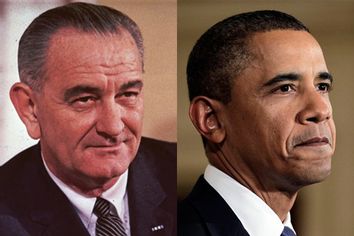
Former president Lyndon B. Johnson and President Barack Obama Scoff all you like at Gallup’s new Barack Obama vs. Hillary Clinton head-to-head poll, in which the president leads his secretary of state among Democrats, 52 to 37 percent. Big deal. The numbers aren’t bad for Hillary, but her political army is completely demobilized, if not folded into the Obama corps.
Of course, it’s easy to think this now. But imagine if she had stayed in the Senate? One doesn’t have to wonder too hard: there’s a close enough comparison in Lyndon Johnson and Robert Kennedy.
It’s nearly forgotten that Lyndon Johnson had the opportunity to put Robert Kennedy on the leash without making him vice president. In the spring of 1964, Attorney General Kennedy offered to go to Vietnam — as ambassador, special envoy, you name it. “I’m tired of chasing people,” he told students at the University of Virginia Law School. He wanted something to do with foreign policy.
Johnson, who had assumed the presidency the previous November, turned him down, for three reasons: he needed him at the Justice Department for the Civil Rights bill; he didn’t want to look like he was shipping off one of the most prominent figures in the Democratic Party before he had picked a vice presidential nominee; and, perhaps most of all, it was a war zone and the nation just couldn’t take another dead Kennedy.
Soon after, the president would offer RFK the ambassadorship of his choosing (“Paris, London or Moscow”), but that wasn’t the kind of foreign service Kennedy was looking for. Still, had Johnson done like Obama and offered up the State Department, RFK would’ve had a hard time turning it down, especially since his brother had planned to can Dean Rusk in a second term (an observation Arthur Schlesinger was all too happy to report at the end of 1965′s “A Thousand Days”).
Alas, President Johnson didn’t muzzle Kennedy, and he suffered dearly for it. In the fall of ’64, Kennedy was elected to the Senate from New York, and by roughly this point in LBJ’s first full term — August of 1966 — Gallup found RFK defeating the president with Democrats, 40 to 38 percent. (With independents, the spread was 38 to 24 percent.) Similar polls would follow, not to mention the handful of statewide polls further enforcing Kennedy’s image as America’s most popular Democrat.
That pollsters routinely conducted these surveys showed just what a political force RFK remained, and surely weighed heavily on the president’s mind. At a July 5 press conference, LBJ found himself rattling off his state-by-state favorability ratings — from memory.
As the junior senator from New York, Kennedy had the platform and independence to put his finger on Johnson’s pressure point: Vietnam. (Hey, he told him he wanted to do something in foreign policy.) Now, imagine Senator Clinton rolling out her prescription for the weak economy today.
What do you think she’d be polling then?
10 years later, David Foster Wallace is a journalism pioneer
With hindsight, the late author's Rolling Stone article on John McCain's 2000 campaign now looks prophetic
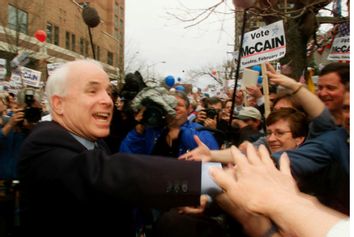
N365190 06: Republican presidential candidate John McCain greets supporters at his campaign headquarters in Virginia February 27, 2000. (Photo by Mark Wilson)(Credit: Mark Wilson) This month, the Harry Ransom Center in Austin, Texas, cracked open the papers of David Foster Wallace, some 48 years after the writer’s birth and a mere 18 months after his suicide.
The papers offer a closer look into the writer’s psyche, a familiar place to his readers. DFW once said that “the shtick” of his nonfiction work — his essays and reporting — consisted of the kaleidoscopic insecurities turning inside his head: Oh gosh, look at me: not a journalist who’s been sent to do all these journalistic things.
Continue Reading CloseCan tea partiers recall the Senate?
A New Jersey court gives the go-ahead for a recall drive aimed at Sen. Robert Menendez. Who's next?
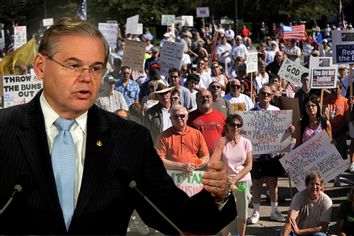
People protest at the Tea Party Movement : The Next Wave at the Oregon State Capitol in Salem, Ore., Saturday, Sept. 12, 2009. (AP Photo, Statesman Journal, Matt Gillis)(Credit: Matt Gillis | Statesman Journal) New Jersey took a big step on Tuesday toward reclaiming its spot at the forefront of political dysfunction: A state appellate court has ruled that the Garden State’s Constitution supersedes the U.S. Constitution.
Last fall, a group called the Sussex County Tea Party Patriots filed paperwork to begin a recall of the state’s junior senator, Robert Menendez. State election officials gave them the cold shoulder because, while New Jersey is one of 18 states that allow recall elections, U.S. senators have long been considered off-limits. Past challenges, such as the 1967 effort against Idaho’s Frank Church, resulted in federal court rulings that the Senate — and only the Senate — can expel a member.
Continue Reading Close