Jon Bowen
Scrambled porn
Why should I pay for the channel when the teaser is free and I enjoy it more?
Every night, at the stroke of 10, something magical happens to one of the channels on my cable service. The all-day stream of ho-hum cooking-and-gardening schlock vanishes with a flicker, and the screen explodes into a kaleidoscopic swirl of scrambled sex flicks. These rowdy hump-a-thons feature your standard hardcore fare: the most insatiable nymphos on earth receiving all manner of orificial service from well-hung hunks with jackhammer hips.
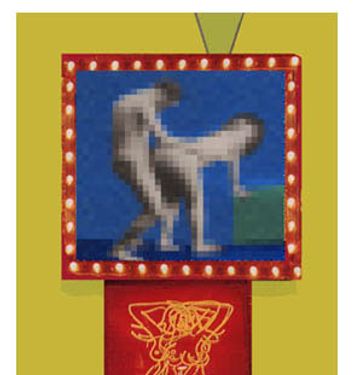
Hardcore porn makes for pretty compelling TV when viewed in its unscrambled form, but once the action is fed through a scrambler into my 27-inch Sony, something much different emerges — something finer and more rewarding. Those highly choreographed shag sessions materialize on the screen as the distorted, sliced-up sequences of porno-cubism that jargon-makers call “Picasso porn.”
A ramrod-stiff penis here, a jiggling breast there, a vague thrusting of hips that you can’t quite trace to two distinguishable human bodies — scrambled porn is a moving mosaic of sex. It can be a little hard to follow the action, as you squint into the flickering screen, but you’re captivated in a way that you never are with straight porn, because you have to envision with your mind’s eye the parts you can’t quite see. And that’s what makes the scrambled stuff so much more fulfilling: It leaves more to the imagination.
I don’t much like unscrambled porn. With its worn-out story lines, its so-bad-it’s-funny acting, and its mechanical humping and sucking, straight porn bores as often as it excites. It’s the too-much-information problem; it doesn’t leave you any room for filling in the blanks. But scrambled porn, like a finely wrought minimalist short story — imagine Raymond Carver erotica — gives you just a scattering of small but telling details. You catch a flash of breast here, a vague hint of penetration there, and then you flesh out the story line from your own mental storehouse of fantasies. It’s interactive titillation, much like the give-and-take of sex itself.
The similarities to real-life sex don’t end there. At its finest, scrambled porn achieves a kind of cinéma vérité effect. Compared to the unscrambled stuff, it bears a much closer resemblance to the actual experience of a sexual encounter. When you’re in the act, you never see yourself and your partner from the camera’s-eye viewpoint. You never observe things from that far-off, objective perspective. There are no slow, steady pans, no pull-back shots of the action. Everything is jumbled and in your face, herky-jerky and dislocated. As you flail around in the sack, you may — in a fleeting moment of clarity, like the interludes of clarity in scrambled porn — catch a glimpse of your partner’s torso writhing above or below you, a gaping mouth near yours, a leg extended at the very edge of your peripheral vision. But you’ll get no slow-motion sequences or tidy freeze-frames. Sex is scrambled, and if pornography aims for verisimilitude, it should be scrambled too.
If it weren’t for a few right-minded justices on the Supreme Court, we might have lost the gift of scrambled porn forever. Last year, in a landmark decision for late-night voyeurs, the court fought off the morality watchdogs in “United States vs. Playboy Entertainment Group.” The case emerged from the Telecommunications Act of 1996, signed into law by President Clinton, which called for an end to scrambled porn. When Sen. Dianne Feinstein pushed an amendment through the Senate that would force cable companies to either scramble their adult programming completely or banish it to the wee hours, the companies waved the First Amendment flag. The court ruled 5-4 that scrambled porn should not be removed from the airwaves, triggering a collective sigh of relief from Picasso porn connoisseurs everywhere.
What’s bizarre is that, despite its obvious inferiority to scrambled porn, unscrambled porn still carries more cash value in the marketplace. In a world of properly assigned values — a world where elementary school teachers pulled down high six-figure salaries while Britney Spears sang for nickels on the street — in a world like that, cable companies would feed their unscrambled smut over the airwaves for free and charge a premium for access to scrambled porn.
Maybe we’re already headed in that direction. In small ways, scrambled porn is starting to receive its due attention. In the opening scene of “American Pie,” last year’s cinematic paean to teen libido, Jason Biggs’ character enacts one of the all-time sacred rituals of male adolescence — masturbating to scrambled porn. The magazine Nerve recently featured an artfully packaged photo gallery of scrambled porn on its site, and pundits are starting to weigh in on the Constitutional ramifications of restricting scrambled porn.
In my fantasy, it won’t be long before cultural critics in the humanities departments of Northeastern universities are devoting entire courses of study to the deconstruction of Picasso porn. Art film houses will put on scrambled porn festivals in sold-out theaters, and bespectacled grad students will slump in their seats tugging at their goatees, trying to mentally fix Picasso porn’s place in the storied history of cinematic art.
In the meantime, though, aficionados of scrambled porn like me remain consigned to late-night surfing, squinting into the screen at those disembodied images tumbling like stray clothes in a dryer.
Of course the reason that these fragments of sliced-and-diced sex slip through the scramblers onto my TV screen in the first place is that the scrambling systems used by cable companies are far from perfect. Porn peddlers could funnel some of their profits into developing better scramblers, but why would they do that? They’re hoping that those teasing glimpses of flesh will compel us to fork over the extra cash for the full smorgasbord of unscrambled smut.
But I say no thanks. I’ll take my sex scrambled.
Trust funds
Will my daughter spend her nest egg on Harvard or new breasts?
It started the day we brought our daughter home from the maternity ward. Or maybe it started earlier, the morning I saw that fateful blue mark on my wife’s pregnancy test strip. No, it began before that. I started worrying about the cost of college tuition the night my wife and I first waded contraceptive-free into the sea of love, letting our reproductive juices mingle for a higher purpose.
Since then the question has dogged me — relentlessly — from every quarter. It’s couched in TV ads, splashed on the sides of city buses and printed on brochures that arrive mysteriously in our mail.
Continue Reading CloseA spoonful of Dickens
British doctors prescribe "bibliotherapy" for the stressed-out and depressed.
Most doctors don’t prescribe fiction for patients who are ill, but that’s exactly what will happen in Britain beginning in September, when doctors and librarians team up to launch a new program that will deliver a therapeutic course of novels to patients suffering from a range of ailments.
As an alternative to traditional medication, family doctors in Kirklees, West Yorkshire, will refer patients who are struggling through bouts of depression, stress and anxiety to a “bibliotherapist” at a local library. The bibliotherapist will then scan the library’s database to create a customized course of books designed to assuage each patient’s particular malady. The goal is to pair patients with books that will serve as an inspiration for them to get better — or at least cheer them up. The pilot program is funded by the government, local health authorities and a libraries’ charity.
Continue Reading CloseKissing therapy
Smooching with a loved one may be good for your health.
“Sweet Helen, make me immortal with a kiss!”
– Doctor Faustus
Consider the case of Melissa, a 32-year-old news writer in Washington, who, after 10 mind-numbing years on the job, had a serious bout of malaise, felt that life had passed her by, decided to quit the damn job and cash out her savings, and went solo vagabonding in the wilds of South America.
One balmy night on the deck of a boat cruising off the coast of Ecuador, she found herself enveloped in the arms of the boat’s swashbuckling captain. They kissed — deeply, passionately. She experienced a sense of absolute liberation, a thrill of letting go. She felt flooded with life-giving energy. Her world, to put it simply, was rocked.
Continue Reading CloseBlue Gene
An IBM supercomputer will try to solve one of the most perplexing mysteries in science: Protein folding.
Big Blue is gearing up to tackle one of science’s most puzzling mysteries. And if the company’s new supercomputer can handle the challenge, its success will mark a giant leap forward in the march against disease.
On Monday, IBM unveiled a $100 million initiative to build a computer that will be 1,000 times more powerful than Deep Blue, the machine that humbled chess champion Garry Kasparov in 1997, and 2 million times more powerful than your average desktop PC. Researchers say the computer, nicknamed Blue Gene, could be operational within five years.
Continue Reading CloseSight for Stevie Wonder?
The singer is interested in an experimental form of eye surgery.
Stevie Wonder is hoping that a new, pioneering form of eye surgery can restore the sight that he lost at birth. The 49-year-old musician says he hopes to undergo an operation to receive an intraocular retinal prosthesis, or IRP, a device that harnesses the powers of microtechnology to revitalize vision in the blind.
During the experimental procedure — which has been performed on just a handful of patients in the United States on an experimental basis — a microchip is inserted into the retina, the layer of cells at the back of the eye that converts light patterns into nerve impulses that travel to the brain. Any retina cells that have not been completely degenerated by disease are stimulated by the chip into functioning again. Images are transported to the chip via a camera that converts the external images into a series of electronic signals. The camera is mounted on a frame that the patient wears like eyeglasses.
Continue Reading ClosePage 1 of 7 in Jon Bowen