Jon Gambrell

12 killed, villages razed in northeast Nigeria

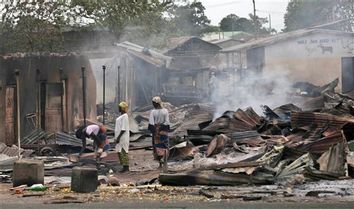
LAGOS, Nigeria (AP) — Gunmen surrounded villages in northeast Nigeria and set them ablaze, killing at least 12 people and wounding 48 others in violence that could spread as attackers remain hiding in the rural region, the Nigerian Red Cross said Monday.

The attacks targeted four villages early Sunday morning in a remote area of Adamawa state, which borders Cameroon. The number of dead could rise as relief workers remain unable to reach the villages affected and about 2,000 people have fled, the Red Cross said in a report obtained by The Associated Press.

Volunteers “could not get safe access to these affected communities as the gunmen are said to be in the bush around the communities changing plans,” the report read. It estimated as many as 100 gunmen attacked the villages.

The dead included at least one police officer, the report read. Those injured suffered gunshot and machete wounds.

Relief workers had warned this weekend that people had begun fleeing the Lamurde local government area as rumors of an attack spread through the villages. The attack likely is a reprisal from Hausa Fulani cattle herdsmen over them being attacked over another killing earlier this year, the Red Cross said.

Soldiers apparently had surrounded the area by Monday. Yushau Shuaib, a spokesman for Nigeria’s National Emergency Management Agency, said Monday that officials were aware of the violence, but had no further details.

Adamawa state police spokesman Nemuel Yoila said the attack appeared to pit the Fulani cattle herders against the Pere people who live in the area, one of Nigeria’s more than 250 ethnic groups. Yoila said the fighting occurred near a group of paramilitary police officers who were unable to stop the attack.

Yoila said only six people had been killed, contradicting the Red Cross report. However, police and military officials often underreport casualties in Nigeria to downplay the severity of attacks.

“Normalcy has been restored to that area,” the spokesman said.

Nigeria, a multiethnic nation of more than 160 million people, often sees outbreaks of violence across religious lines. However, the attacks often find their root in political and economic problems. Meanwhile, the nation is facing increasingly bloody sectarian attacks from a radical Islamist sect known as Boko Haram.

___

Jon Gambrell can be reached at www.twitter.com/jongambrellap.

Abandoned ships a rusting hazard in Nigeria waters

In this photo taken Thursday, March 15, 2012, The rusting hulk of an abandoned petroleum ship is beached on the coastline in Lagos, Nigeria, as the powerful waves of the Atlantic Ocean crash against the ships that lay beached along the coastline just outside of Nigeria's largest city. Government officials say they don't know how many abandoned ships choke Nigeria's waterways outside of Lagos with the resulting environmental and navigational hazards, as well as highlighting the lawlessness and corruption surrounding daily life in Nigeria. (AP Photos/Sunday Alamba)(Credit: AP)

LAGOS, Nigeria (AP) — The powerful waves of the Atlantic Ocean crash against rusting hulks beached along the coastline just outside of Nigeria’s largest city, as lines of cargo ships waiting to come to port stretch across the western horizon.

Government officials say they don’t know how many abandoned ships choke Nigeria’s waterways, but they cause tremendous environmental and navigational hazards. And as more wash ashore daily, the massive vessels cause fast-moving erosion along Nigeria’s beaches that can tear away a kilometer of shoreline in a matter of days, experts say.

“Shorelines are supposed to seasonally increase and decrease,” said Ikenna C. Onyema, a professor of marine sciences at the University of Lagos. “When a manmade structure comes in between, it cuts out its life.”

Forgotten ships rust across Nigeria’s roughly 850-kilometer (525-mile) coastline, while others can been seen partially submerged on inland waterways and creeks. Some have been there for decades, while others only days.

Many, abandoned after the lucrative theft of crude oil, serve as hulking metaphors for the lawlessness that plagues Nigeria.

The history of abandoned ships in Nigeria is intertwined with the slowly growing, strangling grip of corruption that nation has faced since it gained its independence from Britain in 1960. The first such ships came amid the booming trade of importing cement into the country during the massive projects of former military ruler Gen. Yakubu “Jack” Gowon in the early 1970s.

Ships backed up for miles with cement, awaiting for up to a year trying to come into the country. Only later did officials acknowledge much of the cement was inferior and companies put their ships in line to collect fees for being kept waiting. Some of the cement hardened in ships’ holds, sinking the vessels.

Today, it appears many of the boats left to rust along the coast belong to the increasingly lucrative industry known locally as “bunkering” — stealing the crude oil pumped out of Nigeria’s oil-rich southern delta by foreign companies. The CEO of Royal Dutch Shell PLC, the dominant firm in Nigeria, has estimated that thieves steal about 150,000 barrels of oil a day from the region by drilling or sawing into pipelines to install their own spigots.

From the air, one can see the wooden ships that carry crude through the Niger Delta’s winding creeks to makeshift refineries to cook into crude diesel and kerosene. Much of the oil, however, makes it to large tankers that then carry the oil out to sea and into the black market.

Those tankers are later discarded along the coast. Outside of Lagos at Tarkwa Bay, about a dozen abandoned vessels dot the coastline, including one from Zenon Petroleum & Gas Ltd., run by billionaire Femi Otedola, a supporter of President Goodluck Jonathan.

Coves in the area are being rapidly destroyed by ships, which deflect the force of waves in a different way, causing massive erosion, said Onyema, the professor. Oil from the ship and other debris, visible along the sandy beaches of Tarkwa Bay, cause damage as well, he said.

Yet the ships remain on the beaches. Ziakede Patrick Akpobolokemi, director-general of the Nigerian Maritime Administration and Safety Agency, told The Associated Press in a recent interview the ships would be removed — but could not say when or exactly how many abandoned vessels there actually are. Last August, Nigeria’s Transport Minister Yusuf Suleiman promised to remove the wrecks within weeks, though nothing was done.

“No sane-minded man or person should be happy with such a situation when abandoned vessels can cause environmental problems, when they can cause navigation problems, when they can aid and abet criminal activity,” Akpobolokemi said. “Why should you be happy?”

While the government hasn’t begun removing the ships, others have. Groups of salvagers move along the coast, removing whatever electronics and communication gear remaining inside. Gas tanks and blow torches follow, leaving behind exposed metal skeletons along the beach.

But that scavenging takes months, as the heavy waves carry in new ships all the time.

___

Jon Gambrell can be reached at www.twitter.com/jongambrellap.

Continue Reading Close

5 killed in suicide blast in northeast Nigeria

JALINGO, Nigeria (AP) — Two motorcycle-riding suicide bombers drove into a convoy carrying a top police official in northeast Nigeria on Monday, detonating their explosives and killing at least five people, authorities said.

The attack targeted police commissioner Mamman Sule who was being driven in a convoy toward his offices, near the governor’s office in Jalingo, the capital of Taraba state, said police spokesman Ibiang Mbaseki. The bombers missed injuring Sule, but the explosives caused massive damage at a roadside market and blew out the glass windows of the nearby state Ministry of Finance building, witnesses said.

The commissioner “was the prime target,” Mbaseki said.

An Associated Press reporter later saw seven corpses, including those of the suicide bombers, at a local hospital.

No group immediately claimed responsibility for the attack. It comes after bombers attacked Christian worship services Sunday at a university campus and a church in northern Nigeria, killing at least 21 people.

Sunday’s attacks mirrored others carried out by a radical Islamist sect known as Boko Haram. Representatives of Boko Haram, who typically speak to journalists at times of their choosing in telephone conference calls, could not immediately be reached for comment.

Boko Haram is waging a growing sectarian battle with Nigeria’s weak central government, using suicide car bombs and assault rifles in attacks across the country’s predominantly Muslim north and around its capital, Abuja. Those killed have included Christians, Muslims and government officials. The sect has been blamed for killing more than 450 people this year alone, according to an AP count.

Diplomats and military officials say Boko Haram has links with two other al-Qaida-aligned terrorist groups in Africa. Members of the sect also reportedly have been spotted in northern Mali, an area where Tuareg rebels and hardline Islamists seized control over the past month.

On Thursday, the sect carried out a suicide car bombing at the Abuja offices of the influential newspaper ThisDay and a bombing at an office building it shared with other publications in the city of Kaduna. At least seven people were killed in those attacks.

A statement Monday from President Goodluck Jonathan’s office condemned the church service attacks and other assaults in recent days.

“The terrorists … have shown even more clearly by their latest attacks on the media and the academic community that their objective is to destabilize the nation and its vital institutions,” the statement read.

However, Nigerians are growing impatient with the federal government’s inability to stop the ever-increasing bloody attacks.

Taraba state, a largely rural expanse that borders Cameroon, has remained largely peaceful while Boko Haram attacks have raged across Nigeria’s predominantly Muslim north. However, the state has had involvement with the sect in the past.

In February, secret police officers and soldiers in Taraba arrested the alleged mastermind of a Catholic church bombing by Boko Haram that killed at least 44 people. The suspect previously escaped police custody in Abuja.

___

Jon Gambrell reported from Lagos, Nigeria, and can be reached at www.twitter.com/jongambrellap.

Continue Reading Close

In divided Nigeria, latest attack strikes all

A woman stands at the scene of a bomb explosion in Kaduna, Nigeria, Monday, April 9, 2012. The weekend explosion killed at least 38 people and the target for the blast seems unclear as people from all sections of society were caught in the explosion.(AP Photos/Sunday Alamba)(Credit: AP)

KADUNA, Nigeria (AP) — The suicide car bombing that killed at least 38 people in Nigeria claimed victims across its religious and ethnic lines, showing clearly everyone is at risk in this nation often violently divided against itself.

Young Muslim men of the Hausa Fulani people of Nigeria’s north burned to death in Sunday’s blast, pinned under the weight of their motorcycle taxis. A passer-by from Nigeria’s southwestern Yoruba people found himself thrown to the road in the explosion. The blast tore apart businesses owned by Christian Igbo people of the nation’s southeast.

All those who spoke Monday said they wanted Nigeria’s weak central government to stop the violence now spreading across the country, including attacks carried out by a radical Islamist sect. However, authorities in the northeast said the sect known as Boko Haram had killed four people, as soldiers in the northern city of Kano found another car bomb ready to explode.

“Who are they really fighting?” asked one woman while looking over the scene of the Kaduna suicide attack on Monday, choking back a sob before walking away.

Sunday’s blast struck the capital of Kaduna state, apparently after the suicide bomber turned away from attacking a church holding a morning Easter service. The car exploded at a busy junction about 200 meters (yards) away, tearing apart makeshift restaurants made of discarded lumber there serving cheap rice patties to the city’s working poor.

The blast sent metal shards flying in all directions that left bullet-like holes in buildings and killed several people, witnesses said. At a hotel near the blast, the force of the bomb tore away the ceiling and blew out windows. A family staying just across from where the car detonated walked away unharmed, manager Stephen Uka said.

“They checked out with their lives,” he said.

The explosion also ignited black-market jerry cans full of gasoline, which spread a fire that consumed the group of motorcycle taximen, witness Kunle Olowe said.

Those men burned to death as local people tried to pull them away, scorching their own hands, Olowe said.

There was “no water to put them out,” Olowe said. Others blamed security agencies for taking too long to respond in a city where soldiers have been on the street since election violence last year. Administrators at St. Gerard’s Catholic Hospital, which took in some victims, said they didn’t have enough ambulances to ferry the wounded.

Crowds gathered at the blast site Monday, looking on as a road crew used pickaxes to cut away the small crater left by the bomb and concrete to repair the curb running alongside it.

Those gathered in small crowds nearby, however, all seemed fixated on a choppy, mobile-phone video apparently taken immediately after the blast. It showed bleeding victims crying out incoherently, the lifeless dead laying still on the debris-strewn road. One man, bloody, simply crawls along the street unhelped as another slumps by an open sewer.

No one has claimed responsibility for the blast, though suspicion immediately fell upon Boko Haram. Boko Haram, whose name means “Western education is sacrilege” in the Hausa language of Nigeria’s north, is waging an increasingly bloody fight with security agencies and the public. More than 390 people have been killed in violence blamed on the sect this year alone, according to an Associated Press count.

The sect, employing suicide bombers and assault-rifle shootouts, has attacked both Christians and Muslims, as well as the United Nations’ headquarters in Nigeria. It has rejected efforts to begin indirect peace talks with Nigeria’s government and wants the introduction of strict Shariah law across the country, even in Christian areas, and the release of all imprisoned followers.

Boko Haram, which speaks to journalists through telephone conference calls at times of its choosing, could not be immediately reached Monday.

Both the United Kingdom and the United States had warned its citizens living in the country that violence was likely over the Easter holiday, though Nigeria’s government publicly dismissed the alert. Attacks blamed on Boko Haram continued through the weekend into Monday as well.

In the northeastern city of Potiskum, gunmen opened fire on a policeman and his family, killing the policeman’s 6-year-old daughter, Yobe State police spokesman Toyin Gbadegeshin said. Early Monday, gunmen killed three people when they attacked a police station, a church and a bank in the border town of Dikwa in the northeast.

In Kano, the largest city in Nigeria’s Muslim north, military spokesman Lt. Iweha Ikedichi said soldiers discovered a car Monday packed with explosives. Soldiers began searching the area for a man holding the remote control that could detonate the vehicle, though the area around the car had been secured, the lieutenant said.

Nigeria, a nation of more than 160 million people and more than 250 ethnic groups, is largely divided between a Christian south and a Muslim north. Kaduna, on that religious and ethnic dividing line, was at the heart of the violence that followed the nation’s April 2011 presidential election. At least 800 people died in that rioting across the country, Human Rights Watch has said.

In Sunday’s blast, however, members of Nigeria’s three largest ethnic groups became victims of the violence now sweeping the country. At St. Gerard’s Catholic Hospital on Monday, a young Hausa Fulani man who had been selling food from a wheelbarrow near the blast lay in agony, his right hand shorn away by the explosion. Doctors were giving him a third blood transfusion.

A Yoruba man, Femi Johnson, lay in the bed beside him, his arms and legs burned by the flaming gasoline flung from the black market stall alongside the road.

“The bomb blasts (are) getting too much now,” Johnson said.

As Johnson spoke, a young man visiting another patient silently watched the camera-phone footage of the blast’s aftermath.

___

Associated Press writers Haruna Umar in Maiduguri, Nigeria and Salisu Rabiu in Kano, Nigeria contributed to this report.

___

Jon Gambrell can be reached at www.twitter.com/jongambrellap.

Continue Reading Close

New Nigeria free information law changes little

LAGOS, Nigeria (AP) — After years of delays, Nigeria’s president signed into law the country’s first Freedom of Information bill last year, supposedly cutting away old colonial-era secrecy laws and allowing the public access to government documents in this democracy for the first time.

However, a test request filed by The Associated Press for basic information from one government agency shows the problems still plaguing the oil-rich nation’s creaking bureaucracy. Months after the one-week deadline allowed by law, the agency continues to refuse to release the information.

“We are coming from a culture of secrecy,” said Maxwell Kadiri, a lawyer who works on freedom of information issues with Open Society Justice Initiative. “The (law) is basically coming to change over a century of a secrecy culture in the public service.”

In November, the AP published the results of an examination of Freedom of Information laws and how they are administered in more than 100 countries. Nigeria was not included in the examination, as President Goodluck Jonathan had only signed the nation’s own version of the law in June.

Dayo Aiyetan, a journalist who lives in Nigeria’s capital Abuja and now runs a startup organization called the International Center for Investigative Reporting, later wrote to the AP and asked if its journalists could file an information request on his behalf after reading the story. He suggested the AP write the Independent Corrupt Practices and Related Offenses Commission and request a list of all the cases it is prosecuting, including the names of those accused, the charges they face and where they stood in legal proceedings.

The commission, along with the Economic and Financial Crimes Commission, are the premier anti-graft agencies operating in Nigeria. Officials estimate more than $380 billion has been stolen through government corruption in Nigeria since it gained its independence from Britain in 1960. Those agencies, created under former President Olusegun Obasanjo, are charged with stopping that tide.

Under Nigeria’s Freedom of Information law, government agencies have seven days to produce requested information, though it can request another seven days to put records together if the request is complicated. It also makes it a criminal offense to destroy records and protects civil servants who report wrongdoing by their institutions.

Despite the law, the AP has been unable to obtain any of the records Aiyetan suggested the news cooperative obtain. A first letter by AP journalist Yinka Ibukun sent by courier service to the anti-corruption body in Nigeria’s capital Abuja was received on December 8, 2011, according to the courier’s records. However, the body’s spokesman, Folu Olamiti, said it could not be found because it had not been addressed to the agency’s chairman.

Two weeks later, the AP sent a new letter to the anti-corruption body’s office, specifically addressing it to “the chairman.” The spokesman later asked the AP for more time to fulfill the request as Ekpo Nta had taken over as the chairman of the commission.

Follow-up emails were sent to the spokesman on Jan. 30 and then on Feb. 27. Olamiti only responded to the Feb. 27 email, asking for more time once again.

On March 20, Olamiti told the AP that Nta himself was now involved in resolving the records request and that the records would be collected by the end of the week.

However, Olamiti offered a different response on March 25.

“Thanks for your mail Yinka am out of the country for two weeks. Stay blessed,” the spokesman wrote in an email. He did not comment on the commission not following the guidelines of the law.

Journalists and civil rights organizations applaud Jonathan signing the law in 2011, saying would herald a change in governance in a nation once ruled by a revolving door of military leaders. However, government agencies still largely refuse to release information, while security personnel routinely harass, beat and arrest working journalists.

Much of the reluctance of government officials comes from Nigeria’s Official Secrets Act, created in 1911 by British colonialists, Kadiri said. Government officials have pushed agencies to honor requests and a handful have, while civil society groups have sued over refusals in recent months. Private citizens also have complained to the country’s National Human Rights Commission about agencies refusing their requests, Kadiri said.

For Aiyetan, he said he was not surprised about the constant delays in getting the information. He said both journalists and citizens need to be educated about the information law to properly use to it force Nigeria’s government into being more accountable to its people.

“We think with the passing of the act, we have achieved our dreamland, but there’s still so much more work to do,” Aiyetan said.

___

Online:

Independent Corrupt Practices and Related Offenses Commission: http://www.icpc.gov.ng/

Independent Center for Investigative Reporting: http://www.icirnigeria.org

Open Society Justice Initiative: http://www.osiwa.org/en/portal/

___

Jon Gambrell can be reached at www.twitter.com/jongambrellap.

Continue Reading Close

UK, US warn of possible Easter attack in Nigeria

LAGOS, Nigeria (AP) — Nigeria is facing a “high risk” of a terrorist attack over the Easter holiday, the United Kingdom warned its citizens Thursday, as the U.S. issued a similar warning to those living in the West African nation that sees near-daily attacks by a radical Islamist sect.

The U.K. Foreign Office and the U.S. Embassy in Nigeria’s capital Abuja issued the updated travel warnings Thursday, noting that a radical Islamist sect in Nigeria known as Boko Haram carried out attacks on Christmas Day. A sect-claimed car bombing at a Catholic church outside of Abuja that day killed at least 44 people.

The U.K. also advised its citizens to avoid travel to Borno, Niger, Kaduna, Kano, Katsina, Sokoto and Yobe states, part of Nigeria’s Muslim north.

“There is a high threat of terrorist attack during religious festivals,” the U.K. warning read.

The U.S. warning noted the near-daily attacks now hitting Nigeria and that there have been “continued threats, including several that mention U.S. interests.” The warning also noted that personnel from the U.S. Embassy no longer travel to northern Nigeria, a rule put in place after a Boko Haram attack on the city of Kano in January killed at least 185 people.

“The U.S. Embassy continues to monitor closely the ongoing threats posed by Nigerian extremist and criminal groups, and their stated intentions to carry out attacks against the Nigerian government and western interests and targets in Nigeria,” the message read.

Boko Haram, whose name means “Western education is sacrilege” in the Hausa language of Nigeria’s north, is waging an increasingly bloody fight with security agencies and the public. More than 380 people have been killed in violence blamed on the sect this year alone, according to an AP count.

The sect, employing suicide bombers and assault-rifle shootouts, has attacked both Christians and Muslims, as well as the United Nations’ headquarters in Nigeria.

The sect has rejected efforts to begin indirect peace talks with Nigeria’s government. Its demands include the introduction of strict Shariah law across the country, even in Christian areas, and the release of all imprisoned followers.

The sect was blamed for an attack Wednesday on a market in the northeast city of Maiduguri that killed at least seven Christian traders there.

___

Associated Press writer David Stringer in London contributed to this report.

___

Jon Gambrell can be reached at www.twitter.com/jongambrellap.

Continue Reading Close

Page 1 of 9 in Jon Gambrell

www.salon.com/writer/jon_gambrell/index.html