Jon Jensen

What to expect from Egypt’s elections

As the first round of voting begins, we look at who's running and whether the military will actually step down

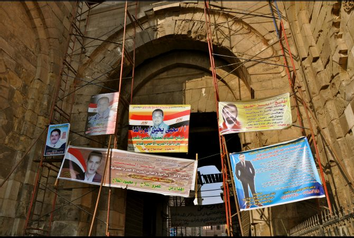
Advertisements for parliamentary candidates hang from scaffolding in Cairo in October 2011 (Credit: Lauren E. Bohn/GlobalPost)
This article originally appeared on GlobalPost.

CAIRO – In the aftermath of a week of violent protests in Tahrir Square, Egyptians head to the polls Monday hoping to take a step closer to establishing a new democracy.

Global PostA protest movement in January may have led to the ouster of former president Hosni Mubarak, but most Egyptians are left wondering how much has actually changed. Were the heady days of street demonstrations truly a revolution or a popular uprising that has resulted in a military takeover?

Political reform has moved at a snail’s pace. Some of the most brutal hallmarks of Mubarak’s autocratic regime have returned, including arbitrary detention, military trials and torture.

And an already stagnating economy is deteriorating amid ongoing workers’ strikes and sporadic violence.

Many now blame the country’s ruling military leaders, the once revered Supreme Council of the Armed Forces (SCAF), which assumed power in the transition following Mubarak’s departure.

“We are all united with one hand against the military,” said Ahmed Gheith, a 22-year-old Muslim Brotherhood member who was at a recent protest in Cairo’s Tahrir Square. “Egyptians should be able to choose whomever they want to lead our country.”

For the most part, Egyptians are optimistic that the final stage of their revolution will take place at the ballot box. The hope is that these elections will be a departure from the Mubarak-era, when voting was often marred with violence, ballot box stuffing, and other fraudulent activities.

But at the first polls on November 28, they will encounter a new electoral process that observers have called convoluted, confusing and mismanaged.

Election Basics

About half of Egypt’s population of more than 80 million residents are eligible to vote in the upcoming elections.

Voter turnout is expected to be much higher than in any election during the Mubarak regime. Earlier this year, a record 40 percent of Egyptians over the age of 18 voted in a referendum on amendments to the nation’s current interim constitution.

There will be elections for both houses of Egyptian Parliament in 2011 and early next year — the People’s Assembly, or lower house parliament, and the Shura Council, or upper house.

Egypt’s next parliament will nominate a constituent assembly that will one day write the nation’s new constitution.

The People’s Assembly (PA) election will consist of three phases across Egypt’s 27 governorates, and will take nearly two months to complete.

The first round begins on Nov. 28, and will take place in Cairo, the Fayoum oasis, Alexandria, Damietta, Kafr El Sheikh, Port Said, Assiut, the Red Sea in Sinai, and Luxor.

The second phase is scheduled to take place on Dec. 14 in Giza, Beni Suef, Ismailia, Sharqia, Menoufiya, Suez, Beheira, Aswan, and Sohag.

On Jan. 3, the remaining governorates will vote – Qaloubia, Gharbia, Dakhliya, North and South Sinai, Marsa Matrouh, Qena, Minya, and the New Valley in Egypt’s Western Desert.

Each round of voting will take place over two days, according to new rules implemented by Egypt’s transitional government only this weekend.

Voting for the Shura Council will begin shortly after the three rounds of PA have been completed.

The Electoral Process

A total of 498 seats are up for grabs in the upcoming PA election.

How the seats will be chosen has changed substantially since the Mubarak era, and has been the subject of much debate and confusion among political parties since the departure of the former president this year.

In past elections, individual candidates were elected from their parliamentary districts.

This year will feature a mixed-system election, including proportional representation party lists as well as individual candidates. Two-thirds of the PA’s seats will be chosen by party list plurality. The remaining third will come from independent candidates in a so-called ‘first-past-the-post system.’

Political parties are required to field at least one woman. From the individual candidates, at least half of the PA will be filled by “farmers and workers,” a throwback to a 1950s-era quota law.

The complex election laws of 2011 were implemented by SCAF, based mostly on recommendations from Egypt’s civil society and political groups as a way of leveling the playing field by reducing the likelihood of a sweep by remnants of Mubarak’s disbanded National Democratic Party (NDP). Mubarak’s former ruling political party maintains a large grassroots movement that was left mostly intact following the uprising.

But the result is a confusing system that will require each voter to submit multiple ballots on election day, possibly with long waiting periods in between for runoffs, according to the Washington, D.C.-based International Foundation for Electoral Systems.

“These issues also pose great and unknown challenges to the legitimate and successful administration of the new election system,” stated the IFES in a briefing paper on November 1. “There is a significant need to educate voters and administrators about the new election system and limited available time to accomplish this important task.”

Who is running?

The days of one-party victories swept by Mubarak’s NDP are over.

This election, over 6,500 candidates are running from more than 45 political parties, many which were launched this year following the uprising. The entire political spectrum will be represented, from liberal seculars to Islamists to socialists.

The formidable parties include the Muslim Brotherhood’s Freedom and Justice Party, with its large grassroots base from years of charitable work in communities throughout the country.

Although the NDP has been dismantled, several remnants from Mubarak’s old party will be running as independents and as part of new parties.

A recent lawsuit attempted to directly bar the participation of former NDP members, one of the major goals of protesters in Tahrir Square.

Following the violent clashes in Cairo last week, SCAF issued a long-awaited “politcal corruption” law that bans anyone convicted of corruption from running for office.

The move, however, did not appease protesters. Most criticized the law for being too vague and coming too late.

Some members of Mubarak’s former party are still on the ballots for at least the first round of voting, according to reports.

Judge Ahmed Abdel Rahman, a member of Egypt’s Supreme Elections Commission, told GlobalPost that condemning members from the former ruling party would be unconstitutional.

“As a people that made a revolution, we should be able to differentiate between the good and the bad; who is a regime remnant and so,” said Abdel Rahman, “we are demanding freedom, we are choosing our representatives in the parliament, and we have the freedom to choose.”

Currently, most experts predict substantial victories for both the MB and the NDP.

Ziad Akl, a researcher at Al-Ahram Center for Political and Strategic Studies, a state-funded think tank, said that remnants of the NDP could win a large plurality in the upcoming election.

Egypt’s revolutionary activists have made little headway with voters in the rural north and south of the country, according to Akl.

“My biggest fear is that these elections would result in a parliament that is 30 or 40 percent NDP,” said Akl.  “And that would not be a parliament reflective of revolution, yet it will be legitimate. Then we could have a real problem because you would have a state claiming legitimacy and a public claiming that this is not what we signed up for.”

Administering the election

When Egypt’s military rulers took power, they promised to hold “free and fair” elections within 6 months — one of the biggest demands of the protest movement in Tahrir Square.

But weeks before the once-delayed elections, several candidates have already come forward with evidence that Mubarak-era fraud is still present among some in the country. An “election market” of people who will rig votes, sell voting blocs, and even thugs-for-hire are all still present in Egypt, according to many observers.

Attempting to guarantee the legitimacy of the 2011 elections will be the judicial branch, one of the few institutions to maintain credibility among a majority of Egyptians.

Around 10,000 judges and other officials will be dispatched across the country to administer the vote.

Several local non-governmental organizations will also send members to polling stations to observe the vote. But many of these groups have criticized SCAF for limiting transparency in the voting process by denying them any real authority to report fraud.

Most foreign poll monitors have been barred from supervising the election. Shortly after taking power, SCAF denied all foreign observers except for one, citing the need to protect Egypt’s sovereignty.

“There is very bad management of this entire electoral process. It has been going on ever since the government released the legislation pertaining to how the elections would be run,” said Ghada Shahbandar, a former poll monitor and activist working at the Egyptian Organization for Human Rights.

The Expatriate Wildcard

Just over a month before the start of the PA elections, an Egyptian court ruled that its citizens living overseas should have the right to vote — a first for the country’s millions of expatriates, and a key demand of protesters in Tahrir.

But with so little time to prepare before the election, and with basic information about the methods of expat voting still undeclared, very few are confident that that the system will work.

The government does not maintain statistics on the number of Egyptians living abroad. Official figures place the number of expatriates at seven million, while some independent estimates are as high as 10 million.

“If Egyptians abroad are not given their chance to vote, it means that at least six percent of Egypt’s population is deprived from their basic political rights,” said Ahmed Ragheb, a lawyer and human rights activist.

Already, there have been numerous complaints about the electronic registration process for expatriates and the Egyptian government’s capacity to monitor and organize millions of potential votes overseas.

Even the government does not seem confident in the process. Just weeks before the historic court ruling, Judge Abdel Rahman told GlobalPost that it would be “impossible for Egyptians abroad to vote.”

He said the preparations would be too complicated and time consuming with such a short period before the elections.

Will the army ever leave power?  

SCAF has already delayed the parliamentary elections once this year. Logistical preparations by both candidates and administrators only started earlier this month. With the shortened process, and signs pointing to a desired lack of transparency, many critics believe that Egypt’s military will be unwilling to transfer power to a civilian government.

On November 18, with less than ten days before the election, tens of thousands of Egyptians returned to the streets of Tahrir Square to criticize military rule in Egypt.

More than nine months after the unfinished revolution, various political elements — mostly led by Islamist groups like the Muslim Brotherhood — all raised “one hand” to say no to the once-vaunted army.

The protesters’ immediate concern was the so-called supra-constitutional document set forth by various political groups and SCAF, several months before the election. The document was meant to solidify certain principles “above” the constitution, in other words, certain inalienable rights that Egyptians would have regardless of which people from which parties come to power.

But the masses in Cairo’s city center were challenging a SCAF amendment to the supra-constitional document that would cement the army’s budgetary immunity into the future constitution, essentially bypassing oversight and accountability to the Egyptian people.

Loai Nagati was one of the protesters in Tahrir.

Nagati knows the perils of military rule better than most. The 22-year-old was one of more than 12,000 Egyptians who have been jailed and tried under secret military courts since the ouster of Mubarak. He said he was abused and tortured during the eight-day detention earlier this year.

“We want an end to military rule in Egypt, finally. In this election, hopefully we can show them that the country is refusing to give the army the ultimate power,” said Nagati.

(GlobalPost-Open Hands Initiative reporting fellows Ahmed Ateyya, Reem Abdellatif and Stephanie Rice contributed reporting to this story.)  

Egypt’s military can’t quell protests

Violence rages on as the army's proposed concessions fail to reassure demonstrators

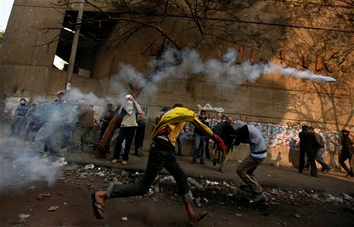
A protester throws a tear gas canister away during clashes with the Egyptian riot police near Tahrir square in Cairo, Egypt, Tuesday, Nov. 22, 2011 (Credit: AP Photo/Khalil Hamra)
This article originally appeared on GlobalPost.

CAIRO, Egypt — Egypt’s ruling military general pledged to transfer political power to a civilian government by mid-2012, one of several concessions that appeared aimed at containing the growing protest movement and prevent a revolt that has raged in downtown Cairo for 5 days from spreading further.

Global PostMohamed Tantawi, the country’s top army commander, who assumed the de facto presidency in February, made the announcement in his first televised speech to the nation.

Tantawi assured the Egyptian people that parliamentary elections would proceed as planned, scheduled to begin on Nov. 28. And he repeatedly promised that neither he, nor anyone in Egypt’s military, would seek for higher office.

“We are not looking into the presidency,” said Tantawi, in a pre-recorded statement on state television Tuesday.

“The Supreme Council of the Armed Forces is only interested in the interests of the people. We don’t care about who will win elections or who will be the next president. It’s up to the people to decide,” he said.

But the proposed concessions failed to quiet protesters on the street, who have now been clashing with security forces for more than 96 hours.

Immediately following the televised speech, which was broadcast throughout Tahrir Square, furious demonstrators began screaming, “Leave, leave!”

The military also accepted the resignation of the entire transitional cabinet and protesters who had been arrested over the weekend were set to be released. Tantawi also allowed for a civilian inquiry into a violent crackdown at a protest in October that left more than 20 protesters dead on the streets, some crushed under the weight of charging military vehicles.

The stakes, however, became much higher for Tahrir demonstrators following this most recent series of clashes in Cairo, where violence between police and protesters over the weekend led to at least 30 deaths and more than 1,000 injuries.

Many protesters were hesitant to trust Tantawi and an “illegitimate” military government that had failed to put an end to more than five days of non-stop tear-gassing and active conflict on the streets surrounding the square.

Some are even calling for Tantawi to stand trial.

“People are in the square dying and they are talking about another seven months of military rule? We will stay until they leave, but now it’s about when they should be tried as murderers and criminals,” said Mohamed Effat, 22, a protester who was shot with rubber bullets by police on Sunday.

If the reaction in Tahrir was not enough to convince the military of the shortcomings in Tantawi’s speech, they needed only to look three blocks to the east, where a pitched battle between hardcore protesters and armed riot police has been going for five days straight.

The fight turned a few-block radius of downtown Cairo into a virtual war zone. Police and protesters formed ever-shifting battle lines delineated by torched-out car skeletons and blackened sheets of corrugated metal, along a street littered with broken bottles and chunks of asphalt.

By day, the incessant roar of agitated battle cries from both camps was pierced only by the hollow thud of police tear gas canisters and booming shotgun blasts fired into the crowds.

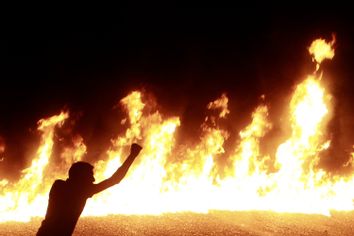
After dark, the unlit streets and shuttered storefronts were illuminated by the bright orange glow of protesters’ Molotov cocktail explosions and blazing bonfires, some fueled by wooden desks and chairs from a nearby girls’ school that was looted.

“The police are sons of garbage! This government is garbage!” screamed the enraged protesters on the front lines at Mohamed Mahmoud street, which is just off Tahrir. “Down with military rule!”

Last week, tens of thousands of a mostly Islamist crowd — including the popular Muslim Brotherhood — gathered for a peaceful protest at Tahrir Square to call for an end to military rule. The last straw had been a recent attempt by the ruling generals to slip budgetary immunity for themselves into the future constitution.

The gathering turned violent only the next day, long after most had gone home. A police crackdown on several hundred overnight campers drew only more angry protesters to Tahrir.

Recent street battles near the square underscore the systemic problems with abuse of authority by police forces in Egypt. More than nine months after police brutality fed the flames of January’s uprising, security forces have yet to be reformed.

For many in Tahrir, the sieges over this weekend highlighted in gruesome detail the immediate need for a complete overhaul of the very forces designed to serve and protect them.

Arrested protesters were beaten mercilessly this weekend by police wielding blunt wooden batons, in plain view of the advancing crowds. Dozens of officers swarmed around detainees, attacking with punches to the head and kicks to the groin.

But the feared police are not the only ones in Egypt that may be losing popular support.

Outside of the square, life for most in Cairo has been relatively normal despite the past weekend of violence. Many average Egyptians are eager to see an end to Tahrir protests — and the resulting frontline clashes — even if it means continued military rule.

For most of Egypt’s “silent majority,” stability is the primary concern in a country that has been wracked by economic uncertainty and security woes for the past nine months.

Even several political movements — including the Muslim Brotherhood — have called for an end to the proposed sit-in in Tahrir, hoping to put the good of the country above the possibility for ongoing clashes.

In Tuesday night’s speech, Tantawi left many in the square skeptical that the military would ever cede power completely from a state that has been run by armed forces behind the scenes for nearly 60 years.

Of particular worry to many liberal activists in Tahrir was Tantawi’s offer to hold a national referendum testing the public will for a complete military withdrawal to the barracks. The protesters’ fear was that a majority of Egyptians might actually vote for the military to stay — giving legitimacy to martial rule.

“The Supreme Council of the Armed Forces… is ready to immediately hand over authority and return to its original task to protect the homeland, through a public referendum, if that is what the people want and if that is what is needed,” Tantawi said.

How elections could proceed next week, amid ongoing violence and the possibility of a Tahrir Square jam-packed with protesters, was far from certain.

Late in the afternoon on Wednesday, an uneasy calm returned to the streets surrounding Tahrir, as police forces finally made a full withdrawal from Mohamed Mahmoud Street.

Hundreds of young protesters milled about the scene of destruction. The road was nearly impassible, littered with rocks, torched vehicles, and at least one broken armoire used as a barricade. Nearby apartments were covered in pockmarks, and a fire still smoldered on the third floor of a building overlooking the rubble.

Many of the protesters were skeptical that any “ceasefire” between the two sides could stick. But they hoped that the worst was over.

“Peaceful! Peaceful!” chanted protesters, screaming into an empty street the police had just fled.

Continue Reading Close

What’s behind Egypt’s violence?

The army blames sectarian clashes. Everyone else blames the military

A protester stands near a line of fire during a demonstration in Cairo October 9, 2011. (Credit: Amr Dalsh / Reuters)

CAIRO, Egypt — At least 24 people were killed during clashes between Egyptian security forces and several hundred protesters, mostly Coptic Christians, in central Cairo on Sunday, in one of the bloodiest street battles since the ouster of former president Hosni Mubarak earlier this year.

The intensity and scope of the violence in downtown Cairo — which left more than 150 injured and included at least one army vehicle plowing into a crowd of protesters — underscored the fragility of Egypt’s security in the run-up to parliamentary elections next month.

Military-led transitional officials re-enforced their late-night appeals for calm with a mandatory curfew in most of downtown Cairo early on Monday.

Official state media and the government immediately blamed the country’s minority Coptic Christians and the influence of unnamed “outside forces” for the clashes — a move that may only heighten the what is typically relatively infrequent sectarian tension in the Arab world’s largest country.

Copts, as well as some Muslims who had joined in the fight, pointed fingers at a powerful military apparatus using Mubarak-style strongman tactics to quash the protests. But as is so often the case in the tumultuous post-uprising Egypt, it was not entirely clear how or why the turbulence on the streets escalated from bad to deadly.

The only certainty when the tear gas settled on Monday morning was that the parties involved — Egypt’s Muslims, Christians and the increasingly vilified military-led regime — had a drastically different view depending on their sources of news.

The violence erupted before dusk on Sunday evening after what appeared to be a typical afternoon of nonviolent demonstrations in Egypt’s capital.

Coptic Christian protesters, still seething over the torching of a church by Muslims in a village in Upper Egypt late last month, took to the streets to demand the ouster of local officials and a tougher government response to such attacks.

Several hundred Copts gathered in the northern Cairo district of Shubra, a densely packed neighborhood predominately made up of Christians, who constitute roughly 10 percent of Egypt’s nearly 80 million residents.

From Shubra, the protesters marched south in the direction of Egypt’s heavily-fortified state television broadcasting headquarters along the Nile River near downtown.

Just before sunset, the march came under fire by “unknown assailants” tossing rocks and shooting pellets, according to eyewitnesses and news reports. Already enraged by the alleged failure of Egypt’s government to guarantee Christians’ security, the protesters began criticizing the country’s military rulers.

Their main chant, “Down with the Field Marshall,” referring to Mohamed Tantawi, has become a recurring swipe at the country’s top military leader among both Muslim and Christian pro-democracy activists in recent months.

Just as quickly as the Copts reached their destination, a massive rock fight erupted between protesters and hundreds of “thugs” across from the television building. It was not immediately clear whether the thugs — an increasingly common catch-all for anyone instigating violence — were average citizens or plainclothes security officials.

Several eyewitnesses reported that the thugs initiated the attack against Christian protesters.

Egypt’s government, on the other hand, blamed the Copts for the violence.

Minor clashes eventually mushroomed into rioting, as military cars and other security vehicles were hit by rocks and torched in a rare display of anger reminiscent of the January uprising that toppled Mubarak.

Gun shots could be heard in several downtown neighborhoods from the TV building to Tahrir Square, and tear gas canisters were fired to disperse the swelling crowds of Christians and some Muslims who had joined the anti-government demonstration, both chanting, “Christians and Muslims, hand in hand.”

Eventually, the military quelled the riot, for the most part with brute force.

Independently-owned satellite news channels aired pictures of armored Egyptian military vehicles barreling into a throng of protesters outside the television building. At least one army vehicle struck several people on the street at full speed.

Government media ignored such graphic shots and instead portrayed a clear battle between Egypt’s Christians and majority Muslims, implying that sectarian divisions had fueled the protests.

On the streets, however, the anger from protesters — among both Christians and Muslims — seemed to be aimed at the ruling military leadership, which has been increasingly criticized for being slow to implement post-Mubarak democratic reforms.

State-run media also at times seemed to be taking cues from Mubarak-era editorial policies, often broadcasting one-sided information to viewers.

One government television network reported Sunday that the majority of the casualties occurred on the military’s side — even as Egypt’s health ministry reported otherwise. State-employed anchors and commentators decried the “violence and thuggery” of Coptic Christians for attacking the security forces throughout the day.

Egyptian officials also interrupted the broadcast of several independent television stations airing footage of the protests. Military police stormed into the on-air studios of the American-funded Al-Hurra channel and Egyptian-owned January 25-TV, according to the state-funded Ahram Online website.

At least one government-funded newspaper wrote that protesting Copts had stolen weapons from security to use in the attacks, according to the Associated Press. Independent observers reported that, aside from a few rocks, the majority of protesters were unarmed.

Prime Minister Essam Sharaf made a rare televised address to the nation early on Monday in an attempt to calm Egyptians, asserting that the violence was not the result of sectarian strife.

Instead, he said, it was sparked by foreign agents working to sow chaos and further divide a post-uprising Egypt.

“The nation is in danger and it is obvious that there are plans by others to destabilize the country. Sectarian strife is asleep, and we don’t want to wake it up,” said the prime minister on state television Monday.

Sectarian violence was typically rare when Mubarak held power.

A few sporadic incidences of violence have broken out between Copts and Egypt’s majority Sunni Muslims — mostly over issues of conversion, marriage and the bureaucratic restrictions involved in the construction of new churches.

In the months following Mubarak’s ouster, sectarian tensions rose after several Christian churches were burned by Muslims. The government’s efforts to keep sectarian tension at bay on Monday morning, however, did not seem to be immediately effective.

Several Christian-owned shops including a liquor store were attacked by “thugs” early on Monday, according to the independently-owned Al-Masry Al-Youm newspaper.

Continue Reading Close

Has the military coopted Egypt's revolution?

The nation's army-led caretaker government appears to be setting an autocratic political course

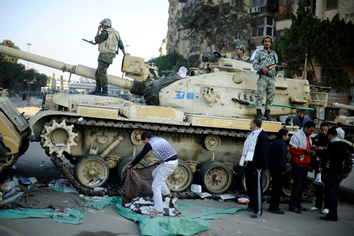
Egyptian soldiers stand on a tank in Cairo(Credit: Dylan Martinez / Reuters)

CAIRO, Egypt — Just days after the departure of former Egyptian president Hosni Mubarak on Feb. 11, the nation’s new, self-appointed military leaders pledged, within six months, a swift transition to civilian rule.

Crowds of the same protesters that demanded Mubarak’s ouster cheered as their army said it would steer the nation toward a “free, democratic system.” Seven months later, however, many Egyptians are finding that little has changed.

As the so-called Supreme Council of the Armed Forces increasingly cements, and in some cases flaunts, its firm grip on power, the revolution that inspired a region is beginning to look more like an old-fashioned military coup.

Military trials of Egyptian civilians persist and the military leadership has expanded and extended the 30-year-old, widely criticized Emergency Law once used by Mubarak to justify his authoritarian tactics.

Egypt’s police chief even announced this month that security would use live ammunition on protesters thought to be illegally entering certain government buildings.

Although the military leadership finally announced a date for the delayed parliamentary elections — Nov. 21 — few are optimistic that the vote will be either fair or help bring stability and security.

“It does not look like the army wants to transfer their power to a civilian government,” said Joshua Stacher, an Egypt expert and professor at Kent State University. “Just like any incumbent, they want to stay in office to preserve their interests.”

Those interests include a sprawling business empire cultivated over the decades by the coutry’s leaders, all of whom have been drawn from the Army’s top brass. As the former commander of Egypt’s air force, Mubarak oversaw the sprawling military complex that owned — and still owns — countless private businesses.

The military runs “an economic empire within Egypt’s economy,” said Samir Soliman, a professor of political science at the American University in Cairo. For decades, Egypt’s army has profited from money invested in everything from bottled water factories to hospitals, to seaside resort hotels and clubs.

No one knows exactly how much of Egypt’s economy is controlled by the army, but most estimates place it in the “billions” of dollars range. The problem, said some analysts, is that the military likely wants to prevent the complete transition to civilian leadership to ensure its hold on these assets.

“The military will never allow a civilian president to have oversight of their budget,” Stacher said. “And the Mubarak-style tactics to control dissent on the streets is one way for the military to consolidate its rule.”

Egypt’s military-led caretaker government announced this week that the Emergency Law, which allows police the right to arrest without cause or warrant, will not be repealed until 2012.

The military said the sweeping powers granted in the law were necessary to prevent the type of chaos that erupted on Sept. 9, when a mob of hundreds of Egyptians stormed the Israeli embassy in Cairo.

Activists and opposition politicians responded by criticizing the military’s use of “scare tactics.” They argue that the state of emergency also gives security forces unfettered authority to intimidate workers on strike and forcibly quell peaceful protests.

Wael Ghonim, a former Google executive who became a visible youth activist during the uprising against Mubarak, recently pleaded with the military to quickly transfer power to an elected civilian authority.

“After weeks and months, the mode of governance in our nation has not fundamentally changed and the excuse has been ‘stability,’ and it did not matter if the result was stability at the bottom of the pit,” wrote Ghonim in a Sept.16 open letter to the army posted on his Facebook account.

Some experts believe that Egypt’s military advisors simply may not know anything other than the exertion of power through brute force. The current leaders running the country, after all, also ruled during Mubarak’s three decades in office.

Mohamed Tantawi, the de facto head of state, was Mubarak’s former minister of defense and a close ally.

“The poor transitional leadership is definitely the result of self interest by a military led by former regime members,” Soliman said. “But it is also sheer ignorance on their part. The role of the army has always been to fight, not to govern.”

Whether for nefarious reasons or because of downright ineptitude, the military government appears to be setting a political course that closely resembles the country’s autocratic past, experts said.

Human rights groups in Egypt have described recent crackdowns on the independent press as evidence that the “Mubarak regime persists” to this day.

Several satellite channels — including one run by Al Jazeera — had their licenses revoked earlier this month for operating without the proper permits, according to Egypt’s information minister. Similar steps were taken in the months before the country’s last widely disputed parliamentary elections in 2010.

“It should be noted that in the run-up to the 2010 elections, the most infamous in Egypt’s history, the Mubarak regime launched an all-out attack on various forms of media … impeding their ability to monitor the elections and expose irregularities,” the Cairo Institute for Human Rights Studies said in a press release on Sept. 19.

Meanwhile, Egypt’s revolutionaries have become increasingly fatigued by months of small-scale demonstrations and strikes that seem unable to foster swifter political reform.

A recent protest against the expansion of Egypt’s emergency law drew only a few hundred activists outside the parliament building in downtown Cairo. Still, the diehard activists that led the charge during the January uprising say they will not quit.

“This is normal for us to have ups and downs,” said human rights lawyer Ragia Omran at the demonstration outside Egypt’s parliament. “Our revolution is definitely not over. It’s still a work in progress.”

Continue Reading Close

The battle for Libya’s not over yet

Despite jubilant celebrations, rebels admit that pockets of resistance remain throughout the nation

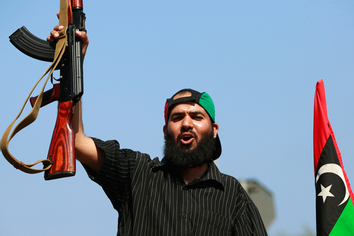
A Libyan rebel fighter celebrates as they drive through Tripoli's Qarqarsh district August 22, 2011

BENGHAZI, Libya — Two days after Libyan rebels marched on Moammar Gadhafi’s once-feared Tripoli stronghold, residents in this de facto revolutionary capital city were still triumphantly celebrating the apparent finale to a six-month, mostly stalemate, civil war.

Thousands of jubilant revelers strolled the streets around Benghazi’s Martyrs’ Square — the epicenter of the February uprising against Gadhafi’s 42-year rule — well into the early hours on Tuesday morning.

Young children and their families sang nationalist songs, launched heart-pounding fireworks from the sidewalks, and waved the ubiquitous red, green, and black “free Libya” flags. Celebratory machine gun bursts tore into the night sky.

Most people in the festival-like square were heartened by news that rebels had captured and detained three of Gadhafi’s sons, Saif, Mohamed, and Saadi, and that the leader’s own Tripoli compound was completely encircled.

“Since making it to Tripoli, it is now all but assured that this is over and that we will be finally free from Gadhafi forever,” said Saif Nasser, 45, sitting under a tent with his friends at Martyr’s Square.

It seems, however, that the party started a little early.

Late on Monday, conflicting reports about the rebels’ military successes in Tripoli began to emerge, leading to much confusion about the veracity of information being disseminated by both sides in the conflict.

Fierce fighting and gunfire was still being reported in several neighborhoods in both Tripoli and Zuwarah, a city west of Tripoli along the coastal route to the Tunisian border. Gadhafi forces were reportedly using grad rockets in Zuwarah, according to rebel leaders in Benghazi.

Meanwhile, Mohamed Gadhafi, who had been apprehended by rebel fighters on Sunday, had already escaped the next day, according to reports.

Rebel claims that Saif Gadhafi was in their custody were also premature. Saif, once presumed to be the heir apparent to Gadhafi’s rule, stepped out of a car in central Tripoli, to flaunt his independence in front of a crowd of journalists.

“We broke the back of the rebels. It was a trap. We gave them a hard time, so we are winning,” Saif screamed on Monday outside his father’s Bab al-Azizia Tripoli compound, defiantly challenging the contradictory reports that he had been arrested, according to Reuters.

Much of what official spokesmen for the Gadhafi regime have said in recent days — that rebel fighters would encounter intense resistance in a heavily guarded capital city — has been largely disproven by rebel accounts on the ground inside Tripoli.

But the conflicting news on Monday has raised some doubts over the credibility of the information coming from the National Transitional Council (NTC), the Benghazi-based rebel administration that has been recognized by the United States and many other countries as the legitimate representative of the Libyan people.

Shamsiddin Abdulmolah, the director of media and communications for the NTC, confirmed to GlobalPost that his government had unknowingly released reports about Saif’s capture based on inaccurate information.

“We should have requested evidence of the detention, but we did not. We took the information on face value,” Abdulmolah admitted. “But the situation on the ground in Tripoli is very fluid, and sometimes commanders on the ground receive conflicting reports from their subordinates.”

Abdulmolah also said that Gadhafi loyalists posing as rebel fighters had helped Mohamed escape on Monday. Mohamed’s request to make a telephone call — which was granted — was most likely used by regime forces to pinpoint his exact location, according to Abdulmolah.

Meanwhile, the NTC reiterated on Monday that 75 percent of Libya was under the control of “liberating forces” on Tuesday, and that only pockets of resistance remained.

Gadhafi’s Bab al-Azizia compound remains one of those pockets, despite being totally surrounded by rebel fighters.

Abdulmolah predicted Gadhafi’s “last hurrah” by Tuesday evening, claiming that rebels would completely overrun his headquarters, once NATO air strikes began to strike the building.

Continue Reading Close

Who are the “sons of Mubarak”?

In Egypt, a small but vocal minority still supports the fallen dictator

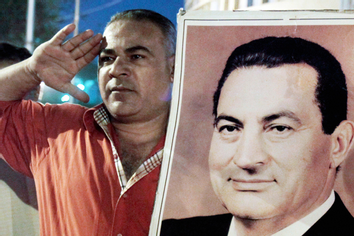
A supporter of former president Hosni Mubarak

CAIRO, Egypt — Egypt’s revolutionaries received a crucial bit of closure earlier this month when Egypt’s ailing ex-president, 83-year-old Hosni Mubarak, was wheeled inside the caged dock of a Cairo courtroom, clad in a white prison jumpsuit.

The televised images of Mubarak, as shocking and surreal as they were, offered many Egyptians a glimmer of hope that justice would finally prevail after the bloodshed of the January 25 uprising and three decades of repressive rule.

Not everyone, however, was cheering.

Outside the court, hundreds of Mubarak allies chanted and waived placards of support before and during his trial, which opened on Aug. 3 and met for a second session on Aug. 15.

“Oh Mubarak, hold your head high,” screamed protesters, according to Reuters. “We will demolish the prison and burn it down, if Hosni Mubarak is sentenced.”

These ardent supporters of the former president — the self-described “sons of Mubarak” — hope to spare their former president from the humiliation of detention and intense scrutiny of a public trial.

His most vocal backers may be in the minority these days — depending on who you ask — but they are unwavering, both online and on the street, in their conviction that Mubarak, who is under detention in a Cairo hospital until his next court date, is a national hero who led the Arab world’s most populous nation to 30 years of peace, prosperity and stability.

“We traded our national security for political corruption and economic chaos,” said Yousry Abdel Razik, a lawyer who attended the recent proceedings. “This was no revolution. Revolutions are supposed to make countries better, not worse.”

Abdel Razik recently signed on to give pro-bono legal aid to Mubarak’s defense team, which is led by veteran Egyptian lawyer Farid el-Deeb.

The charges Mubarak is facing — corruption, abuse of power and ordering his security forces to kill more than 800 protesters — could result in the death penalty if he is found guilty.

That harsh reality alone was enough to bring Abdel Razik, 35, to tears during the trial.

“The only other time I’ve cried in my lifetime was when my father died two years ago,” he said. “But I love Mubarak. He is my father too.”

On the west bank of the Nile River, a few dozen Mubarak supporters have set up a makeshift, Tahrir-like rallying point in a traffic circle. There, they occasionally meet to drink tea, discuss the latest news and reminisce about the old days.

They are angry that billboards carrying Mubarak’s once-ubiquitous image have been torn down, and that his name has been scrubbed from schools and subway station maps.

Most of them — men and a few women, young and old, rich and poor — are still dumbfounded by Mubarak’s ouster. They point fingers at various foreign elements, mostly the United States and Israel, as the ones responsible for his downfall.

They seemingly ignore the widespread criticism that frequently arose during Mubarak’s one-man rule — economic stagnancy, human rights abuses and corruption.

“My family and I never benefited at all from Mubarak, economically speaking,” said Karim Hussein, who grew up in a working class neighborhood near the Pyramids. “But I am proud to defend him even to this day.”

Hussein, a 22-year-old information technology graduate, seems a more likely candidate to join the youth activists who challenged Mubarak earlier this year.

But a day after thousands of young Egyptians descended on Cairo’s Tahrir Square on January 25, aided in part by the coordinated use of social media, Hussein launched his own Facebook page in support of Mubarak.

He said he was inspired to defend his president because he thought protesters were treating the elderly leader unfairly after so many years in power.

The Facebook group, translated as “We Are Sorry Mr. President,” organizes rallies and celebrates and defends Mubarak’s “achievements.” The page has attracted more than 100,000 fans to date, though Hussein admits some of those followers are hackers and naysayers.

In a troubling reversal, it is now these Egyptians, those that support Mubarak, who are on occasion the target of violence. They point to bandages, casts, scars and other battle wounds as signs that they have now become Egypt’s most marginalized minority.

Hassan Ghandour, a 30-year-old who claimed to be a former soldier in Mubarak’s presidential guard unit, unbuttoned his shirt to reveal a long, deep gash he received during clashes that erupted during Mubarak’s trial on Aug. 15.

Insults between the two opposing sides of protesters had escalated into an all out brawl, leaving dozens injured.

Ghandour denied that he or any of his comrades were “counter-revolutionaries” seeking to reinstall the former leader, as reform activists frequently claim.

“All of this chaos happening now is not from us,” Ghandour said. “It’s because of the revolution that burned and destroyed our country.”

Most of the “sons of Mubarak” believe their former president will soon have his legacy restored.

Abdel Razik, the volunteer lawyer, said he is confident that the former president will be exonerated within a few months.

At the very least, said a beaming Abdel Razik, the Egyptian public will no longer be able to watch live images of Mubarak in a cage — the judge ruled that the trial would no longer be televised.

Continue Reading Close
www.salon.com/writer/jon_jensen/index.html