One morning last fall, Claude Daudet drove out to check his snowmobile trails around Churchill, Manitoba, a tiny town on Hudson Bay’s western edge, south of the Arctic Circle. He grimaced at the unfrozen ponds speckling the tundra. His one-man snowmobile tour company had just been forced to cancel its first group of the season for lack of snow. As we bounced along in his truck, the generally sanguine Daudet, 47, seemed sunk in worries. Among these burdens was Camus, his dead dog, which, at the insistence of his animal-lover girlfriend, was boxed in Daudet’s freezer, awaiting cremation on their next trip to Winnipeg. Then there was his business, of course, the muddy terrain, the belated winter, the absent wind, climate change and so forth.
We got out at the small warming hut he’d built in the woods. He started pacing. Normally at this time of year, he’d be inside the hut, serving hot chocolate and homemade Nordic cookies, after leading a convoy of snowmobiling tourists across the frozen Churchill River on a day tour. He pointed to a jagged tear in the door made by certain furry uninvited guests. They have been turning up more frequently, increasingly desperate for something to eat. This is another worry. “We can no longer get insurance for polar bear break-ins,” he said.
As climate change sets in, the Arctic is warming nearly twice as fast as the rest of the planet. Polar bears, which live and hunt year-round on the region’s ice, are becoming stressed for food. A population of about 1,000 bears roams outside Churchill, slightly outnumbering the 900 people in town. In fall, one might be spotted picking through a dumpster outside Gypsy’s Diner or lumbering over the rocks behind the Duke of Marlborough High School. “They eat baby geese by the bundle, like roses,” a lifelong Churchillian told me, a man with two shotguns in his front seat and ammo ringing the headrest. “They step on you, and your head pops off.”
It’s tempting to think of climate change in terms of elusive numbers and future scenarios — a spiking line graph of global temperature, a virtual glacier receding on a climatologist’s computer screen. But the ravages of climate change are already being felt by people and communities. Northern towns like Churchill, dependent on one major resource for its economic survival, may be the most vulnerable. As the ice on the Hudson Bay disappears, biologists and climatologists predict the town’s bears will soon be the first polar bear population wiped out by global warming. This is not welcome news in Churchill. The town’s fate and that of the bears may be terribly intertwined.
“The bears are a big draw because they’re an exotic animal,” town counselor Mike Iwanowsky explained about the town’s booming tourism industry. “They’re a symbolic animal. You think of the North, you think of polar bears. You think of winter, you think of polar bears. They’re, I don’t know, ‘chic.’” Iwanowsky, a brawny man with a daunting red goatee, was clearly not comfortable using the word.
After falling on hard times in the ’70s, Churchill found a way to leverage the menace surrounding it into big business. More than 10,000 tourists now visit the self-made “Polar Bear Capital of the World” each fall. For six weeks, beginning in mid-October, when the bears amass near town, beat-up school buses cart visitors toward the tundra every morning and all the restaurants fill up at the end of the day. Hotels and shops sell embroidered fleeces and high-priced bear kitsch.
It is difficult and expensive to get to the town, and trips are booked far in advance, often through one big company that hauls tourists to see the bears in “tundra buggies”– kind of like mobile ski lodges propped on monster truck tires. Small entrepreneurs like Daudet must make most of their annual income during the “bear season” when the tourists are flooding the town. If the climate doesn’t cooperate, it can throw off the whole system.
Churchill, though, is habituated to hardship. It’s lashed with wind off the bay in winter and battered with “bulldog flies” in summer — bugs, a local paramedic says, that pluck out a slab of skin through your jeans. There are no roads out of town (you arrive from Winnipeg by train or plane) and only a single paved one running through it. “We’re basically a big parking lot with houses on it,” a trapper friend of Daudet’s had told me. He said this affectionately.
Churchill’s history, meanwhile, reads like a 400-year succession of miserable luck. The town has dwindled toward extinction in the past, but always managed to clamber back. Now, facing the near inevitability of yet another bottom dropping out, there’s something about the residents that refuses to be cowed.
“The polar bear business goes through different phases,” Daudet said on the drive back to town. “I think we’re now going through another phase with the changing of the climate. People are figuring out we might not see these bears in 20 years, so we better go see them now.” He had chosen — out of instinct, out of necessity, out of sheer Churchillian-ness — to focus on the opportunities.
Polar bears were frequent newsmakers this winter. All the news was bad. Russian bears, facing a lack of food, were becoming more aggressive. In Alaska, forced to swim longer distances between receding ice sheets, they were drowning. Recognizing the bears’ troubles, Greenland set its first-ever hunting quotas last month, and even the Bush administration is considering classifying them as a threatened species under the Endangered Species Act, citing loss of habitat.
Churchill’s bear population is the southernmost in the world and, like its human population, subsists under less than ideal conditions. Hudson Bay is not frozen all year. After roaming the ice all winter, gorging on seals, the bears decamp where the last ice melts at the southeast of town. They spend the summer on land, living off reserves in what’s called “waking hibernation.” But an influx of fresh water into the bay makes the area north of Churchill first to freeze again. And so, each fall, the bears lurch off the tundra toward it, anticipating their first opportunity to get back on the ice where they’ll spend another winter ambushing seal pups. The town, of course, is in their way.
But Hudson Bay now melts earlier in the spring and freezes later in the fall, leaving the bears marooned on land for longer stretches of time. Ian Stirling, a leading polar bear researcher with the Canadian Wildlife Service, says the summer season has extended by about three weeks over the last 30 years. Churchill’s bear population has fallen nearly 20 percent in the last 20 years, and U.S. and Canadian biologists have correlated the decline to earlier spring melts. Recently a female bear was found torn apart and devoured by a larger male — which, like the increase in bears’ venturing into town, may be a sign of “nutritional stress.”
Meanwhile, projections show Hudson Bay becoming nearly free of ice, year-round, by mid- to late-century. William A. Gough, a climatologist at the University of Toronto Scarborough, has spent a decade analyzing 35 years of sea ice records in Hudson Bay. He’s projected its future using six different climate models created by government agencies around the world. “The Canadian model shows total ice reduction by 2050,” he said. By 2080, when the carbon-dioxide concentration in the atmosphere will have tripled, the other models show the same result. “By the end of the century,” he said, “there will be no platform for polar bears.” And no platform for bear tourism.
While no amount of earnest, Churchillian elbow grease is likely to fix the problem, the townspeople I met seemed staunchly pragmatic. Unable to start his snowmobile season, Daudet bought four reconditioned computers to sell in town. He was also doing snowmobile tuneups, patching tires his neighbors left on his doorstep and, given that the weather had been so mild, washing cars outside.
“When it comes to the pressures on the bears, things like global warming, what can we really do?” Iwanowsky said. “You can move forward or you can stand still and fade away. And this community doesn’t believe in standing still.” He proudly added that Churchill was one of the first remote areas in Canada to get broadband Internet service. It was a testament to the industriousness of the community, but, ultimately, also to its sour luck against the elements. A brutal windstorm knocked out the entire infrastructure not long after it was installed.
- – - – - – - – - – - -
On a bright and balmy morning, about 40 of us packed into a tundra buggy. Each vehicle is retrofitted with wood paneling, a heating stove, rows of seats and windows, and a steel, open-air viewing balcony in back, safely above the reach of the bears, which often rear up lazily to streak the hulls with muddy paw prints.
As we rolled across the tundra and tidal flats outside town, polar bears loafed on tangles of kelp, conserving what was left of their energy. They are breathtaking beasts, to be sure, but in this context — chewing on straw, napping, even rising up to tussle with one another like drunken heavyweights — they seemed more cartoonish than menacing.
Behind me, in matching blue parkas and gray fur hats, a couple from San Jose, Calif., sprung up at the day’s first sighting. A yellowish bear had loped into view, his skeleton and muscles jumbling in his loosened fur like wrenches in a duffle bag. The woman tittered and squealed — “This is a treat!” “Look at his stomach!” — while her husband raised his 2-foot telephoto lens and clicked furiously. They were concerned about the warming weather but had no intention of stopping their annual visits. “I’m just so glad that everybody got to see that!” the woman said, a little flushed, after the driver put the buggy back into gear and we’d rolled on.
Frontiers North, which operates the Tundra Buggy Adventure, owns 18 vehicles, all of which they built themselves. Because the ecosystem is so delicate, the provincial government confines its operation to preexisting trails — the training grounds of the since vanished U.S.-Canadian military installation built up during the Cold War.
“The town never had a bear problem in those days,” Bob Penwarden told me. “The military used lead poisoning — they just shot the bears.” Penwarden moved here in the early ’60s to launch communications and weather satellites for a private contractor. (The old rocket range is now the Northern Studies Centre, a base camp for visiting scientists.) With government agencies and contractors flooding in, the town’s population swelled to 6,000. The military held dances, operated a movie theater and curling rink, and organized a hockey league for Churchill’s kids. “They flew in lobster for New Year’s Eve,” Penwarden remembers.
When the Americans pulled out in 1965, it caused a ripple effect. Penwarden’s outfit shed men fast, laying off nearly a quarter of its employees in one morning. By the early ’80s, Churchill was down to about 1,000 people. There were rows of empty buildings and an infrastructure the town couldn’t afford to keep up. Rocket shells littered the tundra and were sunk in the Bay.
Those who stayed scavenged to rebuild their community. No one wanted to drive the military’s abandoned ambulance, so the woman who drove the town’s cab took on the task. Penwarden and his wife tore down the old jail and built a house from the wood. Slowly — with the buzz and firepower of the base gone, the whaling factory at the mouth of the river defunct and the once-bustling town reduced to a small, shivering settlement — nature moved back in.
“You had all this crumbling and the walls falling down,” said Mike Spence. He was a teenager in Churchill then and now runs two hotels, a restaurant, a flooring business and the town’s only car rental agency. He’s also the mayor. “Then, all of a sudden you’re seeing a lot more wildlife coming in. You’ve got more bears coming in. You’ve got the beluga whale population coming up. You’ve got different kinds of wildlife like foxes, Artcic hare, caribou, all coming together. And then bang!” Spence said, pausing to lend gravity to this creation myth. “All of a sudden you’ve got tourism that’s starting to prosper.”
Merv Gunter, co-owner of Frontiers North, acknowledged the potential of climate change to undermine the Tundra Buggy empire he and his wife, Lynda, have built up over the years. “For a company that relies on the presence and welfare of polar bears, it would be sheer folly not to be concerned,” he said.
He couldn’t be sure to what extent humans are causing global warming, he told me, but “I think we should do everything we can about it just in case. And can we do anything more than that to stop climate change? No,” he said. “So we will coexist with that. We’ll have to, as will the bears. They’re a very tenacious and a very amazing species with their ability to evolve and to adapt.”
Many townspeople seem to expect the same stubborn resilience from the bears that they themselves have always used to get by. They assume the bears will find a way to survive, and some even speculate they’ll learn to eat berries and evolve back into grizzlies. One afternoon on the tundra, I put this hypothesis to Jane Waterman, a Canadian biologist from the University of Central Florida, who was in Churchill studying bear behavior.
“Natural selection can happen very quickly in bacteria because they can breed in 20 minutes,” she said. “Polar bears live 20 or 25 years. That means that for changes to occur genetically, it’s going to take a little bit of time. And that’s something they don’t have. So, no,” she went on. “If the change is as rapid as all the climate models predict, by the middle of this century, there’s no sea ice in Hudson Bay and there are no bears. If there’s no sea ice, you can’t have bears.”
One morning, as an Italian couple shuffled out to their tour bus, Penwarden and I stood chatting in front of a map of Canada in the lobby of the Tundra Inn, which he and his wife, Pat, own. Old Nike missile adapters sit on the porch, used as planters, and a slim, decommissioned rocket leans in the lobby behind a ficus. The floor was appropriated from the old bowling alley and still has its pin markers.
When I’d asked why he and Pat stayed after the military pullout, he’d simply said, “It wouldn’t be home if we went somewhere else.” His faith in the bears seemed informed by an identical logic.
“Oh, I’m worried,” he said, stammering a little. “I’m worried because it’s the livelihood of a lot of people in this town. But I believe that home is here for those bears. I don’t say these scientists are right. I don’t even believe they’re right on this global warming. For the bears, this is home. I may be dead wrong — and they do wander. And hell knows where they go. But they’ll be back next spring.”
Ironically, as the ice vanishes, taking the bears with it, global warming may be clearing the way, literally, for an entirely new industry in Churchill. The town happens to have Canada’s only Arctic seaport — a hulking assemblage of silos and steel that, underutilized through the ’80s and ’90s, quietly sank into disrepair past the edge of town. Only a handful of ships slid in each summer to load up on grain shuttled up from the prairies, and they often arrived dented, having barged through ice cover. “I’ve heard rumors about this place since I started here in 1981 — that it wasn’t going to make it,” one port employee, Randy Spence, told me. “But somebody in the early ’30s decided to put the port here for a reason. And that’s for the future.”
In 1997, the Canadian government dumped off the port for $10 to OmniTrax, an American company that had bought the rail line between Churchill and Winnipeg. OmniTrax immediately began upgrading, realizing the summer shipping season was extending. Moreover, less ice means new trade routes are opening up through the Arctic to northern Russia. Recent delegations have been sent back and forth between Churchill and the Russian city of Murmansk to plot their use. OmniTrax now envisions a realignment of the North American trade system through Churchill, with Canadian farm equipment and grain moving out and incoming goods traveling by rail through Winnipeg and the American Midwest to Mexico.
Yet few people I met in Churchill talked about the port with any real passion. While they’re optimistic for this year, OmniTrax has so far had difficulty luring ships away from well-established routes. And while the Canadian Wheat Board could force more grain shipments through Churchill, there’s a feeling in town that business is locked up in the south, in port cities like Montreal and Thunder Bay, Ontario, and nearer to the vast majority of Canada’s population. “Omnitrax has been trying to make this thing go forward for a long time,” Daudet had told me. “If the people down south would let Churchill be Churchill, this place would be booming. But it’s not happening.”
With the future of the port largely dependent on a vague network of non-local interests, I found instead, in Churchill, a strange streak of wishful entrepreneurialism about almost everything else.
Penwarden bought the dilapidated radar station where he used to work and has talked about turning it into a convention center. Iwanowksy has advocated setting up corporate call centers in Churchill, a feasible business, he said, even given Churchill’s lack of roads. He has also proposed manufacturing prefabricated housing and hauling it over the ice to the tiny Inuit communities farther north.
Despite the great expense and difficulty involved in traveling to Churchill, the town is scrambling to diversify its tourism industry with less spectacular, more dependable attractions. As the Polar Bear Capital of the World may eventually be polar bear-less, it’s pitching itself as “Bird Watcher’s Paradise” in spring, the “Beluga Whale Capital of the World” in summer and “Nature’s Light Show,” for viewing aurora borealis in the middle of winter when it’s routinely 40 below.
“The thing is,” Mayor Spence told me, “we’re trying to build momentum with what we have. Naturally what we have — and again, I’ll refer to it — is the Polar Bear Capital of the World.” It was clear he found great joy in just saying it. “That is a selling point, and that’s what we need to use. We need to build on it. We need to capitalize on it. And if we don’t, we’re going to slide — and we can’t afford to slide. If we want to retain our youth and get our children to invest in this community, then we have to make sure this community progresses. We don’t have a choice,” he said. “We have to.”
- – - – - – - – - – - -
“I feel like a lost and lonely bird,” wrote Danish explorer Jens Munck when, after landing here in the winter of 1619, his men quickly succumbed. Munck slumped into his cot to die too, but the stench of his crew’s cadavers was too much, so he went back outside. There, he found two men who were not quite dead and some green shoots peeking out of the grass. They sucked on the roots, started fishing through the rupturing ice and, eventually, through a massive storm, somehow made it back to Europe in their broken boat.
It was another 100 years before British fur trappers figured out how to survive here, erecting the Fort Prince of Wales on the Churchill River. In early November, Daudet and I stood into the wind at a place called Cape Merry at the edge of town, looking across the river at the fort. Normally, he leads his group over to it for historical tours. But the river had not frozen, and he was still without sufficient snow. He had nobody to give his lecture to, so I asked that he tell it to me.
The entire settlement — the carpenter’s shop, mason, blacksmith — had been contained inside the fort, he began. Then, in 1782, “Three French warships came in with a person called Count La Pérouse. There were only about 20 people inside the fort and they gave up without firing a shot. Well, this La Pérouse guy came in there and wrecked the place. He stole all the fur — which today would be valued in the millions of dollars. And then he left. The people didn’t know what to do. So they moved south of the Fort Prince of Wales, about five miles downriver, and they reconstructed there.”
The Churchillians stayed in that new location until 1928 when the railroad tracks from Winnipeg finally reached the river. Not wanting to build a rail bridge across the river to the town, engineers terminated the tracks on the riverbank. “So everybody moved across the river,” Daudet said matter-of-factly. They disassembled their homes and their two churches, battened them to dogsleds, and lugged them over the frozen water to where we now stood.
“See the white pieces,” Daudet now said, hopping up on a stone bench and pointing into the river. “That’s ice.” The first pans were just starting to form. Thin slates rode the indifferent current. Soon, he hoped, it would be solid and 4 feet deep, as usual. He had a group of 100 booked in a little over a week.
“I’m losing business today,” he told me. “I could be out doing maybe 10 or 15 people today — five in the morning, five in the afternoon. It could add up to be thousands of dollars.” He was already looking ahead to northern lights season to make it up.
“It’s tough,” he said. “But I still have a few computers to sell and the shop’s been a little bit busy, so” For a second, it seemed he wasn’t going to finish his sentence, that he’d given up on it. He hadn’t. “That’ll keep us going,” he said.
Read other articles in the Early Signs: Reports from a Warming Planet directory.
The first thing you see when you walk into the installation “The Universe Within” is a dead Chinese man with very little skin. His hands are triumphantly on his hips, and he’s made to revolve slowly on a turntable like a track and field trophy. A large rhombus of muscle is partially carved off his buttocks and peeled forward, and if you look closely at its edge you notice the familiar, pinkish marbling of a raw flank steak. And then you have an indescribable little epiphany: You realize that you’re looking at this gentleman’s actual flanks.
“The Universe Within,” now at San Francisco’s Nob Hill Masonic Center, is a traveling road show of 21 provocatively posed human bodies and a menagerie of organs, all embalmed by a process called “plastination,” in which body fluids are replaced with liquid plastic. It hails from China and joins two other wildly successful touring exhibits: “Body Worlds” and “Body Worlds 2″ (currently in Chicago and Cleveland, respectively). Those exhibits are promoted by plastination’s inventor, Gunther von Hagens, and have grossed nearly $1 billion worldwide. They’ve also incited almost perpetual controversy, due in part to von Hagens’ Barnum-esque eccentricities. (Most notoriously, after bullet holes were found in two of his specimens’ heads, he was accused of, but never charged with, using the bodies of executed Chinese prisoners. Then in March, when the Body Worlds 2 exhibit was in Los Angeles, someone walked off with a 13-week-old plastinated fetus.)
But after “The Universe Within” debuted in San Francisco in March, it quietly went about its business for two full months before arousing suspicions from local government and scandalizing the citizens. Last week, San Francisco’s ABC affiliate reported that the bodies were leaking a viscous combination of silicone and liquid human fat (signs of a “rush job,” according to anonymous plastination experts cited by the news station). Moreover, the station reported, the corpses were not the property of the Medical University of Beijing, as initially claimed by one of the exhibit’s promoters, an Austrian TV producer named Gerhard Perner. The university has never heard of Perner.
So whose bodies are they?
“Where the bodies came from in terms of donors, they don’t tell us anything,” a docent of the exhibit told the station’s investigative team. “They tell us, ‘Don’t talk about that.’”
These revelations led to protests by Chinese-Americans who, fearing the worst, are likely imagining an otherwise unimaginable class of human rights violations. “There are red flags popping up all over the place,” said city Supervisor Fiona Ma, a Chinese-American herself. She’s now working to shut down the show and to bar such exhibits from the city without clear proof of the donors’ consent.
But those flags have been flying high for the past two months. A reporter from the San Francisco Chronicle sent to the exhibit before its opening was given a terrific runaround by its promoters when she tried to find out the origin of the bodies. She was told only that most were donated to science, though some were “unclaimed.”
Coincidentally, “The Universe Within” opened in San Francisco on March 31, the day Terri Schiavo was officially pronounced dead — a moment when corpses and our moral obligations about how to treat them were at the center of the news. In retrospect, it’s amazing that a giant room full of controversial cadavers slipped under the radar of our culture of life for so long. Especially a room full of corpses like this these — a flamboyant bunch that cavalierly blur the line between science and pure spectacle. I visited last month and found the whole thing exhilarating, God help me.
Despite all its educational pretensions, “The Universe Within” is overwhelmingly a work of art. The potted tropical foliage, the theatrical lighting design and the piano music are all part of it. But most of all, it’s the impishness of whoever’s turning these bodies into sculptures.
Plastination preserves all the nuanced bumps and wriggles of body tissue, sustaining its appearance and allowing the bodies to be easily posed. These are not skeletons or mummies but recognizable humans with skin, fingers, lungs, spleens, tongues, privates, eyelids, even eyelashes, and often enough face left to make things unsettling. Just how much face is up to the curators who have carved up and peeled these folks open with the panache of wedding florists.
It’s with a certain baroque flair that one plastinated dead body rides a shiny blue bicycle with “Forever” decaled on its frame. And what about the man next to him, the one holding out a sagging jumpsuit of his own skin on a wooden hanger — that’s meant to be ironic, right? I didn’t quite know what to make of the guy sawed vertically down the middle, each half stepping forward to shake hands with the other like forthcoming husbands at a barbecue, nor the man charging at me with reddened plates of freed muscle splaying wildly off his body in all directions, the way radishes are carved into roses.
Such mordant morbidity is apparently de rigueur for plastination exhibits. (Some poses are apparently taken straight from von Hagen’s “Body Worlds,” which also features a fleshless corpse turning freestyle skateboard tricks.) But what’s peculiarly unsettling about “The Universe Within” is how little information is put forward.
The diagrams next to the bodies seem largely arbitrary. One bears the heading “Digestive System” and points out things like the clavicle deltoid muscle, biceps brachii, and quadriceps femoris muscle — none of which, of course, digest. There are no clunky blocks of prose explaining what the highlighted body parts do, and the partially fleshless corpse rearing back to pitch a bright new Rawlings baseball in the center of the room doesn’t even get a write-up. He’s just a dead man throwing a ball, you see.
I can’t say all of this didn’t seem suspicious at the time, and I began to feel that leaving “The Universe Within” without a nuanced edification of physiology would somehow dishonor the people, the bodies, who had made it possible. I tried to eavesdrop as the occasional medical student or professional would start explaining respiration or cardiac arrest to the group of friends he or she had doubtless dragged there.
But I also noted that “The Universe Within’s” mission statement stops short of offering any exhaustive education, rather aiming to “stimulate interest in and create a new awareness of the wonder that is the human body.” That is, these bodies may be intended to spark a curiosity more than satisfy it. And it seemed to me there should be a place for just this type of scientific outreach, where the volume of facts isn’t necessarily given a premium over a general sense of wonderment.
I began to think of “The Universe Within” as a kind of secular reliquary — like Rome’s crypt of Santa Maria della Concezione, where room-size mosaics have been fashioned from the bones of thousands of Capuchin monks; or St. Catherine’s glass-encased hand in Siena; or the slumped body of St. Boniface in Prague. The believer was meant to feel earnestly, if not quantifiably, inspired in the presence of these relics. Seeing a cadaver hitchhiking or a plastinated lung — a real lung for chrissakes! — filled me with a not so dissimilar, almost religious exuberance.
“I don’t think you’re wrong to think that,” Michael Sappol, a historian at the National Library of Medicine in Bethesda, Md., and the author of “A Traffic of Dead Bodies: Anatomy and Embodied Social Identity in Nineteenth Century America,” told me later by phone. “You’re not wrong to be amazed, to feel, This is my body. And you’re not wrong to look at a dead body and think, This is death.”
Sappol speculates that plastination exhibits are alluring in part because “we live in a sea of body images that are constantly trying to trump each other in terms of novelty or beauty. Because we can’t directly see into our own interior, there could be nothing more novel.” Yet we also live in a culture intent on hiding death; and these exhibits flaunt it. “You’re seeing yourself, but you’re also seeing a monster at the same time.”
Plastination exhibits follow a long tradition of spectacular anatomical displays that channel this basic curiosity. These range from dissecting humans in a public “anatomical theater” in the 1600s, often for the pleasure of civic dignitaries, to grotesque cadaver exhibits in the dime museums of 19th century New York. Creeping alongside this continuum, however, have been debates (and sometimes riots) over the provenance and rights of those bodies, similar to the arguments erupting now around “The Universe Within.” After all, it was common for 19th century doctors to resort to grave robbing for their specimens — only because there was an inadequate supply of executed criminals and unclaimed vagrants, who were fair game.
In America today, the widely revered principle to adjudicate the use of cadavers is informed consent: Donors must sign off on precisely how their bodies will be used. This is effectively what Fiona Ma is battling for. Sappol calls enforcing it with respect to exhibits like “The Universe Within” a matter of justice, saying, “It’s very unlikely that von Hagens or these plastination people can meet any kind of informed consent.” That is, it’s unlikely a man somewhere in China volunteered specifically to be the skinless fellow riding a bike. Sappol also cited reports of organ harvesting from executed Chinese prisoners.
But Sappol admits he’s ambivalent about the idea of applying that standard retroactively. Informed consent, like all other concepts in bioethics, is relatively recent, having arisen only after donating one’s body to science became a prestigious, upper-middle-class bit of altruism rather than a haphazardly forced arrangement for the destitute. “Every major anatomical museum would have to take things off display,” Sappol said. Just two years ago, the skeleton of a slave in Waterbury, Conn., which had been turned into a medical model by his physician owner and displayed in a local museum for generations, was finally given a proper burial. (Connecticut also commissioned an operetta to honor the slave.)
The ethical controversy surrounding “The Universe Within” may undermine any esoteric argument about art, science and the value of wonder. The excesses of the exhibit itself certainly can’t be justified for their power to instill reverence for the human body if the curators have so basically betrayed that reverence by hijacking bodies and then lying about it. The paradox is, an exhibit that so forcefully inspires curiosity about “the body” also seems to have a strange power to neuter curiosity about the individual bodies staring us in the face.
So it may turn out I was complicit in the handiwork of body-trafficking hucksters, ponying up $15 and shuffling around the gallery with my jaw dropped, exclaiming over how marvelous it all was. And I can’t say I don’t feel pretty filthy about that. The things that amazed me most, while still amazing, are also now vaguely haunting. That flank steak, for one. Or consider the hot fuchsia filigree of arteries that the curators of “The Universe Within” had extracted from a leg to be strewn across the blue velour of a rectangular display case. Consider how the filaments still hold their leg shape, like a knit sock that has nearly worn away. But also consider that it was a toddler’s leg. And a few short wisps of its artery had flecked free of the mass and were, as I stood there gawking at it, static-clinging to the velour — just kicking around, like bits of a cheap feather boa after a costume party.
Continue Reading
Close
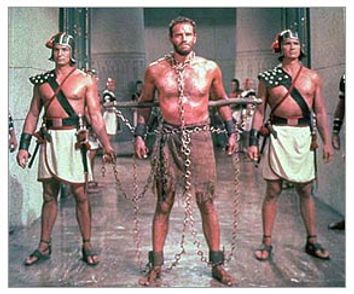
ABC’s airing of Cecil B. DeMille’s biblical epic “The Ten Commandments” this Sunday will be the network’s 24th broadcast of the film in 31 years. Almost every one has been timed to fall on either Palm or Easter Sunday, turning this glitzy, sexed-up production of the foundational Jewish story of deliverance from Egypt into a Christian Holy Week tradition. The “Ten Commandments” broadcast has also often coincided with Passover, when Jews retell that same story during a ritual dinner. Around the country, doubtless more than one family has wound down its Passover Seder amid empty Manischevitz bottles, watching Charlton Heston part the Red Sea.
The film still generally wins the night’s top ratings; last year it won both the adult and kid markets, with an average of 10.6 million viewers. And its influence stretches further than anything Nielsen can measure, though especially to modern eyes it’s little more than a load of camp, with outrageous costumes and overacting, which is never more apparent than in the bedroom scenes between Moses and Egyptian Queen Nefertiti. “Oh Moses, you stubborn, splendid, adorable fool,” she tells the prophet, who has spent the afternoon making bricks with his enslaved Jewish brethren. “You can worship any God you like, as long as I can worship you.” TV Guide dubs the movie “a great big wallow, sublime hootchy-kootchy hokum.” In a recent article on “The Passion of the Christ,” Variety cites a Hollywood “axiom” that you can’t make films about religion, “unless it’s a harmless Cecil B. DeMille-type biblical saga.”
The comparison between DeMille and Mel Gibson, however, is an improbably rich one. DeMille also thought he was creating a serious religious film — a potential proselytizer — and promoted it as rigorously as Gibson has “The Passion.” DeMille deflected criticism of his racy portrayal by claiming he was creating an accurate representation of the Bible, just as Gibson has claimed immunity to charges of anti-Semitism and excessive violence. And long before Gibson invited audiences to “Share the Passion of the Christ” by purchasing promotional “Witness Cards” and crucifixion nail jewelry, DeMille conflated religious fervor and marketing finesse in remarkable ways. “The Passion’s” impact can’t yet be accurately measured. But nearly 50 years after the release of “Ten Commandments,” DeMille’s 70th and final picture has endured, launching a legacy of myth and intrigue that critics and scholars have had a difficult time penetrating.
Cecil’s father, Henry DeMille, had aspired to be a minister. Though he delivered lay sermons at St. Stephen’s Church in Brooklyn, N.Y., he was talked into playwriting by his wife. “[I]n the church he might be able to speak to thousands,” Cecil explained in a 1951 interview, “through the theater he might be able to speak to hundreds of thousands — and then when I came along the mantle fell on my shoulders in a new form which was the motion picture, and I was able to reach hundreds of millions.”
Sex was DeMille’s way or roping in wider audiences. “Hit sex hard!” was his frequent order to screenwriters. He dubbed the Golden Calf scene of “The Ten Commandments” — a sultry bump and grind of sweaty Israelites — “an orgy Sunday-school children can watch.” But his critics were unable to reconcile the professed piousness of DeMille’s vision with his vulgar showmanship and savvy. They constantly sought to expose his claim to a “unique ministry” of film as self-aggrandizing sham. To others, his films were “a fraud that enabled immorality to hide behind the protection of the Holy Book.”
“I imagine that criticism will always follow him,” says James D’Arc, a film scholar and curator of DeMille’s archives at Brigham Young University. “But those who worked with him never doubted the fact that he was a believer, and that he was sincere about what he was doing.”
There were also many instances of religious leaders and strident believers praising DeMille’s work, and the director relays them in his “Autobiography.” DeMille writes, after “The Ten Commandments” he received too many complimentary letters for him to single out one or two, “[b]ut there is one thought that runs through them like a refrain: ‘This picture has made God real to me.’”
DeMille’s eccentricities and penchant for exaggeration likely have fueled critics’ distrust. They also made the careful management of his image difficult for his staff. In his memoir “Yes, Mr. DeMille,” DeMille staffer and “personal representative” Phil Koury writes that the 1951 interview above was intended to settle ongoing confusion among staff members. “We were never quite certain whether the facts in the last interview were final or official, changing as they did from time to time,” Koury writes. Even Cecil’s older brother, William, didn’t remember their father reading to the boys every night from the Bible and American history — another of Cecil’s favorite anecdotes.
“True or not … it was DeMille the showman responding to an intuitive faculty for drama,” Koury writes, “and more important, having those things accepted that pleased and edified him most.”
For her oral history of the making of the movie, “Written in Stone,” Katherine Orrison interviewed the film’s producers, writers, actors, costumers, set designers, soundmen and others, ghostwriting the recollections of each. Orrison has since contributed commentary to the new DVD of “The Ten Commandments” (released March 9, at the height of “Passion” buzz). The man brought to life in “Written in Stone” is by turns a warmhearted mentor, a truculent boss and precisely the ridiculous-sounding cinematic missionary DeMille claimed to be. Regardless of the many glitzy and sultry liberties he took in the film, DeMille was intensely committed to research. His staff pored over the Old and New Testaments, the Koran, and the work of early historians Philo and Josephus. The script was heavily annotated, with chapter and verse cited in the footnotes of every page, according to writer Jesse Lasky Jr. Some costumes were made at UCLA on re-creations of ancient Egyptian looms. DeMille’s head researcher, Henry Noerdlinger, did so much back-reading he later published his own book on the subject.
“He was a veteran of all kinds of arrows shot at him by critics,” says D’Arc. DeMille knew that “skimping on research” would leave him susceptible to more attacks.
But he also became notoriously self-righteous about his research. A qualm with one of his biblical pictures, he claimed, was a qualm with history and the Good Lord Himself. “The Ten Commandments” begins with a mini-lecture by DeMille, shot in a dignified-looking private library, where he vouches for the holy truth and historic truth of what’s to follow.
“Naturally Mr. DeMille liked to have the historians on his side,” Koury writes, “and usually they were.” But DeMille also “claimed he was making history,” and when Noerdlinger’s tireless research contradicted his vision, he would fall on a single, often vague historical reference as justification. Thus, according to “research,” Delilah in “Samson and Delilah” (1949) could wear a crowd-pleasing bra.
DeMille once defined religion as “faith in God and belief in Divinity. I don’t think that the practice of forms is necessary in religion.” If we look past form, past kitsch, past cheap sex, past arrogance, and take DeMille’s religious fervor and earnestness at face value, “The Ten Commandments” emerges as a strange work of faith by an almost delusional autocrat. Attacked by critics who belittled his spirituality and sincerity, DeMille is a tragic figure — an absurd tragic figure.
“I know I’m made fun of,” he told Donald Curtis near the end of his life. (Curtis was both a bit player in the film and, later, a minister.) “I know they call ‘The Ten Commandments’ ‘The Sexodus’ … But my ministry was making religious movies and getting more people to read the Bible than anyone else ever has.”
But the skepticism that undermined DeMille’s career-long religious project continues to color his legacy. In addition to the famous case of Judge Roy Moore’s Alabama courtroom, there have been numerous recent battles over granite replicas of the Ten Commandments displayed on public property — in Indiana, Wisconsin, Colorado, Texas, New York, and other states. In December 2002, Slate reported that nearly half of the monoliths being disputed by the ACLU were from a set of 4,000, donated in the late 1950s by a peculiar partnership: the nonsectarian charitable organization the Fraternal Order of Eagles, and the film director Cecil B. DeMille, who “wanted to promote his movie.” A great many articles written about the contested Eagle monoliths implied or stated outright that DeMille’s involvement was strictly promotional. As proof, they noted that actor Yul Brynner (Pharoah Ramses in the film) had spoken at the very first monolith’s dedication ceremony, in Milwaukee in 1955. Charlton Heston dedicated another in North Dakota.
“They’ve got it all wrong,” Sue Hoffman told me, exasperated. Hoffman has spent the last two years researching a book on the history of the Eagle monoliths. She has tracked 160 of them and is confident the figure 4,000 is exaggerated. She also says she confirmed that the actors who appeared at dedications — there were only three — donated their time. The program was decentralized and grass-roots-based. Local Eagle aeries raised the money for each monolith, and their exact locations were agreed upon with local governments. Furthermore, Ten Commandments monoliths continued to be placed through the 1960s, well after the film’s release. Though the dedications coincided with local openings of the film in some cases, and the Eagles endorsed the movie in a mailing to their members, she says the DeMille-Eagles partnership was hardly the publicity juggernaut alluded to in the media.
DeMille, though, was smart enough to reach out to the Eagles while his film was still in production.
In 1954, DeMille was filming in Egypt. Everything about the production was epic, especially for its time. (Fifteen thousand extras and crew members contributed to the Exodus scene.) Egypt’s splendor, the “Holy Ground,” and possibly his own extravagant sets had inspired a spiritual reaffirmation in DeMille. Another likely cause was the heart attack that struck the 73-year-old director on Take 3 of the Exodus shoot. (Again, a convoluted story: Some claim that DeMille recovered after a few days of heavy praying. The version in DeMille’s “Autobiography” is, uncharacteristically, the less romantic one: To save the production, he defied his doctors and took a “calculated risk.”)
DeMille heard about the Eagles printing keepsakes of the Ten Commandments for juvenile courts and schools around the country. (Hoffman suspects these earlier versions are partly responsible for the figure 4,000.) In a letter written at the foot of Sinai and published in the Eagles’ magazine, DeMille, with his typical melodrama — the fervor that feels like artifice, but might be fervor — endorsed the program:
“To guide young people in today’s complex world,” he wrote, “we need all the light that expert knowledge and advanced scientific techniques can give. But most of all we need the Divine Code of Guidance which was given to the world … the Ten Commandments. They are older than Moses, older than this mountain, because they are not laws: they are the law.”
He telephoned the program’s conceiver, Minnesota Juvenile Court Judge E.J. Ruegemer. Ruegemer, who is now 102, could not be reached for this article, but has recounted elsewhere that DeMille sought to expand the program. He proposed brass plaques. Ruegemer suggested full-blown sculptures, hewn from Minnesota granite.
Elkhart, Ind., a small “City With a Heart,” erected a Decalogue in front of its City Hall on Memorial Day, 1958 — roughly a year and a half after the film’s release. In 1998, a passing cyclist enlisted the Indiana Civil Liberties Union to sue the city for the removal of the Decalogue — and damages — arguing that its display violated the constitutional separation of church and state. The case was brought all the way to the Supreme Court, which, in 2002, refused to hear it. The monolith was removed and placed on private property. (Hoping to avoid a similar lawsuit, Milwaukee voluntarily removed its Eagle monolith — the one Yul Brynner had dedicated — from in front of City Hall.)
William F. Buckley Jr. claimed in 2001 that the planned defense in the Elkhart case hinged on DeMille’s less-than-altruistic involvement. (Buckley, too, claimed DeMille was “promoting his movie” and that the DeMille-Eagle partnership was a way to “combine publicity for ‘The Ten Commmandments’” with the elevation of public morals.) The American Center for Law and Justice (ACLJ), a conservative group representing Elkhart, would argue, in Buckley’s words, “The Ten Commandments tablets had nothing to do with the propagation of religion … It had to do with commerce!” It was a piece of film marketing. Elkhart resident Bob Weaver helped assemble the Elkhart Ten Commandments Committee to defend the monument’s display. He confirms that this defense was considered, but abandoned. Weaver felt DeMille’s involvement — whatever it was — was inconsequential to both the case and the monolith’s meaning. (He referred to the film as “Moses or whatever.”)
Perhaps because DeMille’s involvement had no official bearing on the case, assumptions of his self-interest were never questioned and therefore never fully went away. In a recent phone interview, Elkhart defense attorney David New (not of the ACLJ) referred to the monoliths in passing “as part of ‘The Ten Commandments’ promotion” and “to promote the film.” Even the amicus brief submitted to the Supreme Court by the ACLJ cited DeMille’s involvement as “perhaps self-serving.”
But as with much of what DeMille left behind, the “truth” of the tireless showman’s intentions is perhaps unknowable: It’s hard to argue that the monoliths were the publicity blitz they’re portrayed as, though they surely did something. DeMille likely knew that such a large-scale charitable act, done alongside the Eagles, would help his image as the benevolent public servant he claimed and wanted to be. Which is not to say he wasn’t. According to James D’Arc, DeMille donated all profits from the film “The Ten Commandments” to charity, and signed residual profits entirely over to his cast and crew — to whom ABC has written almost annual checks for over 30 years and will again after Sunday’s broadcast.
Continue Reading
Close