Jonathan Franzen

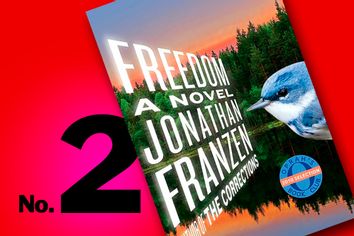
No. 2: Jonathan Franzen’s “Freedom”

The second-best sex scene of the year is an illicit tryst by a married man -- from the biggest novel of 2010

  • more
    • All Share Services

No. 2: Jonathan Franzen's

He had so much to think about, he knew he would be thinking uninterruptedly for weeks if he let himself start now. The only way not to think was to plunge forward. Up in Lalitha’s slope-ceilinged little room, the one-time maid’s quarters, which he hadn’t visited since she’d moved in, and whose floor was an obstacle course of clean clothes in stacks and dirty ones in piles, he pressed her against the side wall of the dormer and gave himself blindly to the one person who wanted him without qualification. It was another state of emergency, it was no hour of no day, it was desperate. He lifted her onto his hips and staggered around with her mouth locked to his, and then they were humping fiercely through their clothes, between piles of other clothes, and then one of those pauses descended, an uneasy recollection of how universal the ascending steps to sex were; how impersonal, or pre-personal. He pulled away abruptly, toward the unmade single bed, and knocked over a pile of books and documents relating to overpopulation.

“One of us has to leave at six to pick up Eduardo at the airport,” he said. “Just want to note that.”

“What time is it now?”

He turned her very dusty alarm clock to check. “Two-seventeen,” he marveled. It was the strangest time he’d seen in his entire life.

“I apologize that the room is so messy,” Lalitha said.

“I like it. I love how you are. Are you hungry? I’m a little hungry.”

“No, Walter.” She smiled. “I’m not hungry. But I can get you something.”

“I was thinking, like, a glass of soy milk. Soy beverage.”

“I’ll get you one.”

She went downstairs, and it was strange to think that the footsteps he heard coming back up, a minute later, belonged to the person who would take Patty’s place in his life. She knelt by him and watched intently, greedily, as he drank down the soy milk. Then she unbuttoned his shirt with her nimble pale-nailed fingers. OK, then, he thought. OK. Forward. But as he undressed himself the rest of the way, the scenes of his wife’s own infidelity, which she’d narrated so exhaustively, came churning up in him, bringing with them a faint but real impulse to forgive her; and he knew he had to crush this impulse. His hatred of her and his friend was still newborn and wavering, it hadn’t hardened yet, the piteous sight and sound of her crying were still too fresh in his mind. Thankfully Lalitha had stripped down to a pair of red-polka-dotted white briefs. She was standing over him insouciantly, offering herself for inspection. Her body, in its youth, was preposterously fabulous. Unblemished, defiant of gravity, all but unbearable to look at. It was true that he’d once known a woman’s body even quite a bit younger, but he had no memory of it, he’d been too young himself to notice Patty’s youth. He reached up and pressed the heel of his hand to the hot, clothed mound between Lalitha’s legs. She gave a little cry, her knees buckled, and she sank onto him, bathing him in sweet agony.

The struggle not to compare began in earnest then, the struggle in particular to clear his head of Patty’s sentence, “There was nothing so wrong with it.” He could see, in retrospect, that his earlier plea that Lalitha go slow with him had been founded on accurate self-knowledge. But going slow, once he’d thrown Patty out of the house, was not an option. He needed the quick fix simply in order to keep functioning — to not get leveled by hatred and self-pity — and, in one way, the fix was very sweet indeed, because Lalitha really was crazy for him, almost literally dripping with desire, certainly strongly seeping with it. She stared into his eyes with love and joy, she pronounced beautiful and perfect and wonderful the manhood that Patty in her document had libeled and spat upon. What wasn’t to like? He was a man in his prime, she was adorable and young and insatiable; and this, in fact, was what wasn’t to like. His emotions couldn’t keep up with the vigor and urgency of their animal attraction, the interminability of their coupling. She needed to ride him, she needed to be crushed underneath him, she needed to have her legs on his shoulders, she needed to do the Downward Dog and be whammed from behind, she needed bending over the bed, she needed her face pressed against the wall, she needed her legs wrapped around him and her head thrown back and her very round breasts flying every which way. It all seemed intensely meaningful to her, she was a bottomless well of anguished noise, and he was up for all of it. In good cardiovascular shape, thrilled by her extravagance, attuned to her wishes, and extremely fond of her. And yet it wasn’t quite personal, and he couldn’t find his way to orgasm. And this was very strange, an entirely new and unanticipated problem, due in part, perhaps, to his unfamiliarity with condoms, and to how unbelievably wet she was. How many times, in the last two years, had he brought himself off to the thought of his assistant, each time in a matter of minutes? A hundred times. His problem now was obviously psychological. Her alarm clock showed 3:52 when they finally subsided. It wasn’t actually clear that she’d come, either, and he didn’t dare ask her. And here, in his exhaustion, the lurking Contrast seized its opportunity to obtrude, for Patty, whenever she could be persuaded to interest herself, had pretty reliably got the job done for both of them, leaving them both reasonably content, leaving him free to go to work or read a book and her to do the little Pattyish things she liked to do. Her very difficulty created friction, and friction led to satisfaction …

Lalitha kissed his swollen mouth. “What are you thinking?”

“I don’t know,” he said. “Lots of things.”

“Are you sorry we did this?”

“No, no, very happy.”

“You don’t look quite happy.”

“Well, I did just throw my wife out of the house after twenty-four years of marriage. That did just happen a few hours ago.”

“I’m sorry, Walter. You can still go back. I can quit and leave the two of you be.”

“No, that’s one thing I can promise you. I am never going back.”

“Do you want to be with me?”

“Yes.” He filled his hands with her black hair, which smelled of coconutty shampoo, and covered his face with it. He now had what he’d wanted, but it was making him somewhat lonely. After all his great longing, which was infinite in scope, he was in bed with a particular finite girl who was very pretty and brilliant and committed but also messy, disliked by Jessica, and no kind of cook. And she was all there was, the sole bulwark, between him and the multitude of thoughts he didn’t want to have. The thought of Patty and his friend at Nameless Lake; the very human and witty way the two of them had spoken to each other; the grownup reciprocity of their sex; their gladness that he wasn’t there. He began to cry into Lalitha’s hair, and she comforted him, brushed his tears away, and they made love again more tiredly and painfully, until he did finally come, without fanfare, in her hand.

Excerpted from “Freedom: A Novel by Jonathan Franzen,” published in September 2010 by Farrar, Straus and Giroux, LLC. Copyright © 2010 by Jonathan Franzen. All rights reserved.

Jonathan Franzen is the author of “The Corrections” and “Freedom,” among other novels.

Chained

The author of "The 27th City" picks five great American novels about slavery.

  • more
    • All Share Services

Chained

Three centuries of slavery, justified by racial difference, is the central deep poisonous fact of American history. As with Holocaust fiction, the stark simplicity of the evil makes the writer’s work difficult. How to tell a good, satisfying story without being didactic and obvious? How to make it entertaining and suspenseful?

Here are five novels (four and a half, at least) that manage it. Each is in some way a mystery novel, and each turns on a particular (logical, emotional, legal, moral) absurdity of human slavery. I’ve left the two most famous novels of the genre off the list. I suspect that Russell Banks’ “Cloudsplitter” may belong here, too, but it’s really long and I haven’t read it.

Pudd’nhead Wilson by Mark Twain
This is Twain’s other great novel about slavery. Two identically white-looking babies are switched at birth. One is raised as a slave, the other as the master; complications ensue. It’s “The Prince and the Pauper” retold as a fundamental American allegory. It’s comic and ironic and tragic all at once. Like “The Moonstone” and the stories of Poe, this is one of the pioneering works of detective fiction. Fingerprints play a role.

Absalom, Absalom! by William Faulkner
Our man in Oxford put more into this book than most writers put into their entire oeuvres. For my money, this and “The Great Gatsby” are the two best American novels ever written. How it was left off the Modern Library’s Hundred Greatest list (in favor of “As I Lay Dying”!) is among the century’s Hundred Greatest Mysteries. Not only a brilliant investigation into the mind of a slaveholder and a racist, not only a breathtaking high-modern tour de force of shifting perspectives and time frames, not only an incredibly tragic and moving love story (with Greek and biblical overtones, for God’s sake), not only the novel that best nails the entire history of the American South since 1865, not only a page turner and an over-the-top gorgeous piece of prose, but the best ever in vivo demonstration of how stories are constructed and why storytelling matters.

Corregidora by Gayl Jones
If a slave owner rapes property, his children become property as well. Jones here tries to bend her mind around this and some related horrible absurdities. The book illuminates the long afterlife of slavery in the love and harm that contemporary descendants of slaves inflict on one another. The main character is a juke-joint singer in the midcentury whose husband pushes her down a flight of stairs and renders her sterile. The story is episodic and incantatory and pretty deeply hopeless; it’s also, in the words of James Baldwin, “the most brutally honest revelation of what has occurred, and is occurring, in the souls of Black men and women.”

The Chaneysville Incident by David Bradley
A believably angry (and very believably alcoholic) African-American historian leaves his white girlfriend in Philadelphia and returns to the town near Gettysburg where he grew up and where, it has been whispered all his life, something very bad went down in the 1800s. Here the absurdity is the Mason-Dixon line: that a distance of a couple of miles one way or another determines whether you’re a human being or somebody’s chattel. Compulsive reading. Likely to make you cry. Really good.

Beloved by Toni Morrison
The baby murdered by her mother to spare her from slavery returns as a ghost. Ignore the effusions that academics have spent on this book and you still have a beautiful and harrowing parable. The second half consists largely of figurative language and is pretty slow going, but the first half, which lushly recounts the appearance of the ghost and the relations between a living man and woman in the years directly following emancipation, helped win Morrison the Nobel Prize.

Continue Reading Close